Characterization, Interfacial Dynamics, and Applications
Leslie Esther O’Leary
In partial fulfillment of the requirements
for the degree of
Doctor of Philosophy
in Chemistry
California Institute of Technology
Pasadena, California
2012
© 2012 Leslie Esther O’Leary
Dedication
Acknowledgements
Before I left the University of Minnesota to come to Caltech for graduate school Prof. Marc
Hillmyer gave me a bit of advice; he said “Leslie, graduate school will go by faster than you think,
and in the end you will only remember the good times, so have fun!” Looking back at my time at
Caltech (granted, as I am writing this I have a few more weeks left), this is been overwhelmingly
true, and I owe that to the wonderful people with whom I have worked, collaborated, talked
science and become friends.
Of course whether or not the above statement can be true depends on the advisor. I cannot
thank Nate Lewis enough for his guidance and mentorship. He gave me freedom in day-to-day
research and always put bread on the table, but was there with a key suggestion or idea whenever
asked. I arrived at Caltech an organic polymer chemist, but with Nate’s wisdom, I am leaving
a surface and semiconductor electrochemist. Beyond his depth of wisdom, I also have to thank
Nate for his support throughout graduate school—sending me to conferences, backing me for
the Link fellowship, aiding in my job search, not firing my SURF after she broke his ping-pong
table, and helping me grow as a scientist and a person. Thank you Nate.
I was so lucky to have had the best committee Caltech has to offer. Perhaps it would have
been improved with the addition of Harry Gray, but being limited in the number of members,
I had the best committee. Bob Grubbs’ adventurous spirit (inside and outside of lab) is an
inspiration to me. I had the fantastic opportunity to learn more materials science through a
collaboration with Julia Greer. Beyond a collaborator, Julia was also a source of support through
her encouragement, advice and belief in my abilities. I thank Theo for serving as the chair of my
committee and for always seeing the start point and the end point and believing in no obstacles.
Bruce Brunschwig, the director of the Molecular Materials Research Center, was our advisor
while Nate was away/busy. Bruce was probably the most difficult to schedule on my committee,
but his door was always open. His passion for science was contagious. Thank you Bruce!
Collaborations are a great thing in research. I thank Ryan Douglas Brown (UChicago), Clara
Cho (Caltech), Yan Li (UC Davis), Gretchen Keller and Astrid Mueller (Caltech), Sergey Malyk
(USC), and Brandon Giles and Kevin Ahn (Berkeley) for all those mornings I got into work
with amazing results in my email in-box. I have learned so much from each of them about
spectroscopy, photophysics, mechanical properties testing, He scattering, STM, computational
chemistry, etc. It was really a pleasure to work with each of them.
I have to thank my undergraduate advisors, Marc Hillmyer and Bill Tolman, for preparing
me for graduate school.
I overlapped with many people during my time in the Lewis group (forgive me if I missed
Marc Woodka, Kate Plass, Steve Maldonado, Xiuling Li, Jim Maiolo, Tony Fitch, Anna Folinsky,
Edgardo Garcia-Berrios, Jordan Theriot, Jeanne Peng (Penguin), Marisa Robles, Don Walker,
David Knapp, David Gleason-Roher, Heather McCaig, Craig Wiggenhorn, Liz Santori, Emily
Warren, James McKone, Joseph Beardslee, Shannon Boettcher, Erik Johansson, Tina Ding,
Karla Reyes, Jacob Good, Matt Bierman, Michael Walter, Greg Kimball, Qixi Mi, Mike Rose,
Bryce Sadtler, Nick Strandwitz, CX Xiang, Shane Ardo, Rob Coridan, Ron Grimm, Adam
Pietrick, Adam Nichols-Nielander, Matt Shaner, Amanda Shing, Chris Roske, SangHee Park,
Andrew Meng, Ruben Britto, Shu Hu, Fan Yang, Teddy Huang, Heather Audesirk, Nick Batara,
Azhar Carim, Dennis Kim, Noah Plymale, Fadl Saadi, Prineha Narang, Victoria Tan, Marino Di
Franco, and Suyeon Pyo. What I enjoyed most about my time with these people was watching
the Lewis group change over time. The change driven, of course, by the wonderful individual
personalities within the group.
Erik Johansson, Kate Plass, David Gleason-Roher, Judy Lattimer, Mike Rose, David Knapp,
Tina Ding, Greg Kimball, Ron Grimm, Adam Nichols-Nielander, Chris Roske, Noah Plymale,
Victoria Tan, and Suyeon Pyo have been my cohorts in surface chemistry. Kate introduced
me to all of the techniques and got me started in lab. Tony, DK, Cinco, Judy, and Joseph
kept the XPS instruments in tip-top shape. Greg Kimball was always excited and ready to talk
about science and KRAH-A-TOS. Ron Grimm taught me so much, and his uncanny ability to
remember names always put a smile on my face. I am most grateful to Ron for his patience in
teaching me to code. Tina Ding was my first undergraduate student. Hi Tina!!! It was a weird
and wonderful experience working with her. I miss the way she described her experiments as
looking like ‘Italy or something’. Tina had a large impact on the work presented here, and she
will go far. Suyeon Pyo spent countless hours at the STM and AFM looking at our samples.
She is dedicated and hard-working and everything we all hope for in a SURF. Thank you Chris,
Noah, and Victoria for taking the surface chemistry torch.
Erik Johansson was my mentor through my 1st and 2nd years as a graduate student. Many
of the creative ideas in this work came from our frequent coffee breaks. I loved talking science
with Erik, I miss him, and I envy his students at Portland State. I owe him a huge thanks and
acknowledgement for all the time he spent with me and all of the knowledge he passed on to me.
Thank you Erik.
If I were to do a post-doc, I might choose Galen Stucky from what I have seen in Shannon
Boettcher and Nick Strandwitz. Shannon and Nick were always happy to be talking about,
thinking about, and doing science. Shannon taught me how to think and write like a scientist
early in my career, and Nick was invaluable to my work on ALD later on.
Matt Bierman, Nick Strandwitz, CX Xiang, Ron Grimm joined Mike Walter, Qixi Mi, and Karla
Reyes were closely followed by Shane Ardo and Rob Coridan. This was an amazing and exciting
time in our group. So many new branches of research took off around this time, and we applied
for JCAP. For as absent as we all say Nate is, it was during this time I stood back and was taken
aback by Nate’s impeccable judge of character. Mike Rose was my partner in Heck chemistry.
He taught me how to think like an inorganic chemist. Bryce Sadtler created an awesome
light-driven material patterning project and filled me in on all of the yoga gossip. Matt Bierman
was always positive and had a compassionate shoulder to lean on. I have not been to 6 a.m.
kickboxing since he left. I look forward to working with him at Dow! JCAP is lucky to get such
a great scientist as CX! Mike Walter taught me about conductive polymers. His enthusiasm
and drive for outreach are inspirational. Shane Ardo helped me keep the midnight oil burning.
Thanks late-night lab partner! Rob Coridan, a kind and gentle lab-mate, made my last Lewis
group retreat one to remember.
James McKone, and Joseph Beardslee made up the 2008 class. James was my partner for
SHArK for two years. James is also an amazing electrochemist. He was a role model and
demonstration of ‘doing everything’ — great work, literature, outreach, mentoring, while still
having time for his own life. I followed Joseph around offices. I hope I wasn’t the one he was
moving away from. Joseph is one of the funniest people I have ever met. There was no one else
that could’ve filled Jim Maiolo’s desk.
There were older students that left too early, and younger students I’ve only begun to get to
know. Thank you Jim Maiolo, Josh Spurgeon, Marc Woodka, Edgardo Garcia-Berrios, Brendan
Kayes, Steve Maldonado, and Kate Plass. Josh who sat next to me for 3 years and taught me
the ideal of efficiency while at work. Marc who blew me away with his research. Brendan who
was so modest and brilliant. Edgardo who took our group to athletic victory in soft-ball and
tug-of-war in the same year. Go Cold Fusion! Steve, who is another example of rigor. Thank
you Stag, Squirtle, Cub, and Real Ben. I never want to visit your apartment. Stag, thank you
for teaching me about basketball and team spirit, and I expect you to take care of Robin. Shu
became my foodie friend, 626! Amanda is full of energy and spunk. Matt Shaner brightened my
day whenever he popped over to Noyes. As I am leaving there are a whole new set of amazing
people starting: Fan, Noah, Victoria, Azhar, Teddy, Fadl, Nick B., and Heather A..
Of course I owe a great debt of gratitude to Barbara Miralles, Elyse Garlock, Paige Johnson,
Nannette Pettis, and Amy Crown. These ladies helped get Nate’s messages out to us, but also
served to help get my messages through to Nate! They were so helpful in everything from my
application for the Link Fellowship to management of grants and purchasing assistance to getting
support, friendship, and most of all, all of your hard work!!!
Class of 2007 with Liz and Emily (and Rachel). Choosing a research group is difficult. Some
of the group members you meet will be gone the next year, and all will be gone before you. The
only thing you can be sure of, is that the people in your class will be there for nearly your entire
time in graduate school, I am so happy I was with Liz and Emily. We learned to make electrodes
and use a potentiostat together. We chose projects and took classes together. We went through
candidacy together. We went on the job market together. I will look back at margaritas after
candidacy, weekends spent preparing for BP, swapping resumes and cover letters, complaining
about graduate school, worrying about the future, and many other memories in fondness. We
will be lifelong friends. We will also take over the world after Emily has saved it, Rachel is a
famous Professor, Liz controls federal science policy, and I still ride on their coat tails. Love you!
Of course the support and love from my friends and family outside of research was invaluable.
Thank you Mom, my inspiration for loving and living life, for respecting and appreciating others,
the rock of my family. Thank you Dad, racer of cars, builder of roller coasters, mover of stones
— self-made, self-taught, and inspirational. Thank you Robin Tucker-Drob, my partner in life,
for supporting me through the job search, props, graduation, and all the way to Michigan! My
niece, Danica, whose picture decorated my computer screens through props and the writing of
my thesis. My sisters Colleen and Shannon who are constantly amazing me and are caring,
loving, and supportive. Their pictures decorated my desk throughout graduate school. Thank
you Dave Klein and Laura O’Leary — 4 parents are greater than two! I will remember Scott
Kelber, Mauricio Gonzalez, and Pheobe Delman from Classic Kickboxing forever. Angela
Lewis-Dmello and Jen Plum, my best friends since childhood who always have the perfect bit of life
advice. Rachel Klet, my best friend through graduate school, and Gretchen Keller the third of
our trio. Love you all!
Of course I will only remember the good times of graduate school, every memory I have of
Abstract
The properties of any semiconductor device rely on the charge separation characteristics
at interfaces within that device. The charge separation characteristics include relative
energetics, interfacial electronic states, and the presence or absence of insulating layers. More
importantly, the interfacial properties determine the maximum solar conversion efficiency for a
photoelectrochemical or photovoltaic device. Solution-based halogenation/alkylation chemistry
was used to functionalize Si surfaces. The chemistry was adapted to allow for the controlled
formation of multicomponent molecular monolayers. Functional molecules were incorporated
by the mixed monolayer approach, and lowered densities of surface electronic defect states
and increased resistance toward the formation of deleterious Si oxides were observed. Heck
coupling reactions were developed at thiophene-containing monolayers. Thiophene terminated
Si(111) surfaces had defect frequencies of> 1 defect per 1,000 surface atoms, too large for solar
energy conversion applications, while multicomponent CH3/thiophene monolayers had defect
densities of < 1 per 500,000 surface atoms. Robust secondary chemistry at Si(111) with facile
charge transfer to covalently linked molecules with preservation of surface electronic properties
was shown for the first time. Molecular adsorbates with interesting electronic dipoles, such as
bromothiophene, were incorporated into mixed monolayers. The electron distribution across
the surface dipole caused a shift in the work function of Si by > 600 mV. The fundamental
mechanism ofWf shift was elucidated by a combined ab initio and experimental study, and the
dependence of Si band-edge positions on pH was relieved using Si-C bonds. Designer surface
chemistry was used to covalently link Si microwires within a flexible PDMS matrix, and a
direct correlation between the surface bonding mechanism and interfacial adhesion strength
was unambiguously observed. The formation and electronic properties of Si/PEDOT junctions
were studied, where PEDOT was covalently linked to the Si surface via electropolymerization
initiation at a mixed molecular monolayer containing 2,2’:5’,2”-terthien-5”-yl- groups.
Low-resistance, ohmic contacts were made at p-Si. Aldehyde groups were also incorporated into
mixed monolayers. Facile, low-temperature atomic layer deposition (ALD) of Al2O3, MnO2,
and TiO2 on aldehyde-functionalized Si was achieved. Neither surface oxidation nor surface
Contents
1 Introduction and background of solution phase surface chemistry 1
1.1 H-terminated Si surfaces . . . 1
1.1.1 Synthesis of H-terminated Si surfaces . . . 1
1.1.2 Reactivity of H-terminated Si surfaces . . . 5
1.2 Halogen-terminated Si surfaces . . . 9
1.2.1 Synthesis of Cl-terminated surfaces . . . 11
1.2.2 Synthesis of Br-terminated surfaces . . . 13
1.2.3 Synthesis of I-terminated surfaces . . . 14
1.2.4 Halogen etching . . . 14
1.3 Carbon terminated Si surfaces . . . 15
1.3.1 Structural characterization of carbon-terminated Si . . . 15
1.3.2 Electronic characterization of carbon-terminated Si . . . 18
1.3.3 Reactivity of carbon-terminated Si . . . 19
1.3.4 Silicon/organic monolayer/metal junctions . . . 24
1.4 Applications and strategies for functionalized Si surfaces . . . 27
1.4.1 Tethered redox centers . . . 28
1.4.2 Conductive polymer coatings . . . 28
1.4.3 Metal films . . . 31
1.4.4 Semiconducting and nonmetallic coatings . . . 34
1.5 Summary . . . 36
2 Synthesis and characterization of mixed monolayers on Si(111) 38 2.1 Introduction . . . 38
2.2 Experimental section . . . 40
2.2.1 Materials and methods . . . 40
2.2.2 Instrumentation . . . 42
2.3 Results . . . 42
2.3.1 GATR-FTIR spectroscopy . . . 43
2.3.2 XPS surface-coverage measurements . . . 44
2.3.3 Surface recombination velocity measurements . . . 45
2.3.4 Oxidation in air . . . 47
2.4 Discussion . . . 47
2.5 Conclusions . . . 49
3 Coupling chemistry at thienyl-functionalized Si(111) 50 3.1 Introduction . . . 50
3.2 Experimental . . . 52
3.2.1 Materials and methods . . . 52
3.2.2 Characterization and electrochemistry . . . 55
3.3 Results . . . 57
3.3.1 FTIR spectroscopy . . . 57
3.3.2 X-ray photoelectron spectroscopy . . . 58
3.3.3 Surface recombination velocity measurements . . . 60
3.3.4 Electrochemistry of bound ferrocene . . . 62
3.4 Discussion . . . 63
3.4.1 Heck coupling at Si(111) surfaces . . . 63
3.4.3 Pd(II) intermediate and addition parameters . . . 65
3.4.4 Electronic defect density . . . 66
3.4.5 Mixed CH3/SC4H3- monolayers . . . 68
3.5 Conclusions . . . 69
4 Controlling Si band-edge position by surface functionalization 70 4.1 Introduction . . . 70
4.2 pH-dependent band-edge energies . . . 71
4.2.1 pH dependence ofVOCfor Si(111) surfaces terminated by mixed methyl/allyl monolayers . . . 76
4.2.2 The effects of a permanent surface dipole onVOC . . . 77
4.2.3 Summary and lessons of decreasing pH-dependence of band-edge positions with Si-C bonds . . . 78
4.3 Understanding the direction and magnitude of fixed interfacial dipoles on Si(111) by ab initio methods . . . 79
4.3.1 Methods and materials . . . 81
4.3.2 Energy position of conduction and valence band-edges . . . 83
4.3.3 Surface dipole moment and work function shift . . . 85
4.4 Increasing ΦB,pat p-Si(111) junctions by surface functionalization with a positive adsorbate dipole . . . 88
4.4.1 Materials and methods . . . 88
4.4.2 Theoretical ∆IP by Si(111) functionalization. . . 90
4.4.3 Si(111)Wf shift with SC4H3- and SC4H2Br- functionalization . . . 91
4.4.4 ΦB,p and ΦB,n of the functionalized Si(111)/Hg junction . . . 92
4.4.5 Summary and outlook . . . 94
4.5 Conclusions . . . 95
5 Surface-initiated polymerization and atomic layer deposition 98 5.1 Surface functionality mediated interfacial strength of Si microwire/PDMS com-posites . . . 98
5.1.1 Results . . . 103
5.1.2 Discussion . . . 105
5.1.3 Fracture analysis . . . 107
5.1.4 Conclusions . . . 109
5.2 Covalent linkage of PEDOT contacts at Si(111) surfaces . . . 109
5.2.1 Materials and methods . . . 111
5.2.2 Results . . . 113
5.2.3 Discussion and future directions . . . 116
5.2.4 Conclusions and future directions . . . 119
List of Schemes
1.1 Pyridine-assisted reaction of H2O with Cl-Si bonds . . . 13
1.2 Schematic illustration of Au behaviors on different self-assembled monolayers . . 32
1.3 Au motif by nanoscale transfer printing . . . 34
2.1 Synthesis of mixed CH3/CH2CHCH2-Si(111) surfaces by the two-step halogena-tion/alkylation reaction . . . 39
3.1 Heck coupling at mixed CH3/SC4H3-Si(111) surfaces . . . 52
4.1 Change in the energetics at flat-band conditions with pH . . . 72
4.2 List of functionalized Si(111) used for band-edge shift studies . . . 87
5.1 Si-microwire surface functionalization for covalent and van der Waals bonding interactions with a PDMS matrix . . . 99
5.2 Chemistry of PDMS components and crosslinking . . . 100
5.3 Summary of surface functionalities explored for surface initiated electropolymer-ization. . . 110
5.4 Summary of surfaces used in atomic layer deposition studies . . . 120
5.5 Formation and deprotection of Si(111) surface bound aldehyde . . . 120
List of Figures
1.1 Internal reflection IR spectra of fluoride-etched Si(111) . . . 3
1.2 Proposed reaction scheme for the chemical dissolution of Si in basic media . . . . 5
1.3 CH3OH reaction with H-Si(111) results in a saturation coverage of 33% Si-O-CH3 8 1.4 Proposed mechanism for the methoxylation of the H-Si(111) surface in neat methanol . . . 8
1.5 Barrier height at Si/metal and SiO2/metal junctions as a function of the metal electronegativity . . . 10
1.6 Transmission FTIR of the Cl-Si(111) surface . . . 11
1.7 Constant current STM images of Cl- and Br-Si(111) surfaces . . . 11
1.8 STM image of CH3at 4.7 K and 77 K. . . 15
1.9 STM imagery of initial propagation of the hydrosilylation of styrene at H-Si(111) 17 1.10 Surface energy band diagram of the CH3-Si(111) surface . . . 19
1.11 SiOxgrowth and J-V behavior of H- and CH3-terminated Si in aqueous solution 21 1.12 J-E behavior of H-Si(111) and CH3-Si(111) in contact with 10 mM MV2+/•+(aq) solution buffered at pH 11.0 . . . 23
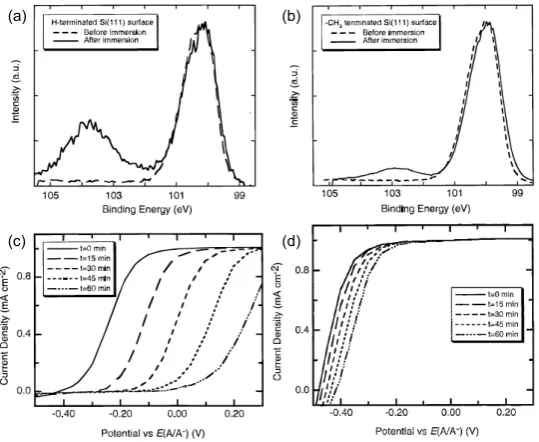
1.13 Time-dependent soft x-ray photoelectron spectra of Cl-Si(111) and CH3-Si(111) surfaces with exposure to air . . . 25
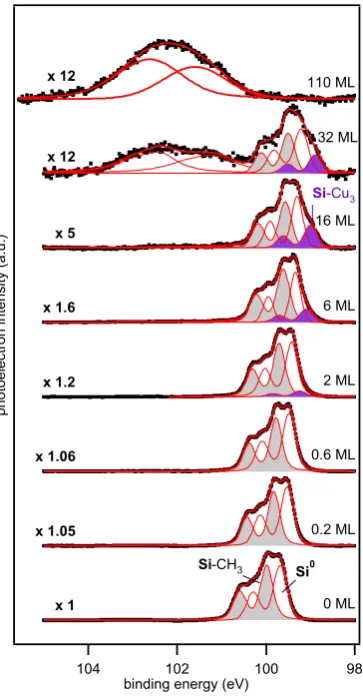
1.14 XP spectra (Eex = 150 eV) of Cu deposition onto the CH3-Si(111) surface . . . 26
1.15 J-E behavior for H- and CH3-terminated Si(111) in contact with Au nanoparticles and evaporated Au . . . 27
1.16 JSC vs.time characteristics for n-Si/Pt/polypyrrole/0.1 M KI, 0.01 M I2, 0.1 M KCl(aq) under 75 mW cm−2 illumination . . . . 29
1.17 Comparison of peel-off test for polypyrrole deposited from a pyrrole-terminated surface, according to scheme, and from a bare surface . . . 30
1.18 Absorption spectra of ALD deposition of Cu metal at a COOH-terminated SAM on Si . . . 36
2.1 Typical M-Probe XP survey, C1s, and Si2p spectra of CH3-Si(111) . . . 41
2.2 Transmission FTIR spectra of CH3- and CH2CHCH2-Si(111) surfaces referenced to a H-Si(111) background . . . 43
2.3 GATR-FTIR spectra of MM-Si(111) . . . 44
2.4 Surface composition,θRvs. reaction solution composition,χCH2CHCH2MgCl. . . . 45
2.5 Fraction of C-terminated Si(111) atop sitesvs.reaction solution composition . . 46
2.6 Surface recombination velocityS vs solution composition,χCH2CHCH2MgCl . . . . 47
2.7 Si2p region of the XP spectrum for CH3-, MM- (made from solutions with χCH2CHCH2MgCl= 0.02 and 0.10), and CH2CHCH2-Si(111) surfaces after 4 weeks exposure to ambient air . . . 49
3.1 GATR-FTIR of T3- and mixed CH3/SC4H3-Si(111) withθSC4H3 = 0.54 and 0.07 57 3.2 XP spectra of a series of CH3/SC4H2X-Si(111) surfaces withθSC4H3 = 0.24 . . . 59
3.3 High-resolution Br 3d XP spectra . . . 59
3.4 High-resolution Pd 3d XP spectra . . . 61
3.5 High-resolution XP spectra after metal complexation of surface-bound protoporphyrin-IX . . . 61
3.8 Surface recombination velocityvs.reaction time . . . 64
3.9 Current,ip,c vs.scan rate or scan rate 1/ 2 . . . . 66
4.1 pH dependence ofVOC for CH3-, MM-, CH2CHCH2-, and H-terminated Si(111) surfaces in contact with MV(2+/•+)(aq) . . . . 74
4.2 Flat-band energetics with a negative or positive fixed dipole across a generic p-or n-semiconductp-or/qE(A+/A) junction . . . . 80
4.3 UPS measurement andWf determination at Br-, H-, and CH3-terminated Si(111) 82 4.4 Model circuit . . . 89
4.5 Calculated molecular dipole moments . . . 90
4.6 Calculated surface dipole moments . . . 90
4.7 UP spectra of CH3-, SC4H3-, and SC4H2Br-terminated Si(111) surfaces . . . 92
4.8 Change in work function with composition for mixed CH3/SC4H2Br-Si(111) surfaces, experiment . . . 93
4.9 Change in work function as a function of composition for mixed CH3/SC4H3 -Si(111) surfaces, theory . . . 97
5.1 Schematic representation and SEM images of the fabrication and processing steps of the Si-microwire/PDMS composite . . . 102
5.2 Sample load (mN) vs. normalized displacement ∆hh 0 behavior of a single Si-microwire pull-out test . . . 104
5.3 Interfacial shear strengthvs.normalized axial displacement of H-, mixed CH3/CH2= CHCH2CH2-, CH3, and C18H37-functionalized Si microwires from a PDMS matrix 107 5.4 Teflon electropolymerization cell . . . 113
5.5 GATR-FTIR spectra of terthiophene-functionalized Si(111) . . . 114
5.6 Photogenerated carrier decay profiles for native oxide, SiOx capped and terthio-phene and mixed CH3/terthiophene-terminated Si(111) . . . 115
5.7 J-V characteristics of p-Si/terthiophene/PEDOT junctions . . . 116
5.8 J-V characteristics of H- or CH3-terminated p-Si(111)/PEDOT:PSS junctions, immediately after fabrication, and after aging . . . 117
5.9 High-resolution Si 2p XP spectra of H- and CH3-terminated Si(111) after anodic electropolymerization of EDOT and removal of deposited PEDOT by the Scotch® tape method . . . 118
List of Tables
1.1 Orientation-dependent etch rates relative to (110) in mm/min as a function of the conc. of KOH at 70◦C . . . 4
2.1 Summary of MM-Si(111) surface coverage . . . 45
3.1 Surface coverages before and after Heck coupling . . . 53
4.1 Dependence of VOC on solution pH for R-Si(111) electrodes in contact with MV(2+/•+)(aq) . . . . 73 4.2 Dependence ofVbi and ΦB,n on solution pH for R-Si(111) electrodes in contact
with Hg . . . 75 4.3 Ionization potential and band gap of C2H5-, CH3-, bulk, H-, Cl, and Br-Si(111)
surfaces evaluated atnL= 12; all energies are in eV . . . 83 4.4 Computed surface dipole moment per terminal group (in Debye) normal to the
surface and induced work function shift (in eV) for various terminal groups (R−) at 1/4 or full coverage. For comparison, dipole moments along the Si-C bond for R-SiH3 are also listed . . . 86 4.5 The total dipole moment (in Debye) of R-SiH3 computed using DFT and QC
methods . . . 87 4.6 Alkylation parameters for surfaces1– 5 . . . 89 4.7 ∆φof Si(111) terminated with mixed molecular monolayers . . . 91 4.8 Experimental ∆ΦB,pand theoretical ∆φof SC4H2Br-functionalized p-Si(111) . . 94 4.9 Experimental ∆ΦB,nand theoretical ∆φof SC4H3-functionalized n-Si(111) . . . 94
5.1 Summary of chemical functionalization and mechanical properties measured by single-wire pull-out tests . . . 106 5.2 Defect densities at Si(111) surfaces with mixed molecular monolayers synthesized
Chapter 1
Introduction and background of
solution phase surface chemistry
The study of solution phase semiconductor surface chemistry, especially at Si surfaces, has
enabled a range of device applications to fundamental surface studies. The H-terminated Si
surface is the starting point for many Si-based devices.1–5 In turn, the electronic and chemical
properties of the H-terminated surface have been well studied. Halogenation of H-terminated
Si surfaces has been studied as a reactive intermediate on the path to further functionalization.
Added chemical functionality has increased utility of Si in chemical and biological sensor,
molecular electronic, photoelectrochemical, and other optoelectronic device configurations. This
thesis details work toward the end goal of functional, low electronic defect density, and air stable
surface chemistries to be utilized by various applications. As such, Chapter 1 will introduce
the state of the art with respect to chemical versatility and passivation, and surface electronic
properties.
1.1
H-terminated Si surfaces
1.1.1
Synthesis of H-terminated Si surfaces
The H terminated Si surface can be formed by a variety of procedures, including vacuum
techniques, electrochemical etching, and chemical etching.6–16H-terminated surfaces prepared by
vacuum-cleavage of Si, followed by exposure to hydrogen, have been studied using high-resolution
electron-energy loss spectroscopy (HREELS) and other ultrahigh vacuum techniques.6,7
Low-energy electron diffraction (LEED) studies have indicated that the surface-order does not change
Although such techniques enable investigation of the properties of very pure H-terminated
surfaces, vacuum-cleavage of bulk crystals is not suitable for large-scale processing. A significant
amount of effort has thus been devoted to elucidating the behavior of solution-based routes
to H-terminated Si surfaces. The composition of the Si surface following HF-etching has been
studied using multiple internal reflection Fourier transform infrared (MIR-FTIR) spectroscopy.
The presence of IR-absorption bands ascribable to Si-H, Si-H2, and Si-H3moieties indicated that
aqueous HF-etching of Si(111) yielded microscopically rough surfaces, but line-width analysis
suggested that the surfaces were locally ordered.8,9,16
The ability to create atomically flat Si(111) surfaces using a wet chemical approach
(Figure 1.1) was discovered in 1989. The method built on the observation that HF-etching
induced microscopic roughness to the Si(111) and Si(100) surfaces.8,11 Following these studies,
the effects of pH were examined to elucidate the effects of the HF(aq) concentration on Si
surface quality.10,11Etching in buffered HF, where the pH was adjusted using either NH
4OH(aq)
or HCl(aq), produced very different results than when the Si was etched in HF(aq) alone.
Specifically, when the pH was greater than 4, a dramatic change occurred in the Si-H region
of the FTIR spectra. A single, dominant peak, attributable to the Si-H stretching vibration,
was produced with no peaks ascribable to the di-, and trihydride species that were observed on
surfaces etched in acidic HF(aq) solutions.
In alkaline solution, the rate-determining step of the fluoride etch on Si is OH- attack.
Simulations have shown that the relative reaction rates of OH- attack on features commonly
encountered on a Si(111) surface, including kinks, dihydride, and monohydride steps, can differ
by as much as eight orders of magnitude. The etch rates of single-crystal Si have been investigated
as a function of crystallographic orientation (Table 1.1).17In all cases, the etch-rate of the
(111)-oriented crystal face was considerably lower than the etch rates of the other faces, and a reaction
scheme for the dissolution of (100) oriented Si is presented in Figure 1.2. The replacement of
H atoms with -OH− groups polarizes the Si back-bonds such that H2O can attack. The (111) surfaces are much more stable because each surface atom has only one bond left to be
OH-terminated. With only one -OH group, the back-bonds are less activated, and H2O is less likely
to attack. The anisotropy of the basic fluoride etch is significantly decreased by the introduction
of trace metal, oxygen or other impurities into the etching-solution.18,19 Introduction of O 2
into an NH4F(aq) etching solution greatly reduces the fidelity of the resulting Si(111) surface,
producing Si-H2and Si-H3 surface-sites, as well as adding to the incorporation of O atoms into
the Si-Si back bonds. Scanning tunneling microscopy (STM) images clearly show the effect of the
presence of oxygen in the NH4F(aq) etching solution. Without oxygen, the surface is dominated
3
This number is comparable to what one would expect for the
misorientation
of
the sample
or
360
A
between
steps).
Another measure
of
surface homogeneity is the
linewidth of the SiH stretch vibration. The inset of Fig.
1
shows an expanded view of this line, measured with higher
resolution (0.25 em
- I )to resolve its linewidth (0.95 cm--
1).Since the homogeneous linewidth of the SiH stretch is
ex-pected to be -
1
em -
1at room temperature, due to
anhar-monic coupling to lower frequency modes,
13the
inhomogen-eous contribution to the linewidth is likely to be small ( 0.1
cm-
1).
It should be stressed that, since the frequency of the
SiH stretch vibration depends on how the Si is bonded to its
neighbors,14 and since its weak dynamic dipole moment
(e*
-
0.1)
15precludes line narrowing due to dipole
interac-tions,I6 the SiR measured width is a sensitive measure of
inhomogeneities. I}
The mechanism responsible for producing these
dra-matically different surface morphologies is elucidated by the
observation that one can go reversibly from a rough surface
(Fig.
1, dashed curve) to a smooth, ideally terminated
sur-face (Fig.
1,
solid curve) by dipping the H-passivated
sur-face in dilute aqueous HF or the
pH
modified HF solution,
without an intervening chemical oxidation. Since addition of
silicon atoms to the surface from the solution is unlikely, the
surface chemical changes must be occurring via etching of
the H-terminated surface. In contrast, concentrated HF
so-lutions do not alter the surface morphology (no change in
concentration of defect modes), implying that the HF acid
itself does not etch the surface.
A possible explanation of the observed etching in dilute
solutions is the slow oxidation of the H-passivated
sur-face,17·18 followed by a fast removal of the surface oxide by
HF. The second step involved in this etching process can be
eliminated by removing the HF from the aqueous solution.
(0) ,1
I
LlR/R '5,,0-4 PER REFLECTION 8"45' SI(HH S-POLARIZATION P- POLARIZATION
..••.
--0-- io
25cm-' PERi
RESOLU-IONI
2062 2086
' -k -_ _ _ _ _ _ _ _ ___ -LI __ __
2020 2060 2,40 2'80
FREQUENCY (em-')
FIG.
1.Internal icficction spectra ofHF-treated Si(1l1) surfaces: Ca)
sur-face treated with pH modified buffered HF (pH
= 9-10)(solid curve:
res-olution
=0.5 cm-- ') and with dilute
HF(100:1 H
20:HF)(dashed curve:
resolution
=I
em-');(b)
spolarization for surface treatment with pH
modified buffered rtF C pH
=9-10) (resolution
=2 cm - ;). Inset:
High-resolution spectrum of Si ( Ill) surface treated with pH modified buffered
HF( pH
= 9-10).657
Appl. Phys. Lett, Vol. 56, No.7, 12 February 1990a RF prepared
Si(111)
surface by water. Surface
prepara-tion in buffered HF
(pH
=
5.0) results in a more defective
surface, with coupled monohydride, dihydride, and
trihy-dride clearly visible [Fig. 2 (a) ]. Immersion in water for 5
min results in the reduction in the amount of coupled
mono-hydride and trimono-hydride and complete removal of the
dihy-dride, accompanied by a narrowing and strengthening of the
line at 2083.7 cm '. The difference spectrum (Fig. 2, top)
shows these effects more clearly. The observed stability of
the ideally terminated Si(
111)
terrace (2083.7 cm-
imode)
accounts for the preferential production of the 8i (
111 )
sur-faces.
Given that
(111)
planes are produced preferentially, it
would be expected that this phenomenon would lead to
roughening of the Si(1oo) surface. While concentrated HF
removes silicon oxide leaving a rough H-passivated SiC 100)
surface mostly covered with dihydride [Fig. 3(a)],8
treat-ment with buffered HF
(pH
=
5.0) still results in a rough
surface [Fig. 3(b)] but with an increase of monohydride
modes (both coupled and uncoupled), indicating the
forma-tion of small
(111)
facets.
The mode at 2083.7 em
-1[arrow in Fig. 3 (b) ],
charac-teristic of the ideally terminated
(111)
terraces, appears
both
ill
s-
and p-polarized spectra (dashed and solid curves,
respectively) with similar intensities, showing that the SiH is
tilted from the
(100)
surface normal as expected for
(111)
facets. The other peaks in the range 2070-2090 cm--
Iare
characteristic
of
other
monohydrides
(coupled
H--Si--Si-H or H attached to Si atoms with Si-Si
bond-ing arrangements different than for bulk 8i) .
The startling result of this study is the formation of a
homogeneous rnonohydride phase on the (
111)
surface
us-ing these pH-modified buffered HF solutions. To our
knowl-edge, this is the first time the ideally terminated Si (
111 )
surface has been produced, whether in solution
7•Ror by
atomic H exposure of clean surfaces in ultrahigh vacuum. I9
To understand how this termination is achieved, one must
understand why the surface is H terminated in the first place.
SI HH)
2020 2060
I
l>R/R. 5. iO- 4PER
-t--0.5 cm-i
RESO,-UTION
(0) •
(b)
2100 2140 2180
FREQUENCY (0",-1)
FIG. 2.
(a) Internal reflection spectrum of
Si( Ill)treated with buffered
HF (pH
=5.0) and (b) subsequently rinsed in water. (b/a) Difference
spectrum showing the decrease in the intensity of defect modes and the
in-crease of the ideally terminated terrace mode.
Higashi
et at
657
Downloaded 08 Apr 2012 to 131.215.21.139. Redistribution subject to AIP license or copyright; see http://apl.aip.org/about/rights_and_permissions
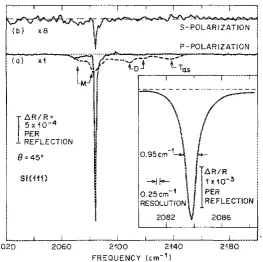
Figure 1.1.Internal reflection IR spectra of fluoride-etched Si(111)10Dashed line: surface etched in dilute, acidic HF solution (100:1 H2O:HF). Solid line: surface etched in buffered HF (pH 9–10) probed under p-polarized light (a) and
etching solutions.18,19
Table 1.1.Orientation-dependent etch rates relative to (110) in mm/min as a function of [KOH] at 70◦C17
Crystallographic Orientation
KOH Concentration
30% 40% 50%
(100) 0.797 (0.548) 0.599 (0.463) 0.539 (0.619) (110) 1.455 (1.000) 1.294 (1.000) 0.870 (1.000) (210) 1.561 (1.072) 1.233 (0.953) 0.959 (1.103) (211) 1.319 (0.906) 0.950 (0.734) 0.621 (0.714) (221) 0.714 (0.491) 0.544 (0.420) 0.322 (0.371) (310) 1.456 (1.000) 1.088 (0.841) 0.757 (0.871) (311) 1.436 (0.987) 1.067 (0.824) 0.746 (0.858) (320) 1.543 (1.060) 1.287 (0.995) 1.013 (1.165) (331) 1.160 (0.797) 0.800 (0.619) 0.489 (0.563) (530) 1.556 (1.069) 1.280 (0.989) 1.033 (1.188) (540) 1.512 (1.039) 1.287 (0.994) 0.914 (1.051)
To further investigate the quality of the Si(111) surface, vacuum STM images and LEED
patterns were obtained.11 LEED-patterns suggested that both HF(aq) and NH
4F(aq) etching
resulted in high-quality 1×1 surfaces with defect-densities of 0.5%. Vacuum STM data, however,
showed clear differences in the surface morphology produced by HF(aq)vs.NH4F(aq) etchants,
consistent with the presence of Si monohydride, dihydride-, and trihydride peaks for
HF(aq)-etched Si(111) surfaces, and consistent with only a sharp Si-H stretch in the IR spectrum of
the NH4F(aq)-etched surfaces. For NH4F(aq)-etched surfaces, flat terraces extending thousands
of ˚Angstr¨oms were observed with less than 1% surface contamination. The level of surface
contamination seemed to not be intrinsic to the NH4F(aq) etching procedure. XP spectra
further confirmed that neither oxygen nor carbon constitute significant contaminants on surfaces
prepared through the NH4F(aq) etch.19,20
The techniques commonly used to characterize Si interfaces electronically were developed to
study the Si/SiO2 or Si/metal interface.21 The formation of Si/SiO2 structures and Si/metal
junctions, however, rarely preserves the H-terminated Si surface. Consequently, almost all
techniques used to study the H-Si surface are contact-less,1,22 or form only soft contacts.23–25
Using a contact-less device, the H-terminated Si has been shown to be very well passivated
electronically. Measurements taken in HF(aq) or in other strong acids yielded minority-carrier
lifetimes>10 ms, suggesting that defect-densities were as low as 1 per 40 million surface atoms.1
The possibility that measurements in various solvents yielded long minority-carrier lifetimes due
to band-bending was investigated extensively, and it was found that one must proceed cautiously
when correlating minority-carrier lifetimes to surface defect densities.26–29The highly ideal, flat,
H-terminated Si(111) surface is attractive from an experimental point of view as it is a very
Figure 1.2.Proposed reaction scheme for the chemical dissolution of Si in basic media.30
1.1.2
Reactivity of H-terminated Si surfaces
Aqueous Acidic Media. The reactivity of H-Si with aqueous acidic media has been extensively
evaluated.30–33 Perhaps one of the most well-known examples of H-Si reacting with an aqueous
acidic solution is the “SC-2 clean”, where H-Si is reacted with an H2O:H2O2:HCl mixture to
ultimately yield a Si surface that is free of organic or inorganic contaminants. The chemistry
of H-Si in aqueous acidic media is highly dependent on both the acid and on the presence of
any additional reactants or reagents. Depending on the solution composition, H-Si surfaces are
protected in some acidic media, oxidize in other media, and dissolve in yet others. In contrast
to alkaline HF-etching, reactivity of Si in acidic media is highly isotropic.
In the absence of fluoride ions or oxidizing reagents, H-Si is stable in concentrated acids.
This behavior is expected, because the high [H+] keeps the surface fully terminated.
H-Si surfaces immersed in strong acids exhibit excellent electronic properties.1 The lifetime of
photogenerated minority carriers, as measured using a contact-less method wherein the carrier
density was measured using an inductively coupled RF-bridge, was shown to be related to the
electronic defect density on the surface. Low SRV values were observed in a number of strong
acids, and the SRV was a function of acid molarity. Furthermore, changing the acid molarity
induced reversible changes to the surface recombination velocity. From the dependence on [H+],
it was suggested that H-Si surfaces contain a finite number of strained, or otherwise weak bonds,
that act as recombination centers. The recombination centers resembled Lewis bases in an
acid-base equilibrium with the surrounding solution, and the observed effect of acid molarity on SRV
was ascribed to neutralization (H-termination) of these defect sites.
In contact with an acidic aqueous solution that contains oxidants, the near-surface layer of
such H-terminated Si(111) surfaces is rapidly converted to 1–2 nm of SiOx.31The SiOxpassivates
the surfaces to further oxidation, because HF-free solutions that contain oxidizers do not etch
SiOx. As part of the Si cleaning procedure developed at RCA laboratories, oxidation of H-Si in
HCl(aq)/H2O2(aq) has been widely utilized.32,34The RCA cleaning procedure removes a variety
of organic contaminants and leaves low levels of metal contaminants.
etches very quickly in HF(aq), however H-Si surfaces are more stable, etching at rates <1 ˚A
min−1. The etch rate increases dramatically when oxidizers are added to the HF(aq) solution,32 and numerous systems composed of H2O, HF, and an oxidizer have been employed to rapidly
etch Si.35 Specifically, the HF(aq)/HNO
3(aq) system etch rate is measured in mm/min.34
Aqueous Basic Media. The H-terminated Si surface is unstable in alkaline media. The etching
of Si in alkaline media has been studied extensively.30 The alkaline etching of Si is anisotropic
and, thus it proceeds very differently from etching in acidic, fluoride-containing, media.33 The
orientation-dependent etch rates were functions of [OH−] and temperature. The alkaline etching of Si also depends on both [H2O] and [OH−]. In organic alkaline solutions the etch rate goes to zero as [H2O] approaches zero. In alkaline aqueous solutions that contain an oxidizing-agent,
hydrogen-terminated Si surfaces rapidly convert to Si covered with a thin overlayer of SiOx. The
conversion of H-Si to SiOxhas been studied extensively for RCA-2, NH4OH/H2O/H2O2.32,34,35
The amount of oxidizer present in the alkaline aqueous solution determines whether a SiOx
overlayer will form and thus protect the Si from further alkaline etching. If only small amounts
of oxidizer are present, the surface will be continuously etched by the hydroxide ions.
Oxygen-containing environments. Electronics must be robust in air, so the stability of
HF-etched Si surfaces in oxygen-containing environments has been investigated quite thoroughly.
The mechanism of the initial oxidation of H-Si surfaces is not fully understood, but many
important aspects have been observed and described. The growth-rate of SiOx on Si(100) was
0.2 nm/decade (hours), with a limiting oxide thickness of<1.4 nm as determined using XPS.36
Conflicting results exist as to the effect of microscopic roughness on the rates of initial oxidation,
but recent data suggest that the oxidation rates depend on the surface roughness.37,38
Oxidation of H-terminated Si in the presence of O2 has also been investigated for the
special case of oxidation in a pure-oxygen, low-pressure (1–15 mTorr) environment at elevated
temperatures (530-590 K). The reaction rate-constants between O2 and various Si surface
moieties, such as monohydrides and dihydrides present on various crystal phases, were quite
different, differing as much as 20-fold. The monohydride-terminated surfaces were substantially
more stable than the other surfaces. Si(111) surfaces oxidized signifinanctly slower than Si(100)
surfaces, and dihydride-steps on Si(111) surfaces oxidized more rapidly than monohydride steps.
Flat Si(111) surfaces were the most stable. It was suggested that neither O2nor H2O alone could
explain the rapid rates of native-oxide formation commonly observed, and perhaps radicals or
other trace contaminants are responsible for the observed rate of oxide formation.38 Curiously,
the initial oxidation of H-Si surfaces proceeds without loss of atop Si-H bonds. Oxygen inserts
into the Si back bonds without the formation of Si-OH species.38,39
thus their interaction with H-terminated Si is of great interest. The H-Si surface is stable in
a number of solvents including acetonitrile,40 toluene and mesitylene,40 and diethyl ether,41
however H-Si surfaces react with various alcohols.29,40,42,43 Early investigations of reactions
between H-Si and alcohols utilized porous Si, which provided for improved signal to noise in
spectroscopic studies and allowed further investigation through its luminescence properties.
Methanol was attached to porous Si through electrochemical processes involving partial
dissolution of the Si substrate,44though simply exposing the H-Si to methanol has also been to
be reported sufficient for CH3O- attachment. Various studies have reported that attachment of
alcohols to H-Si proceeds with partial oxidation of the underlying substrate,45,46 while others
have successfully formed Si-O-C bonds without oxidation of the substrate.47,48 The reactivity
between alcohols and H-Si was used to form ferrocene-modified Si electrodes. The ferrocene
was covalently linked to H-Si(111) simply by immersion in a ferrocene derivative that contained
a terminal OH-group. Immersion in other alcohols also yielded modified surfaces, although
the bonding and surface quality was not thoroughly explored.40 The Si-O-C bond is prone to
hydrolytic cleavage, regenerating the original alcohol and leaving the surface Si-OH terminated,
thus this approach is not generally used to effect subsequent modification of Si surfaces.
Protic and deuterated MeOH were used in a detailed study of Si-O-C formation on
Si(111).29,43Partially methoxy-terminated Si surfaces were synthesized, with the remaining atop
sites H-terminated and no observable incorporation of O atoms into the Si back-bonds. Prolonged
exposure to methanol at room-temperature lead to some subsurface oxidation, while shorter
exposures to methanol at 65 ◦C resulted in no detectable (less than 3%) subsurface oxidation.
Approximately1/
3of the Si atop sites were methoxylated, in agreement with steric considerations
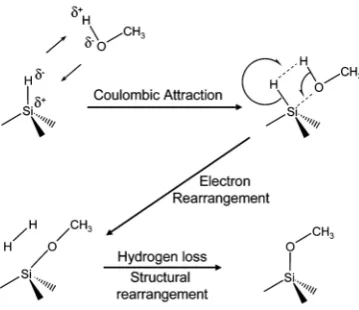
(Figure 1.3). A likely reaction mechanism for the formation of methoxy-termination of Si(111)
was suggested based on polarized FTIR spectra, Figure 1.4, however it was observed that upon
exposure to CD3OD, a Si-D species was present on the surface. The experimental data available
did not allow for determining a likely reaction mechanism for the origin of the Si-D species.
The electronic effects of alcohol-termination of Si surfaces have also been investigated. The
methoxylation of Si improved the anodic stability.49Exposure to methanol vapors affected both
reversible and irreversible changes to H-terminated Si. Results from both capacitance-voltage
and contact-potential measurements indicated that surface-methoxylation shifted the band-edge
positions such that the electron affinity was decreased. The effects of methoxylation on the
SRV were investigated as a function of the sample history, allowing for the separation of effects
due to band-bending and passivation of the Si surface. Low effective SRV was observed due to
band-bending, and it was demonstrated that care must be taken when using methanolic systems
Figure 1.3.Si(111) with a saturation coverage of 66% Si-H (dots) and 33% Si-OCH3(crosses). The Si-OCH3groups
block all nearest neighbor atoms (denoted by hexagon) by the 360◦thermal rotation of the methyl group about the Si-O bond. Adapted from Ref. 29.
Metals Highly rectifying metal contacts on Si can be used as solar cells and photodiodes.
Additionally, an understanding of the Si/metal interface is crucial to understanding the formation
of Ohmic contacts to Si.50 The ability to form Si/metal contacts without disrupting the
H-termination of Si is also of great interest for nondestructive characterization of the interface,
dopant densities, and surface quality across Si wafers. Unfortunately, the electronic properties
of Si/metal junctions are, with a few exceptions, highly nonideal and are dominated by the
junction properties rather than by the properties of the metal and the bulk Si. Ideally, the
barrier height, Φm, of a Si/metal junction should be linearly dependent on the work-function,
χm, of the contacting metal. However, for Si, the barrier height is only weakly dependent
on χm.21,51,52 This behavior has been ascribed to surface states, likely metal silicides, at the
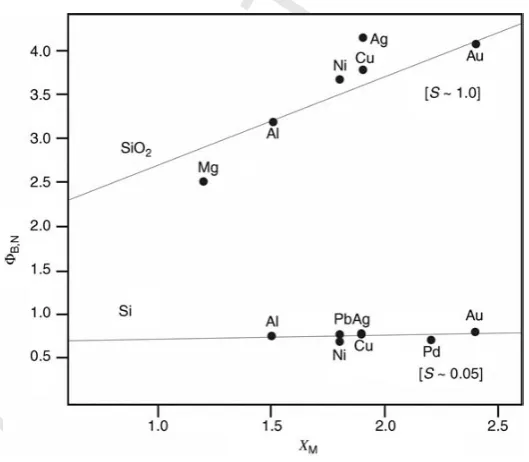
Si/metal interface. The barrier height can be correlated to metal work function, though the
dependence is weak (Figure 1.5).
An important exception is the formation of Si/Hg junctions.23,53–55 Si/Hg silicides do not
form under ambient conditions, as has been shown via XPS.53 Hense, the Si/Hg junction has
proven to be an important tool for soft-contact, non-destructive, electrical characterization of Si
surfaces. Impedance spectroscopy and current density vs voltage (J-V) data have shown that
the Si/Hg junction is near ideal, in contrast to other metal/Si junction formation schemes.
1.2
Halogen-terminated Si surfaces
Halogen terminated silicon,i.e., Cl-, Br- and I-Si, has been studied extensively because halogen
etching and termination was, initially, integral to understanding the reconstructions of Si(111)
and Si(100) surfaces.56,57This work was all performed under UHV conditions, with UHV-cleaned
Si and molecular gases. Later it was discovered that Si surfaces in contact with Br2/ROH or
I2/ROH solutions displayed very low surface recombination velocities.26,58–60While neither the
surface-bound species nor mechanism for surface lifetime enhancement was known, this behavior
sparked much interest, and motivated research in the field. Finally, more recent interest in
halogenated silicon surfaces has been spurred because although the halogen-terminated surfaces
are more reactive than H-terminated surfaces, they can nevertheless be handled briefly in
ambient conditions.61 Accordingly, the halogenated Si surfaces serve as convenient and scalable
intermediates for the solution state-syntheses of bound organic monolayers,62–66and as a reactive
The barrier height can be correlated to metal work function, though the dependence is weak (Fig. 12.5).
An important exception is the formation of Si/Hg junctions [26, 57–59]. Si/Hg silicides do not form under ambient conditions, as has been shown via XPS [59]. Hence, the Si/Hg junction has proven to be an important tool for soft-contact, nondestructive, electrical characterization of Si surfaces. Impedance spectroscopy and current density versus voltage (J–V) data have shown that the Si/Hg junction is near ideal, in contrast to other metal/Si junction formation schemes.
12.2 REACTIVITY OF HALOGEN-TERMINATED SILICON SURFACES
12.2.1 Background
Halogen-terminated silicon, that is, Cl!Si, Br!Si, and I!Si, has been studied extensively because halogen etching and termination was, initially, integral to understanding the reconstructions of Si(111) and Si(100) surfaces [60, 61]. This work was all performed under UHV conditions, with UHV-cleaned Si and molecular gases. Later it was discovered that Si surfaces in contact with Br2/ROH or I2/ROH
solutions displayed very low surface recombination velocities [27, 62–64]. While neither the surface-bound species nor mechanism for surface lifetime enhancement
FIGURE 12.5 Barrier height at Si/metal and SiO2/metal junctions as a function of the metal
electronegativity. The slope,S, is inversely proportional to the extent of Fermi level pinning, where an ideal junction would haveS¼1.0. Adapted from Ref. 56.
Figure 1.5.Barrier height,ΦB,N, at Si/metal and SiO2/metal junctions as a function of the metal electronegativity,χM.
1.2.1
Synthesis of Cl-terminated surfaces
Several methods allow for the synthesis of Cl-terminated Si surfaces, including gas-phase
reac-tions with diatomic molecular halogens under UV irradiation,66,72,73elevated temperatures,74–76
and room temperature,72,77 in addition to solution-state methods like PCl
5 with a radical
initiator.62,72,78–82 These methods have been shown to result in nominally similar Si-Cl surface
bonding, however, the coverage, homogeneity, and etch pit density vary for the different
functionalization methods and for different crystal faces. The Van der Waals radius of Cl is
1.75 ˚A, so Cl atoms can terminate every atop site on an unreconstructed Si(111) surface.83
SEXAFS showed that after exposure of Cl2(g) to the reconstructed Si(111)-(7 × 7) surface,
Si-Cl bonds were present and oriented normal to the surface.84 Variable angle FTIR72, STM77
and HREELS77 have also shown that the Si-Cl bonds are normal to the surface on Cl-Si(111)
surfaces that have been synthesized from solution-phase or gas-phase reactions of the H-Si(111)
surface, Figure 1.6 and Figure 1.7.
Figure 1.6. Transmission FTIR of the Cl-Si(111) surface (referenced to the H-Si(111) surface) produced using a wet chemical technique.72Si-Cl and Si-H (subtracted) bend modes are observed at both 30◦and 74◦off normal. The Si-Cl
and Si-H stretch modes are polarization dependent and observed only at 74◦off normal, indicating these modes are
perpendicular to the surface.
Figure 1.7.Constant-current STM images show full coverage halogenated Si(111) surfaces with little roughening. (a) Cl-Si(111), 50×50 nm2, -1 V sample bias, 40 pA; (b) Cl-Si(111), 6.5×6.5 nm2, -0.5 V, 50 pA; (c) Br-Si(111), 6.5×
6.5 nm2, 0.4 V, 400 pA.77
prepared by gas-phase and based methods. Room temperature gas-phase and
solution-phase methods both produced Si-Cl bonds with a vibrational peak FWHM of 5 cm−1, as observed
via infrared absorption spectroscopy (IRAS).72 This narrow peak width indicated extended
regions of homogeneous Si-Cl termination. At short Cl2 exposure times, partial Si-Cl coverage
was observed without observable roughening of the surface.83 The chemical shift of the Si-Cl
stretching mode was dependent on the Si-Cl surface coverage. An STM study showed that the
solution-state method, PCl5with benzoyl peroxide, was sensitive to the reaction temperature.79
As the temperature of the reaction increased, so did the density of etch pits. Based on SXPS data,
Si-Cl surfaces functionalized by the room-temperature gas-phase reaction gave comparable Si-Cl
coverage to surfaces produced by a solution-state reaction pathway. While the solution-based
method resulted in a higher amount of oxygen, 1.4±0.6 ML as observed via XPS, no SiOxwas
detectable in the SXPS spectra. The presence of oxygen was attributed to solvent work-up steps
that were not necessary for the gas-phase reaction. IRAS is more sensitive for oxide detection,
and based on integration of the 1080 cm−1 peak, gas-phase chlorination gave 3% of a ML of Si-O-Si, whereas the solution-phase chlorination produced<15% Si-O-Si coverage. In other IRAS
studies, very low surface oxidation, 1.2%, or 0.15 ± 0.01 ˚A of subsurface oxide, was observed
to form during the solution-phase chlorination reaction.85The observed differences in oxidation
could thus be due to brief exposure of the surface to ambient air as opposed to the inherent
properties of the reaction sequence. Based on vibrational shifts, the oxidation was presumed
to be in isolated patches.76Despite the difference in etch pit density and initial SiOx coverage,
an SXPS study showed that the surfaces prepared by the room temperature gas-phase and
solution-phase halogenation routes oxidized at comparable rates.86 The initial oxide formation
during the Cl-termination step did not affect the electronic trap-state density at the resulting
Si-C terminated surfaces. In fact, CH3CH2-Si(111) surfaces formed from solution-functionalized
Cl-Si(111) showed only a slightly higher oxidation after> 3 days in air than surfaces made in
gas-phase Si-Cl precursor surfaces, however, the SRV after 24 h in air was measured to be lower
for surfaces made from the solution-phase route than for that of the CH3CH2-Si(111) surface
formed from gas-phase-functionalized Cl-Si(111).
Differences in Si-Cl surface coverage, and surface roughness that resulted from various types
of Cl2(g) reactions, were found to be dependent on the reaction conditions. The photoinitiated
chlorination of silicon led to broadening and a red shift of the Si-Cl vibrational peaks, suggesting
that such Si(111) surfaces were not fully covered with Cl atoms.72A change in the temperature
of chlorination of Si(100) with UV from 350 K to 423 K lead to an increase in surface roughness
from 1.70±0.54 ˚A to 7.9 ±7.0 ˚A.87 The initial H-terminated surface had a roughness of 1.61
The temperature programmed desorption (TPD) analysis of Cl-Si(111) synthesized via a
solution-based benzoyl-peroxide-initiated PCl5 route closely matched that of high-coverage,
gas-phase-functionalized Cl-Si(111), although some differences were observed in the
high-temperature desorption.62,78,88 TPD of high-coverage Si surfaces showed desorption of SiCl
x,
where x = 2 and 3, beginning at 670 K, with some x = 4 and 2 desorbing at 85062 or 95088
K. At low Cl coverage, SiCl2was the main product, and desorbed at 950 K.88 A recombinative
desorption mechanism was proposed, in which Si-Cl + Cl→SiCl2and SiCl2+ Cl→SiCl3. The
Cl-terminated Si surfaces were demonstrated to be stable for> 12 h in inert atmosphere.76,89
Because halogen-terminated Si surfaces are a more reactive than H-terminated Si, the
Cl-Si(111) and Cl-Si(100) surfaces have been used as starting surfaces for the ALD deposition of
Al- and Hf-based dielectrics.90The resulting surfaces were fairly unreactive with water, however
Si-M bonds were readily formed. After exposure to trimethyl aluminum (TMA), Al-CH3and
Si-CH3modes were readily visible via IRAS. Pyridine has, nevertheless, been used as an accelerant
in SiO2growth by ALD (Scheme 1.1).91
Scheme 1.1. Proposed mechanism of pyridine activation during the SiCl4(a) and H2O (b) half-reactions of the ALD
growth of SiO270
1.2.2
Synthesis of Br-terminated surfaces
Several methods, including Br2(g) or Br2(soln) and solution-based bromination reagents, such
as NBS, have been used to obtain Br-terminated silicon surfaces.65 It has been suggested that
thought the NBS reaction generatesin situ, small amounts of Br2, which is presumed to be the
actual brominating agent. Solution-based bromination has been achieved using NBS in DMF,
with a radical initiator present, upon heating to 60◦C for 20 min. Bromochloroform can also be used both under thermolysis (80◦C for 30 min), photolysis (300 nm UV for 30 min), or radical initiation (benzoyl peroxide at 60◦C for 30 min) to produce Si-Br terminated Si surfaces.65All of these methods produced the same Si-Br shift in XPS, and showed C and O present on the
surface, attributable to adventitious C and O sources.
1.2.3
Synthesis of I-terminated surfaces
Unlike Cl- and Br-terminated surfaces, iodine was not observed to terminate every atop site on
Si(111), so such surfaces have always been found to be chemically inhomogeneous. Solution-state
iodination of silicon surfaces has been accomplished through several methods. Si(001) surfaces
functionalized by submersion in I2/benzene gave 33% coverage of Si-atop sites.64 Surfaces
functionalized in this manner showed surface photovoltage effects suggesting the presence of
midgap surface states. SEXAFS data of surfaces resulting from the reaction of I2 with the
reconstructed Si(111)-(7 × 7) surface showed that I binds in the same fashion as Cl-Si(111),
forming Si-I bonds oriented normal to the Si surface.84 Exposure of vacuum cleaned
Si(100)-(2 × 1) surfaces to CH3I resulted in mixed CH3- and I-termination.92–94 Approximately one
CH3I adsorbed per 2 Si atop atoms. The surface was characterized through a variety of
techniques, including kinetic uptake measurements,93 TPD,93 Auger electron spectroscopy
(AES),93 HREELS,92 and IRAS.94
1.2.4
Halogen etching
When clean, reconstructed Si surfaces or H-terminated Si surfaces are exposed to diatomic
halogens, etching can occur, leaving a halogen-terminated surface.56,57,67,72,89 Alternatively
exchange of hydrogen for halogen termination on H-terminated Si surfaces occurs.56,76,89 Both
of these mechanisms result in a halogen-terminated Si surface, however, the choice of reaction
conditions dictates whether the initial surface structure will be preserved. For example, Si is
etched upon exposure to HCl in vacuum at high temperatures, but at lower temperatures, HCl
exposure results in Si-Cl-termination.75
Solution-based Cl-termination of Siviaradical-initiated PCl5(∼0.7 M PCl5in chlorobenzene
with a catalytic amount of benzoyl peroxide) results, by STM, in an increased density of etch
pits relative to functionalization at room temperature with Cl2(g).79The density of etch pits was
dependent on the reaction temperature. IRAS was used to characterize surfaces functionalized
1.3
Carbon terminated Si surfaces
The C-Si bond adds kinetic chemical stability to the Si surface. C-Si reactivity depends on
roughness and crystal orientation, as does the reactivity of H-, Cl-, and Br-terminated Si
surfaces. Additionally, for C-terminated Si surfaces, incomplete termination (i.e., a mix of
Si-C and Si-H terminated atop sites), and physical barriers imposed by large molecules also
affect the surface reactivity. The fully methyl-terminated Si(111) (1×1) surface (CH3-Si(111))
provides a unique opportunity to obtain detailed insight into the inherent chemical reactivity
and electrical properties of the Si-C bond. A comparison between the atop Si atom spacing
of 3.84 ˚A50 and the van der Waals radius of the methyl group (∼2.5 ˚A) suggests that CH3
-is the only saturated hydrocarbon that can terminate every atop site on the unreconstructed
Si(111) surface.81,95,96 The conversion of atomically flat H-Si(111) to CH
3-Si(111),via the Cl-Si(111) surface, produces an atomically flat, CH3-Si(111) surface with nominal unity coverage
(Figure 1.8).62,81,97The CH
3-Si(111) surface can also be synthesized through the anodic addition
of CH3MgI to H-Si(111).95 Because the smallest physical barrier to interacting with the Si-C
bond is presented by the CH3-Si(111) surface, its similarities to, and differences from, other
C-terminated surfaces can be highlighted. Isolation of the stability introduced by a physical
barrier to reactants is more difficult. Attempts at the deconvolution of the effects of a physical
barrier and chemical stability have been attempted.98It is important to understand effects of a
physical barrier on stability, as well as the consequences for common applications.
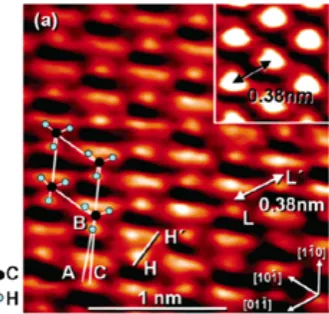
Figure 1.8.STM image of CH3-Si(111) surface (4.7 K, sample biasVs= -2.5 V, and constant current of 0.050 nA).97 Center to center distance of the -CH3groups (L to L’) is 0.38 nm. The low-index planes, denoted in the bottom right,
were determined by x-ray crystallography. The surface unit cell is outlined by the parallelogram with -CH3 groups
superimposed at each vertex. The angle between A and C is 7±3◦. The inset (top right) is the same surface, image
at 77 K.
1.3.1
Structural characterization of carbon-terminated Si
Two methods have been used to synthesize CH3-Si(111) surfaces.62,95 One is through anodic
is through surface halogenation followed by alkylation. In the later approach, highly reactive
Si-Cl, or Si-Br surface is synthesized and then exposed to alkyl Grignard or organolithium
reagents.62 The resulting CH
3-Si(111) surface has been thoroughly characterized. The
chlorination/alkylation procedure results in an unreconstructed Si(111) surface, as evidenced
by LEED.99 The absence of Si-H, Si-O, and Si-Cl stretching modes in the FTIR spectrum
of CH3-Si(111), along with the appearance of a polarization-dependent CH3- umbrella mode,
suggested that Si-C bonds terminated every atop Si atom on the unreconstructed Si(111)
surface.100 The polarization dependence of the methyl umbrella vibrational modes showed
that the CH3-group was attached normal to the Si(111) surfaces plane, and the Si-C bond
has been directly observed through photoelectron spectroscopy (PES),81,101 HREELS78 and
FTIR spectroscopy.100 Surface-sensitive soft x-ray photoelectron spectroscopy (SXPS) and
ultraviolet photoelectron spectroscopy (UPS), in conjunction with use of the substrate overlayer
model, indicated a CH3-group coverage of 1 monolayer.81,101–103Low-temperature STM images
confirmed the high degree of order, and unity coverage, of the CH3-Si(111) surfaces over
large-area terraces.97 Thus the CH
3-Si(111) surface is an ideal surface to understand the effects of
kinetic stabilization of the Si-C bond without the confounding effects of the physical barrier
imposed by a long chain alkane or by additional surface functionality.
A large body of literature describes the structural characterization of Si-C surfaces
functionalized with groups other than methyl. The reactivities of all such surfaces, aside
from CH3-Si(111), are affected by a combination of Si-C site reactivity, non-Si-C-functionalized
site reactivity, the physical barrier imposed by large molecules, and the terminating chain
functionality. The fraction of saturated C-terminated Si atop sites is nominally unity only for the
CH3-Si(111) surface. For all other Si(111) surfaces functionalized with alkanes or alkenes, the
Si-C coverage is less than unity, because of steric factors. For surfaces functionalized using the
two-step reaction or hydrosilylation, the non-Si-C-terminated sites are most commonly terminated by
Si-H bonds.104–106While the CH
3-Si(111) surface coverage was measured to be 100% termination
of Si atop sites, the C2H5-Si(111) surface had a maximum of approximately 85% coverage.82,107
As expected, the coverage decreased as the steric bulk of the alkyl group increased.106 The
maximum coverage of surfaces functionalizedviahydrosilylation, which commonly employs large
molecules, is approximately 50%.96,105 Clearly, the CH
3-Si(111) surface is an attractive choice
for the isolation and study of the Si-C bond.
The hydrosilylation reaction proceeds through a chain reaction on the surface, while for
the two-step mechanism, each site-functionalization reaction is only influenced sterically by
closely adjacent sites. The hydrosilylation surface chain-reaction therefore leads to patches of
is thought to give between random and self-avoiding coverage with bulky functional groups,
because of the irreversibility, mechanistic independence, and steric considerations of each reaction
event. This difference in mechanism, along with the tendency to proceed to higher coverage,
implies that very few adjacent sites are not Si-C terminated on Si surfaces functionalized using
the two-step halogenation/alkylation procedure.82,85 A decreased rate of surface oxidation was
observed on partially alkylated surfaces relative to that of Si-H surfaces.86It was suggested that
if lateral SiOxpropagation proceeds through adjacent Si-H sites, the presence of even incomplete
Si-C termination would retard the oxide growth. Although clear examples are lacking on the
effect of adjacent site identity on surface stability, the degree and identity of non-C-terminated
Si atop sites are likely to affect the reactivity of such surfaces.
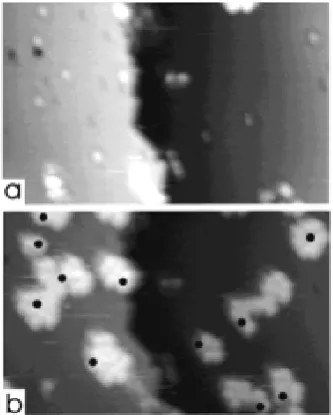
Figure 1.9.Occupied state STM images (215 ˚A×215 ˚A, 22 pA) of a H-Si(111) surface with isolated dangling bonds created by desorption activated with the STM tip (a) before styrene addition and (b) after exposure of 12 L of styrene.108 The black dots in (b) mark the initial dangling bonds showing these sites initiate hydrosilylation of styrene. Maximum height range is∼5 ˚A (a) and∼10 ˚A (b).
Despite a possible lower coverage of functionalized Si surface sites, an increase in the size of
the surface-bound species can also produce a physical barrier on the surface. An increase in the
monolayer thickness and density, but not in the total coverage of Si-C bonds on Si atop sites,
has been obtained by chemical functionalization of ester-terminated alkane monolayers on Si.98
This highly protected overlayer increased the stability of silicon toward oxidation under ambient
conditions. The monolayer protected the underlying substrate not via kinetic stability of the
Si-C bond, but primarilyvia physical separation between reactant and the silicon surface sites.
As the density of dangling bonds decreased, either because of surface roughness or due to the
structure of specific crystal face, increased chemical stability has been observed for Si-H and Si-X
terminated surfaces.90,109 CH
3-Si(111) surfaces are better passivated towards oxidation in air
of dangling bonds than does the Si(111)-(1 ×1) surface, 1.36 ×10¹⁵ compared to 7.83×10¹⁴
cm−3 on Si(111). Hence, on the Si(100) surface, the Si atop sites are more available for attack by oxidants, because sterically there is not enough spa