How to Manage the Support Role to Ensure Successful Learning
Using Industrial Simulation
Simon Mclean BSc hons, MA PGCE FHEA MRICS, Chartered Building Surveyor and Lecturer in Building Surveying, Salford University, UK. - The author is a Chartered Building Surveyor and has been involved in delivering practical higher education to BSc and MSc Construction and Surveying students since 2000. As part of a programme of post graduate research the author has independently adopted the described methodology of using realistic industrial simulations to deliver both academic and skills based learning for Building Surveying Students.
Abstract
The paper analyses the success of an industrial simulation delivered to final year BSc Building Surveying students. Research is undertaken using an action research approach. The analysis does not focus upon the assessment wording and the methodology employed, but upon the support provided to the learners. The need for this support and the nature of the support is initially established using current literature, whilst its effectiveness is monitored using learner feedback and achievement data. The need for prior risk assessment of potential areas of student disadvantage is proposed, leading to establishment of a robust, flexible and evolving regime of support being imposed throughout the activity. The rationale for a support regime is derived from risk assessment of the proposed activity and its success is tested through feedback obtained from participant learners. It was concluded that evidence gained from feedback and achievement data suggested that, when adequately supported, industrial simulation is an appropriate tool for delivering both academic learning and vocational skills training, as required by all four stakeholders to building surveying education.
Key Words
Learner Support, Industrial Simulation, Skills Training, Stakeholders
Introduction
students mostly intend to seek work as building surveyors and enter into the RICS Assessment of Professional Competency (APC) training programme. In a recent survey of 32 final year BSc Building Surveying students, taken by the author, 85% of participants declared that intent, with only 6% not intending to become surveyors and 9% being undecided. Secondly, students' expectations are that their course will give them knowledge and skills in addition to academic qualification, to help them gain employment in an industry where employers often value applicants who have these skills. This was highlighted recently when all respondents who completed a questionnaire believed practical activity was relevant to becoming a building surveyor. Dempsey reinforces this theme by stating that educators should equip students with a strong sense of confidence and competence (Dempsey et al, 2001).
There are four stakeholders to building surveying education. The first is the student customers. The second is the university, who require that a degree programme in all its parts is delivered at a comparable academic standard to all its other degree programmes, is of a standard comparable with similar degrees offered by other institutions and fully meets the academic and quality regulations it lays down for degree provision. The third would be the accrediting body, the RICS, who lay down regulations governing the content of the courses they accredit for entry on to the APC professional membership process. A fourth and final body are the surveying employers, as without the realistic prospect of graduate employment building surveying courses would face decline.
therefore a delicate balance between the tutor, maintaining control and an ability to step in to assist learners, without being seen to totally control the activity, thus losing its student focused learning advantages.
Industrial Simulation to Facilitate Enquiry Based Learning
Many education commentators advocate a constructivist approach to vocational education. One such approach, industrial simulation when used as an educational tool in the context proposed, is part of a family of action focused approaches to learning. These include the more commonly used problem based learning (PBL), and enquiry based learning (EBL). There is a strong overlap between the two (Khan & O'Rourke, 2004), and both utilise student focused learning to resolve a given task. EBL is described by the Centre for Excellence in Enquiry Based Learning as an environment where the process of enquiry is owned by the student. They go on to state that the process involves a scenario being set, supported by a facilitator, which allows students to identify their own issues and questions (CEEBL, 2009). Students can then utilise resources provided for them or sourced by themselves to research the topic. One feature of enquiry based learning is that it might involve a small scale investigation involving field work and a case study adapted to meet the disciplinary contexts (CEEBL, 2009). This definition closely mirrors the activities described within the case study analysed later in this paper. Self directed learning as advocated by both EBL and PBL is believed by many educationalists to be a superior form of vocational training in comparison to traditional teaching. The reasoning being a belief that the things a learner has discovered through experience are more likely to be retained (Park et al, 2003). It is however the belief of the author that this experience needs to be realistic. In both PBL and EBL the role of the teacher changes to facilitator (Bradbeer, 1996). Learning in the context of building surveying education, to meet the requirements of all four stakeholders, should ideally include academic outcomes, technical knowledge and practical vocational skills.
adapt to the constantly changing nature of professional life (Dempsey et al, 2001). This form of learning would appear suitable when stated outcomes are the embodiment of key vocational skills. The use of a small scale simulated industrial exercise as cited by Khan & O'Rourke appears ideal when seeking to focus learning directly in to a disciplinary context (Khan & O'Rourke, 2004). Conventional education theory would, it seems, suggest that industrial simulation in the given context could deliver a dual outcome of academic and vocational learning, providing it can deliver an equitable means of learning for all participants.
The Need To Support Learners During EBL Activity
One danger of such exercises over traditional classroom teaching is that they can take students out of their established comfort zones (CEEBL, 2009). Whilst Nunnington views the challenge of this event as being the catalyst for enhanced learning (Nunnington, 2009), it can if handled poorly, alienate students and detract from that learning. The student taken into a challenge situation must therefore be supported. This support, sometimes referred to in education text as scaffolding, is an essential factor. It must be visible and easily accessible, but also discreet (Nunnington, 2009). If too visible it might overshadow the industrial simulation element. Tosey states the facilitator must "intervene thoughtfully" (Tosey, 2006). Being visible allows the facilitator to exert some control and be on hand to render bespoke support if it becomes essential. The facilitator must however not become a focal point which renders the simulation unrealistic. Support levels also need to be bespoke to the type of learner, and often to individual learners, which requires a complete risk assessment of all aspects of the proposed activity before planning a support regime.
knowledge may be required to prevent a detachment between learner and teacher. These senior roles also allow the tutor/facilitator to nurture the participant students, (Tosey, 2006).
Successful industrial simulation relies upon the learner owning adequate levels of prior knowledge and having access to relevant information pre-event and during the activity, so that they can fully participate in a realistic manner (Khan & O'Rourke, 2004). The activity designer must therefore ensure that the students actually own the required basic skills and can easily gain access to that additional required information. This is a vital part of the imposed scaffolding. Industrial simulation is about using skills, and the author has found it may be necessary to run demonstration activities to achieve, at least test, basic skill levels, or run classroom activities to embody critical information before exposing the students to the main simulation. This helps prevent detrimental levels of individual challenge, due to a lack of essential skills and knowledge or inability to access essential information.
Whilst students will always be aware that the simulation is not real, and this is indeed another part of the support regime in that potential failure does not carry industrial consequences, there is however a need for as much realism as possible. It is a small step for a final year degree student to adopt the role of a newly graduated surveyor, but a huge leap to adopt the role of an experienced chartered surveyor. Likewise the tasks need to be totally commensurate with the role. It is the belief of the author through experience of construction, design and surveying project work that often students told in an assessment brief that they are now an Architect, Chartered Surveyor, Site Manager or Site Engineer sometimes fail to fully engage, due to an inability to believe in their capacity to fill the role. This loses any industrial simulation aspect the project might have sought. Such role elevation, whilst it may still work for academic learning in a theoretically based PBL context, risks rendering an industrial simulation obsolete as a tool for preparing students for immediate vocational requirements. For a case study to be viable the tasks need to be achievable, if they are not it would send out the wrong signals to the participant students about the industry they propose to enter.
The Need for Support
Dempsey states that, for simulations and role plays to be successful, there needs to be a joint ownership of the activity between tutor and learner (Dempsey et al, 2001). This means that the tutor cannot facilitate the activity and then allow learners to participate alone. Claxton describes a process of "disinhibition" by which learners can withdraw and disengage from the teaching activity (Claxton et al, 1996). Lack of support or perceptions of isolation can create that process. Dempsey continues by saying that successfully constructed joint ownership can create a learning community with common goals and challenges (Dempsey et al, 2001). It is the scaffolding implemented and the discreet, but still visible, presence of the tutor which creates this shared learning environment, and differentiates action learning approaches from traditional tutor focused tuition.
Pea compares educational support to the interaction between a mother and her child. A mother will support her child to complete tasks which are beyond it's capabilities. This enables the performance of a more complicated task than would otherwise have been possible, and the consequential enhancement of development, as the child becomes able to autonomously perform the task (Pea, 2004). Pea further states that the mother's support reduces as the child progresses towards independent performance, based upon a maternal assessment of present capabilities (Pea, 2004). By returning to an educational context this would suggest a need to actively and visibly support learners at the start of the activity, with support becoming more discreet as the learning process approaches the meeting of its outcomes, and the learner closes in on autonomous activity, but as with a mother's support, it is never completely withdrawn, even to create greater degrees of challenge, until autonomy is demonstrably reached.
the building surveying profession, a strong sense of organisation and time management is required. It is these soft skills, as well as the harder skills of professionalism, surveying practice and report writing, that the studied simulation sought to deliver. These cannot be researched as can technical information, but rather purely experienced whilst supported by an appropriate support regime.
Use of an Action Research Approach
Data gathering and progression is undertaken using an action research methodology.
"Action research is the name given to a particular way of researching your own learning. It is a practical way of looking at your practice in order to check whether it is as you feel it should be. If you believe your practice is as it should be you will be able to explain how and why you believe this is the case; you will be able to produce evidence to support your claims. If you feel your practice needs attention in some way you will be able to take action to improve it and then produce evidence to show in which way the practice has improved."
(Mcniff & Whitehead, 2002)
This quote from Mcniff and Whitehead describes the philosophy employed by the author. This is reinforced by Carr and Kemmis who state that action research is about improvement of practice, improvement of the understanding of practice and improvement of the mechanics of practice, (Carr and Kemmis, 1984). Action research utilises the action, in this case the supported simulation, to yield improvements and provide data, thus the action becomes the research tool, (Waters-Adam, 2006). A cyclical model described by (Arhar & Kasten, l 2001) and then drawn by (Waters and Adam, 2006), of 4 activities planning, action, monitoring and reflection, mirrors that employed by the author, Unlike the Water-Adams' quite simplistic model the researcher also incorporates external data from additional primary and secondary research in to the reflection and planning stages. This would be endorsed by Stringer who states the importance of the participation of all of the stakeholders, (Stringer, 1996). In this research input from the professional body and employers could only be obtained through separate primary and secondary research. Mcniff noted an important issue with action research is that it can be subject to variables, (Mcniff, 1988). The author endeavoured to keep as many constants as possible from previous simulations , however in research which uses data from learner feedback the unavoidable variable is that the learner cohort changes annually. Any conclusions will therefore require testing against other cohorts, and current research reflects three years of trial and improvement, across a number of similar simulations, based upon eight further years of education practice.
A further purpose of action research in education is elaborated upon by Nixon, who states that the research is a way of informing other teachers within the specialism of practice improvements, (Nixon, 1981), thus encouraging change and improvement to overall practice, (Mills, 2003). As an ex-surveying practitioner teaching specialist surveying modules, this to the author was an important factor, as previous research in to teaching specialist building surveying skills is scarce, and documented pedagogy can inform and improve practice.
students during industrial simulations designed to impart academic knowledge, specialist skills and essential work based skills.
Description of the Activity
The activity is an assessment set to meet the learning outcomes of:
(i) Carry out a building survey of a traditionally constructed commercial building and critically appraise its condition;
(ii) Analyse the condition of a building, formulate and communicate an appropriate course of action to a client;
(iii) Identify and apply to a given context, the legal rights and obligations of property owners, leaseholders and tenants;
(vi) Apply the design process to a given scenario and critically evaluate design options (v) Demonstrate an understanding of current topical issues within the profession;
In line with the module specification, learners need not show evidence for all outcomes to successfully complete the assessment.
Figure 1 The Grading Criteria
Grading Criteria
Organisation, presentation & use of graphic media and illustration (20% of marks) Appropriate technical recording of the survey notes (20% of marks)
Ability to focus the report towards the client's requirements and circumstances, as given during the client briefing (20% of marks)
Appreciation of your client's potential statutory and other liabilities in respect of the building and site (20% of marks)
Application of professional principles of report writing (20% of marks)
Following lectures to reinforce essential knowledge, a practice tutor driven building survey and a briefing session, the activity took place over a period of 4 hours utilising a local commercial building which was following an extensive health and safety audit and risk assessment deemed safe for learners to work in, and was technically suitable for the level of learner. Submissions took the form of an individually compiled, industry accepted format survey report, which met the expectations of the client brief, and the expectations of a surveyor's professional obligations and requirements. The activity was as realistic to the practice work of a building surveyor as it was possible to get, within the requirements for scaffolding, educational health and safety rules and student numbers.
Tutor's Role In the Process
Learning Risk Assessment of the Activity & Measures Imposed
A learning risk assessment was undertaken, which was additional to health and safety assessments, and focused upon situations which might disadvantage individual learners. The following issues were identified as being possible causes of some student disadvantage. It was believed that students were generally aware of the nature of work they would expect to undertake when joining the building surveying industry, and therefore aware of what is realistic and what would be too high a level to be practical.
Figure 2 Risk Assessment Employed
RISK ASSESSMENT OF SIMULATED BUILDING SURVEY ACTIVITY
POTENTIAL PROBLEM SCAFFOLDING IMPOSED
1 Learner requires adequate levels of knowledge Sessions to contextualise prior learning, all required new material front end loaded to be taught before the activity. Access to an electronic database of legislation, books, manuals, technical briefs, etc.
2 Learner feels isolated & unsure on site Field work performed in groups of up to 4 learners, although reports are to be completed individually
3 Learner may require technical assistance during
fieldwork Tutor adopts the role of senior colleague who canbe contacted with specific questions.
4 Learner feels that knowledge levels are
insufficient Provision of an electronic database of technicalmaterial to cover all possible situations arising
from the survey work 5 Learner feels disadvantaged by inexperience of
performing surveys
1. Practice survey arranged
2. Grading expressed to show that results are not heavily dependant upon technical prowess shown on site.
6 Learner feels unsure how to convert field work
in to professional report De-brief session after the fieldwork
7 Learner is unsure how much information is required, and whether they have completed the fieldwork fully.
As above, and arrange return visits for small numbers of students.
8 Some areas of the building are deemed unsafe for student access.
Briefs are written to remove the need for close inspection of the roof and fire escape areas. 9 Learner feels the role set is too advanced Tutor reinforces the nature of work typically
expected in early practice. 10 Learner feels that there is insufficient time and
becomes disengaged through feeling that the task is beyond them
Tutor is available on site to step in with advice if a group appear to be taking irrelevant pathways or under-utilising time resources
Analysis of the Results
Analysis of the success of this activity was undertaken by means of a written feedback sheet, a post activity focus group, where participants were encouraged to air thoughts about the activity, tutor observation, on site and analysis of the academic output. Below can be found a copy of the student feedback sheet. This sheet was offered to participating students on a strictly anonymous and voluntary basis. It was completed by all 32 of the participants, which is a return rate of (100%) of the maximum sample. This feedback sheet was not designed to assess success or failure in isolation, but rather to highlight issues of change for future simulations. For a more valid analysis of this activity the feedback sheets have been supported by a tutor led post-activity briefing where, for part of the session, 28 out of the 32 participants (88%) were encouraged to discuss their experience.
Figure 3 Participant Feedback Template and Data
FEEDBACK SHEET
STATEMENT STRONGLY AGREE
AGREE DISAGREE STRONGLY DISAGREE
1 I feel this activity is relevant to becoming a Building Surveyor
26 6 -
-2 I felt I was given enough information to undertake this activity
16 15 1
-3 This activity was too advanced for my level of knowledge
- 4 26 2
4 I felt I learned/practiced important skills while undertaking this activity
11 20 1
-5 I felt undertaking this exercise
was challenging 14 17 1
-6 I fully understood what was expected of me
6 23 3
-7 I felt I could call upon support if I had needed it throughout this activity
12 19 1
-8 The activity and assessment brief was clear and easily understandable
9 23 -
-9 My role in the activity was realistic.
-10 I enjoyed taking part in this activity
12 19 1
-11 This knowledge could have been better achieved through lectures, seminars and a theoretical assessment
- 6 17 9
12 I felt tutorial support was available throughout this activity
10 18 4
-13 On graduation I intend to seek
employment as a BS 18 9 2 undecided3 No
-14 Please make any observations and comments which you feel might improve the learning experience forfuture Building Surveying activities of this nature This questionnaire will be used exclusively by your tutor to inform future activities for delivering this topic/module. Your genuine opinions will be valuable in ensuring that future simulated activities of this nature are designed to achieve optimum learning outcomes and experience. Thank you for your cooperation
Feedback from both questionnaire and briefing was similar and overwhelmingly supportive. The author on analysis of the data noted that the key issues relating to scaffolding were amongst those receiving highest participant approval. The validity of using simulation, and the desirability of learning both knowledge and skills also scored highly. The author is aware that there is a variable in the data gained to-date in that the cohort changes annually and this may be a particularly benign cohort. Certainly approval whilst always generally high was higher from this cohort than previous year's learners. An important factor in current fee paying education is that it was almost universally accepted by the learners that this was a realistic and valid exercise, in which they had enjoyed participating. Within the participants additional observations and during focus group activity, no factor outside of the risk assessment was identified as potentially causing disadvantage, although elements outside the tutor's control such as timetabling of other modules did impinge upon the continuity of a four hour activity for some students, meaning some second visits were required.
Given the high approval rating the reflected activity to be carried forwards is to replicate this simulation and compare the response to use of identical pedagogy from a different learner cohort. Research in to use of 3D technology to produce a virtual walkthrough building survey to counter problems with student timetable conflicts, is underway, and the author has commissioned such a virtual simulation, using gaming software for piloting with learners in the next academic year.
rather a failure to engage in the preparation required or failure to allocate sufficient effort to the submission document.
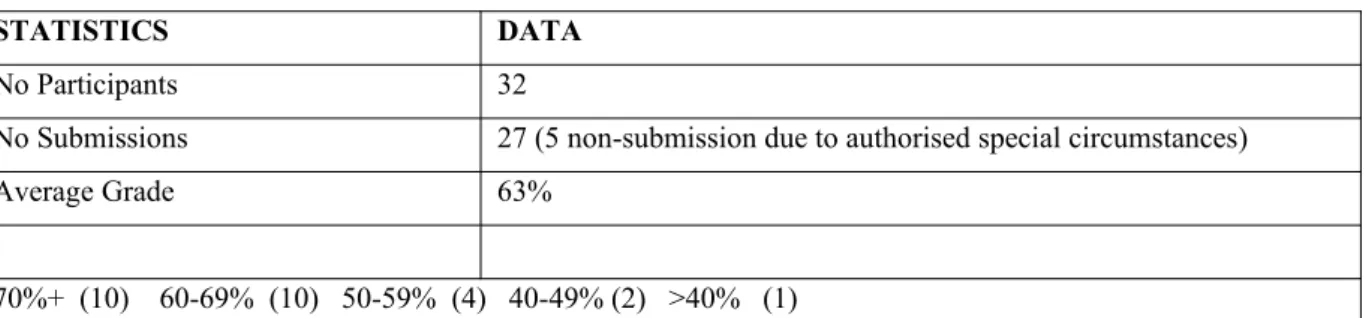
Figure 4 Learner Achievement Data
STATISTICS DATA
No Participants 32
No Submissions 27 (5 non-submission due to authorised special circumstances) Average Grade 63%
70%+ (10) 60-69% (10) 50-59% (4) 40-49% (2) >40% (1)
In a situation the researcher has never known previously student hand-in was reduced significantly by special circumstances which led the university allow deferment of the submission due to illness, injury, family bereavement, identification of special needs, motoring accidents, etc. These students although they participated in the practical work completed their assessment based upon a different brief situations, and therefore performance can not be included.
Conclusion
References
Askham P, (2009) Spotlight on Enquiry Based Learning, Learning Teaching and Student Experience Spring 2009 Sheffield Hallam University Journal, Sheffield
Bradbeer J (1996) Problem Based Learning & Fieldwork a Better Method of Preparation. Published in Journal of Geography in Higher Education Vol 29 No 2 July 2009, Rutledge Publications, London
Carr W, Kemmis S, (1986), Becoming Critical: Education, Knowledge and Action Research, Falmer. Lewes
Centre for Excellence in Enquiry Based Learning (CEEBL), (2009), What is Enquiry Based Learning, Manchester University, www.campus.manchester.ac.uk/ceebl/ebl/, (Accessed 22nd July 2009)
Claxton G, Atkinson T, Osbourne, M, Wallace M, (1996), Liberating the Learner: Lessons for Professional Development in Education, Routledge, London
Dempsey M, Halton C, Murphy M, (2001), Reflective Learning in Social Education, Scaffolding the Process, Vol 20 No 6, Social Work Education, Routledge, London
Khan P, O'Rourke K, (2004) Guide to Curriculum Design, Enquiry-Based Learning, Produced by the Imaginative Curriculum Network, Higher Education Academy, York, UK
Mckenzie J, (2000) , Beyond Technology: Questioning, Research and Information and the Information Literate School Community, Linworth Publishing, Santa Barbara, USA
Mcniff J, (1988), Action Research Principles and Practice, Macmillan, Basingstoke
Mcniff J, Whitehead J, (2002), Action Research Principles and Practice, Routledge Farmer, London
Nixon J, (1981), A Teachers Guide To Action Research Evaluation, Enquiry and Development in the Classroom, Grant McIntyre, London
Nunnington N, (2009), The Use of "Challenges" to Drive Autonomy, Employability and Student Engagement: A Journey through and Evaluation of a Challenge Based Project, CEBE Working Papers Series 16, CEBE Publication, Cardiff
Pea R D (2004, The Social and Technological Dimensions of Scaffolding and Related Theoretical Concepts for Learning, Education and Human Activity, Volume 13(3), Journal of the Learning Sciences, Taylor Francis, Oxford
Park M, Chan S L, Verma Y I. (2003), Three Success Factors for Simulation Based Construction Education, The Journal of Construction Education Volume 8 No 2 Brigham Young University Publication, Utah, USA
Stringer E, (1996), Action Research A Handbook for Practitioners, Sage, London
Tosey P, (2006) , Facilitating Enquiry Based Learning: Getting Started With the Epic Model, Paper given at L2L Regional Event Surrey University January 2006,