Group Differences in the Achievement-Related Cognitions of Australian High School Students
Nadya M. Kouzma
Submitted in fulfilment of the requirements for
the Doctorate of Philosophy degree at the School of Psychology at Victoria University.
Acknowledgements
This project was supervised by Dr. Gerard Kennedy from 2000 to 2003, Dr. Wendy Saunders in 2004, and Dr. Gordon Emmerson in 2005.
Sincere thanks to Dr. Gordon Emmerson for his guidance and support; Romana Morda for her kindness and generosity; and Professor Jill Astbury and Dr. Wally Karnilowicz for providing feedback.
Thanks also to all the school principals, coordinators, teaching staff, and students who participated in this study for their time and cooperation.
Statement of Declaration
I, Nadya M. Kouzma, declare that the PhD thesis entitled “Group Differences in the Achievement-Related Cognitions of Australian High School Students” is no more than 100,000 words in length, exclusive of tables, figures, appendices, references and footnotes. This thesis contains no material that has been submitted previously, in whole or in part, for the award of any other academic degree or diploma. Except where otherwise indicated, this thesis is my own work.
Table of Contents
Acknowledgements...2
Statement of Declaration...3
Table of Contents ...4
List of Tables ...8
Abstract ...9
CHAPTER 1. INTRODUCTION ...10
Overview...10
Contribution to Knowledge...11
Statement of Significance ...13
Participation in Education in Australia ...14
Cultural Group Differences in Participation ...17
Socioeconomic Background Differences in Participation ...19
Gender Differences in Participation...21
Achievement-Related Variables ...22
Achievement Motivation...22
Achievement Motivation and Educational Achievement ...23
Conceptual Approaches ...26
Approach-avoidance motivation ...26
Intrinsic-extrinsic motivation...27
Individual-orientated and social-orientated motivation ...27
Summary ...28
Concept of Academic Ability ...28
Concept of Academic Ability and Educational Achievement ...29
Patterns Between Concept of Academic Ability and Educational Achievement ...31
Academic achievement causes concept of ability...31
Concept of ability causes academic achievement ...31
Academic achievement and concept of ability influence each other in a reciprocal manner...32
A third variable causes both academic achievement and concept of ability32 Summary ...32
Educational and Occupational Aspirations ...33
Theoretical Approaches ...34
Ginzberg's theory ...34
Havinghurst's theory ...34
Gottfredson's theory ...35
Educational and Occupational Aspirations and Educational Achievement...35
A Psycho-Social Model of Aspirations...36
Summary ...37
Parental Cognitions ...37
Multiple Context Theories ...39
Parental Cognitions and Students' Educational Achievement ...39
Summary ...42
Measurement of Students' Perceptions ...42
Group Differences and Achievement-Related Variables...44
Models of Culture and Educational Achievement ...45
The socioeconomic explanation...45
The cultural explanation...45
The cultural differences perspective ...46
The cultural-structural explanation ...47
Individualism-collectivism...47
Culture and Achievement Beliefs ...49
Rosen's Theory...51
Summary ...52
The Role of Socioeconomic Background ...53
Socioeconomic Background and Educational Achievement ...53
Socioeconomic Background and Educational and Occupational Aspirations .56 Models of Socioeconomic Background and Educational Achievement ...60
Contextual/ Individual Effects ...60
Gould's theory ...61
Social-cognitive-causal model ...62
Summary ...63
Measurement of Socioeconomic Background ...64
The Role of Gender...66
Gender Socialisation ...66
Gender and Achievement Motivation ...68
Gender and Attributions to School Successes and Failures...69
Gender and Perception of Academic Ability ...70
Gender and Educational and Occupational Aspirations...72
Summary ...74
The Role of Grade...75
Developmental Changes in Expectations for Success ...75
The Focus on Performance ...76
Grade and Achievement Motivation ...76
Grade and Perception of Academic Ability ...77
School Transition ...78
Summary ...82
The Role of Identity Status ...83
Erikson's Psycho-Social Theory...83
Identity Formation...85
Identity Status and Educational Achievement ...86
Summary ...89
Research objectives...89
Hypotheses ...91
CHAPTER 2. METHODOLOGY ...93
Participants...93
Description of Research Participants ...93
Instruments...95
Demographic Data ...95
Cultural Background ...95
Statistics on the Diversity of the Australian Population ...95
Present Study's Measurement of Cultural Background...96
Educational attainment...97
Occupation ...97
Income...98
Lower, middle, and higher socioeconomic categories...98
Grade...98
Objective Measure of Ego-Identity Status ...99
Research questionnaires...100
Achievement-Related Variables ...100
Achievement Motivation Orientation Scale...100
Brookover Concept of Academic Ability Scale...102
Aspirations Scale...103
Research procedure ...104
CHAPTER 3: RESULTS ...106
Tests of Assumptions for MANOVA ...106
Phase I: Demographic Understanding...108
Cultural Group Differences...108
Socioeconomic Background Differences...109
Gender Differences ...110
Grade Differences ...111
Phase II: Identity Status and Achievement-Related Cognitions in Three Age Groups...113
Identity Status Differences in Year 7 and 8 Students ...113
Identity Status Differences in Year 9 and 10 Students ...116
Identity Status Differences in Year 11 and 12 Students ...116
Summary ...119
CHAPTER 4. DISCUSSION...120
Research objectives...120
Phase 1 ...120
Sociodemographic Differences in Students' Achievement-Related Cognitions ...120
Cultural Group Differences in Students' Achievement-Related Cognitions ...120
Socioeconomic Background Differences in Students' Achievement-Related Cognitions ...123
Gender Differences in Students' Achievement-Related Cognitions ...125
Grade Differences in Students' Achievement-Related Cognitions ...127
Phase 2 ...130
Identity Status Differences in Students' Achievement-Related Cognitions...130
Overall Group Differences in Achievement-Related Variables...132
School Transition ...134
School Transition and Intervention Strategies ...136
Contribution to knowledge...139
Study limitations ...143
School characteristics...143
Measurement of cultural background ...144
Measurement of socioeconomic background...145
Measurement of students’ perceptions...146
Data analyses...147
Statement of significance ...147
Summary and Conclusion ...148
REFERENCES...151
APPENDICES ...207
Appendix 1...208
Demographic Questionnaire ...208
Appendix 2...211
Objective Measure of Ego Identity Status ...211
Appendix 3...216
OMEIS SPSS Scoring Commands...216
Appendix 4...218
Achievement Motivation Orientation Scale...218
Appendix 5...224
Brookover Concept of Academic Ability Scale...224
Appendix 6...226
Educational and Occupational Aspirations Scale ...226
Appendix 7...228
Victoria University Human Research Ethics approval form...228
Appendix 8...230
Victorian Department of Education Ethics approval form ...230
Appendix 9...233
Catholic Education Office of Victoria Ethics approval form ...233
Appendix 10...236
Participant Information Form...236
Appendix 11...238
List of Tables
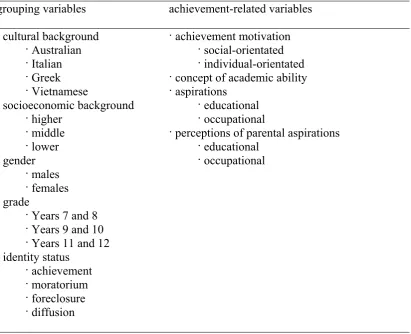
Table 1. Summary of Key Variables
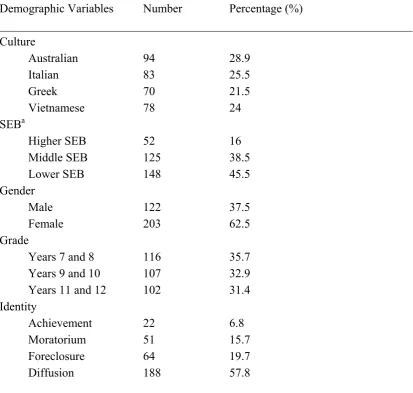
Table 2. Proportion of Participants by Background Variables
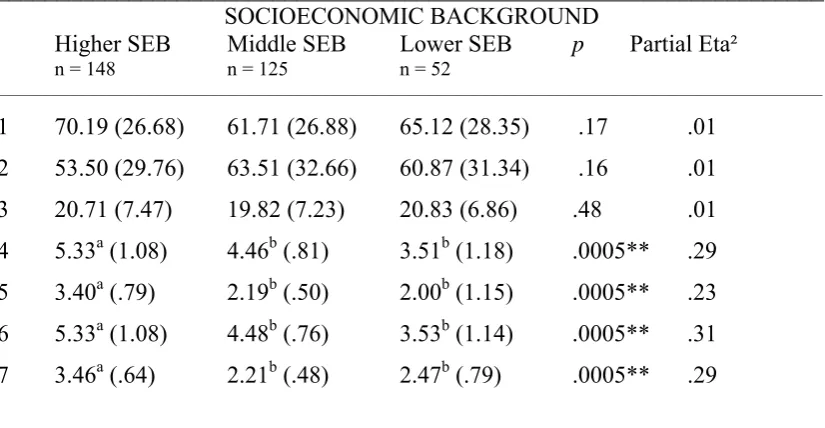
Table 3. Means, Standard Deviations, and Variance Explained for Students' Achievement-Related Cognitions by Socioeconomic Background
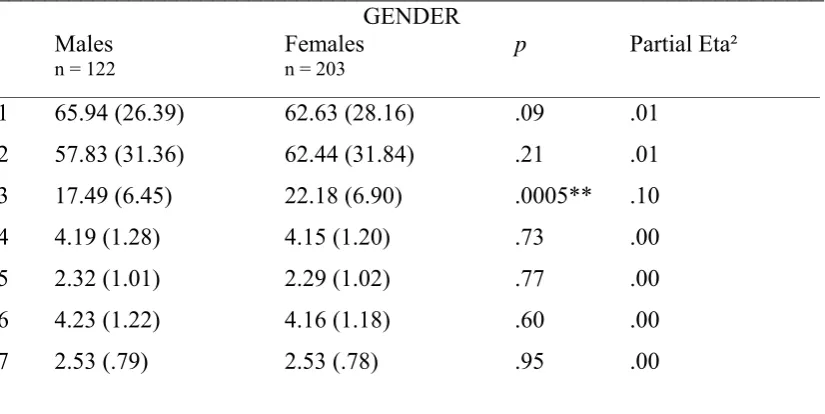
Table 4. Means, Standard Deviations and Variance Explained for Students' Achievement-Related Cognitions by Gender
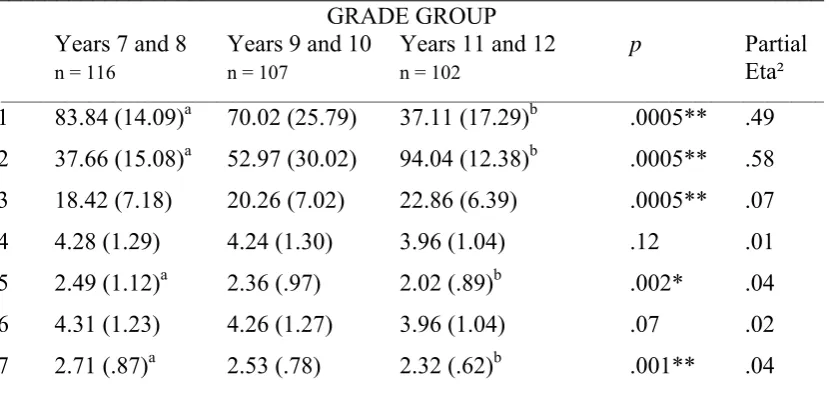
Table 5. Means, Standard Deviations, and Variance Explained for Students' Achievement-Related Cognitions by Grade Group
Table 6. Means, Standard Deviations, and Variance Explained for Year 7 and 8 Students' Achievement-Related Cognitions by Identity Status
Abstract
The aims of this study were to gain a more highly defined understanding of academic achievement by examining possible demographic differences in students' achievement-related cognitions; and provide information that may allow future researchers to design programs aimed at improving students’ academic achievement within specified demographic strata. More specifically, the aims of the present study were two-fold, (a) to investigate sociodemographic differences in students'
CHAPTER 1. INTRODUCTION
Overview
Research supports the contention that a combination of social and psychological factors impact on achievement at school (Hemmings, 1996). Bacete and Remirez (2001) noted that, although intelligence is an important determinant of school achievement (Bacete & Remirez, 2001), it only accounts for an estimated 35% of the variance in achievement (Castejon & Navas, 1992). Achievement motivation (e.g., Anderman & Maehr, 1994), concept of academic ability (e.g., Marks, Fleming, Long, & McMillan, 2000), educational and occupational aspirations (e.g., Qian & Blair, 1999), and parental cognitions (e.g., Grolnick & Slowiaczec, 1994) have been
identified as important variables related to school achievement. A host of researchers have endeavoured to examine group differences in these “achievement-related variables” in an attempt to explain group differences in students' educational outcomes (Strage, 2000).
The value of integrating social group variables such as culture, socioeconomic background, gender, grade, and, to a lesser extent, personality factors such as
adolescent identity status in educational research has been stressed by a number of researchers. Lavery (1999) indicated that achievement-related variables cannot be understood without considering the social fabric in which they are embedded.
Therefore, she suggested that it is important to examine achievement-related variables in light of cultural background, particularly in a multicultural setting where
dynamics of socioeconomic background and achievement-related variables may lead to an enriched understanding of social inequality in students' educational outcomes. Marks, McMillan, and Hillman (2001) noted the importance of gender differences in educational research, especially given the continuing debate about the relatively poor educational outcomes of males compared to females. Wigfield and Eccles (1992) emphasised that age-related or grade-related patterns in educational variables can provide great insight into the developmental aspects of students' achievement-related cognitions. Hummel and Roselli (1983) highlighted the importance of integrating students' personality profiles using adolescent identity status within the educational domain. They argued that the impact of psychosocial developmental tasks (in this case, identity formation) on achievement-related variables is relatively unknown.
Contribution to Knowledge
The need to account for group differences in achievement-related variables is particularly important in order to identify at-risk groups (i.e., at-risk of achievement problems), and to better structure learning environments and support systems for these students, in an effort to enhance or facilitate their achievement prospects (Lavery, 1999). Ponsford and Lapadat (2001) stressed, “[schools can] use their knowledge of
students' views and beliefs to identify support strategies and to modify the educational
environment” (p. 140). Okagaki and Frensch (1998) warned that we cannot assume
are more amenable to change than intelligence, then achievement might be enhanced indirectly through practices that positively influence the development of these achievement-related cognitions in students. This may be particularly important for students who are at-risk of low educational achievement.
Dowson and McInerney (1998) argued, “relationships between students’ school
perceptions, motivation, cognition and achievement vary as a function of their age,
gender, cultural, and socioeconomic backgrounds. There is, therefore, an implied
need to tailor motivational and cognitive programs, aimed at enhancing students’
achievement, based on relevant student differences. This, of course, complicates the
issue somewhat. However, it is possible to suggest that the dividends for paying
appropriate attention to relevant student differences may well be worth the effort
involved in tailoring achievement-enhancing programs to students’ differing cognitive
and motivational profiles” (p. 19).
international setting may not easily be generalised to another country” (p. 2).
More recently, Marjoribanks (2002a) called for more research that seeks to identify between-group factors that are related to school outcomes. He argued, “One
of the persistent challenges confronting societies is how to reduce inequalities in the
educational and occupational attainment of students from different socio-economic,
ethnic and race group backgrounds” (p. 1). The role of culture, socioeconomic
background, gender, grade, and adolescent identity status to achievement-related variables is unknown at this time. Therefore, a thorough investigation of group differences in achievement-related variables is warranted. The present study explored achievement-related variables in a diverse high school student population residing in Metropolitan Melbourne, Australia. This study represented a major research effort aimed at identifying group differences in students' achievement-related cognitions.
Statement of Significance
A unique aspect of this study was that a number of achievement-related variables were examined together in a diverse high school student population in Metropolitan Melbourne, Australia. This was important given the increased diversity of the Australian population, with one in four students now estimated to be from a non-English speaking background and more students continuing their education to beyond high school (Marks et al., 2000). This has resulted in a new population of high school students in Australia, about which we know little (Hemmings, 1996). Graham and Taylor (2002) recently argued, “For the psychologist concerned with academic
achievement, the study of motivation provides a rich framework for addressing some
revolve around problem areas- low test scores, grade retention, early withdrawal,
and various disciplinary practices associated with antisocial behaviour, like
suspension and expulsion” (p. 121).
In Australia's National Goals (1999), it is contended that schooling should be “socially just”, so that students' outcomes from schooling are free from the negative effects of discrimination based on culture, socioeconomic background, or gender, just to name a few; that the learning outcomes of educationally disadvantaged students improve and, over time, match those of other students; and that all students have access to high quality education necessary to enable the completion of school education to Year 12.
These national goals provide a basis for investing in schooling to enable all young people to engage effectively with an increasingly complex world, one which is characterised by advances in information and communication technologies,
population diversity arising from international mobility and migration, and complex environmental and social challenges (Australia's National Goals, 1999). One of the critical first steps to achieving these goals is to identify group differences in students' achievement-related cognitions in order to increase our understanding of such
inequalities.
Participation in Education in Australia
for concern. Similarly, Hugo (2001) stressed that the increased diversity of the school-age population in Australia will concomitantly increase the challenges faced by the Australian education system.
Fullarton, Walker, Ainley, and Hillman (2003) argued, "Levels of participation
in education are important because of the associations between the knowledge and
skills that education can provide, the economic benefits for individuals with higher
levels of educational participation and the well-being of the nation. People with
higher levels of education are more likely to participate in the labour market, less
likely to be unemployed, more likely to have higher earnings and enjoy other social
advantages. More particularly, those people who stay at school until the final year
are more likely to continue their involvement in education and training and thereby
gain more directly from employment-related skills. This is one reason why an
increase in participation in the final year of secondary school, or an equivalent, has
been an important feature of government reports and government policy over the past
two decades" (p. 57).
qualification. This was more than four times the proportion in 1971 (Australian Bureau of Statistics, 1994a). In 1999, 78% of 15-19 year olds were attending an educational institution, compared to 66% in 1989 (Australian Bureau of Statistics, 2000). The retention of students to Year 12 has also increased from 60% in 1989 to 72% in 1999 and has remained relatively stable (Australian Bureau of Statistics, 2000).
Due to the rapid increase in student numbers and changes in the type of students completing secondary schooling, little information is available about the factors that affect the educational outcomes of this new student population (Hemmings, 1996). The major force behind the increase in participation in education has been the increased demand for occupations requiring higher levels of education and training. This demand has arisen through a combination of technological change,
microeconomic reform, and globalisation (Long et al., 1999). McMillan and Marks (2003) also argued, "changes in school curriculum to accommodate a wider range of
students, increased Commonwealth financial assistance for young people in low
income families, a recognition by young people and their families of the growing
importance of educational qualifications, and in the early 1990s, high unemployment
rates prompting some would-be school non-completers to remain at school" (p. 2)
have all contributed to the increase in participation in education in Australia. Most research findings indicate that equality is an important issue in
Cultural Group Differences in Participation
Birrell and Khoo (1995) analysed data with respect to cultural background differences and educational outcomes from the 1991 Australian Census, and found that a greater proportion of students with fathers born in Australia had left school at 16 years of age or earlier compared to students with fathers born in Southern European, Eastern European, Middle Eastern, or Asian countries. They also found that second generation students from Eastern Europe, the Middle East, and Asia had almost double the rates of tertiary education qualifications compared to their
school leaver for students from an English speaking background were 2.2 times those of students from non-English speaking backgrounds. Similarly, the odds of students from English speaking backgrounds leaving school before Year 12 were 2.5 times of those of students from non-English speaking backgrounds. This influence remained significant after controlling for sociodemographic factors as well as literacy and numeracy skills. The Australia Study (Marjoribanks, 2002a) involved analysis of data from the LSAY survey of over 13,000 students who were in Year 9 in 1995 and who were followed-up in 1996 and 1997. The results showed that students from Asian, Middle Eastern, and Southern European backgrounds were more likely to stay at school than were Anglo-Australian students. The Adelaide Study (Marjoribanks, 2002a) was a longitudinal analysis of family and school influences on students’ attainment. The initial data were collected from 1,300 11-year-old students from Adelaide in South Australia who were followed-up until they were 21 years of age. The results revealed that students from Greek and Southern Italian backgrounds were more likely to stay at school than Anglo-Australian students and students from English immigrant families. Marks et al. (2000) analysed data from the 1995 Year 9 LSAY cohort and data from the four YIT cohorts. The results demonstrated that participation in Year 12 was higher for students whose fathers' country of birth was Asia (91%), the Middle East (85%), or Europe (79%) compared to those whose father's country of birth was Australia (74%). Similarly, participation in higher
compared to 74% for Australian students. Participation in higher education was 39% for Greek, 33% for Italian, 33% for Lebanese, and 57% for Vietnamese students compared to 28% for Australian students.
Socioeconomic Background Differences in Participation
With regard to socioeconomic background and educational outcomes,
Rumberger and Lamb (1998) examined the experiences of high school dropouts from the United States of America and Australia. The United States of America data were based on the National Education Longitudinal Study of 1998 that was comprised of over 13,000 Grade 8 students surveyed in 1988, 1990, 1992, and 1994. The Australian data were based on the 1975 YIT cohort. The results illustrated that high school drop out rates were highest for students from lower socioeconomic backgrounds, and lowest for students from higher socioeconomic backgrounds. McMillan and Marks (2003) reported, "during the mid to late 1990s young people from highly educated
families remained less likely to leave school early and more likely to enter higher
education, than young people from less educated family backgrounds. Of those who
were in Year 9 in 1995 and whose parents had very high levels of education (greater
than one standard deviation above the mean years of education), only 4 per cent
subsequently became early school leavers, 7 per cent became later school leavers,
and 30 per cent completed school but did not enter higher education, while nearly 60
per cent completed Year 12 and then entered higher education. In contrast, over twice
the proportion of young people whose parents had very low levels of education
(greater then one standard deviation below the mean) went on to become early or
completed school but did not enter higher education. Only 27 per cent of this group
(from the least educated family backgrounds) completed school and entered higher
education...the odds of students from very highly educated backgrounds progressing
to the next educational stage were roughly three times the odds of those from low
educational backgrounds progressing to the next educational stage" (p. 8). Marks and
41% of students with parents in professional or managerial occupations.
Gender Differences in Participation
1994b). University participation rates have steadily increased for both males and females since 1988 (11.7% each for males and females) to 1996 (17.3% and 20.9% respectively), although the rates for females have increased more than those for males and have been higher than those for males since 1989 (Australian Bureau of Statistics, 1998a).
Achievement-Related Variables
Achievement Motivation
Motivation has been increasingly identified as a crucial factor in explaining academic achievement (Bond & Saunders, 1999). McClelland and his associates (McClelland, 1961; McClelland, Atkinson, Clark, & Lowell, 1953; McClelland, Baldwin, Bronfenbrenner, & Stodtbeck, 1958) conceptualised achievement motivation as a relatively stable and learned personality disposition that compels individuals to fulfil their own internalised standards of excellence, and strive for success. They argued that people with a high “need-for-achievement” are
McClelland et al. (1953) posited two types of achievement motives that describe affective responses and achievement behaviour. They argued that the
anticipation of positive affect is related to what they termed the “motive for success”, which motivates individuals to engage in situations. Conversely, they argued that the anticipation of negative affect is related to what they termed the “motive to avoid failure”, which discourages individuals from engaging in situations. The motive to approach success describes the anticipation of pleasure and pride in achieving a desired outcome or goal and tends to facilitate learning. The motive to avoid failure, on the other hand, describes the anticipation of unpleasantness and fear associated with not achieving a desired outcome or goal and tends to hinder the acquisition of knowledge (Diseth & Martinsen, 2003).
Achievement Motivation and Educational Achievement
Researchers have indicated that achievement motivation is related to various performance outcomes, namely academic performance (i.e., grades), educational attainment, and occupational attainment (Elliott, Hufton, Illushin, & Lauchlan, 2001) and is considered to be one of the most important psychological concepts in the educational domain (Lavery, 1999). Deci and Ryan (2002b) argued, “The more
strongly a person values an outcome and believes he or she is capable of achieving it,
the stronger will be that person's motivation” (p. 63). Elliot and Covington (2001)
argued, “intervention programs and procedures (that seek to enhance students'
academic achievement) that fail to take motivational considerations into account are
Rokeach (1979) indicated that values serve as standards or criteria that guide not only action, but also judgment, choice, attitude, evaluation, argument, exhortation, rationalization, and even attribution of causality. Feather (1995) defined values as abstract structures that involve the beliefs that people hold about desirable ways of behaving or about desirable end states. He argued that values have their sources in basic human needs and in societal demands, and can be considered as generalised beliefs about what is or is not desirable, and as motives. He also argued that the strength of a person's values may affect how much effort they put into an activity, how long they persist at an activity, the choices that they make, the way that they construe situations, and their affective responses to success and failure (Feather, 1990). Atkinson (1957, 1964, 1966) argued that achievement motivation is jointly determined by students' expectations for success and the value they attach to achievement. He termed this relationship the “expectancy-value model”, which is used to explain students' motivation to achieve at school. Wigfield and Eccles (1992) have indicated that most of the research in the area of motivation has focused on “expectancy” and called for more research on the “value” component of the equation. Brophy (1999) also argued that values have been relatively neglected in both
theoretical and empirical work on achievement motivation. Whilst the value
dimension has gained increasing attention (Farmer, Vispoel, & Maehr, 1991; Wong, 1991), it remains largely uncharted (Wong, 1998), particularly in relation to group differences in achievement values.
students' educational outcomes by influencing their need to excel and their
willingness to plan and work hard (i.e., expend effort). Similarly, Bowen and Bowen (1998) noted that students who define their education as meaningful are invested in the learning process and find school a stimulating and rewarding environment. Graham and Taylor (2002) argued that values have motivational significance because they guide thoughts, feelings, and behaviour. Okagaki (2001) also indicated that students who are doing well in school tend to believe that education serves an important function. She argued, “When education serves a relevant, pragmatic
function in an individual's life, it appears that the individual is more likely to be
motivated to do well in school. The converse is also true. Believing that working hard
in school will not bring economic and social benefits is associated with less
motivation for schooling” (p. 12). Hanson and Ginsburg (1988) found that
educational values held by adolescents and their parents were positively related to their achievement outcomes. They also found that educational values had an indirect influence on adolescents' achievement outcomes, through academic behaviours, such as time spent on homework (i.e., effort expenditure). Wong and Weiner (1981) found that, when students did not do well academically, they not only searched for the causes of failure, but they also questioned the value and meaning of their education. The term “existential attribution” was developed to refer to the reason or purpose attached to an action (e.g., what is the point of going to university?). Its primary purpose is to "search for the personal meaning and subjective significance of an
endeavour or a human condition" (Wong, 1998, p. 275).
Motivation orientation concerns the “underlying attitudes and goals that give rise to
action- that is, it concerns the why of actions” (Ryan & Deci, 2000, p. 54). Recent
research has recognised the importance of motivation orientation and has begun examining students' achievement motivation orientation more vigorously (Deci & Ryan, 2002a, 2002b), given that different motivational styles may be associated with different educational outcomes (Lavery, 1999). This research has produced a
substantial body of literature and an extensive variety of conceptual approaches to the study of achievement motivation orientation. These include the approach-avoidance distinction, the intrinsic/ extrinsic conceptualisation, and individual/ social-orientated theory.
Conceptual Approaches
Approach-avoidance motivation
The approach-avoidance distinction (Lewin, 1935; Miller, 1944) has been accepted in the psychological literature as a useful conceptualisation for
understanding achievement motivation orientation. This conceptualisation argues that approach and avoidance motivation differ as a function of valence. In approach motivation, behaviour is instigated or directed by a positive or desirable event or possibility. In avoidance motivation, behaviour is instigated or directed by a negative or undesirable event or possibility (Elliott, 1999; Elliot & Covington, 2001).
experiences or states, called the motive to approach success, or for avoiding negative and “feared-for” experiences or states, called the motive to avoid failure.
Intrinsic-extrinsic motivation
The psychological literature has also accepted the intrinsic-extrinsic motivation distinction as a useful conceptualisation for understanding achievement motivation orientation (Cameron, Banko, & Pierce, 2001; Deci & Ryan, 2000, 2002a, 2002b; Lidenberg, 2001). This conceptualisation argues that intrinsic motivation occurs when there is no apparent reward except within an activity itself (Deci & Ryan, 1985). It is defined as a tendency to engage in activities for their own sake, for the pleasure derived in performing them, or for the satisfaction of curiosity (Covington & Mueller, 2001). The key element is that the rewards reside in the actions themselves, so that the act is its own reinforcement (Csikszentmihalyi, Rathude, & Whalen, 1993). Extrinsic motivation, on the other hand, occurs when an activity is rewarded by incentives not inherent within a task (Deci & Ryan, 1985). It is defined as the performance of an action that is performed not out of any intrinsic satisfaction from the action itself, but for the sake of extrinsic rewards that are unrelated to the act of learning, such as praise or grades (Covington & Mueller, 2001).
Individual-orientated and social-orientated motivation
to individuals who are motivated to achieve for self-satisfaction. It takes into consideration the extent to which achievement goals, achievement behaviours, outcome evaluations, and consequences are regulated by the individual. Hence, it involves a psychological tendency to evaluate criteria internally. The social-orientated achievement motivation, on the other hand, refers to individuals who are motivated to achieve to fulfil others', usually family, expectations. It takes into consideration the extent to which achievement goals, achievement behaviours, outcome evaluations, and consequences are regulated by significant others. Hence, it involves a
psychological tendency to evaluate criteria externally (Yang & Yu, 1988; Yu & Yang, 1989, 1991).
Summary
The individual/social orientated theory was developed in response to concerns that students outside the mainstream often suffer from debilitating negative
motivation that interferes with their academic performance and school progress (Willig, Harnisch, Hill, & Maehr, 1983). These theoretical and practical concerns have generated a host of studies endeavouring to uncover the motivational needs of various groups of students (Maehr & Nicholls, 1980). However, very few studies have examined achievement motivation orientation in an Australian context.
Concept of Academic Ability
Concept of ability has been defined as “a person's self-perceptions formed
Horsley, & Roche, 1995, p. 71). These self-perceptions are especially influenced by evaluations by significant others, reinforcements, and attributions for one's behaviour and accomplishments (Marsh et al., 1995).
Concept of Academic Ability and Educational Achievement
A large body of research has shown that students' concepts of academic ability are related to various achievement measures, including academic performance (e.g., Grolnick, Ryan, & Deci, 1991; House, 1995, 1997a, 1997b; Marsh & Yeung, 1997a, 1997b), educational aspirations (e.g., Hanson, 1994), occupational aspirations (e.g., Chiu, 1990), and school withdrawal (e.g., House, 1992a, 1992b, 1993). Marjoribanks (2002a) argued, “There is much evidence to show that self-concept is one of the most
significant affective characteristics associated with academic achievement” (p. 61).
Maehr (2001) argued that students' perceptions of ability may undermine or
encourage their academic achievement. Recently, Leondari and Gialamas (2002) also argued that concept of ability is a powerful motivational construct that influences academic achievement. Bandura (1993) argued that a person with the same
students who reported a higher concept of ability compared to students who reported a lower concept of ability. In a large longitudinal study, Brookover and his colleagues (Brookover, Erickson, & Joiner, 1967; Brookover, Thomas, & Paterson, 1964; Brookover, LePere, Hamacheck, Thomas, & Erickson, 1965) found that change or stability in students' concept of ability was positively associated with change or stability in their Grade Point Average. Other researchers have shown that students' concepts of ability facilitate interest, effort expenditure, persistence, and task or goal commitment (Dai, 2001; Deci & Ryan, 1994; Harter, 1992). Covington and Beery (1976) suggested that because society tends to regard ability very highly, ability is often equated with self-worth. Consequently, individuals work very hard to maintain perceptions of themselves as being of high ability. They argued that, because ability is often believed to be a stable and immutable trait, perceptions of ability can be
controlled by varying effort expenditure. Covington (1984) argued that one strategy for maintaining the appearance of being 'able' is to simply expend no effort. In this case, failure can then be attributed to lack of effort rather than lack of ability. Hence, it has been argued that the most humiliating achievement situation is to fail under circumstances of high effort expenditure with no way of attributing that failure to low effort expenditure or to external circumstances (Anderman & Maehr, 1994;
students' beliefs about their academic ability are important because, when they change, their achievement motivation also changes.
Patterns Between Concept of Academic Ability and Educational Achievement
Considerable research supports the impact of concept of ability on achievement (Bong, 1998; Kurtz-Costes & Schneider, 1994; Marsh & Yeung, 1997a, 1997b; Skaalvik & Valas, 1999) despite some arguing that the relationship between concept of ability and academic achievement is bidirectional (Filozof, Albertin, Jones, Steme, Myers, & McDermott, 1998). Skaalvik and Hagtvet (1990) proposed that four
possible patterns of causation between academic achievement and concept of ability may exist. They maintained that, although few empirical studies have examined these causal relations, each of these patterns can be argued theoretically.
Academic achievement causes concept of ability
On the basis of social comparison theory (Festinger, 1954), they argued that academic achievement may influence concept of ability through students' evaluations of others. According to this hypothesis, students' relative performance within their social comparison group (usually their classmates) is of primary importance (Rogers, Smith, & Coleman, 1978).
Concept of ability causes academic achievement
self-concept. Therefore, students make less effort to do well in school.
Academic achievement and concept of ability influence each other in a reciprocal manner
On the basis of Marsh's (1984a, 1984b) theory, they argued that academic achievement and concept of ability may act as a balancing beam, called the “dynamic equilibrium model”. According to this hypothesis, academic achievement,
self-concept, and self-attributions are interwoven in a network of reciprocal relations, such that a change in any one would produce change in the other variables in order to re-establish the equilibrium.
A third variable causes both academic achievement and concept of ability
According to this hypothesis, they argued that both academic achievement and concept of ability may be influenced by a third unidentified variable, which may be academic or non-academic. Marsh and Yeung (1998) concluded that, although the direction of the relationship between concept of ability and academic achievement is not always clear, “We have demonstrated good support for models in which there are
significant paths leading from academic self-concept to subsequent academic
outcomes- particularly school grades” (p. 733).
Summary
Steinberg & Kolligian, 1990). However, growing evidence suggests that these relationships vary considerably across different sociocultural settings (Fyans, Salili, Maehr, & Desai, 1983; Little, Oettingen, Stetsenko, & Baltes, 1995). It has been suggested that future studies should focus on diverse student populations (i.e., from different social contexts) and consider the impact of important confounding variables, such as family influence, when considering students' concepts of ability (House, 2000; Marjoribanks & Mboya, 1998, 2001).
Educational and Occupational Aspirations
Aspirations refer to the level of education and occupation to which a person aspires (Farmer, 1985). Student aspirations are part of a set of social-psychological processes that play a crucial part in helping to determine eventual educational and occupational attainment (Qian & Blair, 1999). That is, the extent to which an
individual believes that he or she should attain a higher level of education will directly affect the drive, motivation, and effort that they put toward achieving that goal (Blau & Duncan, 1967; Sewell & Hauser, 1975; Sewell & Shah, 1968). With regard to occupational aspirations, a number of theories have been developed to explain the process of career development. Overall, however, there are three dominant
Theoretical Approaches
Ginzberg's theory
Early theories of career development tended to largely ignore childhood and adolescence. The importance of early developmental processes has increasingly been acknowledged in the career development literature (Wahl & Blackhurst, 2000). One of the first theories of occupational choice to include childhood was Ginzberg's (1952) theory, which included two relevant phases, (1) fantasy choice (prior to age 11) and (2) tentative choice (ages 11-14). According to Ginzberg, the most important career development processes begin in the tentative choice phase, during which children's career aspirations are based almost solely on interest, with little attention given to factors such as ability or other realistic constraints. Research has tended to support the idea that interests play the major role in the selection and rejection of career aspirations throughout childhood (Trice, Hughes, Odem, Woods, & McClellan, 1995).
Havinghurst's theory
Like Ginzberg, Havighurst (1964) theorized that two developmental tasks are related to career development in childhood and adolescence. They include identifying with a worker (ages 5-10) and developing the habits of industry (ages 10-15). There appears to be no direct tests of these ideas in the literature, although recent research has shown that children are most likely to identify with the adult workers in their lives (Wahl & Blackhurst, 2000). Trice and Knapp (1992) showed that children's
Gottfredson's theory
One of the more recent career development theories to incorporate childhood and adolescence is Gottfredson's (1981) theory. Gottfredson postulated that the main role of childhood in the career decision process is the elimination of occupations based on age-specific themes. They include size and power (ages 3-5), gender roles (ages 6-8), social valuation (ages 9-12), and unique personal characteristics (ages 14 and older). According to Gottfredson, occupational references develop in a four-stage process in which children increasingly restrict their occupational preferences and choices as they acquire a better understanding of themselves and the world of work. Following on from this notion, Vondracek, Lerner, and Schulenberg (1986) developed a developmental-contextual model of career growth based on life-span developmental theories and contextualist perspectives. This model conceptualises development as
“the dynamic interaction between a changing (developing) individual and in a
changing context” (p. 5). This notion of “dynamic interaction” implies that
individuals influence the contexts that influence them, and that no one level of
analysis in isolation can be considered as the “prime mover” of change (Vondracek et al., 1986).
Educational and Occupational Aspirations and Educational Achievement
It has been suggested that educational aspirations are among the most
1980). Researchers have found that low educational aspirations are an indicator of early disengagement from school (e.g., Astone & McLanahan, 1991), and high educational aspirations are a good predictor of academic achievement (e.g., Sewell & Shah, 1968; Sewell & Hauser, 1975) and university attendance (e.g., Marjoribanks, 1998). Marks et al. (2000) found that the odds of participating in Year 12 in Australia were seven times higher for students who planned to complete Year 12 compared to those who did not. They also found that the influence of students' aspirations on Year 12 participation was stronger than that of their actual school performance.
A Psycho-Social Model of Aspirations
It has been argued that the increasing diversity of the high school student population requires an understanding of the role of cultural and socioeconomic
Summary
Wilson and Wilson (1992) argued that the significance of identifying and understanding factors that influence aspirations, especially at the adolescent stage of development, cannot be overstated. Research has shown that adolescence is the stage at which status attainment becomes relevant and decisions regarding educational and occupational plans are made (Kouzma & Kennedy, 2002, 2004; Sewell, Haller, & Portes, 1969). Bandura, Barbaranelli, Caprara, and Pastorelli (2001) argued that the choices made during this “formative period” of development shape the course of adolescents’ lives. Wahl and Blackhurst (2000) argued that compared to the vast amount of research and theory related to adult career development, adolescent career development remains relatively unexamined. Arbona (1995) indicated that, while current theories and models of occupational development and choice recognise the importance of demographic and environmental variables, existing research and theory has not “illuminated the character” of these influences. Recently, Trusty, Ng, and Plata (2000) argued that few studies have simultaneously examined the effects of cultural background, socioeconomic background, and gender on occupational aspirations.
Parental Cognitions
The psychological literature indicates that interpersonal influences (parents and peers) are crucial intervening links in models of achievement motivation and
educational attainment.
unexplored (Rosenthal & Gold, 1989). This work is driven by the assumption that children's developmental outcomes are determined largely by their parents' actions and that parental behaviours are influenced by their beliefs (Goodnow & Collins, 1990; Miller, 1988; Murphey, 1992). Researchers agree that knowledge of parents' beliefs may help account for and provide explanations for developmental differences across different groups, such as cultural or social class groups (Goodnow, 1984; Miller, 1988). Three parental beliefs are of particular interest. They include (a) parents' achievement or educational values, (b) parents' evaluation of their child's ability, and (c) parents' educational and occupational aspirations or expectations for their child. Fan and Chen (2001) indicated that the role of parents has been defined and measured by researchers in a variety of ways, mainly by behaviours and beliefs. However, they argued that parents' aspirations/ expectations for their children's educational achievement has the strongest relationship with their children’s academic achievement.
Spenner and Featherman (1978) argued, “the encouragement of one's parents
and the plans of one's peers appear to shape motivations and ambitions more directly
and with greater impact than any other source in adolescence…their effects are
stronger than the direct influence of one's scholastic aptitude or previous academic
achievement, and much stronger then any direct influence from one's social origins
per se” (p. 392). It is important to indicate that researchers have found parental
powerful institutions”. They argued that their influence over their children impacts in every part of their lives, including schooling. Overall, a number of theories seek to explain the role of interpersonal influences in adolescents' educational achievement, most of which are centred around the theme of “multiple contexts”.
Multiple Context Theories
Duncan and Sewell and their associates (Duncan, Featherman, & Duncan, 1972; Sewell & Hauser, 1975) developed a social-psychological model that suggests that the role of interpersonal factors in adolescence is so strong that it mediates the effects of socioeconomic background and ability on levels of aspirations and on subsequent educational and occupational attainment. Bronfenbrenner's (1979) ecological
perspective also argued that students' expectations and values develop within multiple contexts of their lives from macro-system contexts to more proximal micro-system contexts, such as the interpersonal interactions between students and important individuals in their lives. Research has generally shown that proximal processes are the strongest predictors of students' behaviour (e.g., Felner, Brand, BuBois, Adan, Mulhall, & Evans, 1995; Murdock & Miller, 2003).
Parental Cognitions and Students' Educational Achievement
Halle, Kurtz-Costes, & Mahoney, 1997). Boocock (1972) noted, “high achieving
children tend to come from families which have high expectations for them, and who
consequently are likely to 'set standards' and to make greater demands at an earlier
age” (p. 60). Rosen (1956, 1959) showed that strong achievement motivation tends to
develop when parents set high goals for their child to attain, indicate a high evaluation of their child's competence, and impose standards of excellence. Vollmer (1986) suggested that there is a strong correlation between parental expectations and children's school performance, arguing, “many empirical studies have found a
positive linear relationship between expectancy and subsequent academic
achievement” (p. 15). Henderson (1988) found that this relationship held true across
all social, economic, and ethnic backgrounds. More recently, Schoon and Parsons (2002) argued that high parental aspirations have a strong influence on children’s motivation at school and their own occupational aspirations.
Research has shown that adolescents' concepts of ability are affected by how they perceive their parents' appraisals of their abilities (Fehrmann, Keith, & Reimers, 1987; Keith, Reimers, Fehrmann, Pottebaum, & Aubey, 1986). Wagner and Phillips (1992) argued that children's perceptions of their own academic abilities are
influenced by parental behaviours, which tend to reflect parents' beliefs about their children's competencies. Brookover and his colleagues (Brookover et al., 1967; Brookover et al., 1964; Brookover et al., 1965) found a strong relationship between students' perceptions of their parents' evaluation of their ability and their own concept of ability (r = .75) and Grade Point Average (r = .55). Parsons, Kaczala, and Meece
children's grades in school.
The importance of parental values in students' achievement has also been postulated by a number of researchers (e.g., Paulson, 1994; Steinberg, Lamborn, Dornbusch, & Darling, 1992). Marchant, Paulson, and Rothlisberg (2001) found that students' perceptions of their parents' educational values predicted their school achievement, motivation, and academic competence. Some researchers have argued that educational values reflect cultural values that influence parents' attitudes toward goals for their children (Blair, Blair, & Madamba, 1999; Luster & Okagaki, 1993a, 1993b). Kao and Tienda (1998) argued that, “Parental educational aspirations
presumably transmit valuation of education” (p. 354). More recently, Jodl, Michael,
Malanchuk, Eccles, and Sameroff (2001) found that parents' educational values predicted adolescents' occupational aspirations directly and indirectly. That is, they found that parents who held high educational aspirations for their children were more likely to have children who valued school as important for the future, and who had high educational aspirations/ expectations for themselves. In addition, children's perceptions of their parents' evaluation of their ability was associated with higher levels of academic self-concept. After analysing data from the Australia Study and the Adelaide Study, Marjoribanks (2002a) concluded that young adults are more likely to achieve higher levels of educational attainment when they have high personal
Summary
Overall, it has been suggested that parental influences may be the primary force affecting student achievement. It has also been argued that the influence of parents is multidimensional and is reflected through parents' behaviour and attitudes and children's perceptions (Grolnick & Slowiaczek, 1994; Hickman, Greenwood, & Miller, 1995; Trusty & Lampe, 1997). Okagaki and Frensch (1998) argued that a greater understanding of children's perceptions of their parents' beliefs and expectations is needed, particularly across different social groups. More recently, Juang and Silbereisen (2002) argued that research combining students' beliefs and family variables (particularly parents' beliefs and expectations) is scarce in the psychological literature and should be addressed in future research.
Measurement of Students' Perceptions
Some researchers investigating the impact of parental expectations on their children's achievement-related cognitions have utilised students' perceptions of their parent's achievement-related cognitions (Adams & Singh, 1998; Ford & Harris, 1992). These results have been consistent with studies where the parents themselves have completed the questionnaire or interview (Bellow, 2000). In a review of
students' perceptions of their school learning environments, Fraser (1986) found that research has provided consistent support for the predictive validity of student
Hence, the measurement of adolescents' perceptions is important because adolescents' perceptions might be related more strongly to their outcomes (Paulson, 1994). Wigfield and Eccles's (1992) found that children's perceptions of their parents' beliefs are important antecedents of their own beliefs. Similarly, Fyans et al. (1983) argued, “It is a person's perception and definition of achievement and the
achievement situation that counts” (p. 1012).
Cashmore and Goodnow (1985) also argued that children’s perceptions of their parents' position is important. Scheck and Emmerick (1976) argued that perceptions or interpretations are a “theoretically crucial factor... a variable which intervenes
between actual parental behaviour and the child's personality” (p. 40).
Scarr (1993) suggested, “Environments provide a range of opportunities for
development, the same environments do not have the same effect on all individuals;
because individuals construct different experiences from the same environmental
opportunities” (p. 1336). Similarly, Bronfenbrenner and Ceci (1994) proposed the
bio-ecological model of human development, which argues that adolescents'
outcomes are related to proximal processes that occur in immediate settings (such as families), and to environmental contexts in which the immediate settings are
embedded. Grolnick and Slowiaczek (1994) argued that research must consider the child's phenomenological experiences because the child must experience the resources for them to have their influence. “This viewpoint represents the child as an active
processor of information, rather than a passive recipient of inputs” (p. 248). Rosen
(1973) proposed, “Socialization is a two-way process: the child initiates action as
well as receives it. The child's input is often critical” (p. 206). Moreover, Wentzel
(1994) suggested, “the need to study families as an interdependent network of
interpersonal relationships and to focus on the influence of subjective interpretations
need to examine the interpretations and meanings that adolescents have of their family environments and called for researchers to include a dimension that reflects children's perceptions of family variables in their research.
This strategy, of measuring adolescents' perceptions of their parents' beliefs, is justified by reference to the famous dictum: “If men define situations as real, they are
real in their consequences” (Thomas & Thomas, 1928, p. 572). The interaction
between the learner (i.e., students) and their social environment as perceived by the learner is important in research that measures students' perceptions. Plomin (1995) argued that measures reflecting adolescents' active participation in constructing experiences is paramount.
Group Differences and Achievement-Related Variables
The Role of Culture
Over two decades ago, Fyans et al. (1983) declared that few topics are more “intriguing or more elusive” than culture and achievement. They argued that variation in achievement patterns across social and cultural groups is too dramatic to be
ignored, “even by the most casual of observers”. A variety of explanations have been posited to explain this variation. Okagaki and Frensch (1998) summarised these factors as (a) motivational differences in students' desire to improve their lives, (b) differences in parental education and socioeconomic background, (c) differences in parental expectations for their children's achievement, (d) differences in the
Models of Culture and Educational Achievement
The socioeconomic explanation
Fergusson, Lloyd, and Horwood (1991) proposed two models to explain the association between culture and academic achievement. They argued that the
socioeconomic explanation is based on two observations, (1) that families from some cultural groups tend to be disadvantaged in a large number of areas including
employment, income, and housing and (2) that social disadvantage and educational under-achievement are related (e.g., Robinson, 1982). Given these two observations, they argued that the correlation between culture and academic achievement is not due to culture per se, but to socioeconomic differences. Some research suggests that
culture is not a predictor of academic disadvantage when socioeconomic factors are taken into account (e.g., Adams, 1973; Gregory, 1973). However, a number of studies have shown that, while it is possible to explain some of the cultural differences in academic achievement by socioeconomic factors, not all of the variance can be explained by this factor (e.g., Harker, 1978; Reid & Gilmore, 1983; McCreanor, 1988).
The cultural explanation
cultural backgrounds differs significantly from each other. Hence, it is argued that these differences place some cultural groups at a disadvantage in a school system whose organization and methods of student evaluation reflect the practices and values of the dominant culture (Ennis, 1987; Harker & McConnochie, 1985). Hence, it has been suggested that national differences in academic achievement may reflect culturally transmitted values, beliefs, and behaviours (Hess, Chih-Mei, & McDevitt, 1987).
The cultural differences perspective
Portes (1996) posited the cultural difference perspective, which argues that the authority structure, social organization, learning formats and expectations,
communication patterns, and sociolinguistic environment of schools are incompatible with the cultures of different racial and ethnic groups. Meece and Kurtz-Costes (2001) argued that schools have failed to provide role models for ethnic minority students and to create an environment that fosters and values cultural diversity. Ogbu (1992) argued that some minority groups develop an identity in opposition to the majority culture and reject attributes that are valued by that culture in order to cope with their subordination. They suggested that this usually leads to these students devaluing the importance of education and academic success. Wigfield and Eccles (2002) argued that any account of motivational differences across different cultural groups must consider larger contextual issues. Spencer and Markstrom-Adams (1990) argued that many minority students have to deal with several issues not faced by majority
group to serve as role models.
The cultural-structural explanation
McClelland (1990) suggested that variations in adolescents' aspirations are usually examined in relation to two theoretical frameworks. One is a cultural orientation that proposes that aspirations may be considered to be the product of socialisation processes that differ by social origin. The other is a structural framework that proposes that social group differences in aspirations may be explained by a process of social allocation in which individuals from disadvantaged social origins recognise or confront barriers that cause them to lower their goals. McClelland (1990) proposed an alternative framework that integrates the cultural and structural
explanations. She argued, “Socialization processes can orient individuals toward
particular goals and, via the transmission of cultural capital, provide the means
necessary to achieve them; however, through the calculus of the probable, such
influences are constantly mediated by structural constraints in the form of perceptions
of the opportunity structure” (p. 103). Despite such theories, Kao and Tienda (1998)
argued, “there is limited evidence about how race and ethnic origin diversifies
educational aspirations” (p. 350).
Individualism-collectivism
the collective (Singelis, 1994). The meaning of individualism is giving priority to personal goals over in-group goals, whereas the meaning of collectivism is subordinating personal goals to those of the in-group (Triandis, 1988). Therefore, success and failure experienced by individuals from collectivist societies and goes further from the dimensions of self into that of the community. Hence, failure is seen not only as a personal responsibility, but also as a collectivist responsibility of the in-group. Thus, a student who fails causes shame or “loss of face” to their family. Individualism has been associated with most northern and western regions of Europe, North America, and Australia. Whereas, cultures in Asia, Africa, South America, and the Pacific Islands have been identified as collectivist (Markus & Kitayama, 1991).
Several researchers have recognised that the traditional model of achievement motivation developed by McClelland et al. (1953) may be most applicable to
individualistic cultures (De Vos, 1960; Church & Katigbak, 1992; Maehr & Nicholls, 1980; McInerney, 1995; Spence, 1985). De Vos (1960) argued that successful
Japanese students tend to place great importance on affiliation in motivation and that their strive for success is often more motivated by a concern for the reaction of others than by “self-satisfaction” (a term often used to describe the motivation of students from western cultures). De Vos (1973) argued that there is a strong expectation to achieve and emphasis on interpersonal and affiliation motives in individuals from a non-English speaking background and that this is often centred around family and group obligations. This is largely because in collectivist cultures people are socialised to promote the goals of the in-group rather than one's personal goals (Smith & Bond, 1993). Maehr (1974) argued, “the important principle is that achievement and
which they are found, as well as in terms of generalized descriptions of achieving
norms or abstract constructions of psychological processes” (p. 894).
Following from this, Taiwanese researchers (Yang, 1986; Yang & Yu, 1988; Yu & Yang, 1989) proposed a two-dimensional model of achievement motivation that varies along the continuum of individualism and collectivism. Based on McClelland's notion of achievement motivation, the individual-orientated achievement motive is believed to be strongly socialised in individualistic cultures and emphasises the qualities of self-reliance, individualism, and autonomy. In contrast, the social-orientated achievement motive is believed to be strongly socialised in collectivist cultures and emphasises a moral obligation to succeed in order to enhance family and/ or community status.
Culture and Achievement Beliefs
Some researchers have argued that a strong emphasis on education and high academic standards, combined with a cultural emphasis on filial obligations,
particular, there is a much stronger expectation (particularly among parents and other family members) that children will work hard to succeed at school, and it is argued that these expectations are shaped mostly by cultural norms. Students who have been raised to believe that academic success is very important to family honour and that academic failure disgraces the family are likely to work very hard at school
(Fergusson et al., 1991). Consequently, some families foster an environment in which school success is highly valued (Marjoribanks, 1982). The paramount importance that some families attribute to success can place great pressure on students to succeed, particularly when success is associated with values of family loyalty and conformity. In instances where education is less important in family expectations and values, the consequences of failure may be less feared (Good & Brophy, 1994). Zhou (1997) argued that research on the second generation of new immigrants is both “urgent and
necessary” (p. 92).
Triandis (1995a, 1995b, 1995c) argued that, in most western societies, students tend to believe that effort and ability stand in a “multiplicative relationship” to each other. In contrast, in most collectivist societies, students tend to believe that effort and ability have an “additive relationship” to each other. He argued that students from western societies are more likely to believe that, without a given level of ability, no amount of effort will be sufficient. Students from collectivist societies, however, are more likely to believe that effort expenditure will ultimately bring rewards. Carpenter (2000) found that in collectivist cultures only causal attributions for failure were more external. This may be because the consequences of failure are greater in these
satisfaction with school on all four dimensions of general satisfaction with school, attitudes to teachers, views of opportunities their school provides, and sense of achievement. In addition, he found that general school satisfaction and sense of achievement were positively related to self-reported achievement in Year 10.
Rosen's Theory
Rosen (1956, 1959, 1961, 1962, 1973) proposed that achievement orientated families are characterised by achievement training, independence training,
achievement-value orientations, and educational-occupational aspirations. He argued that achievement training and independence training act together to generate
achievement motivation, which provides children with the psychological impetus to excel and succeed. He defined achievement value orientations as meaningful and “affectively charged modes of organising behaviour” that guide human conduct and establish the criteria which influence educational-occupational aspirations. He posited that cultural group differences in social mobility could be partly explained by
of Anglo-Australian and Southern Italian adolescents. In a more recent study,
Marjoribanks (2002b) found that adolescents from Chinese and Vietnamese families reported the highest occupational aspirations, followed by adolescents from Lebanese, Greek, and Italian families.
Summary
While there have been significant advances in identifying the achievement motivational profiles of adolescents from different cultural backgrounds (Strage, 2000), Australian research is largely lacking in the literature. Buchmann and Dalton (2002) argued that researchers may misapply or misinterpret models that are
applicable to one country in others. They warned against generalising knowledge of educational processes in the U.S. to other countries without empirical investigation. Maehr (1974) argued for the need to pursue an ethnographic approach to the study of achievement motivation in cross-cultural research. Clifton, Williams, and Clancy (1987) also suggested, “it would be valuable if future research attempted to
disaggregate further the effects of ethnicity upon academic achievement” (p. 241).
Kao and Tienda (1998) argued that limited research has examined the aspiration formation of adolescents from different cultural groups. Researchers have also
highlighted the need for research on normative development in diverse cultural groups (Wong & Rowley, 2001) and to consider the development of a database of normative development in minority children (McLoyd, 1998a, 1998b; Spencer, 1995).
practices. This notion of examining the influence of a combination of contextual factors on students' achievement-related cognitions has been documented by a number of recent researchers (Anderman & Anderman, 2000; Marchant et al., 2001;
Steinberg, 2000). Steinberg, Sanford, and Brown (1992) proposed, “Any explanation
of the phenomenon of ethnic differences in academic achievement must take into
account multiple, interactive processes of influences that operate across multiple
interrelated contexts” (p. 729). Entwisle and Astone (1994) suggested that cultural
and social group differences offer multiple opportunities for comparative research that can enrich our understanding of key issues in human development. In addition,
Clifton, Williams, and Clancy (1991) noted that relatively few studies have focused on the social-psychological variables that mediate ethnic differences in students' attainments. Marjoribanks (1999) argued the need to examine the educational
outcomes of students from differing cultural backgrounds without combining students from various overseas regions.
The Role of Socioeconomic Background
Socioeconomic Background and Educational Achievement