IJEDR1603055
International Journal of Engineering Development and Research (www.ijedr.org)745
Optimization of Process Parameters of Sinkage EDM
on EN 32Steel by Using Taguchi’s Approach
1Bhoj Raj Chaudhary, 2Upender Dhull 1PG Scholar, 2Assistant Professor 1,2Mechanical Engineering Department 1,2UIET, Kurukshetra Univesity, Kurukshetra
Abstract - Electric discharge machine (EDM) is a non conventional machining which is vastly used in industries for hard and toughened materials and parts with typical in shapes by using absolutely controlled sparks. In EDM an electrode which is an anode and work-piece used as the cathode, both are separated by a small distance and dielectric fluid is present in between them. The spark causes for removal of material from both work-piece and material. Hence the tool wear rate (TWR) and metal removal rate (MRR) are critical importance in this process. However EDM has a wide range of process parameter and the aim of EDM users and manufacturers is to achieve optimal performance of EDM. So in this study, our focus is concentrated on the optimization of process parameter of electric discharge machine for maximizing the MRR and minimizes the TWR. The article presents an overview of parameters like current, pulse on time, electrode and duty cycle for the material EN 32 steel tool. Here parameters are optimized according to Taguchi Method and L16
orthogonal array is used for 4 levels of optimization.
Keywords: MRR, TWR, EDM, EN32 Steel
I. Introduction
Electric discharge machine has an influence in modern industries because of its high precision and machine to hard and tough materials. It meets the technological advancement in the fields of manufacturing military equipments and aerospace. The machining process is applicable in electrically conductive materials which involves controlled erosion by repeated electrical spark of both tool and work piece separated by the dielectric fluid. For spark discharge, a spark gap is maintained in between tool and workpiece.
Joseph Priestley firstly proposed the term erosions of metal in 1878but until late 1930 sparks were not used for machining [1]. Two Russian scientists Butinzky and Lazarenko IN 1943 during an investigation found that erosion was more precisely controlled if machining materials were immerged in a dielectric fluid. So this led them to invent a machine used for machining the difficult to machine materials such as tungsten. However, controlled machining by electric sparks was first coined by Lazarenko in Russia in 1944 and first British patent given to Rudroff in 1950
Joshi S. N. et al [2], in this paper an intelligent approach for process modeling is used for optimization of electric discharge machine. They integrated finite element method (FEM) with soft computing techniques like artificial neural network (ANN) and genetic algorithm (GA) to refine the prediction accuracy of the model. The proposed integrated approach (FEM-ANN-GA) was found robust and efficient. Kumar Prakash et al [3] study the effect of various process parameters on electric discharge machine like current, pulse on time, pulse off time and electrode materials on metal removal rate (MRR), electrode wear rate (EWR), and
surface roughness (SR). The metal used was aluminum boron carbide (Al-B4C) composite. They conclude that for MRR and SR
current is the most significant factor, while electrode material is significant for the EWR.
Muthuramalingam T. et al [4] found that in thermal erosion process modified ISO current pulse generator could produce high MRR and better surface finish over conventional pulse generator. For this study, they investigated machining characteristics of AISI 202 stainless steel with tungsten carbide electrode in thermal erosion process. Gap current, discharge current, and duty factor had been chosen as input parameters to access the machinability. Bassoli Elena et al [5] Paper provides results of deep hole drilling of Inconel 718 from the process performance measured in terms of tool wear rate, surface roughness versus pulse power with varying electrode size and geometry. This paper also addresses the role of debris in the ignition of discharges.
II. Experimental Procedure
Materials
IJEDR1603055
International Journal of Engineering Development and Research (www.ijedr.org)746
Both electrodes are in cylindrical in shape with 16 mm diameter. The work piece used is EN 32. It has a hard wear resistant surface.Table 1 Properties of electrode materials
Property Copper Brass
Thermal Conductivity (W/m.k) 401 150
Electrical Resistivity (Ωm) 1.7×10⁻⁸ 0.8×10⁻⁷
Melting Point (ºC) 1083 900
Density (g/cm3) 8.9 8.5
Table 2Chemical Composition (weight%) of EN 32Steel
C Mn Si P S
Minimum 0.10 0.60 0.05 0.05 0.05
Maximum 0.18 1.00 0.35 0.05 0.05
Experimental Set-up
The electric discharge machine used for this experimental work is Electronica 500×300 series. The machine consist electrode holder, a work table, servo control system, dielectric tank and pulse generator. The work table can hold a work piece of size of 175Kg and tank capacity of 300 liter. The maximum working current is of 35 Amp.
Taguchi method and Design of experiment
Taguchi method is used for optimization of single output parameter. The method is developed by scientist name Genichi Taguchi in 1990 and today it is a most important statistical tool for optimization. The method is based on the orthogonal array experiment which gives the very less variance of control parameter with optimized setting. Dr. Taguchi’s Signal-to-Noise ratio(S/N), which are log function of desired output helps in analyzing the data predicting the optimum results. The ratio considers both mean as well as variability. In Signal-to-Noise (S/N) ratio signal represents desirable value and noise represent undesirable value. A larger S/N ratio means better quality characteristics because of the minimization of noise and corresponding parameters are insensitive to other noise factors. The reason to maximize the S/N ratio is to minimize the effect of random noise factors.
The different type of S/N ratios, lower is better (LB), higher is better (HB), nominal is better (NB). In sinkage EDM smaller tool wear rate (TWR) and higher MRR area indication of better performance. Therefore, higher is better (HB) for MRR and lower is better (LB) for TWR are selected for obtaining optimum machining performance.
Taking the quadric loss function, the objective function can be given as The- Lower-the-Better
η (S/N ratio for Lower-the-Better) = -10log10 (1)
The- Higher-the-Better
η (S/N ratio for Higher-the-better) = -10log10 (2)
Where n is the number of observations data and y is the observed data.
In this experimental work we used L16 array. The input parameters that are examined are shown in table 3. The selection of
orthogonal array depends upon the number of parameters and degree of freedom of each parameter. Inthis paper four input parameters considered with three parameters having at four levels, each having three degree of freedom (DOF). One parameter has two levels and one degree of freedom. Hence L16 orthogonal array was selected.
Table 3Input parameters along with their levels
IJEDR1603055
International Journal of Engineering Development and Research (www.ijedr.org)747
1 2 3 4
CURRENT (Amp) 6 8 10 12
PULSE-ON TIME (µS) 100 200 500 1000
DUTY CYCLE 9 10 11 12
ELECTRODE COPPER BRASS --- ----
III. Result and Discussion
The work piece machined for ten minutes for every combination parameters made in design of experiment (DOE). We calculated MRR and TWR by measuring the mass work piece and tool each time before and after the machining. The units of MRR and TWR are g/min. The weighting machine has the accuracy of 1 mg.
MRR = (3)
TWR = (4)
Where Wbm = Weight of work piece before machining Wam = Weight of work piece after machining
Wtbm = Weight of tool before machining Wtam= Weight of tool after machining t = Time of machining
Table4 Table of experiments L16 orthogonal array
Sr. No. Current(Am p)
T-on (µS) Duty cycle Electrode MRR(g/min) TWR(g/min)
1 6 100 9 Cu 0.016 0.0018
2 6 200 10 Cu 0.021 0.0018
3 6 500 11 Br 0.017 0.0018
4 6 1000 12 Br 0.021 0.0280
5 8 100 10 Br 0.021 0.0310
6 8 200 9 Br 0.020 0.0150
7 8 500 12 Cu 0.031 0.0001
8 8 1000 11 Cu 0.026 0.0001
9 10 100 11 Cu 0.062 0.0017
10 10 200 12 Cu 0.057 0.0047
11 10 500 9 Br 0.014 0.0240
12 10 1000 10 Br 0.012 0.0087
13 12 100 12 Br 0.063 0.1030
14 12 200 11 Br 0.071 0.0870
15 12 500 10 Cu 0.114 0.0016
IJEDR1603055
International Journal of Engineering Development and Research (www.ijedr.org)748
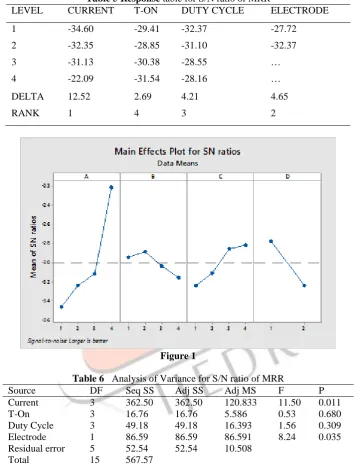
Influences on MRRFrom the response table for S/N ratio, it’s clear that the input process parameter those having greatest delta value get the highest rank. Rank of parameters indicates the relative significance of each input parameter in machining. From this table current has the most significant parameter while pulse on time is the least significant.
Table 5 Response table for S/N ratio of MRR
LEVEL CURRENT T-ON DUTY CYCLE ELECTRODE
1 -34.60 -29.41 -32.37 -27.72
2 -32.35 -28.85 -31.10 -32.37
3 -31.13 -30.38 -28.55 …
4 -22.09 -31.54 -28.16 …
DELTA 12.52 2.69 4.21 4.65
RANK 1 4 3 2
Figure 1
Table 6 Analysis of Variance for S/N ratio of MRR
Source DF Seq SS Adj SS Adj MS F P
Current 3 362.50 362.50 120.833 11.50 0.011
T-On 3 16.76 16.76 5.586 0.53 0.680
Duty Cycle 3 49.18 49.18 16.393 1.56 0.309
Electrode 1 86.59 86.59 86.591 8.24 0.035
Residual error 5 52.54 52.54 10.508
Total 15 567.57
IJEDR1603055
International Journal of Engineering Development and Research (www.ijedr.org)749
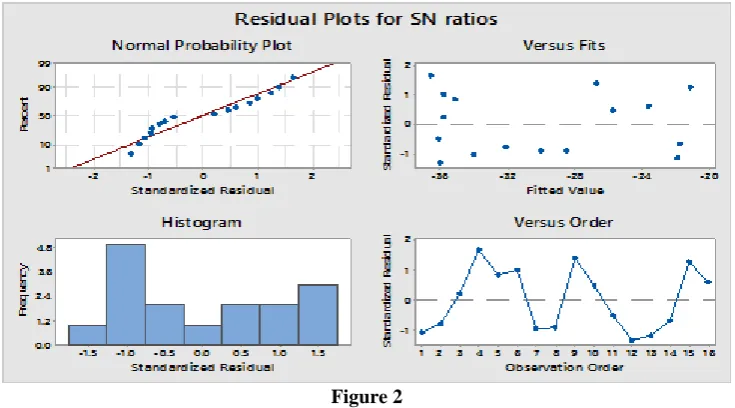
Figure 2Influences on TWR
The tool wear rate should be minimized in EDM. The response table given below, type of electrode used has highest priority because it has the highest rank in response table. In our experiment copper has minimum tool wear rate. Hence the type of electrode has the highest effect on TWR, which followed by current, pulse on time and duty cycle. The main effect plot for S/N ratio of EWR are shown in
Table 7Response table for S/N of TWR
LEVEL CURRENT T-ON DUTY CYCLE ELECTRODE
1 48.94 40.05 44.04 60.01
2 56.66 39.79 45.55 33.40
3 43.89 55.80 52.87 …
4 37.32 51.17 44.34 …
DELTA 19.35 16.02 8.83 26.61
RANK 2 3 4 1
Figure 3
It is clear from the figure 3 that firstly on increasing the current TWR increases, but soon after a further increase in current is it decreases followed by pulse on time, with increasing it TWR decreases but at very high value like 1000 µS it increase again.
The analysis of variance for S/N ratios of TWR are shown in table 8.The analysis of variance clearly reflects that electrode is the most effected parameter in TWR followed by current, pulse on time and duty cycle.
Table 8Analysis of Variance for S/N ratio of TWR
Source DF Seq SS Adj SS Adj MS F P
IJEDR1603055
International Journal of Engineering Development and Research (www.ijedr.org)750
The Fig.4 shows Residuals Versus
the Order of the Data for TWR, the residuals are formed in the cyclic manner. Most of the residuals are lie very close to the residual mean line.
Figure 4
The Fig.4 shows Residuals Versus the Order of the Data for TWR, the residuals are formed in the cyclic manner. Most of the residuals are lie very close to the residual mean line.
I. Conclusion
This study investigates the MRR and TWR of EN 32 Steel by using sinkage EDM on different parameters like current, pulse on time, duty cycle and electrode materials. Based on the results following conclusion can be made:
Based on Taguchi method the combination for optimum input process parameters for maximizing the MRR are current (Ip) 12 Amp, pulse on time 200µS, duty cycle 12 and copper electrode.
On the other hand, for minimizing the tool wear rate (TWR) the combination of optimum input process parameters are current (Ip) 12Amp, pulse on time 500 µS, duty cycle 11and brass electrode.
The analysis of variation results that MRR has the highest influence on current. On the other hand electrode has a major influence on TWR.
References
[1] Jameson,E.C., (2001) Electric discharge machining: tooling, methods and applications.
[2] Joshi, S.N., Pande, S.S., (2011) Intelligent process modeling and optimization of die-sinking electric discharge machining. Applied Soft Computing 11: pp 2743-2755
[3] Paras Kumar & Ravi Parkash (2016) Experimental investigation and optimization of EDM process parameters for machining of aluminum boron carbide (Al–B4C) composite, Machining Science and Technology, 20:2, 330-348
[4] Muthuramalingam, T. & Mohan B., (2013) Influence of discharge current pulse on machinability in electrical discharge machining, Materials and Manufacturing Processes, 28:4, 375-380
[5] Bassoli Elena, Denti Lucia, Gatto Andrea, Luliano Luca, (2016) influence of electrode size and geometry in electro-discharge drilling of Inconel 718, Int J Adv Manuf Technol, DOI 10.1007/s00170-016-8339-4
[6] Garg Sanjeev Kumar, manna Alakesh, Jain Ajai, (2016) Experimental investigation of spark gap and material removal rate o f Al/ZrO2(p) MMC machines with wire EDM, J Braz. Soc. Mech Sci Eng. 38:481-191
[7] Mohanty Chinmaya P., Sahu Jambeswar, Mahapatra S.S., (2013) Thermal-structural analysis of electric discharge machining process, Procedia Engineering 51:508-513
[8] Dastagiri M., Kumar A. Hemantha, (2014) Experimental investigation of EDM parameters on stainless steel & EN 41b, Procedia Engineering 97:1551-1564
[9] Tiwari Mohit, Mausam Kuwar, Sharma Kamal, Singh Ravindra Pratap, (2014) Investigate the optimal combination of process parameters for EDM by using a grey rational analysis, Procedia materials Scienc5:1734-1744
[10] Goswami Amitesh, Kumar Jitinder, (2014) Optimization in wire-cut EDM of Niminic-80A using Taguchi’s approach and utility concept, engineering Science and Technology, an International Jouranal 17:236-246
[11] Zhag Yanzhen, Liu Yonghong, ji Renjie, Cai Baoping, Shen Yang, (2013) Sinking EDM in water-in-emulsion, Int J Adv Manuf Technol, 65:705-716
[12] Zhang Guojun, Zhang Zhen, Ming Wusi, Guo Jianwen, Huang Yu, Shao Xinyu, (2014) The multi-objective optimization of medium-speed WEDM process parameters for machining SKD11 steel by a hybrid method of RSM and NSGA- II, Int J Manuf Technol, 70:2097-2109
T-On 3 779.3 779.3 259.76 5.78 0.044
Duty Cycle 3 208.3 208.3 69.44 1.55 0.312
Electrode 1 2832.66 2832.7 86.591 63.05 0.001
Residual error 5 224.6 224.6 44.9
IJEDR1603055
International Journal of Engineering Development and Research (www.ijedr.org)751
[13] Long Banh Tien, Phan Nguyen Huu, Cuong Ngo, Jatti Vijaykumr S., (2016) Optimization of PMEDM process parameter formaximizing the material removal rate by Taguchi’s method, Int J manuf technol, DOI 10.1007/s00170-016-8586-4
[14] Chakravorty Rina, Gauri Susanta Kumar, Chakraborty Shankar, (2012) Optimization of correlated responses of EDM process, material and Manufacturing Process, 27:3, 337-347