CAREER PLANNING PROCESS AND ITS ROLE IN HUMAN RESOURCE DEVELOPMENT
RENU KUMARI
Assistant Professor of Commerce Govt. College Chhachhrauli
ABSTRACT: This paper addresses specific questions on career planning, activity which plays an
increasingly representative role in the human resources management. People were always
concerned about choosing and building careers to meet their needs and aspirations. Career
planning process involves both individual and organization responsibility. In the contemporary
business environment, highly competitive, we find that career management responsibility rests
increasingly on the individuals. Organizations also play an important role; its need to have and
maintain a competent staff, considered as the main source for obtaining competitive advantage,
most advanced companies develop and apply an integrated management career system,
beneficial both for themselves and for their employees.
1.
CAREER PLANNING – AN ESSENTIAL COMPONENT OF HUMAN RESOURCE MANAGEMENTThe current economic context, marked by increased competition, integration in the
European Union and especially the need to maintain competitive advantage in an increasingly
uncertain business environment, have led to the introduction and the deployment of human
resources activities until recently neglected. Thus, more companies in Romania have started to
develop and implement organized planning and career development systems of employees.
In human resource management, career planning aims to identify needs, aspirations and
opportunities for individuals’ career and the implementation of developing human resources
programs to support that career. According to Edgar Schein career planning (Manolescu, 2003) is a
continuous process of discovery in which an individual slow develops his own occupational concept
as a result of skills or abilities, needs, motivations and aspirations of his own value system . Career
planning is seen as a very systematic and comprehensive process of targeting career
development and implementation of strategies, self assessment and analysis of opportunities and
evaluate the results.
The career planning process involves both the organization and the individual responsibility.
Thus, the individuals must identify their aspirations and abilities, and through assessment and
counseling to understand their needs of training and development; the organization needs to
identify its needs and opportunities, to plan its employees and to ensure its staff the necessary
information and appropriate training for career development.
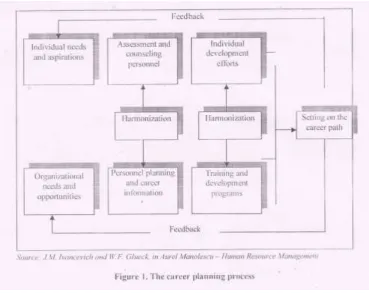
Therefore, career planning (Popescu Neveanu, 2003) must link individual needs and
aspirations with organizational needs and opportunities, evaluating, advising and informing its
staff on career planning, individual development efforts with training and development
programs. Most often this match is not done, the organizations paying a differential attention
to its employees, planning career of the high performance individuals with greater opportunities
A career planning model, taken from the literature is presented in the following figure:
Figure 1. The Career Planning Process
The issues to be considered in the planning of career are:
Organization members should be recognized and treated as individuals with needs, desires
and unique skills;
Individuals are more motivated in an organization that mace their aspirations;
Individuals may develop, change and discover new courses of action if they are shown
exactly the opportunities or if they are encouraged and guided.
The specialized literature recommend that career counseling activities should be introduced
for all the employees, as a formalized activity of the human resources department. Creating a
special service for career counseling, consists of specialists with psychosocial and / or managerial
trending, who knows both individuals and organizations needs, would lead to a better alignment
between the individuals needs of fulfillment and organization objectives.
According to the experts in human resources management (Mathis et al., 1997) are the
“Chance and luck” model. This model is that employee, to get the desired position, is based
only on luck. He must be persevering and always be in place at the right time.
“Organization knows best” model. The model is based on the fact that the employee is moved
from one job to another according to the needs. This model is supported mainly by young
employees, who are dependent on adults forall the views, and less than adults employees.
“Self – oriented” model. This model provides importance to the individuals; the employees are
establishing their own development during their career, while having assistance too. There are
two approaches to career planning (Manolescu, 2003)), depending on the emphasis on the needs of
the organization or on the individual objectives:
a) The organization centered planning system which aims:
the development of Human Resource needs;
to improve the quality of human resources to increase productivity;
defining career paths;
harmonization of organizational and career needs;
career counseling of work and life quality;
audit and control of the planning and career development system. b) the person centered
planning system which aims:
to identify the potential, skills and interests of the individual;
to identify the purposes of his life and his career goals;
researching or seeking and obtaining the best career start;
to communicate the career plan directly to individual by his manager;
request career guidance;
internal and external opportunities’ assessment;
request mentor or sponsor support;
promote their self image or recognition of their own qualities.
2. EMPLOYEES’ CAREER PLANNING RESPONSIBILITY
An important aspect of career planning is to establish the extent to which the two parties
(individuals and organizations) are responsible in this process. On one hand, the individual is
responsible for its development along the stages of his life and, secondly, the organization
involved in planning and development of career helps to improve the organizational
2.1. Individual responsibility on career planning
According to the theory and practice of management, the career planning process focuses
particularly on individual skills, abilities, needs or aspirations. Given all this, the individual will
create a basic information necessary to ensure preparedness for a possible promotion.
Individual career planning (Zlate, 2004) can be defined as all actions of self assessment,
exploration of opportunities, establishing goals etc., designed to help the individual to make
informed choices and changes about career. It is a complex action that requires systematic and
careful thinking in formulating short and long term objectives.
Career planning is based, therefore, on the evaluation of individual skills, interests
and motivation, on the analysis of organizational opportunities, setting goals for their careers
and develop a strategy to achieve those goals.
Individual career planning ((Zlate, 2004)) can browse through five steps:
1. Self assessment is the collection of information about yourself (values, interests, skills),
continuous assessment and reporting to others;
2. Exploring opportunities involves gathering information about existing opportunities within
but also outside organizations (training and other development methods);
3. Making decisions and setting goals on short and long term for training requirements,
change of job / department etc.
4. Planning consists of determining ways and means of achieving goals, ordering their
actions to achieve them, considering its consequences, setting deadlines and resource
requirements
5. Pursuit of achievement goals, action by the individual accounts for his successes and
failures and make decisions to retain or change career course.
Individual perspective on career (Chartered Institute of Personnel and Development - CIPD,
2005) is determined by the status of the individual professional and personal life, age,
family circumstances, financial expectations, desired lifestyle, etc. Some individuals are
hoping to be promoted to a senior position within an organization, others want to take a
new job in another organization, accepting new and different responsibilities by investing
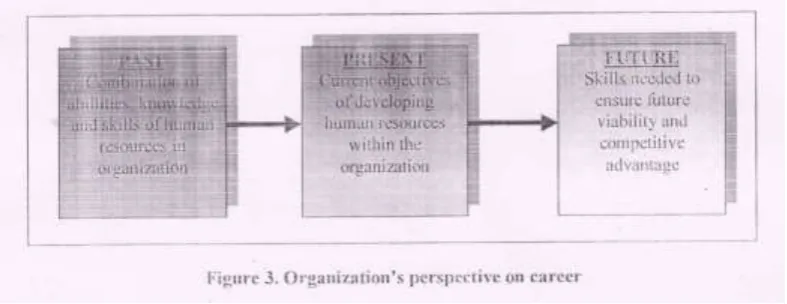
of work hours, or looking for jobs with a flexible working schedule. All these aspects are
covered by the following synthetic scheme
2.2. Organizational responsibility on career planning
To be viable, on short-term, or to maintain competitive advantage, in the long term,
organizations must match employees with appropriate skills in the right positions. The
type and skills of the employees are different, depending on the scope of the firm, economic
sector, specific technology, consumer characteristics, etc.. Peculiarities of organization
affects the jobs structure, the types of recruited employees for each job and the
development ways on the job. Many employers offer numerous promote opportunities to
certain types of positions (especially those involving unique skills to give value to the
organization) and limited opportunities for others
Organizational career planning has a critical role in attracting, developing and
maintaining the staff. Without organization’s involvement in establishing, supporting and
strengthening the careers of its employees it can not achieve the expected results at both
organizational and individual level.
3. THE ORGANIZATIONAL CAREER PLANNING SYSTEM
Due to numerous changes manifested in the lives of individuals and organizations, the
idea of developing a fixed career trajectory has become somewhat outdated because fewer are
those who plan on long term. Careers are shorter and more unstable, job security is reducing
and the short-term employment becomes more common. Most individuals are expected
to change several jobs throughout their working lives and to participate in a variety of
projects. The reduced number of jobs available within organizations and restrict
managerial levels have led to changes in the traditional route to an organizational career
development. There are fewer promotion opportunities so that employees are keeping the
same job on longer periods before being promoted. The traditional career path involved an
upward mobility, giving to the employees the certainty of an well- defined promote pathways.
Currently, the emphasis is on job rotation, multiple skills development and sideways
promotion.
Designing and implementing a career planning system is useful to the organizations for
identifying the employees development needs and matching them to the business needs.
The career planning system contribute to increased employees professional satisfaction
because it helps them to identify and take positions consistent with their objectives and plans.
From the perspective of the company, career planning system reduces the needed time to fill
the vacancies, help succession planning (preparing employees for filling positions that became
vacant following staff turnover or retirement), identify employees with management potential
and ensure to all employees the opportunity to identify career goals and develop plans to
2.1. The main components of career management system
Career planning systems differ in terms of complexity and of emphasis on certain components
of it. However, all career planning systems include the following components:
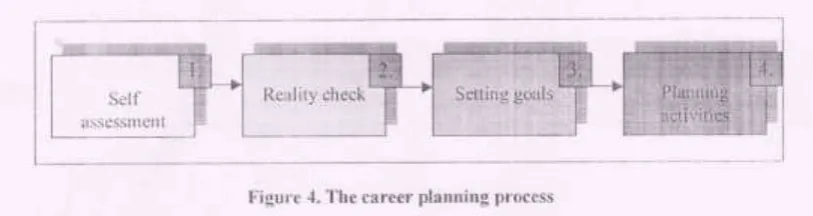
Figure 4. The career planning process
1. Self assessment assists employees in setting goals, values, skills and behavioral
trends. Psychological tests are used as „Inventory goals Strong – Campbell” (it helps
employees to identify occupational and professional goals) and „self quest” (it identify
the employee’ preferences for different working environments -sales, consulting, etc.)
which contributes to
identify the level of emphasis on work and leisure. Career counselors are often used
to assist employees in self-evaluation process and in interpreting test results.
2. Reality check: the employees are informed on how the company assess their skills and
knowledge and what place they took on company plans (eg opportunities for
promotion, lateral moves). Usually, this information is provided by the direct
managers in the performance evaluation process; the discussion on career development
can take place separately.
3. Setting goals: Employees establish the short and long term career objectives
that are related to concerned professional positions, the necessary level of
competence, setting steps forward, learning new skills. These objectives are discussed
with the manager and recorded in the individual development plan.
4. Planning activities: during this phase, the employees determine how to achieve short
and long term career goals. These plans may include attending lectures and
4. THE ROLES OF THE EMPLOYEES, MANAGERS AND ORGANIZATION IN CAREER PLANNING
The employees, managers and organizations (Hollenbeck, et al., 2008) share the
responsibility for career planning.
4.1. The Employee’s Role
Regardless of the operating organization, the individuals must be actively involved in
managing their careers, motivated of its beneficial effects on welfare (the economic and
psychological standpoint) (George, et al., 2007).
The Economic standpoint – at a basic level, the work provides an income to the individuals
to ensure their existence and their families and to satisfy other interests, hobbies and
recreation; career opportunities are a source of extrinsic motivation (external) for
employees.
The psychological standpoint – as a source of spiritual comfort, the work provides a sense
of accomplishment and gives a meaning to the individual existence. Psychologically, career
opportunities are an important source of intrinsic motivation (internal) for employees.
The Psychological Contract consists of all the expectations that employers and their
employees have from each other. In general, the psychological contract emphasizes that
the organization will offer job security and promotion opportunities if the employee remain in
the company and maintain a high level of professional performance. However, due to
technological change, competition and structural social, psychological contract between
employees and organizations has changed. The organizations can no longer offer job security
and promotion opportunities and employees are more interested in a job that offers challenges,
diversity and opportunity to be creative. The employees are still interested in job security even
if they realize that having a job within the same company throughout working life is an
unrealistic goal.
The new psychological contract suggests that employees can become more valuable to
employers by taking responsibility for their career planning.
The organizations which have structured career planning systems expects from their employees
to take responsibility for planning their own careers. Some of it provide to the employees
a crash course to familiarize them with the organization’s specific career system; the
goals and prepare their action plans. Follows that, after a discussion with team manager, to
work towards reaching the targets. Other organizations develop and make available to
employees a planning guide which guides the development stages of self-assessment, target
setting, development planning and action plan.
Regardless of the complexity of the career planning system, employees should take the
following actions:
To take the initiative in the sense of requiring feedback from peers and chiefs
regarding the strengths and weaknesses of their skills;
To identify the stage of career development and the development needs;
To seize as many opportunities to learn (about sales, product design etc.).;
To interact with employees from different work groups within and outside the
organization (e.g. professional associations, project teams)
4.2. The Manager’s Role
Regardless of the career planning system type in the organization, managers have a key role
in its planning process. Generally, the employees ask for advice on career to their direct
managers because they are the ones that determine the level of training and assess their ability
to promote. However, the managers are the main source of information on job vacancies,
training courses and other development opportunities. Unfortunately, many managers are
reluctant to engage in the employees’ career planning activities because they do not feel
prepared to answer questions related to their career, have a limited time allocated for these
activities or they are not able to relate to a full understanding of their needs. To help the
employees in this process, managers must demonstrate effectiveness in four parts: a coach,
evaluator, counselor and referral agent. The success of manager- employee discussion about
career (Otte, et al., 1992) is based on achieving the following aspects:
The managers need to form a complete picture of the employee’s work-related
purposes and goals;
The manager and the employee agree on the next steps for development;
The employee understands the manager's perception of his performance,
development needs and career options;
The manager and the employee agree on how the employee’ needs are satisfied with
The manager identify the resources to help the employee to achieve the
committed objectives set out in their discussion.
A key role of a manager (Zeus et al., 2008) within an organization is to provide
employees with career development coaching. The purpose of this type of coaching is to help
employees to consider various career options and make decisions for them. In return, the
organization will benefit from identifying the employee's career prospects, thereby could plan
and provide the opportunities to achive their goals. Outside the manager, the coaching could be
provided by the human resources professionals within the organization.The coach manager can
help the employees to assume different roles within the organization such as: a coach for
the new employees, mentoring for potential successors, or leadership teams or
committees. Thus, individuals perform their generative task: they share to others what they
know, giving themselves what they received, thus showing care for the next generation.
One of the difficulties created by the flattening of career and lateral transfers is that the
employee status is determined rather by the job, title, number of promotions and salary, and
less by the performance, expertise, entrepreneurial and team spirit. Redefining the prestige and
held position will encourage the employees to remain in the organization and not to seek a job
elsewhere or preferment.
The specific items of the manager's role in career counseling are:
To design and to implement systems and standards of performance assessment: the
role of helping to clarify the organization’ opportunities to develop and discuss options
and directions for future development organization that employees can prepare and
adapt to new requirements;
Analyzing current and future career plans;
Setting Goals: manager occupies a unique position to assess and discuss the
employee's dedication to his professional goals. Manager may refer the employee to
assess his motivations and choices regarding career, getting actively involved in
setting career goals and planning actions;
Systematic encouragement and support of staff during the implementation of the
agreed strategies for career;
Working with employees who feel stressed or unhappy at work: interpersonal
problems of the work place (eg. disputes with colleagues or other team members) may
find ways of conflict resolution can improve performance and it can keep the
employee on his career path.
4.3. The Organization’s Role
The organizations are responsible for providing the necessary resources to be
successful in the employees’ career planning. These resources include:
Career workshops: seminars on various topics (how does the system of career planning, self
assessment or setting goals);
Career centers or information systems (or databases places where / from where the
employees can learn about job openings or training programs);
Career planning guides (printed matter for guidance the staff witch contain exercises,
discussion and advice on career planning);
Career counseling (advice by a specialized professional counselor in assisting the
employees interested in career planning);
Career paths (directions) (planning job stages, identifying the skills needed to advance
within the same family of channels such as wireless promoting a technical professional
position in a managerial position). The organization must monitor the career planning
system to ensure that both managers and employees use it properly and especially to assess
how it is useful in achieving its business objectives (e.g. reducing the period of coverage
vacant posts).
5. CONCLUSIONS
Restructuring of the organizations in the current crisis (marked by mergers, layoffs and
restrictions on activity) and change their strategies make career planning a very important
process for both employees and employers.
From the company perspective, the failure to motivate the employees by planning
their careers can lead to hinder the process of filling vacant posts, a decrease of the staff
involvement and an inappropriate use of the money allocated to training and
development programs. From the employees’ perspective, the lack of career planning can
the right position leads to the need of a job change and / or the company (particularly
in the current crisis). Career planning is effective when the organizations use fully the skills
and knowledge of their employees and they are motivated to achieve maximum
performance and be satisfied with their work, which helps the organization to achieve its
objectives. The frequent manifestation of layoffs, especially in the current crisis, requires
that employees demonstrate certain skills and competencies that prove indispensable to the
actual or potential employers
REFERENCES:
1. George, M.J.; Jones, R.G. (2007) Understanding and Managing Organizational Behavior -
5th Edition, Prentice Hall/Pearson Publishing House, London, p.266
2. Manolescu, A. (2003) Human Resource Management, 4th Edition, The Economic
Publishing House, Bucarest, p.332
3. Mathis, R.L. et al. (1997) Human Resource Management, 4th Edition, The Economic
Publishing House, Bucarest, p.141
4. Noe, A.R.; Hollenbeck, R.J.; Wright, P.; Gerhart, B. (2008) Fundamentals of Human
Resource Management – 3rd Edition, McGraw Hill Company, London , p.428
5. Otte, F.L.; Hutcheson, P.G. (1992) Helping Employees Manage Careers, Englewood
Cliffs, Prentice Hall, pp.57-58
6. Popescu Neveanu, A. (2003) Planning and career management in organizations,
Journal of Organizational Psychology, 3(4)
7. Zeus, P.; Skiffington, S. (2008) Coaching in organizations - A complete Guide, Codecs
Publishing House, Bucarest, pp.101-103
8. Zlate, M. (2004) A dissertation regarding the managerial and organizational psychology,
Polirom Publishing House, Iaşi, p. 377
9. Chartered Institute of Personnel and Development - CIPD (2005) Career management
(a guide), University of Reading Business School, [Online], Available at:
http://www.cipd.co.uk/subjects/lrnanddev/careermand/CrrmngmntGd.htm, [Accessed