Medical Devices: Evidence and Research
Dove
press
O R I G I N A L R E S E A R C H
open access to scientific and medical research
Open Access Full Text Article
A randomized, controlled trial of Veriset™
hemostatic patch in halting cardiovascular
bleeding
David Glineur1
Marc Hendrikx2
Dainis Krievins3
Peteris Stradins3
Bernhard Voss4
Thomas Waldow5
Luc Haenen6
Martin Oberhoffer7
Caroline M Ritchie8
1Saint Luc Cliniques Universitaires,
Brussels, Belgium; 2Faculty of Medicine
and Life Sciences, Jessa Hospital, Hasselt University, Hasselt, Belgium;
3Pauls Stradins Clinical University
Hospital, Riga, Latvia; 4German Heart
Center Munich, Department of Cardiovascular Surgery, Technische Universität München, Munich, Germany; 5Heart Center Dresden
GmbH, University Hospital Dresden, Dresden, Germany; 6Imelda Hospital,
Bonheiden, Belgium; 7Asklepios Klinik
St. Georg, Herzchirurgische Abteilung, Hamburg, Germany; 8Covidien,
Medical Affairs, Bedford, MA, USA
Background: Obtaining hemostasis during cardiovascular procedures can be a challenge, particularly around areas with a complex geometry or that are difficult to access. While several topical hemostats are currently on the market, most have caveats that limit their use in certain clinical scenarios such as pulsatile arterial bleeding. The aim of this study was to assess the effectiveness and safety of Veriset™ hemostatic patch in treating cardiovascular bleeding.
Methods: Patients (N=90) scheduled for cardiac or vascular surgery at 12 European institutions were randomized 1:1 to treatment with either Veriset™ hemostatic patch (investigational device) or TachoSil® (control). After application of the hemostat, according to manufacturer instructions
for use, time to hemostasis was monitored. Follow-up occurred up to 90 days post-surgery.
Results: Median time to hemostasis was 1.5 min with Veriset™ hemostatic patch, compared to 3.0 min with TachoSil® (p<0.0001). Serious adverse events within 30 days post-surgery were
experienced by 12/44 (27.3%) patients treated with Veriset™ hemostatic patch and 10/45 (22.2%) in the TachoSil® group (p=0.6295). None of these adverse events were device-related, and no
reoperations for bleeding were required within 5 days post-surgery in either treatment group.
Conclusion: This study reinforces the difference in minimum recommended application time between Veriset™ hemostatic patch and TachoSil® (30 s versus 3 min respectively). When
com-pared directly at 3 min, Veriset™ displayed no significant difference, showing similar hemostasis and safety profiles on the cardiovascular bleeding sites included in this study.
Keywords: surgical bleeding, cardiac surgery, aortic valve replacement, CABG
Background
Uncontrolled bleeding is a major challenge for surgeons, with both patient safety and economic implications.1,2 This is especially true in the cardiovascular field, due to
anticoagulation and anti-aggregation treatment taken prior to and during surgery and the systolic pulsatility present in the arterial system, which increases stress on sutures. Cardiopulmonary bypass (CPB) is often used during these procedures, affecting the intrinsic coagulation pathway rendering the control of bleeding more challenging.3 In
fact, studies have shown that these interventions are associated with increased blood loss and post-operative mortality.4,5 Thus, the control of bleeding in these situations
requires both an urgent and conservative approach. While there are many topical hemostats that have shown efficacy when applied to cardiovascular tissue,6 their caveats
(e.g., need of a dry field, efficacy only on low pressure bleeding) support the need to develop a topical hemostat that is easy to use, safe, and effective in the cardiovascular patient population.
Correspondence: David Glineur Saint Luc Cliniques Universitaires, 90 Avenue Hippocrate 10/6107, 1200 Brussels, Belgium
Tel +32 477 992 867 Email [email protected]
Journal name: Medical Devices: Evidence and Research Article Designation: ORIGINAL RESEARCH Year: 2018
Volume: 11
Running head verso: Glineur et al
Running head recto: A new patch for cardiovascular bleeding DOI: http://dx.doi.org/10.2147/MDER.S145651
Medical Devices: Evidence and Research downloaded from https://www.dovepress.com/ by 118.70.13.36 on 24-Aug-2020
For personal use only.
Dovepress Glineur et al
Veriset™ (Covidien; Mansfield, MA, USA) hemostatic patch promotes hemostasis through a dual mode of action, serving as a tamponade to physically stem blood flow, while concentrating platelets and other clotting factors at the bleed-ing site to accelerate coagulation. Veriset™ hemostatic patch is left in place after hemostasis is obtained, and is completely absorbed within 4 weeks. In two previous clinical trials, one in hepatic tissue and the other in soft tissue, no adverse events (AEs) related to Veriset™ hemostatic patch were reported, and quick control of bleeding was obtained.7,8 In
order to obtain clinical results on the device when applied to cardiovascular tissue, we performed a randomized, controlled, patient-blinded study comparing the safety and efficacy of Veriset™ hemostatic patch to that of TachoSil® (Nycomed;
Zürich, Switzerland)(currently approved for cardiovascular hemostasis), with a follow-up of 90 days post-surgery.
Ethics statement
This study was conducted in accordance with the Declaration of Helsinki and all local regulatory requirements. Copies of the protocol, proposed informed consent forms, other writ-ten subject information, and other study-related documents, as required by the ethics committees, were submitted to the Independent Ethics Committees (IECs) for approval. IEC approval was obtained before enrollment of subjects into the study and shipment of the study device. A list of participat-ing IECs and their associated clinical trial sites is provided in Table S3.
Methods
Study design
This was a premarket, prospective, randomized, single-blind study to compare Veriset™ hemostatic patch to Tacho-Sil® as an adjunct to hemostasis in patients undergoing
cardiovascular surgery (clinical trial registration number: NCT01639833). Patients at 12 European institutions scheduled for open cardiac or vascular surgery involving the aorta, surface of the heart, or coronary artery bypass grafting (CABG), and who provided informed consent, were considered for enrollment. During surgery, treatment at the target bleeding site (TBS) was randomized 1:1 using a sealed envelope process to Veriset™ hemostatic patch or TachoSil®,
and the time required to obtain hemostasis was monitored. Safety was assessed up to 90 days post-surgery. The clinical study was conducted according to Good Clinical Practice guidelines and the Declaration of Helsinki. All European and national regulations were adhered to. The datasets generated and/or analyzed during the current study are available in the Clinical Trial repository: https://clinicaltrials.gov/ct2/show/
NCT01639833?term=NCT01639833&rank=1.
Study participants
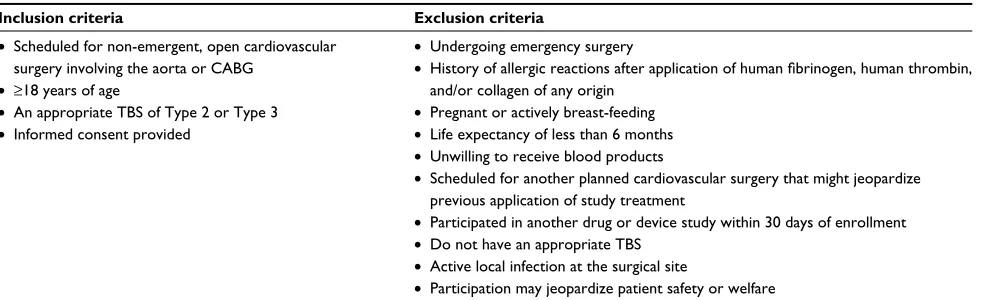
Patients who met certain inclusion criteria, but none of the exclusion criteria, were enrolled in the study (Table 1). An appropriate TBS was defined as an area of bleeding on the aorta, coronary vessels, or surface of the heart, where hemostasis by conventional methods was deemed ineffective, impractical, or potentially detrimental, of Type 2 (oozing/ mild) or Type 3 (moderate) bleeding severity,9 and where it
was possible to hold pressure on Veriset™ hemostatic patch or TachoSil® for at least 3 min. The bleeding severity levels
are based on a published scale in order to increase objectiv-ity; bleeding levels were assigned prior to randomization in order to minimize investigator bias with a Type 1 (no visible bleeding) and Type 4 (uncontrolled bleeding requiring imme-diate conventional surgical intervention) excluded from the study. Ninety patients were enrolled beginning on August 2, 2012, with the final follow-up visit on December 16, 2013.
Table 1 Criteria for study enrollment
Inclusion criteria Exclusion criteria
• Scheduled for non-emergent, open cardiovascular surgery involving the aorta or CABG
• ≥18 years of age
• An appropriate TBS of Type 2 or Type 3
• Informed consent provided
• Undergoing emergency surgery
• History of allergic reactions after application of human fibrinogen, human thrombin,
and/or collagen of any origin
• Pregnant or actively breast-feeding
• Life expectancy of less than 6 months
• Unwilling to receive blood products
• Scheduled for another planned cardiovascular surgery that might jeopardize previous application of study treatment
• Participated in another drug or device study within 30 days of enrollment
• Do not have an appropriate TBS
• Active local infection at the surgical site
• Participation may jeopardize patient safety or welfare
Abbreviations: CABG, coronary artery bypass grafting; TBS, target bleeding site.
Medical Devices: Evidence and Research downloaded from https://www.dovepress.com/ by 118.70.13.36 on 24-Aug-2020
Dovepress A new patch for cardiovascular bleeding
Materials
Veriset™ hemostatic patch (Covidien), a device composed of polyethylene glycol (PEG) and oxidized cellulose, and TachoSil® (Nycomed), a patch composed of equine collagen
coated with human fibrinogen and thrombin, were provided by the study sponsor. There are no known contraindications for Veriset™ hemostatic patch. TachoSil® is contraindicated
for intravascular application to avoid life-threatening throm-boembolic events, and in patients with known hypersensitiv-ity to human blood products or horse proteins. Both hemostats were to be used in accordance with the manufacturers’ instructions for use and could be cut to size. All other sup-plies used in the surgical procedure or for assessment were those standardly used by the institution at which the surgery was performed.
Surgical procedure
Patients underwent open cardiac or vascular surgery accord-ing to the appropriate standard procedures and practices of the institution at which the surgery was performed. Protamine reversal was to occur prior to randomization. Once an appro-priate TBS was identified, the patient was randomized to receive treatment with either Veriset™ hemostatic patch or TachoSil®. After application of Veriset™ hemostatic patch,
direct pressure was applied. Hemostasis was assessed every 30 s after application until the 3 min time point, and then at 1 min intervals until hemostasis was achieved, up to 10 min. After application of TachoSil®, pressure was maintained on
the device and hemostasis was not assessed until 3 min after application, per the manufacturer’s instructions for use. If hemostasis was not obtained at 3 min, continued pressure was applied to the device, and hemostasis was assessed at 1 min intervals up to 10 min. If hemostasis was not obtained within 5 min of application of either device, other hemostatic measures could be used as rescue therapy at the discretion of the investigator. Comparable pre-clinical application images can be found in Howk et al. 10 During CABG procedures,
the location of patch application was at the discretion of the surgeon and not specifically directed by the study protocol, and the force applied to stop suture hole bleeding during the 30 s intervals was not detrimental for graft patency.
Outcome measures
The primary safety endpoint was the proportion of patients with serious adverse events (SAEs) up to 30 days post-surgery, and the secondary safety endpoint was the proportion of patients requiring a reoperation for bleeding complications up to 5 days post-surgery. Although patients were monitored
for 90 days, the Veriset™ patch is absorbed within 30 days making it an appropriate safety endpoint for the device. The safety endpoints were evaluated based on non-inferiority to the control and were tested from an intention to treat per-spective. The primary effectiveness endpoint was the time to hemostasis at the TBS following application of the hemostat. The secondary effectiveness endpoint was the proportion of patients with all treated bleeding sites achieving hemostasis within 3 min. The effectiveness endpoints were evaluated first based on non-inferiority to the control based on a per protocol population perspective, and if met, superiority was also tested from an intention to treat perspective.
Post-operative visits
Patients were assessed 24 hrs, 30 days, and 90 days post-surgery via a physical exam and measurement of both vital signs and clinical laboratory parameters. AEs were recorded until the end of the follow-up period. An SAE was defined as an AE that led to death or a serious deterioration in health (life-threatening illness or injury, permanent impairment, in-patient hospitalization, prolonged hospitalization, or required medical/surgical intervention to prevent life-threatening illness or injury). All AEs recorded as being possibly related to the device or whose relationship to the device was unable to be determined were later adjudicated for their device-relatedness by a single independent medical monitor who was blinded to the group assignments.
Statistical analysis
The required sample size to analyze effectiveness was based on a power of 80% and an alpha of 0.025, assuming true medians for time to hemostasis of Veriset™ hemostatic patch and TachoSil® as 0.5 min and 3.0 min, respectively.
For effectiveness analyses, the required sample size was five patients per treatment group. For safety analyses, the required sample size was determined to provide a 90% probability of being able to detect an AE of a given type within the Veriset™ hemostatic patch group that occurs with a probability of at least 5%. Based on the specification, it was determined that 45 Veriset™ hemostatic patch patients were required. Using a 1:1 randomization scheme, a total sample size of 90 patients (45 per treatment group) was included.
Statistical analyses were performed and P-values were calculated from a two-sample t-test for continuous variables and Fisher’s exact test for categorical variables. All statistical analyses were performed using SAS® version 9.1 or higher.
Two-sided tests and one-sided tests were performed at the 0.05 and 0.025 significance levels, respectively.
Medical Devices: Evidence and Research downloaded from https://www.dovepress.com/ by 118.70.13.36 on 24-Aug-2020
Dovepress Glineur et al
Results
Patient demographics
A total of 235 patients were analyzed for eligibility in the study (Figure 1). Of those, 145 failed the inclusion/exclusion criteria, 141 (97.2%) of whom did not have an appropriate TBS (bleeding not of Type 2 or 3 and/or it was not possible to hold pressure on the bleeding site for at least 3 min). The other four patients not randomized exhibited an appropriate TBS, but did not satisfy one or more of the criteria listed in Table 1. The remaining 90 patients were randomized 1:1 to receive treatment with either Veriset™ hemostatic patch or TachoSil®. Of the 45 patients randomized to the Veriset™
hemostatic patch treatment group, 39 completed the 90-day follow-up. Forty-one of the 45 patients randomized to the TachoSil® group completed their 90-day follow-up. All early
withdrawals (two per treatment group) were by patient deci-sion. The age and gender of patients included in this study were similar in both treatment groups, as well as baseline hemoglobin and platelet count (Table 2).
Surgery
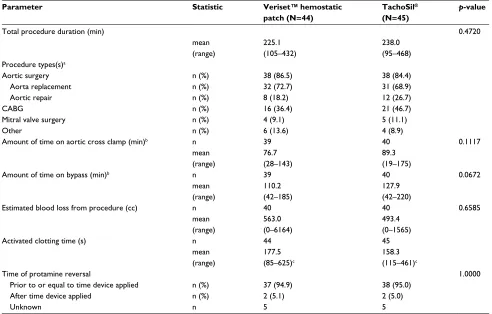
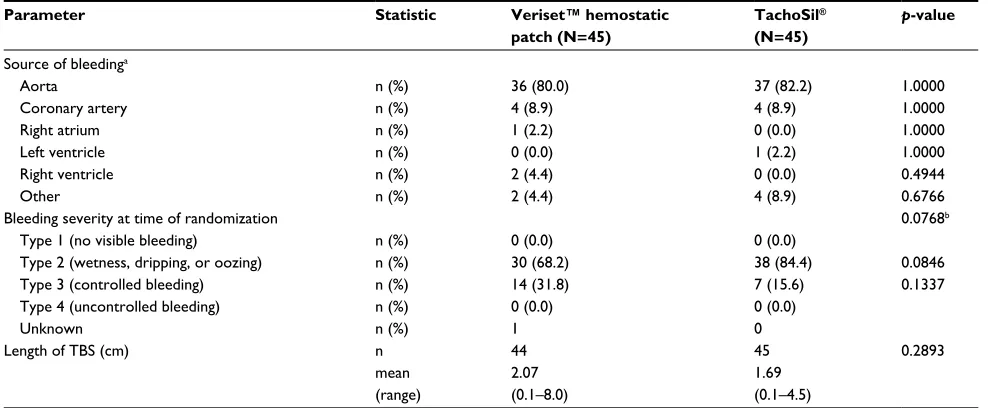
Patients included in the study underwent various types of cardiovascular procedures, with the most common being aortic surgery or CABG. There were no blood transfusions required due to bleeding from the TBS where the hemostat was applied, in either group (Table 3). Five patients from each treatment group did not undergo CPB, nine underwent aortofemoral bypass surgery and one underwent abdominal aorta bypass surgery. The selected TBS occurred from the aorta in 80% of patients in each treatment group (Table 4). Other sources of bleeding included the coronary artery, an atrium, ventricle, distal anastomosis, and diffuse bleed-ing from the operative field. Bleedbleed-ing was of Type 2 in 68.2% of the Veriset™ hemostatic patch group and 84.4% of the TachoSil® group (p=0.0846), with the remaining
patients exhibiting Type 3 bleeding (p=0.1337). There was no significant difference between the two treatment groups in any surgical procedure or TBS characteristic; however, there was a trend toward increased bleeding
Figure 1 Flow diagram of patient randomization and follow-up.
Notes: The number of subjects included in each follow-up assessment is shown, along with the reasons for early termination of subjects. Veriset™ (Covidien; Mansfield,
MA, USA); TachoSil® (Nycomed; Zürich, Switzerland).
Abbreviation: post-op, post-operative.
Assessed for eligibility (N=235)
Failed inclusion/exclusion criteria (N=145)
Randomized (N=90)
Veriset™ hemostatic patch (N=45)
Death (N=1)
Death (N=1)
Death (N=2) Withdrew (N=2)
Death (N=1) Withdrew (N=2) 24 hours post-op
(N=44)
30 days post-op (N=43)
90 days post-op
(N=39) 90 days post-op(N=41)
Death (N=1)
30 days post-op (N=44) 24 hours post-op
(N=45) TachoSil®
(N=45)
Medical Devices: Evidence and Research downloaded from https://www.dovepress.com/ by 118.70.13.36 on 24-Aug-2020
Dovepress A new patch for cardiovascular bleeding
severity in the Veriset™ hemostatic patch group prior to hemostat application (p=0.0768). Conventional methods were used to obtain hemostasis first with suture/ligature used in over 50% of the cases, unless the investigator felt
that use of these methods was not practical, which was the case in almost half of the patients in each group (40.9% of the Veriset™ hemostatic patch group and 42.2% of the TachoSil® group).
Table 2 Demographic and baseline characteristics (intent to treat population)
Variable Statistic Veriset™ hemostatic
patch (N=45)
TachoSil®
(N=45)
p-value
Age (years) 0.5164
mean (range) 68.5 (37–86) 66.7 (37–86)
Gender 0.6523
Female n (%) 16 (35.6) 13 (28.9)
Male n (%) 29 (64.4) 32 (71.1)
Past/current medical history? –
Yes n (%) 45 (100.0) 45 (100.0)
Surgical history? 0.4475
Yes n (%) 33 (73.3) 37 (82.2)
Hemoglobin (g/dL) n 45 45 0.6283
mean 9.82 9.61
(range) (6.9–15.8) (6.6–17.0)
Platelet count (10³/L) n 44 44 0.4531
mean 151.02 140.93
(range) (52.0–305.0) (53.0–318.0)
Notes: Veriset™ (Covidien; Mansfield, MA, USA); TachoSil® (Nycomed; Zürich, Switzerland).
Table 3 Surgical procedure (as-treated population)
Parameter Statistic Veriset™ hemostatic
patch (N=44)
TachoSil®
(N=45) p
-value
Total procedure duration (min) 0.4720
mean (range)
225.1 (105–432)
238.0 (95–468) Procedure types(s)a
Aortic surgery n (%) 38 (86.5) 38 (84.4)
Aorta replacement n (%) 32 (72.7) 31 (68.9)
Aortic repair n (%) 8 (18.2) 12 (26.7)
CABG n (%) 16 (36.4) 21 (46.7)
Mitral valve surgery n (%) 4 (9.1) 5 (11.1)
Other n (%) 6 (13.6) 4 (8.9)
Amount of time on aortic cross clamp (min)b n 39 40 0.1117
mean (range)
76.7 (28–143)
89.3 (19–175)
Amount of time on bypass (min)b n 39 40 0.0672
mean (range)
110.2 (42–185)
127.9 (42–220) Estimated blood loss from procedure (cc)
Activated clotting time (s)
n mean (range) n
40 563.0 (0–6164) 44
40 493.4 (0–1565) 45
0.6585
mean (range)
177.5 (85–625)c
158.3 (115–461)c
Time of protamine reversal 1.0000
Prior to or equal to time device applied n (%) 37 (94.9) 38 (95.0)
After time device applied n (%) 2 (5.1) 2 (5.0)
Unknown n 5 5
Notes: aPercentages may sum to more than 100% since more than one category may apply. bAmount of time excludes patients not on CPB. cHigh-end ACT outliers of 427,
601, and 625 for Veriset™ hemostatic patch and 461 for TachoSil® occurred because ACT was taken before protamine reversal. Veriset™ (Covidien; Mansfield, MA, USA);
TachoSil® (Nycomed; Zürich, Switzerland).
Abbreviations: CABG, coronary artery bypass grafting; CPB, cardiopulmonary bypass; ACT, activated clotting time.
Medical Devices: Evidence and Research downloaded from https://www.dovepress.com/ by 118.70.13.36 on 24-Aug-2020
Dovepress Glineur et al
Safety outcomes
Safety was assessed at 24 hrs, 30 days, and 90 days after surgery. All AEs were recorded, along with their severity and relationship to the investigational device or control. A summary of AEs is shown in Table 5 and the safety endpoints of the study are shown in Table 6. Within 30 days post-surgery, 12/44 (27.3%) and 10/45 (22.2%) patients treated with Veriset™ hemostatic patch and TachoSil®, respectively,
exhibited at least one SAE. The only SAEs to affect more than one patient treated with Veriset™ hemostatic patch were cardiac arrest, pleural effusion, and respiratory failure. None of the AEs in either treatment group were device-related and, within 5 days post-surgery, no patients required a reoperation for bleeding complications. Six patients died during follow-up (four from the Veriset™ hemostatic patch grofollow-up and two from the TachoSil® group; p=0.4340), the causes of which
were unrelated to the investigational device or control device.
Effectiveness outcomes
The median time to hemostasis at the TBS was 1.5 min in patients treated with Veriset™ hemostatic patch and 3.0 min
in patients treated with TachoSil® (p<0.0001), which was the
minimum time based on instructions for use (Table 7). This significant difference of p<0.001 remained when only patients on CPB were included in the analysis, although the median time to hemostasis at the TBS increased to 1.75 min with Veriset™ hemostatic patch. These results were statistically significant; clinical significance is determined by the clini-cian. The proportion of patients who achieved hemostasis at all treated bleeding sites at 3 min was similar between the two treatment groups. For the Veriset™ hemostatic patch, 49% achieved hemostasis at all treated bleeding sites within 1.5 min, 80% within 2 min, and 88% within 3 min. These per-centages were slightly less when only patients on CPB were included at 47%, 78%, and 86%, respectively. A subgroup analysis of time to hemostasis at the TBS is shown based on hemostat application to the aorta (Table S1). Veriset™ hemostatic patch was slightly less effective when applied to the aorta than to other anatomical locations.
The results in Table 7 and Table S1 are shown on a per protocol population, which excluded four patients. One patient did not receive the study or control device after
Table 4 Target bleeding site (TBS) details (intent to treat population)
Parameter Statistic Veriset™ hemostatic
patch (N=45) TachoSil
®
(N=45) p-value
Source of bleedinga
Aorta n (%) 36 (80.0) 37 (82.2) 1.0000
Coronary artery n (%) 4 (8.9) 4 (8.9) 1.0000
Right atrium n (%) 1 (2.2) 0 (0.0) 1.0000
Left ventricle n (%) 0 (0.0) 1 (2.2) 1.0000
Right ventricle n (%) 2 (4.4) 0 (0.0) 0.4944
Other n (%) 2 (4.4) 4 (8.9) 0.6766
Bleeding severity at time of randomization 0.0768b
Type 1 (no visible bleeding) n (%) 0 (0.0) 0 (0.0)
Type 2 (wetness, dripping, or oozing) n (%) 30 (68.2) 38 (84.4) 0.0846
Type 3 (controlled bleeding) n (%) 14 (31.8) 7 (15.6) 0.1337
Type 4 (uncontrolled bleeding) n (%) 0 (0.0) 0 (0.0)
Unknown n (%) 1 0
Length of TBS (cm) n 44 45 0.2893
mean (range)
2.07 (0.1–8.0)
1.69 (0.1–4.5)
Notes: aPercentages may sum to more than 100% since more than one category may apply. bp-value based on Wilcoxon rank sum statistic for distribution of bleeding
severity. Veriset™ (Covidien; Mansfield, MA, USA); TachoSil® (Nycomed; Zürich, Switzerland).
Table 5 Adverse events overview (as-treated population)
Parameter
Veriset™ hemostatic patch (N=44)
TachoSil®
(N=45) p-value
One or more adverse events 33 (75.0%) 34 (75.6%) 1.0000
One or more serious adverse events 13 (29.5%) 11 (24.4%) 0.6384
One or more device-related adverse eventsa 0 (0.0%) 0 (0.0%) –
Death 4 (9.1%) 2 (4.4%) 0.4340
Notes: aDevice-related adverse events are events with a definite, probable, possible, unknown/impossible to determine, or missing relationship to the device. Veriset™
(Covidien; Mansfield, MA, USA); TachoSil® (Nycomed; Zürich, Switzerland).
Medical Devices: Evidence and Research downloaded from https://www.dovepress.com/ by 118.70.13.36 on 24-Aug-2020
Dovepress A new patch for cardiovascular bleeding
randomization, in two patients the study device was not applied to an appropriate TBS, and for one patient the study device was applied incorrectly. In the four cases in which Veriset™ hemostatic patch did not remain in place at the end of the procedure, there was no tissue damage observed after removal of the device (Table S2). Three device deficiencies occurred as a result of Veriset™ hemostatic patch being applied incorrectly, in which the device was not positioned correctly (PEG-side down, toward the bleeding site). In two of these patients, a new patch was applied, and hemostasis was obtained; rescue therapy was administered in the third patient. Only two device deficiencies occurred as a result of Veriset™ hemostatic patch not adhering to the TBS, both of which resulted in the use of rescue therapy. One patient treated with TachoSil® required rescue therapy due to
hemo-stasis not being achieved, but TachoSil® was not removed
prior to the administration of rescue therapy.
Discussion
This study tested the safety and effectiveness of a novel topical hemostat when applied to cardiac and vascular tis-sue during a variety of cardiovascular procedures, though the hemostat was applied to the aorta in the majority of patients included in the study. When applied per the manu-facturer’s instructions for use, median time to hemostasis at
the TBS was 3.0 min in patients treated with TachoSil® and
1.5 min in patients treated with Veriset™. The requirement in human studies to follow manufacturer instructions for use is a potential limitation of this randomized study as the minimum application time between the two products is not identical. TachoSil® labeling is based on regulatory approvals
following three earlier clinical trials. Alternatively, Veriset™ hemostatic patch labeling only requires 30 s of pressure. A more direct comparison of time to hemostasis, in which the manufacturer instructions do not need to be adhered to, would require a nonclinical study. Although Veriset™ was found to be superior to TachoSil® in a previously published
randomized clinical study of the liver,7 for the purposes of
this study the two devices were determined to be equivalent. Another potential study limitation is that CPB may have been managed differently across investigational sites, although baseline hemoglobin and platelet count were similar, and there was no differences in activated clotting time or the number of patients receiving protamine reversal prior or equal to the time of device application.
Based on the platform chemistry of the CE Mark-approved DuraSeal®, Veriset™ contains two primary
com-ponents, an oxidized cellulose absorbable backing material and synthetic PEG. When in contact with physiological fluids Veriset™ forms a cross-linked PEG-based gel that
Table 6 Primary and secondary safety endpoints (as-treated population)
Parameter Statistic Veriset™
hemostatic patch (N=44)
TachoSil®
(N=45)
Difference in % (TachoSil® – Veriset™)
and 95% CIa
p-valueb
Proportion of patients with serious adverse events up to 30 days post-surgery
n/N (%) 12/44 (27.3) 10/45 (22.2) –5.1 (–23.0, 12.9) 95% CI
for %c
(15.0, 42.8) (11.2, 37.1) 0.6295
Proportion of patients with a reoperation for bleeding complications up to 5 days post-surgery
n/N (%) 0/44 (0.0) 0/45 (0.0) 0.0 (---, ---) 95% CI
for %c
(0.0, 8.0) (0.0, 7.9) –
Notes: aCI based on the normal approximation. bp-value from a two-sided Fisher’s exact test, testing for a difference in proportions between treatments. cClopper–Pearson
exact CI for a binomial proportion. Veriset™ (Covidien; Mansfield, MA, USA); TachoSil® (Nycomed; Zürich, Switzerland).
Table 7 Effectiveness endpoints (per protocol population)
Parameter Statistic Veriset™ hemostatic
patch (N=41)
TachoSil®
(N=45)
p-value
Time to hemostasis for TBS (min) medianb 1.50 3.00
95% CI for medianc (1.50, 2.00) (—, —) <0.0001d<0.0001e
Proportion of patients achieving hemostasis at all treated bleeding sites within 3 min
n/N (%) 36/41 (87.8) 41/45 (91.1)
95% CI for %a (77.8, 97.8) (82.8, 99.4) 0.6169f
Notes: aCI based on the normal approximation. bKaplan–Meier estimate of the median. cBrookmeyer–Crowley CI for the median. dp-value from a one-sided median test,
testing for non-inferiority of Veriset™ hemostatic patch compared to TachoSil® with a non-inferiority margin of 1 min. ep-value from a one-sided median test, testing for
superiority of Veriset™ hemostatic patch compared to TachoSil®. fp-value from a two-sided Chi-square test of superiority of Veriset™ hemostatic patch to TachoSil® with
respect to a binomial proportion. Veriset™ (Covidien; Mansfield, MA, USA); TachoSil® (Nycomed; Zürich, Switzerland).
Abbreviation: TBS, target bleeding site.
Medical Devices: Evidence and Research downloaded from https://www.dovepress.com/ by 118.70.13.36 on 24-Aug-2020
Dovepress Glineur et al
rapidly absorbs fluid assisting in hemostasis while main-taining flexibility without the risk of viral transmission or use of the traditional coagulation cascade. Additionally, the oxidized cellulose may provide anti-microbial properties. Furthermore, Veriset™ hemostatic patch was shown to be safe, with no AEs resulting from use of the device. Results from this study support the inclusion of Veriset™ hemostatic patch as a new device in the cardiovascular surgeon’s toolkit. A variety of hemostatic agents are already approved for use on cardiovascular tissue. Fibrin glues and sealants have been used for several decades.11 Prospective randomized controlled
trials (RCTs) have shown approximately 90% of patients obtained hemostasis within 5 min of Tisseel® fibrin sealant
(Baxter International Inc., Deerfield, IL, USA) application during major cardiovascular surgery.12,13 The safety and
effec-tiveness of Gelfoam® sterile sponge (Pfizer, Inc., New York,
NY, USA) and FloSeal™ hemostatic matrix (Baxter Inter-national Inc.) were compared in a randomized trial by Oz et al.14 At 3 min, roughly 31% of patients treated with FloSeal™
hemostatic matrix and 78% of patients treated with GelFoam®
sterile sponge were still bleeding. TachoSil® has been shown
previously in an RCT to obtain hemostasis faster (75% success rate at 3 min) than standard hemostatic fleece in cardiovascular indications.15 The current study showed a success rate of 88%
within 3 min of applying Veriset™ hemostatic patch, a device that is completely free of animal- and human-derived compo-nents. Thus, results suggest that Veriset™ hemostatic patch is equivalent in efficacy to other products on the market, while eliminating components that have elicited safety concerns.16–20
Conclusion
This is the first study publishing on the safety and efficacy of Veriset™ hemostatic patch, which is completely free of animal- and human-derived components, in cardiovascular surgery applications, compared with a randomized TachoSil®
control. Although there were differences in the minimum application time that affected the comparability of outcomes, the products were determined to be comparable. These data support the use of Veriset™ hemostatic patch during car-diovascular surgery, when perioperative bleeding requires urgent attention.
Acknowledgments
This work was sponsored and funded by Covidien ( Mansfield, MA, USA), which contributed to the study design, data collection, and data analysis, and assisted with manuscript writing. Covidien LP is an indirect wholly owned subsidiary of Medtronic plc.
The authors would like to thank the other principal inves-tigators who participated in the study: Professor Parla Astarci (Saint Luc Cliniques Universitaires), Professor Michael Schmoeckel (Asklepios Klinik St. Georg, Herzchirurgische Abteilung), Professor Martin Misfeld (Herzzentrum Leipzig), Professor Francis Wellens (UZ Brussels), Professor Filip Rega (UZ Leuven), and Michael Sudkamp, MD, PhD (Uni-versitätsklinikum Freiburg). Additionally, they thank all the co-investigators and study personnel who assisted in the sur-gical procedures, follow-up assessments, and data collection. Statistical support was provided by Biostatistical Consulting, Inc. (Burlington, MA, USA). Editorial support was provided by John Hauschild and Nicholas Paquette (Medtronic).
Author contributions
Authors made substantial contributions to the study conduct and manuscript development beginning with the initial study conception, including study design (DG, MH, DK, PS, BV, TW, LH, MO), data acquisition (DG, MH, DK, PS, BV, TW, LH, MO), data analysis (DG, MH, DK, PS, BV, TW, LH, MO, CMR), data interpretation (DG, MH, DK, PS, BV, TW, LH, MO, CMR), manuscript writing (DG, CMR), critical revisions (DG, MH, DK, PS, BV, TW, LH, MO, CMR), final approval of the manuscript for submission (DG, MH, DK, PS, BV, TW, LH, MO, CMR); and agree to be accountable for the accuracy and integrity of the work (DG, MH, DK, PS, BV, TW, LH, MO, CMR).
Disclosure
All authors or their institutions received support from Covidien (the manufacturer of Veriset™) to conduct this study. The authors report no other conflicts of interest in this work.
References
1. Carson JL, Poses RM, Spence RK, Bonavita G. Severity of anaemia
and operative mortality and morbidity. Lancet. 1988;1(8588):727–729.
2. Shander A. Financial and clinical outcomes associated with surgical
bleeding complications. Surgery. 2007;142(4 Suppl):S20–25.
3. Paparella D, Brister SJ, Buchanan MR. Coagulation disorders of
cardiopulmonary bypass: a review. Intensive Care Med. 2004;30(10):
1873–1881.
4. Biancari F, Airaksinen KE, Lip GY. Benefits and risks of using clopi-dogrel before coronary artery bypass surgery: systematic review and meta-analysis of randomized trials and observational studies. J Thorac Cardiovasc Surg. 2012;143(3):665–675.
5. Dacey LJ, Munoz JJ, Baribeau YR, et al. Reexploration for hemorrhage following coronary artery bypass grafting: incidence and risk factors.
Northern New England Cardiovascular Disease Study Group. Arch
Surg. 1998;133(4):442–447.
6. Shander A, Kaplan LJ, Harris MT, et al. Topical hemostatic therapy
in surgery: bridging the knowledge and practice gap. J Am Coll Surg.
2014;219(3):570–579.e4.
Medical Devices: Evidence and Research downloaded from https://www.dovepress.com/ by 118.70.13.36 on 24-Aug-2020
Dovepress A new patch for cardiovascular bleeding
7. Ollinger R, Mihaljevic AL, Schuhmacher C, et al. A multicentre, ran-domized clinical trial comparing the Veriset haemostatic patch with fibrin sealant for the management of bleeding during hepatic surgery.
HPB (Oxford). 2013;15(7):548–558.
8. Schuhmacher C, Pratschke J, Weiss S, et al. Safety and effectiveness of a synthetic hemostatic patch for intraoperative soft tissue bleeding.
Med Devices (Auckl). 2015;8:167–174.
9. Mehran R, Rao SV, Bhatt DL, et al. Standardized bleeding definitions for cardiovascular clinical trials: a consensus report from the
Bleed-ing Academic Research Consortium. Circulation. 2011;123(23):
2736–2747.
10. Howk K, Fortier J, Poston R. A novel hemostatic patch that stops
bleed-ing in cardiovascular and peripheral vascular procedures. Ann Vasc
Surg. 2016;31:186–195.
11. Rousou JA. Use of fibrin sealants in cardiovascular surgery: a systematic
review. J Card Surg. 2013;28(3):238–247.
12. Lowe J, Luber J, Levitsky S, et al. Evaluation of the topical hemostatic efficacy and safety of TISSEEL VH S/D fibrin sealant compared with currently licensed TISSEEL VH in patients undergoing cardiac surgery: a phase 3, randomized, double-blind clinical study. J Cardiovasc Surg (Torino). 2007;48(3):323–331.
13. Rousou J, Levitsky S, Gonzalez-Lavin L, et al. Randomized clinical trial of fibrin sealant in patients undergoing resternotomy or reopera-tion after cardiac operareopera-tions. A multicenter study. J Thorac Cardiovasc Surg. 1989;97(2):194–203.
14. Oz MC, Cosgrove DM 3rd, Badduke BR, Hill JD, Flannery MR, Palumbo R, Topic N. Controlled clinical trial of a novel hemostatic
agent in cardiac surgery. The Fusion Matrix Study Group. Ann Thorac
Surg. 2000;69(5):1376–1382.
15. Maisano F, Kjaergard HK, Bauernschmitt R, et al. TachoSil surgical patch versus conventional haemostatic fleece material for control of bleeding in cardiovascular surgery: a randomised controlled trial. Eur J Cardiothorac Surg. 2009;36(4):708–714.
16. Hino M, Ishiko O, Honda KI, Yamane T, Ohta K, Takubo T, Tatsumi N. Transmission of symptomatic parvovirus B19 infection by fibrin sealant
used during surgery. Br J Haematol. 2000;108(1):194–195.
17. Kawamura M, Sawafuji M, Watanabe M, Horinouchi H, Kobayashi K. Frequency of transmission of human parvovirus B19 infection
by fibrin sealant used during thoracic surgery. Ann Thorac Surg.
2002;73(4):1098–1100.
18. Pope M, Johnston KW. Anaphylaxis after thrombin injection of a
femoral pseudoaneurysm: recommendations for prevention. J Vasc
Surg. 2000;32(1):190–191.
19. Tadokoro K, Ohtoshi T, Takafuji S, et al. Topical thrombin-induced
IgE-mediated anaphylaxis: RAST analysis and skin test studies. J Allergy
Clin Immunol. 1991;88(4):620–629.
20. Wai Y, Tsui V, Peng Z, Richardson R, Oreopoulos D, Tarlo SM. Anaphy-laxis from topical bovine thrombin (Thrombostat) during haemodialysis
and evaluation of sensitization among a dialysis population. Clin Exp
Allergy. 2003;33(12):1730–1734.
Medical Devices: Evidence and Research downloaded from https://www.dovepress.com/ by 118.70.13.36 on 24-Aug-2020
Dovepress Glineur et al
Supplementary materials
Table S1 Subgroup analysis effectiveness by treatment application site (per protocol population)
Parameter Treatment
application site
Statistic Veriset™ hemostatic
patch (N=41) TachoSil
®
(N=45)
Time to hemostasis for target bleeding site (min)
Aorta n 35 39
mediana 2.00 3.00
95% CI for medianb (1.50, 2.00) (---, ---)
Other n 6 6
mediana 1.25 3.00
95% CI for medianb (1.00, 1.50) (---, ---)
Notes: aKaplan–Meier estimate of the median. bBrookmeyer–Crowley CI for the median. Veriset™ (Covidien; Mansfield, MA, USA); TachoSil® (Nycomed; Zürich,
Switzerland).
Table S2 Rescue therapy (as-treated population)
Parameter Veriset™ hemostatic
patch (N=44) n (%) TachoSil
® (N=45)
n (%)
p-value
Did device remain in place at conclusion of procedure? (#1)
0.0556
Yes 40 (90.9) 45 (100.0)
No 4 (9.1) 0 (0.0)
If “No” in #1, was tissue damage present? –
Yes 0 (0.0) 0 (0.0)
Any rescue therapy used? 0.2028
Yes 4 (9.1) 1 (2.2)
Type of rescue therapy useda
Cautery 0 (0.0) 1 (2.2) 1.0000
Suture 3 (6.8) 0 (0.0) 0.1166
Topical agent 2 (4.5) 1 (2.2) 0.6164
Other 0 (0.0) 1 (2.2) 1.0000
Was device removed prior to use of rescue therapy? 0.2000
Yes 4 (9.1) 0 (0.0)
Notes: aA patient may have had more than one type of rescue therapy, so the percentages may sum to more than 100%. Veriset™ (Covidien; Mansfield, MA, USA); TachoSil®
(Nycomed; Zürich, Switzerland).
Table S3 Independent ethics committees and their associated clinical trial sites
Participating independent ethics committee Associated clinical site
Comité d’Ethique Hospitalo-Facultaire Saint-Luc – UCL Saint Luc Cliniques Universitaires Ethik-Kommission an der Medizinischen Fakultät der Universität Leipzig Herzzentrum Leipzig
Commissie medische ethiek UZ Leuven UZ Leuven
Commissie Medische Ethiek Imeldaziekenhuis Bonheiden Imelda Hospital
Ethik-Kommission der Albert-Ludwigs-Universität Freiburg Universitätsklinikum Freiburg
Commissie Medische Ethiek UZ Brussel UZ Brussels
Ethische Toetsingscommissie Jessa Ziekenhuis Jessa Ziekenhuis
Ethik-Kommission an der Technischen Universität Dresden Herzzentrum Dresden GmbH Universitätsklinik an der Technischen Universität Dresden Klinik für Herzchirurgie
Ethik-Kommission der Ärztekammer Hamburg Asklepios Klinik St. Georg, Herzchirurgische Abteilung Comité Medische Ethiek Ziekenhuis Oost-Limburg Hospital Oost-Limburg
Ethik-Kommission der Fakultät für Medizin der Technischen Universität München
Deutsches Herzzentrum München – Klinik für Herz – und Gefäßchirurgie
Ethics Committee for Clinical Research at Pauls Stradins Clinical University Hospital Development Society
Pauls Stradin Clinical University Hospital
Medical Devices: Evidence and Research downloaded from https://www.dovepress.com/ by 118.70.13.36 on 24-Aug-2020
Dovepress
Medical Devices: Evidence and Research
Publish your work in this journal
Submit your manuscript here: https://www.dovepress.com/medical-devices-evidence-and-research-journal Medical Devices: Evidence and Research is an international,
peer-reviewed, open access journal that focuses on the evidence, technology, research, and expert opinion supporting the use and application of medical devices in the diagnosis, monitoring, treatment and management of clinical conditions and physiological processes. The identification of novel
devices and optimal use of existing devices which will lead to improved clinical outcomes and more effective patient management and safety is a key feature. The manuscript management system is completely online and includes a quick and fair peer-review system. Visit http://www. dovepress.com/testimonials.php to read real quotes from authors.
Dove
press
A new patch for cardiovascular bleeding
Medical Devices: Evidence and Research downloaded from https://www.dovepress.com/ by 118.70.13.36 on 24-Aug-2020