576
EFFECT OF JOB AUTONOMY, JOB SECURITY AND EMPLOYEE TRANNING
ON PERCEIVED ORGANIZATION SUPPORT
Abdul Khaliq ALVI
1Rizwan HAIDER
Rana Raffaqat ALI
ABSTRACT
Perceived organizational support has been considered attention as main variable of research for long period. A number of studies have conducted on this variable. Due to its importance, latest researches are still considered as key variable. There is lack of researches about perceived
organizational support in developing country like Pakistan. The main focus of this study is to explore the relationship of job autonomy, job security and employees training with perceived
organizational support. Job autonomy, job security and employees training are considered as independent variables while perceived organizational support is taken as dependent variable. In
this regard, current study has proposed three hypotheses about the positive relationship of these variables. This research has carried out on banking industry of Pakistan. For this purpose, sample
of 312 respondents of city Lahore was selected randomly. For this purpose a structured questionnaire was designed for collection of primary data. Software, AMOS and SPPS were utilized for statistical analyses. Factor analysis, reliability analysis, regression analysis and
correlation analysis were the test for conducting the current study. Results of this study have confirmed that job autonomy, job security and employees training are positively associated with
perceived organizational support.
Keywords: Pakistan, Job autonomy, Job security, Employees training, Perceived organizational support, Banking sector
INTRODUCTION
According to Aselage and Eisenberger, (2003); Eisenberger et al. (1986) organizational support theory can define perceived organizational support as treatments which are offered by the organizations (in term of job conditions and fairness) and it acts as a sign for workers about the level at which organizations worth the employee’s assistance and about their well beings.
1 Peak Solutions College, Griffin Campus Lahore Pakistan, Email:[email protected]
Asian Journal of Empirical Research
577
According to Blau, (1964) and Gouldner, (1960), organizational support theory explains that perceived organizational support proposes that staff who experience support from their organizations are showed better commitment with their organizations, lower job turnover ratio and showing better organizational based citizenship behaviors (Rhoades and Eisenberger, 2002). In this way, organizations can attain the competitive advantage on other organizations (Pfeffer, 2005). That is why; perceived organizational support is very important factor for the organizations. The organizational support theory describes that for attaining the emotional needs organizations must evaluate the benefits which are paid at the effort of employee about their jobs (Eisenberger et al.
1986; Shore and Shore, 1995; Rhoades and Eisenberger, 2002). These researchers also assert that employees value their contributions about organizations when an organization cares about their wellbeing. This kind of organizational support can enhance the employee’s good perceptions and ultimately it can support to attain the objectives of organizations, foster organizational commitment, and enhance the organizational performance (Rhoades and Eisenberger, 2002). POS is also promoted the good behaviors which can results in better performance and reduce the negative behaviors such as employee turnover and absenteeism (Rhoades and Eisenberger, 2002). Rhoades and Eisenberger, (2002) have conducted a meta-analysis on POS. They includes seventy studies in their meta-analysis and points out number of antecedents of POS. This study is only limited to three antecedents of POS. For best of author knowledge, before this study these antecedents are not included collectively in any study in regard of Pakistani cultural context.
Objectives of the study
The main objective of the current study is to check impact of job autonomy, job security and employee training on POS (perceived organizational support).
LITERATURE REVIEW
Job autonomy
578
atmospheres should have many more opportunities offered by suitable job features to be innovative and visualize the constructive ways for better organizational performance. It is also proposed that better job autonomy encourage the workers to negotiate task related perceptions concerned with innovative working environment (Langfred and Moye, 2004). Workers with higher level of job autonomy consider themselves accountable for their work (Parker and Sprigg, 1999) and so, employees are stimulated to take initiative for the creative thinking that improves organizational performance. On the other hand, workers with low job autonomy have only predefined policies and procedures to complete their works (Humphrey et al. 2007; Langfred and Moye, 2004). Consequently, the workers with low job autonomy are not stimulated to perform any creative task except the responsibilities of their status quo. Furthermore, as these workers with lesser options to perform creative tasks and less encouraging response from innovative work participation may have lower stages of innovative self-efficacy (Unsworth and Clegg, 2010).
Employee training
Employee Training is defined as “the designed instructed involvement that is formulated to improve the determinants of individual work performance” (Chiaburu and Tekleab, 2005). Training is related to the expertise that is considered essentially by the management of a firm that must be obtained by the employees of that specific firm to enhance the opportunities of accomplishment of its objectives (Chen et al. 2004). Training obtained by the workers, may facilitate them to decrease their nervousness or irritation that arises due to new work demand. And employees had not the skills to cope with those tasks due to the lack of training. Consequently, employees participate constructively to handle those difficulties after obtaining training (Chen et al., 2004).Employee training visualizes a variety of principles which are not limited to management improvement (Ladyshewsky, 2007), but also acknowledging latest technologies (Hasan, 2006), socialization and familiarizing with changing organizational culture for the new and existing employees as well (Akdere and Schmidt, 2007), training of new staff regarding their responsibilities to complete the tasks (Anderson et al. 1994), and training of workers regarding organizational moral values (Ladyshewsky, 2007). In any case of the declared objectives of these training plans, these struggles are mostly anticipated to effect of perfection in the organizational functions or degree of effectiveness (Hughey and Mussnug, 1997; Ladyshewsky, 2007). Eisenberger et al. (2002)asserted that employee training was the predictor of organizational support.
Job security
579
aspect of the definition completely identifies that job security not only enhances economic conditions of individuals, but emotional (De Witte, 1999) and physical (Ferrie et al. 1998) welfare as well. Job security is also related to welfare of the workers. Roslender et al. (2006) propose that welfare of workers stands for an element of intellectual assets. Eisenberger et al. (2002)describes that job security is the predictor of organizational support.
Perceived organizational support
Organizational support theory (OST) states the dealings of the organizations (in the form of working environment and justice) related to the employees that offer the level to which the organizations value the contribution and care about well being of employees (perceived organizational support; POS), (Aselage and Eisenberger, 2003; Eisenberger, Huntington et al.
1986). According to Social exchange theory (Blau, 1964), perceived organizational support describes that workers who consider the organization more supportive are supposed to reciprocate their dealings as more affective and they are more emotionally attached with the organization. Consequently, organizations that ensure perceived organizational support within the workers are believed to have competitive advantage on those organizations that do not foster the attachment of their workers (Pfeffer, 2005). Perceived organizational support is not purely psychological but societal procedure designed by the information that workers get from the social set up. Organizational support theory shows the positive and constant findings (Rhoades and Eisenberger, 2002), and it is explanatory power which is assumed that workers examine and respond the dealings independently which are took place within the organization. That’s why, OST offers only individual level of emotional thinking for expectations of workers regarding the relationship with the organization. The extensive amount of observation and interpretations are required generally for social exchange relations (Emerson, 1976) and fostering of POS specifically (Eisenberger et al.
2004). Previous theoretical and experimental researches have enlightened the impacts of social context on workers’ POS (Kiewitz et al. 2009).
Organizational support is defined as “an employee’s expectations of the concern an organization shows for his or her well-being” (Eisenberger et al. 1990). It may also be defined as the faith of the organizational values and their role and take care about the well-being of the employees (Rhoades and Eisenberger, 2002). It is also a main source of creating variety of positive outcomes (e.g. job satisfaction, organizational commitment, performance) (Rhoades and Eisenberger, 2002). Human Resource practices like contribution of employees, reward and cognition, developmental skills indicate the organizational respect for the capabilities of workers and consequently are related significantly to POS (Allen et al. 2003; Hutchison, 1997; Wayne et al. 1997, 2002).
Hypotheses development
580
H1: Training and development is positively linked with perceived organizational support
H2: The relationship of employee job autonomy and perceived organizational support is positive
H3: Job security is positively correlated with perceived organizational support
Hypothesized Research Model
Independent Variables Dependent Variable
Data collection
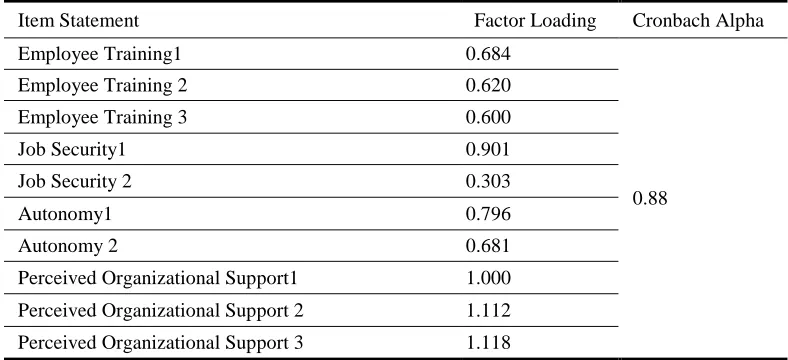
Data was collected with the help of structured questionnaire. Simple random sampling technique was used. Respondents for this study were officer level employees of banking sector. Overall 423 questionnaires were distributed. 322 questionnaires were retrieved with the response rate of 76%; out of received 312 questionnaires were selected for final analyses, rest were not complete.This study utilized an instrument with 10 items. It is developed with the help of previous articles published in the same area of research. Validity of the scale is checked with the help of factor loading. Factor loading of 9 items included in the instrument was more than 0.50. Value of one statement is less than 0.50. This value is less than 0.50 and it is dropped before further analyses.Reliability of data is being checked with the help Cronbach alpha. SPSS 16 is used for performing the test. Data is reliable if the value of cronbach alpha is more than 0.50 (Nunnally and Bernstein, 1978). Cronbach alpha of all the instruments is more than 0.88 which indicates that data is more reliable and is used for further analysis.
Employee Training
Employee Job
Autonomy
Job Security
581
Table 1: Reliability of data and validity of scale
Item Statement Factor Loading Cronbach Alpha
Employee Training1 0.684
0.88
Employee Training 2 0.620
Employee Training 3 0.600
Job Security1 0.901
Job Security 2 0.303
Autonomy1 0.796
Autonomy 2 0.681
Perceived Organizational Support1 1.000 Perceived Organizational Support 2 1.112 Perceived Organizational Support 3 1.118
Table 2: Correlation analysis
POS Job Autonomy Job Security Employee Training
POS 1
Job Autonomy 0.536** 1
Job Security 0.570** 0.437** 1
Employee Training 0.397** 0.366** 0.354** 1
***Significant at the 0.01 level. **Significant at the 0.05 level. * Significant at the 0.10 level.
Table 2 represents the correlations among the different variables which are used in this study. This table shows that all the variables positively and significantly correlated with each other.
This implies that strong correlation between these variables.
Regression analysis
582
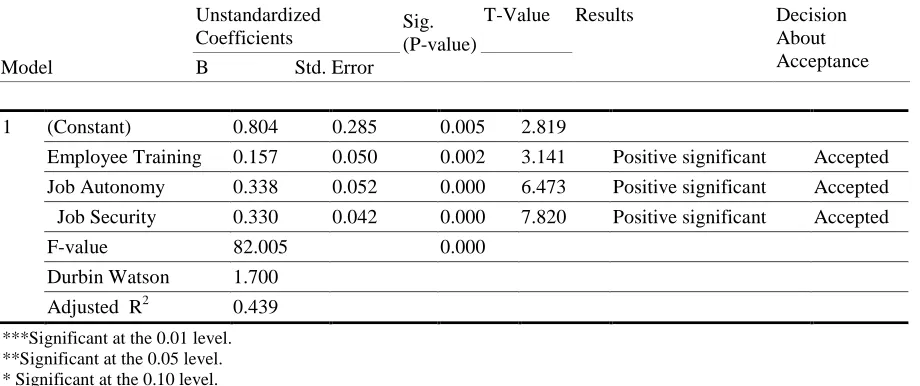
and perceived organizational support value of β = 0.157and value of p=0.002i.e. <0.05. This shows that employee training has significant impact on perceived organizational support.
Table 3: Dependent variable: organizational support
For the relationship of employee job autonomy and perceived organizational support value of β = 0.338and value of p=0.000i.e. <0.01. This shows that employee job autonomy has significant and strong impact on perceived organizational support.For the relationship of employee job security and perceived organizational support value of β = 0.330and value of p=0.000i.e. <0.01. This shows that employee job autonomy has significant and strong impact on perceived organizational support.From above discussion it is clear that employee job security is the stronger predictor of perceived organizational support. Job autonomy is the second one predictor of perceived organizational support and employee training and development is the third predictor of perceived organizational support.
CONCLUSION
Results of this study have confirmed that job autonomy, job security and employees training are the important predictor of perceived organizational support. It is noted that job autonomy is stronger predictor of perceived organizational support. Then the second predictor of perceived organizational support is job security. That is why, Banking sector of Pakistan formulate the steady policies about these variables. Employee training has lesser impact on perceived organizational support as compare to job autonomy and job security. Banking sector of Pakistan makes better policies about employee training for enhancement the impact of it on perceived organizational support. Impact of another important predictor of perceived organizational support like perceived supervisor support may also be checked in future research.
Model
Unstandardized
Coefficients Sig. (P-value)
T-Value Results Decision
About Acceptance
B Std. Error
1 (Constant) 0.804 0.285 0.005 2.819
Employee Training 0.157 0.050 0.002 3.141 Positive significant Accepted Job Autonomy 0.338 0.052 0.000 6.473 Positive significant Accepted Job Security 0.330 0.042 0.000 7.820 Positive significant Accepted
F-value 82.005 0.000
583
REFERENCES
Akdere, M. and Schmidt, W. S. (2007). Measuring the effects of employee orientation training on employee perceptions of organizational culture: implications for organization development, The Business Review, Cambridge, Vol. 8, No. 1, pp. 234-239.
Allen, D. G. Shore, L. M. and Griffeth, R. W. (2003). The role of perceived organizational support and supportive human resources practices in the turnover process, Journal of Management,
Vol. 29, No. 1, pp. 99–118.
Anderson, C. J. Dooley, K. and Rungtusanatham, M. (1994). Training for effective continuous quality improvement, Quality Progress, Vol. 27, No. 12 , pp. 57-61.
Aselage, J. and Eisenberger, R. (2003). Perceived organizational support and psychological contracts: A theoretical integration. Journal of Organizational Behavior, Vol. 24, No. 2 , pp. 491–509.
Blau, P. M. (1964).Exchange and power in social life. New York, Wiley
Chen, Y. T. Chang, L. P. and Yeh, W. C. (2004). A study of career needs, career development programs, job satisfaction and the turnover intensity of R & D personnel. Career Development International, Vol. 9, No 4 , pp. 424-37.
Chiaburu, S. D. and Tekleab, G. A. (2005). Individual and contextual influences on multiple dimensions of training effectiveness, Journal of European Industrial Training, Vol. 29, No. 8, pp. 604-26.
Cohen-Meitar, R. Carmeli, A. and Waldman, A. D. (2009). Linking meaningfulness in the workplace to employee creativity: The intervening role of organizational identification and positive psychological experiences , Creativity Research Journal, Vol. 21, No.1, pp. 361– 375.
De Witte, H. (1999). Job insecurity and psychological well-being: review of the literature and exploration of some unresolved issues, European Journal of Work and Organizational Psychology, Vol. 8, No.2 , pp.155-177.
Eisenberger, R. Fasolo, P. and Davis-La Mastro, V. (1990). Perceived organisational support and employee diligence, commitment, and innovation, Journal of Applied Psychology, Vol. 75 , No. 1, pp. 51–59.
Eisenberger, R. Huntington, R. Hutchison, S. and Sowa, D. (1986). Perceived organizational support, Journal of Applied Psychology, Vol. 71, No. 2 , pp. 500–507.
Eisenberger, R. Stinglhamber, F. and Vandenberghe, C. (2002). Perceived supervisor support: contributions to perceived organizational support and employee retention, Journal of Applied Psychology, Vol.87, No.1, pp. 565–573.
584
Emerson, R. (1976). Social exchange theory, Annual Review of Sociology, Vol. 2, No. 2, pp. 335– 362.
Ferrie, E. J. Shipley, J. M. Marmot, G. M. and Stansfe. (1998). The health effects of major organisational change and job insecurity, Social Science & Medicine, Vol. 46, No. 2, pp. 243-254.
Fried, Y. and Ferris, R. G. (1987). The validity of the job characteristics model: A review and meta-analysis, Personnel Psychology, Vol. 40 , No.1, pp. 287-322.
Genelas, P. (2005) Redefining total compensation to include the value of job security, Ive Business Journal, Vol.70, No.2 , pp.1-7.
Gouldner,A.W. (1960). The norm of reciprocity: A preliminary statement, American Sociological Review, Vol. 25, No. 1, pp. 161–178.
Hackman, R. J. and Lawler, E. E. (1971). Employee reactions to job characteristics , Journal of Applied Psychology Monograph, Vol. 55, No. 1, pp. 259–286.
Hackman, R. J. and Oldham, R. G. (1975). Development of the job diagnostic survey, Journal of Applied Psychology, Vol. 60, No. 1, pp. 159–170.
Hackman, R. J. and Oldham, R. G. (1976). Motivation through the design of work: Test of a theory, Organizational Behavior and Human Performance, Vol. 16, No. 1, pp. 250–279. Hasan, B. (2006). Effectiveness of computer training: the role of multilevel computer self-efficacy,
Journal of Organizational and End User Computing, Vol. 18, No. 1, pp. 50-68.
Hutchison, S. (1997).A path model of perceived organizational support, Journal of Social Behavior and Personality, Vol.12, No.1, pp.159–174
.
Hughey, W. A. and Mussnug, J. K. (1997). Designing effective employee training programmes ,
Training for Quality, Vol. 5, No. 2 , pp. 52-57.
Humphrey, E. S. Nahrgang, D. J. and Morgeson, P. F. (2007). Integrating motivational, social, and contextual work design features: A meta-analytic stheoretical extension of the work design literature, Journal of Applied Psychology, Vol. 92, No. 5, pp. 1332–1356.
Karasek, R. and Theorell, T. (1990) Healthy work. Stress, productivity and the reconstruction of working life, New York: Basic Books.
Kiewitz, C. Restubog, S. L. D. Zagenczyk, T. J. and Hochwarter, W. (2009). The interactive effects of psychological contract breach and organizational politics on perceived organizational support: Evidence from two longitudinal studies, Journal of Management Studies, Vol. 46, No. 3 pp. 806–834.
Ladyshewsky, R. (2007). A strategic approach to integrating theory to practice in leadership development. Leadership & Organization Development Journal, Vol. 28, No. 5, pp. 426-43. Langfred, W. C. and Moye, A. N. (2004). Effects of task autonomy on performance: An extended
model considering motivational, informational, and structural mechanisms, Journal of Applied Psychology, Vol. 89, No. 4, pp. 934–945.
585
Unsworth, L. K.& Clegg, W. C. (2010). Why do employees undertake creative action? , Journal of Occupational and Organizational Psychology, Vol. 83,No.1, pp. 77-99.
Parker, K. S. and Sprigg, A. C. (1999). Minimizing strain and maximizing learning: The role of job demands, job control, and proactive personality, Journal of Applied Psychology, Vol. 84, No.4, pp. 925–939.
Pfeffer, J. (2005). Producing sustainable competitive advantage through the effective management of people, Academy of Management Executive, Vol.19, pp. 95–106.
Rhoades, L. and Eisenberger, R. (2002). Perceived organizational support: a review of the literature, Journal of Applied Psychology, Vol. 87,No. 3, pp. 698-714.
Roslender, R. Stevenson, J. and Kahn, H. (2006). Employee wellness as intellectual capital:an accounting perspective, Journal of Human Resources Costing and Accounting, Vol. 10, No.1, pp. 48-64.
Rosow, M. J.& Zager, R. (1984). Employment Security in a Free Economy, A Work in America Institute Policy Study, Pergamon Press, New York, NY , 180.
Shalley, C. E. and Gilson, L. L. (2004) What leaders need to know: A review of social and contextual factors that can foster or hinder creativity, Leadership Quarterly, Vol. 15, No.1, pp. 33–53.
Shore and Shore, T. H. (1995). Perceived organizational support and organizational justice, in R. S. Cropanzano and K. M. Kacmar (eds.). Organizational Politics, Justice, and Support:
Managing the Social Climate of the Workplace (Westport, CT: Quorum), Vol. 4. No.1, pp. 149–64.
Wang, C. A. and Cheng, B. S. (2010). When does benevolent leadership lead to creativity? The moderating role of creative role identity and job autonomy, Journal of Organizational Behavior, Vol. 31,No.1, pp.106–121.
Wayne, S. J. Shore, L. M. and Liden, R. C. (1997). Perceived organizational support and leader– member exchange: A social exchange perspective, Academy of Management Journal, Vol. 40, No.1, pp. 82–111