Nat. Hazards Earth Syst. Sci., 19, 1189–1213, 2019 https://doi.org/10.5194/nhess-19-1189-2019 © Author(s) 2019. This work is distributed under the Creative Commons Attribution 4.0 License.
A high-resolution spatial assessment of the impacts of drought
variability on vegetation activity in Spain from 1981 to 2015
Sergio M. Vicente-Serrano1, Cesar Azorin-Molina2, Marina Peña-Gallardo1, Miquel Tomas-Burguera3,
Fernando Domínguez-Castro1, Natalia Martín-Hernández1, Santiago Beguería3, Ahmed El Kenawy4, Iván Noguera1, and Mónica García5
1Instituto Pirenaico de Ecología, Spanish National Research Council (IPE-CSIC), Campus de Aula Dei, P.O. Box 13034, 50059 Saragossa, Spain
2Department of Earth Sciences, Regional Climate Group, University of Gothenburg, Gothenburg, Sweden 3Estación Experimental de Aula Dei, Spanish National Research Council (EEAD-CSIC), Saragossa, Spain 4Department of Geography, Mansoura University, 35516, Mansoura, Egypt
5Department of Environmental Engineering, Technical University of Denmark, Lyngby, Denmark
Correspondence:Sergio M. Vicente-Serrano ([email protected]) Received: 26 November 2018 – Discussion started: 27 November 2018 Revised: 6 May 2019 – Accepted: 7 May 2019 – Published: 17 June 2019
Abstract. Drought is a major driver of vegetation activ-ity in Spain, with significant impacts on crop yield, forest growth, and the occurrence of forest fires. Nonetheless, the sensitivity of vegetation to drought conditions differs largely amongst vegetation types and climates. We used a high-resolution (1.1 km) spatial dataset of the normalized differ-ence vegetation index (NDVI) for the whole of Spain span-ning the period from 1981 to 2015, combined with a dataset of the standardized precipitation evapotranspiration index (SPEI) to assess the sensitivity of vegetation types to drought across Spain. Specifically, this study explores the drought timescales at which vegetation activity shows its highest re-sponse to drought severity at different moments of the year. Results demonstrate that – over large areas of Spain – veg-etation activity is controlled largely by the interannual vari-ability of drought. More than 90 % of the land areas exhib-ited statistically significant positive correlations between the NDVI and the SPEI during dry summers (JJA). Neverthe-less, there are some considerable spatio-temporal variations, which can be linked to differences in land cover and arid-ity conditions. In comparison to other climatic regions across Spain, results indicate that vegetation types located in arid re-gions showed the strongest response to drought. Importantly, this study stresses that the timescale at which drought is as-sessed is a dominant factor in understanding the different re-sponses of vegetation activity to drought.
1 Introduction
1190 S. M. Vicente-Serrano et al.: A high-resolution spatial assessment of the impacts
numerous studies have alternatively employed the available remotely sensed data to assess the impacts of drought on veg-etation activity (e.g. Ji and Peters, 2003; Wan et al., 2004; Rhee et al., 2010; Zhao et al., 2017).
Several space-based products allow for quantifying vege-tation conditions, given that active vegevege-tation responds dis-similarly to the electromagnetic radiation received in the vis-ible and near-infrared parts of the vegetation spectrum (Kni-pling, 1970). As such, with the available spectral information recorded by sensors on board satellite platforms, it is possible to calculate vegetation indices and accordingly assess vege-tation activity (Tucker, 1979). In this context, several studies have already employed vegetation indices not only to develop drought-related metrics (e.g. Kogan, 1997; Mu et al., 2013), but to determine the impacts of drought on vegetation con-ditions as well (García et al., 2010; Vicente-Serrano et al., 2013; Zhang et al., 2017). An inspection of these studies re-veals that drought impacts can be characterized using vege-tation indices, albeit with a different response of vegevege-tation dynamics as a function of a wide-range of factors, includ-ing – among others – vegetation type, bioclimatic conditions, and drought severity (Bhuiyan et al., 2006; Vicente-Serrano, 2007; Quiring and Ganesh, 2010; Ivits et al., 2014).
Given the high interannual variability of precipitation, combined with the prevailing semi-arid conditions across vast areas of the territory, Spain has suffered from frequent, intense, and severe drought episodes during the past decades (Vicente-Serrano, 2006). Nonetheless, in the era of tem-perature rise, the observed increase in atmospheric evapo-rative demand (AED) during the last decades has acceler-ated the severity of droughts (Vicente-Serrano et al., 2014c), in comparison to the severity caused only by precipitation deficits (Vicente-Serrano et al., 2014b; González-Hidalgo et al., 2018). Over Spain, the hydrological and socio-economic impacts of droughts are well-documented. Hydrologically, droughts are often associated with a decrease in streamflow and reservoir storages (Lorenzo-Lacruz et al., 2010, 2013). The impacts of drought can extend further to crops, leading to crop failure due to deficit in irrigation water (Iglesias et al., 2003), and even in arable unirrigated lands (Austin et al., 1998; Páscoa et al., 2017). Over Spain, numerous investi-gations also highlighted the adverse impacts of drought on forest growth (e.g. Camarero et al., 2015; Gazol et al., 2018; Peña-Gallardo et al., 2018a) and forest fires (Hill et al., 2008; Lasanta et al., 2017; Pausas, 2004; Pausas and Fernández-Muñoz, 2012).
Albeit with these adverse drought-driven impacts, there is a lack of comprehensive studies that assess the impacts of drought on vegetation activity over the entire Spanish ter-ritory, with a satisfactorily temporal coverage. While nu-merous studies employed remotely sensed imagery and veg-etation indices to analyse spatial and temporal variability and trends in vegetation activity over Spain (e.g. del Bar-rio et al., 2010; Julien et al., 2011; Stellmes et al., 2013), few attempts have been made to link the temporal
dy-namics of satellite-derived vegetation activity with climate variability and drought evolution (e.g. Vicente-Serrano et al., 2006; Udelhoven et al., 2009; Gouveia et al., 2012; Mühlbauer et al., 2016). An example is González-Alonso and Casanova (1997), who analysed the spatial distribution of droughts in 1994 and 1995 over Spain, concluding that the most affected areas are semi-arid regions. In their com-parison of the MODIS normalized difference vegetation in-dex (NDVI) data and the standardized precipitation inin-dex (SPI) over Spain, García-Haro et al. (2014) indicated that the response of vegetation dynamics to climate variability is highly variable, according to the regional climate condi-tions, vegetation community, and growth stages. A similar finding was also confirmed by Vicente-Serrano (2007) and Contreras and Hunink (2015) in their assessment of the re-sponse of NDVI to drought in semi-arid regions of northeast and southeast Spain, respectively. With these comprehensive efforts, a detailed spatial assessment of the links between droughts and vegetation activity, which covers a long time period (decades), is highly desired for Spain to explore the differences in the response of vegetation activity to drought under different environments with various land cover and vegetation types.
The overriding objectives of this study are (i) to deter-mine the possible differences in the response of vegetation activity to drought over Spain, as a function of the different land cover types and climatic conditions, and (ii) to explore the drought timescales at which vegetation activity highly responds to drought severity. An innovative aspect of this study is that it provides – for the first time – a compre-hensive assessment of the response of vegetation activity to drought using a multidecadal (1981–2015) high-spatial-resolution (1.1 km) NDVI dataset over the study region.
2 Data and methods 2.1 Datasets
2.1.1 NDVI data
Pin-S. M. Vicente-Serrano et al.: A high-resolution spatial assessment of the impacts 1191
zon and Tucker, 2014; Ma et al., 2015). While the Global Inventory Modeling and Mapping Studies (GIMMS) dataset from NOAA AVHRR is available at a semi-monthly tempo-ral resolution for the period from 1981 onwards (Tucker et al., 2005; Pinzon and Tucker, 2014), its spatial resolution is quite low (64 km2), which makes it difficult to capture the high spatial variability of vegetation cover over Spain. How-ever, the NDVI dataset derived from MODIS dates back only to 2001 (Huete et al., 2002), which is insufficient to give in-sights into the long-term response of vegetation activity to drought. To overcome these spatial and temporal limitations, our decision was made to employ a recently developed high-resolution spatial NDVI dataset (Sp_1Km_NDVI), which is available at grid intervals of 1.1 km, spanning the period from 1981 onwards. In accordance with the GIMMS dataset, Sp_1Km_NDVI is available at a semi-monthly temporal res-olution. This dataset has already been validated (Vicente-Serrano et al., 2018), showing high performance in compari-son to other available NDVI datasets. As such, it can be used – with confidence – to provide a multidecadal assessment of NDVI variability at high spatial resolution, especially in ar-eas of highly variable vegetation. Herein, it is noteworthy to indicate that the data from the Sp_1Km_NDVI dataset was standardized (sNDVI), so that each series has an average equal to zero and a standard deviation equal to 1. This proce-dure is motivated by the strong seasonality and spatial differ-ences of vegetation activity over Spain. Following this proce-dure, the magnitudes of all NDVI time series are comparable over space and time. To accomplish this task, the data were fitted to a log-logistic distribution, which shows better skill in standardizing environmental variables, in comparison to other statistical distributions (Vicente-Serrano and Beguería, 2016).
In order to limit the possible impact of changes in land cover on the dependency between drought and vegetation cover, we assumed that strong changes in NDVI can be seen as an indicator of changes in land cover. As such, those pixels with strong changes in NDVI during the study period were excluded from the analysis. These pixels were defined after an exploratory analysis in which we tested different thresh-olds. Specifically, we excluded those pixels that exhibited a decrease in the annual NDVI higher than 0.05 units or an in-crease higher than 0.15 units between 1981 and 2015. The spatial distribution of these pixels (not shown here) concurs well with the areas identified in earlier studies over Spain in which there was an abrupt modification of the land cover type: creation of new irrigated lands (Lasanta and Vicente-Serrano, 2012; Lecina et al., 2010; Stellmes et al., 2013; Vicente-Serrano et al., 2018), urban expansion (Gallardo and Martínez-Vega, 2016; Palazón et al., 2016; Serra et al., 2008), agricultural abandonment (Lasanta et al., 2017), deforesta-tion (Camarero et al., 2015; Carnicer et al., 2011), reforesta-tion (Ortigosa et al., 1990), etc. Furthermore, to avoid the possible influence of spatial autocorrelation, which can occur in areas with dominant positive changes in NDVI due to
ex-cessive rural exodus and natural revegetation processes (Hill et al., 2008; Vicente-Serrano et al., 2018), we detrended the standardized NDVI series by means of a linear model. We then add the residuals of the linear trend to the average of NDVI magnitude over the study period. A similar approach has been adopted in several environmental studies (Olsen et al., 2013; Xulu et al., 2018; Zhang et al., 2016). Correlations with the drought dataset were based on the sNDVI.
2.1.2 Drought dataset
Due to its complicated physiological strategies to cope with water stress, vegetation can show specific and even individ-ual resistance and vulnerability to drought (Chaves et al., 2003; Gazol et al., 2017, 2018). As such, it is quite dif-ficult to directly assess the impacts of drought on vegeta-tion activity and forest growth. Alternatively, drought indices can be an appropriate tool to make this assessment, partic-ularly with their calculation at multiple timescales. These timescales summarize the accumulated climatic conditions over different periods, which make drought indices closely related to impact studies. Overall, to calculate drought in-dices, we employed data for a set of meteorological variables (i.e. precipitation, maximum and minimum air temperature, relative humidity, sunshine duration, and wind speed) from a recently developed gridded climatic dataset (Vicente-Serrano et al., 2017). This gridded dataset was developed using a dense network of quality-controlled and homogenized mete-orological records. Data are available for the whole Spanish territory at a spatial resolution of 1.1 km, which is consis-tent with the resolution of the NDVI dataset (Sect. 2.1.1). Based on this gridded dataset, we computed the atmospheric evaporative demand (AED) and the standardized precipi-tation evapotranspiration index (SPEI). We used the refer-ence evapotranspiration (ETo) as the most reliable way of estimating the AED. ETo was calculated using the physi-cally based FAO-56 Penman–Monteith equation (Allen et al., 1998). Conversely, the SPEI was computed using pre-cipitation and ETo data (Vicente-Serrano et al., 2010). The SPEI is one of the most widely used drought indices and has thus been employed to quantify drought in a number of agricultural (e.g. Peña-Gallardo et al., 2018b), environmen-tal (e.g. Vicente-Serrano et al., 2012; Bachmair et al., 2018), and socio-economic applications (e.g. Bachmair et al., 2015; Stagge et al., 2015). The SPEI is advantageous compared to the Palmer Drought Severity Index (PDSI), as it is calcu-lated at different timescales. In comparison to the standard-ized precipitation index (SPI) (McKee et al., 1993), the SPEI does not account only for precipitation, but it also considers the contribution of ETo in drought evolution.
1192 S. M. Vicente-Serrano et al.: A high-resolution spatial assessment of the impacts
the response of different hydrological and environmental sys-tems to drought. It is well-recognized that natural syssys-tems can show different responses to the timescales of drought (Vicente-Serrano et al., 2011, 2013). The timescale refers to the period in which antecedent climate conditions are ac-cumulated and it allows adaptation of the drought index to the drought impacts since different hydrological and envi-ronmental systems show different response sensitivities to the timescales of climate variability. This has been shown for hydrological systems (López-Moreno et al., 2013; Barker et al., 2016), but ecological and agricultural systems also show strong differences in the response to different timescales of climatic droughts (Pasho et al., 2011; Peña-Gallardo et al., 2018b) given different biophysical conditions and the different strategies of vegetation types to cope with water stress (Chaves et al., 2003; McDowell et al., 2008), which are strongly variable in complex Mediterranean ecosystems. For instance, drought indices can be calculated on flexible timescales since it is not known a priori the most suitable pe-riod at which the NDVI responds. Herein, we also detrended and standardized the semi-monthly SPEI data to be compa-rable with the de-trended sNDVI.
Finally, we used the CORINE Land Cover for 2000 (https://land.copernicus.eu/pan-european/corine-land-cover, last access: 21 May 2019) to determine how land cover can impact the response of NDVI to drought severity. This map is representative of the main classes of land cover in the study domain over the period of investigation.
2.2 Statistical analysis
We used the Pearson’srcorrelation coefficient to assess the relationship between the interannual variability of the sNDVI and SPEI. This association was evaluated independently for each semi-monthly period of the year. Specifically, we cal-culated the correlation between the sNDVI for each semi-monthly period and SPEI recorded in the same period, at 1- and 48-semi-monthly timescales. Significant correlations were set atp<0.05. Importantly, as the data of the sNDVI and SPEI were de-trended, the possible impact of serial cor-relation on the corcor-relation between sNDVI and SPEI is min-imized, with no spurious correlation effects that can be ex-pected from the co-occurrence of the trends. Similarly, as the data were analysed for each semi-monthly period indepen-dently, our results are free from any seasonality effect. Given that it is not possible to know a priori the best cumulative period to explain the response of the vegetation activity to drought variability, we retained for further analysis the max-imum correlation, independently of the timescale at which this is obtained.
Based on the correlation coefficients between the sNDVI and SPEI in the study domain, we determined the semi-monthly period of the year and the SPEI timescale at which the maximum correlation is found. This information was then used to determine the spatial and seasonal variations
accord-ing to the different land cover categories. Finally, the average climate conditions over the study domain, including aridity (precipitation minus ETo) and average temperature, were re-lated to the timescales at which the maximum correlation be-tween the sNDVI and SPEI was found.
3 Results
3.1 General influence of drought on the sNDVI
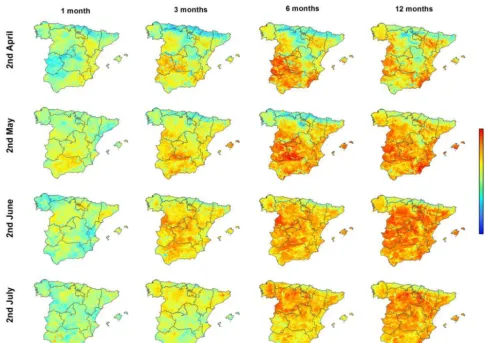
Figure 1 shows an example of the spatial distribution of the Pearson’s r correlation coefficients calculated between the sNDVI and the SPEI at the timescales of 1, 3, 6, and 12 months (2, 6, 12 and 24 semi-monthly periods). Results are shown only for the second semi-monthly period of each month between April and July. The differential response of the NDVI to the different timescales of the SPEI is illus-trated. As depicted, the 6-month timescale was more rel-evant to vegetation activity in large areas of southwestern and southeastern Spain during the second half of April. Con-versely, vegetation activity was more determined by the 12-month SPEI across the Ebro basin in northeastern Spain. This stresses the need to consider different drought timescales to know the climate cumulative period that mostly affects veg-etation activity. The 6-month and 12-month SPEIs produced similar results during the second period of May, while the 12-month timescale is more related to vegetation activity in June and July.
S. M. Vicente-Serrano et al.: A high-resolution spatial assessment of the impacts 1193
Figure 1.Spatial distribution of the Pearson’sr correlation coefficient calculated between the sNDVI and different SPEI timescales for different semi-monthly periods.
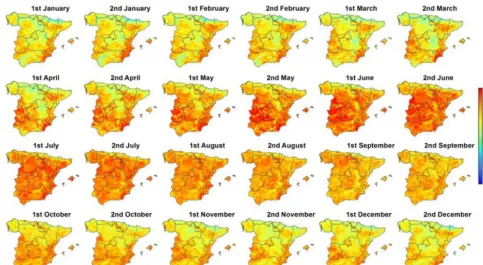
the maximum average correlation is recorded. In contrast, the correlations between the SPEI and sNDVI decrease progres-sively from August to December.
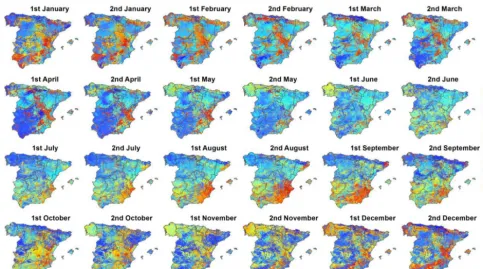
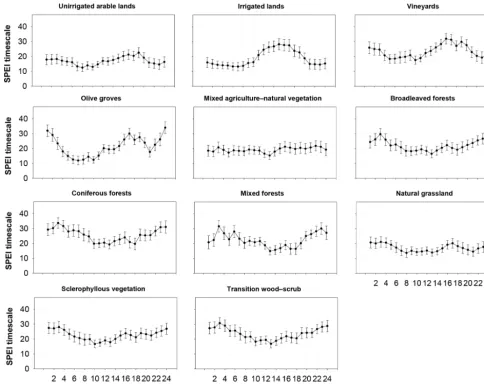
The response of the sNDVI to different timescales of the SPEI and seasons is quite complex. Figure 4 shows the spa-tial distribution of the SPEI timescale at which the maxi-mum correlation was found for each one of the 24 semi-monthly periods of the year. It can be noted that there are considerable seasonal and spatial differences. Nonetheless, these differences are masked with the estimated average val-ues of the SPEI timescale recorded for the semi-monthly pe-riods (Fig. 5), which are less variable (oscillating between 18 and 22 semi-monthly periods – 9–11 months) throughout the year. In general, the areas and periods with higher cor-relations are recorded at 7- and 24-semi-monthly timescales (3–12 months).
3.2 Land cover differences
There are differences in the magnitude and seasonality of the Pearson’srcorrelation coefficients among all land cover types. Figure 6 shows the average and standard error of the
1194 S. M. Vicente-Serrano et al.: A high-resolution spatial assessment of the impacts
Figure 2.Spatial distribution of the maximum correlation between the sNDVI and the SPEI during the different semi-monthly periods.
Figure 3.Spatial average and standard error of the Pearson’sr cor-relation coefficient between the sNDVI and SPEI time series.
the sNDVI and SPEI during the second half of May and in October, suggesting a quasi-bimodal response of the NDVI to drought. This pattern is also revealed in the percentage of the surface area with significant correlations (Table S4). In the same context, the areas of natural vegetation exhibit their maximum correlation between the sNDVI and SPEI during summer months. The highest correlations are found in July and August for the forest types, compared to earlier June for the natural grasslands and the areas of sclerophyllous vegeta-tion. Conversely, the mixed forests tend to show lower corre-lations than broad-leaved and coniferous forests. A quick in-spection of all these types of land cover indicates that the
cor-relations between the sNDVI and SPEI are generally positive and significant during summer months (Tables S5 to S11).
re-S. M. Vicente-Serrano et al.: A high-resolution spatial assessment of the impacts 1195
Figure 4.Spatial distribution of the SPEI timescales at which the maximum correlation between the sNDVI and SPEI is found for each one of the semi-monthly periods.
Figure 5. Average and standard error of the SPEI timescale at which the maximum Pearson’srcorrelation coefficient between the sNDVI and SPEI is found.
sponse to shorter SPEI timescales (i.e. 20 semi-monthly pe-riods in winter and 15 in spring and early summer).
3.3 Influence of average climatic conditions
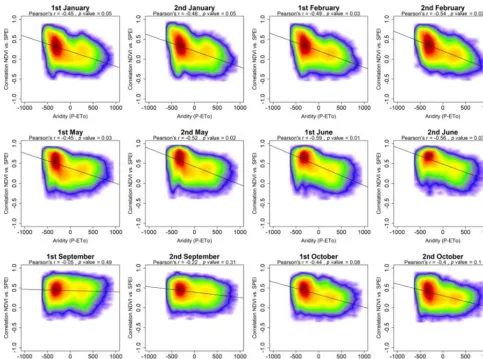
In addition to the impact of the timescale at which drought is quantified, the response of vegetation activity to drought can also be closely related to the prevailing climatic condi-tions. Figure 8 summarizes the spatial correlation between aridity (P-ETo) and the maximum correlation between the sNDVI and SPEI. For most of the semi-monthly periods of
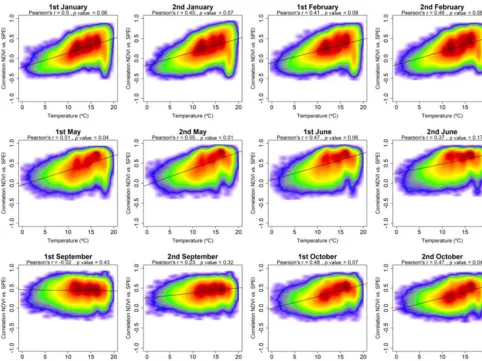
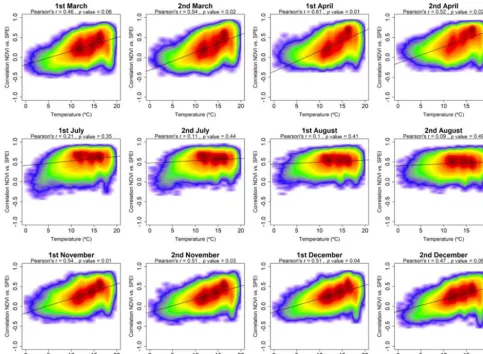
the year aridity is negatively correlated with the maximum correlation between sNDVI and SPEI, indicating that veg-etation activity at arid sites is more responsive to drought variability. This correlation is more pronounced for the pe-riod between December and June. In contrast, this negative association becomes weaker and statistically non-significant during warmer months (July to August). Figure 9 illustrates the spatial correlation between mean air temperature and the maximum correlation between the sNDVI and SPEI. Results demonstrate similar results to those found for aridity, with a general positive and significant correlation from March to June, followed by a non-significant and weak correlation dur-ing summer months.
Nev-1196 S. M. Vicente-Serrano et al.: A high-resolution spatial assessment of the impacts
Figure 6.Average and standard error of the Pearson’sr correlation coefficient between the sNDVI and SPEI for the different land cover types.
ertheless, for the different natural vegetation categories, the correlations are negative and statistically significant during large periods. The mixed agricultural–natural vegetation ar-eas show a significant correlation between October and July, with stronger association at the beginning of the summer sea-son. Broadleaved and coniferous forests, scrub, and pasture-lands also show a negative relationship between the spatial patterns of the sNDVI–SPEI correlations and aridity.
As depicted in Fig. 9, the relationship between the sNDVI– SPEI correlation and air temperature shows that the response of vegetation activity to drought is modulated by air tem-perature during springtime. This implies that warmer areas are those in which the sNDVI is more controlled by drought. A contradictory pattern is found during warmer months, in which the role of air temperature in modulating the impact of drought on vegetation activity is minimized. The relation-ships between air temperature and the NDVI–SPEI
S. M. Vicente-Serrano et al.: A high-resolution spatial assessment of the impacts 1197
Figure 7.Average and standard error of the SPEI timescale at which the maximum Pearson’srcorrelation coefficient was found between the sNDVI and SPEI for the different land cover types.
natural vegetation types such as broad-leaved and coniferous forests, natural grasslands, sclerophyllous vegetation, and mixed wood–scrub.
We also analysed the dependency between climatic con-ditions (i.e. aridity and air temperature) and the SPEI timescale(s) at which the maximum correlation between the sNDVI and SPEI is recorded. Figure 10 shows the values of aridity corresponding to SPEI timescales at which the max-imum correlation between the sNDVI and SPEI is found for each semi-monthly period. The different box plots indi-cate complex patterns, which are quite difficult to interpret. Overall, less arid areas show stronger correlations at longer timescales (25–42 semi-monthly periods) during springtime. In the same context, the regions with maximum correla-tions at short timescales (1–6 months) tend to be located in less arid regions that record their maximum correlations at timescales between 7 and 24 semi-monthly periods. This suggests that the most arid areas mostly respond to the SPEI
timescales between 6 and 12 months, compared to short (1– 3 months) or long (> 12 months) SPEI timescales in more humid regions. In contrast, during the summer season, the in-terannual variability of the sNDVI in the arid areas is mostly determined by the SPEI recorded at timescales higher than 6 months (12 semi-monthly periods), while responding to short SPEI timescales (< 3 months) over the most humid re-gions.
Also, we found links between the spatial distribution of air temperature and the SPEI timescales at which maximum cor-relation between the sNDVI and SPEI is recorded (Fig. 11). In early spring, short SPEI timescales dominate in warmer areas, compared to long SPEI timescales in colder regions. A contradictory pattern is observed from June to September, with a dominance of shorter SPEI timescales in colder areas and longer SPEI timescales in warmer regions.
1198 S. M. Vicente-Serrano et al.: A high-resolution spatial assessment of the impacts
Figure 8.
dominate, is illustrated in Fig. 12. Mixed forests are located in the most humid areas, while vineyards, olive groves, unir-rigated arable lands, and the sclerophyllous natural vegeta-tion are distributed at the most arid sites. Nevertheless, there is a gradient of these land cover types in terms of their re-sponse to drought, as those types located under more arid conditions show a stronger response of vegetation activity to drought than those located in humid environments. For ex-ample, the mixed forests show lower correlations than crop types and other vegetation areas. This pattern is more evident during the different semi-monthly periods, albeit with more differences during spring and autumn. In summer, these dif-ferences are much smaller between land cover categories, ir-respective of aridity conditions.
There are also differences in the average SPEI timescale at which the maximum sNDVI–SPEI correlation is obtained (Fig. 13). However, these differences are complex, with no-ticeable seasonal differences in terms of the relationship be-tween climate aridity and land cover types. In spring and late autumn, land cover types located in more arid conditions tend to respond to shorter SPEI timescales than those located in
more humid areas. This pattern can be seen in late summer and early autumn, in which the most arid land cover types (e.g. vineyards and olive groves) tend to respond at longer SPEI timescales, compared to forest types (mostly the mixed forests), which are usually located under more humid condi-tions.
4 Discussion
This study assesses the response of vegetation activity to drought in Spain using a high-resolution (1.1 km) spatial NDVI dataset that dates back to 1981 (Vicente-Serrano et al., 2018). Based on another high-resolution semi-monthly gridded climatic dataset, drought was quantified using the standardized precipitation evapotranspiration index (SPEI) at different timescales (Vicente-Serrano et al., 2017).
be-S. M. Vicente-Serrano et al.: A high-resolution spatial assessment of the impacts 1199
Figure 8. Scatterplots showing the relationships between the maximum correlation obtained between the sNDVI and the SPEI and the climate aridity (precipitation minus ETo). Given the high number of data, the significance of the correlation was obtained using a bootstrap method. A total of 1000 random samples of 30 data points each were extracted, from which correlations andpvalues were obtained. The final significance was assessed by means of the average of the obtained correlation coefficients andpvalues, which are indicated in the figure.
tween the NDVI and SPEI. A similar response of the NDVI to drought is confirmed in earlier studies in different semi-arid and subhumid regions worldwide, including northeast-ern Brazil (e.g. Barbosa et al., 2006), the Sahel (e.g. Her-rmann et al., 2005), central Asia (e.g. Gessner et al., 2013), Australia (e.g. De Keersmaecker et al., 2017), and California (e.g. Okin et al., 2018). Albeit with this generalized response, our results also show noticeable spatial and seasonal differ-ences in this response. These differdiffer-ences can be linked to the timescale at which the drought is quantified, in addition to the impact of other dominant climatic conditions (e.g. air temperature and aridity).
4.1 The response of vegetation activity to drought variability
This study stresses that the response of vegetation activity to drought is more pronounced during the warm season
1200 S. M. Vicente-Serrano et al.: A high-resolution spatial assessment of the impacts
Figure 9.
more sensitive to drought due to temperature rise. Accord-ingly, the photosynthetic activity, which determines NDVI, is highly controlled by soil water availability (Myneni et al., 1995). In this study, the positive spatial relationship found between air temperature and the sNDVI–SPEI correlation re-inforces this explanation. In spring, we found low correla-tions between the NDVI and SPEI, even in cold areas. In con-trast, summer warm temperatures reinforce vegetation activ-ity, but with some exceptions such as cereal cultivations, dry pastures, and shrubs. This would explain why the response of vegetation activity to the SPEI is stronger during summer in vast areas of Spain.
Also, this study suggests clear seasonal differences in the response of the NDVI to drought, and in the magnitude of the correlation between the NDVI and the SPEI, as a func-tion of the dominant land cover. These differences are con-firmed at different spatial scales, ranging from regional and local (e.g. Ivits et al., 2014; Zhao et al., 2015; Gouveia et al., 2017; Yang et al., 2018) to global (e.g. Vicente-Serrano et al., 2013), Over Spain, the unirrigated arable lands, natu-ral grasslands, and sclerophyllous vegetation show an earlier
S. M. Vicente-Serrano et al.: A high-resolution spatial assessment of the impacts 1201
Figure 9. Scatterplots showing the relationships between the maximum correlation obtained between the sNDVI and the SPEI and the average air temperature. Given the high number of points, the significance of correlation was obtained by means of 1000 random samples of 30 cases from which correlations andpvalues were obtained. The final significance was assessed by means of the average of the obtained pvalues.
to the summer dryness generating the seed bank before the summer (Peco et al., 1998; Russi et al., 1992), the trees and shrubs would base their adaptation on deeper root systems, translating the drought sensitivity to the period of highest wa-ter demand and wawa-ter limitation.
In addition to the seasonal differences among land cover types, we have shown that in Spain herbaceous crops show a higher correlation between the NDVI and the SPEI than most natural vegetation types (with the exception of the scle-rophyllous vegetation). This behaviour could be explained by three different factors: (i) a higher adaptation of natural vegetation to the characteristic climate of the region where drought is a frequent phenomenon (Vicente-Serrano, 2006), (ii) the deeper root systems that allow shrubs and trees to obtain water from the deep soil, and (iii) cultivated lands that tend to be typically located in drier areas than natural vegetation. Different studies showed that the vegetation of dry environments tends to have a more intense response to
drought than subhumid and humid vegetation (Schultz and Halpert, 1995; Abrams et al., 1990; Nicholson et al., 1990; Herrmann et al., 2016). Vicente-Serrano et al. (2013) anal-ysed the sensitivity of the NDVI in the different biomes at a global scale and found a spatial gradient in the sensitivity to drought, which was more important in arid and semi-arid regions.
4.2 Response to the average climatology
1202 S. M. Vicente-Serrano et al.: A high-resolution spatial assessment of the impacts
Figure 10.Box plots showing the climate aridity values, as a function of the SPEI timescales at which the maximum correlation between the sNDVI and SPEI is recorded.
runoff. This characteristic would make the vegetation less sensitive to drought in the cold season. Drought indices are relative metrics in comparison to the long-term climate with the purpose of making drought severity conditions compa-rable between areas of very different climate characteris-tics (Mukherjee et al., 2018). This means that in humid ar-eas the corresponding absolute precipitation can be suffi-cient to cover the vegetation water needs although drought indices provide information on below-average conditions. Conversely, in arid regions a low value of a drought index is always representative of limited water availability, which would explain the closer relationship between the NDVI and the SPEI.
Here we also explored if the general pattern observed in humid and semi-arid regions is also affected by the land cover, and found that the behaviour in the unirrigated arable lands is the main reason for the global pattern. Herbaceous crops show that aridity levels have a clear control of the re-sponse of the NDVI to drought during the period of
vegeta-tion activity. Nevertheless, after the common harvest period (June) this control by aridity mostly disappears. This is also observed in the grasslands and in the sclerophyllous vegeta-tion, and it could be explained by the low vegetation activ-ity of the herbaceous and shrub species during the summer, given the phenological strategies to cope with water stress with the formation of the seeds before the period of dryness (Chaves et al., 2003). The limiting aridity conditions that characterize the regions in which these vegetation types grow would also contribute to explaining this phenomenon. Con-versely, the forests, both broadleaved and coniferous, also show a control by aridity in the relationship between the NDVI and the SPEI during the summer months since these land cover types show the peak of the vegetation activity dur-ing this season.
S. M. Vicente-Serrano et al.: A high-resolution spatial assessment of the impacts 1203
Figure 11.Box plots showing air temperature values, as a function of the SPEI timescales at which the maximum correlation between the sNDVI and SPEI is recorded.
explained by the NDVI saturation under high levels of leaf area index (Carlson and Ripley, 1997) since once the tree tops are completely foliated the electromagnetic signal is not sensitive to additional leaf growth. This could explain the less sensitive response of the forests to drought in compar-ison to land cover types characterized by lower leaf area (e.g. shrubs or grasslands). Nevertheless, we do not think that this phenomenon can totally explain the decreased sen-sitivity to drought with aridity in summer since the dominant coniferous and broadleaved forests in Spain are usually not characterized by a 100 % leaf coverage (Castro-Díez et al., 1997; Molina and del Campo, 2012), so large signal satura-tion problems are not expected. Conversely, the ecophysio-logical strategies of forests to cope with drought may help explain the observed lower relationship between aridity dur-ing the summer months. Experimental studies suggested that the interannual variability of the secondary growth could be more sensitive to drought than the sensitivity observed by the photosynthetic activity and the leaf area (Newberry, 2010).
1204 S. M. Vicente-Serrano et al.: A high-resolution spatial assessment of the impacts
S. M. Vicente-Serrano et al.: A high-resolution spatial assessment of the impacts 1205
1206 S. M. Vicente-Serrano et al.: A high-resolution spatial assessment of the impacts
Table 1.Percentage of the total surface area according to the differ-ent significance categories of Pearson’srcorrelations between the sNDVI and SPEI.
Negative Negative Positive Positive
(p<0.05) (p>0.05) (p>0.05) (p<0.05)
1 Jan 0.3 9.8 41.3 48.6
2 Jan 0.4 8.7 40.2 50.7
1 Feb 0.3 7.5 39.9 52.3
2 Feb 0.1 7.5 39.0 53.4
1 Mar 0.2 8.9 41.6 49.4
2 Mar 0.2 11.3 38.2 50.3
1 Apr 0.0 7.6 34.9 57.5
2 Apr 0.0 3.4 27.0 69.7
1 May 0.0 1.6 19.0 79.4
2 May 0.0 0.9 14.2 84.9
1 Jun 0.0 1.2 10.8 88.0
2 Jun 0.0 0.5 7.4 92.0
1 Jul 0.0 0.3 5.3 94.4
2 Jul 0.0 0.1 4.5 95.4
1 Aug 0.0 0.1 5.9 94.1
2 Aug 0.0 0.2 10.6 89.2
1 Sep 0.0 0.6 14.0 85.4
2 Sep 0.0 0.4 16.9 82.6
1 Oct 0.0 1.5 24.5 74.0
2 Oct 0.0 1.9 31.1 67.0
1 Nov 0.0 4.5 35.6 59.8
2 Nov 0.0 4.8 41.8 53.4
1 Dec 0.0 4.4 38.9 56.7
2 Dec 0.2 5.9 43.1 50.8
response of the NDVI to drought is similar during summer months, even with the different land cover types and envi-ronmental conditions.
4.3 The importance of drought timescales
A relevant finding of this study is that the response of the NDVI is highly dependent on the timescale at which drought is quantified. Numerous studies indicated that the accumu-lation of precipitation deficits during different time peri-ods is essential to determine the influence of drought on the NDVI (e.g. Malo and Nicholson, 1990; Liu and Ko-gan, 1996; Lotsch et al., 2003; Ji and Peters, 2003; Wang et al., 2003). This is simply because soil moisture is im-pacted largely by precipitation and the atmospheric evapo-rative demand over previous cumulative periods (Scaini et al., 2015). Moreover, the different morphological, physio-logical, and phenological strategies would also explain the varying response of vegetation types to different drought timescales. This finding is confirmed in previous works us-ing NDVI and different timescales of a drought index (e.g. Ji and Peters, 2003; Vicente-Serrano, 2007), but also us-ing other variables like tree-rus-ing growth (e.g. Pasho et al., 2011; Arzac et al., 2016; Vicente-Serrano et al., 2014a). This study confirms this finding, given that there is a high
spatial diversity in the SPEI timescale at which vegetation has its maximum correlation with the NDVI. These spatial variations, combined with strong seasonal differences, are mainly controlled by the dominant land cover types and arid-ity conditions. In their global assessment, Vicente-Serrano et al. (2013) found gradients in the response of the world biomes to drought, which are driven mainly by the timescale at which the biome responds to drought in a gradient of aridity. Again, the response to these different timescales im-plies not only different vulnerabilities of vegetation to wa-ter deficits, but also various strategies from plants to cope with drought. In Spain, we showed that the NDVI responds mostly to the SPEI at timescales of around 20 semi-monthly periods (10 months), but with some few seasonal differ-ences (i.e. shorter timescales in spring and early autumn than in late summer and autumn). Herein, it is also noteworthy to indicate that there are differences in this response, as a function of land cover types. Overall, during the periods of highest vegetation activity, the herbaceous land covers (e.g. unirrigated arable lands and grasslands) respond to shorter SPEI timescales than other forest types. This pattern can be seen in the context that herbaceous covers are more depen-dent on the weather conditions recorded during short peri-ods. These vegetation types could not reach deep soil lev-els, which are driven by climatic conditions during longer periods (Changnon and Easterling, 1989; Berg et al., 2017). In contrast, the tree root systems would access these deeper levels, having the capacity to buffer the effect of short-term droughts, albeit with more vulnerability to long droughts that ultimately would affect deep soil moisture levels. This pat-tern has been recently observed in southeaspat-tern Spain when comparing herbaceous crops and vineyards (Contreras and Hunink, 2015). Recently, Okin et al. (2018) linked the dif-ferent responses to drought timescales between scrubs and chaparral herbaceous vegetation in California to soil water depletion at different levels.
S. M. Vicente-Serrano et al.: A high-resolution spatial assessment of the impacts 1207
(Quiroga and Iglesias, 2009). However, these adapted cul-tivations can be sensitive to severe droughts under extreme summer dryness. In comparison to other natural vegetation, mixed forests show a response to shorter SPEI timescales. This could be explained by the low resistance of these forest species to water deficits (e.g. the different fir species located in humid mountain areas; Camarero et al., 2011, 2018).
Here, we also showed that climate aridity can partially explain the response of the NDVI to the different SPEI timescales. In Spain, the range of the mean aridity recorded by the mean land cover types is much lower than that ob-served at the global scale for the world biomes (Vicente-Serrano et al., 2013). This might explain why there are no clear patterns in the response of the land cover types to the aridity gradients and the SPEI timescales at which the maxi-mum correlation between the NDVI and SPEI is found. Nev-ertheless, we found some seasonal differences between the cold and warm seasons. In summer, the NDVI responds to longer SPEI timescales, as opposed to the most humid forests that respond to shorter timescales. This stresses that – in addition to aridity – the degree of vulnerability to different duration water deficits, which are well-quantified using the drought timescales, may contribute to explaining the spatial distribution of the main land cover types across Spain given different biophysical conditions, but also the different strate-gies of vegetation types to cope with water stress (Chaves et al., 2003; McDowell et al., 2008), which are strongly variable in complex Mediterranean ecosystems.
5 Conclusions
The main conclusions of this study are as follows.
– Vegetation activity over large parts of Spain is closely related to the interannual variability of drought. – The response of vegetation activity to drought is more
pronounced during the warm season, which is attributed to the phenology of vegetation under different land cover types.
– There are clear seasonal differences in the response of the NDVI to drought.
– Natural grasslands and sclerophyllous vegetation show an earlier response to drought.
– There is a control in the response of the NDVI to drought severity by the climatic aridity, which is par-tially controlled by the land cover.
– The response of the NDVI is highly dependent on the timescale at which drought is quantified although there are differences in this response, as a function of land cover types.
Data availability. The drought index dataset is available at http:// monitordesequia.csic.es (Begueria et al., 2019). The NDVI data are available upon request.
Supplement. The supplement related to this article is available online at: https://doi.org/10.5194/nhess-19-1189-2019-supplement.
Author contributions. SMVS designed the research; SMVS per-formed research. CAM, MTB, NMH, and MPG worked on data generation. MG, SB, FDC, MPG and IN assisted with data process-ing and figure creation. SMVS and AEK drafted the paper and all the authors contributed to the writing.
Competing interests. The authors declare that they have no conflict of interest.
Special issue statement. This article is part of the special issue “Hydroclimatic extremes and impacts at catchment to regional scales”. It is not associated with a conference.
Financial support. This research has been supported by the Span-ish Commission of Science and Technology and FEDER (grant no. PCIN-2015-220), the Spanish Commission of Science and Tech-nology and FEDER (grant no. CGL2014-52135-C03-01), the Span-ish Commission of Science and Technology and FEDER (grant no. CGL2017-83866-C3-3-R), the Spanish Commission of Science and Technology and FEDER (grant no. CGL2017-82216-R), Water-Works 2014 (grant no. 690462, IMDROFLOOD), the JPI Climate (grant no. 690462, INDECIS), and WaterWorks 2015 (FORWARD grant).
Review statement. This paper was edited by Chris Reason and re-viewed by two anonymous referees.
References
Abrams, M. D., Schultz, J. C., and Kleiner, K. W.: Ecophysiological responses in mesic versus xeric hardwood species to an early-season drought in central Pennsylvania, Forest Sci., 36, 970–981, 1990.
Allen, C. D., Macalady, A. K., Chenchouni, H., Bachelet, D., Mc-Dowell, N., Vennetier, M., Kitzberger, T., Rigling, A., Bres-hears, D. D., Hogg, E. H., T., Gonzalez, P., Fensham, R., Zhang, Z., Castro, J., Demidova, N., Lim, J.-H., Allard, G., Run-ning, S. W., Semerci, A., and Cobb, N.: A global overview of drought and heat-induced tree mortality reveals emerging cli-mate change risks for forests, Forest Ecol. Manag., 259, 660– 684, https://doi.org/10.1016/j.foreco.2009.09.001, 2010. Allen, C. D., Breshears, D. D., and McDowell, N. G.: On
die-1208 S. M. Vicente-Serrano et al.: A high-resolution spatial assessment of the impacts
off from hotter drought in the Anthropocene, Ecosphere, 6, 1–5, https://doi.org/10.1890/ES15-00203.1, 2015.
Allen, R. G., Pereira, L. S., Raes, D., and Smith, M.: Crop Evap-otranspiration Guidel, Comput. Crop Water Requir., Add FAo, Rome, 1998.
Anyamba, A. and Tucker, C. J.: Analysis of Sahelian
vegetation dynamics using NOAA-AVHRR NDVI
data from 1981–2003, J. Arid Environ., 63, 596–614, https://doi.org/10.1016/j.jaridenv.2005.03.007, 2005.
Arzac, A., García-Cervigón, A. I., Vicente-Serrano, S. M., Loidi, J., and Olano, J. M.: Phenological shifts in climatic response of sec-ondary growth allowJuniperus sabinaL. to cope with altitudinal and temporal climate variability, Agr. Forest Meteorol., 217, 35– 45, https://doi.org/10.1016/j.agrformet.2015.11.011, 2016. Asseng, S., Ewert, F., Martre, P., Rötter, R. P., Lobell, D. B.,
Cam-marano, D., Kimball, B. A., Ottman, M. J., Wall, G. W., White, J. W., Reynolds, M. P., Alderman, P. D., Prasad, P. V. V., Aggar-wal, P. K., Anothai, J., Basso, B., Biernath, C., Challinor, A. J., De Sanctis, G., Doltra, J., Fereres, E., Garcia-Vila, M., Gayler, S., Hoogenboom, G., Hunt, L. A., Izaurralde, R. C., Jabloun, M., Jones, C. D., Kersebaum, K. C., Koehler, A.-K., Müller, C., Naresh Kumar, S., Nendel, C., O’leary, G., Olesen, J. E., Palo-suo, T., Priesack, E., Eyshi Rezaei, E., Ruane, A. C., Semenov, M. A., Shcherbak, I., Stöckle, C., Stratonovitch, P., Streck, T., Supit, I., Tao, F., Thorburn, P. J., Waha, K., Wang, E., Wal-lach, D., Wolf, J., Zhao, Z., and Zhu, Y.: Rising temperatures reduce global wheat production, Nat. Clim. Change, 5, 143–147, https://doi.org/10.1038/nclimate2470, 2015.
Austin, R. B., Cantero-Martínez, C., Arrúe, J. L., Playán, E., and Cano-Marcellán, P.: Yield-rainfall relationships in ce-real cropping systems in the Ebro river valley of Spain, Eur. J. Agron., 8, 239–248, https://doi.org/10.1016/S1161-0301(97)00063-4, 1998.
Bachmair, S., Kohn, I., and Stahl, K.: Exploring the link between drought indicators and impacts, Nat. Hazards Earth Syst. Sci., 15, 1381–1397, https://doi.org/10.5194/nhess-15-1381-2015, 2015. Bachmair, S., Tanguy, M., Hannaford, J., and Stahl, K.: How
well do meteorological indicators represent agricultural and for-est drought across Europe?, Environ. Res. Lett., 13, 034042, https://doi.org/10.1088/1748-9326/aaafda, 2018.
Bailing, M., Zhiyong, L., Cunzhu, L., Lixin, W., Chengzhen, J., Fuxiang, B., and Chao, J.: Temporal and spatial het-erogeneity of drought impact on vegetation growth on the Inner Mongolian Plateau, Rangel. J., 40, 113–128, https://doi.org/10.1071/RJ16097, 2018.
Baldocchi, D. D., Xu, L., and Kiang, N.: How plant functional-type, weather, seasonal drought, and soil physical proper-ties alter water and energy fluxes of an oak-grass savanna and an annual grassland, Agr. Forest Meteorol., 123, 13–39, https://doi.org/10.1016/j.agrformet.2003.11.006, 2004.
Barbosa, H. A., Huete, A. R., and Baethgen, W. E.: A 20-year study of NDVI variability over the North-east Region of Brazil, J. Arid Environ., 67, 288–307, https://doi.org/10.1016/j.jaridenv.2006.02.022, 2006.
Barker, L. J., Hannaford, J., Chiverton, A., and Svensson, C.: From meteorological to hydrological drought using standard-ised indicators, Hydrol. Earth Syst. Sci., 20, 2483–2505, https://doi.org/10.5194/hess-20-2483-2016, 2016.
Begueria, S., Latorre, B., Reig, F., and Vicente-Serrano, S. M.: Drought Indices dataset for Spain, available at: http:// monitordesequia.csic.es, last access: 29 May 2019.
Berg, A., Sheffield, J., and Milly, P. C. D.: Divergent surface and total soil moisture projections under global warming, Geophys. Res. Lett., 44, 236–244, https://doi.org/10.1002/2016GL071921, 2017.
Bhuiyan, C., Singh, R. P., and Kogan, F. N.: Monitoring drought dynamics in the Aravalli region (India) using different indices based on ground and remote sensing data, Int. J. Appl. Earth Obs. Geoinf., 8, 289–302, https://doi.org/10.1016/j.jag.2006.03.002, 2006.
Breshears, D. D., Cobb, N. S., Rich, P. M., Price, K. P., Allen, C. D., Balice, R. G., Romme, W. H., Kastens, J. H., Floyd, M. L., Belnap, J., Anderson, J. J., Myers, O. B., and Meyer, C. W.: Regional vegetation die-off in response to global-change-type drought, P. Natl. Acad. Sci. USA, 102, 15144–15148, https://doi.org/10.1073/pnas.0505734102, 2005.
Camarero, J. J., Bigler, C., Linares, J. C., and Gil-Pelegrín, E.: Syn-ergistic effects of past historical logging and drought on the de-cline of Pyrenean silver fir forests, Forest Ecol. Manag., 262, 759–769, https://doi.org/10.1016/j.foreco.2011.05.009, 2011. Camarero, J. J., Gazol, A., Sangüesa-Barreda, G., Oliva, J., and
Vicente-Serrano, S. M.: To die or not to die: Early warnings of tree dieback in response to a severe drought, J. Ecol., 103, 44–57, https://doi.org/10.1111/1365-2745.12295, 2015.
Camarero, J. J., Gazol, A., Sangüesa-Barreda, G., Cantero, A., Sánchez-Salguero, R., Sánchez-Miranda, A., Granda, E., Serra-Maluquer, X., and Ibáñez, R.: Forest growth responses to drought at short- and long-term scales in Spain: Squeezing the stress memory from tree rings, Front. Ecol. Evol., 6, https://doi.org/10.3389/fevo.2018.00009, 2018.
Carlson, T. N. and Ripley, D. A.: On the relation between NDVI, fractional vegetation cover, and leaf area index, Remote Sens. Environ., 62, 241–252, https://doi.org/10.1016/S0034-4257(97)00104-1, 1997.
Carnicer, J., Coll, M., Ninyerola, M., Pons, X., Sánchez, G., and Peñuelas, J.: Widespread crown condition decline, food web disruption, and amplified tree mortality with increased climate change-type drought, P. Natl. Acad. Sci. USA, 108, 1474–1478, https://doi.org/10.1073/pnas.1010070108, 2011.
Castro-Díez, P., Villar-Salvador, P., Pérez-Rontomé, C., Maestro-Martínez, M., and Montserrat-Martí, G.: Leaf morphology and leaf chemical composition in three Quercus (Fagaceae) species along a rainfall gradient in NE Spain, Trees-Struct. Funct., 11, 127–134, https://doi.org/10.1007/s004680050068, 1997. Changnon, S. A. and Easterling, W. E.: Measuring Drought
Im-pacts: The Illinois Case, J. Am. Water Resour. Assoc., 25, 27–42, https://doi.org/10.1111/j.1752-1688.1989.tb05663.x, 1989. Chaves, M. M., Maroco, J. P., and Pereira, J. S.: Understanding plant
responses to drought – From genes to the whole plant, Funct. Plant Biol., 30, 239–264, https://doi.org/10.1071/FP02076, 2003.
S. M. Vicente-Serrano et al.: A high-resolution spatial assessment of the impacts 1209
G., Soussana, J. F., Sanz, M. J., Schulze, E. D., Vesala, T., and Valentini, R.: Europe-wide reduction in primary productivity caused by the heat and drought in 2003, Nature, 437, 529–533, https://doi.org/10.1038/nature03972, 2005.
Contreras, S. and Hunink, J. E.: Drought effects on rainfed agri-culture using standardized indices: A case study in SE Spain, in Drought: Research and Science-Policy Interfacing – Proceed-ings of the International Conference on Drought: Research and Science-Policy Interfacing, 65–70, 2015.
Dardel, C., Kergoat, L., Hiernaux, P., Mougin, E., Grippa, M., and Tucker, C. J.: Re-greening Sahel: 30 years of remote sensing data and field observations (Mali, Niger), Remote Sens. Environ., 140, 350–364, https://doi.org/10.1016/j.rse.2013.09.011, 2014. De Keersmaecker, W., Lhermitte, S., Hill, M. J., Tits, L., Coppin,
P., and Somers, B.: Assessment of regional vegetation response to climate anomalies: A case study for australia using GIMMS NDVI time series between 1982 and 2006, Remote Sens., 9, https://doi.org/10.3390/rs9010034, 2017.
del Barrio, G., Puigdefabregas, J., Sanjuan, M. E., Stellmes, M., and Ruiz, A.: Assessment and monitoring of land condition in the Iberian Peninsula, 1989–2000, Remote Sens. Environ., 114, 1817–1832, https://doi.org/10.1016/j.rse.2010.03.009, 2010. FAO: Food and Agricultural Organization, Food and Agriculture
data, available from: http://www.fao.org, last access: 1 October 2018.
Fischer, E. M., Seneviratne, S. I., Vidale, P. L., Lüthi, D., and Schär, C.: Soil moisture-atmosphere interactions during the 2003 European summer heat wave, J. Clim., 20, 5081–5099, https://doi.org/10.1175/JCLI4288.1, 2007.
Gallardo, M. and Martínez-Vega, J.: Three decades of land-use changes in the region of Madrid and how they re-late to territorial planning, Eur. Plan. Stud., 24, 1016–1033, https://doi.org/10.1080/09654313.2016.1139059, 2016. García, M., Litago, J., Palacios-Orueta, A., Pinzón, J. E., and
Ustin Susan, L.: Short-term propagation of rainfall per-turbations on terrestrial ecosystems in central California, Appl. Veg. Sci., 13, 146–162, https://doi.org/10.1111/j.1654-109X.2009.01057.x, 2010.
García-Haro, F. J., Campos-Taberner, M., Sabater, N., Belda, F., Moreno, A., Gilabert, M. A., Martínez, B., Pérez-Hoyos, A., and Meliá, J.: Vegetation vulnerability to drought in Spain, Vulnera-bilidad de la vegetación a la sequía en España, Rev. Teledetec., 42, 29–37, https://doi.org/10.4995/raet.2014.2283, 2014. Gazol, A., Camarero, J. J., Anderegg, W. R. L., and
Vicente-Serrano, S. M.: Impacts of droughts on the growth resilience of Northern Hemisphere forests, Glob. Ecol. Biogeogr., 26, 166– 176, https://doi.org/10.1111/geb.12526, 2017.
Gazol, A., Camarero, J. J., Vicente-Serrano, S. M., Sánchez-Salguero, R., Gutiérrez, E., de Luis, M., Sangüesa-Barreda, G., Novak, K., Rozas, V., Tíscar, P. A., Linares, J. C., Martín-Hernández, N., Martínez del Castillo, E., Ribas, M., García-González, I., Silla, F., Camisón, A., Génova, M., Olano, J. M., Longares, L. A., Hevia, A., Tomás-Burguera, M., and Galván, J. D.: Forest resilience to drought varies across biomes, Glob. Change Biol., 24, 2143–2158, https://doi.org/10.1111/gcb.14082, 2018.
Gessner, U., Naeimi, V., Klein, I., Kuenzer, C., Klein, D., and Dech, S.: The relationship between precipita-tion anomalies and satellite-derived vegetation
activ-ity in Central Asia, Glob. Planet. Change, 110, 74–87, https://doi.org/10.1016/j.gloplacha.2012.09.007, 2013.
González-Alonso, F. and Casanova, J. L.: Application of NOAA-AVHRR images for the validation and risk assessment of natural disasters in Spain, in Remote Sensing ’96, Balkema, Rotterdam, 227–233, 1997.
González-Hidalgo, J. C., Vicente-Serrano, S. M., Peña-Angulo, D., Salinas, C., Tomas-Burguera, M., and Beguería, S.: High-resolution spatio-temporal analyses of drought episodes in the western Mediterranean basin (Spanish mainland, Iberian Peninsula), Acta Geophys., 66, 381–392, https://doi.org/10.1007/s11600-018-0138-x, 2018.
Gouveia, C. M., Bastos, A., Trigo, R. M., and Dacamara, C. C.: Drought impacts on vegetation in the pre- and post-fire events over Iberian Peninsula, Nat. Hazards Earth Syst. Sci., 12, 3123– 3137, https://doi.org/10.5194/nhess-12-3123-2012, 2012. Gouveia, C. M., Páscoa, P., Russo, A., and Trigo, R. M.: Land
degradation trend assessment over iberia during 1982–2012, Evaluación de la tendencia a la degradación del suelo en Iberia durante 1982–2012, Cuad. Investig. Geogr., 42, 89–112, https://doi.org/10.18172/cig.2808, 2016.
Gouveia, C. M., Trigo, R. M., Beguería, S., and Vicente-Serrano, S. M.: Drought impacts on vegetation activity in the Mediter-ranean region: An assessment using remote sensing data and multi-scale drought indicators, Glob. Planet. Change, 151, 15– 27, https://doi.org/10.1016/j.gloplacha.2016.06.011, 2017. Grissino-Mayer, H. D. and Fritts, H. C.: The International
Tree-Ring Data Bank: An enhanced global database serv-ing the global scientific community, Holocene, 7, 235–238, https://doi.org/10.1177/095968369700700212, 1997.
Gu, Y., Brown, J. F., Verdin, J. P., and Wardlow, B.: A five-year anal-ysis of MODIS NDVI and NDWI for grassland drought assess-ment over the central Great Plains of the United States, Geophys. Res. Lett., 34, L06407, https://doi.org/10.1029/2006GL029127, 2007.
Herrmann, S. M., Anyamba, A., and Tucker, C. J.: Recent trends in vegetation dynamics in the African Sahel and their re-lationship to climate, Glob. Environ. Change, 15, 394–404, https://doi.org/10.1016/j.gloenvcha.2005.08.004, 2005. Herrmann, S. M., Didan, K., Barreto-Munoz, A., and Crimmins, M.
A.: Divergent responses of vegetation cover in Southwestern US ecosystems to dry and wet years at different elevations, Environ. Res. Lett., 11, https://doi.org/10.1088/1748-9326/11/12/124005, 2016.
Hill, J., Stellmes, M., Udelhoven, T., Röder, A., and Som-mer, S.: Mediterranean desertification and land degrada-tion, Mapping related land use change syndromes based on satellite observations, Glob. Planet. Change, 64, 146–157, https://doi.org/10.1016/j.gloplacha.2008.10.005, 2008.
Hirschi, M., Seneviratne, S. I., Alexandrov, V., Boberg, F., Boroneant, C., Christensen, O. B., Formayer, H., Orlowsky, B., and Stepanek, P.: Observational evidence for soil-moisture im-pact on hot extremes in southeastern Europe, Nat. Geosci., 4, 17–21, https://doi.org/10.1038/ngeo1032, 2011.
1210 S. M. Vicente-Serrano et al.: A high-resolution spatial assessment of the impacts
Huxman, T. E., Smith, M. D., Fay, P. A., Knapp, A. K., Shaw, M. R., Lolk, M. E., Smith, S. D., Tissue, D. T., Zak, J. C., Weltzin, J. F., Pockman, W. T., Sala, O. E., Haddad, B. M., Harte, J., Koch, G. W., Schwinning, S., Small, E. E., and Williams, D. G.: Con-vergence across biomes to a common rain-use efficiency, Nature, 429, 651–654, https://doi.org/10.1038/nature02561, 2004. Iglesias, E., Garrido, A., and Gómez-Ramos, A.: Evaluation of
drought management in irrigated areas, Agr. Econ., 29, 211–229, https://doi.org/10.1016/S0169-5150(03)00084-7, 2003. Ivits, E., Horion, S., Fensholt, R., and Cherlet, M.: Drought
foot-print on European ecosystems between 1999 and 2010 assessed by remotely sensed vegetation phenology and productivity, Glob. Change Biol., 20, 581–593, https://doi.org/10.1111/gcb.12393, 2014.
Jenkins, J. C., Chojnacky, D. C., Heath, L. S., and Birdsey, R. A.: National-scale biomass estimators for United States tree species, Forest Sci., 49, 12–35, 2003.
Ji, L. and Peters, A. J.: Assessing vegetation response to drought in the northern Great Plains using vegetation and drought indices, Remote Sens. Environ., 87, 85–98, https://doi.org/10.1016/S0034-4257(03)00174-3, 2003. Julien, Y., Sobrino, J. A., Mattar, C., Ruescas, A. B.,
Jiménez-Muñoz, J. C., Sòria, G., Hidalgo, V., Atitar, M., Franch, B., and Cuenca, J.: Temporal analysis of normalized difference vegetation index (NDVI) and land surface temperature (LST) parameters to detect changes in the Iberian land cover be-tween 1981 and 2001, Int. J. Remote Sens., 32, 2057–2068, https://doi.org/10.1080/01431161003762363, 2011.
Knipling, E. B.: Physical and physiological basis for the reflectance of visible and near-infrared radiation from vegetation, Re-mote Sens. Environ., 1, 155–159, https://doi.org/10.1016/S0034-4257(70)80021-9, 1970.
Kogan, F. N.: Global Drought Watch from Space, B. Am. Meteorol. Soc., 78, 621–636, 1997.
Lasanta, T. and Vicente-Serrano, S. M.: Complex land cover change processes in semiarid Mediterranean regions: An approach using Landsat images in northeast Spain, Remote Sens. Environ., 124, 1–14, https://doi.org/10.1016/j.rse.2012.04.023, 2012.
Lasanta, T., Arnáez, J., Pascual, N., Ruiz-Flaño, P., Errea, M. P., and Lana-Renault, N.: Space–time process and drivers of land abandonment in Europe, Catena, 149, 810–823, https://doi.org/10.1016/j.catena.2016.02.024, 2017.
Lecina, S., Isidoro, D., Playán, E., and Aragüés, R.: Irrigation modernization and water conservation in Spain: The case of Riegos del Alto Aragón, Agr. Water Manage., 97, 1663–1675, https://doi.org/10.1016/j.agwat.2010.05.023, 2010.
Liu, N., Harper, R. J., Dell, B., Liu, S., and Yu, Z.: Vegetation dy-namics and rainfall sensitivity for different vegetation types of the Australian continent in the dry period 2002–2010, Ecohy-drology, 10, e1811, https://doi.org/10.1002/eco.1811, 2017. Liu, W. T. and Kogan, F. N.: Monitoring regional drought using the
vegetation condition index, Int. J. Remote Sens., 17, 2761–2782, https://doi.org/10.1080/01431169608949106, 1996.
Lloret, F., Lobo, A., Estevan, H., Maisongrande, P., Vayreda, J., and Terradas, J.: Woody plant richness and NDVI response to drought events in Catalonian (northeastern Spain) forests, Ecology, 88, 2270–2279, https://doi.org/10.1890/06-1195.1, 2007.
Lobell, D. B., Hammer, G. L., Chenu, K., Zheng, B., Mclean, G., and Chapman, S. C.: The shifting influence of drought and heat
stress for crops in northeast Australia, Glob. Change Biol., 21, 4115–4127, https://doi.org/10.1111/gcb.13022, 2015.
López-Moreno, J. I., Beguería, S., and García-Ruiz, J. M.: The management of a large Mediterranean reservoir: Storage reg-imens of the Yesa Reservoir, Upper Aragon River basin, Central Spanish Pyrenees, Environ. Manag., 34, 508–515, https://doi.org/10.1007/s00267-003-0249-1, 2004.
López-Moreno, J. I., Vicente-Serrano, S. M., Zabalza, J., Beguería, S., Lorenzo-Lacruz, J., Azorin-Molina, C., and Morán-Tejeda, E.: Hydrological response to climate variability at different time scales: A study in the Ebro basin, J. Hydrol., 477, 175–188, https://doi.org/10.1016/j.jhydrol.2012.11.028, 2013.
Lorenzo-Lacruz, J., Vicente-Serrano, S. M., López-Moreno, J. I., Beguería, S., García-Ruiz, J. M., and Cuadrat, J. M.: The impact of droughts and water management on various hydrological sys-tems in the headwaters of the Tagus River (central Spain), J. Hy-drol., 386, https://doi.org/10.1016/j.jhydrol.2010.01.001, 2010. Lorenzo-Lacruz, J., Morán-Tejeda, E., Vicente-Serrano, S. M., and
López-Moreno, J. I.: Streamflow droughts in the Iberian Penin-sula between 1945 and 2005: spatial and temporal patterns, Hy-drol. Earth Syst. Sci., 17, 119–134, https://doi.org/10.5194/hess-17-119-2013, 2013.
Lotsch, A., Friedl, M. A., Anderson, B. T., and Tucker, C. J.: Coupled vegetation-precipitation variability observed from satellite and climate records, Geophys. Res. Lett., 30, 1774, https://doi.org/10.1029/2003GL017506, 2003.
Ma, X., Huete, A., Moran, S., Ponce-Campos, G., and Eamus, D.: Abrupt shifts in phenology and vegetation productivity under climate extremes, J. Geophys. Res.-Biogeo., 120, 2036–2052, https://doi.org/10.1002/2015JG003144, 2015.
Malo, A. R. and Nicholson, S. E.: A study of rainfall and vegeta-tion dynamics in the African Sahel using normalized difference vegetation index, J. Arid Environ., 19, 1–24, 1990.
Martínez-Fernández, J. and Ceballos, A.: Temporal Stability of Soil Moisture in a Large-Field Experiment in Spain, Soil Sci. Soc. Am. J., 67, 1647–1656, 2003.
McDowell, N., Pockman, W. T., Allen, C. D., Breshears, D. D., Cobb, N., Kolb, T., Plaut, J., Sperry, J., West, A., Williams, D. G., and Yepez, E. A.: Mechanisms of plant survival and mortality during drought: Why do some plants survive while others succumb to drought?, New Phytol., 178, 719–739, https://doi.org/10.1111/j.1469-8137.2008.02436.x, 2008. McKee, T. B., Doesken, N. J., and Kleist, J.: The relationship of
drought frequency and duration to time scales, Eighth Conf. Appl. Climatol., Am. Meteorol. Soc., 179–184, 1993.
Milich, L. and Weiss, E.: Characterization of the sahel: Implica-tions of correctly calculating interannual coefficients of variation (CoVs) from GAC NDVI values, Int. J. Remote Sens., 18, 3749– 3759, https://doi.org/10.1080/014311697216603, 1997. Molina, A. J. and del Campo, A. D.: The effects of
exper-imental thinning on throughfall and stemflow: A contri-bution towards hydrology-oriented silviculture in Aleppo pine plantations, Forest Ecol. Manag., 269, 206–213, https://doi.org/10.1016/j.foreco.2011.12.037, 2012.
S. M. Vicente-Serrano et al.: A high-resolution spatial assessment of the impacts 1211
Mühlbauer, S., Costa, A. C., and Caetano, M.: A spatiotemporal analysis of droughts and the influence of North Atlantic Oscilla-tion in the Iberian Peninsula based on MODIS imagery, Theor. Appl. Climatol., 124, 703–721, https://doi.org/10.1007/s00704-015-1451-9, 2016.
Mukherjee, S., Mishra, A., and Trenberth, K. E.: Climate Change and Drought: a Perspective on Drought Indices, Curr. Clim. Change Reports, 4, 145–163, https://doi.org/10.1007/s40641-018-0098-x, 2018.
Myneni, R. B., Hall, F. G., Sellers, P. J., and Marshak, A. L.: In-terpretation of spectral vegetation indexes, IEEE T. Geosci. Re-mote, 33, 481–486, https://doi.org/10.1109/36.377948, 1995. Newberry, T. L.: Effect of climatic variability on δ13C and
tree-ring growth in piñon pine (Pinus edulis), Trees-Struct. Funct., 24, 551–559, https://doi.org/10.1007/s00468-010-0426-9, 2010. Nicholson, S. E., Davenport, M. L., and Malo, A. R.: A com-parison of the vegetation response to rainfall in the Sahel and East Africa, using normalized difference vegetation in-dex from NOAA AVHRR, Climate Change, 17, 209–241, https://doi.org/10.1007/BF00138369, 1990.
Okin, G. S., Dong, C., Willis, K. S., Gillespie, T. W., and Mac-Donald, G. M.: The Impact of Drought on Native Southern Cal-ifornia Vegetation: Remote Sensing Analysis Using MODIS-Derived Time Series, J. Geophys. Res.-Biogeo., 123, 1927–1939, https://doi.org/10.1029/2018JG004485, 2018.
Olsen, J. L., Ceccato, P., Proud, S. R., Fensholt, R., Grippa, M., Mougin, B., Ardö, J., and Sandholt, I.: Relation between season-ally detrended shortwave infrared reflectance data and land sur-face moisture in semi-arid Sahel, Remote Sens., 5, 2898–2927, https://doi.org/10.3390/rs5062898, 2013.
Ortigosa, L. M., Garcia-Ruiz, J. M., and Gil-Pelegrin, E.: Land reclamation by reforestation in the Central Pyrenees, Mt. Res.-Dev., 10, 281–288, https://doi.org/10.2307/3673607, 1990. Palazón, A., Aragonés, L., and López, I.: Evaluation of
coastal management: Study case in the province of Al-icante, Spain, Sci. Total Environ., 572, 1184–1194, https://doi.org/10.1016/j.scitotenv.2016.08.032, 2016.
Páscoa, P., Gouveia, C. M., Russo, A., and Trigo, R. M.: The role of drought on wheat yield interannual variability in the Iberian Peninsula from 1929 to 2012, Int. J. Biometeorol., 61, 439–451, https://doi.org/10.1007/s00484-016-1224-x, 2017.
Pasho, E., Camarero, J. J., de Luis, M., and Vicente-Serrano, S. M.: Impacts of drought at different time scales on forest growth across a wide climatic gradient in north-eastern Spain, Agr. Forest Meteorol., 151, 1800–1811, https://doi.org/10.1016/j.agrformet.2011.07.018, 2011.
Pausas, J. G.: Changes in fire and climate in the eastern Iberian Peninsula (Mediterranean Basin), Climate Change, 63, 337–350, https://doi.org/10.1023/B:CLIM.0000018508.94901.9c, 2004. Pausas, J. G. and Fernández-Muñoz, S.: Fire regime changes
in the Western Mediterranean Basin: From fuel-limited to drought-driven fire regime, Climate Change, 110, 215–226, https://doi.org/10.1007/s10584-011-0060-6, 2012.
Peco, B., Ortega, M., and Levassor, C.: Similarity be-tween seed bank and vegetation in Mediterranean grass-land: A predictive model, J. Veg. Sci., 9, 815–828, https://doi.org/10.2307/3237047, 1998.
Peña-Gallardo, M., Vicente-Serrano, S. M., Camarero, J. J., Gazol, A., Sánchez-Salguero, R., Domínguez-Castro, F., El Kenawy,
A., Beguería-Portugés, S., Gutiérrez, E., de Luis, M., Sangüesa-Barreda, G., Novak, K., Rozas, V., Tíscar, P. A., Linares, J. C., del Castillo, E., Ribas Matamoros, M., García-González, I., Silla, F., Camisón, Á., Génova, M., Olano, J. M., Longares, L. A., Hevia, A., and Galván, J. D.: Drought Sensitiveness on Forest Growth in Peninsular Spain and the Balearic Islands, Forests, 9, 2018a. Peña-Gallardo, M., SM, V.-S., Domínguez-Castro, F., Quiring, S.,
Svoboda, M., Beguería, S., and Hannaford, J.: Effectiveness of drought indices in identifying impacts on major crops across the USA , Clim. Res., 75, 221–240, 2018b.
Pinzon, J. E. and Tucker, C. J.: A non-stationary 1981–2012 AVHRR NDVI < inf > 3g < /inf > time series, Remote Sens., 6, 6929–6960, https://doi.org/10.3390/rs6086929, 2014.
Quiring, S. M. and Ganesh, S.: Evaluating the utility of the Vegetation Condition Index (VCI) for monitoring meteorolog-ical drought in Texas, Agr. Forest Meteorol., 150, 330–339, https://doi.org/10.1016/j.agrformet.2009.11.015, 2010.
Quiroga, S. and Iglesias, A.: A comparison of the climate risks of cereal, citrus, grapevine and olive production in Spain, Agr. Syst., 101, 91–100, https://doi.org/10.1016/j.agsy.2009.03.006, 2009. Reichstein, M., Ciais, P., Papale, D., Valentini, R., Running, S.,
Viovy, N., Cramer, W., Granier, A., Ogée, J., Allard, V., Aubi-net, M., Bernhofer, C., Buchmann, N., Carrara, A., Grünwald, T., Heimann, M., Heinesch, B., Knohl, A., Kutsch, W., Loustau, D., Manca, G., Matteucci, G., Miglietta, F., Ourcival, J. M., Pile-gaard, K., Pumpanen, J., Rambal, S., Schaphoff, S., Seufert, G., Soussana, J.-F., Sanz, M.-J., Vesala, T., and Zhao, M.: Reduction of ecosystem productivity and respiration during the European summer 2003 climate anomaly: A joint flux tower, remote sens-ing and modellsens-ing analysis, Glob. Change Biol., 13, 634–651, https://doi.org/10.1111/j.1365-2486.2006.01224.x, 2007. Restaino, C. M., Peterson, D. L., and Littell, J.: Increased
wa-ter deficit decreases Douglas fir growth throughout west-ern US forests, P. Natl. Acad. Sci. USA, 113, 9557–9562, https://doi.org/10.1073/pnas.1602384113, 2016.
Rhee, J., Im, J., and Carbone, G. J.: Monitoring agricultural drought for arid and humid regions using multi-sensor re-mote sensing data, Rere-mote Sens. Environ., 114, 2875–2887, https://doi.org/10.1016/j.rse.2010.07.005, 2010.
Russi, L., Cocks, P. S., and Roberts, E. H.: Seed bank dynam-ics in a Mediterranean grassland, J. Appl. Ecol., 29, 763–771, https://doi.org/10.2307/2404486, 1992.
Scaini, A., Sánchez, N., Vicente-Serrano, S. M., and
Martínez-Fernández, J.: SMOS-derived soil moisture
anoma-lies and drought indices: A comparative analysis using in situ measurements, Hydrol. Process., 29, 373–383, https://doi.org/10.1002/hyp.10150, 2015.
Schultz, P. A. and Halpert, M. S.: Global analysis of the re-lationships among a vegetation index, precipitation and land surface temperature, Int. J. Remote Sens., 16, 2755–2777, https://doi.org/10.1080/01431169508954590, 1995.
Serra, P., Pons, X., and Saurí, D.: Land-cover and land-use change in a Mediterranean landscape: A spatial analysis of driving forces integrating biophysical and human factors, Appl. Geogr., 28, 189–209, https://doi.org/10.1016/j.apgeog.2008.02.001, 2008. Slayback, D. A., Pinzon, J. E., Los, S. O., and Tucker,