O R I G I N A L R E S E A R C H
Long noncoding RNA HCP5 suppresses skin
cutaneous melanoma development by regulating
RARRES3
gene expression via sponging miR-12
This article was published in the following Dove Press journal: OncoTargets and Therapy
Xihua Wei1
Xuelian Gu1
Min Ma2
Chunxiang Lou3
1Department of Dermatology,
2Department of Oncology,3Department
of Gynecology and Obstetrics, the Third
Hospital of Ji’nan, Jinan, Shandong
250132, People’s Republic of China
Objective:This research aimed to investigate the role and mechanism of long noncoding RNA (lncRNA) HCP5 in skin cutaneous melanoma (SKCM).
Materials and methods: Survival analysis was performed using The Cancer Genome
Atlas (TCGA)-SKCM data and SKCM patients’ clinical data. Primary SKCM cells were
derived from patients’pathologic tissue specimens. HCP5 overexpression was achieved by
lentiviral transduction. Malignancy of SKCM cells was evaluated in vitro by cell
prolifera-tion, colony formaprolifera-tion, apoptosis and transwell invasion assays.RARRES3knockdown was
achieved by siRNA transfection. DIANA microT-CDS algorithm was used to predict
miRNAs that might interact with HCP5 and 3ʹ untranslated region of RARRES3 mRNA.
microRNA target luciferase reporter assay and AGO2-RNA immunoprecipitation were used
to verify the interaction between HCP5, 3ʹUTR ofRARRES3mRNA and miR-1286.
Results:HCP5 level was decreased in SKCM tissue specimens compared to noncancerous
counterparts. Low expression of HCP5 was associated with SKCM patients’ poor overall
survival and disease progression. HCP5 overexpression significantly reduced the malignancy
of primary SKCM cells in vitro. RARRES3 was found as a HCP5-co-expressing gene in
SKCM cells. HCP5 overexpression significantly increasedRARRES3expression in SKCM
cells.RARRES3knockdown partially abolished the anti-SKCM effect of HCP5
overexpres-sion. MiR-1286 was found interacting with both HCP5 and 3ʹUTR ofRARRES3mRNA.
Conclusion:HCP5 is a cancer-suppressive lncRNA in SKCM. HCP5 overexpression decreased
SKCM cell malignancy in vitro by upregulatingRARRES3, possibly via sponging miR-1286.
Keywords:skin cutaneous melanoma, long noncoding RNA, HCP5,RARRES3, miR-1286
Introduction
Cutaneous melanoma (or skin cutaneous melanoma, SKCM) is the least common
but most aggressive skin cancer.1,2 Hyperactivation of PI3K-Akt and MEK-ERK
signaling pathways are fundamental to the malignant transformation and
progres-sion of SKCM.3,4Target therapies aiming to dampen these two signaling pathways
have achieved significant progress, but the resistance of SKCM to these therapies
has been increasingly reported.5,6A more in-depth understanding of the
pathologi-cal mechanism of SKCM might help overcoming this obstacle in SKCM
manage-ment and improving patients’welfare.
Long noncoding RNAs (lncRNAs) are single-stranded RNA over 200 nt in
length without protein-coding potential.7 One of the major functions of lncRNAs
is to regulate gene expression by interacting with microRNAs, thus preventing the
Correspondence: Xihua Wei
Department of Dermatology, the Third
Hospital of Ji’nan, No.1, North
Wangsheren Street, North Gongye Rd,
Licheng, Jinan, Shandong 250132, People’s
Republic of China Tel +86 531 8585 3902 Email [email protected]
OncoTargets and Therapy
Dove
press
open access to scientific and medical research
Open Access Full Text Article
OncoTargets and Therapy downloaded from https://www.dovepress.com/ by 118.70.13.36 on 25-Aug-2020
latter from inducing translational repression and mRNA degradation mediated by the RNA-induced silencing
complex (RISC) via interacting with mRNA 5ʹ or 3ʹ
UTRs.8 By regulating the expression of oncogenes or
cancer suppressive genes, lncRNA also participates in
oncogenesis and cancer progression,9,10 making them
not only as potential biomarkers for diagnosis or
prog-nosis but also as possible therapeutic targets for
treatment.10,11 Although several cancerpromotive or
-suppressive lncRNAs have been reported in SKCM, research on the lncRNAs in SKCM is still at its
dawn.12,13
The initial aim of this research was tofind lncRNA(s)
with prognostic value in SKCM. After querying some transcriptomic studies, we found that high expression of lncRNA HCP5 been proposed as a risk factor of SKCM
progression.14,15 Research on the role and mechanism of
this lncRNA in cancer development is lacking, and pre-vious publications have described this lncRNA as either cancer promotive or suppressive in different cancer
types.16–22 In this study, we investigated the clinical
rele-vance of HCP5 expression level to SKCM progression and
patients’survival. Using patient-derived SKCM cells, we
preliminarily investigated the role of HCP5 in SKCM cells. To our surprise, we found that low expression of HCP5 was associated with SKCM stage progression, lymph node metastasis, distal metastasis and SKCM
patients’ shortened overall survival. Overexpression of
HCP5 significantly inhibited SKCM cell proliferation,
sur-vival, colony formation and transwell invasion but pro-moted serum deprivation-induced apoptosis in vitro. By
querying the TCGA-SKCM data, we found RARRES3 as
a potential HCP5-co-expressing gene. We further
con-firmed that HCP5 regulated the malignancy of SKCM
cells partially through RARRES3, and HCP5
overexpres-sion increased RARRES3gene expression in SKCM cells
by preventing the degradation from RISC-mediated degra-dation, possibly via sponging miR-1286.
Materials and methods
Bioinformatic analysis
We obtained the HCP5 relative expression level and
patients’ overall survival data in the TCGA-SKCM data
from the OncoLnc website.23 To predict the HCP5 and 3ʹ
UTR of RARRES3 mRNA-interacting miRNAs, we used
the DIANA microT-CDS algorithm24 and DIANA
microT25 websites, respectively. The predicted miRNAs
with an overall score >0.6 were subject to
cross-referencing (Figure 5C).
Analysis of SKCM patients
’
tissue
specimens
This research was approved by the ethical review committee
of the Third Hospital of Ji’nan and all patients informed
consent in written. This study was performed in accordance with the Declaration of Helsinki. The 54 patients included 33 males at age of 56.18±9.76 and 21 females at age of 51.81 ±9.62. All patients received anti-SKCM surgery and other
treatment in our facility during 2007–2017. Each patient’s
SKCM pathologic tissue specimen and normal tissue speci-mens obtained from the contralateral limb of the same patient were stored in liquid nitrogen immediately after
sampling. Patients’survival data were recorded during the
postoperative follow-ups. Patients’clinical features,
includ-ing their age, gender, cancer stage, lymph node metastasis and distal metastasis, were recorded during their diagnosis
and analyzed inTable 1.
Establishment of primary SKCM cell lines
Two SKCM cell lines were established using SKCM pathologic tissue specimens from two patients (Chinese male, at age of 46 and 55) who received treatment in our facility in 2017. The excised SKCM tissue from each patient was minced and transplanted subcutaneously on two NU/NU nude mice (Vital River laboratory, Beijing, China). The animal experiments were approved by the Institutional Animal Care and Use Committee of the
Third Hospital of Ji’nan and performed in accordance
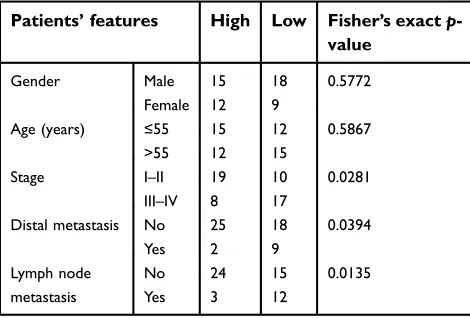
Table 1 Clinical relevance of HCP5 expression level in SKCM patients
Patients’features High Low Fisher’s exactp -value
Gender Male 15 18 0.5772
Female 12 9
Age (years) ≤55 15 12 0.5867
>55 12 15
Stage I–II 19 10 0.0281
III–IV 8 17
Distal metastasis No 25 18 0.0394
Yes 2 9
Lymph node metastasis
No 24 15 0.0135
Yes 3 12
Abbreviations:HCP5, human leucocyte antigen complex P5; SKCM, skin cutaneous melanoma.
OncoTargets and Therapy downloaded from https://www.dovepress.com/ by 118.70.13.36 on 25-Aug-2020
with the guidelines of the National Animal Care and Ethics Institution. The xenografts were excised from the
mice when the volume reached 2,000 mm3and grounded
through a 100μm cell strainer (F613463, Sangon Biotech,
Shanghai, China). The cells were cultured using
a complete cell culture media (GlutaMAX-supplemented RPMI-1640 media, supplemented with 10% FBS and 1%
of penicillin‒streptomycin solution, all from Thermo
Fisher Scientific, Waltham, MA, USA) in a cell incubator
with a humidified atmosphere at 37°C with 5% CO2. The
cells were subcultured every 2–3 days for 20 passages
before further analysis.
HCP5 overexpression, RARRES3
knockdown and miR-1286 mimic
transfection
We overexpressed HCP5 in the primary SKCM cells by lentiviral transduction. The HCP5-overexpressing (OE) (LPP-Y1990-Lv105-400) and empty lentiviral particles were purchased from Genecopoeia (Rockville, MD, USA) and transduced into SKCM cells at log phase at the MOI of 5 TU/cell using EndoFectin Lenti transfection reagent (EF002, Genecopoeia) following the
manufac-turer’s instructions. Cells with positive transduction were
enriched by puromycin selection. For RARRES3
knock-down, the SKCM cells were transfected with a siRNA pool (GenePharma, Shanghai, China) composed of 4
dif-ferent siRNA oligos that target RARRES3 mRNA. The
cells were transfected with siRNA pool at the overall concentration of 50 nM using Lipofectamine 2000
(Thermo Fisher Scientific). To simulate miR-1286
over-expression, SKCM cells were transfected with single-stranded miR-1286 mimic (GenePharma) at 30 nM using
Lipofectamine 2000. Transfection efficacy was assayed at
24 hrs after transfection by qRT-PCR or western blotting. A miRNA mimic negative control with scrambled sequence was used as negative control for miRNA mimic transfection.
qRT-PCR
Total RNA from cells cultured in vitro or from tissue speci-mens was extracted using Trizol reagent (R0016, Beyotime,
Shanghai, China). HCP5 or RARRES3 mRNA in the total
RNA was detected by qRT-PCR with 2−ΔΔCtmethod using
a one-step SYBR green RT-qPCR Kit (QP084,
Genecopoeia) and the following primers (Genecopoeia):
RARRES3 (HQP108527), GAPDH (HQP006940), HCP
(Fw, CAGCCTGAGAGAAGTAGGGC; Rev, TCAGTCG
CATTTCCAGGTAATTT; sequences from PrimerBank).26
GAPDH was used as an internal reference when applicable. Detection of miRNAs levels in the total RNA was
per-formed by qRT-PCR with 2−ΔΔCt method using All-in-One
miRNA qRT-PCR detection kit (QP016, Genecopoeia) and
the following primers (5ʹ to 3ʹ, Genecopoeia): hsa-miR
-1286 (TGCAGGACCAAGATGAGCCCTAA); hsa-miR
-6783-3p (TTCCTGGGCTTCTCCTCTGTAGAA);
hsa-miR-6866-5p (TTAGAGGCTGGAATAGAGATTCTAA);
hsa-miR-6858-3p (CAGCCAGCCCCTGCTCACCCCT
AA); hsa-miR-504-5p (AGACCCTGGTCTGCACTCTAT CAA); hsa-miR-4725-5p (AGACCCTGCAGCCTTCCC ACCAA) and hsa-miR-6874-5p (ATGGAGCTGGAAC CAGATCAGGCAA).
Western blotting
Western blotting detecting RARRES3 protein level in
SKCM cells in vitro was performed by using RIPA lysis buffer (P0013B, Beyotime) and separating the cellular proteins in the cell lysate by SDS-PAGE in reducing con-dition, followed by transferring the separated proteins onto nitrocellulose membrane and probing with primary and secondary antibodies. Protein bands were then developed
using ECL substrate (32,106, Thermo Fisher Scientific)
and X-ray films (34,090, Thermo Fisher Scientific). The
following antibodies purchased from Abcam (Cambridge, MA, USA) were used for western blotting: rabbit poly-clonal anti-TIG3 antibody (ab96468), rabbit polypoly-clonal anti-GAPDH antibody (ab9485) and goat anti-rabbit IgG H&L antibody (HRP-conjugated, ab205718).
Cell proliferation, colony formation,
apoptosis and transwell invasion assays
SKCM cell proliferation was evaluated by CCK-8 cell viability assay. SKCM cells after transfection were inoculated on 96-well-plate at 5,000 cells/well. Cell viability was assessed using CCK-8 (CK04, Dojindo, Kumamoto, Japan) at 2, 24, 48, or 72 hrs postinocula-tion using a microplate reader. Clonogenicity of SKCM cells was evaluated by colony formation assays. SKCM cells after transfection were inoculated on 24-well-plate at 100 cells/well. Cells were cultured for 2 weeks before
fixation and staining with crystal violet. Colonies with
more than 50 cells were counted under a microscope. SKCM cell survival was evaluated by apoptosis assay. Cells after transfection were seeded on 24-well-plate at
OncoTargets and Therapy downloaded from https://www.dovepress.com/ by 118.70.13.36 on 25-Aug-2020
2×10⁵ cells/well and cultured for 2 hrs, followed by serum deprivation for 8 hrs. Cell apoptosis was assessed by detecting the percentage of Annexin V-positive and PI-positive or -negative staining cells using Annexin
V-FITC/PI Apoptosis detection kit (640,914,
Biolegend, San Diego, CA, USA) and flow cytometry.
Invasiveness of SKCM cells was evaluated by transwell
invasion assay. 5×10⁴ SKCM cells after transfection
were inoculated in a matrigel-coated transwell chamber
(08-774-122, Thermo Fisher Scientific) in serum-free
culture media supplemented with 2% BSA. The trans-well chamber was then incubated in complete culture
media for 16 hrs, and invasive cells were fixed and
stained for counting under a microscope (Olympus,
Tokyo, Japan) with five random fields (x200
magnification).
microRNA target luciferase reporter
assay
Three different reporter plasmids were constructed by Genecopoeia for the miRNA target luciferase reporter assay: for the wild-type (WT) plasmids, the cDNA of
RARRES3 mRNA 3ʹ UTR was inserted at the 3ʹ flank of Gaussia luciferase (Gluc) gene on the reporter plasmids; for
the Scrambled plasmids, the cDNA sequence ofRARRES3
mRNA 3ʹUTR was scrambled; for mutant (MUT) plasmids,
mutations were induced into the cDNA ofRARRES3mRNA
3ʹUTR (as demonstrated inFigure 5E). All plasmids carried
the secreted alkaline phosphatase (SEAP) gene for normal-ization. The plasmids were transfected into SKCM cells in vitro using EndofectinMAX (Genecopoeia). At 48 hrs after transfection, activity of Gluc and SEAP in the cell culture media was assessed using Secrete-Pair Gaussia luci-ferase assay kit (LF032, Genecopoeia) and a microplate reader.
AGO-RNA immunoprecipitation
(AGO-RIP)
AGO-RIP was performed using Imprint RNA immuno-precipitation kit (RIP-12RXN) with rat AGO2 anti-body and rabbit anti-rat IgG antianti-body. SKCM cells after lentiviral transduction were cultured on 6-well plate
until ~80% confluence. The cells were lysed on the
plate with a mild lysis buffer (P0013, Beyotime), and the cell lysate was centrifuged at 15,000× g for 10 min at 4°C. The supernatant was then incubated with Protein A magnetic beads preloaded with rabbit anti-rat IgG
antibody and rat anti-AGO2 antibody at 4°C for 16 hrs. The beads were then enriched with a magnetic
stand, and RNAs associated with the beads were purified
following the product manual. RARRES3 mRNA and
miRNAs in the purified RNA were detected by
qRT-PCR as described above.
Statistical analysis
Statistical analysis was performed using GraphPad Prism 7
software. Each data group inFigures 2,4and5represent 6
replicates from 2 primary SKCM cell lines (2 biological repli-cates ×3 technical replirepli-cates). Data were presented as mean ±
SD fashion, unless otherwise indicated. Fisher’s exact test was
performed for significance test inTable 1. Log-rank test was
performed for survival analysis. Mann‒Whitney test was
per-formed for significance test inFigures 1Band3A. Pearson and
Spearman correlation analysis was performed for significance
test inFigure 3B. Student’st-test or ANOVA was performed
for significance test in the rest of thefigures. A difference was
considered statistically significant whenp<0.05.
Ethical Statement
This research was approved by the ethical review
commit-tee of the Third Hospital of Ji’nan and all patients provided
written informed consent. This study was performed in accordance with the Declaration of Helsinki. The animal experiments were approved by the Institutional Animal
Care and Use Committee of the Third Hospital of Ji’nan.
All experiments were performed following the guidelines
and the regulations of the Third Hospital of Ji’nan.
Results
Downregulation of HCP5 in SKCM was
correlated with patients
’
unfavored
prognosis
Previous researches have implicated dysregulation of HCP5 in SKCM progression. We thought to verify whether the increased expression of HCP5 would
cor-relate with SKCM patients’ worsened outcome. After
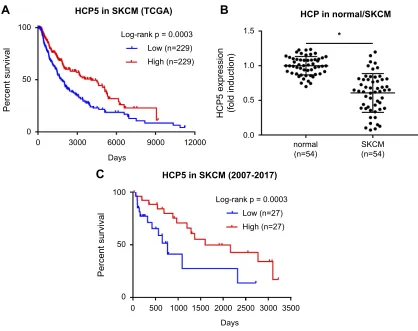
querying the TCGA-SKCM data, to our surprise, we found that high expression of HCP5 actually associated
with increased survival of SKCM patients (Figure 1A),
implying that HCP5 might limit SKCM progression. To investigate the role of HCP5 in SKCM progression, we analyzed the expression level of HCP5 in 54 SKCM
patients’tissue specimens preserved during 2007–2017,
and found that HCP5 expression level in the SKCM
OncoTargets and Therapy downloaded from https://www.dovepress.com/ by 118.70.13.36 on 25-Aug-2020
pathological tissue specimens was significantly lower than that in the normal skin tissue specimens obtained from the contralateral limbs of the same patients (Figure 1B). Moreover, we also found that low expres-sion of HCP5 was associated with disease progresexpres-sion,
lymph node and distal metastasis of SKCM (Table 1)
as well as the worsened outcome of these 54 SKCM
patients (Figure 1C). These data implied that HCP5
might seve as a tumor suppressor in SKCM.
HCP5 overexpression signi
fi
cantly
reduced primary SKCM cell proliferation,
survival, colony formation and transwell
invasion but promoted apoptosis in vitro
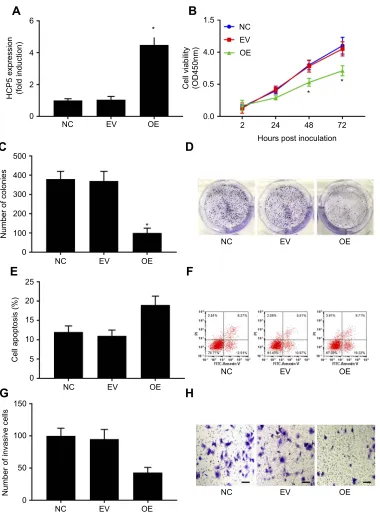
To investigate whether HCP5 would regulate the malig-nancy of SKCM cells, we established 2 patient-derived SKCM cell lines and transduced these cells with either HCP5-OE or empty (EV) lentiviral vectors for 24 hrs.
Transduction with HCP5-OE vectors significantly
increased HCP5 expression level in the primary SKCM
cells in vitro (Figure 2A). Moreover, HCP5 overexpression
significantly reduced cell proliferation, survival,
clono-genicity and transwell invasion capacity but increased
serum deprivation-induced apoptosis of these cells
(Figures 2B–H and S1). These results suggested that HCP5 addition inhibited SKCM progression in vitro.
HCP5 overexpression reduced SKCM
cell malignancy by upregulating RARRES3
gene expression
lncRNAs are known to regulate gene expression via miRNA sponging. To investigate whether HCP5 would regulate the malignancy of SKCM cells through similar mechanisms, we
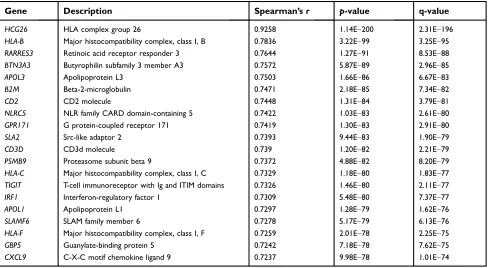
queried the TCGA-SKCM data in an attempt tofind HCP5
co-expressing genes. The top 20 genes whose mRNA levels showed the highest correlation with that of HCP5 in
TCGA-100
Log-rank p = 0.0003
Low (n=229)
High (n=229) HCP5 in SKCM (TCGA)
A
50
Percent survival
0
0 3000 6000
Days
1.5
1.0
0.5
0.0
normal (n=54)
SKCM (n=54) HCP in normal/SKCM
B
HCP5 expression (fold induction)
*
9000 12000
100
Log-rank p = 0.0003
Low (n=27)
High (n=27) HCP5 in SKCM (2007-2017)
C
50
Percent survival
0
0 500 1000 1500 2000 2500 3000 3500
Days
Figure 1Clinical significance of HCP5 expression in SKCM. (A) Survival analysis of HCP5 using TCGA-SKCM data. (B) HCP5 levels in 54 pairs of SKCM tissue specimens and normal skin tissue specimens were compared by qRT-PCR. Each dot represents one tissue specimen. (C) Survival analysis of HCP5 using the 54 SKCM patients’clinical data. *p<0.05.
Abbreviation:TCGA-SKCM, The Cancer Genome Atlas-skin cutaneous melanoma.
OncoTargets and Therapy downloaded from https://www.dovepress.com/ by 118.70.13.36 on 25-Aug-2020
SKCM data are listed in Table 2. Among these genes, we
found RARRES3, a recently proposed cancer-suppressive
gene, in the top 3 genes. Thus, we investigated whether
HCP5 would regulateRARRES3gene expression in SKCM
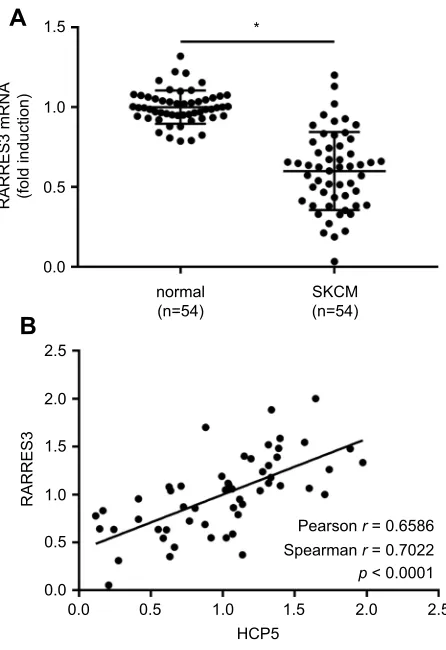
cells. We found that RARRES3 gene expression was also
significantly reduced in the 54 SKCM tissue specimens
com-paring to their normal counterparts, significantly correlating
with that of HCP5 (Figure 3A and B). Overexpression of
A
6
* 4
2
HCP5 expression (fold induction)
0
500 400 300 200
Number of colonies
Cell apoptosis (%)
100
25 20 15 10 5 0 150
100
Number of invasive cells
50
0 0
NC EV OE
NC EV OE
NC EV OE
NC EV OE NC EV OE *
NC EV OE
C
D
E
G
H
F
NC EV OE
B
1.5
NC EV OE
* * 4.0
0.5
Cell viability (OD450nm)
0.0
2 24 48 Hours post inoculation
72
Figure 2HCP5 overexpression inhibited primary SKCM cell proliferation, survival, clonogenicity and invasiveness in vitro. SKCM cells were transduced with empty (EV) or HCP5 (overexpressing; OE) lentiviral vectors for 24 hrs before assay. (A) HCP5 levels in SKCM cells with or without HCP5 overexpression were compared by qRT-PCR. (B) SKCM cell proliferation was assessed by cell proliferation assay. (CandD) Clonogenicity of SKCM cells was assessed by colony formation assay. (EandF) Survival of SKCM cells was assessed by apoptosis assay. Cell apoptosis was induced by serum deprivation for 8 hrs. G and H, invasiveness of SKCM cells was assessed by transwell invasion assays. Bar indicates 100μM. *p<0.05.
Abbreviations:SKCM, skin cutaneous melanoma; NC, normal control.
OncoTargets and Therapy downloaded from https://www.dovepress.com/ by 118.70.13.36 on 25-Aug-2020
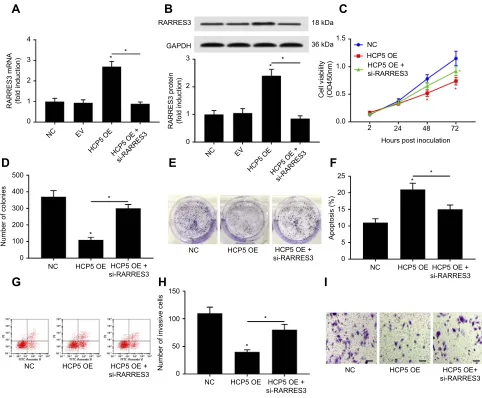
HCP5 also significantly increasedRARRES3mRNA and
pro-tein levels in the primary SKCM cells in vitro (Figure 4Aand
B). To investigate whether HCP5 would regulate SKCM cell
malignancy throughRARRES3, we transfected siRNA
target-ing RARRES3(si-RARRES3) for 24 hrs to reduce its gene
expression (Figure 4AandB).RARRES3knockdown partially
attenuated HCP5-mediated inhibition of cell proliferation, survival, colony formation and transwell invasion and
promo-tion of apoptosis in SKCM cells (Figures 4C–I and S2),
suggesting that HCP5 would regulate the malignancy of
SKCM cells in vitro partially throughRARRES3.
HCP5 protected RARRES3 mRNA from
RISC-mediated degradation via sponging
miR-
1286
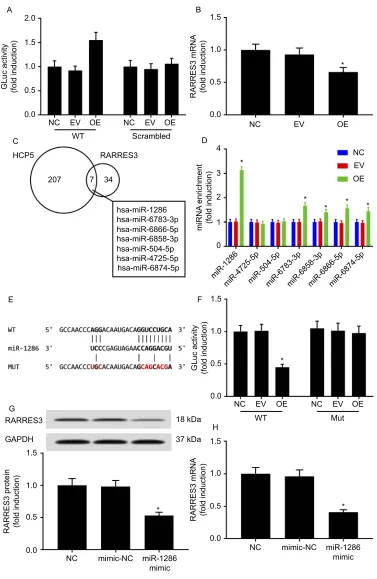
We performed the miRNA target luciferase reporter assay and AGO2-RIP assay to investigate whether HCP5 would
regulate RARRES3 gene expression through interacting
with miRNAs. Our data showed that OE HCP5 signifi
-cantly increased the activity of Gluc, whose expression
was governed by the WT 3ʹ UTR ofRARRES3in SKCM
cells, and scrambling the sequence of this 3ʹ UTR of
RARRES3 abolished the regulation of HCP5 on Gluc
expression (Figure 5A). HCP5 overexpression also
signif-icantly reduced the association of RARRES3mRNA with
AGO2 protein in the RISC complex in SKCM cells (Figure 5B). These data suggested that HCP5 would pro-tectRARRES3 mRNA from miRNA and the RISC com-plex-mediated degradation. To identify the miRNA(s)
regulated by HCP5 in maintainingRARRES3gene
expres-sion, we employed the DIANA microT-CDS algorithm to predict miRNAs that would interact with HCP5 or mRNA ofRARRES3. By cross-referencing the miRNA prediction results, we found 7 miRNAs putatively interacting with
both HCP5 and 3ʹUTR ofRARRES3mRNA (Figure 5C).
However, by analyzing the enrichment of these miRNAs by HCP5 overexpression in the AGO2-RIP products, we found that miR-1286 was the one miRNA that most
sig-nificantly associated with HCP5, and some other miRNAs
were not significantly enriched (Figure 5D). Further
ana-lysis using microRNA target luciferase assay confirmed
the binding site of miR-1286 on the 3ʹUTR of RARRES3
mRNA (Figure 5E and F), and miR-1286 overexpression
significantly reducedRARRES3mRNA and protein levels
in SKCM cells after transfection with miR-1286 mimic for
24 hrs (Figure 5GandH). These data suggested that HCP5
would regulateRARRES3gene expression in SKCM cells
by sponging miR-1286.
Discussion
The present research aimed to investigate the role of HCP5 in SKCM development. Previous studies described the potential association between high expression of HCP5 and SKCM
patients’decreased survival.14,15In the present research,
how-ever, we found that high expression of HCP5 might favor
SKCM patients’good prognosis, and that this lncRNA was
significantly decreased in SKCM pathologic tissue specimens
comparing to normal tissue specimens. These results implied HCP5 as a cancer suppressor in SKCM.
Previous studies have described HCP5 as a cancer
promoter in follicular thyroid carcinoma,16 cervical
cancer17 and glioma,21 while the expression level of this
lncRNA was also found to be downregulated in lung
adenocarcinoma,19nasopharyngeal carcinoma20and
ovar-ian cancer22 tissue specimens comparing to nonmalignant
counterparts. The mechanism of HCP5 is largely
A
B
1.5 *
1.0
0.5
0.0
2.5
2.0
1.5
1.0
0.5
0.0
0.0 0.5 1.0 1.5
Pearson r = 0.6586 Spearman r = 0.7022 p < 0.0001
2.0 2.5
HCP5 normal
(n=54)
SKCM (n=54) RARRES3 mRNA (fold induction)
RARRES3
Figure 3RARRES3mRNA expression correlated with that of HCP5 in SKCM. (A) RARRES3mRNA levels in 54 pairs of SKCM tissue specimens and normal skin tissue specimens were compared by qRT-PCR. (B) Correlation analysis of RARRES3 mRNA and HCP5 expression levels. Each dot represents one tissue specimen. *p<0.05.
Abbreviation:SKCM, skin cutaneous melanoma.
OncoTargets and Therapy downloaded from https://www.dovepress.com/ by 118.70.13.36 on 25-Aug-2020
underexplored. In this research, we used patient-derived SKCM cells to demonstrate that HCP5 overexpression
could significantly reduce the malignancy of these cells,
marked by the significant decrease of cell proliferation,
survival, colony formation and transwell invasion and increase of apoptosis caused by serum deprivation.
To further investigate the mechanism underlying the SKCM-suppressive role of HCP5, we explored HCP co-expressing genes in TCGA-SKCM data. We found that the
expression of a novel cancer-suppressive gene, RARRES3,
was significantly correlated with that of HCP5 in SKCM that
were sampled in TCGA. Our qRT-PCR results also suggested
the downregulation ofRARRES3gene expression in SKCM
and its correlation with HCP5, and our in vitro data further
showed that overexpression of HCP5 could significantly
increase RARRES3 mRNA and protein level in primary
SKCM cells. We transfected the HCP5-OE SKCM cells with
siRNA forRARRES3knockdown at a series of continuously
diluted concentrations to downregulate their RARRES3
expression to a“near wild-type”level.RARRES3knockdown
partially attenuated the SKCM-suppressive effect of HCP5 overexpression, suggesting that HCP5 might suppress
SKCM development throughRARRES3.
The cancer-suppressive role of RARRES3 was first
described in 1998, when DiSepio et al reported that over-expression of this gene would decrease the proliferation of
A
D
G
H
I
E
F
25 *
*
20
15
Apoptosis (%)
10
5
0 500
*
* 400
Number of colonies
300
200
100
0
NC HCP5 OE HCP5 OE + si-RARRES3
150
100 *
*
Number of invasive cells
50
0
NC HCP5 OE HCP5 OE + si-RARRES3
NC HCP5 OE HCP5 OE+
si-RARRES3
NC HCP5 OE HCP5 OE +
si-RARRES3
NC HCP5 OE HCP5 OE +
si-RARRES3
NC HCP5 OE HCP5 OE + si-RARRES3
RARRES3 18 kDa
C
36 kDa GAPDH
B
4
* * 3
RARRES3 mRNA (fold induction)
RARRES3 protein (fold induction)
Cell viability (OD450nm) 2
1
0
NC EV
HCP5 OE HCP5 OE + si-RARRES3
3
1.5 NC HCP5 OE HCP5 OE +
si-RARRES3 *
*
* 1.0
0.5
0.0
24 48
Hours post inoculation 72 2
* *
2
1
0
NC EV
HCP5 OE HCP5 OE + si-RARRES3
Figure 4HCP5 overexpression reduced SKCM cell malignancy throughRARRES3. After transducing with HCP5 overexpressing lentiviral vector (HCP5 OE), SKCM cells were transfected with siRNA forRARRES3knockdown (si-RARRES3) for 24 hrs. (AandB) Upregulation ofRARRES3mRNA and protein level by HCP5 overexpression was abolished byRARRES3knockdown. (C–I) SKCM cell malignancy was evaluated by cell proliferation, colony formation, survival and transwell invasion assays, as described in
Figure 2. In panel 4C, red asterisks labeled the comparison to NC group, while the green asterisks labeled the comparison to HCP5 OE group. Bar indicates 100μM. *p<0.05.
Abbreviations:SKCM, skin cutaneous melanoma; NC, normal control.
OncoTargets and Therapy downloaded from https://www.dovepress.com/ by 118.70.13.36 on 25-Aug-2020
A
C
E
G
RARRES3 18 kDa
H
1.5
1.0
0.0
0.5 *
*
37 kDa GAPDH
1.5
1.0
0.5
0.0
F D
HCP5 RARRES3
207 7 34
hsa-miR-1286 hsa-miR-6783-3p hsa-miR-6866-5p hsa-miR-6858-3p hsa-miR-504-5p hsa-miR-4725-5p hsa-miR-6874-5p
B
2.0 1.5
1.0
0.5
0.0
4
3
2
1
0
1.5
1.0
0.5 *
0.0
miR-1286
miR-4725-5pmiR-504-5pmiR-6783-3pmiR-6858-3pmiR-6866-5pmiR-6874-5p
*
*
*
* * *
1.5
GLuc activity (fold induction)
RARRES3 mRNA (fold induction)
miRNA
enrichment
(fold induction)
GLuc activity (fold induction)
RARRES3 mRNA (fold induction)
RARRES3 protein (fold induction) 1.0
0.5
0.0
NC EV OE
WT
NC EV OE
NC
NC mimic-NC miR-1286
mimic
NC mimic-NC miR-1286
mimic
WT Mut
EV OE NC EV OE
NC
NC EV
EV OE
OE Scrambled
Figure 5HCP5-regulatedRARRES3expression in SKCM cells by sponging miR-1286. (A) HCP5 overexpression increased the expression of Gaussia luciferase (Gluc) governed by the 3ʹUTR ofRARRES3mRNA. (B) HCP5 overexpression reduced the association ofRARRES3mRNA with AGO2 protein. (C) Putative HCP5 andRARRES3 mRNA interacting miRNAs, predicted by the DIANA microT-CDS algorithm with prediction score >0.6. (D) HCP5 overexpression increased the association of miR-1286 as well as other miRNAs with AGO2 protein in SKCM cells. (E) Putative miR-1286-binding site on the wild type 3ʹUTR ofRARRES3(WT), which was mutated (MUT). (F) miR-1286 mimic transfection reduced the-expression of Gluc governed by wild-type 3ʹUTR ofRARRES3. (GandH)RARRES3mRNA and protein level in SKCM was reduced by miR-1286 mimic transfection. *p<0.05.
Abbreviations:SKCM, skin cutaneous melanoma; NC, normal control.
OncoTargets and Therapy downloaded from https://www.dovepress.com/ by 118.70.13.36 on 25-Aug-2020
various types of malignant or nonmalignant cells in vitro.27
Since then,RARRES3has been found as a cancer-suppressive
gene in liver cancer,28breast cancer,29,30B cell leukemia31and
skin cancer.32 RARRES3 gene was also found to promote
cancer cell differentiation30,33–36 and suppress cancer
metastasis.28,30,37,38Mechanistically, Hsu et al reported that
RARRES3protein would suppress WNT/β-catenin signaling by mediating the acylation of Wnt proteins as well as LRP6, thus reducing the epithelial-to-mesenchymal transition (EMT)
and cancer stem cell property of breast cancer cells.39An early
report from Ou et al showed thatRARRES3protein
transcrip-tionally repressed the expression of HER2, resulting in the
inactivation of PI3K/Akt/mTOR signaling.40 Thesefindings
suggested that RARRES3 as a cancer suppressor is
multifunctional.
However, how HCP5 would regulate RARRES3 gene
expression remains unclear. We hypothesized that this
lncRNA might sustain RARRES3 mRNA level via
miRNA sponging. The miRNA target luciferase reporter
assay and AGO2-RIP assay results confirmed that HCP5
overexpression would protect the RARRES3mRNA from
miRNA-RISC-mediated degradation. By bioinformatic
analysis and AGO2-RIP assay, we identified miR-1286
as a candidate miRNA. Through miRNA target luciferase reporter assay and transfecting SKCM cells with
miR-1286 mimic, we for the first time confirmed RARRES3
mRNA as a target of miR-1286 in SKCM cells.
Previous research has demonstrated thatRARRES3might
suppress EMT in cancer cells,37,39and the EMT of SKCM cells
was closely related to their proliferation, survival and metasta-sis. Here we also detected the protein levels of N-cadherin, Vimentin and E-cadherin in SKCM cells with or without HCP5 overexpression after the transfection for 48 or 72 hrs. However, the western blotting results suggested that overexpression of
HCP5 seemed to have no statistically significant impact on the
protein level of these markers in SKCM in vitro (data not shown). The EMT markers might be affected at other time points because their expressions follow a time course which maybe has been skipped in their unique western blot. Although
these observations need to be verified, we speculate that, as
a lncRNA, HCP5 might regulate the expressions or functions of other genes and proteins, and the overall effect of HCP5 over-expression on SKCM cells might be different from that of
RARRES3overexpression. Besides, previous studies indicated that HCP5 might be involved in T cell- or NC cell-mediated
cytolysis of cancer cells.20,41By querying the TCGA-SKCM
data, we also found that HCP5 expressions might be signifi
-cantly associated with that of some MHC I genes in SKCM. Whether HCP5 would regulate the immunogenicity of cancer cells will be investigated in our future research.
Table 2Top 20 HCP5 co-expressing genes in the TCGA-SKCM data
Gene Description Spearman’sr p-value q-value
HCG26 HLA complex group 26 0.9258 1.14E−200 2.31E−196
HLA-B Major histocompatibility complex, class I, B 0.7836 3.22E−99 3.25E−95
RARRES3 Retinoic acid receptor responder 3 0.7644 1.27E−91 8.53E−88
BTN3A3 Butyrophilin subfamily 3 member A3 0.7572 5.87E−89 2.96E−85
APOL3 Apolipoprotein L3 0.7503 1.66E−86 6.67E−83
B2M Beta-2-microglobulin 0.7471 2.18E−85 7.34E−82
CD2 CD2 molecule 0.7448 1.31E−84 3.79E−81
NLRC5 NLR family CARD domain-containing 5 0.7422 1.03E−83 2.61E−80
GPR171 G protein-coupled receptor 171 0.7419 1.30E−83 2.91E−80
SLA2 Src-like adaptor 2 0.7393 9.44E−83 1.90E−79
CD3D CD3d molecule 0.739 1.20E−82 2.21E−79
PSMB9 Proteasome subunit beta 9 0.7372 4.88E−82 8.20E−79
HLA-C Major histocompatibility complex, class I, C 0.7329 1.18E−80 1.83E−77 TIGIT T-cell immunoreceptor with Ig and ITIM domains 0.7326 1.46E−80 2.11E−77
IRF1 Interferon-regulatory factor 1 0.7309 5.48E−80 7.37E−77
APOL1 Apolipoprotein L1 0.7297 1.28E−79 1.62E−76
SLAMF6 SLAM family member 6 0.7278 5.17E−79 6.13E−76
HLA-F Major histocompatibility complex, class I, F 0.7259 2.01E−78 2.25E−75
GBP5 Guanylate-binding protein 5 0.7242 7.18E−78 7.62E−75
CXCL9 C-X-C motif chemokine ligand 9 0.7237 9.98E−78 1.01E−74
OncoTargets and Therapy downloaded from https://www.dovepress.com/ by 118.70.13.36 on 25-Aug-2020
Conclusion
In the present research, we found HCP5 as a cancer-suppressive lncRNA in SKCM with high clinical relevance.
Overexpression of HCP5 significantly reduced the
prolifera-tion, survival, clonogenicity and invasiveness of SKCM cells and contributed to serum deprivation-induced apoptosis
in vitro throughRARRES3. We found that HCP5
overexpres-sion significantly increased RARRES3 gene expression in
SKCM cells in vitro by sponging miR-1286. Our data sug-gested HPC5 as a possible prognostic factor and therapeutic target in clinical practice.
Disclosure
The authors report no conflicts of interest in this work.
References
1. Lai V, Cranwell W, Sinclair R. Epidemiology of skin cancer in the mature patient.Clin Dermatol. 2018;36(2):167–176. doi:10.1016/j. clindermatol.2017.10.008
2. Gandhi SA, Kampp J. Skin cancer epidemiology, detection, and management. Med Clin North Am. 2015;99(6):1323–1335. doi:10.1016/j.mcna.2015.06.002
3. Schadendorf D, van Akkooi ACJ, Berking C, et al. Melanoma.Lancet. 2018;392(10151):971–984. doi:10.1016/S0140-6736(18)31559-9 4. Schadendorf D, Fisher DE, Garbe C, et al. Melanoma.Nat Rev Dis
Primers.2015;1:15003. doi:10.1038/nrdp.2015.3
5. Luke JJ, Flaherty KT, Ribas A, Long GV. Targeted agents and immunotherapies: optimizing outcomes in melanoma.Nat Rev Clin Oncol.2017;14(8):463–482. doi:10.1038/nrclinonc.2017.43 6. Johnson DB, Sosman JA. Therapeutic advances and treatment
options in metastatic melanoma. JAMA Oncol.2015;1(3):380–386. doi:10.1001/jamaoncol.2015.0565
7. Kurokawa R, Rosenfeld MG, Glass CK. Transcriptional regulation through noncoding RNAs and epigenetic modifications. RNA Biol. 2009;6(3):233–236.
8. Thomson DW, Dinger ME. Endogenous microRNA sponges: evi-dence and controversy. Nat Rev Genet. 2016;17(5):272–283. doi:10.1038/nrg.2016.20
9. Adams BD, Parsons C, Walker L, Zhang WC, Slack FJ. Targeting noncoding RNAs in disease. J Clin Invest. 2017;127(3):761–771. doi:10.1172/JCI84424
10. Lin C, Yang L. Long noncoding RNA in cancer: wiring signaling circuitry.
Trends Cell Biol.2018;28(4):287–301. doi:10.1016/j.tcb.2017.11.008 11. Bhan A, Soleimani M, Mandal SS. Long noncoding RNA and cancer:
a new paradigm. Cancer Res. 2017;77(15):3965–3981. doi:10.1158/ 0008-5472.CAN-16-2634
12. Aftab MN, Dinger ME, Perera RJ. The role of microRNAs and long non-coding RNAs in the pathology, diagnosis, and management of melanoma. Arch Biochem Biophys. 2014;563:60–70. doi:10.1016/j. abb.2014.07.022
13. Leucci E, Coe EA, Marine JC, Vance KW. The emerging role of long non-coding RNAs in cutaneous melanoma.Pigment Cell Melanoma Res.2016;29(6):619–626. doi:10.1111/pcmr.12537
14. Chen X, Guo W, Xu XJ, et al. Melanoma long non-coding RNA signature predicts prognostic survival and directs clinical risk-specific treatments. J Dermatol Sci. 2017;85(3):226–234. doi:10.1016/j. jdermsci.2016.12.006
15. Ma X, He Z, Li L, Yang D, Liu G. Expression profiles analysis of long non-coding RNAs identified novel lncRNA biomarkers with predictive value in outcome of cutaneous melanoma.Oncotarget. 2017;8(44):77761–77770. doi:10.18632/oncotarget.20780 16. Liang L, Xu J, Wang M, et al. LncRNA HCP5 promotes follicular
thyroid carcinoma progression via miRNAs sponge.Cell Death Dis. 2018;9(3):372. doi:10.1038/s41419-018-1111-y
17. Yu Y, Shen HM, Fang DM, Meng QJ, Xin YH. LncRNA HCP5 promotes the development of cervical cancer by regulating MACC1 via suppression of microRNA-15a. Eur Rev Med Pharmacol Sci. 2018;22(15):4812–4819. doi:10.26355/eurrev_201808_15616 18. Wang Z, Lu B, Sun L, Yan X, Xu J. Identification of candidate genes
or microRNAs associated with the lymph node metastasis of SCLC.
Cancer Cell Int.2018;18:161. doi:10.1186/s12935-018-0653-5 19. Zhu TG, Xiao X, Wei Q, Yue M, Zhang LX. Revealing potential long
non-coding RNA biomarkers in lung adenocarcinoma using long non-coding RNA-mediated competitive endogenous RNA network.
Braz J Med Biol Res. 2017;50(9):e6297. doi:10.1590/1414-431X20176071
20. Low JS, Chin YM, Mushiroda T, et al. A genome wide study of copy number variation associated with nasopharyngeal carcinoma in Malaysian Chinese identifies CNVs at 11q14.3 and 6p21.3 as candidate loci.PLoS One.2016;11(1):e0145774. doi:10.1371/journal.pone.0145774 21. Teng H, Wang P, Xue Y, et al. Role of HCP5-miR-139-RUNX1
feedback loop in regulating malignant behavior of glioma cells.Mol Ther.2016;24(10):1806–1822. doi:10.1038/mt.2016.103
22. Liu N, Zhang R, Zhao X, et al. A potential diagnostic marker for ovarian cancer: involvement of the histone acetyltransferase, human males absent on the first. Oncol Lett. 2013;6(2):393–400. doi:10.3892/ol.2013.1380
23. Anaya JJPCS. OncoLnc: linking TCGA survival data to mRNAs, miRNAs, and lncRNAs.PeerJ Comput Sci.2016;2:e67.
24. Paraskevopoulou MD, Vlachos IS, Karagkouni D, et al. DIANA-LncBase v2: indexing microRNA targets on non-coding transcripts. 2015;44(D1):D231–D238. doi:10.1093/nar/gkv1270
25. Paraskevopoulou MD, Georgakilas G, Kostoulas N, et al. DIANA-microT web server v5. 0: service integration into miRNA functional analysis workflows.2013;41(W1):W169–W173. doi:10.1093/nar/gkt393 26. Wang X, Spandidos A, Wang H, Seed B. PrimerBank: a PCR primer database for quantitative gene expression analysis, 2012 update. 2011;40(D1):D1144–D1149. doi:10.1093/nar/gkr1013
27. DiSepio D, Ghosn C, Eckert RL, et al. Identification and character-ization of a retinoid-induced class II tumor suppressor/growth regu-latory gene.Proc Natl Acad Sci U S A.1998;95(25):14811–14815. 28. Wei L, Chiu DK, Tsang FH, et al. Histone methyltransferase G9a
promotes liver cancer development by epigenetic silencing of tumor suppressor gene RARRES3. J Hepatol. 2017;67(4):758–769. doi:10.1016/j.jhep.2017.05.015
29. Errico A. Breast cancer: RARRES3-suppressing metastases to the lung in breast cancer. Nat Rev Clin Oncol. 2014;11(7):378. doi:10.1038/nrclinonc.2014.103
30. Morales M, Arenas EJ, Urosevic J, et al. RARRES3 suppresses breast cancer lung metastasis by regulating adhesion and differentiation.
EMBO Mol Med.2014;6(7):865–881. doi:10.15252/emmm.201303675 31. Casanova B, de la Fuente MT, Garcia-Gila M, et al. The class II tumor-suppressor gene RARRES3 is expressed in B cell lymphocytic leukemias and down-regulated with disease progression. Leukemia. 2001;15(10):1521–1526.
32. Duvic M, Helekar B, Schulz C, et al. Expression of a retinoid-inducible tumor suppressor, Tazarotene-inducible gene-3, is decreased in psoriasis and skin cancer.Clin Cancer Res.2000;6(8):3249–3259.
33. Wu CC, Shyu RY, Chou JM, et al. RARRES1 expression is signifi -cantly related to tumour differentiation and staging in colorectal adenocarcinoma.Eur J Cancer.2006;42(4):557–565. doi:10.1016/j. ejca.2005.11.015
OncoTargets and Therapy downloaded from https://www.dovepress.com/ by 118.70.13.36 on 25-Aug-2020
34. Lotz K, Kellner T, Heitmann M, et al. Suppression of the TIG3 tumor suppressor gene in human ovarian carcinomas is mediated via mitogen-activated kinase-dependent and -independent mechanisms.
Int J Cancer.2005;116(6):894–902. doi:10.1002/ijc.21127
35. Jiang SY, Chou JM, Leu FJ, et al. Decreased expression of type II tumor suppressor gene RARRES3 in tissues of hepatocellular carcinoma and cholangiocarcinoma.World J Gastroenterol.2005;11(7):948–953. 36. Shyu RY, Jiang SY, Chou JM, et al. RARRES3 expression positively
correlated to tumour differentiation in tissues of colorectal adenocarcinoma. Br J Cancer. 2003;89(1):146–151. doi:10.1038/sj. bjc.6601049
37. Wang Z, Wang L, Hu J, et al. RARRES3 suppressed metastasis through suppression of MTDH to regulate epithelial-mesen chymal transition in colorectal cancer. Am J Cancer Res. 2015;5 (6):1988–1999.
38. Anderson AM, Kalimutho M, Harten S, Nanayakkara DM, Khanna KK, Ragan MA. The metastasis suppressor RARRES3 as an endogenous inhibitor of the immunoproteasome expression in breast cancer cells. Sci Rep. 2017;7:39873. doi:10.1038/ srep39873
39. Hsu TH, Jiang SY, Chang WL, Eckert RL, Scharadin TM, Chang TC. Involvement of RARRES3 in the regulation of Wnt proteins acylation and signaling activities in human breast cancer cells. Cell Death Differ. 2015;22(5):801–814. doi:10.1038/cdd.2014.175
40. Ou CC, Hsu SC, Hsieh YH, et al. Downregulation of HER2 by RIG1 involves the PI3K/Akt pathway in ovarian cancer cells.
Carcinogenesis.2008;29(2):299–306. doi:10.1093/carcin/bgm263 41. Bauer S, Groh V, Wu J, et al. Activation of NK cells and T cells by
NKG2D, a receptor for stress-inducible MICA. Science. 1999;285 (5428):727–729.
OncoTargets and Therapy downloaded from https://www.dovepress.com/ by 118.70.13.36 on 25-Aug-2020
Supplementary materials
Materials and methods
Cell viability
SKCM cells after transfection were seeded into 96-well
plates at a density of 5x10³/well. After the incubation for
2, 24, 48 or 72 hrs, cells were interacted with 0.5 mg/mL MTT solution (Sigma-Aldrich, St. Louis, MO, USA) for another 4 hrs. Subsequently, the formazan was solubilized by DMSO. The absorbance at 490 nm was measured using a microplate reader (Bio-Rad, Hercules, CA, USA).
OncoTargets and Therapy
Dove
press
Publish your work in this journal
OncoTargets and Therapy is an international, peer-reviewed, open access journal focusing on the pathological basis of all cancers, potential targets for therapy and treatment protocols employed to improve the management of cancer patients. The journal also focuses on the impact of management programs and new therapeutic
agents and protocols on patient perspectives such as quality of life, adherence and satisfaction. The manuscript management system is completely online and includes a very quick and fair peer-review system, which is all easy to use. Visit http://www.dovepress.com/ testimonials.php to read real quotes from published authors.
Submit your manuscript here:https://www.dovepress.com/oncotargets-and-therapy-journal
2 24 48 72
0.0 0.5 1.0 1.5 2.0
Hours post inoculation
OD value (490 nm)
NC
EV
OE
*
*
Figure S1HCP5 overexpression inhibited SKCM cell proliferation. SKCM cells were transduced with empty (EV) or HCP5 (overexpressing; OE) lentiviral vectors before assay. Cell proliferation was measured by MTT assay. *p<0.05.
Abbreviations:HCP5, human leucocyte antigen complex P5; SKCM, skin cuta-neous melanoma; NC, negative control; EV, empty; OE, HCP-ovreexpressing.
2 24 48 72 0.0
0.5 1.0 1.5
Hours post inoculation
OD value (490nm)
NC HCP5 OE HCP5 OE + si-RARRES3
*
* *
Figure S2HCP5 overexpression suppressed SKCM cell proliferation byRARRES3. After transducing with HCP5 overexpressing lentiviral vector (HCP5 OE), SKCM cells were transfected with siRNA forRARRES3knockdown (si-RARRES3). Cell proliferation was measured by MTT assay. *p<0.05. Red asterisks labeled the comparison to NC group, while the green asterisks labeled the comparison to HCP5 OE group.
Abbreviation:SKCM, skin cutaneous melanoma.
OncoTargets and Therapy downloaded from https://www.dovepress.com/ by 118.70.13.36 on 25-Aug-2020