School of Information Systems Faculty of Business and Law
Victoria University
E-Mentoring and Information Systems Effectiveness Models:
a useful nexus for evaluation in the small business context.
Submitted by : Kim Rickard
This thesis is presented to fulfil the requirements for the award of Doctor of Philosophy, Victoria University
Abstract
While information communications technology provides new opportunties for supporting mentoring, there is a need to explore how effectively these potential benefits are being realised.
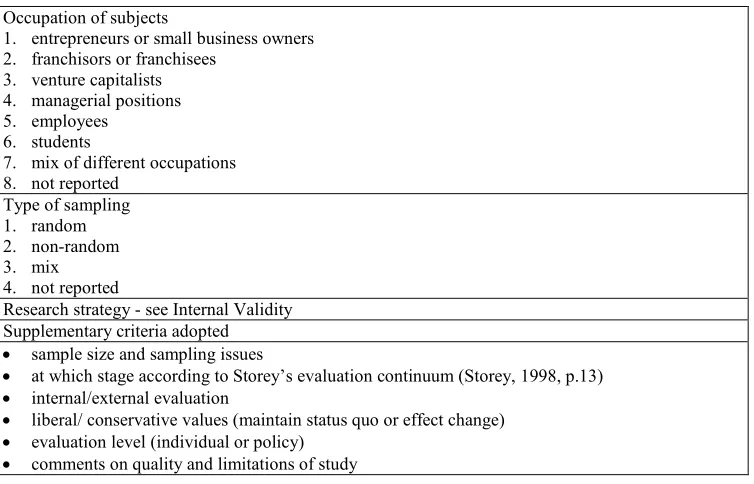
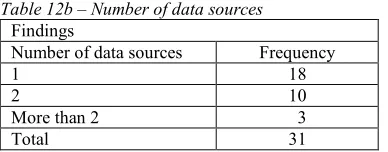
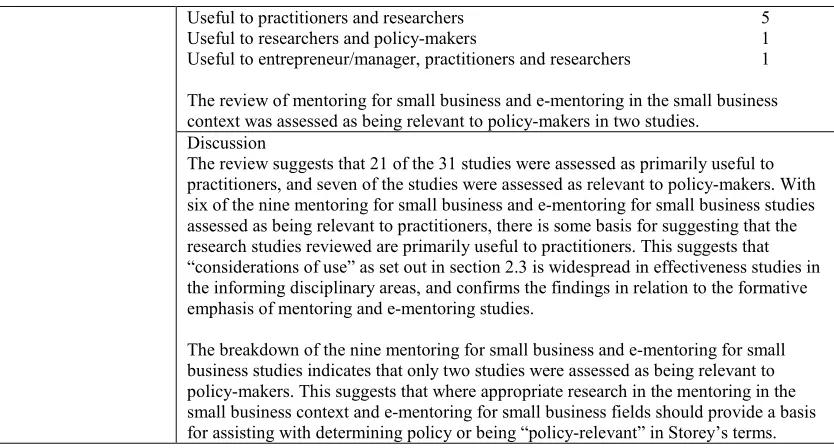
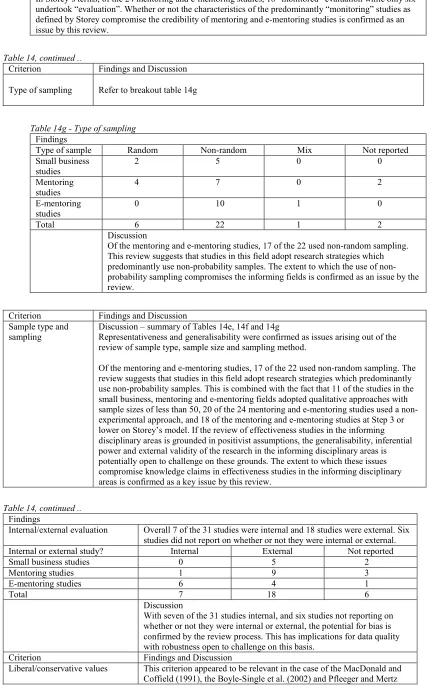
The evaluation of the effectiveness of structured e-mentoring in the small business context is problematic because it is contingent upon a multitude of contextual factors and characterised by a range of research difficulties. A review of 31 effectiveness studies across the mentoring, e-mentoring and small business fields undertaken as part of this study provided a basis for systematically determining the nature of these research challenges. They included the
heterogeneity and divergent pedagogical needs of individuals, the complexity of the mentoring phenomenon, measurement difficulties, the paradigm location of evaluation models, inherent problems with evaluation methodologies and data quality, and the almost contradictory
imperatives to evaluate individualised outcomes while exploring commonalities and patterns in effectiveness.
To extend understanding and knowledge in the field of e-mentoring for small business, it will be necessary to develop empirically-based theories of effective e-mentoring systems.
As a means of contributing to the generation and refinement of theory, this study proposed a framework as a potential solution to some of the research challenges and contextual
contingencies identified. The framework integrates the DeLone and McLean model of
Information Systems Success (1992) which is based on the principle that Information Systems success is best evaluated by considering the dimensions of effectiveness - System quality, Information quality, Use, User satisfaction and Impact - together as a system rather than in isolation. The Rickard model extends this principle to structured e-mentoring, and adapts and redefines DeLone and McLean’s Information Systems dimensions for the mentoring context.
The study investigated the framework as a means of consolidating and classifying the metrics used in the informing disciplinary areas, as a reference tool for designing qualitative and quantitative effectiveness measurement instruments, for selecting situationally-responsive research strategies, and most critically, for describing, classifying and interpreting variability in effectiveness outcomes. The framework was applied to evaluate the effectiveness of an
determinants of e-mentoring effectiveness. This work in turn provided a basis for understanding how the potential benefits of structured e-mentoring are being realised.
Student declaration - statement of originality
I, Kim Rickard, declare that the PhD thesis entitled “E-Mentoring and Information Systems Effectiveness Models: a useful nexus for evaluation in the small business context?” is no more than 100,000 words in length, exclusive of tables, figures, appendices, references and footnotes. This thesis contains no material that has been submitted previously, in whole or in part, for the award of any other academic degree or diploma. Except where otherwise indicated, this thesis is my own work.
Signed:
Acknowledgements
I would like to thank Gina Reyes, Arthur Tatnall, Angela Scollary, Rod Turner, Jamie Doughney, Usha Sukumaran, Tina Jeggo and Natalie Sciberras from Victoria University for their help throughout my research program.
I am very grateful to my employer - the Association of Professional Engineers, Scientists and Managers, Australia –in particular, Geoff Fary, whose unerring confidence in my ability to undertake this task was much appreciated.
I would also like to thank those who helped with both phases of data collection - firstly, the mentees and mentors who took time out of their busy schedules to help me understand their experiences, and secondly, the members of the expert panel who made the effort to provide considered comments on my effectiveness evaluation framework.
Table of contents
Page
Abstract ...ii
Student declaration - statement of originality ...iv
Acknowledgements ...v
Table of contents ...vi
List of tables ...ix
List of figures ...xii
Part I – Introduction to the research problem and purpose of study ...2
Chapter 1 - Introduction and literature review ...3
1.1 Origin of project ...3
1.2 Chapter overview ...3
1.3 Introduction ...4
1.4 Objectives of the study ...8
1.5 Research questions ...8
1.6 Overview of methodology ...9
1.7 Thesis outline by chapters and research sub-questions ...11
1.8 Structure of thesis ...12
1.9 What’s not the aim? ...13
1.10 Overview of the proposed framework ...13
1.11 Context of e-mentoring research and practice for self-employed professionals ....15
1.12 Literature review ...19
1.13 DeLone and McLean model ...49
1.14 Chapter summary ...53
Chapter 2 - Research rationale and methodology ...54
2.1 Chapter overview ...54
2.2 Theoretical location, research paradigms and effectiveness evaluation ...54
2.3 The distinction between evaluation and research ...57
2.4 Advancing research ...59
2.5 Location of the study ...67
2.6 Key research challenges and implications ...69
2.7 Ethical considerations ...71
2.8 Definitions ...73
2.9 Chapter summary ...74
Chapter 3 - A taxonomy for selecting strategies for evaluating effectiveness in
the area of e-mentoring for small business ...76
3.1 Chapter overview ...76
3.2 Respecification and the evaluation checklists ...77
3.3 Overview of the checklists to be used ...84
3.4 The review process ...88
3.5 Overview of effectiveness studies used in the review ...92
3.6 Findings and discussion ...94
3.7 Summary of findings and discussion ...107
3.8 Proposed framework ...110
3.9 Conclusions ...114
Chapter 4 - Refining the contingency framework ...116
4.1 Chapter overview ...116
4.2 Research rationale - why a Delphi study? ...116
4.3 The Delphi process ...119
4.4 The Delphi questions ...120
4.5 Findings ...121
4.6 Discussion ...128
4.7 Summary of key respecifications ...146
4.8 Next chapter ...146
Part III - Application and testing of translated model and framework - examination of actual practice ...148
Chapter 5 – Research rationale and methodology ...149
5.1 Introduction ...149
5.2 Evaluation design ...150
5.3 Application of framework to evaluation aims and evaluation questions ...157
5.4 Quantitative analysis ...164
5.5 Qualitative inquiry ...168
5.6 Summary of operationalisation of effectiveness construct for this evaluation ...172
5.7 Summary of process of evaluation strategy selection according to Items 1-5 of the framework ...174
Chapter 6 - Program description ...175
6.1 Introduction ...175
6.2 Program context ...175
6.3 Structure of the program ...175
6.4 The program’s pedagogical basis and features ...178
Chapter 7 – Examination of actual practice – quantitative ...190
7.1 Chapter overview ...190
7.2 Introduction ...191
7.3 Limitations of quantitative analysis ...192
7.4 Findings – general ...192
7.5 Main findings ...196
7.6 Extrapolating to program effectiveness ...227
7.7 Conclusions ...228
Chapter 8 ...231
8.1 Chapter overview ...231
8.2 Introduction to qualitative enquiry ...232
8.3 Limitations of data collection method ...233
8.4 Operationalisation of the effectiveness construct ...234
8.5 Methodology summary ...235
8.6 Characteristics of the sample ...235
8.7 Data presentation and analysis - qualitative data classification, description and interpretation ...236
8.8 Conclusion ...279
Part IV – Conclusions and implications ...282
Chapter 9 ...283
9.1 Introduction ...283
9.2 Conclusions about research questions and sub-questions ...283
9.3 Conclusions about the research problem ...305
9.4 Model respecification ...311
9.5 Implications for theory and practice ...320
9.6 Scope for further research ...320
9.7 Summary and conclusion ...321
Bibliography ...324
Appendices ...343
Appendix 1 – Evaluation review checklist ...344
Appendix 2a – Delphi study questionnaire 1 ...401
Appendix 2b – Delphi study questionnaire 2 ...405
Appendix 3 – Framework guidelines ...409
Appendix 4 – Mentee questionnaire ...425
Appendix 5 – Semi-structured interview questions ...433
List of tables
Page
Chapter 1
Table 1 – Summary of characteristics of monitoring compared with evaluation
according to Storey 1998 ...25
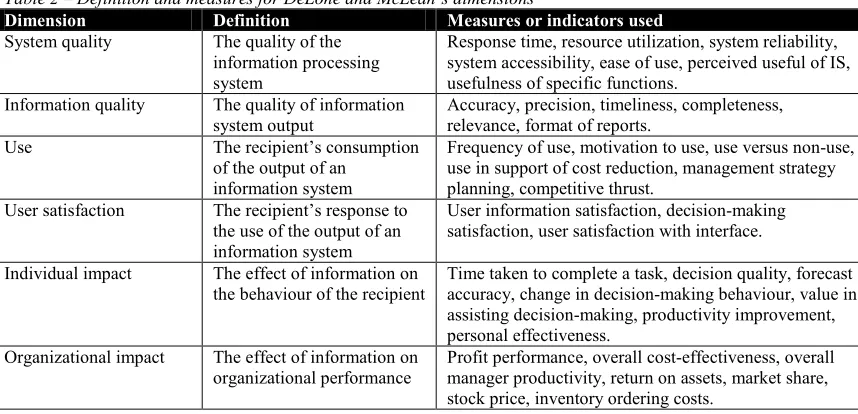
Table 2 – Definition and measures for DeLone and McLean’s dimensions ...50
Chapter 2 Table 3 – Summary of characteristics of evaluation and researc – Owen and Rogers 1999 ...57
Table 4 – Pasteur’s quadrant, as adapted from Stokes 1997 ...58
Table 5 – Commonalities, research challenges and implications ...69
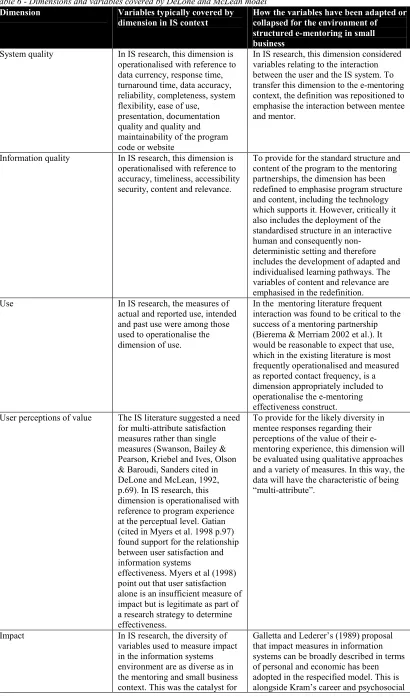
Chapter 3 Table 6 - Dimensions and variables covered by DeLone and McLean model ...85
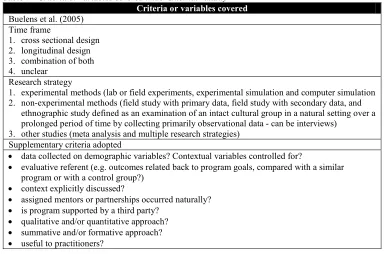
Table 7 - Criteria or variables covered under Internal validity ...87
Table 8 - Criteria or variables covered under External validity ...87
Table 9 - Criteria or variables covered under Construct validity ...88
Table 10 - Number of evaluation studies reviewed by disciplinary research area ...89
Table 11 - Overview of studies to be included in review and how effectivenes is operationalised and/or measured across the studies reviewed ...92
Table 12 - Findings - DeLone and McLean model ...95
Table12a – Methodology used to collect data ...96
Table 12b – Number of data sources ...97
Table12c – Number of studies which relied exclusively on self-report data ...97
Table 13 - Findings - Internal validity ...98
Table14 - Findings - External validity ...101
Table 14a - Type of sample (private, public, mix, other) ...101
Table 14b - Occupation of subjects ...101
Table 14c - Table 14c – Nature of sample - homogenous ...102
Table14d – Table 14d – Nature of sample - heterogenous ...102
Table 14e – Sample size by qualitative or quantitative research methodology ...103
Table14f – Table14f - At which stage of Storey’s model ...103
Table 14g - Type of sampling ...104
Table 15 - Findings - Construct validity ...105
Table 15a(i) - Stakeholders - small business studies ...105
Table 15a(ii) - Stakeholders - mentoring and e-mentoring studies ...105
Table 15b(i) - Evaluation on behalf of which stakeholders - small business studies ....106
Table 15b(ii) - Evaluation on behalf of which stakeholders - mentoring an e-mentoring studies ...106
Table 15c - Measures of ineffectiveness as well as effectiveness ...107
Table 16 - Structured e-mentoring in the small business context contingency theory development framework ...111
Chapter 4 Table 17 – Delphi panel of experts ...119
Table 18 – Responses to 1.1 ...121
Table 19 – Responses to 1.2 ...121
Table 20 – Responses to 1.3 ...121
Table 21 – Responses to 1.4 ...121
Table 22 – Responses to 1.5 ...122
Table 24 – Responses to 1.7 ...123
Table 25 – Responses to 1.8 ...123
Table 26 – Responses to 2.1 ...123
Table 27 – Responses to 2.2 ...124
Table 28 – Responses to 2.3 ...124
Table 29 – Responses to 3.1 ...124
Table 30 – Responses to 3.2 ...124
Table 31 – Responses to 3.3 ...125
Table 32 – Responses to 3.4 ...125
Table 33 – Responses to 3.4 ...125
Table 34 – Responses to 5.1 ...125
Table 35 – Responses to 5.2 ...125
Table 36 – Responses to 5.3 ...125
Table 37 – Responses to 5.4 ...126
Table 38 – Responses to 5.5 ...126
Table 39 – Responses to 5.6 ...126
Table 40 – Responses to 5.7 ...126
Table 41 – Responses to 5.8.1 ...127
Table 42 – Responses to 5.8.2 ...127
Table 43 – Responses to 5.8.3 ...127
Table 44 – Responses to 6.1.1 ...127
Table 45 – Responses to 6.1.2 ...127
Table 46 – Responses to 6.1.3 ...128
Table 47 – Responses to 6.2 ...128
Table 48 - Revised contingency framework for selecting a research strategy to evaluate the effectiveness of structured e-mentoring in the small business context ...143
Table 49 –Summary of measures added to contingency framework ...146
Chapter 5 Table 50 – Evaluation questions by program function, program goals an evaluation purpose ...162
Table 51a – Interaction frequency – 2002 to 2004 ...167
Table 51b - Contact frequency - 2005 and 2006 ...167
Table 52 – Summary of evaluation criteria selected from contingency framework for examination of actual practice ...172
Chapter 6 Table 53 – Reeves’ model setting out “What really matters in computer-based education” adapted for a proposed model of what matters when developing an e-mentoring program as a computer-based learning framework ...181
Chapter 7 Table 54 - Comparison of percentage distribution of self-employed contractors and self-employed contractors working as Professionals by gender characteristics for Australian population at August 1998 compared with those participating in e-mentoring program, 2002-2006 ...193
Table 55 - Comparison of percentage distribution of self-employed contractors and self-employed contractors working as Professionals by age characteristics for Australian population at August 1998 compared with those participating in e-mentoring program, 2002-2006 ...193
Table 56 - Summary of ASCO minor group occupations eligible for professional association membership ...194
Table 57 – Education level ...195
Table 58 – Key to scoring system – E-mentoring Scoring Scale ...198
Table 60 – Participant scores ...199
Table 61 – Data summary - description of effectiveness across the DeLon and McLean dimensions ...199
Table 62 – Triangulation of data around effectiveness ...203
Table 63 – Correlation matrix – reliability for the five effectiveness dimensions ...218
Table 64 – Correlation matrix – summary of five inter-item correlations ...219
Table 65 – Correlation matrix – summary of six inter-item correlations ...219
Table 66 – Summary of correlation coefficients and strength of relationship between nominated variables in Australian context ...221
Table 67 – Mentor as sounding board ...225
Table 68 – Mean effectiveness scores by gender ...226
Table 69 – Mean effectiveness scores by gender ...226
Table 70 – Summary of classification of degree of effectiveness ...229
Chapter 8 Table 71 – Operationalisation of effectiveness construct – qualitative study ...234
Table 72 – Characteristics of the sample ...236
Table 73 - Nature and quality of the mentoring relationship ...237
Table 74 - Mentor as sounding board ...240
Table 75 – Types of advice and support provided to mentees ...241
Table 76 - Diversity of support and advice sought or provided by mentee ...244
Table 77 - Quality of match ...248
Table 78 – Nature and quality of program structure ...250
Table 79 – Adaptation of program content and structure ...253
Table 80 – Goal-setting ...255
Table 81 - Integration of program with business activities ...256
Table 82 – Summary of responses to the question “Was the combination of structured content, mentor support and contact with host useful?” ...257
Table 83 - Interaction frequency ...260
Table 84 - Email program delivery ...261
Table 85 – Matrix of quotational data indicating level of User satisfaction ...265
Table 86 – Learning by mentees) ...268
Table 87 – Major obstacles identified by mentees ...269
Table 88 – Outcomes for participants in specific business skills areas ...270
Table 89 - Benefits/outcomes ...272
Table 90 - Long-term benefits ...275
Table 91 – Meeting mentees’ needs ...276
Table 92 – Unanticipated outcomes ...277
Chapter 9 Table 93 – Commonalities, research challenges, implications and solutions ...305
List of figures
Page
Chapter 1
Figure 1 - Rickard framework for evaluation of structured e-mentoring effectiveness
in the small business context ...14
Figure 2 – DeLone and McLean model of IS success ...49
Chapter 4 Figure 2a - Model of structured e-mentoring effectiveness as derived from DeLone and McLean’s 1992 model of IS successs ...142
Chapter 6 Figure 3 – Diagram setting out the structure of e-mentoring website ...177
Chapter 7 Figure 4 – Geographical location of e-mentoring program participants ...194
Figure 5 –Spread of effectiveness scores ...201
Figure 6 – Effectiveness by Impact ...210
Figure 7 – Effectiveness by System Quality ...210
Figure 8 – Effectiveness by Information Quality ...211
Figure 9 – Effectiveness by User Satisfaction ...211
Figure 10 – Effectiveness by Use ...212
Figure 11 – Impact by System Quality ...213
Figure 12 – Impact by Information Quality ...213
Figure 13 – Impact by Use ...214
Figure 14 – Impact by User Satisfaction ...214
Figure 15 – Use by User Satisfaction ...215
Figure 16 – System Quality by Information Quality ...215
Figure 17 - Effectiveness pentagon ...227
Chapter 8 Figure 18 – Frequency of advice by sub-category– Career ...242
Figure 19 – Frequency of advice by sub-category – Business ...242
Figure 20 – Summary of frequency of advice by sub-category – Personal/social ...243
Figure 21 – Comparative analysis of advice and support sought by effective with ineffective partnerships ...244
Figure 22 – Radar plot of pre- and post-program knowledge ...272
E-Mentoring and Information Systems Effectiveness Models:
Part I - Introduction to the research problem and purpose of study
Chapter 1
Introduction and Literature Review
1 Introduction
1.1 Origin of project
In 2001, a Productivity Commission report documented the prevalence and growth of non-standard work arrangements in the Australian labour market (Waite & Will 2001). Among the Commission’s findings were that 10 per cent of self-employed contractors were professionals, a high proportion relative to other occupational groupings. Publication of the Productivity
Commission report followed the release of a document discussing the decline in training
undertaken by those in non-standard work arrangements including the self-employed (Hall et al. 2000). At the same time, the Federal Government was funding the development of
organisations’ capacity to provide mentoring support to segments of the small business sector via a merit-based competitive grant scheme called the Small Business Enterprise Culture Program (SBECP).
From 2001 to 2007, the researcher undertaking this study has been employed by a professional association to develop and deliver a program of advice and support services to professionals operating in a self-employed capacity. The proportion of the Association’s membership operating as self-employed contractors increased from around 2 to an estimated 7 per cent over the previous ten years. It was in this context that an e-mentoring program was developed to address the training needs of these professionals. The pilot e-mentoring program received SBECP funding of A$14,000 and was conducted in 2002. The program has subsequently been delivered annually. An evaluation of the program’s effectiveness was undertaken as part of the requirements of the Government grant. This evaluation process raised issues around how claims of effectiveness ought to be substantiated indicating that further research in the area might be useful. This thesis reports on the exploration of structured e-mentoring effectiveness evaluation that followed.
1.2 Chapter overview
evaluation of the effectiveness of structured e-mentoring in the small business context be advanced by drawing on Information Systems (IS) effectiveness evaluation models?
The chapter will detail the study’s objectives, provide an overview of how the research was conducted, list the research questions to be explored, detail the data collection methods in line with the research steps to be undertaken, and foreshadow the framework for the evaluation of structured e-mentoring proposed in this study. It will then discuss some of the major
characteristics of each of the informing disciplinary areas, with a view to identifying some of the significant intersections between the informing literature. The chapter will conclude with an outline of the basis for drawing on IS effectiveness models in the e-mentoring context, in particular, DeLone and McLean’s 1992 model of IS success (DeLone & McLean 1992).
1.3 Introduction
1.3.1 Online modes and their relationship to their originary counterparts
Information communications technology has significant implications for practice and evaluation in a range of learning and support contexts. In their discussion of the evaluation of e-learning, Hughes and Attwell state: “[The question is raised] ... whether evaluation of e-learning compared with traditional learning should be the real issue or is it evaluation of e-learning within itself” (2003). In referring to e-therapy practice, Childress says of psychotherapy interventions: “Both history and theoretical frameworks are missing from the practice of interactive text-based therapy, and it is currently unclear to what degree traditional therapeutic orientations and models can be translated into online, text-based communication” (2000). These comments raise important new issues for both practice and evaluation about the relationship between the originary or traditional mode and their “e-counterpart”. The degree to which traditional models of mentoring practice and evaluation translate into the online delivery mode, as in the cases of e-learning and e-therapy, is similarly at issue in the emerging research area of mentoring effectiveness research. O’Neill (1998) highlights the issue in the field of
e-mentoring when he suggests that e-e-mentoring relationships may “develop differently from their traditional counterparts, and serve different functions for the participants … to the point where mentoring and e-mentoring may deserve no comparison at all” (p.31).
Contrary to O’Neill’s view, this thesis develops the position that research in the related
1.3.2 Defining e-mentoring
While various mentoring researchers in the late 1970s and early 1980s developed definitions of mentoring (Bolton 1980, Clawdon 1980, Hunt & Michael 1983, Klaus 1981 cited in Noe 1988), there is no shared definition of the mentoring construct across the fields in which it is practised and evaluated (Broadbridge 1999). This thesis adopts the definition of mentoring developed by Levinson et al. in 1978. The mentoring process is described by Levinson et al. (Levinson et al. cited in Boyle-Single and Single 2005)as follows:
Mentoring describes when knowledgeable, experienced persons (ie mentors) support the personal or professional development of newcomers or less knowledgeable persons (ie proteges)” (p.302).
Assigned or formal mentoring relationships occur when a mentor is assigned to a mentee by a program provider or organisation (Noe 1988).
Electronic mentoring, known in abbreviated form as e-mentoring, is a term derived from the originary mode of mentoring and is used to describe mentoring which utilises computer-based electronic communications technology as the means of communication between mentors and mentees or proteges (hereinafter described in this thesis as mentees) and may involve the use of digital communications tools.
Using the definition of mentoring developed by Levison et al. (1978), Single and Muller (2001) define e-mentoring and structured e-mentoring as follows:
E-mentoring is a naturally occurring relationship or a paired relationship within a program that is established between a more senior individual (mentor) and a lesser skilled or experienced individual (protégé), primarily using electronic communications, and is intended to develop and grow the skills, knowledge, confidence, and cultural understanding of the lesser skilled individual to help him or her succeed (p.108).
Structured e-mentoring normally involves email exchanges between mentees and mentors around discussion topics identified by the mentoring partners themselves and/or the host organisation which delivers regular emails to support the process (for further detail on the program structure involved in this study, refer to Section 6.3). Harris et al. (1996), O’Neill et al. (1996) and Single and Muller (2001) suggest that developing and maintaining mentoring relationships across email is difficult and can benefit from the use of structure or support. The combination of the use of electronic communication and this support alongside the mentoring process combine to create the practice of structured e-mentoring, the definition of which is set out by Single and Muller (2001) as follows:
Structured e-mentoring is e-mentoring that occurs within a formalized program
the e-mentoring process, evaluates the results of the program to determine the impact on the participants, and identifies improvements for future programs (p.108).
1.3.2.1 Refining the definition
In the context of this thesis, Single and Muller’s definition of structured e-mentoring requires clarification. Firstly, the definition fails to separate the mentoring process from evaluation. When considering effectiveness, both matching and training are, in temporal terms, antecedents to effectiveness while evaluation is not. The statement that the evaluation of structured e-mentoring involves evaluating the results of the program to determine the impact on the
participants, and/or identifies improvements for future programs is a definition of the evaluation process rather than of structured e-mentoring. While of course it is desirable that evaluation is part of any formalised program, it is not of itself part of the structured e-mentoring process nor of every formalised program environment. For this reason, evaluation is removed from the definition of structured e-mentoring for the purposes of this thesis.
Secondly, the definition implicitly rather than explicitly defines what constitutes a formalised program environment. For the purposes of this thesis, the refined definition states that the formalised program environment comprises matching and training, and extends the definition to provide for the provision of some form of program content to program participants.
Thirdly, the definition is not explicit about how the structure, content, mentee and mentor relate. To this end, the definition will be refined to state how the program structure, content, mentee and mentor interact in the structured e-mentoring process.
Fourthly, the definition will be amended to provide for assigned and self-selected mentors. In e-mentoring, as well as a program assigning mentors to mentees, technology provides for self-selection of mentors by mentees from a web-based database. Mentors can therefore be assigned to or self-selected by mentees. This amendment to the definition will make explicit the fact that in structured e-mentoring, the mentoring partnerships are not spontaneously initiated by the mentee and mentor themselves but may be assigned or self-selected.
The definition will therefore be extended and clarified by (a) removing the references to evaluation, (b) explicitly defining the formalised program environment, (c) specifying that mentors may be assigned to or selected by mentees, (d) relating the formalised program structure to the program content, mentee and mentor, and (e) specifying email as the form of electronic communications technology used to support the structured e-mentoring process as follows:
Structured e-mentoring is e-mentoring which occurs within a formalised program environment.
The formalised program environment comprises email communication between mentee and mentor, pre-program training and matching (either assigned or self-selected), and provision of program content in some form to program participants.
Structured e-mentoring is therefore defined as a partnership between a mentee and mentor using email as the primary mode of communication within a formalised program environment which provides matching, training and content around which mentoring participants engage.
This refined definition of structured e-mentoring, in conjunction with Single and Muller’s definition of e-mentoring, will be used in this thesis.
1.3.4 Defining and evaluating structured e-mentoring effectiveness
While the potential benefits of mentoring using computer-mediated communication are widely acknowledged as replicating the same benefits as mentoring (Single & Single 2006), as Murphy (2004) says in the introduction to her discussion of online asynchronous discussions: “there remains an imperative to determine whether or not these potential benefits are actually being realized”. Evaluation is the means by which it is possible to explore whether or not, how, why and for whom, structured e-mentoring is effective, or in Murphy’s terms, whether the benefits are being realised.
How then can effectiveness be measured or evaluated in the context of structured e-mentoring? There is no single measure to emerge from the literature across the parent disciplines which can be used as either a direct or surrogate measure for evaluating structured e-mentoring
effectiveness. In fact, quite the opposite is true – there is extensive variability in approaches to evaluation – in the definition of the mentoring construct, the measures used to operationalise the mentoring and e-mentoring constructs, the contextual settings upon which effectiveness is contingent, the methodologies used to explore it, and in outcomes and benefits which arise.
e-mentoring processes, context and methodologies upon which the definition and understanding of effectiveness is contingent, and which gives rise to such variability.
1.4 Objectives of the study
1.4.1 General objective and location of the study
The general objective of this thesis is to develop and test the DeLone and McLean model of IS success (1992) as a justified, flexible and useful basis for evaluating effectiveness and
accounting for variability in approaches with reference to a structured e-mentoring program. The framework will be developed and applied in the small business context because the researcher is engaged as an e-mentoring practitioner in this field.
1.4.2 Specific objectives of the study
The specific aims of this study are to:
review the metrics and methodologies used in existing research studies of mentoring, e-mentoring and small business interventions, and respecify the model based on this review;
use the results of the above-mentioned review and the respecified model as a basis for selecting an appropriate evaluation strategy;
use the respecified model as a basis for developing an evaluation instrument; apply and test the framework, evaluation strategy and instrument by way of an
examination of actual practice; and
demonstrate how the framework provides a solution to the identified research challenges inherited from the informing disciplinary areas.
1.5 Research questions
The research questions are directly derived from the objectives of the study set out in 1.4.
1.5.1 Central research question
The central question this thesis seeks to answer is: “How does translating the DeLone and McLean’s model of Information Systems Success to the structured e-mentoring context, provide a justified, flexible and useful taxonomy for accommodating variability and advancing
effectiveness evaluation?”
1.5.2 Research sub-questions
•How does the framework provide a coherent and sufficient taxonomy for the metrics used in the informing disciplinary areas?
•How does the framework assist with selecting an evaluation research strategy?
•How does the DeLone and McLean taxonomy provide a basis for developing quantitative and qualitative evaluation instruments?
•How does integrating the DeLone and McLean taxonomy within the framework assist with classifying and interpreting data when applied in the research setting?
•In what ways does the framework provide solutions to the identified research challenges inherited by the field?
The central proposition of this thesis is that the framework contributes in each of these ways, and therefore assists with evaluating effectiveness, confirming the proposed nexus between the DeLone and McLean IS success model and the evaluation of structured e-mentoring as justified, relevant, congruent, useful, and critical as a basis for advancing the field.
1.6 Overview of methodology
The rationale for the methodologies to be used in the study will be more fully detailed in Chapter 2. The discussions of the methodologies relating to the particular stages of the research will be outlined in detail in Chapters 3, 4 and 5. This section aims to provide a preliminary overview of the study’s methodology to assist with clarity and understanding for the reader.
1.6.1 Conduct of research
The study was designed to review a selection of past research studies across the informing research disciplines to establish and consolidate the metrics and methodologies used to date. On this basis, a framework for evaluation is proposed which integrates the respecified DeLone and McLean model (1992). The framework was then refined with the assistance of experts across the informing fields. It was then tested by applying the framework to an examination of actual practice with a view to gaining an understanding of the possible determinants of structured e-mentoring effectiveness. The study reports on the sufficiency and limitations of the framework in this new context.
methodologies are appropriate to the questions being asked and adopt a variety of approaches (Denzin 1978).
Because the field involves human/social actors, the inclusion of ‘human-centred’ research was regarded as appropriate. Understanding the meanings of individuals and effectiveness involves utilising qualitative approaches which extend beyond approaches that seek understanding exclusively in quantitative terms. The methodologies provide for capturing individualised outcomes, the distinctive or differentiating features of e-mentoring partnerships, as well as patterns or commonalities across the e-mentoring experience.
1.6.2 Research process
The steps toward addressing these research questions were as follows: Research step 1:
Cognisant of the issues raised in a review of the literature, review a selection of studies from each of the informing disciplinary areas of small business and entrepreneurial learning, mentoring and e-mentoring to identify firstly the metrics used, and secondly some of the difficulties, disincentives and limitations which inform the evaluation of the effectiveness of structured e-mentoring. This data will be presented and discussed in Chapter 3. Because of the interdependence of the
effectiveness dimensions, the need to discuss criteria in relation to other criteria rather than in isolation, and the complexity of the issues arising from the review, the
presentation of the discussion and findings is unavoidably complex. Every effort has been made to present data arising from the review in a logical and orderly way by explaining and numbering the main and breakout tables.
Step 2:
Based on the understanding of the characteristics of existing approaches developed in Step 1, draw on the DeLone and McLean model to develop a conceptually and theoretically appropriate taxonomy for evaluating e-mentoring in the small business context.
Step 3:
Step 4:
Use the framework developed and refined in Steps 1, 2 and 3 to select an evaluation research strategy and develop appropriate evaluation instruments. Because the examination of actual practice has the dual purpose of establishing links between the DeLone and McLean dimensions and effectiveness, and testing out the proposed contingency framework, the evaluation strategy developed is necessarily driven by these dual imperatives. The methodology for the examination of actual practice will be set out in Chapter 5.
Step 5
Using the research strategy and evaluation instruments developed in Step 4, apply the framework to an examination of a case of actual practice to (i) consider the adequacy of the dimensions to support a quantitative analysis of effectiveness, and (ii) consider the adequacy of the framework for supporting description, classification, analysis and interpretation of qualitative data around effectiveness. The examination of actual practice will be set out in Chapters 6, 7 and 8.
Step 6
To examine the value and limitations of the model, the ways the framework extends our understanding of effectiveness and the ways substantiating claims of effectiveness can be approached. This discussion and analysis will be presented in Chapter 9.
If the data and findings arising from each of these research steps confirms the DeLone and McLean model as useful in each respect, the research steps outlined above would provide support for the proposition that the framework is useful as a means of evaluating the effectiveness of structured e-mentoring in this context.
1.7 Thesis outline by chapters and research sub-questions
The thesis will report on an exploration of the following questions:
Part II - Chapters 3 and 4 will address the question “How might the model require
respecification for the new context of structured e-mentoring?” The focus will be on developing a framework which might assist with advancing effectiveness evaluation research. These chapters will consider the questions “What metrics have been used in the informing disciplinary areas?” and “What are some of the research difficulties and disincentives which have arisen in the informing research areas in different research settings?” On the basis of the review of a selection of existing studies of effectiveness in the informing disciplinary areas, the question of the form of framework that might be developed to usefully abstract the complexity of the constructs and processes involved to assist with advancing effectiveness evaluation will be considered. This will be followed up by asking experts in the informing disciplinary areas to critique and suggest modifications or refinements to the proposed framework, and will conclude with an initial respecification of the model applied in the context of structured e-mentoring.
Part III - Chapters 5, 6, 7 and 8 will report on the application of the framework in the research setting. Chapter 5 will outline the methodology used in the examination of actual practice. Chapter 6 will outline how the program was intended to function and the pedagogical features which informed the program’s development. Chapter 7 will apply the framework using quantitative approaches to data collection, and Chapter 8 will apply the framework using a qualitative approach. Chapter 8 will comprise a comparative analysis of effective and
ineffective e-mentoring partnerships. This part will consider whether or not there is support for proposing factors which may influence effectiveness. The question “Does the proposed
framework provide a basis for meaningfully classifying and interpreting the effectiveness of structured e-mentoring?” will be considered.
Part IV - Chapter 9 will discuss the conclusions and implications of the study. It will consider whether or not the framework accommodates the metrics used across the informing disciplinary areas, provides a relevant, flexible and justified basis for selecting a research strategy, provides a basis for developing measurement instruments, provides a basis for credible, meaningful and valid interpretation, and provides a solution to some of the research challenges inherited from the informing disciplinary areas and therefore inherent to the evaluation of structured e-mentoring effectiveness.
1.8 Structure of the thesis
The structure of the thesis can be summarised as follows:
Part I Introduction to the research problem and purpose of study Chapter 1 Introduction and Literature Review
Part II Development and refinement of framework
Chapter 3 Review of selection of existing studies of effectiveness Chapter 4 Delphi study to refine framework
Part III Application and testing of translated model and framework
Chapter 5 Examination of actual practice - research rationale and methodology
Chapter 6 Outline of how program was intended to function Chapter 7 Findings and discussion – quantitative study Chapter 8 Findings and discussion – qualitative study Part IV Conclusions and implications
Chapter 9 Conclusions and implications
1.9 What is not the aim?
It is not the aim of this study to develop protocols for evaluation because, as Patton suggests, there are no rules for standardising data collection and methods in evaluation (Patton 1990). Cronbach observed that designing an evaluation is as much art as science – “[d]eveloping an evaluation is an exercise of the dramatic imagination” (Cronbach cited in Patton 1990 p.13). A framework for evaluation must therefore provide for the art as much as the science of evaluation design. This thesis proposes that the respecified framework provides a basis for the art and science of evaluation design.
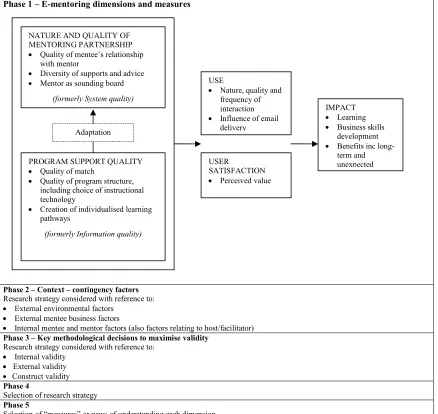
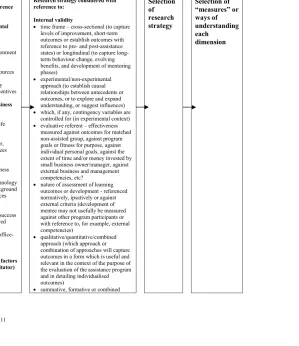
1.10 Overview of the proposed framework
Phase 1 – E-mentoring dimensions and measures
Phase 2 – Context – contingency factors Research strategy considered with reference to:
• External environmental factors
• External mentee business factors
• Internal mentee and mentor factors (also factors relating to host/facilitator) Phase 3 – Key methodological decisions to maximise validity
Research strategy considered with reference to:
• Internal validity
• External validity
• Construct validity Phase 4
Selection of research strategy Phase 5
Selection of “measures” or ways of understanding each dimension
Figure 1 - Rickard contingency framework for evaluation of structured e-mentoring (derived from DeLone and McLean’s 1992 model of IS success)
The framework set out in Figure 1 is a collapsed version of the expanded Figure 23 and Table 96 presented in Chapter 9. To summarise the proposed contingency framework,, Phase 1 of Figure 1 (expanded fully in Figure 23 and Table 96 in Chapter 9) incorporates the DeLone and McLean model respecified for the structured e-mentoring context further to the Literature review in Chapters 1 and 2, the results of a review of a selection of effectiveness studies in Chapter 3, critique and refinement by an expert panel in Chapter 4, and the application of the framework in Chapters 7 and 8. The respecified DeLone and McLean model represented in Phase 1 also details the linkages between effectiveness and the DeLone and McLean dimensions identified in the examination of actual practice. The detail of the proposed linkages within each of the dimensions is expanded in Figure 23.
NATURE AND QUALITY OF MENTORING PARTNERSHIP
• Quality of mentee’s relationship with mentor
• Diversity of supports and advice
• Mentor as sounding board
(formerly System quality)
IMPACT
• Learning
• Business skills development
• Benefits inc long-term and unexpected USE
• Nature, quality and frequency of interaction
• Influence of email delivery
USER
SATISFACTION
• Perceived value PROGRAM SUPPORT QUALITY
• Quality of match
• Quality of program structure, including choice of instructional technology
• Creation of individualised learning pathways
(formerly Information quality)
Phase 2 of Figure 1 (expanded fully in Table 96) codifies the contextual influences upon which effectiveness is contingent. These influences are classified as External environmental factors, External mentee business factors and Internal mentee and mentor factors. Phase 3 of Figure 1 (also expanded fully in Table 96) outlines the methodological decisions identified as common to the informing disciplinary areas to be considered in developing an evaluation strategy. These are classified for the potential impact of the decisions on the validity of an effectiveness study. Phases 4 and 5 represent in sequential terms the finalisation of the process of selecting an evaluation strategy which this figure represents.
This thesis is a critical exposition of the program of research which led to the final
specifications that are set out in Figure 23 and Table 96 of Chapter 9 and summarised here.
1.11 Context of e-mentoring research and practice for self-employed professionals
The evaluation of the effectiveness of structured e-mentoring for small business sits at the intersection of the three problematic research areas of (a) small business training/entrepreneurial learning, (b) mentoring and (c) e-mentoring. The study occurs at a time of growth in non-standard work arrangements, when support for small business is a priority, and information communications technology offers new opportunities for delivering support and assistance.
To set this research into the current Australian context, it was necessary to briefly review the literature and data sources in the areas of the contribution of small business to the Australian economy, the importance of the self-employed as a segment of the labour market, the growth in non-standard work, and the global imperative for training solutions which utilise information and communications technology. It was also necessary to position the study by acknowledging the lag in mentoring effectiveness evaluation research behind practice in the small business e-mentoring context.
1.11.1 The contribution of small business to the Australian economy and
Government mentoring assistance programs
For the purposes of this thesis, the definition of small business will be that adopted by the Australian Bureau of Statistics (2001) as a business employing less than 20 people. Categories of small businesses include:
• non-employing businesses - sole proprietorships and partnerships without employees;
• other small businesses - businesses employing 5 or more people, but less than 20
people.
The application of the framework involves self-employed contractors who are a segment within small business. They are defined in detail in Chapter 5, Section 5.2.3.
The importance of the small business sector to the Australian economy is widely recognised. At 2001, small businesses employed over 3.5 million people comprising 49 per cent of private sector employment, they accounted for 13 per cent of total export revenue in 2000, and in 2002, contributed around 30 per cent to Australia’s Gross Domestic Product (Australian Bureau of Statistics 2001). A range of current Government assistance programs funded and administered under the Building Entrepreneurship in Small Business Program (prior to 2005, known as the Small Business Enterprise Culture Program), provide mentoring support to small business owners/operators in an effort to maximise the contribution of the small business sector to promoting sustainable economic growth, creating employment and improving export performance.
1.11.2 Growth of self-employed contractors within small business sector and
growth of professionals as an occupational group within self-employed contractors
A 2001 Productivity Commission report, Self-Employed Contractors in Australia: Incidence and Characteristics (Waite & Will 2001) concludes that contracting including independent
contracting, dependent contracting and sub-contracting, had grown relative to the employed workforce in Australia between 1978 and 1998. The authors however discuss the difficulties with obtaining accurate and comparable time series data. They suggest that: “[r]esearchers investigating contract employment have had to deal with a lack of suitable data in the official Australian Bureau of Statistics (ABS) labour force collections ... [because] until 1998, the ABS did not collect data specifically on contracting” (2001 p.17). The nature of ABS data collection and analysis, they suggest, may have led to incorrect conclusions. They go on to state:
Self-employed contractors are classified within the own-account worker, employee and employer categories in standard ABS labour force data. A quick look at the LFS [Labour Force Survey] data indicates that own-account workers and employers fell as a share of total employment between February 1978 and August 1998 (ABS 1997b, Cat. No. 6359.0). However the raw data are deceptive. Owner-managers of incorporated enterprises can effectively be working either on their own account or as employers, but because they are employees of their own business they are classified into the employee category of the LFS data. If they are redistributed into the own-account worker and employer categories it is clear that these forms of employment became more common in the two decades to 1998 (Table 3.1):
Table 3.1 The distribution of employment by type* Share of total employment
February 1978 August 1998
Employers 6.7 8.6
Own-account workers 9.7 11.8
Employees 83.6 79.6
*Owner-managers of incorporated enterprises have been redistributed from the employee category of LFS data to the own-account worker and employer categories. Sources: ABS (‘Owner managers of incorporated enterprises’, Feature article, Labour Force, Australia. Cat. No. 6203.0, July; Forms of employment survey, ABS Cat. No. 6359.0)
“… In summary, time-series data specifically on self-employed contracting do not exist. Within the ABS time series data on different categories of employment, self-employed contractors are classified within the employee, own-account worker and employer groups, and cannot be separately identified. However, these data can be used to shed light on changes across time in self-employed contracting.
Between 1978 and 1998 the shares of own-account workers and employers in total employment rose, while the share of employees fell. Using this information, and assuming that the shares of self-employed contractors in each type of employment in 1978 and 1998 as those reported by VandenHeuvel and Wooden (1995a) for 1994, the share of self-employed contractors in total employment rose from about 7.3% in 1978 to 8.4% in 1998 - a 15 per cent increase.
Furthermore, own account employment growth has been higher in industries in which self-employed contracting is relatively common. It is therefore likely that the share of self-employed contracting in own-account employment has risen. Because the majority of self-employed contractors ... are classified as own-account workers, it is therefore likely that the share of self-employed contractors in total employment has grown to more than 8.4 per cent.
Evidence from cross section data suggest an increase in contracting generally, but the comparable data from more than one point in time ... do not permit a clean
identification of self-employed contractors (2001, pp.27-28).
The difficulties of accessing Australia-wide aggregated data is clearly problematic - and this is also the case with obtaining data for particular industry segments or occupational categories.
Waite and Will (2001) did however confirm the relatively high percentage of professionals as an occupational group operating as self-employed contractors compared with other occupational groups:
The share of self-employed contractors in the professionals workforce, 10 per cent, was high relative to contractors’ share in most other occupational groups.
(Productivity Commission estimate derived from ABS Forms of Employment Survey, Cat. no. 6359.0)
1.11.3 Growth of contingent workforce and implications for training
This research intersects with recent debate around the growth of the contingent or non-standard workforce. Recent studies have indicated that there are significant implications for training and skills development for those in non-standard work arrangements (Hall et al. 2000, Bound & Owen 2000, Vandenheuvel & Wooden 1999). The Hall et al. study found a link between low levels of skills formation and non-standard forms of work. In light of the significant and growing proportion of professionals in non-standard work arrangements, there is a potential impact on skills and knowledge formation for this group.
1.11.4 International Labour Organisation (ILO) Recommendation on Human
Resources (HR) and Training
In 2004, the ILO formulated a Recommendation concerning Human Resources Development: Education, Training and Lifelong Learning which includes reference to the need to promote access to education, training and lifelong learning for people with nationally identified special needs including the self-employed, and to encourage the use of new information and
communications technology in learning and training (ILO 2003): The ILO recommends that: [m]embers should:
• promote access to education, training and lifelong learning for people with nationally identified special needs, such as youth, low-skilled people, people with disabilities, migrants, older workers, indigenous people, ethnic minority groups and the socially excluded; and for workers in small and medium-sized enterprises, in the informal economy, in the rural sector and in self-employment, and ..
• encourage the use of new information and communication technology in learning and training, to the extent possible.
The growth of self-employed contractors as a segment within the small business sector and their potential for differential access to training suggests that professionals operating as
self-employed contractors constitute a segment of the small business sector that justifies some attention; developing targeted technology-assisted training is potentially a useful way of assisting this group.
1.11.5 Lag between practice and research creates a gap in the literature
computer-mediated communication impacts the learning process,: that “the utilization of the medium .. has in many respects outstripped the development of theory on which to base such utilization” (Gunawardena et al. 1997 p.397-398 cited in Murphy 2004). This lag between practice and research was confirmed by Perren as characterising the e-mentoring field. Perren’s Review of the Literature (2002) acknowledged this and urged a robust examination of actual practice which explicitly addressed the evaluation of e-mentoring effectiveness. Megginson et al. also noted the scarcity of data available on e-mentoring effectiveness in the small business context (Megginson et al. 2003).
1.11.6 Summary
This section briefly highlighted each of the major contextual factors which make this study significant. The importance of small business to the growth of the Australian economy, the growing and relatively high proportion of professionals which comprise self-employed contractors as a segment of the labour market, and the suitability of mentoring as a means of delivering suitable learning to those in small business make self-employed professionals a significant segment of small business, make effective mentoring support a timely and relevant issue. The use of information and communications technology to support learning and training for those in non-standard forms of work, the need to explore and understand how to provide some form of robust substantiation of e-mentoring effectiveness, and the need to provide a basis for developing theory to support the utilisation of computer-mediated communication in e-mentoring practice and evaluation all combine to make evaluation of the effectiveness of structured e-mentoring i relevant and important.
1.12 Literature review
The aim of this literature review is to identify the characteristics in each of the informing disciplinary areas which may constitute obstacles, difficulties and disincentives to evaluating effectiveness. This review will provide a basis for identifying the synergies between the key research challenges which characterise effectiveness evaluation across the informing disciplinary areas.
1.12.1 Key characteristics and research challenges in the informing disciplinary
areas – the small business context
areas of the complexity of the phenomena, context, methodology, data collection, paradigm location and measurement which arise out of this heterogeneity.
1.12.1.1 Complexity and variability in small business
In discussing the complexity and heterogeneity of the small business sector, Atterton says:
We talk about the small business sector as if it is some sort of market niche and I do not know how 96 per cent of anything can be a market niche. It is a massively heterogenous group and I think we could do far more in terms of segmentation: which segments we want to work with and how we develop the capability to work in that sector (Atterton 2002, p.970).
Assistance to the small business sector can therefore be characterised by, in Atterton’s terms, the need for segmentation. There is widespread acknowledgement of the “uniqueness” of each business in terms of size, the type of business engaged in, profit and turnover, whether home or office-based, the industry sector in which they operate, in the products and services produced, in the processes and level of technology used, and in the specific community and business
environment in which they are located (Tolentino 1998, Devins & Gold 2000). This complexity and the multiplicity of intervening contextual variables which may influence outcomes has implications not only for practice but also for exploring the concomitant variability in effectiveness outcomes.
1.12.1.1.1 The appropriateness of competency-based approaches in small business
In the United Kingdom, the trend in small business research is toward a competency-based approach to developing learning frameworks for owner-managers in small business. This approach whereby learning is related to broad external competencies is however criticised by Gibb who suggests that generic competency standards as a basis for entrepreneurial learning is inconsistent with the research on learning requirements for small business. The entrepreneurial literature strongly indicates a need and preference for individualised, contextualised and experiential learning (Gibb, A.A. 1997). This was also confirmed in the work of Devins and Gold (2000). “Cracking the Tough Nuts: mentoring and coaching the managers of small firms”, an exploration of mentoring of the managers of small firms who participated in a program called Building Management Competencies. A case study approach was used to examine and evaluate the program’s impact on 20 organisations working closely with their Business Coach based on generic management competencies. Devins and Gold found that:
Devins and Gold found that the model of business support they applied did not provide for the heterogenous and diverse engagement with the support provided.
Just as the characteristics of small business have implications for practice, so too are there implications for evaluation research.
1.12.1.2 Quality of data in small business research
1.12.1.2.1 Nature of data
Much small business research gives rise to self-report data. Storey (1998) identified problems with bias and error in self-report research methods in small business in that “.. some
entrepreneurs will overestimate the impact of the initiatives … [while others] .. are likely to underestimate the contribution of policy by claiming that any improvements in their business reflected their entrepreneurial skills, rather than public money” (p.20). Nisbett (1977) suggested that findings using self-report data may be contradicted by findings using other methods of data collection, so data quality is a key methodological challenge in small business research.
1.12.1.2.2 Sampling problems
Sampling difficulties are a major issue with much small business research largely due to the heterogeneity of the sector. The segmentation approach advocated by Atterton has implications for research in that any sample based on a particular “segment” is potentially atypical of the small business sector more generally and this impacts on the validity of inferences made to the broader small business population.
The heterogeneity which characterises small business can also make it difficult to construct matched samples (Curran & Storey 2000). This means that experimental work comparing outcomes of a group which has accepted business support with a control group that has not, is problematic. Evaluating effectiveness which is grounded in positivist assumptions leads to a difficulty in establishing causality between an intervention and effectiveness.
Curran and Storey (2000) point out that while small sample size is not necessarily of itself a difficulty, the issue of response bias which may follow from small sample size is potentially a problem. They identify the most common biases in small business research as firm size bias (that is, smaller firms have been shown to be less likely to respond than larger firms) (Goffee and Scase 1995 cited in Curran & Storey 2000) and sector bias (that is, firms in some sectors are more likely to respond than others (Curran & Blackburn 2001). If the individuals or firms who respond have, in Curran and Blackburn’s terms, “had a more positive experience than those who do not” this may also result in response bias and therefore impact on the external validity of the research findings (Curran & Blackburn 2001 p.61).
1.12.1.2.3 Bias
While potentially having a positive impact on outcomes in practice, administrative and self-selection are problems which arise in evaluation research in relation to small business (Curran & Storey 2000). Curran and Storey define administrative selection as occurring “when only a proportion of the firms/individuals which apply to join [a] program are selected for inclusion” (2000 p.13). They define self-selection as occurring “when certain types of firms apply to join/participate in particular programmes” (p.13). The issue is that when these forms of selection occur, the outcomes of an intervention may not be representative in that the selection process may have involved firms or individuals who are atypical in some way. That is, the qualities that led to the individuals nominating or being selected for participation in a program may produce causal ambiguity in that these qualities, rather than the assistance program, may have contributed to the outcomes observed or reported.
Generalisability in small business research then is always open to challenge on the basis that the representativeness of the sample which supposedly represents the segment may be challenged therefore compromising generalisations to the particular small business segment and the small business sector more generally.
1.12.1.3 Measurement difficulties in small business research
1.12.1.3.1 Definition of concepts
1.12.1.3.2 Causality
Measurement problems are widely discussed in small business research. Storey’s study “Six Steps to Heaven” (1998) considers the evaluation of the impact of an assistance program. While it considers evaluation at the policy level, the methodological and conceptual difficulties which are discussed in Storey’s approach are also relevant to evaluation at other levels. Storey (1998) details the need to measure additionality with reference to deadweight and displacement, and discusses the difficulties with finding evaluators, politicians and policy-makers who will accept such issues as important to effectiveness evaluation.
Curran and Storey (2000) suggest that “it should be relatively easy to measure [additionality accounting for deadweight and displacement] .. but .. in practice, it is extremely difficult” (2000 p.11). This is because of the diversity of contextual variables which must be controlled to produce small business research with high internal validity. One of the major threats to internal validity is the failure to control for the influence of external or intervening variables which means outcomes cannot be attributed solely to the assistance provided to a small business (Buelens et al. 2005). This creates what is another major challenge in small business research - that of establishing causality between an intervention and its outcomes - because of the diversity of contexts into which the assistance is delivered, and the impossibility of controlling for all relevant variables.
Gibb confirms these challenges about small business training interventions when he states:
In the light of the substantial research that has been undertaken into cost benefit analysis of training there must be considerable doubt as to whether a definitive answer could ever be found to the question of payback on training (Gibb A.A. 1997 p.13).
Given the difficulties of, in Gibb’s terms, finding such definitive answers, the question then becomes “how can claims around structured e-mentoring effectiveness be substantiated?”, and this is the subject of this study.
1.12.1.3.3 Capturing intangible benefits
The difficulties with measurement are symptomatic of a broader debate within small business research around the challenge of measuring intangible impacts. Lenihan and Hart’s struggle with how to “calibrate less tangible impacts into deadweight estimates” (Lenihan & Hart 2004 p.10) sits alongside Wright and Tao’s discussion around the issue of “hard” and “soft”
business research has in the past been dominated by quantitative methods which are grounded in positivist assumptions based on the idea that reality can be explained and knowledge and truth revealed by using quantitatively-based experimental methods. In “Six Steps to Heaven” (1989) Storey asserts that sophisticated evaluation relies on objectives being specified in a quantitative manner in the form of targets (p.4). “It is then necessary,” he says “to compare the assisted firms with groups of firms not assisted by the policy” while all other influences are held constant (p.21). Storey does not address how experimental methodologies assist with understanding or quantifying, in his terms, the “unobservables” (Storey 1998 p.27).
1.12.1.4 Research paradigm – location of this study in relation to existing research
The present trend in evaluation of intervention programs for small to medium enterprises (SME) is a return to goal-orientated approaches. In the Organisation for Economic Co-operation and Development (OECD) report “Evaluation of SME Policies and Programmes”, Storey (2004) advocates the use of approaches which specify goals, quantify targets and evaluate program success in terms of achievement of these goals. Storey’s model uses a monitoring/evaluation continuum which both contrasts and has parallels with a transdisciplinary model of program evaluation set out by Scriven (1993).
Scriven elucidates some of the limitations of the goal-orientated approach which implicitly underpin Storey’s methodology. Principally, Scriven suggests that such an approach potentially fails to take account of what he refers to as shortfalls, overruns and side effects. Scriven (1993) rejects the idea that program evaluation should simply involve assessing the attainment of predetermined goals. Such an approach may neglect important information on the effectiveness of a program. He says of side effects:
Side effects are often the main point ... Side effects were a latent killer for a literal interpretation of goal achievement evaluation. They cannot be ignored because they may require the abandonment of an otherwise successful program or the salvation of an otherwise unsuccessful program. But it is hard to design an investigation to find them, since they are, more or less by definition, unanticipated. The only systematic methodology for detecting side effects is the goal-free approach (p.49).
Storey is that it effectively values at zero the intangible, unanticipated “side effects” and evolving benefits.
Storey proposes a “Six Steps” taxonomy for evaluating SME assistance programs. The steps include Step 1 - Take up of schemes, Step 2 - Recipients Opinions, and Step 3 - Recipients views of the difference made by the Assistance. These three steps are referred to by Storey as monitoring. The next three steps include Step 4 - Comparison of the Performance of ‘Assisted’ with ‘Typical’ firms, Step 5 - Comparison with ‘Match’ firms, and Step 6 - Taking account of selection bias. Steps 4, 5 and 6 are referred to as evaluation. Storey goes on to say that using a control group, applying statistical methods to account for the influence of variables other than those being studied and measuring against specific and pre-set targets ensures appropriate evaluation is occurring. In his proposed evaluation framework, Storey suggests that measuring use and asking users about their perceptions of value can be referred to as monitoring because they do not take into account an intervention program’s objectives. A summary of the binary oppositions created by Storey’s stance are set out in Table 1.
Table 1 – Summary of characteristics of monitoring compared with evaluation according to Storey 1998
Monitoring Evaluation
• undertaken by cheap and cheerful brigade
• happy sheets
• sloppy analysts
• analysts without integrity
• methodology – report (includes selfish and self-interested as well as truthful)
• only building blocks for evaluation
• simple
• targets – anything it happens to hit
• selection methods ignored
• not Heaven
• careful
• accurate
• sophisticated
• serious research community
• methodology – must necessarily involve a control group
• statistical methods
• objectives which should be quantified and become explicit targets
• approach receives “heavyweight” support
• controlled for selection
• Heaven
What are the implications of the conceptual separations between monitoring and evaluation set out in Table 1 for effectiveness evaluation in the small business context?
Storey’s approach is limited in that it is prescriptive about methodologies to be used to evaluate effectiveness. The most significant limitation of Storey’s analytical framework is that outcomes which cannot be researched using quantitative methods are implicitly valued as contributing less to an understanding of effectiveness than those which can be measured in quantitative terms.