R E S E A R C H
Open Access
Intelligent throat polyp detection with separable
compressive sensing
Wei Wang
*, Dunqiang Lu
*, Ying Wang, Qinghua Chen and Baoju Zhang
Abstract
Compressive sensing can minimize the collection of redundant data in the acquisition step. However, it requires a huge amount of storage and creates a tremendous computation burden due to the size of random measurement matrix in compressive sensing theory for big data collection. The separable compressive sensing theory uses two-dimensional separable random measurement matrixes instead of a huge size of random matrix to remedy sensing matrix storage and computation complexity. In this paper, we proposed an intelligent throat polyp detection with singular value decomposition and support vector machine algorithms based on the vowel/a:/and/i:/ voices. We compared the detection effects of the proposed intelligent detection method between original voice signals and compressed signals which were collected by separable compressive sensing theory. The experimental results showed that the matrix size of original vowel voices signal could affect the correct rate of prediction. Also, the correct rate of prediction was stable under different random measurement matrix and different compressed ratio.
Keywords:Throat polyp detection; Separable compressive sensing; Support vector machine; Singular value decomposition
1 Introduction
A throat polyp is an abnormal growth of tissue that grows in the throat which is often referred to as vocal polyps because the majority of these growths are located on the vocal cords. The presence of polyps in the throat is often non-life threatening but can also become cancerous, so a doctor should perform a biopsy. It is common to have throat polyps and to be completely unaware of them, particularly if they are fairly small. These polyps then break off and disappear inside the body or clear up by themselves. However, throat polyps can increase in size to the extent that they affect a person's ability to speak.
The position of these polyps will determine the effect on the voice. They can change the pitch of the voice so that it becomes lower than normal or cause the voice to sound hoarse and croaky.
The traditional methods of throat polyp diagnosis are indirect laryngoscope, video-laryngoscope, and strobo-scope light [1]. These methods need special instrument
and depend on the experience of the pathologists. Also, the patients will feel uncomfortable pain usually. Ac-cording to the symptoms of throat polyps, it can be seen that the throat polyps would be detected based on the change of patient voices. In [2], the statistical character-istic root-mean square-delay spread and standard devi-ation were employed to describe the speech frequency domain characteristic and used as two antecedents. The Fuzzy logic system was used to make polyp patients' diagnosis. The results demonstrated that the proposed method could detect the throat polyps with low prob-ability of miss detection and 0% false alarm rate. In [1], two fuzzy classifiers and a Bayesian classifier were de-signed for throat polyp detection based on patient vowel voices/a:/and/i:/. Also, the experimental results showed that an interval type-2 fuzzy classifier performed the better. Meanwhile, short-time Fourier transform and singular value decomposition were applied to the vowel voice samples and the power decay rate could be ob-served. It can be used as an identifier in throat polyp de-tection. In [3], some methods of speech analysis for the diagnosis of the laryngeal function have been discussed.
* Correspondence:[email protected];[email protected] College of Electronic and Communication Engineering, Tianjin Normal University, Tianjin 300387, China
Also, a new scheme for the diagnosis of the voice using parametric method has been presented because that the existing methods cannot be applied in clinical case. In [4], a novel algorithm based on Daubechies' discrete wavelet transform, linear prediction coefficients, and least squares support vector machines to identify laryn-geal pathologies by the digital analysis of the voice has been described. The experimental results showed that the proposed approach led to an adequate larynx path-ology classifier to identify nodules in vocal folds and it presented over 90% of classification accuracy. However, more voice data should be sampled in order to reach a better diagnosis result. It becomes increasing difficult due to the sampling bandwidth and storage space con-straints. In this paper, we will use the separable compres-sive sensing and singular value decomposition (SVD) to detect the throat polyps based on support vector machine (SVM) algorithm while reducing the burden of voice data collection and storage.
Compressive sensing (CS) has attracted the interest of theoreticians and practitioners which was proposed by Donoho and Candès in 2006 [5,6]. In contrast to the common framework of first collecting as much data as possible and then discarding the redundant data by digital compression techniques, CS can minimize the collection of redundant data in the acquisition step [7]. Then, the original signal could be reconstructed from the low-dimensional information with solving an optimization problem. It means that the compressed sampled data con-tained the main features of the original signal. However, the bottleneck of CS for big data collection is due to the size of random measurement matrix which requires a huge of storage and creates a tremendous computations burden. To overcome the difficulty, a separable com-pressive sensing operator was proposed and the cost of it manifested as a small increase of the number of com-pressive samples but remedied sensing matrix storage and computation complexity [7,8].
According to the merits of separable compressive sensing in big data collection, an intelligent throat polyp detection algorithm based on vowel voices analysis of the patients with separable compressing sensing is proposed in this paper. The remainder of the paper is organized as follows. In the Section 2, the throat polyp detection method with SVD and SVM will be deduced. Then, the theory of separable compressive sensing will be introduced in Section 3. Experimental results of throat polyp detection with the proposed procedure will be showed and analyzed in Section 4. Section 5 is the conclusion and discussion.
2 Intelligent throat polyp detection algorithm A speech usually consists of vowels and voiced conso-nants. The voiced consonants cannot produce vocal cord
vibration because they come from the vibration of lips and teeth. Meanwhile, the multi-vowel in one speech samples can result in an aliasing in spectrum map of the samples. Consequently, we only use the vowels to investigate the throat polyp detection methods based on voices of patients, especially vowels /a:/ and /i:/ in this paper.
2.1 Singular value decomposition of vowel voices
A successive speech of vowel /a:/ or /i:/ usually has periodic change characteristics every once in a while. Thus, we can construct aP×QmatrixDto express the whole successive speech, where the length of each vowel voice segment is QwithPsegments.
SVD is one of a number of effective numerical analysis tools used to analyze matrices. A SVD of the matrixDis its factorization of the form
D¼USVT ð1Þ
whereUis aP×Porthogonal matrix,Vis aQ×Q orthog-onal matrix, whileSis aP×Qdiagonal matrix with non-negative diagonal elementsλi. The quantitiesSiare called singular values of the matrix D. The singular values con-tain very valuable information about the properties of the matrix [9-11].
In order to eliminate the effect of small diagonal ele-ments for throat polyp detection, we only chose the main K elements and normalized them with followed formula.
Therefore, the mainKsingular values will varied when a person suffer throat polyps. In other words, they can be analyzed for throat polyp detection with intelligent algorithms. We can choose the parameter K when the sum ofKsingular values is nearly be same with the sum of all singular values.
2.2 Intelligent throat polyp detection based on SVM SVM is a relatively new computational learning method based on the statistical learning theory which is based on Vapnik-Chervonenkis theory. The SVM is based on the structural risk minimization principle rooted in the statistical learning theory and is a popular machine learn-ing method for classification, which has the potential to handle very large feature spaces.
Given a training set ofLdata points (f(xi),x),=1,2,3...L
where xi∈RK is the K singular values of a vowel voice.
(xi) =−1 for the class without throat polyps. The
classi-fier is constructed as follows. One assumes that [12,13]
ωTϕð Þ þxi b≥1; if f xið Þ ¼1;
ωTϕð Þ þxi b≤1; if f xið Þ ¼−1; ð3Þ
which is equivalent to
f xið ÞωTϕð Þ þxi b≥1; i¼1;2; ::::::L; ð4Þ
where φ is a nonlinear function which maps the input space into a higher dimensional space, and the vector φ is used to define the position of separating hyperplane. However, function (4) is not explicitly constructed. In order to obtain the separating hyper plane in the higher dimensional space, variables ξi are introduced to solve the following primal optimization problem
min ω;b;ξ
1 2ω
TωþCXN I¼1
ξi
subject to yiðωTϕð Þ þxi bÞ≥1−ξi ð5Þ
Through the successive training data, we can obtain the support vectors and kernel parameters in the model for prediction.
In this paper, we extract a successiveKsingular values of vowel voices /a:/ and /i:/ from patients with throat polyps and without throat polyps. Some data are used as training data for establishing classification model for throat polyp detection with SVM algorithm.
3 Background on separable compressive sensing Compressive sensing is an emerging theory that is based on the fact that a relatively small number of random projections of a signal can contain most of its salient information.
Given that an observation of an vowel voice x∈RN, it can be expressed as:
x¼Φθ; ð6Þ
where θ∈RN is the expansion coefficients vector under the orthonormal basis Φ. If θ has only U≤N nonzero coefficients, we can say that signalxis U-sparse.
If a length-N signal that is U-sparse in some basis, then it can be recovered exactly/approximately from a non-adaptive linear projection of the signal onto a random projection basis according to CS theory. In matrix nota-tion, it can be described as follows [14-25]:
y¼Ψx; ð7Þ
wherey∈RMandΨis anM×Nrandom matrix. The appeal of CS is that we only need to collect M=O(Klog(N/U)) random measurements to recover the signalxby solving thel0-norm constrained optimization problem.
For largeN, the storage of random measurement matrix Ψ∈RM×N
and computational solving (7) are hardly pos-sible. In the paper, we will show that the difficulties could be solved by using a random measurement matrix which is separable in two dimensions.
Considering the random projection matrix Ψ that is two dimensions separable, we can rewrite the Equation (7) as a two-dimeional (2-D) separable transform [7,8]:
Y¼ΨxX Ψy T; ð8Þ
whereX∈RP×Qis the 2-D representation of voice signalx with N=P×Q. The random matrix Ψ can be given by the Kronecker product of matrixΨx ∈ Rm × P and Ψy∈
Rn × Q
,Ψ=Ψx⊗Ψy. Note that random matrix Ψ is de-termined by as little as (m×P+n×Q) entries compared to random non-separable matrix which is determined by
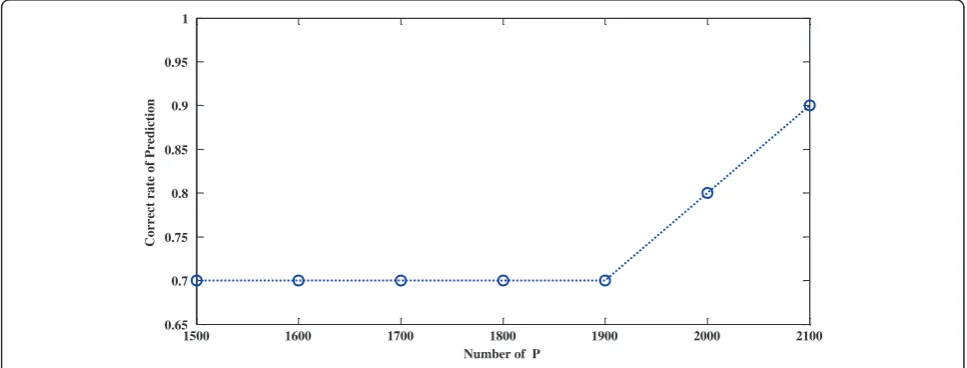
1500 1600 1700 1800 1900 2000 2100
0.65 0.7 0.75 0.8 0.85 0.9 0.95 1
Number of P
Correct rate of Prediction
(M×N) entries. It can alleviate the storage and compu-tation burden of random matrix obviously.
Further, the orthonormal basis Φ also can be given by the Kronecker product. Then, Equation (8) can be further changed as:
Y¼ΨxΦxΘ Φy T Ψy T; ð9Þ
whereΦ=Φx⊗Φy,Θis the 2-D representation of the expansion coefficients vectorθ. We can rewrite the re-construction formula based on the recovery theory of compressive sensing.
mink kΘ 1 subject to Y ¼ΨxΦxΘ Φy T Ψy T:
ð10Þ The provable success of separable CS for signal recon-struction demonstrated that the collected low-dimensional measurementsYcontained the main features of the original
signal. In other words, we may detect the throat polyps with compressed samples which are collected by separable compressive sensing based on the proposed intelligent algorithm.
4 Experimental results and analysis
In the experiments, vowel /a:/ and /i:/ voice signals of 26 patients were collected which 13 patients have throat polyps and 13 patients did not have throat polyps. The main 20 singular values were chosen as the features. The C-SVM program proposed by Dr. Lin was used for the classification and throat polyp prediction.
Firstly, we tested the classification effect for differentP and Qwith the proposed intelligent detection algorithm based on SVD and SVM. The features of eight patients without throat polyps and eight patients with throat polyps were used as training data for creating the predic-tion model. The other features of ten patients were used
100 150 200 250 300 350 400 450 500 550
0.5 0.55 0.6 0.65 0.7 0.75 0.8 0.85 0.9
Number of Q
Correct Rate of Prediction
Figure 2Correct rate of throat polyp prediction under differentQwithP= 2,000.
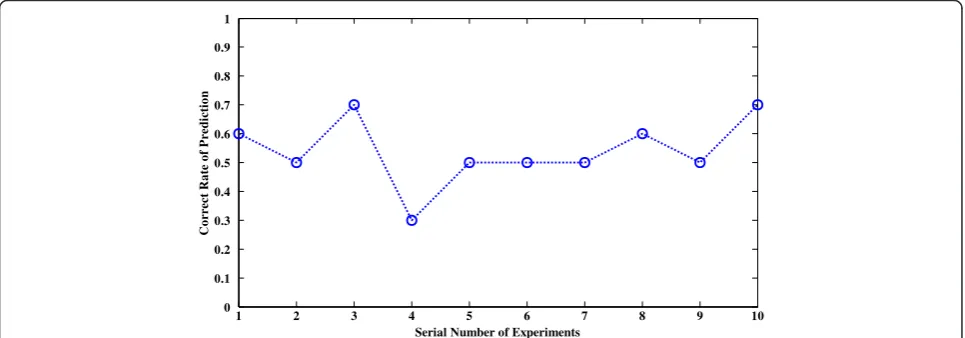
1 2 3 4 5 6 7 8 9 10
0 0.1 0.2 0.3 0.4 0.5 0.6 0.7 0.8 0.9 1
Serial Number of Experiments
C
o
rrect R
a
te o
f P
redi
cti
o
n
to test the performance of the detection method. The experimental results were showed in Figures 1 and 2.
Figures 1 and 2 showed the prediction results of throat polyp detection under differentP with stationary Qand differentQwith stationaryP. It can be seen that the size of matrixDhas influence on the correct rate of prediction. The correct rate will be higher with the longer the length of row, because we could get a more complete period of vowel voices when the length of row in matrix D. In the other hand, the correct rate of prediction was fluctuant with increasing length of column in matrixD. It was be-cause the length of column was influence on singular values. Therefore, we should collect the vowel voice signals with a complete period of voices to improve the correct rate of prediction.
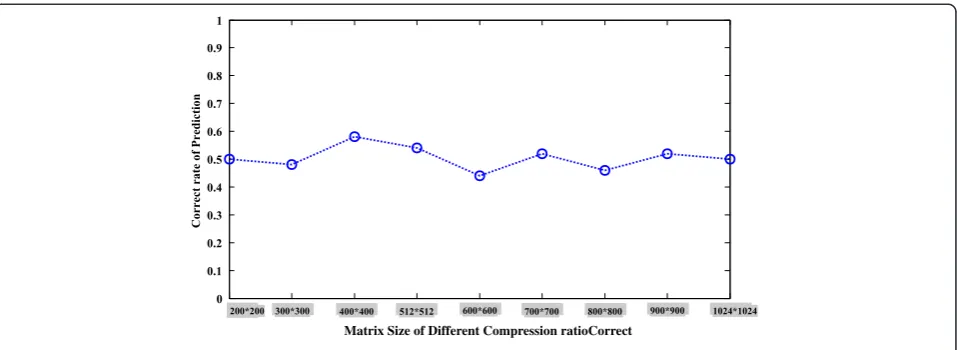
Secondly, we used the separable compressive sensing theory to obtain the compressed vowel voice signals and predicted the classification results with the pro-posed intelligent algorithm. We set up the matrix D with the size of 1,024 × 1,024 and test the correct rate of prediction with the compressed data matrix under different compression ratio. The results were showed in Figures 3 and 4.
According to the separable compressive sensing theory, we can see that the measurement matrix is random. Therefore, the correct rate of prediction for compressed data may not be the same under different random meas-urement matrix. We predicted the detection results under ten different random measurement matrixes when the size of compressed data was 512 × 512. Figure 3 showed the prediction results. It could be seen that the mean value of correct rate of prediction was about 50% with small fluctuations. It manifested that the singular values used for training and testing with SVM were similar though obtained with different random measurement matrixes. Moreover, the less training samples also caused the fluctuation of low correct rate of prediction.
Figure 4 showed the prediction results of different com-pressed ratio, and all correct rates of prediction were the mean value of five detection results under different ran-dom measurement matrix. We also could see that the cor-rect rate of prediction was about 50% for different compressed ratio while we thought that the fluctuations might be caused by the few training data. It demonstrated that the intelligent throat polyp detection method with compressed data was effective even with very few data. It conquered the storage and computation burden for throat polyp detection in big data domain.
5 Conclusions
Big data is the term of a collection of large, complex, longitudinal, and distributed data sets that it becomes difficult to process using on-hand database management tools or traditional data processing applications. Compres-sive sensing theory can sample and compress data simul-taneously which provide a new approach for big data classification.
In this paper, we proposed an intelligent method to detect throat polyps with SVD and SVM based on the vowel voices of the patients. Due to the burden of voice signals in storage and computation, we used the separable compressive sensing theory for data compressing and sampling. Then, the throat polyp detection was carried out in the compressed domain. The experimental results demonstrated that the performance of the prediction was stable.
Competing interests
The authors declare that they have no competing interests.
Acknowledgements
The authors would like to thank Professor Qilian Liang in University of Texas at Arlington for providing the experimental data. This research was supported by the Tianjin Younger Natural Science Foundation
(12JCQNJC00400), National Natural Science Foundation of China (61271411), and Tianjin Natural Science Foundation (13JCYBJC15800).
Matrix Size of Different Compression ratioCorrect
Received: 16 November 2013 Accepted: 7 January 2014 Published: 16 January 2014
References
1. Z Zhong, Z Chen, Q Liang, S Xiao, Throat polyps detection based on patient voices. Lect Notes Electr Eng202, 531–539 (2012)
2. Z Zhong, T Jiang, WS Zhang, H Yao,Analysis Speech of Polypus Patients Based on Channel Parameters and Fuzzy Logic Systems(Proceedings of the 2010 Seventh International Conference on Fuzzy Systems and Knowledge Discovery, Yantai, 2010), pp. 529–532
3. JM Choi, MW Sung, KS Park, New Method in Acoustic Analysis for the diagnosis of the Laryngeal Functions. Proc Second Jt EMBS/BMES Conf10, 135–136 (2002) 4. E Silva Fonseca, R Capobianco Guido, P Rogerio Scalassara, C Dias Maciela,
JC Pereiraa, Wavelet time-frequency analysis and least squares support vector machines for the identification of voice disorders. Comput Biol Med 37, 571–578 (2007)
5. DL Donoho, Compressed sensing. IEEE Trans Inf Theory52(4), 1289–1306 (2006) 6. E Candès,Compressive sampling, in Proceedings of International Congress of
Mathematicians(European Mathematical Society Publishing House, Madrid, 2006), pp. 1433–1452
7. Y Rivenson, A Stern, Compressed imaging with a separable sensing operator. IEEE Signal Process Lett16(6), 449–452 (2009)
8. Y Rivenson, A Stern,Practical Compressive Sensing of Large Images
(Proceedings of the 16th International Conference on Digital Signal Processing, Santorini-Hellas, 2009), pp. 1–8
9. A Hocker, V Kartvelishvili, SVD approach to data unfolding. Nucl Inst Methods Phys Res A372, 469–481 (1996)
10. CC Chang, P Tsai, CC Lin, SVD-based digital image watermarking scheme. Pattern Recogn Lett26, 1577–1586 (2005)
11. B Zhang, W Wang, Through-wall detection of human being with compressed UWB radar data. Eurasip J Wirel Comm2013, 162 (2013)
12. CC Chang, CJ Lin, LIBSVM: a library for support vector machines. ACT Trans Intell Syst Technol2(27), 1–27 (2011)
13. A Widodo, BS Yang, Support vector machine in machine condition monitoring and fault diagnosis. Mech Syst Signal Process21, 2560–2574 (2007) 14. L Xu, Q Liang, X Cheng, D Chen, Compressive sensing in distributed radar
sensor networks using pulse compression waveforms. Eurasip J Wirel Comm (2013). DOI: 10.1186/1687-1499-2013-36
15. L Xu, Q Liang, Zero Correlation Zone Sequence Pair Sets for MIMO Radar. IEEE Trans Aerospace Electron Syst48(3), 2100–2113 (2012)
16. L Xu, Q Liang,Orthogonal Pulse Compression Codes for MIMO Radar System
(IEEE Globecom, Miami, FL, 2010)
17. L Xu, Q Liang,Waveform Design and Optimization in Radar Sensor Network
(IEEE Globecom, Miami, FL, 2010)
18. Q Liang, JM Mendel, Design interval type-2 fuzzy logic systems using SVD-QR method: rule reduction. Int J Intell Syst15(10), 939–957 (2000)
19. W Wang, X Zhou, B Zhang, J Mu,Anomaly Detection in Big Data from UWB Radars(Wiley Security and Communication, Networks, 2003)
20. Q Liang, J Wu, X Cheng, D Chen, J Liang,Sparsity and compressive sensing of sense-through-foliage radar signals(Proceedings of the 2012 IEEE
International Conference on Communications, Ottawa, 2012), pp. 6367–6380 21. J Chen, Q Liang, J Paden, P Gogineni,Compressive Sensing Analysis of
Synthetic Aperture Radar Raw Data(Proceedings of the 2012 IEEE International Conference on Communications, Ottawa, 2012), pp. 6367–6380 22. J Chen, Q Liang,Rate Distortion Performance Analysis of Compressive Sensing
(Proceedings of the IEEE Globecom, Houston, TX, 2011), pp. 1–5 23. Q Liang,Compressive Sensing for Synthetic Aperture Radar in Fast-Time and
Slow-Time Domains(Proceedings of the Asilomar Conference on Signals, Systems, and Computers, Pacific Grove, CA, 2011), pp. 1479–1483 24. D Kirachaiwanich, Q Liang,Compressive Sensing: to Compress or Not to
Compress(Proceedings of the Asilomar Conference on Signals, Systems, and Computers, Pacific Grove, CA, 2011), pp. 809–813
25. Q Liang,Compressive Sensing for Radar Sensor Networks(Proceedings of the IEEE Globecom, Miami, FL, 2010), pp. 1–5
doi:10.1186/1687-6180-2014-6
Cite this article as:Wanget al.:Intelligent throat polyp detection with separable compressive sensing.EURASIP Journal on Advances in Signal Processing20142014:6.
Submit your manuscript to a
journal and benefi t from:
7 Convenient online submission
7 Rigorous peer review
7 Immediate publication on acceptance
7 Open access: articles freely available online
7 High visibility within the fi eld
7 Retaining the copyright to your article