R E S E A R C H
Open Access
Cytoreductive nephrectomy with
thrombectomy before targeted therapy
improves survival for metastatic renal cell
carcinoma with venous tumor thrombus: a
single-center experience
Nienie Qi
1, Pengjie Wu
2, Jinchao Chen
1, Teng Li
1, Xianghui Ning
1, Jin Wang
3and Kan Gong
4*Abstract
Background:The aim of the study is to evaluate the role of cytoreductive nephrectomy (CN) with thrombectomy before targeted molecular therapy (TMT) on survival in metastatic renal cell carcinoma (mRCC) with venous tumor thrombus.
Methods:We performed a retrospective analysis of 47 patients treated in our center from April 2008 to October 2014. In the study, 20 patients underwent CN with thrombectomy followed by targeted therapy (group 1); 15 patients received targeted therapy alone (group 2); and 12 patients underwent CN with thrombectomy alone (group 3). The overall survival (OS) and cancer-specific survival (CSS) were calculated according to the Kaplan-Meier survival curve method, and prognostic variables were assessed by Cox regression analyses.
Results:The median follow-up times of group 1, group 2, and group 3 were 24.5, 12, and 6.5 months, respectively. During follow-up, in both group 1 and group 3, 12 patients died. In group 2, 14 patients died. The median OS of group 1, group 2, and group 3 was 22, 12, and 6 months, respectively (P< 0.001). Compared with surgery alone and targeted therapy alone, patients with cytoreductive surgery before targeted therapy had statistically better survival benefits (P< 0.001,P= 0.009, respectively). On univariate analysis, the number of metastatic sites (P= 0.004) was a statistically significant prognostic factor influencing OS.
Conclusions:Our single-center experience showed that CN with thrombectomy before targeted therapy improved the survival of patients with mRCC with venous tumor thrombus. The number of metastatic sites was an
independent prognostic factor influencing OS.
Keywords:Renal cell carcinoma, Metastasis, Venous tumor thrombus, Cytoreductive surgery, Targeted molecular therapy
* Correspondence:[email protected]
4Department of Urology, Peking University First Hospital, Institute of Urology, Peking University; National Urological Cancer Center, No. 8, Xishiku St., Xicheng Dist, Beijing 100034, China
Full list of author information is available at the end of the article
Background
Venous tumor thrombus (VTT) occurs in approximately 5–10% of patients undergoing nephrectomy for renal cell carcinoma (RCC) [1]. In addition to venous involve-ment, 25% of patients with RCC have metastatic disease when diagnosed [2]. Patients with RCC and VTT should be considered for surgical intervention, irrespective of the extent of tumor thrombus at presentation [3]. Before the era of targeted therapy, two prospective randomized controlled trials had demonstrated the overall benefit of cytoreductive nephrectomy (CN) in metastatic RCC [4, 5]. A population-based study also showed the beneficial effect of CN on survival [6]. The emerging of targeted therapy offers more choices for mRCC and has prompted a reeval-uation of cytoreductive surgery [7]. Tyrosine kinase inhibi-tor (TKI) had been shown to extend the progression-free survival and overall survival [8]. Differential expression of prognostic proteomic markers, such as VEGFR1, was found in primary tumor, VTT, and metastatic renal cell cancer tissue [9], suggesting that TKI alone may help im-prove the survival of mRCC with VTT.
Although CN with inferior vena cava (IVC) thrombec-tomy was performed with acceptable complication rates [10], it remains unclear whether surgery is still a good choice for concomitant mRCC with VTT. Thus, we retrospectively evaluated the benefits of CN with thrombectomy before tar-geted therapy in patients presenting with mRCC with VTT.
Methods
We reviewed the medical records of all patients who presented to our center from April 2008 to October 2014 for evaluation of or treatment for concomitant mRCC with VTT. During the study period, 61 patients presented with concomitant mRCC with VTT who had received no systemic therapy. Among them, 20 patients underwent CN with thrombectomy followed by TMT (combined therapy, group 1); 15 patients received TMT alone (group 2); 12 patients underwent CN with thrombectomy alone (group 3); and 2 refused any therapy. The treatment of the other 12 patients was un-certain. Patients in group 1, group 2, and group 3 had postoperative pathology or biopsy confirmed of RCC histology. Metastasis was confirmed by radiology. The following clinical characteristics of each patient were recorded: age, gender, ECOG PS (Eastern Cooperative Oncology Group performance score), tumor size, pathologic type, nuclear grade, venous thrombus level, number of metastatic sites, T stage and N stage. These characteristics were potential prognostic factors [11–14]. Staging was determined according to the 2009 AJCC sta-ging system [15]. Nuclear grade was graded using the Fuhrman grading system [16]. Venous tumor extent was graded according to the Mayo Clinic grading system [17]. Nineteen patients received sorafenib (18 cases as
first-line therapy and 1 case as second-line therapy fol-lowing sunitinib). Sorafenib was administered at a dose of 400 mg twice daily and continued until disease pro-gression or the onset of an intolerable adverse drug event. The 19 patients received sunitinib (16 cases as first-line therapy and 3 cases as second-line therapy fol-lowing sorafenib). Sunitinib was administered at a dose of 50 mg once daily for 4 weeks, followed by 2 weeks off by repeated 6-week cycles. All the 19 patients were treated continuously until disease progression or un-acceptable toxicities occurred. Pazopanib monotherapy was administered at a dose of 800 mg once daily in 1 pa-tient. No neoadjuvant targeted therapy was used. In-formed consent was obtained from all individual participants included in the study. The study was ap-proved by the institutional review board from Peking University First Hospital.
Statistical analysis
Likelihood ratio with chi-square andttests was used for comparisons between groups in categorical and continu-ous variables, respectively. OS (overall survival) and CSS (cancer-specific survival) curves were derived by the Kaplan-Meier method with the log-rank test. Each group was further compared with Kaplan-Meier curve. Univar-iate Cox hazards regression were applied to evaluate the value of prognostic factors including advanced age, gen-der, ECOG PS, pathological type, nuclear grade, venous thrombus level, T stage, N stage, and number of metastatic sites in predicting OS and CSS. All statistical analyses were performed using SPSS version 19 (SPSS Inc., Chicago, IL, USA). Statistical significance was set at
P< 0.05.
Results
metastasis, and adrenal metastasis appeared in 9, 3, 1, and 1 patient, respectively.
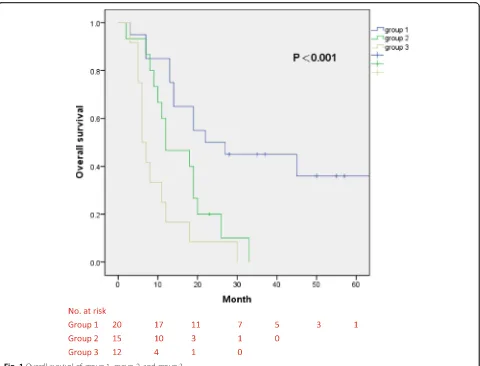
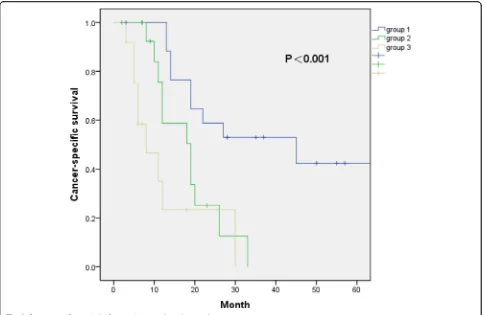
The median follow-up time of group 1, group 2, and group were 24.5 (range 3–66), 12 (range 2–33), and 6.5 (range 3–30) months. During follow-up, 12 patients died in both group 1 and group 3. Fourteen patients died in group 2. The median OS of group 1, group 2, and group 3 was 22 (95% CIs 4.5–39.5), 12 (95% CIs 3.2–20.8), and 6 (95% CIs 4.3–7.7) months, respectively (P< 0.001, Fig. 1). The median CSS of group 1, group 2, and group 3 was 45, 19, and 8 months, respectively (P< 0.001, Fig. 2). The me-dian progression-free survival of group 1 and group 2 were 12 (range 1–66) and 9 (range 2–23) months, respect-ively. Compared with patients who underwent surgery alone or targeted therapy alone, patients with
cytoreductive surgery before targeted therapy had statisti-cally better overall survival benefits (P< 0.001 and P= 0.009, respectively). Patients with combined therapy also had better CSS benefits. In a univariate Cox proportional hazards model to predict OS, we found that the number of metastatic sites was a significant predictor of OS (Table 2). Compared with patients with solitary metas-tasis, patients with more than one metastatic site had a 2.94-fold higher risk of overall mortality (95% CIs 1.41–6.09, P= 0.004). However, the number of metas-tasis did not affect the probability of CSS (Table 2).
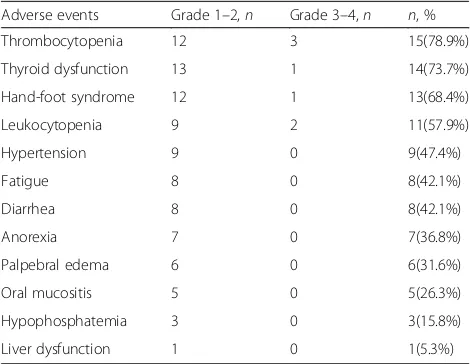
One patient in group 1 achieved complete remission. None of patients in group 2 achieved complete remis-sion. The median treatment duration of sorafenib was 8 months. Adverse events were shown in Table 3. Most of them were grade 1–2 adverse events. The grade 3–4 major adverse events (4 cases) included hand-foot syn-drome (2 cases), rash (1 case), and fatigue (1 case). All of them kept treatment with symptomatic support. The median treatment duration of sunitinib was 12 months. Ad-verse events were shown in Table 4. The grade 3–4 major adverse events (7 cases) included thrombocytopenia (3 cases), leukocytopenia (2 cases), hand-foot syndrome (1 case), and thyroid dysfunction (1 case). Six patients had dose decrement or drug discontinuation. All of them kept treat-ment with symptomatic support. The patient treated with pazopanib emerged with hand-foot syndrome, nausea, and vomit during treatment. After 16 months, he progressed with lung metastasis and withdrew from treatment.
Discussion
The combination of CN and systemic therapy plays an important role in the management of patients with mRCC. Retrospective studies suggest that mRCC pa-tients with IVC tumor thrombus may experience im-proved survival after surgical resection and systemic therapy. These studies were conducted before the current era of targeted therapy, which, at present, repre-sent a standard therapy for mRCC. In the era of targeted therapy, few researches explored this problem. Taekmin Kwon et al. found that surgical resection of the primary renal mass with IVC thrombus before use of TKI did not affect the overall mortality [18]. Conversely, Karin E et al. suggested that CN with IVC thrombectomy should be considered as an integral part of the treatment ap-proach for patients with mRCC with IVC tumor thrombi [10]. However, proper treatment of mRCC with VTT has yet to be determined. Our study showed that compared with surgery alone and targeted therapy alone, cytore-ductive surgery before targeted therapy improved the overall survival and cancer-specific survival of mRCC with VTT.
The prognosis was quite poor for the majority of pa-tients with RCC with VTT when left untreated,
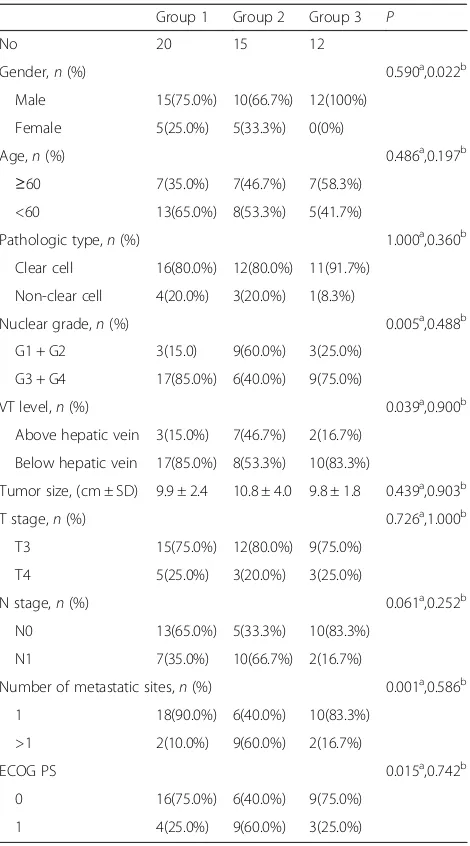
Table 1Patient demographics of group 1, group 2, and group 3
Group 1 Group 2 Group 3 P
Pathologic type,n(%) 1.000a,0.360b
Clear cell 16(80.0%) 12(80.0%) 11(91.7%)
Non-clear cell 4(20.0%) 3(20.0%) 1(8.3%)
Nuclear grade,n(%) 0.005a,0.488b
G1 + G2 3(15.0) 9(60.0%) 3(25.0%)
G3 + G4 17(85.0%) 6(40.0%) 9(75.0%)
VT level,n(%) 0.039a,0.900b
Above hepatic vein 3(15.0%) 7(46.7%) 2(16.7%)
Below hepatic vein 17(85.0%) 8(53.3%) 10(83.3%)
Tumor size, (cm ± SD) 9.9 ± 2.4 10.8 ± 4.0 9.8 ± 1.8 0.439a,0.903b
Number of metastatic sites,n(%) 0.001a,0.586b
1 18(90.0%) 6(40.0%) 10(83.3%)
Comparison between group 1 and group 2
b
especially for those with metastases. In patients present-ing with metastatic disease, 1-year DSS (disease-specific survival) was 23% (median DSS: 4 months) for those with thrombus below the diaphragm and 10% (median DSS: 3 months) for those with thrombus above the diaphragm [19]. For those with distant metastases at the time of diagnosis who underwent surgery, 1-year survival was 60%. This finding highlighted the import-ance of surgery on their prognosis. With the develop-ment of surgical skills, novel anesthetic technique, and hemodynamic monitor, the perioperative mortality and complications associated with nephrectomy with thromb-ectomy decreased to an acceptable level [17, 20]. In some patients, surgery may help to relieve symptoms. However, the surgery was still challenging, and surgery-related mor-bidity or mortality could not be neglected. Bissada et al. reported higher perioperative mortality in patients with metastasis (33%) versus patients without metastasis (2%) [21]. Fortunately, all of the 32 patients survived surgery in our center. However, some patients may undergo disease
progression during recovery from surgery and may not proceed to receive systemic therapy for their metastatic tumor burden [22]. In fact, we observed that some pa-tients failed to receive targeted therapy after surgery for several reasons. Silberstein et al. [23] have demonstrated that patients with poor performance status are more likely to experience postoperative complications, and these pa-tients tend not to receive systemic therapy on time after surgery. Culp et al. [24] identified seven risk factors that predicted inferior OS after CN, including high lactate de-hydrogenase activity, low albumin level, symptoms caused by metastatic disease, liver metastasis, retroperitoneal ade-nopathy, supradiaphragmatic adeade-nopathy, and a greater than cT3 disease. Patients with≥4 risk factors did not ap-pear to benefit from CN. Based on the present study, it seems that patients’ general condition and performance status should be used to best define candidates for CN with VTT. While the risk of perioperative complications outweighed the potential benefits, cytoreductive surgery should not be the first option considered.
On univariate Cox regression analysis, pathologic type, nuclear grade, and venous tumor thrombus level were not significantly associated with survival. In contrast, more than one metastatic site was an independent prog-nostic factor of a poor OS. In fact, a previous study had already shown that the number of metastatic sites
affected the survival rates of the patients with mRCC [25]. This may be owing to the more disease burden and worse functional status. More studies are needed to help ameliorate the poor prognosis.
Our study had some limitations. The number of pa-tients was low and follow-up time was short. Because of
Fig. 2Cancer-specific survival of group 1, group 2, and group 3
Table 2Univariate analysis of potential prognostic factors for OS and CSS
Univariate for OS Univariate for CSS
Variables HR(95% CI) Pvalue HR(95% CI) Pvalue
Age (≥60 vs. <60) 1.56(0.82–2.96) 0.178 1.53(0.73–3.21) 0.256
Gender (female vs. male) 1.02(0.48–2.17) 0.958 1.07(0.45–2.51) 0.883
ECOG PS (1 vs. 0) 0.59(0.29–1.20) 0.145 0.64(0.29–1.41) 0.267
Pathological type (non-clear cell vs. clear cell) 0.71(0.28–1.83) 0.480 0.76(0.26–2.18) 0.605
Nuclear grade (G3 + G4 vs. G1 + G2) 0.84(0.43–1.64) 0.608 0.65(0.31–1.40) 0.273
VT level (above hepatic vein vs. below hepatic vein) 1.67(0.71–3.03) 0.302 1.36(0.58–3.20) 0.482
T stage (T4 vs. T3) 1.50(0.70–3.20) 0.294 1.63(0.69–3.87) 0.264
N stage (N1 vs. N0) 1.32(0.69–2.54) 0.407 1.63(0.77–3.47) 0.203
Number of metastatic sites (more than 1 vs. 1) 2.94(1.41–6.09) 0.004 2.14(0.86–5.34) 0.103
Combined therapy
TMT alone 2.69(1.20–6.02) 0.017 3.25(1.28–8.27) 0.013
its retrospective nature, the study lacked randomization and has selection bias. Many factors may influence the decision to undergo cytoreductive surgery before tar-geted therapy. One obvious bias is that patients choosing targeted therapy alone have a higher percentage of mul-tiple metastatic sites. Pierorazio PM has already shown that patients with widespread metastatic burden may not benefit from surgery and are likely to choose conser-vative management [26]. A population-based study based on the surveillance, epidemiology, and end results database revealed a similar result [27]. Some patients even failed to receive targeted therapy after surgery for various reasons. In additional, these patients had not been resected of metastatic sites, even though complete metastasectomy provides benefits in terms of OS, CSS, and delay of systemic therapy [3]. Moreover, in our study, the population was small, so we did not introduce multivariable Cox analysis. Large-scale, randomized, and prospective studies are needed to determine the effect on survival of CN with thrombectomy before targeted therapy.
Conclusions
Compared with cytoreductive surgery alone and targeted therapy alone, CN with thrombectomy before targeted therapy may offer better survival for mRCC with VTT. Our single-center experience suggested a positive role for cytoreductive surgery followed by targeted therapy in these patients.
Abbreviations
CN:Cytoreductive nephrectomy; CSS: Cancer-specific survival; DSS: Disease-specific survival; ECOG PS: Eastern Cooperative Oncology Group performance score; IVC: Inferior vena cava; mRCC: Metastatic renal cell carcinoma; OS: Overall survival; TKI: Tyrosine kinase inhibitor; TMT: Targeted molecular therapy; VTT: Venous tumor thrombus
Acknowledgements
Not applicable.
Funding
This work was supported by grants from the Beijing Natural Science Foundation (7142160).
Availability of data and materials
Please contact author for data requests.
Authors’contributions
NQ conceived the study, participated in its design, collected the data, performed the statistical analysis, and drafted the manuscript. PW participated in its design, collected the data, and performed the statistical analysis. JC participated in its design, collected the data, and performed the statistical analysis. TL participated in its design and performed the statistical analysis. XN participated in its design and performed the statistical analysis. JW participated in its design and collected the data. KG participated in its design, collected the data, performed the statistical analysis, and helped to draft the manuscript. All authors read and approved the final manuscript.
Competing interest
The authors declare that they have no competing interests.
Consent for publication
Written informed consent was obtained from the patient for the publication of this report.
Ethics approval and consent to participate
Informed consent was obtained from all individual participants included in the study. The study was approved by the institutional review board from Peking University First Hospital.
Author details 1
Department of Urology, Peking University First Hospital, Institute of Urology, Peking University, Beijing, China.2Department of Urology, Beijing Hospital, Beijing, China.3Department of cardiac surgery, Peking University First Hospital, Beijing, China.4Department of Urology, Peking University First Hospital, Institute of Urology, Peking University; National Urological Cancer Center, No. 8, Xishiku St., Xicheng Dist, Beijing 100034, China.
Received: 11 May 2016 Accepted: 14 December 2016
References
1. Rabbani F, Hakimian P, Reuter VE, Simmons R, Russo P. Renal vein or inferior vena caval extension in patients with renal cortical tumors: impact of tumor histology. J Urol. 2004;171:1057–61.
2. Gupta K, Miller JD, Li JZ, Russell MW, Charbonneau C. Epidemiologic and socioeconomic burden of metastatic renal cell carcinoma (mRCC): a literature review. Cancer Treat Rev. 2008;34:193–205.
3. Ljungberg B, Bensalah K, Canfield S, Dabestani S, Hofmann F, Hora M, et al. EAU guidelines on renal cell carcinoma: 2014 update. Eur Urol. 2015;67:913–24.
Table 3Adverse events of sorafenib
Adverse events Grade 1–2,n Grade 3–4,n n, %
Diarrhea 11 0 11(57.9%)
Hand-foot syndrome 9 2 11(57.9%)
Hypertension 8 0 8(42.1%)
Alopecia 7 0 7(36.8%)
Rash 5 1 6(31.6%)
Fatigue 1 1 2(10.5%)
Nausea and vomit 1 0 1(5.3%)
Anemia 1 0 1(5.3%)
Leukocytopenia 1 0 1(5.3%)
Liver dysfunction 1 0 1(5.3%)
Elevation of uric acid 1 0 1(5.3%)
Table 4Adverse events of sunitinib
Adverse events Grade 1–2,n Grade 3–4,n n, %
Thrombocytopenia 12 3 15(78.9%)
Thyroid dysfunction 13 1 14(73.7%)
Hand-foot syndrome 12 1 13(68.4%)
Leukocytopenia 9 2 11(57.9%)
Hypertension 9 0 9(47.4%)
Fatigue 8 0 8(42.1%)
Diarrhea 8 0 8(42.1%)
Anorexia 7 0 7(36.8%)
Palpebral edema 6 0 6(31.6%)
Oral mucositis 5 0 5(26.3%)
Hypophosphatemia 3 0 3(15.8%)
4. Mickisch GH, Garin A, van Poppel H, de Prijck L, Sylvester R. Radical nephrectomy plus interferon alfa-based immunotherapy compared with interferon alfa alone in metastatic renal-cell carcinoma: a randomized trial. Lancet. 2001;358:966–70.
5. Flanigan RC, Salmon SE, Blumenstein BA, Bearman SI, Roy V, McGrath PC, et al. Nephrectomy followed by interferon alfa-2b compared with interferon alfa-2b alone for metastatic renal-cell cancer. N Engl J Med. 2001;345:1655–9.
6. Zini L, Capitanio U, Perrotte P, Jeldres C, Shariat SF, Arjane P, et al. Population-based assessment of survival after cytoreductive nephrectomy versus no surgery in patients with metastatic renal cell carcinoma. Urology. 2009;73:342–6. 7. You D, Jeong IG, Ahn JH, Lee DH, Lee JL, Hong JH, et al. The value of
cytoreductive nephrectomy for metastatic renal cell carcinoma in the era of targeted therapy. J Urol. 2011;185:54–9.
8. van der Veldt AA, Haanen JB, van den Eertwegh AJ, Boven E. Targeted therapy for renal cell cancer: current perspectives. Discov Med. 2010;10: 394–405.
9. Laird A, O'Mahony FC, Nanda J, Riddick AC, O'Donnell M, Harrison DJ, et al. Differential expression of prognostic proteomic markers in primary tumor, venous tumor thrombus and metastatic renal cell cancer tissue and correlation with patient outcome. PLoS One. 2013;8(4):e60483.
10. Westesson KE, Klink JC, Rabets JC, Fergany AF, Klein EA, Stephenson AJ, et al. Surgical outcomes after cytoreductive nephrectomy with inferior vena cava thrombectomy. Urology. 2014;84:1414–9.
11. Tilki D, Nguyen HG, Dall'Era MA, Bertini R, Carballido JA, Chromecki T, et al. Impact of histologic subtype on cancer-specific survival in patients with renal cell carcinoma and tumor thrombus. Eur Urol. 2014;66:577–83. 12. Ciancio G, Manoharan M, Katkoori D, De Los SR, Soloway MS. Long-term
survival in patients undergoing radical nephrectomy and inferior vena cava thrombectomy: single-center experience. Eur Urol. 2010;57:667–72. 13. Martínez-Salamanca JI, Huang WC, Millán I, Bertini R, Bianco FJ, Carballido
JA, et al. Prognostic impact of the 2009 UICC/AJCC TNM staging system for renal cell carcinoma with venous extension. Eur Urol. 2011;59:120–7. 14. Patard JJ, Leray E, Cindolo L, Ficarra V, Rodriguez A, De La Taille A, et al.
Multi‐institutional validation of a symptom based classification for renal cell carcinoma. J Urol. 2004;172:858–62.
15. Edge SB, Compton CC. The American Joint Committee on Cancer: the 7th edition of the AJCC cancer staging manual and the future of TNM. Ann Surg Oncol. 2010;17:1471–4.
16. Fuhrman SA, Lasky LC, Limas C. Prognostic significance of morphologic parameters in renal cell carcinoma. Am J Surg Pathol. 1982;6:655–63. 17. Abel EJ, Thompson RH, Margulis V, Heckman JE, Merril MM, Darwish OM, et
al. Perioperative outcomes following surgical resection of renal cell carcinoma with inferior vena cava thrombus extending above the hepatic veins: a contemporary multicenter experience. Eur Urol. 2014;66:584–92. 18. Kwon T, Lee JL, You D, Jeong IG, Song C, Ahn H, et al. Impact of surgery on
the prognosis of metastatic renal cell carcinoma with IVC thrombus received TKI therapy. J Surg Oncol. 2014;110:145–50.
19. Reese AC, Whitson JM, Meng MV. Natural history of untreated renal cell carcinoma with venous tumor thrombus. Urol Oncol. 2012;31:1305–9. 20. Parekh DJ, Cookson MS, Chapman W, Harrell Jr F, Wells N, Chang SS, et al.
Renal cell carcinoma with renal vein and inferior vena caval involvement: clinicopathological features, surgical techniques and outcome. J Urol. 2005; 173:1897–902.
21. Bissada NK, Yakout HH, Babanouri A, Elsalamony T, Fahmy W, Gunham M, et al. Long-term experience with management of renal cell carcinoma involving the inferior vena cava. Urology. 2003;61:89–92.
22. Wood CG. The role of cytoreductive nephrectomy in the management of metastatic renal cell carcinoma. Urol Clin North Am. 2003;30:581–8. 23. Silberstein JL, Adamy A, Maschino AC, Ehdaie B, Garg T, Favaretto RL, et al.
Systematic classification and prediction of complications after nephrectomy in patients with metastatic renal cell carcinoma (RCC). BJU Int. 2012;110: 1276–82.
24. Culp SH, Tannir NM, Abel EJ, Margulis V, Tamboli P, Matin SF, et al. Can we better select patients with metastatic renal cell carcinoma for cytoreductive nephrectomy? Cancer. 2010;116:3378–88.
25. Mekhail TM, Abou-Jawde RM, Boumerhi G, Malhi S, Wood L, Elson P, et al. Validation and extension of the Memorial Sloan-Kettering prognostic factors model for survival in patients with previously untreated metastatic renal cell carcinoma. J Clin Oncol. 2005;23:832–41.
26. Pierorazio PM, McKiernan JM, McCann TR, Mohile S, Petrylak D, Benson MC. Outcome after cytoreductive nephrectomy for metastatic renal cell carcinoma is predicted by fractional percentage of tumor volume removed. BJU Int. 2007;100:755–9.
27. Whitson JM, Reese AC, Meng MV. Factors associated with surgery in patients with renal cell carcinoma and venous tumor thrombus. BJU Int. 2011;107:729–34.
• We accept pre-submission inquiries
• Our selector tool helps you to find the most relevant journal
• We provide round the clock customer support
• Convenient online submission
• Thorough peer review
• Inclusion in PubMed and all major indexing services
• Maximum visibility for your research
Submit your manuscript at www.biomedcentral.com/submit