A Corpus of Argument Networks:
Using Graph Properties to Analyse Divisive Issues
Barbara Konat
1, John Lawrence
1, Joonsuk Park
2,
Katarzyna Budzynska
3,1, Chris Reed
11Centre for Argument Technology, University of Dundee, Scotland 2Department of Computer Science, Cornell University, New York, USA 3Institute of Philosophy and Sociology, Polish Academy of Sciences, Poland
Abstract
Governments are increasingly utilising online platforms in order to engage with, and ascertain the opinions of, their citizens. Whilst policy makers could potentially benefit from such enormous feedback from society, they first face the challenge of making sense out of the large volumes of data produced. This creates a demand for tools and technologies which will enable governments to quickly and thoroughly digest the points being made and to respond accordingly. By determining the argumentative and dialogical structures contained within a debate, we are able to determine the issues which are divisive and those which attract agreement. This paper proposes a method of graph-based analytics which uses properties of graphs representing networks of arguments pro- & con- in order to automatically analyse issues which divide citizens about new regulations. By future application of the most recent advances in argument mining, the results reported here will have a chance to scale up to enable sense-making of the vast amount of feedback received from citizens on directions that policy should take.
Keywords:Argument Analysis, Argument Structure, Automatic Text Interpretation, Divisiveness Measures, e-Participation, Graph-based Analytics
1.
Introduction
The aim of this paper is to show how the analysis of argu-mentative and dialogical structures, and in particular pro-and con-arguments, allows for the principled identification ofdivisiveissues in an online corpus of debates. More pre-cisely, we show that structuring data as networks of inter-acting arguments, claims, reasons and conflicts means that the data is represented in the form of a graph. This repre-sentation, in turn, offers the possibility of using graph prop-erties to automatically analyse which issues attracted most attention and which most divided disputants.
We present an annotated corpus which builds on previ-ous work in argument mining (Park and Cardie, 2014) by adding further mark-up capturing dialogical interactions between participants in an eRulemaking system for online deliberative democracy. We demonstrate how the rich net-work structure available in this style of annotation supports multiple interpretations of divisiveness which in turn pro-vide powerful insights into the nature of the debate – in-sights which can be valuable in creating summaries and overviews of complex, multi-faceted debates for decision-makers who need sense-making tools to develop a coherent understanding of large volumes of data from public contri-butions – in this case on contentious policy issues within the remit of the Department of Transportation in the US.
The paper is structured as follows. Section 2 discusses some related work in argument analysis and controversy detection. Section 3 presents language resources used in this study. Section 4 demonstrates the type of informa-tion which can be extracted by applying our model – we show how the structure of argument networks can be used to calculate measures of divisiveness with respect to citi-zens’ opinions about new regulations. Finally, Section 5 shows the automation of the model.
2.
Related work
Automated identification of divisive issues in the context of argumentative dialogue is closely related to two research areas: argument analysis and controversy detection.
2.1.
Argument analysis
Argument analysis is one of two key areas, together with argument evaluation, of the theory of argumentation (see e.g. (van Eemeren et al., 2014)). The most recent ad-vances in computational linguistics have been exploring methods and techniques for making automation of this pro-cess possible and efficient. Argument mining aims at ex-traction of argument structures from natural language texts (see e.g. (Peldszus and Stede, 2013)). Models of arguments adopted in computational approaches vary with regards to their complexity. In some studies the argument is under-stood as just one proposition, whereas in others as a binary, reason-conclusion pair. The theory of argumentation how-ever allows for more developed and complex conceptualisa-tions, using argument diagrams (Toulmin, 1958), argument schemes (Walton et al., 2008), distinguishing between con-vergent and linked arguments (Freeman, 1991) or between supports and attacks (Dung, 1995). The initial stage in ar-gument mining consists of manual annotation of an argu-ment dataset, using tools which impleargu-ment the theoretical concepts. Several resources and tools for manual annota-tion and visualisaannota-tion of arguments are available, including Carneades (Gordon et al., 2007), AIFdb (Lawrence et al., 2012) and Araucaria (Reed and Rowe, 2004)).
Ar-gumentative Zoning - an attempt at automated extraction of arguments from scientific papers (Teufel, 1999; Teufel and Moens, 2002). In the study, arguments are understood as spans of texts serving various argumentative functions, and automated recognition obtained the highest F-score of 0.86 for the recognition of parts of papers in which an au-thor refers to their own research and the lowest F-score of 0.26 for the recognition of parts in which an author presents arguments against other approaches. In (Moens et al., 2007) similarly, spans of texts (sentences) are clas-sified as either argumentative or non-argumentative, find-ing that automated extraction of arguments is more efficient from well-structured texts than from informal Internet de-bates (for example newspaper articles achieved 73.22% ac-curacy whereas discussion fora – 68.4%). Mining of argu-ments understood as graphs, explored in (Palau and Moens, 2009) results in 73% accuracy on the Araucaria corpus and 80% on the ECHR corpus (a corpus of texts issued by the European Court of Human Rights). Another set of well-structured argumentative texts (“microtexts” in German) is used in (Peldszus, 2014) and provides a highest achieved F-score of 0.7 for automated extraction of reason-conclusion structures.
Mining the arguments from less structured texts can be sup-ported with various methods. Combining the statistical ap-proach with the application of argument schemes to argu-ment mining (Lawrence and Reed, 2015) allows for the F-score of 0.83 on the corpus of Internet arguments. Naturally occurring dialogues (either face-to-face or on-line) do not have pre-defined structure, which makes extraction of argu-ments even more difficult. This is why mining arguargu-ments from dialogue (Budzynska et al., 20xx) explores how ar-gumentative structures are built upon dialogical structures (mainly illocutionary connections) in interaction.
2.2.
Controversy detection
Controversy detection seeks to develop automated meth-ods for identifying events or issues which attract conflict-ing opinions. Controversy of a given issue can be mea-sured by the number of revisions of an article in Wikipedia (Kittur et al., 2007), or the number of Tweets concerning a certain topic over a time window (Popescu and Pennac-chiotti, 2010). Controversy can be also detected using timent analysis (Choi et al., 2010), when conflicting sen-timents expressed towards a given issue by different users is understand as an indicator of controversy. In Internet Argument Corpus (Walker et al., 2012), agreement and dis-agreement in dialogue are treated as indicators of contro-versy (Rosenthal and McKeown, 2015). Extracting con-troversy in the Web can also enable users to be informed of controversial issues and alerted when alternative view-points are available, as presented in (Dori-Hacohen and Allan, 2013). Analysing online idealogical dialogues in (Misra et al., 2015) connects the concept of argument and controversy, by studying controversy in the context of cen-tral claim and the concept of argument facet.
There are two most distinctive features that distinguish these works from ours. First, our goal is not to mine contro-versial issues directly, but to mine arguments pro- & con- to create argument maps as graphs, and then use graph
prop-erties to automatically compute controversial issues. This means our work presented here constitutes only one (final) stage of the argument mining process, i.e. the automated interpretation and summarization of mined data. Second, automatic extraction of just two categories (arguments pro-& con-) allows for the more fine-grained overview of com-ments on policies. Using the apparatus of graph theory, we can introduce different and precise definitions of divisive-ness (see Section 4.2. for two such definitions) in order to capture various interpretations of what divides people. In order to make a clear distinction between our approach and that of controversy mining, we introduce a distinctive term ‘divisive’ instead of ‘controversial’.
3.
Material and methods
3.1.
e-Participation in the US
eRulemaking (online deliberative democracy) is a multi-step process of social media outreach that US federal agen-cies use to consult with citizens about new regulations on health and safety, finance, and other complex topics. In order to ensure public awareness and participation of new regulations, agencies are required to publish materials de-scribing the legal basis, factual and technical support, pol-icy rationale, and costs and benefits of a proposal. They must specify a comment period, usually 60 to 90 days, dur-ing which anyone may send the agency their comments. Further, agencies are required to respond to information, arguments, and criticisms presented by the public as part of its final rule (Lubbers, 2012).
Once the agency introduces the new regulation (either in the original form or a modified one as a result of public consultation), it is obliged to summarise the comments it received; respond to questions and criticisms; and explain why it did not make changes. In case of complaints from citizens, the court will use this documentation in order to make sure that the agency respected public comments in a satisfactory way. The court will return the regulation to the agency for modification, if it decided that some citizens’ suggestions or criticism were not addressed.
RegulationRoom.org is one of a number of eRule-making platforms which host regulation proposals from various US government agencies allowing people to sub-mit online comments. Such platforms allow for collecting a large amount of socially valuable data (e.g. in the US over 200 million citizens are eligible to vote and thus can partic-ipate in RegulationRoom (Farina and Newhart, 2013; Park et al., 2012)). On the other hand the volume of data makes the task of its interpretation and summarisation extremely challenging. This work aims to address this problem.
3.2.
Datasets
Our corpus is comprised of user comments extracted from RegulationRoom.org. First, we transferred part of the annotated data fromAirline Passenger Rights (APR) rule – a subset of a yet unpublished corpus collected at Cor-nell containing the relation labels of pro-arguments.1 The
1
APR-Cornell dataset consists of 923 comments and 8,320 propositions (segments).
In the next step, we selected only those comments which had dialogical nature, i.e. which attracted at least one re-ply. This dataset was called Regulation Room Divisiveness (RRD). It consists of 209 comments, which in this case con-stitute turns in the dialogical exchange, and 70 maps which are graphs representing argument networks. The annotation was extended by adding more pro-arguments (using more fine-grained criteria) and con-arguments which are inher-ently dialogical (see Table 1 for the size of language re-sources used in this study).
Table 1: Summary of the language resources: Cornell cor-pus forAirline Passenger Rights(APR) discussion; and the Regulation Room Divisiveness (RRD) corpus.
Words Segments Comments Maps
APR 118,789 8,320 923
-RRD 23,682 1,657 209 70
3.3.
Regulation Room Divisiveness Corpus
The annotation was performed using the OVA+ annotation tool (Janier et al., 2014)2 marking three types of relations
between propositional contents of comments (see Table 2): pro-arguments (Default Inference, RA); con-arguments (Default Conflict, CA); and the relation of Rephrase (De-fault Rephrase, MA), which captures situations when peo-ple give the same comment, but use a different linguistic surface.
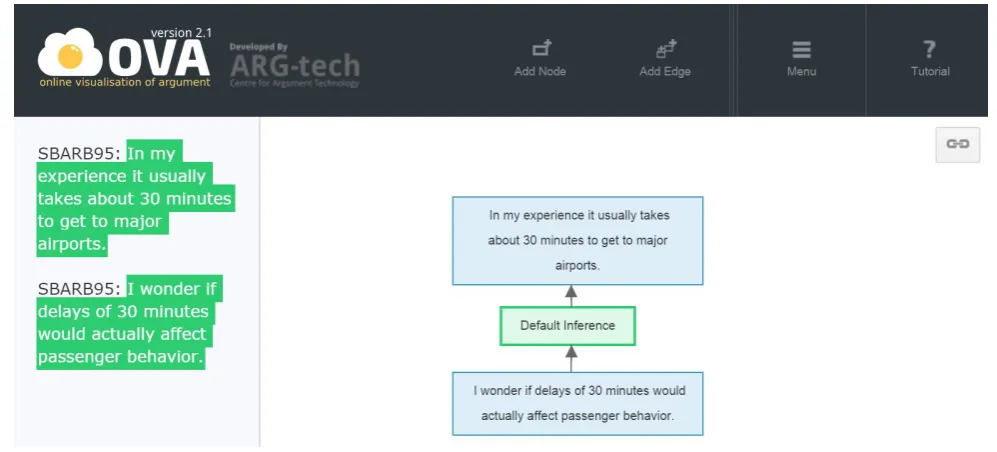
In the annotation, the argumentative function is understood as the relation between two propositions, not as the property of one span of text. In the OVA+ tool, these relations are marked as edges connecting information nodes (I-nodes) which contain propositions (see Fig. 1). To convert the raw text into an argument map, the analyst needs to paste the text into the left hand panel and then click on the right hand panel to create an I-node. Edges can be created by clicking the “Add edge” button and dragging the mouse between I-nodes. After the annotation, the map can be saved to the AIFdb database3 (Lawrence et al., 2012) and later
down-loaded in various file formats (including .json and .pl). The tool is a web-based application, freely available to use for annotation of argument diagrams.
Default Inference holds between two propositions when one proposition provides a reason to accept another propo-sition. In other words, a supporting claim can be used to answer the question “whyp?”. In the example (1) from the map RRD:#4900, (1-a) provides support for (1-b). If the propositional content of (1-a) was challenged in a dialog-ical situation with the question “why?”, proposition (1-b) could be used as an answer to this question. In this ex-ample the user “SBARB95” is arguing that the suggested regulation (obligating airlines to inform passengers about delays longer than 30 minutes) should not be introduced. As the reason for this claim, the user “SBARB95” provides
2
Available athttp://ova.arg-tech.org 3
Available athttp://aifdb.org
the statement that it usually takes longer than 30 minutes to travel to the airport.
(1) a. SBARB95: In my experience it usually takes about 30 minutes to get to major airports
b. SBARB95: I wonder if delays of 30 minutes would actually affect passenger behavior
Default Conflict holds between two propositions which cannot be both true at the same time. Speakers use con-flicting propositions to attack another speaker’s claims, by means of providing counter-claims. Example (2) from the map RRD:#4891 presents the situation in which the claim (2-a) provided by one user is attacked with the claim (2-b) by another user. In the example, user “AKTRAVELLER” suggests a new regulation, according to which the airlines should inform passengers in advance about possible delays or cancellations. This statement is attacked by the user “SOFIEM”, who is providing a counter-claim, saying that the solution is not possible.
(2) a. AKTRAVELLER:The airline could call in advance and give the passenger their options
b. SOFIEM:Unfortunately, there’s no way to give ad-vance notice
Default Rephrase holds between two propositions with the same or similar content expressed with different lin-guistic surface. Our concept of Rephrase is quite broad and covers all propositions serving the same argumentative function (e.g. repeated conclusions or premises) even in cases where the meaning equivalence of the propositions is not complete. We decided to annotate the relation of Rephrase to capture the fact that rephrased content does not constitute additional support (i.e. one propositional con-tent repeated three times should not be counted as three separate supports for a claim). In the example (3) from the map RRD:#5411) one speaker is rephrasing their own conclusion (3-a) by restating similar propositional content in (3-b). The user “DBERGER” repeats and reformulates their opinion concerning regulation on peanuts being con-sumed on the planes.
(3) a. DBERGER:There must be a complete ban on tree nuts and peanuts on planes
b. DBERGER:Again all nuts should be banned from airplanes
These binary annotations of relations between propositions create the “building blocks” of argument networks. Results of simple annotations of examples (1), (2), (3) are presented in Fig. 2, and Section 4. describes in more detail how they are used in creation of more complex argument networks.
Figure 1: OVA+ – Online Visualisation of Arguments tool: annotation window.
Figure 2: Relations of Inference, Conflict and Rephrase as building blocks of argument networks.
Table 2: Occurrences of relations between contents of com-ments in the annotated corpus of argument networks.
Relation type Number Inference (RA) 671 Conflict (CA) 97 Rephrase (MA) 14
Total 782
4.
Divisiveness in argument networks
4.1.
Argument network
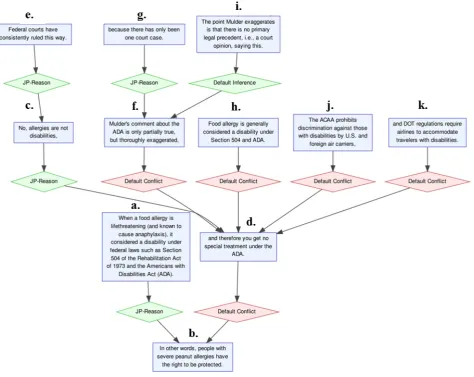
Spotting quickly the most divisive issues in a large data of texts is a real challenge. Consider a conversation between three RegulationRoom users about whether or not peanuts should be prohibited on planes as they may cause an aller-gic reaction.
(4) a. MALLONE: When a food allergy is life threaten-ing (and known to cause anaphylaxis), it considered a disability under federal laws such as Section 504 of the Rehabilitation Act of 1973 and the Americans with Disabilities Act (ADA).
b. In other words, people with severe peanut allergies have the right to be protected.
c. MULDER:No, allergies are not disabilities, d. and therefore you get no special treatment under the
ADA.
e. Federal courts have consistently ruled this way.(..) f. ANTANAGOGE:Mulder’s comment about the ADA
is only partially true, but thoroughly exaggerated. g. because there has only been one court case. h. Food allergy is generally considered a disability
un-der Section 504 and ADA.
i. The point Mulder exaggerates is that there is no pri-mary legal precedent, i.e., a court opinion, saying this.(...)
j. The ACAA prohibits discrimination against those with disabilities by U.S. and foreign air carriers, k. and DOT regulations require airlines to
accommo-date travelers with disabilities.
Even in such a short excerpt of online comments, it is not trivial to identify the most divisive issue. However the task becomes much easier if we unpack the structure of this dialogue and create its representation as a directed graph of pro-arguments (green nodes) and con-arguments (red nodes) (see Fig. 3; manually annotated using the OVA+ tool). Notice that it is now clear that the issue (4-d) at-tracted the highest number of arguments, even though it is (4-b) which is a main claim of the discussion.
Divisiveness can be conceptualised as a feature of an issue, but also as the strength of conflict between two issues. In Fig. 3 from the total number of five conflict relations, the one between (4-d) and (4-f) attracts the highest number of pro-arguments, i.e. (4-c) for (4-d); and (4-g) and (4-i) for (4-f). Intuitively, the more support two conflicting issues have, the higher strength of the conflict between them.
4.2.
Graph properties
Figure 3: Fragment of the argument network with the example of divisive issues (RRD:# 5695). Full map available in the Regulation Room Divisiveness corpus athttp://arg.tech/rrd.
defined with the properties of the graph.
We construe the argumentation analysis as a directed graph,
G = (V, E), in which vertices (V) are either proposi-tions or relaproposi-tions between proposiproposi-tions, and those rela-tions are either support (pro-arguments) or conflict (con-arguments), captured by a function R which mapsV 7→ {prop, support, conf lict} and edges exist between them
E ⊂ V ×V. For syntactic convenience, we refer to the number of edges (i.e. the IN-order of) at a vertexvas|v|
and add superscript to indicate whether we are interested in the number of incoming or outgoing edges, and a su-perscript to indicate whether the edge connects v with a support or a conflict, e.g.,|v|in
support.
A first estimate of the divisiveness of a propositionv, which captures the intuition behind assessing the issue (4-d) in Example (4) as the most divisive, can be calculated thus:
D1(v) =|v|insupport∗ |v| in conf lict
Alternatively, the divisive issue may be described with the strength of the conflict to capture the interpretation of the divisiveness of the conflict between (4-d) and (4-f). In this case it will be measured as the relation between two nodes
v1, v2 which are in conflict. For that, we need to account for the number of supports provided for each of the nodes.
Thus, given(v1, vc) ∈ E and(vc, v2) ∈ E andR(vc) =
conf lict:
D2(v1, v2) =|v1|insupport∗ |v2|insupport
The two concepts of divisiveness presented here allow for automated identification of divisive issues in the corpus of argument networks.
5.
Results
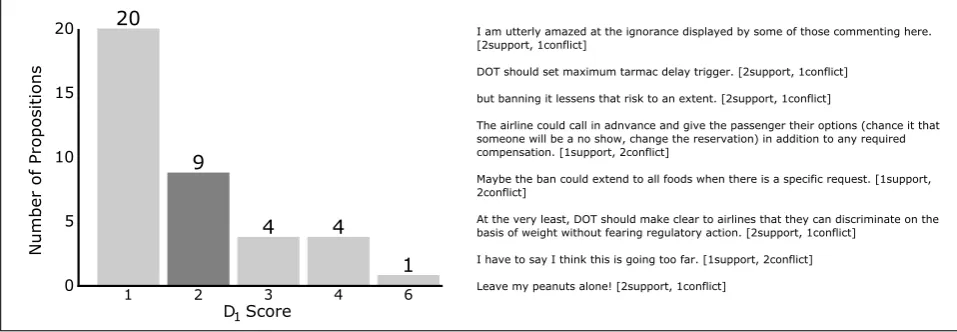
These two measures were implemented as a first step of the development of an Graph-based Analytics tool available athttp://arg.tech/rrdgraph. Fig. 4 and 5 show the automatically identified divisiveness scores,D1andD2 respectively, for our corpus as a whole. In each chart, the score is plotted against the number of propositions with that score. For example, in Fig. 4, we can see that there are twenty propositions with a D1 score of 1 (i.e. with one incoming conflict and one incoming support), nine with a
D1 score of 2, four with a score of 3, four with a score of 4, and one proposition with aD1 score of 6. The four propositions withD1score of 4 are listed below:
Figure 4: Chart showing Divisiveness ScoreD1. The text on the right hand side lists a selection of the issues with aD1 score of 2 (highlighted in darker grey), along with the number of supporting and conflicting items each issue has.
Figure 5: Chart showing Divisiveness ScoreD2. The text shows those pairs of conflicting issues with the highestD2scores (of 6, 10 and 12), along with the number of supporting items for the issue on each side.
2. ALL minors should have additional protections[2 sup-port, 2 conflict]
3. I would support a full ban of peanut products on any airline[4 support, 1 conflict]
4. and therefore you get no special treatment under the ADA[1 support, 4 conflict]
Notice that the system automatically spotted the divisive issue (4-d) in the argument network depicted in Fig. 3: (4-d) is the fourth proposition listed above.
Fig. 5 shows that there is one conflict identified which es-pecially divides people, with aD2score of 12. This is the conflict between the propositions “Apparently Samsmom is the ignorant one” and “I am utterly amazed at the igno-rance displayed by some of the users here”, with the first of these propositions having six supporting claims and the second proposition having two supporting claims. The di-visive conflict between (4-d) and (4-f) in Fig. 3, has aD2 score of 2, making it one of the sixteen most divisive con-flicts within the corpus.
Validation of these results by comparison to human anno-tations of divisive issues is, unfortunately, not a
straight-forward task. Divisiveness is not a property intrinsic to a specific issue or comment, but is a result of how different comments interact. With a large volume of data to process, it is impossible for an annotator to process the connections and dependencies between hundreds of comments, and so determine those which are divisive. Additionally, the fact that divisiveness occurs when multiple people are in dis-agreement, either over a single issue, or are split in favour of two conflicting points makes this a challenging concept for a single annotator to identify: an issue which seems perfectly clear to the annotator may in fact be divisive in the context of a multi-participant dialogue. However, the measures of divisiveness which we present here give scores based precisely on these criteria, meaning that, as long as the dialogue structure has been correctly captured, those is-sues with the highestD1andD2will be precisely those that most divided people.
6.
Conclusion
and understanding of the complex interactions through the Argument Graph Analytics tool. The two measures of divi-siveness which we have introduced, whilst simple to calcu-late, give a clear indication of where contentious issues in the discussion are taking place, and match closely with an intuitive understanding of the topic.
Though the work described in this paper relies upon man-ual annotation of data, automatic techniques for identifying argument structure could be used as input to these same processes. As these argument mining techniques (Peldszus and Stede, 2013; Lawrence and Reed, 20xx; Budzynska et al., 20xx) continue to improve, the ability to interpret the resulting argument network will be a valuable tool in creat-ing fully automated summaries and overviews of complex, multi-faceted debates, supporting deep insights into large volumes of argument and debate data.
7.
Acknowledgments
The authors would like to acknowledge that the work re-ported in this paper has been supre-ported in the UK in part by RCUK Lifelong Health and Wellbeing Programme grant number EP/K037293/1 - BESiDE: The Built Environment for Social Inclusion in the Digital Economy, in part by the EPSRC grant number EP/N014871/1 Argument Min-ing and in part by the Innovate UK under grant 101777 and in the US in part by NSF grant IIS-1314778. Any opinions, findings, and conclusions or recommendations expressed in this material are those of the author(s) and do not necessar-ily reflect the views of the National Science Foundation or other funders.
8.
References
Budzynska, K., Janier, M., Kang, J., Konat, B., Reed, C., Saint-Dizier, P., and Yaskorska, O. (20xx). Automat-ically identifying transitions between locutions in dia-logue, in press. InProceedings of 1st European Confer-ence on Argumentation: Argumentation and Reasoned Action (ECA 2015).
Choi, Y., Jung, Y., and Myaeng, S.-H. (2010). Identifying controversial issues and their sub-topics in news articles. In Proceedings of the Intelligence and Security Infor-matics Conference, Pacific Asia Workshop, PAISI 2010, pages 140–153.
Dori-Hacohen, S. and Allan, J. (2013). Detecting contro-versy on the web. InProceedings of the 22nd ACM Inter-national Conference on Information & Knowledge Man-agement, pages 1845–1848. ACM.
Dung, P. M. (1995). on the acceptability of arguments and its fundamental role in nonmonotonic reasoning, logic programming and n-person games. Artificial Intel-ligence, 77(2):321–357.
Farina, C. R. and Newhart, M. J. (2013). Rulemaking 2.0: Understanding and getting better public participation. In
Cornell e-Rulemaking Initiative Publications.
Freeman, J. B. (1991). Dialectics and the macrostruc-ture of arguments: A theory of argument strucmacrostruc-ture, vol-ume 10. Walter de Gruyter.
Gordon, T. F., Prakken, H., and Walton, D. (2007). The Carneades model of argument and burden of proof. Arti-ficial Intelligence, 171(10):875–896.
Janier, M., Lawrence, J., and Reed, C. (2014). OVA+: An argument analysis interface. InProceedings of the Fifth International Conference on Computational Models of Argument (COMMA 2014), pages 463–464.
Kittur, A., Suh, B., Pendleton, B. A., and Chi, E. H. (2007). He says, she says: Conflict and coordination in Wikipedia. InProceedings of the SIGCHI conference on Human factors in computing systems, pages 453–462. ACM.
Lawrence, J. and Reed, C. (2015). Combining argument mining techniques. InWorking Notes of the 2nd Argu-mentation Mining Workshop, ACL’2015.
Lawrence, J. and Reed, C. (20xx). Argument mining, in review.
Lawrence, J., Bex, F., Reed, C., and Snaith, M. (2012). AIFdb: Infrastructure for the Argument Web. In Pro-ceedings of the 4th International Conference on Compu-tational Models of Argument COMMA, pages 515–516. Lubbers, J. (2012). A Guide to Federal Agency
Rulemak-ing. ABA Section of Administrative Law and Regulatory Practice and Government and Public Sector Lawyers Di-vision.
Misra, A., Anand, P., Tree, J. F., and Walker, M. (2015). Using summarization to discover argument facets in on-line idealogical dialog. In Proceedings of the Confer-ence of the North American Chapter of the Association for Computational Linguistics – Human Language Tech-nologies (NAACL HLT 2015).
Moens, M.-F., Boiy, E., Palau, R. M., and Reed, C. (2007). Automatic detection of arguments in legal texts. In Pro-ceedings of the 11th International Conference on Ar-tificial Intelligence and Law (ICAIL), pages 225–230. ACM.
Palau, R. M. and Moens, M.-F. (2009). Argumentation mining: the detection, classification and structure of ar-guments in text. InProceedings of the 12th International Conference on Artificial Intelligence and Law (ICAIL), pages 98–107. ACM.
Park, J. and Cardie, C. (2014). Assess: A tool for as-sessing the support structures of arguments in user com-ments. InProceedings of the Fifth International Confer-ence on Computational Models of Argument (COMMA 2014), pages 473–474.
Park, J., Klingel, S., Cardie, C., Newhart, M., Farina, C., and Vallb´e, J.-J. (2012). Facilitative moderation for on-line participation in erulemaking. InProceedings of the 13th Annual International Conference on Digital Gov-ernment Research, pages 173–182. ACM.
Park, J., Blake, C., and Cardie, C. (2015). Toward machine-assisted participation in eRulemaking: An ar-gumentation model of evaluability. Proceedings of the 15th International Conference on Artificial Intelligence and Law (ICAIL).
Peldszus, A. and Stede, M. (2013). From argument dia-grams to argumentation mining in texts: a survey. Inter-national Journal of Cognitive Informatics and Natural Intelligence (IJCINI), 7(1):1–31.
of argumentation structure in short texts. InProceedings of First Workshop on Argumentation Mining.
Popescu, A.-M. and Pennacchiotti, M. (2010). Detect-ing controversial events from Twitter. In Proceedings of the 19th ACM International Conference on Informa-tion and Knowledge Management (CIKM), pages 1873– 1876. ACM.
Rahwan, I., Zablith, F., and Reed, C. (2007). Laying the foundations for a World Wide Argument Web. Artificial Intelligence, 171(10-15):897–921.
Reed, C. and Rowe, G. (2004). Araucaria: Software for argument analysis, diagramming and representation.
International Journal on Artificial Intelligence Tools, 13(4):961–980.
Rosenthal, S. and McKeown, K. (2015). I couldn’t agree more: The role of conversational structure in agreement and disagreement detection in online discussions. In
16th Annual Meeting of the Special Interest Group on Discourse and Dialogue, pages 168–177.
Teufel, S. and Moens, M. (2002). Summarizing scientific articles: Experiments with relevance and rhetorical sta-tus. Computational linguistics, 28(4):409–445.
Teufel, S. (1999). Argumentative Zoning: Information Ex-traction from Scientic Text. Ph.D. thesis, University of Edinburgh.
Toulmin, S. E. (1958). The uses of argument. Cambridge University Press.
van Eemeren, F. H., Garssen, B., Krabbe, E. C., Snoeck Henkemans, A., Verheij, B., and Wagemans, J. H. (2014). Handbook of Argumentation Theory. Springer.
Walker, M. A., Tree, J. E. F., Anand, P., Abbott, R., and King, J. (2012). A corpus for research on deliberation and debate. In Proceedings of 8th International Con-ference on Language Resources and Evaluation (LREC), pages 812–817.