Survey of Conversational Behavior: Towards the Design of
a Balanced Corpus of Everyday Japanese Conversation
Hanae Koiso
†Tomoyuki Tsuchiya
‡Ryoko Watanabe
†Daisuke Yokomori
‡Masao Aizawa
†Yasuharu Den
§††National Institute for Japanese Language and Linguistics, Japan ‡Faculty of Languages and Cultures, Kyushu University, Japan
§Faculty of Letters, Chiba University, Japan
Abstract
In 2016, we set about building a large-scale corpus of everyday Japanese conversation—a collection of conversations embedded in naturally occurring activities in daily life. We will collect more than 200 hours of recordings over six years, publishing the corpus in 2022. To construct such a huge corpus, we have conducted a pilot project, one of whose purposes is to establish a corpus design for collecting various kinds of everyday conversations in a balanced manner. For this purpose, we conducted a survey of everyday conversational behavior, with about 250 adults, in order to reveal how diverse our everyday conversational behavior is and to build an empirical foundation for corpus design. The questionnaire included when, where, how long, with whom, and in what kind of activity informants were engaged in conversations. We found that ordinary conversations show the following tendencies: i) they mainly consist of chats, business talks, and consultations; ii) in general, the number of participants is small and the duration of the conversation is short; iii) many conversations are conducted in private places such as homes, as well as in public places such as offices and schools; and iv) some questionnaire items are related to each other. This paper describes an overview of this survey study, and then discusses how to design a large-scale corpus of everyday Japanese conversation on this basis.
Keywords: corpus of everyday Japanese conversation, corpus design, survey of everyday conversational behavior
1.
Introduction
Since everyday conversation is a foundation of our social life, it is important to describe the characteristics of conver-sational language and clarify the mechanisms of conversa-tional interaction. In order to capture the diversity of ev-eryday conversations and to observe natural conversational behavior in our daily life, we require corpora containing various kinds of everyday conversations. Although several corpora of Japanese conversations have been developed, most of them are biased towards conversations among friends or families on the telephone or in artificially created settings, and there has been no corpus that covers a diversity of everyday conversations (see Table 1).
Considering this situation, in 2016, we set about building a large-scale corpus of everyday Japanese conversation in a balanced manner. To construct such a huge corpus, we have conducted a pilot project, whose purposes are i) to establish a corpus design for collecting various kinds of everyday conversations in a balanced manner, ii) to develop a methodology for recording naturally occurring conversations, and iii) to create a transcription system suitable for precisely and efficiently transcribing natural conversations.
As for the first issue, we conducted a survey of everyday conversational behavior, with about 250 Japanese adults, last year in order to reveal how diverse our everyday conversational behavior is and to to build an empirical foundation for corpus design. The questionnaire included when, where, how long, with whom, and in what kind of activity informants were engaged in conversations. This paper describes an overview of this survey study, and then discusses how to design a large-scale corpus of everyday Japanese conversation on this basis.
2.
Survey Method
In this study, conversational behavior was surveyed from three perspectives: conversation attributes, conversational situation attributes, and informant attributes (see Table 2), which were defined in reference to previous surveys conducted in Japan (National Language Research Institute, 1980; Hata, 1983; National Language Research Institute, 1987; Japan Broadcasting Corporation, 2010).
The survey was performed according to the following procedures.
1. Informants were collected from native speakers of Japanese living in the Greater Tokyo Area (20 to 25 men/women from each of the following 5 age ranges: 20–29, 30–39, 40–49, 50–59, over 60).
2. Survey materials were sent to informants via post in advance.
3. Informants could freely choose two weekdays/ workdays and one weekend/day-off, carrying out the survey within two weeks after the arrival of the mate-rials.
4. On the survey days, informants carried around, from waking up until going to sleep, a survey note, on which they wrote an overview of all conversations they had as well as the answers to the survey questions regarding the attributes of their conversations and conversational situations.
Table 1: Major existing corpora of Japanese conversations
Corpus Name Size Contents
Multilingual Corpus of Spoken Language by Basic Transcription System (BTS)
294 conversations 66 hours
chats among friends, professor-student mentoring, telephone conversations, etc.
(audio files available only for some portion) Sakura Corpus 18 conversations chats among four undergraduate students
(topics assigned) Chiba Three-Party Conversation Corpus 12 conversations
2 hours
chats among three undergraduate/graduate students on campus (initial topics assigned)
CALL HOME Japanese 120 conversations 20 hours
telephone conversations between Japanese living in the U.S. and their families/friends in Japan
CallFriend Japanese 31 conversations telephone conversations between Japanese living in the U.S. Meidai Conversational Corpus 161 speakers
100 hours
chats among friends (audio files unavailable) Women’s Language at the Workplace
Men’s Language at the Workplace
21 speakers each natural conversations in formal and informal situations at the workplace (audio files unavailable)
Table 2: Survey items
Attribute Explanation Choices
Conversation attributes
Form Conversation form chat, business talk/consultation, meeting/conference, class/lesson/lecture Length Conversation length below 5 minutes, 5–15 minutes, 15–30 minutes, 30 minutes–1 hour,
1–2 hours, 2–5 hours, 5–10 hours Relationship Relationship between the
infor-mant and his/her interlocutors
family member, relative, teacher–student, co-worker, friend/acquaintance, public/commercial service, familiar/unfamiliar person
Number of interlocutors
Number of interlocutors by rela-tionship
(number)
Remote conver-sation
Voice or video conversation on the phone/Internet
(Choose if applicable)
Non-native inter-locutor
Conversation including a non-native interlocutor
(Choose if applicable)
Foreign language Conversation in/including a for-eign language
(Choose if applicable)
Conversational situation attributes
Time period Time period in which the conver-sation was carried out
morning, afternoon, evening
Place Place in which the conversation was carried out
home, workplace/school, public/commercial facility, transport facility, other indoor place, other outdoor place
Activity Activity in which the conversation was embedded
eating, housework/chore, personal task, medical treatment, work/schoolwork, after-work/after-school activity, communal activity, leisure activity, spending time with friend, transfer, rest
Informant attributes
Sex Sex of the informant male, female
Age Age of the informant 20–29, 30–39, 40–49, 50–59, over 60
Occupation Occupation of the informant office worker, self-employed worker, part-time worker, student, full-time housewife, unemployed person
3.
Results
3.1.
Overview of the Results
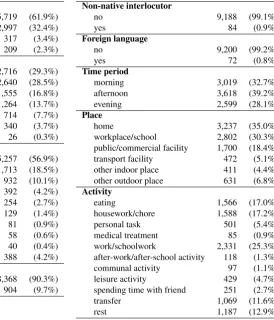
Two hundreds and forty-three informants participated in the survey, who engaged in 9,272 conversations in total. Table 3 shows the distributions of answers to the survey items1.
The results are outlined below.
1For some survey items, there were missing answers. The
counts of answers in such items do not add up to 9,272, i.e., the total number of conversations.
1. Chats (62%) and business talks/consultations (32%) occur very frequently, while meetings/conferences (3%) and classes/lessons/lectures (2%) are quite rare.
2. Most conversations are short (under 30 minutes =
75%), and few are long (over one hour=12%).
Table 3: Distributions of answers to the survey items
Form Non-native interlocutor
chat 5,719 (61.9%) no 9,188 (99.1%)
business talk/consultation 2,997 (32.4%) yes 84 (0.9%) meeting/conference 317 (3.4%) Foreign language
class/lesson/lecture 209 (2.3%) no 9,200 (99.2%)
Length yes 72 (0.8%)
below 5 minutes 2,716 (29.3%) Time period
5–15 minutes 2,640 (28.5%) morning 3,019 (32.7%) 15–30 minutes 1,555 (16.8%) afternoon 3,618 (39.2%) 30 minutes–1 hour 1,264 (13.7%) evening 2,599 (28.1%) 1–2 hours 714 (7.7%) Place
2–5 hours 340 (3.7%) home 3,237 (35.0%)
5–10 hours 26 (0.3%) workplace/school 2,802 (30.3%)
Number of interlocutors public/commercial facility 1,700 (18.4%) 1 5,257 (56.9%) transport facility 472 (5.1%) 2 1,713 (18.5%) other indoor place 411 (4.4%) 3 932 (10.1%) other outdoor place 631 (6.8%)
4 392 (4.2%) Activity
5 254 (2.7%) eating 1,566 (17.0%)
6 129 (1.4%) housework/chore 1,588 (17.2%)
7 81 (0.9%) personal task 501 (5.4%)
8 58 (0.6%) medical treatment 85 (0.9%)
9 40 (0.4%) work/schoolwork 2,331 (25.3%)
over 10 388 (4.2%) after-work/after-school activity 118 (1.3%)
Remote conversation communal activity 97 (1.1%)
no 8,368 (90.3%) leisure activity 429 (4.7%) yes 904 (9.7%) spending time with friend 251 (2.7%) transfer 1,069 (11.6%)
rest 1,187 (12.9%)
4. Most conversations are conducted at home (35%) or at workplaces/schools (30%).
5. Most conversations are carried out during
work/schoolwork (25%), housework/chore (17%), eating (17%), or resting (13%).
3.2.
Relationships among Survey Attributes
In this section, we focus on the relationships among the survey attributes. Before the analysis, we combined some survey answers using the following procedures:
1. The associations among survey items were analyzed by using multiple correspondence analysis.
2. Hierarchical cluster analysis of the (three-dimensional) scores assigned to survey answers was conducted.
3. Some survey answers were combined based on the results of the cluster analysis2.
2
The combined answers are as follows: Form: meeting (meeting/conference + class/lesson/lecture);Length: 1–5 hours (1–2 hours + 2–5 hours); Number of interlocutors: 4–5 persons (4 persons + 5 persons), over 6 persons (6 persons + · · · + over 10 persons); Place: outdoor/transport facility (other outdoor place + transport facility); Activity: house-work/chore (househouse-work/chore + personal task + medical treat-ment), work/schoolwork (work/schoolwork + after-work/after-school activity), leisure activity (leisure activity + spending time with friend).
Figure 1 shows the occurrence rates of conversation and conversational situation attributes with respect to the in-formant’s occupation. As for the conversation attributes, regardless of occupation, most conversations i) consist of chats and business talks/consultations, ii) involve a small number of participants, and iii) last for only a short time3.
There are, however, also differences according to occupa-tion. For example, working people’s conversations often take the form of a business meeting/conference or a busi-ness talk/consultation, while full-time housewives more often engage in chats than people with other occupations do.
With regard to the conversational situation attributes, there are many occupation-based differences. For example, conversations by full-time housewives are often carried out at home or in public/commercial facilities during engaging in housework/chore; working people often have conver-sations at their workplaces during engaging in work; and students often have conversations not only during studying at schools but also during resting or transferring.
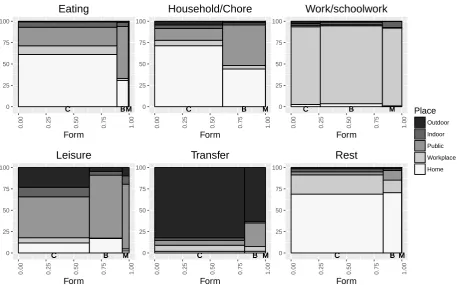
Figure 2 shows associations between conversation form and place with respect to the activity in which the conversation is embedded. The width and the height of a bar indicate the relative frequencies of a form and a place categories, respectively, and the area shows the relative frequency of a “form×place” combination.
3
0
Number of interlocutors
0
Figure 1: Occurrence rates of conversation and conversational situation attributes with respect to occupation
C
0.00 0.25 0.50 0.75 1.00
Form
0.00 0.25 0.50 0.75 1.00
Form
0.00 0.25 0.50 0.75 1.00
Form
0.00 0.25 0.50 0.75 1.00
Form
0.00 0.25 0.50 0.75 1.00
Form
0.00 0.25 0.50 0.75 1.00
Form
1
0.00 0.25 0.50 0.75 1.00
Number of interlocutors
Chat
0.00 0.25 0.50 0.75 1.00
Number of interlocutors
Business Talk/Consultation
0.00 0.25 0.50 0.75 1.00
Number of interlocutors
Meeting/Conference
Figure 3: Associations between the number of interlocutors and conversation length with respect to conversation form
The figure reveals the dependence of the conversation form on the activity. For example, when eating, transferring, or resting, chats occupy the great majority of cases; during activities like housework/chore and leisure, chats are the most frequent, followed by business talks/consultations; and while engaged in work or schoolwork, business talks/consultations are the most frequent, followed by busi-ness meetings/conferences.
Such dependence can also be found between the conver-sation place and the activity: converconver-sations during eating or resting frequently take place at home; conversations during working or studying tend to occur at workplaces and schools; conversations while engaged in leisure ac-tivities or spending time with friends often take place at public/commercial facilities; and conversations during transferring is strongly related to place outside.
Considering the perspectives of the conversation form and place together with respect to the activity, it can further be seen i) that as for eating, chats are overwhelmingly frequent at home, while not only chats but also business talks/consultations occur frequently at public/commercial facilities; and ii) that in regard to housework/chore, chats and business talks/consultations with family members are frequent at home, while conversations with people like store employees at public/commercial facilities tend to take the form of business talk/consultation.
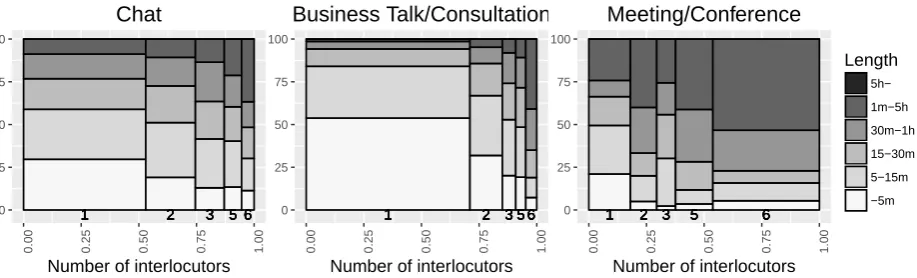
Figure 3 shows associations between the number of inter-locutors and conversation length with respect to conversa-tion form. It is found i) that business talks/consultaconversa-tions involve few conversants and are short in length—70% are dyadic (two-party) conversations and 80% are shorter than fifteen minutes, ii) that meetings/conferences and classes/lessons/lectures are composed of a relatively large number of people and last for long periods of time, and iii) that chats fall in between these two. Furthermore, for all conversation forms, conversation length increases as the number of conversants increases.
4.
Toward a Corpus Design
4.1.
Recording Method
In order to capture the diversity of everyday conversations and to observe natural conversational behavior in our daily life, one must record conversations that naturally occur in daily situations (Mondada, 2012). The British National
Corpus (BNC), constructed in the former half of the 1990s in the U.K., provides a methodology for such purpose. The BNC is comprised of one-hundred million British English words (Crowdy, 1995; Burnard and Aston, 1998). While the majority of it contains written language, approximately 10% of the words (ten million) are from spoken language. This spoken language part of the BNC is composed of the following two data groups:
Spoken demographic: Recorded with a portable tape recorder over the course of seven days by 124 infor-mants who were chosen so as to avoid bias in terms of age, sex, social class, and region.
Spoken context-governed: Spoken language that many people listen to (e.g., broadcasts and lectures). Di-vided into four categories: educational, business, pub-lic/organizational, and leisure.
The first of the above BNC methods is suited for recording conversations embedded in naturally occurring activities. With their approach in mind, we decided to record everyday conversations using the following two methods4.
Individual-based method: We choose a set of informants balanced in terms of sex, age, etc., provide them portable recording devices (compact action cameras and IC recorders) for approximately one to two months, and have them record conversations in their daily activities. In principle, the project members do not mediate their field recordings.
Situation-specific method: We select specific situations in which recording based on the individual-based method is technically and/or ethically difficult, e.g., exchanges with store employees, meetings at work-places, regional activities, public events, etc., and record conversations occurring in these situations. Although the project members coordinate recording settings, only conversations in these naturally occur-ring activities are recorded.
4
Table 4: Constituent ratios with respect to conversation form, conversation place, and activity
Form
chat business talk/consultation meeting/class Activity\Place private public other private public other private public other
eating/resting 30% 5% 10% 5% 5% 5%
work/study 15% 10% 5% 15% 40% 20% 0% 70% 10%
other 5% 20% 0% 0% 15% 0% 0% 15%
4.2.
Constituent Ratio of Conversation and
Conversational Situation Attributes
By reference to the constituent ratios derived from the survey results, we now draft a corpus design for collecting various kinds of everyday conversations in a balanced manner.
Because it is expected that conversations recorded by using the individual-based method consist mostly of chats and business talks/consultations, we first estimate the ratio with respect to the conversation form. From the survey results in Section 3.1., an approximate proportion would be chat: 60%, business talk/consultation: 30%, and meet-ing/conference or class/lesson/lecture: 10%.
The next issue is a breakdown within each conversation form. The survey results show that there is a strong association among the number of conversants, conversation length, and conversation form (Figure 3). This suggests that if conversation forms are well-balanced, the number of conversants and conversation length would naturally be distributed in a balanced manner as well. Therefore, we do not care the number of conversants and conversation length in the corpus design.
Next, we focus on place and activity. As pointed out in Sec-tion 3.1., most conversaSec-tions are conducted at homes (35%) or workplaces/schools (30%). Thus, we classify places into three categories: i) private places, ii) public places, and iii) the others. As for activity, most conversations are carried out during work, schoolwork, or housework/chore (42%) and eating or resting (30%). We, thus, classify activities into three categories: i) eating/resting, ii) work/study, and iii) the others.
Based on these observations, we derived the constituent ratio of the conversation form, the conversation place, and the activity as in Table 4.
5.
Concluding Remarks
In this paper, we reported our survey of everyday conver-sational behavior, which was conducted in order to reveal how diverse our everyday conversational behavior is and to build an empirical foundation for corpus design. Based on the survey results, we discussed how to design a balanced corpus of everyday Japanese conversation.
The constituent ratios of various conversational attributes presented in Table 4 were calculated only considering the results of the survey. We need to finalize the corpus design by taking into account technical and ethical issues related to recording in daily situations (Koiso et al., submitted). In our project, more than 200 hours of conversations will be recorded. The recorded speech is precisely transcribed and
is annotated with morphological information, dependency structure, utterance boundary, dialog act, and so on. The corpus is planned to be published in 2022. It is expected that our corpus will greatly contribute to various research fields including linguistics, conversation analysis, psychol-ogy, cognitive science, Japanese language teaching, speech processing, and social robotics.
Language and behavior change with the times. In the future, our conversation corpus will also be a precious record to know our everyday language and conversational behavior in the early part of the 21st century. It is a significant role for researchers to record and preserve a diversity of everyday conversation that mirrors our culture.
6.
Acknowledgements
This work is supported by Grant-in-Aid for Collaborative Research Project of NINJAL “A multifaceted study of spoken language using a large-scale corpus of everyday Japanese conversation” led by Hanae Koiso.
7.
References
Burnard, L. and Aston, G. (1998). The BNC Handbook. Edinburgh University Press, Edinburgh, U.K.
Crowdy, S. (1995). The BNC spoken corpus. In Leech, G., Myers, G., and Thomas, J., editors,Spoken English on computer: Transcription, mark-up and application, pages 224–235. Longman, Harlow, U.K.
Hata, H. (1983). Situation and language (in Japanese).
Kokugogaku, 133:55–68.
Japan Broadcasting Corporation. (2010). Survey report of national living hours in 2010 (in Japanese). NHK Broadcasting Culture Research Institute.
Koiso, H., Tanaka, Y., Watanabe, R., and Den, Y. (sub-mitted). A large-scale corpus of everyday Japanese conversation: On methodology for recording naturally occurring conversations. In Proceedings of the LREC 2016 workshop on casual talk among humans and ma-chines.
Mondada, L. (2012). The conversation analytic approach to data collection. In Sidnell, J. and Stivers, T., editors,
The Handbook of Conversation Analysis, pages 32–56. Wiley-Blackwell, Hoboken, NJ.
National Language Research Institute. (1980). The reality of the spoken language of the educated class in Japan(in Japanese). National Language Research Institute. National Language Research Institute. (1987). Aspects of