Automatic recognition of linguistic replacements in text series generated from
keystroke logs
Daniel Couto-Vale, Stella Neumann, Paula Niemietz
RWTH Aachen University, GermanyK´arm´anstr. 17-19, D-52062 Aachen
[email protected],{firstname.familyname}@ifaar.rwth-aachen.de
Abstract
This paper introduces a toolkit used for the purpose of detecting replacements of different grammatical and semantic structures in ongo-ing text production logged as a chronological series of computer interaction events (so-called keystroke logs). The specific case we use involves human translations where replacements can be indicative of translator behaviour that leads to specific features of translations that distinguish them from non-translated texts. The toolkit uses a novel CCG chart parser customised so as to recognise grammatical words independently of space and punctuation boundaries. On the basis of the linguistic analysis, structures in different versions of the target text are compared and classified as potential equivalents of the same source text segment by ‘equivalence judges’. In that way, replace-ments of grammatical and semantic structures can be detected. Beyond the specific task at hand the approach will also be useful for the analysis of other types of spaceless text such as Twitter hashtags and texts in agglutinative or spaceless languages like Finnish or Chinese.
Keywords:translation process, keystroke logging, character chart parser
1.
Introduction
In a na¨ıve approach, it would be assumed that the task of translating consists in giving literal renditions of the words of the source language text in the target language, i.e. in finding equivalent words for each word in the source text and simply replacing the source text words by these target language words in the same order. However, various factors such as the incommensurability of the languages involved, differences in the situational features that determine a reg-ister, specific goals and guidelines of the translation brief among others will result in non-literal translations. Moreover, the task of mediating between two potentially different lingua-cultures also leads to translations being dif-ferent in terms of the distribution of linguistic features from original text production in the target language in several ways (Hansen-Schirra et al., 2012). Machine learning ap-proaches to translation as a sub-language (‘translationese’) report high accuracies in classifying texts as translations and non-translated texts in a mixed set based on proper-ties such as mean 1-gram length, frequencies of spellings of derivational and inflectional prefixes and suffixes, ratio between function words and content words (Volansky et al., 2015). While such studies provide evidence for the claim that translations are indeed different from non-translated texts, they do not easily support explanations for the ob-served differences. It is also assumed that some of the sta-tistical patterns are caused not by linguistic and cultural dif-ferences, but by cognitive factors such as (lack of) under-standing of the source text and fatigue by the translator. Process-oriented translation research aims at characteris-ing this cognitive activity in terms of translators’ behaviour during the translation task. For this purpose, keystroke log-gers such as Translog (Jakobsen and Schou, 1999; Carl, 2012) are used to record and replay the text-producing ac-tions of different translators in the task of translating the same source text from language A to language B. Instead of analysing corpora of the products of the translation
pro-cess in the carefully composed final order in which they are deemed to best achieve their goals, log files represent the text production process as a chronological series of com-puter interaction events (log events such as character key strokes and hot key strokes, mouse clicks etc.). A text pro-duction process will always include sequences of uninter-rupted text production, but it may also include (i) poten-tially discontinuous modifications (insertions, deletions) of text produced so far when an existing part of the text is modified at a later stage and (ii) actions of changing cur-sor positions, in which case insertions in the middle of the produced text move the tail of the text right and down to other screen coordinates. Especially in the revision phase towards the end of the text production process, modifica-tions consisting of individual log events occur at various places of the text produced so far.
Processual data enables researchers not only to align source text segments with segments of the final target text (?, ‘equivalence’, cf)]Catford:1965vc, but also to track the se-ries of possible alternate equivalents produced by one and the same translator for the same original segment through-out time. Intermediate (non-final) target texts offer a unique opportunity for researchers to observe intermediary stages of a chained transfer procedure and also to infer personal and collective preferences between divergent equivalents when translators consider two or more alternates.
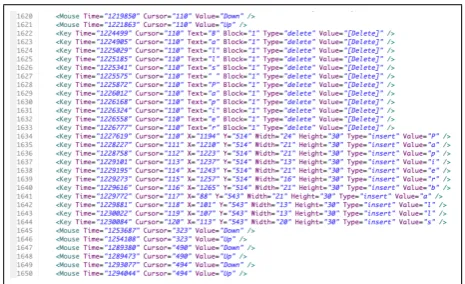
Keyloggers are useful for collection of such data since they store timestamped text-producing actions by the translator. Figure 1 illustrates an action of replacing the underlined part of the nominal groupeines solchen Balls Papier(‘of such a ball of paper’) by the more frequent wordingeines solchen Papierballs(‘of such a paper ball’). This replace-ment actually consists of backwards deleting 12 individual characters from lines 1622 to 1633 and inserting 11 charac-ters from lines 1634 to 1644 in the XML representation of the log events.
Figure 1: Log events in Translog XML (lines 1620-1650 out of 4072).
not) is faced with the task of reassembling such individ-ual log events (see Figure 1) into strings of letters of un-folding words for further analysis of, say, which linguis-tic elements are replaced and what they are replaced by. Though log files are comprehensive and very useful, man-ually analysing such data is at times cumbersome and at times altogether impossible for the human analyst. Among the reasons why analysis is so difficult is the fact that trans-lators’ actions during text production affect an intermedi-ary text produced until then that the analyst does not have access to visually and must reconstruct mentally from the beginning of the file.
In this paper we present a method for creating a human-inspectable visualisation of keystroke logs in a corpus of keystroke logging files and of automatically analysing them linguistically, which allows us to detect replacements of grammatical and semantic structures between different text versions automatically. The remainder of the paper is or-ganised as follows. Section 2 will elaborate on the role that replacements play in translation and why a computational tool is useful for analysing them. The toolkit developed for the analysis of replacements is introduced in two steps: In Section 3 the approach to parsing log files is explained, while Section 4 discusses the approach to detecting alter-nate translation attempts in the log files. Section 5 provides details on the evaluation of the toolkit we developed. Sec-tion 6 discusses the limitaSec-tions of our toolkit, and, finally, Section 7 summarises the main findings and provides an outlook on future work.
2.
The role of replacements in translation
Experimental studies have shown that translators approach their task in a cyclic fashion, not simply translating one source text segment by a final target text segment, but rather attempting a translation and coming back to it for revision potentially at various times during the translation process (Carl, 2009; Alves and Couto-Vale, 2011). Especially in cases when the translator finds it difficult to map lexical, grammatical or semantic structures between the languages, the translation may be attempted in several ways involving replacements of previously written segments by new ones. For instance, this can involve packing phenomena repre-sented by a clause in an earlier translation attempt into a segment represented by a nominal group, a strategy thatwill often include nominalisations. When we detect such a replacement, we gather evidence that some translations might be divided into a first transfer procedure between similar verbal representations in each language (clause to clause, nominal group to nominal group) and a second pro-cedure between representations of different ranks in the same language. This means that a rank shift might hap-pen between two target representations and not necessarily between source and target ones for the translation of some segments. It is equally conceivable that the first transfer procedure already involved a rank shift across languages (nominal group to clause) with the second procedure in-volving another rank shift (clause to nominal group) result-ing in a final translation that appears inconspicuous when only comparing the source text with the final translation product.
[image:2.595.307.537.451.600.2]Steps of translations such as these can be reconstructed from logged text-affecting actions. This type of informa-tion may yield insight among others into how specific fea-tures of translations come about. Rank shifts and other translational phenomena have been discussed for a long time (Vinay and Darbelnet, 1958). More recently, Cyrus (2006) and ˇCulo et al. (2008) provided corpus evidence that transfer procedures have a residual effect on translated texts. In addition, a better understanding of such procedures has also been recognised as a bottleneck for machine trans-lation (Helmreich et al., 2004). Therefore, modelling how humans translate may result not only in a theory of transla-tion better capable of describing, explaining, and predicting translational phenomena but also in a better understanding of what can be done to improve machine translation.
Figure 2: Beginning of a text series file
A computational tool should help detect and visualise keystrokes on related text-affecting actions to support fur-ther analysis. We demonstrate such a tool based on analysing a keystroke logged corpus collected by Serbina et al. (2015). The corpus contains the logs generated with Translog v. 3.0.1 based on 16 translations of a popular-scientific text about the physical properties of the action of crumpling paper.1
The computational task involves, among other things, iden-tifying meaningful grammatical units from a not neces-sarily meaningful stream of log events that may include keystrokes in an inconsistent order from the linguistic point of view as well as identifying versions of the ongoing text production that are actually modifications of the same ele-ment (e.g. the replaceele-ment ofBalls PapierbyPapierballs in Figure 1) and not chance occurrences of similar lexico-grammatical items that are to be expected to occur multiple times in a text on a given topic. Our solution to this task in-volves drawing on grammatical analysis already in the ini-tial task of identifying meaningful units in the intermediary versions of the target text.
Drawing on a computational solution to the problem laid out here also has an additional advantage. Since the units that the parser recognises (see Section 3) are not necessar-ily unambiguous, the parser will produce several alterna-tive analyses (a standard approach to handling ambiguous items in language data). This is seen as a major advantage for the purposes of the present analysis, because the ambi-guity of the text production data is intended to be kept in the linguistic analysis. In many cases, it will be impossible to determine which of the possible readings of an incom-plete textual unit was intended by the author. Drawing on an approach to a similar problem in learner corpus research (L¨udeling, 2008), the various readings are captured as tar-get hypotheses, i.e. the analyst’s different interpretations of the target construction the learner/writer attempted to use, rather than deliberately narrowing down the possible read-ings to the one the analyst happens to prefer.
3.
How to parse texts
For recognising replacements, we first developed a soft-ware2for creating atext series filefor each log file. Each line of these files contains four tab separated values: a timestamp of a text-producing action and the resulting dot position, mark position,3and text (see Figure 2).
Because these files are too large for any thorough manual annotation, we used a parser for annotating all text ver-sions. Since we were interested in replacements such as Ball Papier(‘ball of paper’ in German) byPapierball (‘pa-per ball’), we could not rely on gram-based chart parsers. For that reason, we customised the OpenCCG chart parser (Steedman and Baldridge, 2011) so that it is capable of recognising grammatical words independent of space and
1
One file had to be excluded from our analysis due to poor translation quality. Another file had to be discarded at a later stage due to incomplete logging of mouse interactions by Translog (see Section 5).
2
Software available at https://github.com/DanielCoutoVale/TranslogToolset 3
Documentation: https://docs.oracle.com/javase/tutorial/uiswing/events/caretlistener.html
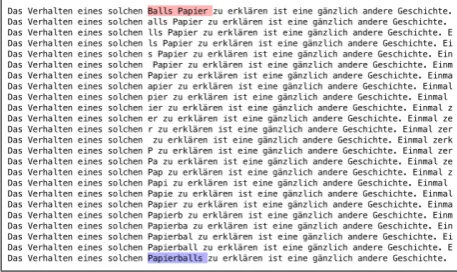
[image:3.595.307.536.165.301.2]punctuation boundaries.4 In particular, this parser is capa-ble of recognising Papier andballas two different words even when they are written together as inPapierball. Figure 3 illustrates an automatically recognised replace-ment of a 2-gram by a 1-gram. The first segreplace-ment high-lighted in pink is the replaced 2-gram and the second one highlighted in purple is the substitute 1-gram.
Figure 3: Replacement ofBalls PapierbyPapierballs au-tomatically recognised and highlighted in our application
Our new method of parsing does not treat all space-separated letter sequences (1-grams or orthographic words5) as word spellings. By separating the notion of
1-gram from that of word spelling, we were able to con-sider any sequence of morphemes a separate grammatical word according to our needs. As a result, we could treat both the 1-gram Papierballs‘paper ball’ and the 2-gram Balls Papier‘ball of paper’ as a sequence of two grammat-ical words. This way of cutting strings (see Section 4) into word spellings and not grams shall facilitate the next step of judging whether two wordings are alternate equivalents.
eines∗ solchen∗ Balls∗ Papier∗
Modifier Modifier2 Head Modifier
– – Thing Material
Table 1: A 4-gram with 4 grammatical words
eines∗ solchen∗ Papier balls∗
Modifier Modifier2 Modifier Head
[image:3.595.319.522.568.606.2]– – Material Thing
Table 2: A 3-gram with 4 grammatical words
In Tables 1 and 2, the symbol∗represents a space ‘inside’ a word spelling, the last character of a word spelling being usually a space. However, since word spellings are not nec-essarily 1-grams, not all word spellings recognised by our parser end in a space character. Some of them such as Pa-pierin the nominal groupeines∗solchen∗Papierballs∗end with a letter, in this case the letterr.
The process for achieving this is the following. First an n×nmatrix is created wherenis the number of charac-ters in the text string. Each celli, jof the matrix represents
4
Parser available at https://github.com/DanielCoutoVale/openccg 5
a substringi, j wherei is the initial character of the string
andj is the last. Becauseimust be lesser or equalj only half of the matrix can be filled. Matrices of this kind are called ‘charts’ in parsing. The difference between our chart parser and traditional chart parsers is that we use a ‘charac-ter chart’ whereas other approaches use ‘1-gram charts’. The first module that fills the chart is a word spelling recog-niser. This module recognises all word spellings that are predicted with an internal vocabulary. In our case, we cre-ated the internal vocabulary based on a corpus of the final target texts by translators. Since we have several transla-tions of the same original text, the coverage of the word spelling recogniser is close to 100% for intermediate ver-sions.
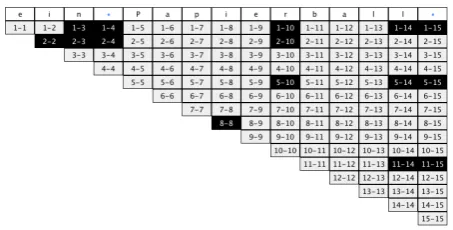
From that point on, a combinatory categorial unifier takes words as instances of ‘combinatory categories’ and unites them according to the combinatory rules that apply to each structure category. Two grammatical structures categorised according to combinatory rules are only to be united if the spelling of the first ends immediately before the spelling of the second and if the combinatory rules allow it. Each composite structure produced by the parser has a spelling resulting from the concatenation of the spellings of its parts. Each composite structure is put into a chart cell that corre-sponds to its spellings. Figure 4 shows a filled character chart for the 2-gramein Papierball‘a paper ball’. Notice that both the incomplete structure for the substring1−10
and that for the substring5−15are inserted. The complete
nominal group for the substring1−15is inserted into the
chart as expected.
Figure 4: A character chart filled with complete and incom-plete grammatical structures.
Since our parser fills a character chart by recognising word spellings and uniting structures based on their com-binatory categories, it does not depend on a prepro-cessing with a 1-gram tokeniser nor a part-of-speech tagger (pos-tagger). As a result, both grammatical structures eines∗solchen∗Balls∗Papier∗ in Table 1 and eines∗solchen∗Papierballs∗in Table 2 could be treated by our parser as nominal groups directly composed of four words with no intermediary unit corresponding to the 1-gramPapierballs∗. In other words, our parser does not need to take 1-grams as grammatical atoms from a preprocessing phase nor to build up any structure that corresponds to them in order to complete a linguistic analysis. In that sense, our parser does not distinguishes the two structures in Tables 1 and 2 but by the fact that they differ in word order and that the chosen word spellings are also different (Balls∗vs
balls∗andPapier∗vsPapier).
Once parsing is finished, a semantic structure is created in terms of what nominal groups represent. Tables 3-5 are examples of such semantic structures. The prefix eum: stands forExperiential Upper Model(Bateman et al., 2010) whereas the prefixdeu:stands forDeutsches Unteres Mod-ell‘German Lower Model’.
Superclass Subclass
eum:Thing deu:Ball eum:Material deu:Papier
Table 3:eines solchen Balls Papieras representation
Superclass Subclass
[image:4.595.366.482.246.288.2]eum:Thing deu:Ball eum:Material deu:Papier
Table 4:eines solchen Papierballsas representation
[image:4.595.366.483.413.455.2]Superclass Subclass eum:Thing deu:Ball eum:Material deu:Papier
Table 5:der Papierballas representation
Superclass Subclass
[image:4.595.56.283.438.553.2]eum:Thing deu:Kugel eum:Material deu:Papier
Table 6:eine Papierkugelas representation
Contrary to grammatical structures, two representations such as those in Tables 3 and 4 can be identical even if the word sequences are different. Moreover, two represen-tations such as those in Tables 4 and 5 can also be identical despite the fact that the grammatical case and the deictic terms of the nominal groups are different. Furthermore, two representations such as those in Tables 5 and 6 can be alternate equivalents of the same original during a transla-tion even if they differ as far as representatransla-tion is concerned. All classes of phenomena specified in a general upper model such as things and materials are further specified with language specific classes of representable phenomena (taxa). These general and specific classifications of repre-sentable phenomena are what enables a system to detect alternates as we shall demonstrate in the next section.
4.
How to detect alternates
two charts, indicating that a structure was added to or re-moved from the unfolding translation. For example, each time the second text string is one character shorter than the first, the procedure searches for all the structures that exist in the first chart either at the same position as in the second chart or one position before. If the structure is not found there, then it is considered removed.
A second procedure iterates over the chart difference se-ries to find replacements. Whenever it finds a removal of a grammatical structure, it searches for additions of struc-tures in the 50 following differences in a window of 25 characters from the dot position. If it finds an addition of structure, it sends the removed-added structure pair to soft-ware modules that we called ‘equivalence judges’.
For each segment of text, the parser builds zero or more lexicogrammatical structures, each one associated with the corresponding semantic structures in the form of entities. When a removed grammatical structure is compared with an added structure for equivalence, the ‘equivalence judges’ are activated. If the structures in the pair are judged by any of the judges to be potential equivalents of the same seg-ment in the source text, they are kept in the list of replace-ments.
Two equivalence judges have been implemented so far. The first equivalence judge checks whether two references to an entity are references to instances of the same type. For in-stance,eines solchen Balls Papier (‘such a ball of paper’) andeines solchen Papierballs(‘such a paper ball’) are in-stances of the same class of things made of the same mate-rial. Although lexicogrammatically different, these entities are identical as far as their semantics is concerned. The second equivalence judge checks whether two references to an entity are references to instances of different but in-terchangeable types in a given situation. For instance,ein zerkn¨ulltes Blatt Papier(‘a crumpled sheet of paper’) and eine Papierkugel (‘a paper ball’) are indeed two ways of classifying things, but they happen to be references to the same thing and are in the same textual position. In that sense, the second equivalence judge checks whether two entity classes are interchangeable ways of classifying the same thing in a given situation. This equivalence judge re-lies on user-specified groups of classes of phenomena. The information used for the equivalence judges has to be pro-vided by the human analyst for each specific domain based on the divergent equivalents found in the corpus of the final translations of the source text.
5.
Evaluation
For calculating precision, we used the whole corpus and all hits of our algorithm. For calculating recall, we manually detected the first two and the last two non-overlapping re-placements in each text series files. When less than four replacements occurred in a text series file, we counted each once. There are 55 instances of replacements in our test sample, resulting in a granularity of 2%.6
We ran the software over 15 text series files. All but the last were successfully processed (see Footnote 1, Section
6Each replacement that is recalled corresponds to an
approxi-mate increase of 2% to the total count.
2). Out of the 14 remaining files, the replacement detection had 405 hits with 92% precision and 22% recall without any tuning.
A large fraction of the non-recognised replacements were changes in the way things are classified. In a random sam-ple, these accounted for 22% of the cases. To increase recall, we created interchangeability groups that are rele-vant for the field of activity of our texts, based on the vo-cabulary of the target text. These groups included repre-senting the same portion of matter either as a ‘crumpled sheet’ (zerkn¨ulltes Blatt, zerknittertes Blatt, and verknit-tertes Blatt) or as a ‘ball’ (Kugel,Ball, andB¨undel). When we added such thing class interchangeability groups to our German linguistic resource, we increased hits by 113 to a total of 518. Recall rose in the test sample to 25%. Pre-cision rose collaterally from 92% to 94% because of the newly recognised replacements.
For improving recall, we implemented a filter that relies on a user-specified blacklist of classes of things that we do not expect in the current translation task. We manu-ally tagged the wrongly recognised replacements in the list. All of them consisted of segments of words such asichin Gewicht,sichandnicht, asduindurch, such asmengein zusammengedr¨ucktand such as ¨anderunginVer¨anderung. By adding references to people, sets, types, and the noun ¨anderung(changes) to our blacklist, we excluded all and only the 32 wrong hits, resulting in an increase in precision from 94% to 100% without affecting recall.
Inspecting the test sample shows that 31% of the replace-ments are neither replacereplace-ments of identical classes nor re-placements of interchangeable classes and are therefore not covered by the equivalence judges implemented so far.
6.
Discussion
Our method of recovering replacements in text series files has a satisfactory precision and recall for the researched register in our German corpus. Recall can be improved with a better lexical coverage and tuning. The remaining 31% of replacements will be more costly to detect auto-matically because they involve a variety of linguistic phe-nomena. These phenomena include:
1. typing of a word spelled in the source language but capitalised according to German graphology: e.g. En-ergyreplaced byEnergie;
2. replacing an elliptic reference by a non-elliptic one: e.g.[...] Kanten [...] und kleinere werden gebildet re-placed by[...] Kanten [...] und kleinere Kanten wer-den gebildet; and
3. grammatical ‘unpacking’ of semantic content.
are of particular interest from the point of view of transla-tion studies, this is an aspect that will be addressed in future work.
Two important points remain to be made. First, we noticed that our hit list contains replacements that were hard to de-tect – e.g. instances when local changes have implications for larger structures – and thus overlooked during manual creation of the test sample. We take this as evidence for the unreliability of manual inspection of such data. Sec-ond, the high cost of manual analysis prohibits attempts to increase support for low-frequency phenomena without au-tomation. For this data, we foresee that further replacement types can be detected through the implementation of addi-tional equivalence judges.
7.
Conclusion
In this paper, we presented an open-source toolkit for gen-erating text series files, parsing without word boundaries, and detecting replacements in text series files. With this toolkit, we are now able to describe the behaviour of trans-lators with a corpus size and a reliability that was up to now unfeasible with human analysts. We hope to have shown that the effort of providing domain-specific information for the equivalence judges is justified because it gives access to modifications made during the translation process which are otherwise simply not reliably accessible to the human analyst.
In our own research, the tool will be used to analyse which grammatical features are particularly likely to attract atten-tion during the translaatten-tion process in the form of (repeated) replacements across participants. Moreover, such observa-tions and inferences can contribute to our general under-standing of language as a meaning-making resource and to our understanding of why translations tend to display un-typical grammatical and semantic patterns.
These tools are not only important for translation stud-ies, but also for research in other areas such as authoring tools (R¨osener, 2010) and MT post-editing (Koehn, 2009). Moreover, a parser that does not rely on space bound-aries may be used to process spaceless fragments of a text such as Twitter hashtags (Couto-Vale and Hansen-Ampah, 2016), texts in agglutinative languages such as Turkish, and Finnish, and texts in predominantly spaceless languages such as Chinese and Japanese.
8.
Acknowledgements
The research reported here was funded by the German Re-search Council, grant no. NE 1822/2-1.
9.
Bibliographical References
Alves, F. and Couto-Vale, D. (2011). On drafting and revi-sion in translation: a corpus linguistics oriented analysis of translation process data. Translation: Corpora, Com-putation, Cognition, 1(1):105–122.
Bateman, J. A., Hois, J., Ross, R., and Tenbrink, T. (2010). A linguistic ontology of space for natural language pro-cessing.Artificial Intelligence, 174:1027–1071.
Carl, M. (2009). Triangulating product and process data: quantifying alignment units with keystroke data. In In-ger M. Mees, et al., editors, Methodology, Technology
and Innovation in Translation Process Research, num-ber 38 in Copenhagen Studies in Language, pages 225– 247. Samfunds Litteratur, Frederiksberg.
Carl, M. (2012). Translog-II: a Program for Recording User Activity Data for Empirical Reading and Writ-ing Research. In Proceedings of the Eight Interna-tional Conference on Language Resources and Evalu-ation (LREC’12), Istanbul, Turkey. European Language Resources Association.
Couto-Vale, D. and Hansen-Ampah, A. (2016). The mean-ing of hashtags matters: detectmean-ing hashtags such as #je-suiskouachi. In Proceedings of the 8th International Corpus Linguistics Conference (CILC 2016), page 29, M´alaga.
ˇ
Culo, O., Hansen-Schirra, S., Neumann, S., and Vela, M. (2008). Empirical Studies on Language Contrast Us-ing the English-German Comparable and Parallel CroCo Corpus. In Proceedings of LREC 2008, pages 47–51, Marrakesh.
Cyrus, L. (2006). Building a resource for studying transla-tion shifts. InProceedings of LREC 2006, pages 1240– 1245, Genoa, Italy.
Hansen-Schirra, S., Neumann, S., and Steiner, E. (2012). Cross-linguistic Corpora for the Study of Translations - Insights from the language pair English-German. de Gruyter Mouton, Berlin.
Helmreich, S., Farwell, D., Dorr, B., Habash, N., Levin, L., Mitamura, T., Reeder, F., Miller, K., Hovy, E., Rambow, O., and Siddharthan, A. (2004). Interlingual Annotation of Multilingual Text Corpora. In Adam Meyers, editor, HLT-NAACL 2004 Workshop: Frontiers in Corpus Anno-tation, pages 55–62, Boston, Massachusetts, USA, May. Association for Computational Linguistics.
Jakobsen, A. L. and Schou, L. (1999). Translog documen-tation. In Gyde Hansen, editor, Probing the process in translation: Methods and results, pages 9–20. Samfunds Litteratur, Frederiksberg.
Koehn, P. (2009). A process study of computer-aided translation.Machine Translation, 23(4):241–263. L¨udeling, A. (2008). Mehrdeutigkeiten und
Kate-gorisierung: Probleme bei der Annotation von Lernerko-rpora. In Maik Walter et al., editors, Fortgeschrittene Lernervariet¨aten: Korpuslinguistik und Zweitspracher-werbsforschung, pages 119–140. Niemeyer, T¨ubingen. R¨osener, C. (2010). Computational linguistics in the
lator’s workflow—combining authoring tools and trans-lation memory systems. In Proceedings of the NAACL HLT 2010 Workshop on Computational Linguistics and Writing: Writing Processes and Authoring Aids, pages 1–6, Los Angeles.
Serbina, T., Niemietz, P., Fricke, M., Meisen, P., and Neu-mann, S. (2015). Part of speech annotation of interme-diate versions in the keystroke logged translation corpus. In Proceedings of the 9th Linguistic Annotation Work-shop, pages 102–111, Denver.
du Franc¸ais et de l’Anglais: M´ethode de Traduction. Di-dier, Paris.