Annotating Temporally-Anchored Spatial Knowledge
on Top of OntoNotes Semantic Roles
Alakananda Vempala
and
Eduardo Blanco
Human Intelligence and Language Technologies LabUniversity of North Texas
[email protected],[email protected]
Abstract
This paper presents a two-step methodology to annotate spatial knowledge on top of OntoNotes semantic roles. First, we manipulate semantic roles to automatically generate potential additional spatial knowledge. Second, we crowdsource annotations with Amazon Mechanical Turk to either validate or discard the potential additional spatial knowledge. The resulting annotations indicate whether entities are or are not located somewhere with a degree of certainty, and temporally anchor this spatial information. Crowdsourcing experiments show that the additional spatial knowledge is ubiquitous and intuitive to humans, and experimental results show that it can be inferred automatically using standard supervised machine learning techniques.
Keywords:spatial knowledge, temporally-anchored knowledge, semantic inference
1.
Introduction
Extracting meaning from text has received considerable at-tention in the last decade. In particular, semantic role la-beling and efforts focused on spatial meaning—both cor-pora development and automatic tools—have become pop-ular. Semantic roles capture semantic links between pred-icates and their arguments; they capture who did what to whom, how, when and where (Baker et al., 1998; Palmer et al., 2005). Efforts targeting spatial meaning use special-ized relations such asTRAJECTORandLANDMARK (Kord-jamshidi et al., 2011; Kolomiyets et al., 2013), or define subtasks such as identifying spatial elements and spatial signals (Pustejovsky et al., 2015).
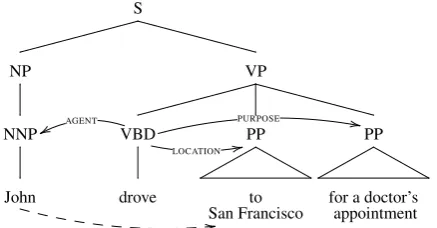
There are several corpora with semantic role annotations, e.g., FrameNet (Baker et al., 1998), PropBank (Palmer et al., 2005), and OntoNotes (Hovy et al., 2006). While se-mantic roles are useful, there is much more meaning in all but the simplest statements. Consider the sentence John drove to San Francisco for a doctor’s appointment and the semantic roles annotated in OntoNotes (Figure 1, solid ar-rows). On top of these valuable semantic roles, one can infer that John hadLOCATION San Francisco for a short period of time afterdrove(more precisely, during the doc-tor’s appointment), but probably not long after, long be-fore or duringdrove. This additional knowledge is intuitive to humans although it is disregarded by existing tools and highly ambiguous: ifJohn drove home to San Francisco af-ter a vacation in Colorado, it is reasonable to believe that he hadLOCATIONSan Franciscowell afterdrove.
This paper presents (1) annotations of temporally-anchored spatial knowledge on top of OntoNotes semantic roles, and (2) experiments to extract this knowledge automatically. We release a new resource1 that annotates where entities are and arenot located, and temporally anchor this infor-mation. Additionally, we incorporate certainty levels since there is often evidence that something is (or is not) located somewhere, but one cannot fully commit.
1
Available athttp://hilt.cse.unt.edu/
Annotating Temporally-Anchored Spatial Knowledge
on Top of OntoNotes Semantic Roles
Alakananda Vempala
and
Eduardo Blanco
Human Intelligence and Language Technologies Lab University of North Texas
[email protected],[email protected] Abstract
This paper presents a framework to infer additional meaning from existing semantic role representations. Given the semantic links between predicates and arguments of PropBank we extract links between the arguments and temporally anchor them. We also add levels of certainity to each additional relation extracted.The core concept is to infer temporally-anchored spatial knowledge as humans intuitively understand it. We describe an algorithm that generates potential additional spatial knowledge. Crowdsourced annotation effort on OntoNotes with detailed analysis is presented. Annotation examples and ambiguity encountered while inferring the additional spatial knowledge are illustrated. We also present experiments to automatically infer this temporally anchored spatial knowledge.
Keywords:keyword A, keyword B, keyword C
1. Introduction
Extracting meaning from text has received considerable at-tention in the last decade. In particular, semantic role la-beling and efforts focused on spatial meaning—both cor-pora development and automatic tools—have become pop-ular. Semantic roles capture semantic links between pred-icates and their arguments; they capture who did what to whom, how, when and where (Baker et al., 1998; Palmer et al., 2005). Efforts targeting spatial meaning use special-ized relations such asTRAJECTORandLANDMARK (Kord-jamshidi et al., 2011; Kolomiyets et al., 2013), or define subtasks such as identifying spatial elements and spatial signals (Pustejovsky et al., 2015).
There are several corpora with semantic role annotations, e.g., FrameNet (Baker et al., 1998), PropBank (Palmer et al., 2005), and OntoNotes (Hovy et al., 2006). While se-mantic roles are useful, there is much more meaning in all but the simplest statements. Consider the sentence John drove to San Francisco for a doctor’s appointment and the semantic roles annotated in OntoNotes (Figure 1, solid ar-rows). On top of these valuable semantic roles, one can infer thatJohn hadLOCATION San Francisco for a short period of time afterdrove (more precisely, during the doc-tor’s appointment), but probably not long after, long be-fore or duringdrove. This additional knowledge is intuitive to humans although it is disregarded by existing tools and highly ambiguous: ifJohn drove home to San Francisco af-ter a vacation in Colorado, it is reasonable to believe that he hadLOCATIONSan Francisco well after drove. This paper presents (1) annotations of temporally-anchored spatial knowledge on top of OntoNotes semantic roles, and (2) preliminary experiments to extract this knowledge auto-matically. We release a new resource1that annotates where
entities are and arenotlocated, and temporally anchor this information. Additionally, we incorporate certainty levels since there is often evidence that something is (or is not) located somewhere, but one cannot fully commit.
1Available athttp://hilt.cse.unt.edu/
S
NP VP
NNP AGENT VBD PURPOSEPP
LOCATION
PP
John drove to
San Francisco for a doctor’sappointment
Figure 1: Semantic roles in OntoNotes (solid arrows) and additional spatial knowledge (dashed arrow).
2. OntoNotes and Additional Spatial
Knowledge
We represent a semantic relationRbetweenx and y asR(x,
y). R(x, y) can be read “x hasRy”, e.g.,AGENT(bought,
Bill) can be read “bought hasAGENTBill.” Semantic roles
are relationsR(x, y) such that (1) x is a predicate and (2) y is an argument ofx. We use the termadditional spatial knowledgeto refer to relationsLOCATION(x, y) that are not
semantic roles, i.e., when (1)x is not a predicate or (2) x is a predicate andy is not an argument of x.
2.1. Semantic Roles in OntoNotes
OntoNotes (Hovy et al., 2006) is a large corpus of 63,918 sentences from several genres including newswire, broad-cast news and conversations, and magazines.2 It includes
POS tags, word senses, parse trees, speaker information, named entities, semantic roles and coreference.
OntoNotes semantic roles follow PropBank framesets and only account for verbal roles, i.e., for all semantic roles
R(x, y), x is a verb. The role set consists of numbered
ar-guments and argument modifiers. Numbered arar-guments, also referred to as core arguments, range fromARG0 to
ARG5, and their meanings are verb-dependent, e.g.,ARG3
is used to indicate theINSTRUMENTwithapply.03and the
2We use the CoNLL-2011 Shared Task distribution (Pradhan
et al., 2011), available athttp://conll.cemantix.org/2011/.
Figure 1: Semantic roles in OntoNotes (solid arrows) and additional spatial knowledge (dashed arrow).
2.
OntoNotes and Additional Spatial
Knowledge
We represent a semantic relationRbetweenxandyasR(x, y). R(x,y) can be read “x hasRy”, e.g., AGENT(bought, Bill) can be read “boughthasAGENTBill.” Semantic roles are relationsR(x,y) such that (1)xis a predicate and (2)y is an argument of x. We use the term additional spatial knowledgeto refer to relationsLOCATION(x,y) that are not semantic roles, i.e., when (1)x is not a predicate or (2)x is a predicate andy is not an argument ofx.
2.1.
Semantic Roles in OntoNotes
OntoNotes (Hovy et al., 2006) is a large corpus of 63,918 sentences from several genres including newswire, broad-cast news and conversations, and magazines.2 It includes POS tags, word senses, parse trees, speaker information, named entities, semantic roles and coreference.
OntoNotes semantic roles follow PropBank framesets and only account for verbal roles, i.e., for all semantic roles
R(x,y),x is a verb. The role set consists of numbered ar-guments and argument modifiers. Numbered arar-guments, also referred to as core arguments, range from ARG0 to ARG5, and their meanings are verb-dependent, e.g., ARG3 is used to indicate theINSTRUMENTwithapply.03and the
2We use the CoNLL-2011 Shared Task distribution (Pradhan
Captain Simons likely died ARGM-ADV ARG0
ARGM-MNR
on impact versus perhaps freezing ARGM-ADV ARG2
ARGM-LOC to
death the Alpsin
Figure 2: Semantic roles in OntoNotes (solid arrows) and additional spatial knowledge of type (1b) (dashed arrow).
[The paint]ARG1was [applied]v[with a hard-bristle brush]ARG3. [In ’69]ARGM-TMP [at the age of 11]ARGM-TMP [you]ARG0 [went]v [from Beijing]ARG3[to Shanghai]ARG4.
Table 1: Examples of PropBank-style semantic roles.
ARGM-LOC: location ARGM-CAU: cause ARGM-EXT: extent ARGM-TMP: time ARGM-DIS: discourse connectives ARGM-PNC: purpose ARGM-ADV: general-purpose ARGM-MNR: manner ARGM-NEG: negation marker ARGM-DIR: direction ARGM-MOD: modal verb
Table 2: Argument modifiers in PropBank and OntoNotes.
2.2. Additional Spatial Knowledge
OntoNotes annotates spatial information with (1) ARGM -LOCfor all verbs, and (2) numbered arguments for a few verbs, e.g., theSTART POINTandEND POINTofgo.01 are annotated withARG3andARG4respectively.
There are 2 types of additional relationsLOCATION(x, y): (1) those whose argumentsx and y are semantic roles of some verb, and (2) those whose argumentsx and y are not semantic roles of any verb. Type (1) can be further divided into type (1a) ifx and y are roles of the same verb, and type (1b) ifx and y are roles of different verbs.
Figure 1 exemplifies an inference of type (1a): John and San Francisco are theAGENTandLOCATIONofdrove; the additional spatial knowledge is inferred between roles of the same verb. Figure 2 exemplifies an inference of type (1b):Captain Simons is theARG0ofdied and in the Alps is theARGM-LOCoffreezing; the additional spatial knowl-edge links roles of different verbs.
The following statement exemplifies type (2): [Palm Beach estate owners]AGENT drive [Bentleys and other lux-ury cars]THEME. Semantic roles indicate the AGENT and THEMEofdrive; additional spatial knowledge includesLO -CATION(Bentleys and other luxury cars, Palm Beach). In this paper, we focus on annotating and extracting addi-tional spatial knowledgeLOCATION(x, y) of type (1) when x and y satisfy certain constraints (Section 3.1.).
3. Corpus Creation
We follow a two-step methodology to annotate temporally-anchored spatial knowledge on top of OntoNotes. First, we manipulate semantic roles to generate potential spatial knowledge. Second, we gather crowdsourced annotations to either discard or validate the potential knowledge.
3.1. Generating Potential Additional Spatial Knowledge
All potential spatial knowledge inferable from OntoNotes semantic roles (i.e., spatial knowledge of type 1, Section 2.2.) can be generated by calculating all combinations of
foreachsentence sdo
foreachsemantic roleARGM-LOC(yverb,y)∈sdo
foreachsemantic roleARGi(xverb,x)∈sdo
ifis valid(x, y)then
isx located at y a day before yverb?
isx located at y a during yverb?
isx located at y a day after yverb?
Algorithm 1: Procedure to generate all potential additional spatial knowledge targeted in this paper.
semantic roles. Such a brute-force approach generates a lot of potential knowledge that is later discarded during the annotation process. In order to make the annotation effort more efficient, we target additionalLOCATION(x, y) infer-able from intra-sentential numbered argumentsARGi(xverb,
x) andARGM-LOC(yverb,y), and impose the following
re-strictions:
1. x and y must not overlap;
2. the head ofx must be a named entity of typeperson,
org,work of art,fac,norp,productorevent;4
3. the head of y must be a noun subsumed by physi-cal entity.n.01in WordNet (Miller, 1995) or a named entity of typefac,gpe,loc, ororg; and
4. the heads ofx and y must be different than the heads of all previously generated pairs (x’, y’).
We defined these restrictions with two goals in mind: to ease the annotation effort and generate the least amount of invalid potential knowledge possible. ARGM-LOC is the most likely role to indicate spatial information in OntoNotes and the vast majority of roles (71%) are num-bered roles. Whenx is a named entity, the additional spa-tial knowledge is more intuitive. Wheny does not satisfy restriction (3), e.g.,here, in my brain, under him, potential additional knowledge is almost always invalid.
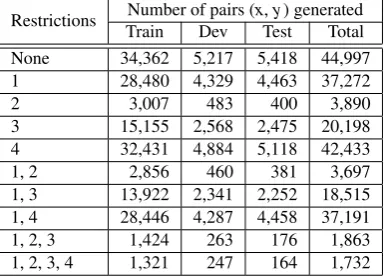
All potential spatial knowledge targeted in this paper is generated using Algorithm 1. is valid(x,y) returns true if restrictions 1–4 above are satisfied. The total number of ARGM-LOCs is9,612, and the total number of pairs (x, y) prior to enforcing any restriction is44,997. Table 3 shows the number of pairs (x, y) generated using several combi-nations of restrictions. After enforcing all restrictions, we generate1,732pairs; for each pair, we generate 3 questions to gather temporally-anchored spatial knowledge:
• Isx located at y the day before yverb? • Isx located at y during yverb? • Isx located at y the day after yverb?
4For a description and examples of these named entity types,
refer to (Weischedel and Brunstein, 2005).
Figure 2: Semantic roles in OntoNotes (solid arrows) and additional spatial knowledge of type (1b) (dashed arrow).
[The paint]ARG1was [applied]v[with a hard-bristle brush]ARG3.
[In ’69]ARGM-TMP [at the age of 11]ARGM-TMP [you]ARG0 [went]v
[from Beijing]ARG3[to Shanghai]ARG4.
Table 1: Examples of PropBank-style semantic roles.
ARGM-LOC: location ARGM-CAU: cause ARGM-EXT: extent ARGM-TMP: time ARGM-DIS: discourse connectives ARGM-PNC: purpose ARGM-ADV: general-purpose ARGM-MNR: manner ARGM-NEG: negation marker ARGM-DIR: direction ARGM-MOD: modal verb
Table 2: Argument modifiers in PropBank and OntoNotes.
START POINT withgo.01(Table 1). Argument modifiers have a common meaning across verbs, the list of modifiers provided by Palmer et al. (2005) is reproduced verbatim in Table 2. For a more detailed description of the semantic roles used in OntoNotes, we refer the reader to the LDC catalog3and PropBank (Palmer et al., 2005).
Throughout this paper, semantic roles are drawn with solid arrows. To improve readability, we often rename semantic roles, e.g.,AGENTinstead ofARG0in Figure 1.
2.2.
Additional Spatial Knowledge
OntoNotes annotates spatial information with (1) ARGM
-LOCfor all verbs, and (2) numbered arguments for a few verbs, e.g., theSTART POINTandEND POINTofgo.01are annotated withARG3andARG4respectively.
There are 2 types of additional relations LOCATION(x,y): (1) those whose argumentsx andy are semantic roles of some verb, and (2) those whose argumentsx andyare not semantic roles of any verb. Type (1) can be further divided into type (1a) ifxandyare roles of the same verb, and type (1b) ifxandy are roles of different verbs.
Figure 1 exemplifies an inference of type (1a): John and San Franciscoare theAGENTandLOCATIONofdrove; the additional spatial knowledge is inferred between roles of the same verb. Figure 2 exemplifies an inference of type (1b): Captain Simonsis theARG0ofdied andin the Alps is theARGM-LOCoffreezing; the additional spatial knowl-edge links roles of different verbs.
The following statement exemplifies type (2): [Palm Beach estate owners]AGENT drive [Bentleys and other lux-ury cars]THEME. Semantic roles indicate the AGENT and THEMEofdrive; additional spatial knowledge includesLO
-CATION(Bentleys and other luxury cars,Palm Beach). In this paper, we focus on annotating and extracting addi-tional spatial knowledgeLOCATION(x,y) of type (1) when x andysatisfy certain constraints (Section 3.1.).
3
https://catalog.ldc.upenn.edu/LDC2013T19
foreachsentence sdo
foreachsemantic roleARGM-LOC(yverb,y)∈sdo foreachsemantic roleARGi(xverb,x)∈sdo
ifis valid(x, y)then
isxlocated atya day beforeyverb? isxlocated atya duringyverb? isxlocated atya day afteryverb?
Algorithm 1: Procedure to generate all potential additional spatial knowledge targeted in this paper.
3.
Corpus Creation
We follow a two-step methodology to annotate temporally-anchored spatial knowledge on top of OntoNotes. First, we manipulate semantic roles to generate potential spatial knowledge. Second, we gather crowdsourced annotations to either discard or validate the potential knowledge.
3.1.
Generating Potential Additional Spatial
Knowledge
All potential spatial knowledge inferable from OntoNotes semantic roles (i.e., spatial knowledge of type 1, Section 2.2.) can be generated by calculating all combinations of semantic roles. Such a brute-force approach generates a lot of potential knowledge that is later discarded during the annotation process. In order to make the annotation effort more efficient, we target additionalLOCATION(x,y) infer-able from intra-sentential numbered argumentsARGi(xverb,
x) andARGM-LOC(yverb,y), and impose the following
re-strictions:
1. x andymust not overlap;
2. the head ofx must be a named entity of typeperson, org,work of art,fac,norp,productorevent;4 3. the head of y must be a noun subsumed by
physi-cal entity.n.01in WordNet (Miller, 1995) or a named entity of typefac,gpe,loc, ororg; and
4. the heads ofxandymust be different than the heads of all previously generated pairs from the same sentence. We defined these restrictions with two goals in mind: to ease the annotation effort and generate the least amount of invalid potential knowledge possible. ARGM-LOC is the most likely role to indicate spatial information in OntoNotes and the vast majority of roles (71%) are num-bered roles. Whenx is a named entity, the additional spa-tial knowledge is more intuitive. Wheny does not satisfy restriction (3), e.g.,here,in my brain,under him, potential additional knowledge is almost always invalid.
All potential spatial knowledge targeted in this paper is generated using Algorithm 1. is valid(x,y) returns true if
4For a description and examples of these named entity types,
certYES probYES certNO probNO UNK INV
# % # % # % # % # % # %
Day Before 481 27.77 200 11.54 589 34.00 145 8.37 94 5.42 223 12.87
During 1066 61.54 61 3.52 293 16.91 44 2.54 56 3.23 212 12.24
Day After 647 37.35 191 11.02 436 25.17 141 8.14 99 5.71 218 12.58
All 2194 42.22 452 8.69 1318 25.36 330 6.35 249 4.79 653 12.56
Table 3: Label counts and percentages per temporal anchor.
Restrictions Number of pairs (x,y) generated Train Dev Test Total None 34,362 5,217 5,418 44,997
1 28,480 4,329 4,463 37,272
2 3,007 483 400 3,890
3 15,155 2,568 2,475 20,198
4 32,431 4,884 5,118 42,433
1, 2 2,856 460 381 3,697
1, 3 13,922 2,341 2,252 18,515 1, 4 28,446 4,287 4,458 37,191
1, 2, 3 1,424 263 176 1,863
1, 2, 3, 4 1,321 247 164 1,732 Table 4: Number of pairs (x,y) generated after enforcing different restrictions (Section 3.1.).
restrictions 1–4 above are satisfied. The total number of
ARGM-LOCs is9,612, and the total number of pairs (x,y) prior to enforcing any restriction is44,997. Table 4 shows the number of pairs (x,y) generated using several combi-nations of restrictions. After enforcing all restrictions, we generate1,732pairs; for each pair, we generate 3 questions to gather temporally-anchored spatial knowledge:
• Isxlocated aty the day beforeyverb?
• Isxlocated aty duringyverb?
• Isxlocated aty the day afteryverb?
3.2.
Crowdsourcing Annotations
Once potential additional spatial knowledge is generated via simple plain English questions, it is time to gather an-swers. After pilot annotations (Blanco and Vempala, 2015), it became clear that it is suboptimal to force annotators to answerYES,NOorUNKNOWN—often times there is evidence that something is (or is not) located somewhere, but it is difficult to fully commit. Inspired by previous work (Saur´ı and Pustejovsky, 2012), we considered 6 labels:
• certYES: I am certain that the answer is yes.
• probYES: The answer is probably yes, but I am un-sure.
• certNO: I am certain that the answer is no.
• probNO: The answer is probably no, but I am unsure. • UNK: There is not enough information to choose one
of the labels above.
• INV: The question is invalid, I can’t understand it.
Annotations were gathered using Amazon Mechanical Turk. We created Human Intelligence Tasks (HITs) con-sisting of the 3 questions regarding a potential additional
LOCATION(x,y). The only information available to anno-tators was the source sentence, they did not have access to
Genre #pairs Day Before During Day After All
nw 685 0.85 0.87 0.82 0.86
bn 437 0.85 0.85 0.82 0.84
bc 161 0.92 0.94 0.89 0.92
mz 306 0.66 0.92 0.79 0.78
wb 143 0.84 0.87 0.85 0.87
All 1,732 0.80 0.87 0.79 0.83
Table 5: Pearson correlation between crowdsourced anno-tations and control sentences (10% of annotated sentences).
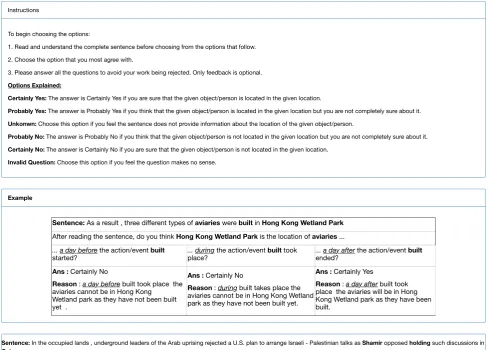
semantic role information or any additional linguistic infor-mation. Figure 3 shows the interface including instructions, an example, and the radio buttons that force annotators to chose one option per temporal anchor.
We created 1,732 HITs (5,196 questions) and published them in batches based on the genre of the source text. We recruited annotators with previous approval rate≥90%and past approved HIT count over5,000. We discarded submis-sions that took unusually short time compared to other sub-missions, and work done by annotators who always chose the same label. We requested 5 annotations per HIT and paid annotators$0.03per HIT. 150 annotators participated in the task, on average they annotated 57.33 HITs (min-imum: 1, max(min-imum: 1,409). The final labels were as-signed using the mode among the 5 annotations (the label that occurs most often). Ties had to be broken randomly for 22.48% of questions.
4.
Corpus Analysis
Columns 2–13 in Table 3 summarize the counts for each label. Overall, 42.22% of questions are answered with certYES and 25.36% with certNO, i.e. 67.58% of po-tential additional spatial knowledge can be inferred with certainty (annotators are sure that x is or is not located at y). Percentages forprobYESandprobNOare substantially lower, 8.69% and 6.35% respectively. It is worth noting that 61.54% of questions for during temporal anchor are answered withcertYES. This is due to the fact that some events (almost always) require their participants to be at the
LOCATIONof the eventduringthe event, e.g., participants in meetings, people standing somewhere.
4.1.
Annotation Quality
Feedback About the questions
Submit Instructions
To begin choosing the options:
1. Read and understand the complete sentence before choosing from the options that follow.
2. Choose the option that you most agree with.
3. Please answer all the questions to avoid your work being rejected. Only feedback is optional.
Options Explained:
Certainly Yes: The answer is Certainly Yes if you are sure that the given object/person is located in the given location.
Probably Yes: The answer is Probably Yes if you think that the given object/person is located in the given location but you are not completely sure about it.
Unkonwn: Choose this option if you feel the sentence does not provide information about the location of the given object/person.
Probably No: The answer is Probably No if you think that the given object/person is not located in the given location but you are not completely sure about it.
Certainly No: The answer is Certainly No if you are sure that the given object/person is not located in the given location.
Invalid Question: Choose this option if you feel the question makes no sense.
Example
Sentence: As a result , three different types of aviaries were built in Hong Kong Wetland Park
After reading the sentence, do you think Hong Kong Wetland Park is the location of aviaries ...
... a day before the action/event built
started? ... duringplace? the action/event built took ... a day afterended? the action/event built Ans : Certainly No
Reason : a day before built took place the aviaries cannot be in Hong Kong Wetland park as they have not been built yet .
Ans : Certainly No
Reason : during built takes place the aviaries cannot be in Hong Kong Wetland park as they have not been built yet.
Ans : Certainly Yes
Reason : a day after built took place the aviaries will be in Hong Kong Wetland park as they have been built.
Sentence: In the occupied lands , underground leaders of the Arab uprising rejected a U.S. plan to arrange Israeli - Palestinian talks as Shamir opposed holding such discussions in
Cairo .
After reading the sentence, do you think Cairo is the location of Shamir ...
... a day before the action/event holding
started? ... duringplace? the action/event holding took ... a day afterended? the action/event holding
Certainly Yes Probably Yes Unknown Probably No Certainly No Invalid Question
Certainly Yes Probably Yes Unknown Probably No Certainly No Invalid Question
Certainly Yes Probably Yes Unknown Probably No Certainly No Invalid Question
Figure 3: Amazon Mechanical Turk instructions, example and interface used to crowdsource annotations.
thanbefore and after (0.80, 0.79). Correlations per genre are between 0.78 and 0.92, i.e., all genres achieved high agreements. The highest Pearson correlation is obtained with sentences from broadcast conversations (bc, 0.92), fol-lowed by web data (wb, 0.87), newswire (nw, 0.86), broad-cast news (bn, 0.84), and magazine (mz, 0.78)
We also calculated the raw inter-annotator agreements and the percentages of questions for which there is no tie (Table 6). At least 3 annotators agreed (perfect match) in 58.6% of
Figure 4: Label distribution for the top 20 most frequent verbs to whichyattaches (yverb).
% of annotators that agree
% No Tie ≥5 ≥4 ≥3 ≥2
Day Before 2.9 15.3 54.9 98.4 75.69
During 12.4 35.1 68.4 98.6 82.21
Day After 3.4 16.3 52.5 98.5 74.65
All 6.2 22.2 58.6 98.5 77.52
Table 6: Percentage of questions for which at least 5, 4, 3 or 2 annotators agree (out of 5), and percentage of questions without a tie.
Top 20 most certain verbs
leave,explode,begin,march,stand,bear,teach,discuss, arrest, discover, carry, receive, raise, bury, establish, appear,live,die,baseandopen
Top 20 verbs with highest inter-annotator agreement hear, hire, begin, lead, bear, locate, march, conduct, call, receive, bury, provide, attack, retire, lock, draw, teach,base,executeandstop
Table 7: Top 20 most certain verbs (i.e., with the most certYES andcertNO labels) and top 20 verbs with the highest inter-annotator agreements sorted by frequency. Out of the top 50 most frequent verbs to whichy attaches (yverb), the ones with the mostcertYESandcertNOlabels
and the ones with highest inter-annotator agreements are presented in Table 7. Finally, Figure 4 depicts the label distribution for the top 20 most frequent verbs. Note that most labels are eithercertYESorcertNO, i.e., additional spatial knowledge can be inferred with certainty.
4.2.
Annotation Examples
In this section, we provide samples of easy and difficult annotations based on annotator agreement.
Consider sentence[Officer Payne]AGENT[collected]verb[the
AK-47]THEME[at the warehouse]LOCATION. Annotators inter-preted that theAK-47 certainly hadLOCATIONwarehouse the day before (certYES: 3, probYES:2) and during col-lected(certYES: 5), but not the day after (certNO: 5).
Consider now sentence [Reporter Garith
McClain]ARG0, v1 is [covering]v1 [the story]ARG1, v1
[for the [London]ARGM-LOC, v2 [based]v2 [Guardian
Newspaper]ARG1, v2]ARGM-ADV, v1. While there is not enough
information to determine whether Garith McClain has
LOCATIONLondon at any point of time, some annotators interpreted that it is probable (probYES:2,UNK: 3).
5.
Experimental Results
We follow a standard supervised machine learning ap-proach. Each of the5,196questions becomes an instance. In this paper, we experiment with instances whose majority label is notINV(Invalid) and for which at least 3 annotators agreed (2,725intances, 52%). We follow the CoNLL-2011 Shared Task (Pradhan et al., 2011) split into train, develop-ment and test, and train an SVM model with RBF kernel using scikit-learn (Pedregosa et al., 2011). The feature set and parametersC and γ were tuned using 10-fold cross-validation with the train and development sets, and results were calculated using test instances. All features are de-rived from gold standard linguistic annotations (POS tags, parse trees, semantic roles, etc.). We have previously pre-sented results including instances for which less than 3 an-notators agreed and using predicted linguistic annotations (Vempala and Blanco, 2016).
Feature selection.Table 8 presents the feature set. Lexical and syntactic features are standard in semantic role label-ing (Gildea and Jurafsky, 2002). We added several features extracted from the semantic role representations we infer from (Features 12–20).
Semantic features are derived from the verb-argument structures from which the potential additional relationLO
-CATION(x,y) is generated (Algorithm 1). Features 12–15 correspond to the surface form and part-of-speech tag of the verbs to whichx andy attach (i.e.,xverb andyverb).
Feature 16 indicates whetherxverbandyverbare the same,
it differentiates between inferences of type (1a) and (1b). Features 17 and 18 are the number of ARGM-LOC and
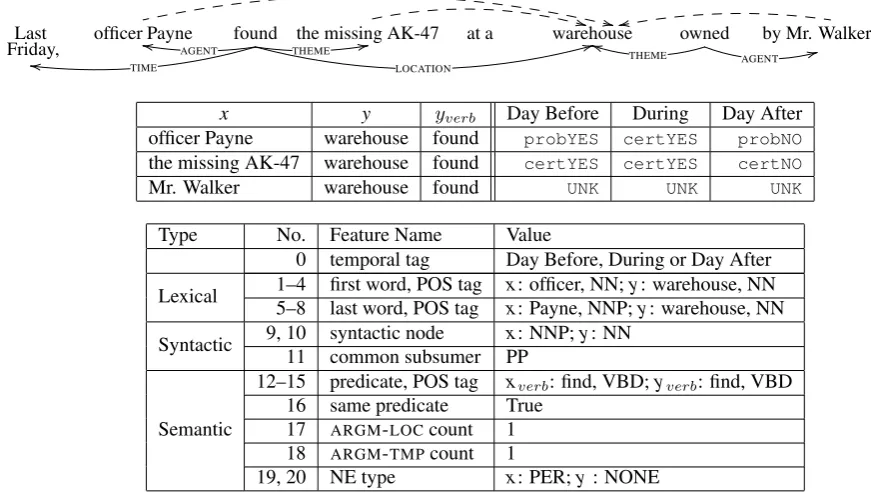
ARGM-TMP semantic roles in the sentence. Finally, fea-tures 19 and 20 are the named entity types, if any, of the heads ofx andy. Figure 5 exemplifies all features. We also tried several additional semantic features, e.g., flags indicating presence of all semantic roles (not only
ARGM-LOC and ARGM-TMP), counts for each semantic role attaching toxverbandyverb, numbered semantic role
betweenxverbandx, but discarded them because they did
not improve performance during the tuning process using cross-validation with train and development instances.
Results. Table 9 presents results obtained using a
Type No. Name Description
0 temporal tag are we predicting theLOC(x,y) a day before, during or a day afteryverb?
Lexical 1–4 first word, POS tag first word and POS tag inxandy 5–8 last word, POS tag last word and POS tag inxandy Syntactic 9, 10 syntactic node syntactic node ofxandy
11 common subsumer syntactic node subsumingxandy
Semantic
12–15 predicate, POS tag word form and POS tag ofxverbandyverb
16 same predicate whetherxverbandyverbare the same token
17 ARGM-LOCcount number ofARGM-LOCsemantic roles in the sentence 18 ARGM-TMPcount number ofARGM-TMPsemantic roles in the sentence 19, 20 NE type named entity types of head ofxandy, if any
Table 8: Lexical, syntactic and semantic features to infer potential additional relationsLOCATION(x,y).
System Day Before During Day After All
P R F P R F P R F P R F
most frequent per temporal anchor baseline
certYES 0.00 0.00 0.00 0.72 1.00 0.84 0.44 1.00 0.61 0.59 0.45 0.51 certNO 0.58 1.00 0.74 0.00 0.00 0.00 0.00 0.00 0.00 0.58 0.45 0.51 Other 0.00 0.00 0.00 0.00 0.00 0.00 0.00 0.00 0.00 0.00 0.00 0.00 All 0.34 0.58 0.43 0.52 0.72 0.60 0.19 0.44 0.27 0.51 0.59 0.54
lexical + syntactic + semantic features
certYES 0.33 0.18 0.23 0.74 1.00 0.85 0.65 0.69 0.67 0.69 0.80 0.74 probYES 1.00 0.14 0.25 0.00 0.00 0.00 0.25 0.25 0.25 0.40 0.17 0.24 certNO 0.63 0.91 0.75 1.00 0.14 0.24 0.68 0.76 0.71 0.66 0.69 0.67 probNO 0.00 0.00 0.00 0.00 0.00 0.00 0.00 0.00 0.00 0.00 0.00 0.00 UNK 0.00 0.00 0.00 0.00 0.00 0.00 0.00 0.00 0.00 0.00 0.00 0.00 All 0.53 0.58 0.51 0.75 0.75 0.67 0.57 0.62 0.60 0.61 0.66 0.63
Table 9: Results obtained with the baseline and all features. We report results using instances whose majority label is not INVand for which at least 3 annotators agree.
Type No. Name Description
0 temporal tag are we predicting theLOC(x, y) a day before, during or a day after yverb?
Lexical 1–4 first word, POS tag first word and POS tag in5–8 last word, POS tag last word and POS tag inx and yx and y
Syntactic 9, 10 syntactic node11 common subsumer syntactic node ofsyntactic node subsumingx and y x and y
Semantic
12–15 predicate, POS tag word form and POS tag ofxverbandyverb
16 same predicate whetherxverbandyverbare the same token
17 ARGM-LOCcount number ofARGM-LOCsemantic roles in the sentence
18 ARGM-TMPcount number ofARGM-TMPsemantic roles in the sentence
19, 20 NE type named entity types of head ofx and y, if any
Table 8: Lexical, syntactic and semantic features to infer potential additional relationsLOCATION(x, y).
Day Before During Day After All
P R F P R F P R F P R F
lexical + syntactic + semantic features
certYES 0.54 0.33 0.41 0.71 0.96 0.82 0.59 0.66 0.62 0.66 0.74 0.69
probYES 0.43 0.16 0.23 0.00 0.00 0.00 0.17 0.17 0.17 0.26 0.14 0.18
certNO 0.46 0.74 0.57 0.43 0.12 0.19 0.47 0.50 0.48 0.46 0.54 0.50
probNO 0.09 0.08 0.09 0.00 0.00 0.00 0.43 0.17 0.24 0.22 0.11 0.15
UNK 0.40 0.17 0.24 0.00 0.00 0.00 0.30 0.30 0.30 0.31 0.16 0.21
All 0.44 0.44 0.41 0.57 0.70 0.61 0.48 0.49 0.48 0.51 0.54 0.52
Table 9: Results obtained with all features per temporal anchor and all anchors.
Last
Friday, officer PayneAGENT found TIME
THEME
LOCATION
the missing AK-47 at a warehouse owned
THEME AGENT
by Mr. Walker
x y yverb Day Before During Day After
officer Payne warehouse found probYES certYES probNO the missing AK-47 warehouse found certYES certYES certNO
Mr. Walker warehouse found UNK UNK UNK
Type No. Feature Name Value
0 temporal tag Day Before, During or Day After Lexical 1–4 first word, POS tag5–8 last word, POS tag x: officer, NN; y: warehouse, NNx: Payne, NNP; y: warehouse, NN
Syntactic 9, 10 syntactic node11 common subsumer x: NNP; y: NNPP
Semantic
12–15 predicate, POS tag xverb: find, VBD;yverb: find, VBD
16 same predicate True 17 ARGM-LOCcount 1
18 ARGM-TMPcount 1
19, 20 NE type x: PER; y : NONE
Figure 5: Semantic role labels (solid arrows), all potential additional spatial knowledge (dashed arrows), annotations per temporal anchor, and feature values extracted for pair (officer Payne, warehouse).
Results. Results obtained with test instances derived from gold-standard linguistic information (semantic roles, parse trees, named entities, etc.) are provided in Table 9. Overall F-measure is 0.63, and results are higher withduring in-stances (0.67 vs. 0.51 and 0.60). This is not surprising, as these instances obtained higher inter-annotator agreements. Performance is better for the labels that allows us to
in-Most frequent label per temporal tag baseline obtaind an F-measure of 0.31. Experiments with feature ablation and predicted linguistic information are presented in (Blanco and Vempala, 2016). Results with predicted linguistic in-formation are obtained after generating instances with pre-dicted role labels and eliminating those instances that were overgenerated, i.e., those that do not belong to the gold
x y yverb Day Before During Day After
officer Payne warehouse found probYES certYES probNO
the missing AK-47 warehouse found certYES certYES certNO
Mr. Walker warehouse found UNK UNK UNK
Type No. Feature Name Value
0 temporal tag Day Before, During or Day After Lexical 1–4 first word, POS tag x: officer, NN;y: warehouse, NN
5–8 last word, POS tag x: Payne, NNP;y: warehouse, NN Syntactic 9, 10 syntactic node x: NNP;y: NN
11 common subsumer PP
Semantic
12–15 predicate, POS tag xverb: find, VBD;yverb: find, VBD
16 same predicate True 17 ARGM-LOCcount 1 18 ARGM-TMPcount 1
19, 20 NE type x: PER;y: NONE
Figure 5: Semantic role labels (solid arrows), all potential additional spatial knowledge (dashed arrows), annotations per temporal anchor, and feature values extracted for pair (officer Payne,warehouse).
Using all features, the overall F-measure is 0.63. During instances obtain higher F-measure (0.67) thanbefore(0.51) andafter(0.60). This is not surprising, asduringinstances obtained higher inter-annotator agreements. F-measures are higher for the labels that allow us to infer spatial
6.
Previous Work
Tools to extract the PropBank-style semantic roles we infer from have been studied for years (Carreras and M`arquez, 2005; Hajiˇc et al., 2009). These systems extract semantic links between verbs and their arguments. In contrast, the work presented here complements semantic role represen-tations with temporally-anchored spatial knowledge. There have been several proposals to extract semantic links not annotated in well-known corpora such as Propbank (Palmer et al., 2005), FrameNet (Baker et al., 1998) or Nombank (Meyers et al., 2004). Gerber and Chai (2010) augmented NomBank annotations with additional num-bered arguments appearing in the same or previous sen-tences, and Laparra and Rigau (2013) presented an im-proved algorithm for the same task. The SemEval-2010 Task 10: Linking Events and their Participants in Discourse (Ruppenhofer et al., 2009) targeted cross-sentence missing numbered arguments in PropBank and FrameNet. We have previously proposed an unsupervised framework to com-pose semantic relations out of previously extracted rela-tions (Blanco and Moldovan, 2011a; Blanco and Moldovan, 2011b), and a supervised approach to infer additional ar-gument modifiers (ARGM) for verbs in PropBank (Blanco and Moldovan, 2014). Unlike the current work, these pre-vious efforts improve the semantic representation of pred-icates. None of them infer semantic links between ar-guments of predicates, target temporally-anchored spatial knowledge or account for degrees of certainty.
Attaching temporal information to semantic relations is un-common. In the context of the TAC KBP temporal slot fill-ing track (Garrido et al., 2012; Surdeanu, 2013), relations common in information extraction (e.g., SPOUSE,COUN
-TRY OF RESIDENCY) are assigned a temporal interval in-dicating when they hold. In contrast, the approach pre-sented in this paper builds on top of semantic roles, targets temporally-anchoredLOCATIONrelations, and accounts for uncertainty (certYES/certNOvs.probYES/probNO). The task of spatial role labeling (Hajiˇc et al., 2009; Kolomiyets et al., 2013) aims at thoroughly representing spatial information with so-called spatial roles, i.e., trajec-tor, landmark, spatial and motion indicators, path, direc-tion, distance, etc. Unlike us, the task does not consider temporal anchors or uncertainty. As the examples through-out this paper illustrate, doing so is useful because (1) spa-tial information does not hold forever for most entities and (2) humans sometimes can only state that it is probably the case that an entity is (or is not) located somewhere. This paper is an extension of our previous work. We have presented preliminary annotations and experiments following the same approach to generate potential addi-tional spatial knowledge (Section 3.1.), but only enforcing restriction 1 and using 200 sentences (Blanco and Vem-pala, 2015). We have also presented additional results us-ing the same crowdsourced annotations detailed in this pa-per (Vempala and Blanco, 2016).
7.
Conclusions
Semantic roles capture who did what to whom, how, when and where. Among other role labels, PropBank uses num-bered arguments (ARG0, ARG1, etc.) to encode the core
arguments of a verb, and ARGM-LOC to encode the loca-tion. This work takes advantage of OntoNotes semantic roles in order to infer temporally-anchored spatial knowl-edge. Semantic role representations within a sentence are combined in order to infer whether entities are or arenot located somewhere, and assign a certainty label to this ad-ditional knowledge.
A new resource with additional spatial knowledge anno-tated on top of OntoNotes is presented with detailed anal-ysis. Most potential additional spatial knowledge automat-ically generated can be inferred with certainty (certYES: 42.22% , certNO: 25.36%). Crowdsourcing experiments show that the additional knowledge is intuitive to humans, the overall Pearson between final labels and control sen-tences is 0.83.
Experimental results show that inferring additional spatial knowledge can be done with a modest weighted F-measure of0.63. Results are higher forcertYESandcertNO(0.74 and 0.67), the labels that indicate that something is cer-tainly located somewhere or not. Inferring spatial knowl-edge for the day before or after an event occurred is harder than during the event (0.51and0.60vs.0.67).
The most important conclusion of this work is the fact that given an ARGM-LOC semantic role, temporally-anchored spatial knowledge can be inferred for numbered arguments in the same sentence. Indeed, annotators answered 50.91% of questions with certYES or probYES, and 31.71% of questions withcertNOorprobNO(Table 3). Another im-portant observation is that spatial knowledge can be in-ferred from most verbs, not only motion verbs. While it is fairly obvious to infer fromJohn moved to Paristhat he had LOCATION Paris the day aftermoved but (probably) not the day before or during, we can also infer the location of an entity with respect to verbs such asfound(Figure 5). Indeed, several of the top 20 most certain verbs (Table 7) are non-motion verbs, e.g.,explode,begin,stand,teach.
8.
Bibliographical References
Baker, C. F., Fillmore, C. J., and Lowe, J. B. (1998). The Berkeley FrameNet Project. InProceedings of the 17th international conference on Computational Linguistics, Montreal, Canada.
Blanco, E. and Moldovan, D. (2011a). A model for com-posing semantic relations. In Proceedings of the Ninth International Conference on Computational Semantics, pages 45–54. Association for Computational Linguistics. Blanco, E. and Moldovan, D. (2011b). Unsupervised learning of semantic relation composition. In Proceed-ings of the 49th Annual Meeting of the Association for Computational Linguistics: Human Language Technolo-gies, pages 1456–1465, Portland, Oregon, USA, June. Association for Computational Linguistics.
Blanco, E. and Moldovan, D. (2014). Leveraging verb-argument structures to infer semantic relations. In Pro-ceedings of the 14th Conference of the European Chapter of the Association for Computational Linguistics, pages 145–154, Gothenburg, Sweden, April. Association for Computational Linguistics.
Pro-ceedings of the 2015 Conference of the North American Chapter of the Association for Computational Linguis-tics: Human Language Technologies, pages 452–461, Denver, Colorado, May–June. Association for Compu-tational Linguistics.
Carreras, X. and M`arquez, L. (2005). Introduction to the CoNLL-2005 shared task: semantic role labeling. In CONLL ’05: Proceedings of the Ninth Conference on Computational Natural Language Learning, pages 152– 164, Morristown, NJ, USA. Association for Computa-tional Linguistics.
Garrido, G., Pe˜nas, A., Cabaleiro, B., and Rodrigo, A. (2012). Temporally anchored relation extraction. In Proceedings of the 50th Annual Meeting of the Associ-ation for ComputAssoci-ational Linguistics: Long Papers - Vol-ume 1, pages 107–116, Jeju Island, Korea. Association for Computational Linguistics.
Gerber, M. and Chai, J. (2010). Beyond NomBank: A Study of Implicit Arguments for Nominal Predicates. In Proceedings of the 48th Annual Meeting of the Associ-ation for ComputAssoci-ational Linguistics, pages 1583–1592, Uppsala, Sweden, July. Association for Computational Linguistics.
Gildea, D. and Jurafsky, D. (2002). Automatic labeling of semantic roles. Computational Linguistics, 28(3):245– 288, September.
Hajiˇc, J., Ciaramita, M., Johansson, R., Kawahara, D., Mart´ı, M. A., M`arquez, L., Meyers, A., Nivre, J., Pad´o, S., ˇStˇep´anek, J., Straˇn´ak, P., Surdeanu, M., Xue, N., and Zhang, Y. (2009). The conll-2009 shared task: Syn-tactic and semantic dependencies in multiple languages. In Proceedings of the Thirteenth Conference on Com-putational Natural Language Learning: Shared Task, CoNLL ’09, pages 1–18, Boulder, Colorado. Association for Computational Linguistics.
Hovy, E., Marcus, M., Palmer, M., Ramshaw, L., and Weischedel, R. (2006). OntoNotes: the 90% Solution. In NAACL ’06: Proceedings of the Human Language Technology Conference of the NAACL, Companion Vol-ume: Short Papers, pages 57–60, Morristown, NJ, USA. Association for Computational Linguistics.
Kolomiyets, O., Kordjamshidi, P., Moens, M.-F., and Bethard, S. (2013). Semeval-2013 task 3: Spatial role labeling. In Second Joint Conference on Lexical and Computational Semantics (*SEM), Volume 2: Proceed-ings of the Seventh International Workshop on Semantic Evaluation (SemEval 2013), pages 255–262. Association for Computational Linguistics.
Kordjamshidi, P., Van Otterlo, M., and Moens, M.-F. (2011). Spatial role labeling: Towards extraction of spa-tial relations from natural language.ACM Trans. Speech Lang. Process., 8(3):4:1–4:36, December.
Laparra, E. and Rigau, G. (2013). Impar: A deterministic algorithm for implicit semantic role labelling. In Pro-ceedings of the 51st Annual Meeting of the Association for Computational Linguistics (Volume 1: Long Papers), pages 1180–1189, Sofia, Bulgaria, August. Association for Computational Linguistics.
Meyers, A., Reeves, R., Macleod, C., Szekely, R.,
Zielin-ska, V., Young, B., and Grishman, R. (2004). The Nom-Bank Project: An Interim Report. In A. Meyers, editor, HLT-NAACL 2004 Workshop: Frontiers in Corpus Anno-tation, pages 24–31, Boston, Massachusetts, USA, May. Association for Computational Linguistics.
Miller, G. A. (1995). Wordnet: A lexical database for en-glish. InCommunications of the ACM, volume 38, pages 39–41.
Palmer, M., Gildea, D., and Kingsbury, P. (2005). The Proposition Bank: An Annotated Corpus of Semantic Roles.Computational Linguistics, 31(1):71–106. Pedregosa, F., Varoquaux, G., Gramfort, A., Michel, V.,
Thirion, B., Grisel, O., Blondel, M., Prettenhofer, P., Weiss, R., Dubourg, V., Vanderplas, J., Passos, A., Cour-napeau, D., Brucher, M., Perrot, M., and Duchesnay, E. (2011). Scikit-learn: Machine learning in Python. Jour-nal of Machine Learning Research, 12:2825–2830. Pradhan, S., Ramshaw, L., Marcus, M., Palmer, M.,
Weischedel, R., and Xue, N. (2011). Conll-2011 shared task: Modeling unrestricted coreference in ontonotes. In Proceedings of the Fifteenth Conference on Com-putational Natural Language Learning: Shared Task, pages 1–27, Portland, Oregon, USA, June. Association for Computational Linguistics.
Pustejovsky, J., Kordjamshidi, P., Moens, M.-F., Levine, A., Dworman, S., and Yocum, Z. (2015). Semeval-2015 task 8: Spaceeval. In Proceedings of the 9th In-ternational Workshop on Semantic Evaluation (SemEval 2015), pages 884–894, Denver, Colorado, June. Associ-ation for ComputAssoci-ational Linguistics.
Ruppenhofer, J., Sporleder, C., Morante, R., Baker, C., and Palmer, M. (2009). SemEval-2010 Task 10: Link-ing Events and Their Participants in Discourse. In Pro-ceedings of the Workshop on Semantic Evaluations: Re-cent Achievements and Future Directions (SEW-2009), pages 106–111, Boulder, Colorado, June. Association for Computational Linguistics.
Saur´ı, R. and Pustejovsky, J. (2012). Are you sure that this happened? assessing the factuality degree of events in text.Computational Linguistics., 38(2):261–299, June. Surdeanu, M. (2013). Overview of the tac2013 knowledge
base population evaluation: English slot filling and tem-poral slot filling. InProceedings of the TAC-KBP 2013 Workshop.
Vempala, A. and Blanco, E. (2016). Complementing se-mantic roles with temporally-anchored spatial knowl-edge: Crowdsourced annotations and experiments. In Proceedings of the Twenty-Ninth AAAI Conference on Artificial Intelligence, Phoenix, AZ.