R E S E A R C H
Open Access
Multiple linear epitopes (B-cell, CTL and Th) of
JEV expressed in recombinant MVA as multiple
epitope vaccine induces a protective immune
response
Fengjuan Wang
1†, Xiuli Feng
1†, Qisheng Zheng
2, Hongyan Hou
3, Ruibing Cao
1*, Bin Zhou
1, Qingtao Liu
4,
Xiaodong Liu
1, Ran Pang
1, Jin Zhao
1, Wenlei Deng
1and Puyan Chen
1Abstract
Epitope-based vaccination might play an important role in the protective immunity against Japanese encephalitis virus (JEV) infection. The purpose of the study is to evaluate the immune characteristics of recombinant MVA carrying multi-epitope gene of JEV (rMVA-mep). The synthetic gene containing critical epitopes (B-cell, CTL and Th) of JEV was cloned into the eukaryotic expression vector pGEM-K1L, and the rMVA-mep was prepared. BALB/c mice were immunized with different dosages of purified rMVA-mep and the immune responses were determined in the form of protective response against JEV, antibodies titers (IgG1 and IgG2a), spleen cell lymphocyte proliferation, and the levels of interferon-γand interleukin-4 cytokines. The results showed that live rMVA-mep elicited strongly immune responses in dose-dependent manner, and the highest level of immune responses was observed from the groups immunized with 107TCID50rMVA-mep among the experimental three concentrations. There were almost no difference of cytokines and neutralizing antibody titers among 107TCID50rMVA-mep, recombinant ED3 and inactivated JEV vaccine. It was noteworthy that rMVA-mep vaccination potentiates the Th1 and Th2-type immune responses in dose-dependent manner, and was sufficient to protect the mice survival against lethal JEV challenge. These findings demonstrated that rMVA-mep can produce adequate humoral and cellular immune responses, and protection in mice, which suggested that rMVA-mep might be an attractive candidate vaccine for preventing JEV infection.
Keywords:Japanese encephalitis virus, rMVA-mep, Immune response, Protection response
Introduction
The Japanese encephalitis virus (JEV), which belongs to the family Flaviviridae, infects the human central ner-vous system [1,2]. The virus has a zoonotic transmission cycle between birds and mosquitoes, in which swine serves as an intermediate amplifier hosts and JEV can spread from swine to humans via mosquito bites [3-5]. Thus the vaccination of swine against JEV should con-tribute to minimize the occurrence of JE epidemics in humans [6].
Both inactivated and live-attenuated vaccines have been widely used in many Asian countries. Inactivated mouse brain vaccines are considered first generated, inactivated cell culture vaccines and live SA14-14-2 are considered second generation vaccines against JEV [7], which play vital roles on effectively decreased the mor-bidity of Japanese encephalitis. During the vaccination with both inactivated and live-attenuated JEV vaccines, there are various disadvantageous conditions, including poor availability, high production costs, poor long-term immunity, and the possibility of allergic reactions [8]. These problems may be solved by using epitope-based vaccines containing selected protective epitopes, ap-propriately presented, which are capable of stimulating effective B cell, T cell, and cytotoxic immune responses * Correspondence:[email protected]
†Equal contributors
1
Key Laboratory of Animal Diseases Diagnosis and Immunology, Ministry of Agriculture, Nanjing Agricultural University, Nanjing 210095, China Full list of author information is available at the end of the article
cytotoxic T lymphocytes (CTLs), which confer protection against lethal challenge in mice [12]. Likewise, the enve-lope (E) protein of JEV was reported to be a strong immunogen for the production of neutralizing antibodies and CTLs [13]. Many vital epitopes identified in the JEV E protein [14-16] are effective in inducing protective immunity against JEV. Moreover, it has been reported that the design and delivery of epitope-based vaccines have the potential to be a novel vaccine against JEV [17-19].
In recent years, modified vaccinia virus Ankara has showed great promise as vectors for recombinant vac-cine development [20-24]. Despite its replication defi-ciency in human and most mammalian cells, MVA provides high-level gene expression and has been proven to be immunogenic when delivering heterologous anti-gens in animals and humans [25-27]. MVA vector vac-cines induce significant levels of humoral and cellular immune responses to vaccine antigens and were found to be less affected by preexisting vaccinia virus-specific immunity when compared to replication-competent vac-cinia virus vectors [28]. In this study, we first constructed the recombinant MVA by synthesizing multi-epitope gene from JEV envelope protein, which combined six B-cell epitopes (amino acid residues 75–92, 149–163, 258–285, 356–362, 373–399 and 397–403) and a CTL epitope (amino acid residues 60–68) and a Th epitope (amino acid residues 436–445) [29], and evaluated the abilities to induce immune responses in mice and pro-tective efficacy against JEV challenge.
Materials and methods
Cells and mice
Baby hamster kidney (BHK-21) cell (ATCC CCL-10) and rabbit kidney cell (RK-13) cell (ATCC CCL-37) growed in Dubach’s modified Eagle’s medium (DMEM) supple-mented with 10% heat-inactivated fetal bovine serum (FBS), 100 μg/mL of streptomycin, and 100 μg/mL of penicillin.
Female BALB/c mice (4–6 weeks old) were purchased from the Experimental Animal Center of Nanjing Med-ical University (Nanjing, China). All animal experiments were conducted according to the guidelines approved by the Animal Ethical and Experimental Committee of Nanjing Agriculture University.
of the supernatants were approximately 1.0 × 10 pfu. Recombinant proteins MEP and EDIII(which were used as vaccination control)were expressed in E. coli BL21 as previous reported [30], and purified on Ni-affinity chromatography column (Amersham Bioscience HiTrap chelating HP 5mL × 1column) according to the manufacturer’s instructions.
The inactivated JEV vaccine (SA14-14-2 strain,
2.0 × 10⁷pfu) was obtained from ZHONGMU
BIO-INDUSTRY CO., LTD.
Preparation of rMVA-mep
Construction of the rMVA-mep
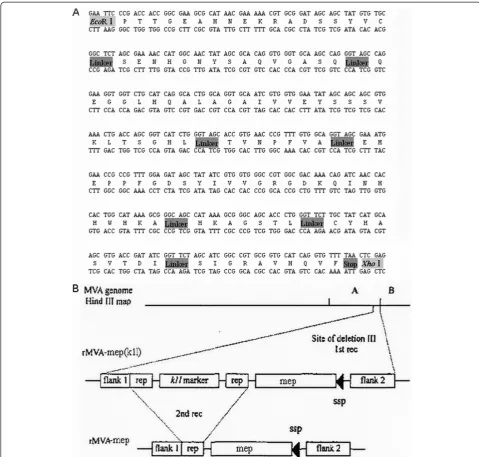
In this paper, according to the previously report [29], the multiple-epitope fragment from the E protein of JEV (SA14-14-2 strain), named MEP (eight epitopes), was designed by arranging the eight epitopes in the order of amino acids (75–92)–(149–163)–(258–285)–(356–362)– (373–399)–(397–403)–(60–68)–(436–445). The amino acid sequence and the nucleotide sequence of MEP are shown in Figure 1A. To minimize interference between adjacent epitopes, each was separated from its neighbor-ing epitope by a glycine and a serine codon [29]. The multiple-epitope gene was chemically synthesized by Invitrogen Biotechnology Co. Ltd. (Shanghai, China) and cloned into the transfer vector pGEM-K1L plasmid and named pGEM-K1L-mep (Figure 1B).
The MVA recombinants were produced according to the manufacturer’s instructions [31] on BHK-21 cells, named BHK-21. Simple, the rMVA-mep-BHK-21, which included rMVA-mep and wild MVA, was purified by serially infecting RK-13 cells, which was called rMVA-mep-RK-13. The rMVA-mep-RK-13 with k1l gene but no MVA was used to transfect BHK-21 cells, in which k1l was removed by intra-genomic hom-ologous recombination. The purified recombinant MVA containing multiple-epitope gene was called rMVA-mep, which was determined by the tissue culture infectious dose 50 (TCID50) methods.
Identification of rMVA-mep by PCR
infected with recombinant viruses were prepared to de-tect the host range gene k1l and MEP by PCR method. These primers used were shown in Table 1.
Identification of expressed proteins of MEP
Western blot was performed as described previously [29]. The lysates of BHK-21 cells infected with or with-out rMVA-mep were separated by 15% SDS-PAGE, in which non-infected BHK-21 cells was used as a negative control. The expressions of MEP proteins were identified
Figure 1Construction of the rMVA-mep. A. Design and construction of the multi-epitope peptide (MEP). The MEP was constructed from six B-cell epitopes and two T-cell epitopes, with a glycine and a serine (GS) as a spacer between epitopes. The amino acid sequences of the epitopes were obtained from the envelope protein of the JEV (AF315119) [29].B. The construction of the rMVA-mep. pGEM-K1L-mep contains the multi-epitope peptide (MEP).
Table 1 The primers of Identification of rMVA-mep by PCR
Gene Primer (from 5’to 3’)
Mep Forward primer: ctcgagatgccgaccaccggcgaagcgca
Reverse primer:
catatgatttttataaaaatttaaaacacctgatgcaccgcacggccgatgctag
K1l Forward primer: gaatgcacatacataagtaccggcatctctagca
Reverse primer: caccagcgtctacatgacgagcttccgagtt
MVA (wild) Forward primer: acataagtaccggcatctctagcacacagc
TCID50/0.1mL, 10 TCID50/0.1mL and 10 TCID50/0.1mL
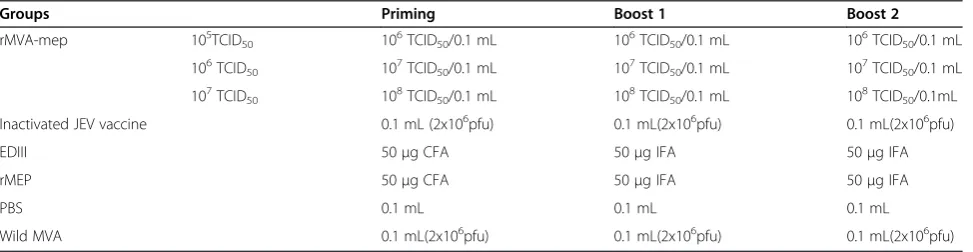
rMVA-mep, respectively. Vaccine group mice were each given 0.1ml of JEV (SA14-14-2 strain, 2x10⁶pfu). Also, the recombinant protein immunization groups were given purified 50μg MEP and 50μg EDIII in complete Freund’s adjuvant (CFA) for the first immunizations, in incomplete Freund’s adjuvant (IFA) for the second and the third immunizations. In addition, mice immunized with 0.1mL MVA (2x10⁶pfu) or 0.1mL PBS was used as negative con-trols (Table 2), respectivley. One week after the final immunization, three mice from each group were sacri-ficed, and their spleens removed aseptically for in vitro lymphocyte proliferation assay. Also, on 14thday after the third immunization, mice were challenged by i.p. injec-tion of a lethal dose of 5 × 10⁶ pfu of the JEV (SA14 strain) and the survival of the mice was monitored daily up to 15 days post-challenge. The animal groups and immunization doses were described in Table 2, and immunization schedule was shown in Figure 2.
Antibody assays
The sera were collected at 14, 28 and 42 days after immunization to perform the antibody assay by ELISA. Simply, the purified multi-epitope protein (rMEP) was coated in 96-well plates (1μg/mL) overnight at 4°C. After blocking, the coated plates were incubated with mouse serum in a sequential dilution of 1:50, 1:100, 1:200, 1:400, 1:800, 1:1600, 1:3200 and 1:6400 for 1.5 h at 37°C. And then, 50μL of a 1:1000 dilution of HRP- conjugated goat anti-mouse IgG, and a 1:2000 dilution of IgG1 and IgG2a were incubated for 45min at 37°C. After extensive washing, tetramethyl benzidine (TMB) substrate was added for 10 minutes at room temperature, and the
collected from all experiment groups to measure the productions of IL-4 and IFN-γusing commercially mice cytokine ELISA kits (RD, USA), according to the manu-facturer’s instructions.
Lymphocyte proliferation assay
One week after the final immunization, three mice of each group were killed, and splenocyte were prepared, and were incubated with 10μg/mL rMEP protein in 96-well flat-bottomed microtiter plates (100μL/well, 2 × 10⁶cells/mL in RPMI 1640 medium with 10% FBS). After incubation for 72 h, a final concentration of 20μg/mL MTT (Sigma) was added to each well for 4-h incubation. The medium was removed, and 100μL of DMSO was added into each well [32]. The light absorb-ance was measured at 570 nm to analyze cell viability expressed as the value of the A570 of cells from immu-nized mice vs. the control samples. All the data were statistically analyzed with SPSS software.
Plaque reduction neutralization assay (PRNT)
Neutralization antibodies elicited in immunized mice were valuated by PRNT as described previously [33]. Mouse serum was heat inactivated at 56°C for 30 min. Twofold serial dilutions of murine sera starting at 1:5 were tested, and then incubated with 100 pfu of JEV (virulent SA-14 strain) at 37°C for 1 h. The virus titers were then determined by plaque formation on BHK-21cell monolayers [34,35]. Percentage neutralization was calculated from the number of plaques obtained in the presence and the absence of the serum. The reciprocal of the highest serum dilution giving at least 50%
Table 2 The diagram of mouse immunization
Groups Priming Boost 1 Boost 2
rMVA-mep 105TCID50 10
6
Inactivated JEV vaccine 0.1 mL (2x10⁶pfu) 0.1 mL(2x10⁶pfu) 0.1 mL(2x10⁶pfu)
EDIII 50μg CFA 50μg IFA 50μg IFA
rMEP 50μg CFA 50μg IFA 50μg IFA
PBS 0.1 mL 0.1 mL 0.1 mL
Wild MVA 0.1 mL(2x10⁶pfu) 0.1 mL(2x10⁶pfu) 0.1 mL(2x10⁶pfu)
neutralization was regarded as the JEV neutralization titer.
Statistical analysis
The data were recorded as mean ± standard deviation (SD). Biochemical and physiological parameters were analyzed statistically using one-way analysis of variance (ANOVA) followed by Dunnet-t-test using SPSS statis-tical software to evaluate variations between groups. A value of P < 0.05 was considered to be statistically significant.
Results
Generation of the recombinant virus (rMVA-mep) and purification
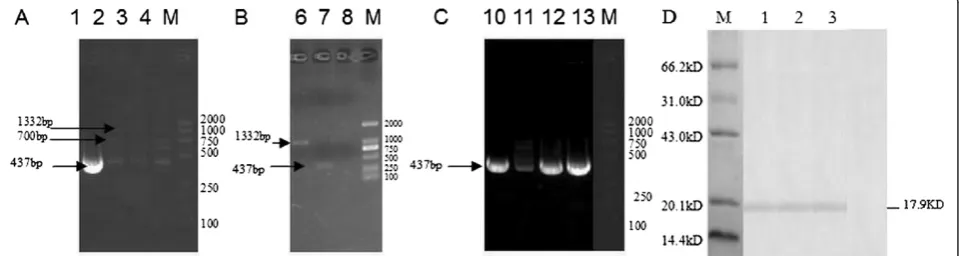
Recombinant viruses carrying wild MVA and host range gene k1l were selected by alternately infecting RK-13 cells and BHK-21cells. The first generation of purified viruses included targeted gene MEP (437bp), specific gene of wild MVA (nearly 700bp) and K1l gene (1332bp) (Figure 3A, lane 4: RK-13-1). To contract with the first generation, the concentration of wild MVA of the fourth
generation, RK-13-4 (Figure 3A, lane 2), was obviously lower. There was no wild MVA in the last generation (RK-13-6, Figure 3A, lane 1 and Figure 3B, lane 8), and only the targeted recombinant viruses carrying host range gene k1l (Figure 3B, lane 6) and targeted gene MEP (Figure 3B, lane 7) were presented. Under nonselective growth conditions, k1l was removed by intra-genomic homologous recombination when the recom-binant viruses (RK-13-6) were reinfected into BHK-21 cells (Figure 3C). K1l could not be found in the six generation on BHK-21 cells (Figure 3C, lane 10), but not in the fourth, second and first generation (Figure 3C, lane11: BHK-21-4; lane12: BHK-21-2; lane13: BHK-21-1). These results showed that recombinant virus has been purified.
Western Blotting of rMVA-mep
The rMEP was highly expressed in E. coli, and purified with the expected 17.9 kDa protein verified by Western blotting analysis (Figure 3D, lane 1). Moreover, it was observed that the MEP of JEV was stably expressed in BHK-21 cells after rMVA-mep infection, which were proved by Western blotting analysis with the sixth Figure 2Vaccination schedule and viral challenge period of in vivo experiment.Mice were given a first followed by a second
immunization and third immunization. The sera samples were collected at 14, 28 and 42 days after immunization. The immunized mice were challenged intraperitoneally with a lethal dose of 5 × 10⁶pfu of the JEV (SA14 strain). The health of each mouse was assessed twice daily.
Cellular immune responses
Cellular immune responses were evaluated by measuring the production of IFN-γ and IL-4 by splenocytes from mice at 35 dpi when stimulated by rMEP protein. As shown in Figure 4A, IFN-γ and IL-4 productions from mice received rMVA-mep (105TCID50, 106TCID50,
107TCID50), inactivated vaccine, EDIII, and rMEP were
significantly higher than that in the PBS and wild MVA (P < 0.05). Mice immunized with rMVA-mep promoted the IFN-γand IL-4 levels in dose-dependent manner, in
the groups as shown in Figure 4B. The highest occurred in the group immunized with inactivated vaccine of JEV SA14-14-2, and this level was significantly higher than those produced by PBS, wild MVA, or rMVA-mep (105TCID50; 106TCID50). We also found that the level of
splenocyte proliferation observed from the groups immunized with rMVA-mep (107TCID50), EDIII, and
rMEP was nearly equal; rMVA-mep can enhance antigen-specific splenocyte proliferative response in a dose-independent manner. No significantly lymphocyte
proliferation was induced by immunization with PBS and wild MVA.
Anti-rMEP of JEV antibody titers and subtype analysis
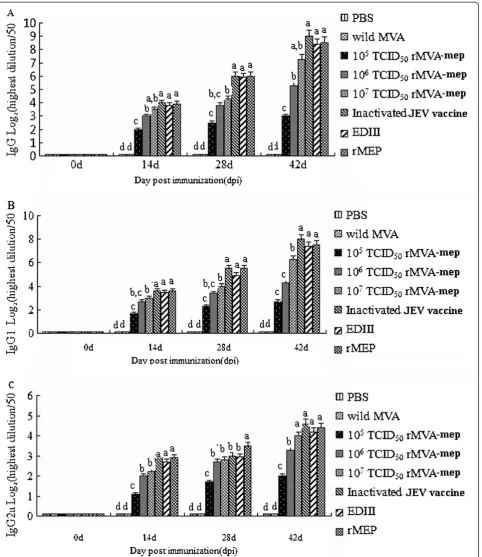
To estimate the potential roles of rMVA-mep on the humoral immune response, the IgG isotopes profiles of sera from immunized mice at two weeks after three
immunizations were measured by ELISA method
(Figure 5). These results showed that mice immunized with rMVA-mep generated a significant rMEP-specific antibody response in dose-dependent manner, in which mice injected with 107TCID50 rMVA-mep produced the strongest antibody response among the three reachable dosages (Figure 5A, IgG). Also, it was observed that the level of IgG from mice given the inactivated vaccine, EDIII and MEP were higher than that of mice given with 107TCID50 rMVA-mep. It was found that a combined IgG1/2a response was characteristic of mice immunized using an rMVA-mep prime-boost protocol (Figure 5B, IgG1 and Figure 5C, IgG2a). Moreover, the antibody level of IgG1 was significantly higher than that of IgG2a, which indicated that the IgG1 antibody was the domin-ant domin-antibody subtype induced by rMVA-mep vaccination. Low levels of both IgG1 and IgG2a were found in control sera.
These results suggested that rMVA-mep might be as potential candidate vaccine for the prevention of JEV infection.
Neutralizing antibodies
Serum samples collected on days 14, 28 and 42 were further evaluated for their ability to neutralize JEV in vitro by the plaque reduction neutralization assay (PRNT). As shown in Table 3 (2nd boost), although neutralization titer of serum from mice immunized
with rMVA-mep (105TCID50 [20 ± 1.33] and 106
TCID50 [33 ± 2.33]) was significantly lower than that of the mice immunized with JEV vaccine (58 ± 2.01), EDIII (56 ± 1.99) and MEP (57 ± 1.99), rMVA-mep vac-cination (107TCID50 [56 ± 1.01]) almostly produced the
equal level of neutralization antibody to that JEV vac-cine, EDIII and MEP vaccinations. No JEV-neutralizing antibodies were found in the PBS or wild MVA con-trol group.
Mouse protection against JEV challenge
To investigate the development of protective immunity further, all immunized mice were intraperitoneally chal-lenged with a lethal dose (5 × 10⁶pfu) of JEV SA14 at two weeks after the final immunization. After the chal-lenge, mice immunized with rMVA-mep (107TCID50),
EDIII, and rMEP or the inactivated vaccine showed complete (100%) protection against JEV challenge, but only one mouse (1/12) survived in the PBS control
group. Mice of the wild MVA group almost no survived (Table 3).
Discussion
It was reported that the recombinant multi-epitope pep-tide (rMEP) from JEV using epitope-based vaccine strat-egies is capable of inducing remarkable humoral and cellular immune responses and provided complete pro-tection against lethal JEV challenge in mice [29]. Modi-fied vaccinia virus Ankara (MVA) has been used to develop recombinant vaccines against the vital diseases including JEV, with some advantages, including contrib-uting to replication-deficient virus efficiently replicates, high bio-safety, high-level immunogenic heterologous antigens expression. So it has been wildly used to de-velop genetic engineering vaccines and gene therapy [28]. In this paper, we investigated the potential immune functions of the recombinant multi-epitope peptide (rMEP) from JEV expressed in recombinant MVA as multiple epitope vaccine.
The E protein of JEV is a major immunogenic antigen, which shares various B-cell and T-cell epitopes [36]. Some studies have shown that fusion proteins containing Th epitopes may enhance antibody production against the B cell determinant [37], and the linking of a Th epi-tope to a CTL determinant is effective in the generation of antiviral CTLs [38]. Moreover, the Th cells activated by a vaccine that contains CD4+ Th epitopes may se-crete several CTL-inducing or antiviral cytokines, induce CTL responses, and maintain CTL memory [39]. Ideally, epitope-based vaccines should contain both B-cell and T-cell epitopes (CTL epitopes, Th epitopes) that will serve to induce humoral and cellular immune responses. Therefore, in the present study, the selected epitopes containing six B-cell epitopes {(75–92)–(149–163)– (258–285)–(356–362)–(373–399)–(397–403)}, one CTL epitope (60–68), and one Th epitope (436–445) from the E protein of JEV [29] was constructed and generated the recombinant virus (rMVA-mep), designated rMVA-mep. In this paper, we obtained a recombinant MVA expres-sing recombinant multi-epitope peptide (rMEP) from JEV with genetic stability and good immunogenicity (Figure 3D).
Balb/c mice are widely used experimental animal mod-els. The immune epitopes and protection functions of JEV are verified on Balb/c mice immunization experi-ments [29]. Therefore, in this paper, we select the Balb/c mice model to confirm the immune response of multiple linear epitopes (B-cell, CTL and Th) of JEV expressed in recombinant MVA. Although the results of Figures 4 and 5 showed no difference of IFN-γ, IL-4, IgG1, and IgG2a titers among 107 TCID50 rMVA-mep,
in dose-dependent manner, and the highest level of immune responses was observed from the groups
immunized with 107 TCID50 rMVA-mep among the
experimental three concentrations. Our paper proved that in the mouse model experiments, live rMVA-mep could elicit strongly humoral and cellular immune responses. Unexpectedly, expect for humoral immune responses, recombinant ED3 and inactivated JE vaccine also could induce cellular immune responses. Addition-ally, the optimum concentration of live rMVA-mep to trigger the maximum immune responses during the immunization is unidentified, which need to be further verified.
In this paper, it was found that mice immunized with rMVA-mep produced the high level of the antibody pro-duction with the major antibody subtype IgG1 and the minor antibody subtype IgG2a. Our data showed that rMVA-mep immunization could trigger the strongly cytokine productions in which the levels of IFN-γ were higher than that of IL-4. It has been reported that IgG1 is believed to indicate a humoral immune response, whereas IgG2a is indicative of a cellular response [40]. Furthermore, cytokines play vital roles on various im-mune responses. IFN-γ, the representative factor of Th1 type immune response, is produced by stimulated T cells and has important immunomodulatory effects [41]. IL-4 can promote B-cell differentiation and enhance the pro-duction of antibodies by sensitized B cells [42], which is the representative factor of Th2 type immune response. These results suggested that rMVA-mep could induce both the humoral and cellular immune responses. It was
proved that the rMVA-mep vaccination produced strong antibody response in dose-dependent manner, and a mixed Th1/Th2 response in a mouse model.
These findings are consistent with previous studies that rMEP could induce fine immune responses. Although the levels of the neutralizing antibodies from mice immu-nized with three concentrations of rMVA-mep were lower than that of inactivated JEV vaccine, EDIII and rMEP controls at the prime and 1stboost immunizations, the level of the neutralizing antibodies from mice immu-nized with 107TCID50 rMVA-mep was almost equal to
that of these controls at the 2nd boost immunization. Also, the levels of the neutralizing antibodies from mice immunized with three concentrations of rMVA-mep were increased in dose-dependent manner. It was found that the levels of the neutralizing antibodies from mice immunized with three concentrations of rMVA-mep were increased with three time immunization. Further-more, it was observed that 107TCID50 rMVA-mep
vac-cination elicited high-level neutralizing antibody and protection against JEV challenge. As for the duration of neutralizing antibodies, it was required to be further investigated. These results suggested that rMVA-mep might be an attractive candidate vaccine for preventing against JEV infection.
In conclusion, we first constructed the recombinant viruses (rMVA-mep) expressing recombinant multi-epitope peptide (rMEP) from JEV. It was demonstrated that rMVA-mep vaccination can elicit both humoral and cellular immune responses in a mouse model, such as antibody and cytokines productions increase, and pro-tection response against JEV challenge. These results suggested recombinant MVA/M might be an attractive candidate vaccine for JEV infection.
Competing interests
The authors declare that they have no competing interests.
Authors’contributions
FJW and XLF carried out most of the experiments and wrote the manuscript. QSZ, HYH, BZ, XDL, RP, JZ, WLD, QTL and PYC helped with the experiments. RBC designed the experiments and revised the manuscript. All of the authors read and approved the final version of this manuscript.
Acknowledgments
This work was supported by the National Special Research Programs for Non-Profit Trades, Ministry of Agriculture (No. 200803015 and No. 201203082) and the National Special Research Programs for Cultivating New Transgenic Organisms, Ministry of Agriculture (NO.2009ZX08006-007B), and A Project Funded by the Priority Academic Program Development of Jiangsu Higher Education Institutions (PAPD).
Author details
1
Key Laboratory of Animal Diseases Diagnosis and Immunology, Ministry of Agriculture, Nanjing Agricultural University, Nanjing 210095, China.2National
Veterinary Biological Medicine Engineering Research Center, Nanjing 210014, People's Republic of China.3Veterinary Office, Gansu Agriculture and Animal
Husbandry Department, Lanzhou 730000, People's Republic of China.
4Veterinary Medicine, Yangzhou University, Yangzhou 225009, China.
Table 3 The neutralizing antibody levels and protection against JEV infection in immunized mice
Treatment PRNT50a Survival
rate (%) Prime 1stboost 2ndboost
rMVA-mep 105TCID50 <5 <8 20±1.33 60 c
106TCID50 <7 9±1.33 33±2.33* 85 c
107TCID50 <8 18±2.33* 56±1.01** 100 c
Inactivated JEV vaccine 9±1.33* 29±1.02** 58±2.01** 100c EDIII 8±2.00* 28±1.99** 56±1.99** 100c rMEP 9±1.01* 27±2.01** 57±1.99** 100c
Wild MVAb – – – 0
PBSb – – – 8.33
a
Prime-boost-boost vaccinations (days 0, 14 and 28) with rMVA-mep were carried out. On day 14 (prime), day 28 (first boost) and day 42 (second boost) sera were taken and analyzed. 50% plaque reduction neutralizing titer (PRNT50) was shown as the geometrical reciprocal of the sera dilution resulting in a 50% reduction.
b
No JEV-neutralizing antibodies were detectable in 1:2 diluted sera of the mice in the PBS and wild MVA groups. n = 12, values represent the mean ± standard error. Standard group is rMVA/M (105
TCID50). * Significance [p< 0.05 to animals immunized with rMVA/M (105
TCID50)]. **Significance [p<0.01 to animals immunized with rMVA/M (105
TCID50)]. c
Press; 1986:375–440.
3. Scherer WF, Moyer J, Izumi T, Gresser I, McCown J:Ecologic studies of Japanese encephalitis virus in Japan: VI, Swine in fection.AmJTrop Med Hyg1959,8:698–706.
4. Konno J, Endo K, Agatsuma H, Ishida N:Cyclic outbreaks of Japanese encephalitis among pigs and humans.Am J Epidemiol1966,84(2):292–300. 5. Oya A:The role of mammals as primary and supplementary hosts.Jpn J
Med Sci Biol1967,20(Suppl):26–30.
6. Vythilingam I, Oda K, Mahadevan S, Abdullah G, Thim CS, Hong CC, Vijayamalar B, Sinniah M, Igarashi A:Abundance, parity, and Japanese encephalitis virus infection of mosquitoes (Diptera: Culicidae) in Sepang District, Malaysia.J Med Entomol1997,34:257–262.
7. Tsai TF, Chang GF, Yu YX:Japanese encephalitis vaccines. InVaccines. 3rd edition. Edited by Stanley AP, Oreustein WA. Philadelphia, USA: Saunders; 1999:672–710.
8. Plesner AM:Allergic reactions to Japanese encephalitis vaccine.Immunol. Allergy Clin. North Am.2003,23:665–697.
9. Olszewska W, Steward MW:Nasal delivery of epitope-based vaccines.
Advanced Drug Delivery Reviews2001,51:161–171.
10. Kimura-Kiroda J, Yasui K:Protection of mice against Japanese encephalitis virus by passive administration with monoclonal antibodies.J Immunol 1988,141:3606–3610.
11. Mason PW, Pincus S, Fournier MJ, Masom TL, Shope RE, Paoletli E:Japanese encephalitis virus wmcinia recombinants produce particle form of the structural membrane proteins and induce high levels of protection against lethal JEV infection.Virology1991,180:294–305.
12. Murali-Krishna K:Ravi VR, Manjunath: Protection of adult but not newborn mice against lethal intracerebral challenge with Japanese encephalitis virus by adoptively transferred virus-specific cytotoxic T lymphocytes: requirement for L3T4+ T cells.J Gen Virol1996,77(Pt. 4):705–714. 13. Kaur R, Sachdeva G, Vrati S:Plasmid DNA immunization against Japanese
encephalitis virus: immunogenicity of membrane-anchored and secretory envelope protein.J Infect Dis2002,185:1–12.
14. Dewasthaly S, Ayachit VM, Sarthi SA, Gore MM:Monoclonal antibody raised against envelope glycoprotein peptide neutralizes Japanese encephalitis virus.Arch Virol2001,146:1427–1435.
15. Kolaskar AS, Kulkarni-Kale U:Prediction of three-dimensional structure and mapping of conformational epitopes of envelope glycoprotein of Japanese encephalitis virus.Virology1999,261:31–42.
16. Seif SA, Morita K, Matsuo S, Hasebe F, Igarashi A:Finer mapping of neutralizing epitope(s) on the C-terminal of Japanese encephalitis virus E-protein expressed in recombinantEscherichia coli-system.Vaccine1995,
13:1515–1521.
17. Sette A, Fikes J:Epitope-based vaccines: an update on epitope identification, vaccine design and delivery.Curr Opin Immunol2003,
15:461–470.
18. Sette A, Newman M, Livingston B, McKinney D, Sidney J, Ishioka G, Tangri S, Alexander J, Fikes J, Chesnut R:Optimizing vaccine design for cellular processing, MHC binding and TCR recognition.Tissue Antigens2002,
59:443–451.
19. Sette A, Livingston B, McKinney D, Appella E, Fikes J, Sidney J, New M, Chesnut R:The development of multi-epitope vaccines: epitope identification, vaccine design and clinical evaluation.Biologicals2001,
29:271–276.
20. Sutter G, Wyatt LS, Foley PL:A recombinant vector derived from the host range-restricted and highly attenuated MVA strain of vaccinia virus stimulates protective immunity in mice to influenza virus.Vaccine1994,
12:1032–1040.
21. Stittelaar KJ, Wyatt LS, de Swart RL:Protective immunity in macaques vaccinated with a modified vaccinia virus Ankara-based measles virus
an Established Murine Tumor Modes.J Immunol2003,170:3401–3407. 25. Rosenberg SA:Cancer vaccines based on the identification of the genes
encoding cancer regression antigens.Immunol Today1997,18:175–182. 26. Schneider J, Gilbert SC, Blanchard TJ, Hanke T, Robson KJ, Hannan CM:
Enhanced immunogenicity for CD8+ T cell induction and complete protective efficacy of malaria DNA vaccination by boosting with modified vaccinia virus Ankara.Nat Med1998,4:397–402.
27. Zavala F, Rodrigues M, Rodriguez D, Rodriguez JR, Nussenzweig RS, Esteban M:A striking property of recombinant poxviruses: efficient inducers of in vivo expansion of primed CD8 (+) T cells.Virology2001,280:155–159. 28. Ramirez JC, Gherardi MM, Rodriguez D:Attenuated modified vaccinia virus
Ankara can be used as an immunizing agent under conditions of preexisting immunity to the vector.J Virol2000,74:7651–7655. 29. Wei J-, Huang Y-, Zhong D-, Kang L, Ishag H, Mao X, Cao R-, Zhou B, Chen
P-:Design and evaluation of a multi-epitope peptide against Japanese encephalitis virus infection in BALB/c mice.Biochem Biophys Res Commun 2010,96:787–792.
30. Ho CY:Lau Clara BS, Kim CF, Leung KN, Fung KP, Tse TF, Chan Helen HL, Chow Moses SS: Differential effect of Coriolus versicolor (Yunzhi) extract on cytokine production by murine lymphocytes in vitro.Int
Immunopharmacol2004,4:1549–1557.
31. Stuart N:Isaacs: Vaccinia Virus and Poxvirology: Methods and Protocols in Methods in Molecular Biology, vol. 269. Totowa, New Jersey: Humana Press Inc; 2004. 32. Ding J, Lu Y, Chen Y:Candidate multi-epitope vaccines in aluminium
adjuvant induce high levels of antibodies with predefined multi-epitope specificity against HIV-1.FEMS Immunol Med Microbiol2000,29:123–127. 33. Wu SC, Yu CH, Lin CW, Chu IM:The domain III fragment of Japanese
encephalitis virus envelope protein: mouse immunogenicity and liposome adjuvanticity.Vaccine2003,21:2516–2522.
34. Vrati S, Agarwal V, Malik P, Wani SA, Saini M:Molecular characterization of Indian isolate of Japanese encephalitis virus that shows an extended lag phase during growth.J Gen Virol1999,80:1665–1671.
35. Hamano M, Lim CK, Takagi H, Sawabe K, Kuwayama M, Kishi N:Detection of antibodies to Japanese encephalitis virus in the wild boars in Hiroshima prefecture, Japan.Epidemiol Infect2007,135(6):974–977. 36. Kaur R, Vrati S:Development of a recombinant vaccine against Japanese
encephalitis.J Neurovirol2003,9:421–431.
37. Lowenadler B, Lycke N, Svanholm C, Svennerholm AM, Krook K, Gidlund M:
T and B cell responses to chimeric proteins containing heterologous T helper epitopes inserted at different positions.Mol Immunol1992,
29:1185–1190.
38. Shirai M, Pendleton CD, Ahlers J, Takeshita T, Newman M, Berzofsky JA:
Helper-cytotoxic T lymphocyte (CTL) determinant linkage required for priming of anti-HIV CD8+ CTL in vivo with peptide vaccine constructs.
J Immunol1994,152:549–556.
39. Cardin RD, Brooks JW, Sarawar SR, Doherty PC:Progressive loss of CD8+ T cell-mediated control of a gamma-herpesvirus in the absence of CD4+ T cells.J Exp Med1996,184:863–871.
40. Hauge S, Madhun A, Cox RJ, Haaheim LR:Quality and kinetics of the antibody response in mice after three different low-dose influenza virus vaccination strategies.Clin Vaccine Immunol2007,14:978–983.
41. Farrar MA, Schreiber RD:The molecular cell biology of interferon-γand its receptor.Annu Rev Immunol1993,11:571–611.
42. Belardelli F:Role of interferons and other cytokines in the regulation of the immune response.APMIS1995,103:161–179.
doi:10.1186/1743-422X-9-204