R E S E A R C H
Open Access
Cognitive decode-and-forward relaying
with successive interference cancelation
Chao Zhai
1*, Lina Zheng
1and Weidong Guo
2Abstract
In this work, we study the cognitive decode-and-forward (DF) relaying, where a primary user (PU) communicates with an access point (AP), and in the same geographical region, a secondary source (SS) communicates to a secondary destination (SD) with assistance from a secondary relay (SR). Either SR or SD can decode the secondary data directly (DIR) or using the successive interference cancelation (SIC) technique. Based on the decoding methods of SR and SD, we proposed SR-DIR-SD-DIR, SR-DIR-SD-SIC, SR-SIC-SD-DIR, and SR-SIC-SD-SIC-based cognitive DF relaying schemes. The outage probabilities of both primary and secondary systems are analyzed for all the decoding manners. The transmit powers of SS and SR are further determined to minimize the outage probability of secondary system subject to the constraint that the outage performance loss of primary system should not exceed a certain percentage compared with the stand-alone primary network without spectrum sharing. Numerical results show that by using the SIC decoding, the outage probability of secondary system can be greatly decreased, especially when the interference from PU is strong or the transmission rate of primary data is low.
Keywords: Cognitive relaying, Spectrum sharing, Decode-and-forward, Successive interference cancelation
1 Introduction
Spectrum sharing schemes have been extensively studied to meet the ever-growing wireless transmission require-ments using the licensed spectrum, which is often under-utilized across time and space. Primary users (PUs) own the licensed spectrum and have higher priorities of access-ing it. Secondary users (SUs) can share the spectrum under the performance constraint of primary system [1]. Traditionally, SUs could sense the spectrum to see whether it is used by PUs or not and opportunistically access the idle spectrum. If the spectrum is busy for a long time, SUs can rarely access it [2]. Instead, SUs can transmit concurrently with PUs, but they should carefully control their powers to avoid violating the performance constraint of primary system [3]. Furthermore, SUs can cooperatively transmit primary data to exchange some resources for the spectrum access [4]. In the multiple SU scenario, the pri-mary data can be quickly delivered with assistance from a selected SU, so the secondary data can be transmitted in the remaining time over the spectrum [5]. SU can also
*Correspondence:[email protected]
1School of Information Science and Engineering, Shandong University, 72 Binhai Road, Qingdao, 266237 China
Full list of author information is available at the end of the article
help exchange primary data in the two-way system and superposes the secondary transmission on network-coded primary signals [6,7].
1.1 Related works
For the underlay spectrum sharing, the concurrent trans-missions of PUs and SUs will cause mutual interferences between them. In order to guarantee the interference con-straint of primary system, the transmit powers of SUs should be conservatively set, especially when they are close to PUs, so the transmission requirements of SUs can be hardly satisfied [8,9]. It becomes more difficult to satisfy the quality of service (QoS) requirements of mul-tiple SUs under the interference temperature constraint [10]. By introducing a secondary relay (SR) between a secondary source (SS) and a secondary destination (SD), the distance of each hop can be shortened and the com-munication reliability can be enhanced [11–14]. Both SS and SR should strictly control their transmit powers to avoid causing intolerable interference to the primary sys-tem, so the cooperative diversity is lost [15, 16]. Either the interference-alignment or the beamforming tech-nique can be adopted by PUs and SUs to mitigate the mutual interference [17,18]. An adaptive power allocation
scheme was proposed in [19], where SUs can access the power control signaling of PUs and control their powers in both the long-time and short-time scales to improve the capacity of secondary system while guaranteeing the QoS of PUs [19]. Since the underlay mode will result in low transmission efficiency due to restricted power, to max-imize the throughput of secondary system, researchers have proposed dynamic overlay-underlay and interweave-underlay spectrum sharing schemes based on the statuses of PUs [20–23].
In the underlay spectrum sharing, SUs can implicitly access the spectrum without coordinating with PUs, and it is useful when the distances between SUs and PUs are long, as higher powers can be allowable for the secondary data transmission. For the cognitive relaying, SS and SD could exchange information via SR using network cod-ing to improve the spectral efficiency [24–26] or selecting a best relay for the two-way relaying [27]. For the full-duplex relaying, SR will suffer the interference from not only PUs but also itself, and higher spectral efficiency can
be achieved compared with the half-duplex mode [28].
If PUs transmit with the in-band full-duplex mode, the self-interference in the primary system will impede the opportunity of spectrum access for SUs [29]. For the mul-tiuser cognitive relaying, a SU could select the best relay and destination to cooperatively transmit data by prop-erly adjusting their powers [30–33]. If the SUs can harvest energy from the primary data transmission, then they can use the harvest energy to cooperatively forward the pri-mary data and meanwhile transmit the secondary data using the Alamouti coding [34].
In large-scale cognitive radio networks, PUs and SUs are randomly distributed on the plane, and their locations can be modeled as an independent homogeneous Pois-son point process (PPP). The interference encountered at a typical receiver comes from all the active PUs and SUs on the plane except the dedicated transmitter. It is vitally important to properly model the aggregated inter-ference at a typical receiver for the performance analysis. The transmission capacity was analyzed for a cognitive ad hoc network underlaying cellular network [35,36]. If SUs could access the spectrum only when they lie outside the exclusive regions of PUs, the active SUs can be modeled as a Poisson hole process and the performance was ana-lyzed by approximating their distribution as a PPP [37,38]. Zhai et al. applied a cooperation zone between each base station (BS) and cell-edge users, wherein a SU is selected to cooperatively forward the primary data to exchange for some disjoint bandwidth for the secondary data trans-mission [39]. In cellular networks, device-to-device (D2D) communications can greatly reduce the transmit powers of users, and D2D users can share the spectrum of cellu-lar users to improve the spectral efficiency [40–42]. If PUs are capable of harvesting wireless energy to sustain their
operations, the best SU in the energy cooperation zone can be selected to wirelessly charge PUs to exchange for some disjoint bandwidths for the secondary data trans-mission [43], or SUs can opportunistically transmit sec-ondary data only when they lie outside the guard zones of PUs [44].
1.2 Motivation and contribution
In the traditional cognitive relaying scheme, both SR and SD decode the secondary data directly by treating the received primary signal as interference. The cognitive relaying scheme works properly only when the mutual interferences between PUs and SUs are weak enough. For the successful operation of traditional cognitive relaying, the distances between SUs and PUs should be long enough, so the mutual interference is greatly weakened due to the strong path-loss. When the dis-tances between SUs and PUs are moderate or short, to avoid violating the interference constraint of primary system, the transmit powers of SS and SR are often set very small. Meanwhile, SR and SD could encounter very strong interference from PUs. Due to the weak signal and the strong interference, the communication performance of secondary system is very bad. Inspired by this fact, we proposed the interference cancelation-based cognitive relaying scheme to improve the spectral efficiency.
The rest of this paper is organized as follows. Section2
briefly outlines the methods. Section3illustrates our
pro-posed cognitive relaying scheme with SIC. Sections 4
and5 analyze the outage probability of primary system and secondary system, respectively. The transmit powers
of SS and SR are determined in Section6. Results and
discussion are presented in Section7. Finally, Section8
concludes this paper.
2 Methods
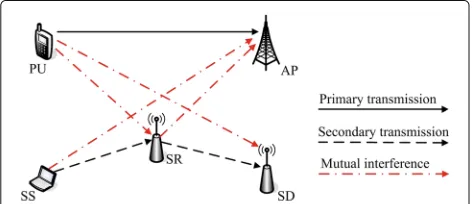
We consider a cognitive decode-and-forward (DF) relay-ing system as shown in Fig.1, where PU communicates to an access point (AP), and meanwhile, SS communicates to SD with assistance from SR. Each node has one omnidi-rectional antenna and works in the half-duplex mode. The transmission time is divided into equal-length blocks, and each block is normalized to have 1 s. The Rayleigh block fading is assumed for each channel, which keeps invariant in each block, but changes independently across different links and blocks. Due to the blockage or deep fading, we assume that there is no direct link between SS and SD, so the data transmission from SS to SD should be forwarded by SR. The DF protocol is adopted by SR for the secondary data relaying. We assume that SR and SD know the related channel state information (CSI) in each block, so they can perform the DIR decoding or the SIC decoding. For the DIR decoding, after receiving the composite signals from SS and PU, SR and SD directly decode the secondary data by treating the received primary signal as interference. For the SIC decoding, SR and SD could decode the primary data and then cancel it from the received composite sig-nal, and after that, they will try to decode the secondary data without interference.
We assume that both PU and SS do not know the instan-taneous CSI towards their intended receivers; thus, they transmit their data with fixed rates. The transmission rates of primary data and secondary data are denoted as RpandRs, respectively. The data transmission is assumed to be successful if the channel achievable rate is greater than the transmission rate. The channel achievable rates of primary system and secondary system are denoted as Cp = log2(1+γ )andCs = 12log2(1+γ ), respectively,
Fig. 1Cognitive DF relaying with SIC decoding at SR and SD
whereγ denotes the to-noise-ratio (SNR) or signal-to-interference-plus-noise-ratio (SINR) of the received signal. Through the expressions ofCp ≥RpandCs ≥Rs, we can equivalently obtain the SNR or SINR thresholds asξp = 2Rp−1 andξs = 22Rs −1, respectively.
There-fore, the primary data and secondary data are assumed to be successfully decoded if the received SNR and SINR are greater than ξp and ξs, respectively; otherwise, the outage event occurs. We analyze the outage probabilities of both primary and secondary systems by considering the DIR or the SIC decoding at SR and SD. Expectations are taken over power fadings of different channels, which are independently and exponentially distributed with unit mean.
We aim to minimize the outage probability of the sec-ondary system while satisfying that the outage
perfor-mance loss of the primary system should not exceed
percentage compared with the none spectrum sharing scenario. The optimal transmit powers of SS and SR are jointly determined through minimizing the outage prob-ability of the secondary system while guaranteeing the performance constraint of primary system. Numerical and simulation results are provided to validate our theoretical analysis and verify that our proposed scheme can greatly improve the outage performance of secondary system.
3 Cognitive relaying with DIR and SIC decoding 3.1 Cognitive relaying process
The transmission process is shown in Fig.2. In each block, PU always transmits a new primary data packet to AP. In an even block 2n,(n= 0, 1, ...), SS transmits a secondary data packet to SR. If SR correctly decodes the secondary data from SS, it will forward the secondary data to SD in the odd block 2n+1; otherwise, if SR erroneously decodes the secondary data, it will keep silent in the odd block 2n+ 1. The secondary data receptions at SR and SD are inter-fered by the primary data transmission of PU. The primary data reception at AP is interfered by the secondary data transmissions of SS and SR. AP decodes the primary data directly by treating the received secondary data as inter-ference, while SR and SD decode the secondary data using the DIR or the SIC scheme:
• SR-DIR-SD-DIR: Both SR and SD decode the secondary data directly by treating the received primary data as interference.
• SR-DIR-SD-SIC: Both SR and SD perform the DIR decoding. If SD erroneously decodes the secondary data, it will try to decode and cancel the primary data to further decode the secondary data.
Fig. 2Transmission process of the cognitive DF relaying withn=0, 1, ...
• SR-SIC-SD-SIC: Both SR and SD perform the DIR decoding. If SR or SD erroneously decodes the secondary data, it will try to decode and cancel the primary data to further decode the secondary data.
Remark:SR and SD try to decode the secondary data
directly, and if not successful, the SIC decoding may be performed. Intuitively, the stronger the interference from PU, the more difficult for SR and SD to decode the sec-ondary data directly, but the more easily for them to decode and cancel the interference. If the two systems are close, the interference is strong, so the SIC decoding performs better than the DIR decoding. If the two sys-tems are departed far away, the interference is weak, so the SIC decoding achieves a similar performance as the DIR decoding. The SIC decoding always outperforms the DIR decoding, but the cost is that SR or SD should know the CSI and codebook of PU for the interference cancela-tion. To avoid the security issue, we assume that PU firstly encrypts the primary information and then transmits it by appending the error detection code, such as the cyclic redundancy check (CRC) code. SR and SD can decode the primary data without endangering the security of primary information.
3.2 SINR and SNR at AP
In an even block, when SS transmits secondary data to SR along with PU transmitting primary data to AP, with the interference from SS, the SINR of primary data reception at AP is denoted asγpsaand given by
γpsa= ppGpapa psGsasa+N0
, (1)
whereppandpsrepresent the transmit power of PU and SS, respectively; Gpa and Gsa represent the small-scale power fading of the channel PU→AP and SS→AP, respec-tively;paandsarepresent the large-scale path-loss of the channel PU→AP and SS→AP, respectively; andN0is the power of additive white Gaussian noise (AWGN) at each receiver.
In an odd block, when SR forwards secondary data to SD along with PU transmitting primary data to AP, with the interference from SR, the SINR of primary data reception at AP is denoted asγpraand given by
γpra= prGrarappGpapa+
N0, (2)
wherepris the transmit power SR;Graandrarepresent the small-scale power fading and the large-scale path-loss of the channel SR→AP, respectively.
For the stand-alone primary network without spectrum sharing from SUs, the data reception at AP is interference-free. For the cognitive DF relaying, if SR erroneously decodes the secondary data in an even block, it will keep silent in the next odd block and the primary data reception at AP is also interference-free. If there is no interference, the SNR of the primary data reception at AP is denoted as γpaand given by
γpa= ppGpapa N0
. (3)
So far, we have presented the SINR and SNR of the received primary signal at AP, which will be used later for the outage performance analysis.
3.3 SINR and SNR at SR
In an even block, when SS transmits secondary data along with PU transmitting primary data to AP, with the inter-ference from PU, the SINR of the secondary data reception at SR is denoted asγsprand given by
γspr= psGsrsr
ppGprpr+N0, (4)
whereGsrandGprrepresent the small-scale power fading of the channel SS→SR and PU→SR, respectively, andsr andprrepresent the large-scale path-loss of the channel SS→SR and PU→SR, respectively.
For the SIC decoding, if the direct decoding of sec-ondary data fails at SR, it will try to decode and cancel the primary data to further decode the secondary data. By viewing the secondary data as interference, the SINR
of primary data reception at SR is denoted as γpsr and
given by
γpsr= ppGprpr psGsrsr+N0
. (5)
If the primary data can be successfully decoded and can-celed by SR, the SNR of the remaining secondary data is denoted asγsrand given by
γsr= psGsrsr
N0 . (6)
the probability of SR correctly decoding the secondary data.
3.4 SINR and SNR at SD
In an odd block, when SR forwards secondary data along with PU transmitting primary data to AP, with the inter-ference from PU, the SINR of secondary data reception at SD is denoted asγrpdand given by
γrpd= prGrdrd
ppGpdpd+N0, (7)
whereGrdandGpdrepresent the small-scale power fading of the channel SR→SD and PU→SD, respectively, andrd andpdrepresent the large-scale path-loss of the channel SR→SD and PU→SD, respectively.
If SD can perform the SIC, it will first try to decode the secondary data directly. If the direct decoding of sec-ondary data fails, SD will try to decode and cancel the primary data. By viewing the secondary data as interfer-ence, the SINR of primary data reception at SD is denoted asγprdand given by
γprd= ppGpdpd prGrdrd+N0
. (8)
If the primary data can be successfully decoded and can-celed by SD, the SNR of the remaining secondary data is denoted asγrdand given by
γrd= prGrdrd N0
. (9)
So far, we have presented the SINR and SNR of the received signals at SD, which will be used later for the outage performance analysis.
4 Outage probability of primary system 4.1 Stand-alone primary system
For the stand-alone primary network without spectrum sharing from SUs, the SNR of received primary data at AP isγpa given in (3). Denoted as PNSoutp, the outage proba-bility of primary data transmission in the none spectrum sharing scenario isPoutpNS =Prγpa< ξp, obtained as
PNSoutp=1−exp
−pppaξpN0
, (10)
where we consider that the power fadingGpais exponen-tially distributed with unit mean.
4.2 Cognitive DF relaying
For the cognitive DF relaying, the outage probability of primary system is denoted asPoutp. LetAdenote the event that SR correctly decodes the secondary data from SS in
an even block. When the event A occurs, SR will
for-ward the secondary data to SD in the next odd block.
With the interference from SS and SR, the average outage probability of primary system is given as
Poutp= 1 2
Prγpsa< ξp+PrA,γpra< ξp +PrA¯,γpa< ξp, (11)
where A¯ denotes the complement event ofA. The first term represents the outage probability of primary data decoding in even blocks with interference from SS. The second and third terms represent the outage probabilities of primary data decoding in odd blocks when SR forwards the secondary data or keeps silent in caseAorA¯occurs. The prefactor 1/2 is used, as we consider the primary data transmission in both the even and odd blocks. Next, we will analyze the three terms of (11) by considering whether the DIR or the SIC decoding is performed by SR.
4.2.1 First term of (11)
By substituting the expression ofγpsa, we can derive
Prγpsa< ξp=1− pppa
pppa+ξppssaexp
−pppaξpN0
,
(12)
where we consider thatGpa and Gsa are independently and exponentially distributed with unit mean. With the increase ofps, SS causes more interference to AP in even blocks, so the outage probability Prγpsa< ξpgets larger.
4.2.2 Second term of (11) with SR-DIR
If SR performs the DIR decoding, we can express
the second term of (11) as PrA,γpra < ξp =
Prγspr≥ξs,γpra< ξp, derived as
PrA,γpra< ξp=
pssr pssr+ξspppr
exp
−ξsN0 pssr
×
1− pppa pppa+ξpprra
exp
−ξpN0 pppa
,
(13)
where we consider thatGsr,Gpr,Gpa, andGraare all inde-pendently and exponentially distributed with unit mean. With the increase ofps, SR could decode the secondary data more easily and then transmits in odd blocks, which causes more interference to AP and leads to a larger outage probability of PrA,γpra< ξp.
4.2.3 Second term of (11) with SR-SIC
If SR performs the SIC decoding, by considering the cases of SR correctly decoding the secondary data, we can express the second term of (11) as
PrA,γpra< ξp=Prγspr≥ξs,γpra < ξp +Prγspr< ξs,γpsr≥ξp,
where the first probability considers that SR correctly decodes the secondary data directly; the second probabil-ity considers that SR fails in decoding the secondary data directly, but it correctly decodes the secondary data after successfully decoding and canceling the primary data. The first probability of (14) has been derived in (13) and the second probability can be derived as
Prγspr< ξs,γpsr≥ξp,γsr≥ξs,γpra< ξp
where1(C)is an indicator random variable, which equals one if the conditionCis satisfied; otherwise, it equals zero, and
The derivation details of (15) are given in Appendix1. Substituting (13) and (15) into (14), we can obtain the
second probability of (11) when SR performs the SIC
decoding.
4.2.4 Third term of (11) with SR-DIR
If SR performs the DIR decoding, we can express
the third term of (11) as PrA¯,γpa< ξp = cause less interference to AP in odd blocks, resulting in the lower outage probability of PrA¯,γpa< ξp.
4.2.5 Third term of (11) with SR-SIC
If SR performs the SIC decoding, by considering the cases of SR erroneously decoding the secondary data, we can express the third term of (11) as
PrA¯,γpa< ξp=Prγspr< ξs,γpsr< ξp,γpa< ξp +Prγspr<ξs,γpsr≥ξp,γsr<ξs,γpa<ξp,
(18)
where the first probability considers that both the direct decoding of secondary data and the cancelation of pri-mary data are not successful at SR; the second proba-bility considers that SR fails in decoding the secondary
data directly, even after successfully canceling the primary data. The first term of (18) is derived as
The derivation details of (19) are given in Appendix2. The second term of (18) can be derived as the third probability of (11) when SR performs the SIC decoding.
5 Outage probability of secondary system 5.1 SR-DIR-SD-DIR decoding
In the SR-DIR-SD-DIR scheme, both SR and SD decode secondary data directly by treating the received primary data as interference. For this scheme, the outage probabil-ity of secondary system is given as
Pouts=PSR−DIRouts +
1−PoutsSR−DIRPSD−DIRouts , (22)
wherePoutsSR−DIRandPoutsSD−DIRrepresent the outage proba-bility of DIR decoding of secondary data at SR and SD, respectively. The first term represents the probability of SR erroneously decoding the secondary data directly. The second term represents the probability that SR correctly decodes the secondary data but SD erroneously decodes the secondary data forwarded by SR. Since the chan-nel SS→SR is independent with the channel SR→SD, we can write the second term as the multiplication of two probabilities.
where we consider thatGsrandGprare independently and exponentially distributed with unit mean.
If SR correctly decodes the secondary data from SS in the even block, it will forward the secondary data to SD in the next odd block. The probability of SD erroneously decoding the secondary data directly is PSD−DIRouts = Prγrpd< ξs, i.e.,
where we consider that Grd andGpd are independently
and exponentially distributed with unit mean.
5.2 SR-DIR-SD-SIC decoding
In the SR-DIR-SD-SIC scheme, SR and SD perform DIR and SIC decoding, respectively. If SD fails in decoding the secondary data directly, it will try to decode and cancel the primary data for the further decoding of secondary data. For this scheme, the outage probability of secondary system is given as
Pouts=PoutsSR−DIR+
1−PSR−DIRouts
PSD−SICouts , (25)
where PSD−SICouts represents the outage probability of SIC decoding at SD.
The outage probability of direct decoding at SR that is PoutsSR−DIRhas been derived in (23). The outage probability of SIC decoding at SD can be expressed as
PSD−SICouts =Prγrpd< ξs,γprd< ξp
where the first probability represents that both the direct decoding of secondary data and the cancelation of pri-mary data are not successful at SD; the second probability represents that SD fails in decoding the secondary data, even after successfully canceling the primary data.
By substituting the related items into (26), we can derive the first probability as
• Ifξpξs>1, we have
The second probability of (26) can be expressed as
Pouts2SD−SIC=Prγprd≥ξp,γrd< ξsand derived as
PSD−SICouts2 = pppd
pppd+ξpprrdexp
the outage probability of SD performing the SIC decoding of secondary data.
5.3 SR-SIC-SD-DIR decoding
In the SR-SIC-SD-DIR scheme, SR and SD perform SIC and DIR decoding, respectively. If SR fails in decoding the secondary data directly, it will try to decode and cancel the primary data to further decode the secondary data. For this scheme, the outage probability of secondary system is given as
Pouts=PoutsSR−SIC+
1−PSR−SICouts PoutsSD−DIR, (30)
where PoutsSR−SIC represents the outage probability of SIC decoding at SR. The probabilityPoutsSR−SIC can be derived similarly as (26) by replacing pr, dpd, and drd with ps, dpr, anddsr, respectively. The outage probability of DIR decoding at SD that isPSD−DIRouts has been derived in (24).
5.4 SR-SIC-SD-SIC decoding
In the SR-SIC-SD-SIC scheme, both SR and SD perform the SIC decoding. If SR or SD fails in decoding the sec-ondary data directly, they will try to decode and cancel the primary data to further decode the secondary data. In this scheme, the outage probability of secondary system is given as
respectively. The outage probability of SIC decoding at SD that isPoutsSD−SIChas been derived in (26).
6 Power settings for SS and SR
Compared with the stand-alone primary network without spectrum sharing, the outage probability of primary sys-tem in the cognitive relaying can be degraded no more
thanpercentage. The optimization problem can be
for-mulated as primary system,Poutpis obtained in (11) by considering the DIR or the SIC decoding at SR. The transmit powers
of SS and SR can not exceedpm due to the hardware or
regulation constraint. Since the maximal value ofPoutpis smaller than 1, we have to constrain(1+)PoutpNS ≤1, that
is ≤ 1
PNS outp −
1, wherePoutpNS is derived in (10).
6.1 Impacts and region ofps
If we setpr=0, only SS transmits secondary data in even blocks, and there is no secondary data transmission in odd blocks. For a given value ofps, we can derive a lower bound of the outage probability of primary system, i.e.,
ˇ
where the first probability is obtained in (12) and the sec-ondary probability is PoutpNS given in (10). Since Pˇoutp is a monotonically increasing function ofps, we can deter-mine an allowable region ofpsas follows:
• Case I: Letps=pm, ifPˇoutp≥(1+)PNSoutp, calculate
. An upper bound of the transmit
power of SS can be derived as
p†s = pppa
Thus, the transmit power of SS should be constrained in the region ofps∈0,p†s.
6.2 Impacts and region ofpr
As can be seen from (11), no matter whether SR
per-forms the DIR or the SIC decoding,Poutpalways increases monotonically with pr. Given ps, we should determine a critical power of SR, denoted as p†
r(ps). This critical value means that if the transmit power of SR is smaller thanp†r(ps), the outage performance constraint of primary system can be guaranteed; otherwise, it is violated.
• Case I: Letpr=pm, ifPoutp≥(1+)PNSoutp, then do
the following calculation: Letpr=0, if
Poutp< (1+)PoutpNS , calculatep†r(ps)via Poutp=(1+)PoutpNS ; otherwise, if
Poutp≥(1+)PNSoutp, the givenpsis not valid. • Case II: Letpr=pm, ifPoutp< (1+)PNSoutp, the
critical power isp†
r(ps)=pm.
Considering whether SR performs the DIR or the SIC decoding, the critical powerp†
r(ps)in case I can be deter-mined as follows.
6.2.1 SR-DIR decoding
If SR performs the DIR decoding, the critical power is obtained as
6.3 Transmit powers of SS and SR
The transmit power of SS can be numerically searched in the region ofps∈
0,p† s
.
• For both the SR-DIR-SD-DIR and the
SR-SIC-SD-DIR schemes, the outage probability of secondary system is a monotonically decreasing function ofpr; thus, for each givenps, the optimal
transmit power of SR isp†r(ps). If there is no valid
p†r(ps), the givenpsis not valid.
• For both the SR-DIR-SD-SIC and the SR-SIC-SD-SIC schemes, the outage probability of secondary system may not monotonically decrease withpr. For a given
ps, the optimal power of SR is numerically searched
in0,p† r(ps)
. As shown in Fig.8, the outage
probability of secondary system gets smaller with the increase ofpr. We use the critical powerp†r(ps)as the
value ofprto guarantee the outage performance
constraint of primary system.
Thus, we can numerically determine the powerspsandpr using the above steps.
7 Results and discussion
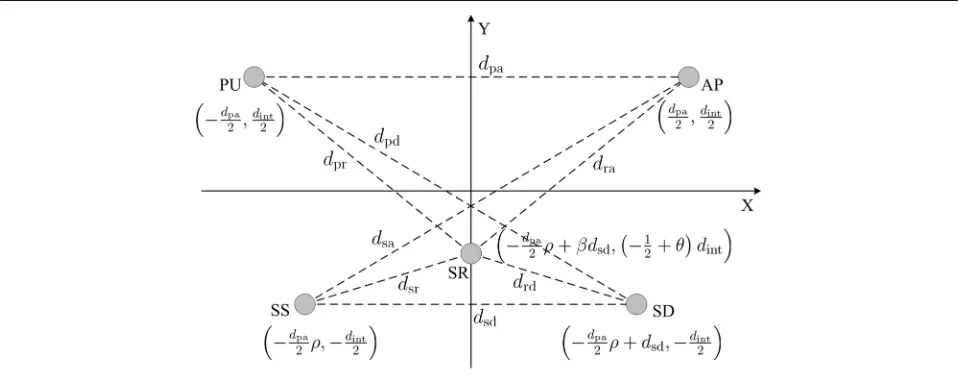
In our simulations, the SS-SD line is placed parallel with the PU-AP line as shown in Fig.3, and the vertical
distance between them is set as dint. The horizontal
distance between SS and PU is characterized byρ. The
distance between SS and SD is set asdsd. The horizontal distance between SR and SS is characterized byβ ∈(0, 1). The vertical distance between SR and SS is
character-ized by θ. The distance between SS and AP is dsa =
"
(1+ρ)2d2
pa/4+dint2 . The distance between SR and
AP is dra = "(1+ρ)dpa/2−βdsd2+(1−θ)2d2 int.
The distance between PU and SR is dpr =
"
(ρ−1)dpa/2−βdsd
2+(
1−θ)2d2
int. The distance
between PU and SD is dpd =
"
(ρ−1)dpa/2−dsd
2+
d2int. The distance between
SS and SR is dsr =
#
(βdsd)2+(θdint)2. The distance between SR and SD isdrd=
"
(1−β)2d2
sd+(θdint)2. Similar to the simulation setup of [3,10,19], unless spec-ified otherwise, we set the system parameters asα = 3,
= 0.2,ρ = β = 0.5,θ = 0.25,N0 = − 80 dBm,
pp = ps = pr = 0 dBm,pm = 20 dBm,Rp = 1
bits/s/Hz,Rs = 0.5 bits/s/Hz,dpa = dint = 200 m, and dsd = 100 m.
7.1 Outage probabilities of both systems
In this subsection, the transmit powers of ST and SR, i.e., ps and pr, are not obtained through the optimiza-tion problem (32), but they are given as fixed values. We perform simulations to reveal the impacts of various parameters to the outage performance of both the primary and secondary systems.
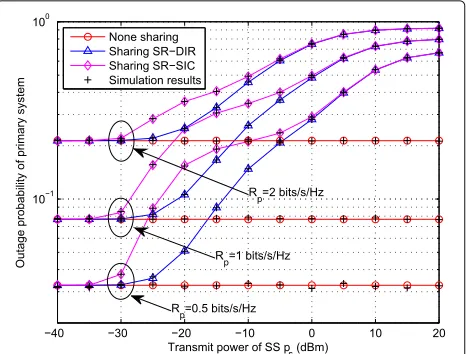
Figure4 shows the outage probability of primary sys-tem versusps. With the increase of ps, SS and SR cause more interference to AP, so the outage probability of pri-mary system gets larger. It is more likely for SR to correctly decode the secondary data using the SIC scheme com-pared with the DIR scheme; thus, SR will more possibly forward the secondary data to SD in odd blocks. Conse-quently, more interference will be caused to AP, so the SR-SIC scheme makes the outage probability of primary system larger than the SR-DIR scheme. Whenps is small enough, SR can hardly decode the secondary data and the interference caused to AP is very weak; thus, the outage probability is close to that of the none sharing scheme no
Fig. 4Outage probability of primary system vs the transmit power of SS
matter whether SR performs DIR or SIC decoding. When psis large enough, the outage probability of primary sys-tem is almost the same with SR-SIC and SR-DIR, because it is very difficult for SR to cancel the interference and the secondary data is directly decoded by SR in most of the time. With the increase of the transmission rate of primary data, the outage probability gets larger.
Figure5 shows the outage probability of primary sys-tem versuspr. With the increase of pr, SR causes more interference to AP, so the outage probability of primary system gets larger. Since SR can decode the secondary data more successfully using the SIC scheme, more interfer-ence is caused to AP due to the data forwarding of SR in odd blocks, so the outage probability of primary sys-tem is larger for the SR-SIC scheme compared with the SR-DIR scheme. SS always causes interference to AP in
Fig. 5Outage probability of primary system vs the transmit power of SR
even blocks, so the outage probability of primary system is always larger than the none sharing scenario. With higher power used by PU for the primary data transmission, the outage probability of primary system gets smaller.
Figure6shows the outage probability of primary system versusRp. With the increase ofRp, it becomes more dif-ficult for AP to correctly decode the primary data, so the outage probability gets larger. WhenRp is large enough, it becomes very difficult for SR to successfully cancel the primary data, and the SR-SIC scheme causes similar out-age performance to the primary system as the SR-DIR scheme. With the increase of pp, the outage probability gets smaller as stronger primary signal can be received by AP to suppress the interferences from SS and SR.
Figure7shows the outage probability of secondary sys-tem vsps. With the increase ofps, it becomes more likely for SR to correctly decode the secondary data and for-wards the data to SD. As a result, the outage probability of secondary system gets smaller. Given the decoding method of SD, the SR-SIC scheme can achieve a smaller outage probability then the SR-DIR scheme. But, whenps is large enough, the SR-SIC scheme has almost the same performance as the SR-DIR scheme, because it becomes very difficult to cancel the primary data at SR; thus, the secondary data is more likely decoded by SR directly. Given the decoding method of SR, the SD-SIC scheme can achieve a much smaller outage probability than the SD-DIR scheme.
Figure8shows the outage probability of secondary sys-tem vspr. With the increase ofpr, the outage probability gets smaller. Given the decoding method of SR, the SD-SIC decoding achieves a smaller outage probability than the SD-DIR scheme. But, whenpris large enough, the SD-SIC scheme achieves almost the same outage probability as the SD-DIR scheme. Given the decoding method of SD,
Fig. 7Outage probability of secondary system vs the transmit power of SS
the SR-SIC scheme achieves a much smaller outage proba-bility than the SR-DIR scheme, because SR can decode the secondary data from SS more successfully, so it will more possibly forward the secondary data to SD in odd blocks.
Figure9shows the outage probability of secondary
sys-tem vs Rs. With the increase of Rs, it becomes more
difficult for both SR and SD to correctly decode the secondary data, so the outage probability of secondary system gets larger. The outage probability of the SR-DIR-SD-SIC scheme is larger than the SR-SIC-SD-DIR scheme, because SR can achieve more opportunities to forward the secondary data in the latter scheme.
7.2 Minimum outage probability of secondary system
In this and the next subsections, we numerically deter-mine the optimal transmit powers of SS and SR using the
Fig. 8Outage probability of secondary system vs the transmit power of SR
Fig. 9Outage probability of secondary system vs the transmission rateRs
method of Section6. The minimum outage probability of secondary system is obtained while guaranteeing the per-formance constraint of primary system. In obtaining the following numerical results, we setρ = 3 andRs = 0.3 bits/s/Hz.
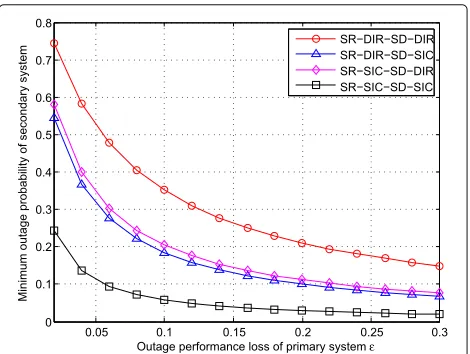
Figure 10 shows the minimum outage probability of
secondary system vs . With the increase of , more
outage performance loss can be tolerated by primary system compared with the none sharing scenario; thus, higher transmit powers can be used by SS and SR for the secondary data transmission. As a result, the mini-mum outage probability of secondary system gets smaller. The SR-DIR-SD-DIR scheme performs the worst, and the SIC-SD-SIC scheme performs the best, while the SR-SIC-SD-DIR scheme and the SR-DIR-SD-SIC scheme have the performance in the middle.
Figure 11 shows the minimum outage probability of secondary system vsdint. With the increase ofdint, the dis-tance between the two systems gets longer, so the mutual interference gets weaker. In this sense, more power can be used by SS and SR for the secondary data transmission. As a result, the minimum outage probability of secondary system gets smaller. We can see that using the SIC scheme at both SR and SD can greatly improve the outage per-formance of secondary system compared with the DIR decoding.
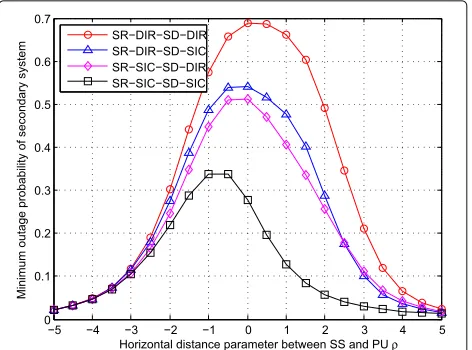
Figure12shows the minimum outage probability of sec-ondary system vsρ. Withρincreasing from – 5 to 5, the secondary system moves from left to right. Equivalently, SS and SR move closer to PU and then farther. As a result, the transmit powers of SS and SR get smaller first and then larger to satisfy the outage performance constraint of pri-mary system. Therefore, the minimum outage probability of secondary system gets larger first and then smaller. It is better to place SS and SR farther away from the primary system.
Figure13shows the minimum outage probability of sec-ondary system vsβ. With the increase ofβfrom 0 to 1,dsr gets larger anddrdgets smaller, which means SR departs farther away from SS, but closer to SD. With the increase ofβfrom 0 to 1,dprgets larger anddragets smaller, which means SR departs farther away from PU, but closer to AP. Thus, SR will receive weaker signal from SS and weaker interference from PU. Under the performance constraint of primary system, the transmit power of SR gets smaller. If the degradation of desired signal is less than the inter-ference, considering the stronger transmit power of SR, the minimum outage probability of secondary system gets smaller. Otherwise, if the desired signal is very weak and the transmit power of SR is very small, the outage per-formance of secondary system deteriorates. In general,
Fig. 11Minimum outage probability of secondary system vs the distance factordint
Fig. 12Minimum outage probability of secondary system vs the distance factorρ
the minimum outage probability of secondary system gets smaller first and then larger.
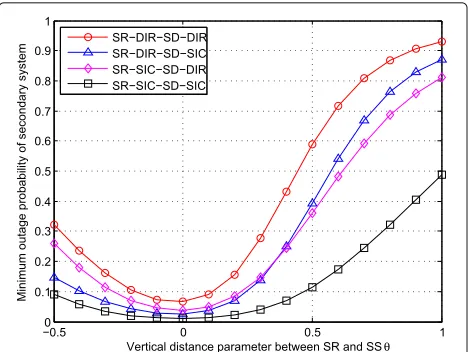
Figure14shows the minimum outage probability of sec-ondary system vsθ. With the increase ofθ from – 0.5 to 1,dpr anddrabecome smaller, so SR moves closer to the primary system; consequently, the transmit power of SR gets smaller to avoid violating the performance constraint of primary system. Meanwhile,dsranddrdget smaller first and then larger, so SR moves closer to SS and SD first and then farther away; consequently, the performance of sec-ondary data relaying becomes better first and then worse. Therefore, the minimum outage probability of secondary system gets smaller first and then larger.
Figures15and16show the minimum outage
probabil-ity of secondary system vs Rs andRp, respectively. With the increase of Rs, the minimum outage probability of
Fig. 14Minimum outage probability of secondary system vs the distance factorθ
secondary system gets larger, as it becomes more dif-ficult to correctly decode the secondary at SR and SD. With the increase ofRp, the minimum outage probabil-ity of secondary system varies in different trends for the four decoding schemes. In general, with the increase of Rp, the primary data transmission fails more likely. In this sense, the performance of primary system gets worse. Then, more interference can be tolerated given the per-formance loss ratio. So, higher power can be allowable for SS and SR for the secondary data transmission. As a result, the outage probability of the SR-DIR-SD-DIR scheme decreases continuously. However, the minimum outage probability of secondary system gets larger first and then smaller if either SR or SD or both of them perform the SIC decoding. With the increase of Rp, it
Fig. 15Minimum outage probability of secondary system vs the transmission rateRs
Fig. 16Minimum outage probability of secondary system vs the transmission rateRp
becomes more difficult for SR and SD to successfully can-cel the primary data. The higher powers of SS and SR, and the more likely failure of SIC decoding together lead to the variation trends of the SIC-based schemes.
7.3 Throughput improvement
In this subsection, we will calculate the total network throughput and compute the throughput improvement ratio compared with the none sharing scenario. Since both primary data and secondary data are transmitted with fixed rates, the throughputs of primary system and
sec-ondary system are given as Tp = (1 − Poutp)Rp and
Ts = (1 − Pouts)Rs, respectively. For the stand-alone primary network without spectrum sharing, the through-put isTpNS = 1−PoutpNS Rp. The throughput improve-ment ratio of the spectrum sharing is calculated as η= Tp+Ts−TpNS
TNS
p ×100%.
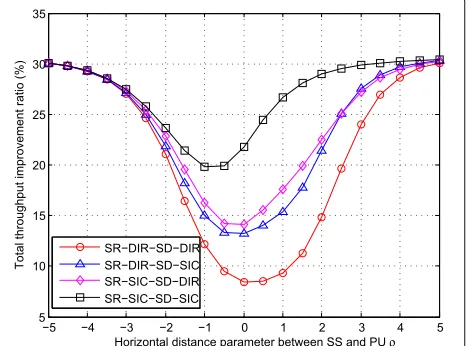
Figures 17and18 show the throughput improvement
ratio of the whole network vsandρ, respectively. We can see from Fig.17that with the increase of, the throughput improvement ratio gets larger. The maximal improvement approaches 30% for the SR-SIC-SD-SIC scheme. We can see from Fig.18that with the increase ofρ, the through-put improvement ratio gets smaller and then larger. The maximal improvement of 30% is also achievable. The SR-SIC-SD-SIC scheme achieves more than 14% improve-ment compared with the SR-DIR-SD-DIR scheme when ρ=0.
7.4 Discussion
Fig. 17Throughput improvement ratio vs the outage performance loss
because it becomes more difficult to perform the SIC decoding at both SR and SD. In general, the SR-SIC-SD-SIC scheme performs the best and the SR-DIR-SD-DIR performs the worst, while the performances of SR-SIC-SD-DIR and SR-DIR-SD-SIC lie in-between.
From Figs. 10, 11, 12, 13, 14, 15, and 16, we can see that the cognitive relaying with SIC decoding significantly outperforms its counterpart with DIR decoding in terms of outage probability. When SR and SD move close to PU, stronger interference will be encountered, so the cog-nitive relaying with DIR decoding performs worse. But, the cognitive relaying with SIC decoding achieves better performance, as the strong interference can be properly canceled. Furthermore, the SIC decoding can be more successfully performed when the transmission rate of pri-mary data is low.
Fig. 18Throughput improvement ratio vs the distance factorρ
Figures17and18tell us that the total throughput of the whole cognitive radio network can be greatly increased compared with the none spectrum sharing scenario; thus, our proposed SIC-based scheme can effectively improve the spectral efficiency.
8 Conclusions
In this work, we have studied the cognitive DF relay-ing scheme with SS or SR capable of performrelay-ing the SIC decoding. Considering SR and SD using either the DIR or the SIC decoding method, we proposed four cognitive relaying schemes. Through minimizing the outage prob-ability of secondary system subject to the performance constraint of primary system, the transmit powers of SS and SR are determined. Numerical results show that the outage performance of secondary system can be signif-icantly improved by using the SIC technique, especially when the secondary system is close to the primary sys-tem or the transmission rate of primary data is low. Our scheme is applicable for the general cognitive relaying net-work no matter whether SUs are close to or far away from PUs.
Appendix 1: Derivation of (15)
By substituting the related SNR or SINR, we can obtain
Prγspr< ξs,γpsr≥ξp,γsr≥ξs,γpra< ξp
=Pr
Gpa< pppaξp (prGrara+N0)
×Pr
Gsr≥ ξsN0 pssr,Gpr>
1 pppr
psGsrsr ξs −N0
,
Gpr≥ ξp
pppr(psGsrsr+N0)
=
1− pppa
pppa+ξpprra exp
−pppaξpN0 (H1+H2),
(39)
where we consider thatGpr,Gsr,Gpa, andGraare indepen-dently and exponentially distributed with unit mean. Con-sidering p1
ppr
psGsrsr
ξs −N0
is greater or smaller than
ξp
pppr(psGsrsr+N0), we can divide the second probability
of (39) as two probabilities, i.e.,
H1=1(ξpξs≤1)Pr
Gpr> 1 pppr
psGsrsr ξs −N0
,
Gsr≥ (1+ξp)ξsN0 (1−ξpξs)pssr
,
(40)
H2=1(ξpξs≤1)Pr
The probabilityH1can be further derived as
H1=1(ξpξs≤1) ppprξs
The probabilityH2can be further derived as
H2= simplifications, we can derive the result of (15).
Appendix 2: Derivation of (19)
By substituting the related SNR or SINR, we can obtain
Prγspr< ξs,γpsr< ξp,γpa< ξp
where the first probability can be derived as
Pr
Considering the lower limit ofGsris larger or smaller than zero, we can divide the second probability of (44) into two probabilitiesH3andH4given as follows:
H3=Pr
The probability ofH3can be further derived as
H3=1−exp
The probability ofH4can be further derived as
H4= ξppssr simplifications, we can derive the result of (19).
Abbreviations
AP: Access point; AWGN: Additive white Gaussian noise; BS: Base station; CRC: Cyclic redundancy check; CSI: Channel state information; D2D: Device-to-device; DF: Decode-and-forward; DIR: Direct; PPP: Poisson point process; PU: Primary user; QoS: Quality of service; SD: Secondary destination; SIC: Successive interference cancelation; SINR: Signal-to-interference-plus-noise-ratio; SNR: Signal-to-noise-ratio; SR: Secondary relay; SS: Secondary source; SU: Secondary user
Funding
This work was supported by the Fundamental Research Funds of Shandong University, the Scientific Research Initial Fund of Qufu Normal University (no. BSQD2012055), and a project of Shandong Province Higher Educational Science and Technology Program (no. J15LN57).
Availability of data and materials
The datasets used or analyzed during the current study are available from the corresponding author on reasonable request.
Authors’ contributions
Competing interests
The authors declare that they have no competing interests.
Publisher’s Note
Springer Nature remains neutral with regard to jurisdictional claims in published maps and institutional affiliations.
Author details
1School of Information Science and Engineering, Shandong University, 72 Binhai Road, Qingdao, 266237 China.2College of Physics and Engineering, Qufu Normal University, 57 Jingxuan West Road, Qufu, 273165 China.
Received: 24 July 2018 Accepted: 18 September 2018
References
1. A. Goldsmith, S. A. Jafar, I. Maric, S. Srinivasa, Breaking spectrum gridlock with cognitive radios: an information theoretic perspective. Proc. IEEE.
97(5), 894–914 (2009)
2. Y. C. Liang, Y. Zeng, E. C. Y. Peh, A. T. Hoang, Sensing-throughput tradeoff for cognitive radio networks. IEEE Trans. Wirel. Commun.7(4), 1326–1337 (2008)
3. L. B. Le, E. Hossain, Resource allocation for spectrum underlay in cognitive radio networks. IEEE Trans. Wirel. Commun.7(12), 5306–5315 (2008) 4. C. Zhai, W. Zhang, P. C. Ching, Cooperative spectrum sharing based on
two-path successive relaying. IEEE Trans. Commun.61(6), 2260–2270 (2013)
5. C. Zhai, W. Zhang, Adaptive spectrum leasing with secondary user scheduling in cognitive radio networks. IEEE Trans. Wirel. Commun.12(7), 3388–3398 (2013)
6. Q. Li, S. H. Ting, A. Pandharipande, Y. Han, Cognitive spectrum sharing with two-way relaying systems. IEEE Trans. Veh. Technol.60(3), 1233–1240 (2011)
7. Y. Li, H. Long, M. Peng, W. Wang, Spectrum sharing with analog network coding. IEEE Trans. Veh. Technol.63(4), 1703–1716 (2014)
8. J. Chen, J. Si, Z. Li, H. Huang, On the performance of spectrum sharing cognitive relay networks with imperfect CSI. IEEE Commun. Lett.16(7), 1002–1005 (2012)
9. J. M. Moualeu, W. Hamouda, F. Takawira, Cognitive coded cooperation in underlay spectrum-sharing networks under interference power constraints. IEEE Trans. Veh. Technol.66(3), 2099–2113 (2017) 10. Y. Xing, C. N. Mathur, M. A. Haleem, R. Chandramouli, K. P. Subbalakshmi,
Dynamic spectrum access with QoS and interference temperature constraints. IEEE Trans. Mob. Comput.6(4), 423–433 (2007)
11. J. Lee, H. Wang, J. G. Andrews, D. Hong, Outage probability of cognitive relay networks with interference constraints. IEEE Trans. Wirel. Commun.
10(2), 390–395 (2011)
12. L. Luo, P. Zhang, G. Zhang, J. Qin, Outage performance for cognitive relay networks with underlay spectrum sharing. IEEE Commun. Lett.15(7), 710–712 (2011)
13. W. Xu, J. Zhang, P. Zhang, C. Tellambura, Outage probability of decode-and-forward cognitive relay in presence of primary user’s interference. IEEE Commun. Lett.16(8), 1252–1255 (2012) 14. C. Zhong, T. Ratnarajah, K. K. Wong, Outage analysis of
decode-and-forward cognitive dual-hop systems with the interference constraint in Nakagami-m fading channels. IEEE Trans. Veh. Technol.
60(6), 2875–2879 (2011)
15. J. P. Hong, B. Hong, T. W. Ban, W. Choi, On the cooperative diversity gain in underlay cognitive radio systems. IEEE Trans. Commun.60(1), 209–219 (2012)
16. H. Ding, J. Ge, D. B. Da Costa, Z. Jiang, Asymptotic analysis of cooperative diversity systems with relay selection in a spectrum-sharing scenario. IEEE Trans. Veh. Technol.60(2), 457–472 (2011)
17. N. Zhao, F. R. Yu, H. Sun, M. Li, Adaptive power allocation schemes for spectrum sharing in interference-alignment-based cognitive radio networks. IEEE Trans. Veh. Technol.65(5), 3700–3714 (2016) 18. K. T. Phan, S. A. Vorobyov, N. D. Sidiropoulos, C. Tellambura, Spectrum
sharing in wireless networks via QoS-aware secondary multicast beamforming. IEEE Trans. Signal Process.57(6), 2323–2335 (2009)
19. M. G. Khoshkholgh, K. Navaie, H. Yanikomeroglu, Interference
management in underlay spectrum sharing using indirect power control signalling. IEEE Trans. Wirel. Commun.12(7), 3264–3277 (2013) 20. S. Senthuran, A. Anpalagan, O. Das, Throughput analysis of opportunistic
access strategies in hybrid underlay-overlay cognitive radio networks. IEEE Trans. Wirel. Commun.11(6), 2024–2035 (2012)
21. J. Zou, H. Xiong, D. Wang, C. W. Chen, Optimal power allocation for hybrid overlay/underlay spectrum sharing in multiband cognitive radio networks. IEEE Trans. Veh. Technol.62(4), 1827–1837 (2013) 22. P. Mach, Z. Becvar, Energy-aware dynamic selection of overlay and
underlay spectrum sharing for cognitive small cells. IEEE Trans. Veh. Technol.66(5), 4120–4132 (2017)
23. T. M. C. Chu, H. Phan, H. J. Zepernick, Hybrid interweave-underlay spectrum access for cognitive cooperative radio networks. IEEE Trans. Commun.62(7), 2183–2197 (2014)
24. S. Hatamnia, S. Vahidian, S. Aissa, B. Champagne, M. Ahmadian-Attari, Network-coded two-way relaying in spectrum-sharing systems with quality-of-service requirements. IEEE Trans. Veh. Technol.66(2), 1299–1312 (2017)
25. S. Vahidian, E. Soleimani-Nasab, S. Aissa, M. Ahmadian-Attari, A.F. Bidirectional, relaying with underlay spectrum sharing in cognitive radio networks. IEEE Trans. Veh. Technol.66(3), 2367–2381 (2017)
26. D. B. da Costa, H. Ding, M. D. Yacoub, J. Ge, Two-way relaying in interference-limited AF cooperative networks over Nakagami-m fading. IEEE Trans. Veh. Technol.61(8), 3766–3771 (2012)
27. X. Zhang, Z. Zhang, J. Xing, R. Yu, P. Zhang, W. Wang, Exact outage analysis in cognitive two-way relay networks with opportunistic relay selection under primary user’s interference. IEEE Trans. Veh. Technol.
64(6), 2502–2511 (2015)
28. Y. Deng, K. J. Kim, T. Q. Duong, M. Elkashlan, G. K. Karagiannidis, A. Nallanathan, Full-duplex spectrum sharing in cooperative single carrier systems. IEEE Trans. Cognitive Commun. Netw.2(1), 68–82 (2016) 29. M. Gaafar, O. Amin, W. Abediseid, M. S. Alouini, Underlay spectrum sharing
techniques with in-band full-duplex systems using improper Gaussian signaling. IEEE Trans. Wirel. Commun.16(1), 235–249 (2017) 30. Y. Zou, J. Zhu, B. Zheng, Y. D. Yao, An adaptive cooperation diversity
scheme with best-relay selection in cognitive radio networks. IEEE Trans. Signal Process.58(10), 5438–5445 (2010)
31. E. E. B. Olivo, D. P. M. Osorio, D. B. da Costa, J. C. S. S. Filho, Outage performance of spectrally efficient schemes for multiuser cognitive relaying networks with underlay spectrum sharing. IEEE Trans. Wirel. Commun.13(12), 6629–6642 (2014)
32. F. R. V. Guimaraes, D. B. da Costa, T. A. Tsiftsis, C. C. Cavalcante, G. K. Karagiannidis, Multiuser and multirelay cognitive radio networks under spectrum-sharing constraints. IEEE Trans. Veh. Technol.63(1), 433–439 (2014)
33. E. E. B. Olivo, D. P. M. Osorio, D. B. da Costa, J. C. S. S. Filho, Outage performance of spectrally efficient schemes for multiuser cognitive relaying networks with underlay spectrum sharing. IEEE Trans. Wirel. Commun.13(12), 6629–6642 (2014)
34. C. Zhai, J. Liu, L. Zheng, Relay based spectrum sharing with secondary users powered by wireless energy harvesting. IEEE Trans. Commun.64(5), 1875–1887 (2016)
35. J. Lee, J. G. Andrews, D. Hong, Spectrum-sharing transmission capacity with interference cancellation. IEEE Trans. Commun.61(1), 76–86 (2013) 36. K. Huang, V. K. N. Lau, Y. Chen, Spectrum sharing between cellular and
mobile ad hoc networks: Transmission-capacity trade-off. IEEE J. Sel. Areas Commun.27(7), 1256–1267 (2009)
37. C. H. Lee, M. Haenggi, Interference and outage in poisson cognitive networks. IEEE Trans. Wirel. Commun.11(4), 1392–1401 (2012) 38. Z. Wang, W. Zhang, Opportunistic spectrum sharing with limited
feedback in Poisson cognitive radio networks. IEEE Trans. Wirel. Commun.
13(12), 7098–7109 (2014)
39. C. Zhai, W. Zhang, G. Mao, Cooperative spectrum sharing between cellular and ad-hoc networks. IEEE Trans. Wirel. Commun.13(7), 4025–4037 (2014) 40. X. Lin, J. G. Andrews, A. Ghosh, Spectrum sharing for device-to-device
communication in cellular networks. IEEE Trans. Wirel. Commun.13(12), 6727–6740 (2014)
42. B. Kaufman, J. Lilleberg, B. Aazhang, Spectrum sharing scheme between cellular users and ad-hoc device-to-device users. IEEE Trans. Wirel. Commun.12(3), 1038–1049 (2013)
43. C. Zhai, J. Liu, L. Zheng, Cooperative spectrum sharing with wireless energy harvesting in cognitive radio network. IEEE Trans. Veh. Technol.
65(7), 5303–5316 (2016)
44. C. Zhai, H. Chen, X. Wang, J. Liu, Opportunistic spectrum sharing with wireless energy transfer in stochastic networks. IEEE Trans. Commun.