Volume 2006, Article ID 62173, Pages1–7 DOI 10.1155/WCN/2006/62173
Joint Frequency Ambiguity Resolution and Accurate Timing
Estimation in OFDM Systems with Multipath Fading
Jun Li,1Guisheng Liao,1and Shan Ouyang2
1National Laboratory of Radar Signal Processing, Xidian University, Xi’an 710071, China
2Department of Communication and Information Engineering, Guilin University of Electronic Technology, Guilin 541004, China
Received 29 May 2005; Revised 28 September 2005; Accepted 4 November 2005
Recommended for Publication by Lawrence Yeung
A serious disadvantage of orthogonal frequency-division multiplexing (OFDM) is its sensitivity to carrier frequency offset (CFO) and timing offset (TO). For many low-complexity algorithms, the estimation ambiguity exists when the CFO is greater than one or two subcarrier spacing, and the estimated TO is also prone to exceeding the ISI-free interval within the cyclic prefix (CP). This paper presents a method for joint CFO ambiguity resolution and accurate TO estimation in multipath fading. Maximum-likelihood (ML) principle is employed and only one pilot symbol is needed. Frequency ambiguity is resolved and accurate TO can be obtained simultaneously by using the fast Fourier transform (FFT) and one-dimensional (1D) search. Both known and unknown channel order cases are considered. Computer simulations show that the proposed algorithm outperforms some others in the multipath fading channels.
Copyright © 2006 Jun Li et al. This is an open access article distributed under the Creative Commons Attribution License, which permits unrestricted use, distribution, and reproduction in any medium, provided the original work is properly cited.
1. INTRODUCTION
Orthogonal frequency-division multiplexing (OFDM) is an effective technique to deal with the multipath fading channel in high-rate wireless communications [1]. It has been chosen for the European digital audio and video broadcasting dards, as well as for the wireless local-area networking stan-dards IEEE802.11a and HIPERLAN/2. It is also a promising candidate for the fourth-generation (4G) mobile communi-cation standard.
Despite many advantages, OFDM systems are very sen-sitive to symbol timing offset (TO) and carrier frequency offset (CFO) [2,3]. A lot of schemes for CFO and TO es-timation for OFDM systems have been proposed in the lit-erature [4–12]. However, most low-complexity estimation approaches can only estimate the CFO within one or two subcarrier spacing [4–6]. When the CFO is larger than one subcarrier spacing, the frequency ambiguity would appear. The frequency ambiguity is called integer frequency offset (IFO) because it is the integer multiple of one subcarrier spacing. The part of CFO within one subcarrier spacing is called fractional frequency offset (FFO). Schmidl and Cox [7] presented an efficient algorithm (called SCA for simplic-ity) for estimating the FFO, IFO, and TO. For the IFO es-timation, however, their algorithm requires the observation
of two consecutive symbols and supposes that the symbol timing is perfect. Moreover, the broad timing metric plateau inherent in [7] results in a large TO estimation variance. Morelli et al. [8] and Chen and Li [9] enhanced the per-formance of SCA [7] for the IFO estimation by employ-ing maximum-likelihood (ML) technique (note that if there is no virtual subcarrier, Morelli’s method is equivalent to Chen’s method). However, their methods require perfect timing still. Park et al. [10] proposed an IFO estimator robust to the timing error, but its performance is unsatisfactory (see
Figure 3).
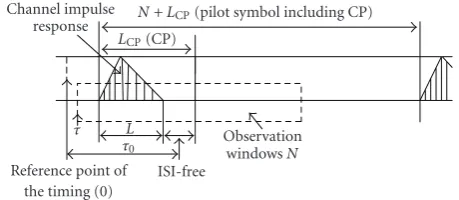
Channel impulse
response N+LCP(pilot symbol including CP) LCP(CP)
τ τ0
L
Reference point of the timing (0)
ISI-free
Observation windowsN
Figure1: Accurate timing position under multipath fading.
The organization of this paper is as follows. The signal model of OFDM is introduced inSection 2. InSection 3, the algorithm for joint timing and IFO estimation using FFT is developed and the estimation in the cases of UCO and KCO are discussed. Computer simulations are presented in
Section 4to demonstrate the performance of the proposed algorithm with comparisons to the available methods [7,9–
11].Section 5concludes the paper.
Notation
Capital (small) bold face letters denote matrices (column vectors). Frequency domain components are indicated by a tilde. (·)∗, (·)T, and (·)Hrepresent conjugate, transpose, and conjugate transpose, respectively. · denotes the Frobenius norm, andIN×N denotes theN×N identity matrix. Re(·) denotes the real part of a complex number (·). diag(·) de-notes a diagonal matrix constructed by a vector.∗denotes the convolution andfft(·) denotes the FFT of the columns of a matrix.
2. PROBLEM FORMULATION
The OFDM signal is generated by taking theN-point inverse fast Fourier transform (IFFT) of a block of symbols with a linear modulation such as PSK and QAM. The OFDM sam-ples at the output of IFFT are given by
x(i)= N−1
n=0 an
exp(√ j2πni/N)
N , 0≤i≤N−1, (1)
whereanis modulated data sequence with unit energy. The useful part of each block has the duration ofTseconds and is preceded by a cyclic prefix (CP) with the size ofLCP, longer than the channel impulse response, so as to eliminate the in-terference between adjacent blocks. Each OFDM block is se-rialized for the transmission through the possible unknown time-invariant composition multipath channel. The channel can be denoted by a discrete-time filter h(l) with orderL (L≤LCP):
h(l)=gtr(t)∗hp(t)∗grec(t)|t=lTs−t0, (2)
where gtr(t) and grec(t) are, respectively, the response of transmitting and receiving filters. hp(t) is the impulse response of the dispersive channel.Ts = T/N is sampling
period, andt0is propagation delay. In the presence of a fre-quency offset f, the samples at the receiving filter output are
r(k)=exp
j
2πkvI+vF
N
L−1
l=0
h(l)x(k−l) +w(k), (3)
wherevIandvFare, respectively, the IFO and the FFO nor-malized by the subcarrier space 1/T,x(m(N+LCP) +n) is the serialized version of themth OFDM block with thenth entry, andw(k) denotes zero-mean additive white Gaussian noise (AWGN).
Assuming that a length-N observation window slides through the received data stream (Figure 1), we can ob-tain observation vectors represented by the following matrix form:
r(τ)=CvFCvIX(τ)hξ+w(τ), (4)
where τ is the start point of observation window, ξ =
exp[j2πτ(vF+vI)/N],
r(τ)=r(τ),r(τ+ 1),. . .,r(τ+N−1)T,
C(v)=diag
1, exp
j2πv N
,. . ., exp
j2πv(N−1) N
,
X(τ)i,j=x(i−j), τ≤i≤N+τ−1, 0≤j≤L−1,
h=h(0),h(1),. . .,h(L−1)T,
(5)
andw(τ)=[w(τ),. . .,w(τ+N−1)]Tis a zero-mean Gaus-sian vector with covariance matrix
Cw=E
wwH=σ2I
N×N. (6)
As illustrated inFigure 1, as long as the timing estimate is within the ISI-free guard interval, the timing offset, regard-less of its values, will not degrade the system performance.
Assume the FFO is corrected in advance, then the term C(vF) in (4) can be removed. We construct the matrixX by pilot symbol [xN−L+1,. . .,xN,x0,. . .,xN−1] and replace the matrixX(τ) in (4) by the matrixX. The termξin (4) can be incorporated into the channel parametersh. Then the ob-served data can be expressed as
Now, we can find from the first term in the right-hand side of (7) that there are three kinds of unknown parame-ters in (7), namely TOτ, IFOvI, and channel parameters. Assumeτ0is the offset from a given reference to the ISI-free interval. Our task is to findτ0and estimate the IFOvI simul-taneously based on the observationr(τ) for givenX.
3. MAXIMUM-LIKELIHOOD ESTIMATION USING FAST FOURIER TRANSFORM
In this section, the ML principle is applied to derive an al-gorithm for jointly estimating the timing and IFO. The joint estimation problem in the case of unknown channel order is also discussed.
3.1. Derivation of the algorithm
Since all the parameters except for noise in (7) are determin-istic, the log-likelihood function of received data can be rep-resented as
ln(L)=const−2Nlnσ2−r(τ)−C
vIXh2
σ2 . (8)
The estimation ofτ,vI, andhis the solution of the fol-lowing joint optimization problem:
h,τ,vI=min ˆ h, ˆτ, ˆvI
r(τ)−CvIXh2. (9)
For givenτandvI, the minimum for (9) is
h=XHX−1XHCHvIr(τ). (10)
Substituting (10) into (9),τ andvI can be obtained by maximizing the following cost function:
JvI,τ=CHvIr(τ)HPCHvIr(τ) (11)
= −b(0,τ) + 2 Re
N−1
m=0
b(m,τ) exp
− j2πmvN I
,
(12)
b(m,τ)=
N−1
k=m
[P]k−m,kr∗(k−m+τ)r(k+τ), (13)
whereP=X(XHX)−1XHand [P]i,jis the (i,j)th entry ofP. The main steps in obtaining (12) are outlined in the ap-pendix.
AsvIandτ are integers, the estimation range of the nor-malized IFOvIis in [0,N−1] and the search range of timing
τis in [0,Lτ−1] (assumeτ0is in [0,Lτ−1]), where 0 is the reference point of TO andLτis the length of TO search.
Construct twoN×Lτ matricesB andJ whose entries are denoted by b(m,τ) and J(vI,τ), respectively. The cost
function (12) can be expressed in the following matrix form:
J=2 Refft(B)−B0, (14)
whereB0is anN×Nmatrix with the same columns from the first column ofB.
The maximum entry of the matrixJcan be obtained by 1D search. It is clear that the indexes of the row and col-umn corresponding to the maximum entry ofJrepresent the IFOvIand the TOτ0, respectively.
3.2. Unknown channel order case
In fact, there is still a hidden parameter unknown in the data model (7). In order to construct the matrixX, the channel orderL should be known in advance. Thus the additional algorithm for the channel order estimation is needed. Fur-thermore, since the channel order is varying in practice, the matricesXandPhave to be reconstructed according to dif-ferentL. However, we find that the estimator is robust to the overestimated channel order. Hence the channel orderLcan be simply replaced byLCP under the condition ofLCP ≥L which is generally satisfied in OFDM systems. Therefore, we do not need to estimateLand to reconstructXandP. Com-parisons of the KCO with the UCO will be given in detail next.
3.3. Effects of unknown channel order
Assume the IFOvI=13 and the search range of TO is from 0–18. The cost functionJ(vI,τ) in the cases of the KCO and UCO are plotted in Figure 2. It can be seen that the cost function has a narrow timing metric plateau whenvI =13 in the case of KCO, whereas it gives a wide timing metric plateau within the ISI-free guard interval in the case of UCO. It should be noted that the wide plateau is likely to be be-yond the ISI-free interval to degrade the performance (see
Simulation 2inSection 4). For both the KCO and UCO, the cost functions have the unique tall peak at the IFO metric. However, the IFO metric of the UCO case has higher side-lobes relative to the mainlobe than that of the KCO case. It implies that there is still loss in terms of the performance of the IFO estimation when channel order is unknown (see
Simulation 1inSection 4).
Remarks
(1) MatrixPcan be calculated in advance, which reduces largely the burden of online computations.
(2) The multipath fading channel parameters can be ob-tained by (10) after both the IFO and TO, are corrected. The phase offset of estimated channel parameters can be compen-sated by itself in the process of channel equalization.
(3) Only one pilot symbol is needed in the algorithm to estimate the IFO, TO, and channel parameters, and the pilot symbol can be selected as a random sequence.
15 14 the case of UCO.
4. SIMULATION RESULTS AND DISCUSSIONS
The performance of the proposed approach to joint estima-tion of the IFO and TO is evaluated by computer simula-tions. Consider an OFDM system with 64 subcarriers and the length of cyclic prefix with 16 samples. The QPSK sym-bol modulation is employed. The additive channel noise is zero-mean white Gaussian. The delay-power-spectrum func-tion is exponential. The channel orderLis varying between 8 and 16. The TX/RX filters in the simulations are raised-cosine rollofffilters with a rollofffactor 0.5. The performance of the estimated IFO is evaluated by means of the probability of failure (POF), Pr{vI =vI}. The performance of the esti-mated TO is evaluated by mean square error (MSE) and the timing error is counted with reference to the bound of the ISI-free guard interval.
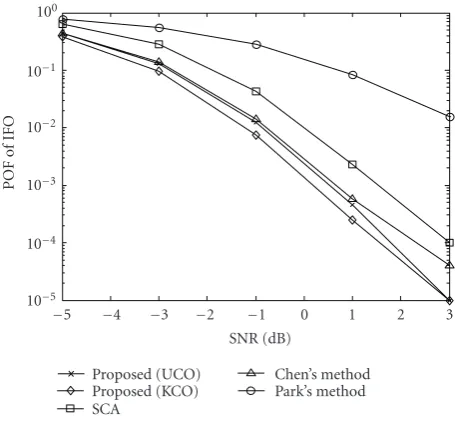
Simulation 1(performance of integer frequency offset esti-mation). InFigure 3, the POF of the proposed method for the IFO estimation using one pilot symbol is compared with that of the SCA [7] and Chen’s method [9]. Firstly, we use Minn’s method [11] to obtain the timing. And then, SCA and Chen’s method are used to estimate the IFO. Note that the SCA and Chen’s method are based on two pilot symbols. Park’s method using one pilot symbol [10] with 32 virtual subcarriers is also plotted inFigure 3. The timing error is as-sumed withinτ0±3 for the estimator in [10]. The simulations were performed with 100 000 runs. As shown inFigure 3, our method has smaller POF than other methods even in the case of UCO. Similar to the previous simulation, the estimated performance in the KCO case is better than that in the UCO case.
Simulation 2 (performance of timing offset estimation).
Figure 4shows the MSE of the proposed and conventional methods for the TO estimation. We can observe that our method outperforms both the SCA [7] and Minn’s method [11] in both the KCO and UCO cases. It is also noted that in the KCO case, the proposed method has a much smaller MSE than in the UCO case. The reason is that the timing metric plateau of the cost function in the UCO case is beyond the ISI-free interval.
Figure3: IFO performance comparison for the proposed method, SCA, Chen’s method, and Park’s method (N =64,LCP=16,vI = 13). Note that only the pilot symbol of Park’s method has virtual subcarriers.
−5 0 5 10 15 20
Figure4: TO performance comparison for the proposed method, SCA, and Minn’s method (N=64,LCP=16,vI=13).
SCA + proposed (UCO) SCA + proposed (KCO) Ideal synchronous
Figure5: WER performance comparison for the system using pro-posed method along with SCA and the ideal synchronized system. SCA is used to estimate the FFO and coarse TO.
5. CONCLUSIONS
A method for joint frequency ambiguity resolution (or IFO estimation) and TO estimation using one pilot symbol for OFDM system is proposed. The FFT and the 1D search are employed to obtain the accurate estimation of the TO and IFO. Especially, when channel order is known, the perfor-mance of both the IFO and TO can be improved consider-ably. The replacement of channel order by the length of CP leads to the negligible loss in terms of the WER of systems.
APPENDIX
This appendix outlines the main steps in obtaining (12):
JvI,τ=CHvIr(τ)HPCHvIr(τ)
(2) Because P is a projection matrix, [P]k−m,k =
This research was supported by China National Science Fund under contract 60172028. The authors are grateful to the anonymous referees for their constructive comments and suggestions in improving the quality of this paper.
REFERENCES
[1] J. A. C. Bingham, “Multicarrier modulation for data transmis-sion: an idea whose time has come,”IEEE Communications Magazine, vol. 28, no. 5, pp. 5–14, 1990.
[2] T. Pollet and M. Moeneclaey, “Synchronizability of OFDM sig-nals,” inProceedings of IEEE Global Telecommunications Con-ference (GLOBECOM ’95), vol. 3, pp. 2054–2058, Singapore, November 1995.
[3] T. Pollet, M. Van Bladel, and M. Moeneclaey, “BER sensitiv-ity of OFDM systems to carrier frequency offset and Wiener phase noise,”IEEE Transactions on Communications, vol. 43, no. 2/3/4, part 1, pp. 191–193, 1995.
[4] P. H. Moose, “A technique for orthogonal frequency division multiplexing frequency offset correction,”IEEE Transactions on Communications, vol. 42, no. 10, pp. 2908–2914, 1994. [5] J.-J. van de Beek, M. Sandell, and P. O. B¨orjesson, “ML
esti-mation of time and frequency offset in OFDM systems,”IEEE Transactions on Signal Processing, vol. 45, no. 7, pp. 1800–1805, 1997.
[6] B. Chen and H. Wang, “Blind estimation of OFDM carrier fre-quency offset via oversampling,”IEEE Transactions on Signal Processing, vol. 52, no. 7, pp. 2047–2057, 2004.
[7] T. M. Schmidl and D. C. Cox, “Robust frequency and timing synchronization for OFDM,”IEEE Transactions on Communi-cations, vol. 45, no. 12, pp. 1613–1621, 1997.
[8] M. Morelli, A. N. D’Andrea, and U. Mengali, “Frequency am-biguity resolution in OFDM systems,”IEEE Communications Letters, vol. 4, no. 4, pp. 134–136, 2000.
[9] C. Chen and J. Li, “Maximum likelihood method for integer frequency offset estimation of OFDM systems,”Electronics Let-ters, vol. 40, no. 13, pp. 813–814, 2004.
[10] M. Park, N. Cho, J. Cho, and D. Hong, “Robust integer fre-quency offset estimator with ambiguity of symbol timing off -set for OFDM systems,” inProceedings of 56th IEEE Vehicular Technology Conference (VTC ’02), vol. 4, pp. 2116–2120, Van-couver, BC, Canada, September 2002.
[11] H. Minn, M. Zeng, and V. K. Bhargava, “On timing offset es-timation for OFDM systems,”IEEE Communications Letters, vol. 4, no. 7, pp. 242–244, 2000.
[12] H. Minn, V. K. Bhargava, and K. B. Letaief, “A robust tim-ing and frequency synchronization for OFDM systems,”IEEE Transactions on Wireless Communications, vol. 2, no. 4, pp. 822–839, 2003.
[13] M. Morelli and U. Mengali, “Carrier-frequency estimation for transmissions over selective channels,”IEEE Transactions on Communications, vol. 48, no. 9, pp. 1580–1589, 2000.
Jun Lireceived the B.S. degree from Uni-versity of Electronic Science and Technol-ogy, Chengdu, China, in 1994 and the M.S. degree from the Guilin University of Elec-tronic Technology, Guilin, China, in 2002. He received the Ph.D. degree in information and communication engineering from Xid-ian University, Xi’an, China, in 2005. From 1994 to 1999, he was with Research Institute of Navigation Technology, Xi’an. In June
2005, he joined the National Laboratory of Radar Signal Process-ing, Xidian University. His current research interests include smart antenna, synchronization and channel estimation algorithms for OFDM systems, and signal processing for radar.
Guisheng Liao received the B.S. degree from Guangxi University, Guangxi, China, in 1985 and the M.S. and Ph.D. degrees from Xidian University, Xi’an, China, in 1990 and 1992, respectively. He joined the National Laboratory of Radar Signal Pro-cessing, Xidian University in 1992, where he is currently Professor and Vice Director of the laboratory. His research interests are mainly in statistical and array signal
pro-cessing, signal processing for radar and communication, and smart antenna for wireless communication.
Shan Ouyang received the B.S. degree in electronic engineering from Guilin Univer-sity of Electronic Technology, Guilin, in 1986, and the M.S. and Ph.D. degrees in electronic engineering from Xidian Univer-sity, Xi’an, in 1992 and 2000, respectively. In 1986, he joined Guilin University of Elec-tronic Technology, where he is presently a Professor and the Director in the Depart-ment of Communication and Information