R E S E A R C H
Open Access
Spatial aliasing for efficient
direction-of-arrival estimation based on
steering vector reconstruction
Feng-Gang Yan, Bin Cao
*, Jia-Jia Rong, Yi Shen and Ming Jin
Abstract
A new technique is proposed to reduce the computational complexity of the multiple signal classification (MUSIC) algorithm for direction-of-arrival (DOA) estimate using a uniform linear array (ULA). The steering vector of the ULA is reconstructed as the Kronecker product of two other steering vectors, and a new cost function with spatial aliasing at hand is derived. Thanks to the estimation ambiguity of this spatial aliasing, mirror angles mathematically relating to the true DOAs are generated, based on which the full spectral search involved in the MUSIC algorithm is highly compressed into a limited angular sector accordingly. Further complexity analysis and performance studies are conducted by computer simulations, which demonstrate that the proposed estimator requires an extremely reduced computational burden while it shows a similar accuracy to the standard MUSIC.
Keywords: Multiple signal classification (MUSIC), Direction-of-arrival (DOA) estimation, Spatial aliasing, Steering vector reconstruction
1 Introduction
Direction-of-arrival (DOA) estimation using a sensor array has been an important topic that arises in many fields such as radar, sonar, passive localization, and wireless communication [1, 2]. Over several decades, numerous outstanding algorithms including maximum-likelihood (ML) [3], multiple signal classification (MUSIC) [4], estimation of signal parameters via rotational invari-ance technique (ESPRIT) [5], and subspace fitting [6] have been developed to estimate the DOA of narrow-band sources. Among state-of-the-art parameter estima-tion techniques, the MUSIC algorithm which can offer a so-called super-resolution probability for two sufficiently closely spaced sources is one of the most popular one. The primary advantage of the MUSIC algorithm over the other subspace-based methods is distinguished by its easy implementation with arbitrary geometries [7, 8]. However, since the standard MUSIC involves a subspace decom-position step and a tremendous spectral search step, the computational complexity of MUSIC is usually expensive,
*Correspondence: [email protected]
Harbin Institute of Technology, 150001 Harbin, China
and a variety of low-complexity approaches have been proposed to reduce this computational burden.
The research in [9] and [10] suggest that the spec-tral search step dominates the complexity of the MUSIC algorithm, therefore, avoiding the spectral search step or limiting the range for this spectral search becomes the key to reducing the complexity of MUSIC, and numerous modifications of the standard MUSIC have been pre-sented from this point of view. For example, when the array geometry satisfies the rotational invariant prop-erty, DOAs can be computed without spectral search by the well-known ESPRIT method. Although ESPRIT saves a much lower complexity, it sacrifices a signif-icant estimation accuracy as compared to MUSIC on the other hand. Another premising search-free method is the root-MUSIC algorithm [11], which can be taken as a special extension of MUSIC with uniform linear arrays (ULAs). Using the Vandermonde sturcture of a ULA, the root-MUSIC algorithm transforms the MUSIC function into a polynomial and finds signal DOAs by rooting instead of spectral search. Although root-MUSIC has been extended to nonuniform linear arrays (NULAs)
[12–17], and has an improved computational load and threshold performances as compared to the standard MUSIC [18], the former usually requires to find all the roots of a polynomial whose order is about twice of the number of sensors. Therefore, the computational burden of root-MUSIC is in fact much higher than expected, especially when large numbers of sensors are used (Fig. 1). An outstanding structural (instead of algorithmic) method is recently proposed to overcome the complex-ity problem that arises in the famous ML DOA estima-tor [19]. The algorithm is based on a complex doubly scaled aperture nested array (DSANA) which can gen-erate spatial aliasing(also known as ambiguous DOAs) in the ML spectral. The spatial aliasing is used to highly compress the full grid search into small angular sectors to reduce significant computational burden, and unique determination of DOA is finally obtained by implement-ing the ML algorithm with different sub-arrays selected from DSANA. Following this idea, we propose in this paper a new method with a uniform linear array (ULA) to reduce the computational complexity of the MUSIC algorithm. Unlike DSANA, the array geometry in this work is much simpler and more popular in practice. Fur-thermore, the proposed technique can be used to reduce the complexity of both MUSIC and ML while that in [19] cannot be used for MUSIC directly (since imple-menting MUSIC on DSANA requires the number of any sub-arrays selected from DSANA being larger than that of sources).
The proposed method starts at reconstructing the steer-ing vector of a ULA as the Kronecker product of two other steering vectors, which has been successfully used in two-dimensional (2D) polarization estimate [20], MIMO radar [21], and nested array [22]. Using the Kronecker prod-uct, the high-cost MUSIC function is further reformu-lated as an eigenvector-based optimization problem, and a new low-complexity cost function with spatial aliasing
is derived. Due to the ambiguous DOAs caused by spa-tial aliasing, the full spectral search is finally compressed into a limited angular sector, and hence a significant com-putational burden as compared to the standard MUSIC is saved.
The outline of this paper is as follows. The narrow-band signal model and the conventional MUSIC algorithm are introduced in Section 2. In Section 3, the steering vector of a ULA that used in the standard MUSIC is firstly recon-structed as two other steering vectors, based on which the proposed low-complexity cost function with spatial aliasing is addressed. The characteristics of this spatial aliasing are analyzed, and the compressed spectral range is discussed in detail finally in this section. The complex-ity of our method is analyzed in Section 4, and simulation results are conducted to validate the effectiveness of new method in Section 5.
2 Signal model and standard MUSIC
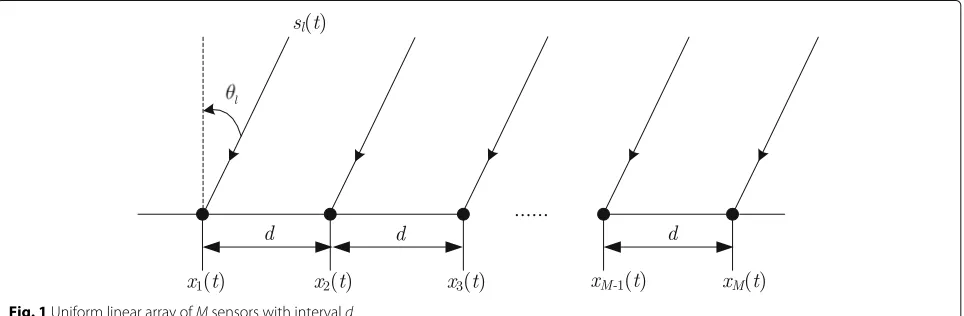
Assume that L narrowband signals with unknown DOAs simultaneously impinge from far-field on a ULA with omnidirectional antenna elements indexed by {0, 1, 2,. . .,M−1}, as shown in Fig. 1, the received signal can be written in matrix form as [1–19]
x(t)=A(θ )s(t)+n(t) (1) whereA(θ )= [a(θ1),a(θ2),. . .,a(θL)] Ais theM×L matrix of the signal direction vectors and
a(θ )
1,e−j·2π·dλ·sinθ,e−j·2·2π·dλ·sinθ,. . .,
e−j·(M−1)·2π·dλ·sinθ
T (2)
is theM×1 steering vector,s(t)is theL×1 source wave-forms, andn(t) is theM×1 sensor noise. In addition,
j √−1,λis center wavelength,dis array interval, and
(·)T is transpose.
Given N snapshots of the received signals {x(1),x(2),. . .,x(N)}, the main task of DOA estimation is to determine the incident signal angles{θ1,θ2,. . .,θL}, provided that the total number of signals L is detected in advance. This task can be equivalently regarded as the estimation of a set of steering vectors as a set of directions and that of steering vectors are related in a one-to-one correspondence [19]. The study follows will focus on the angle estimation of the incident signals to simplify the DOA estimation problem with the assump-tion that the number of signals has been detected in advance.
Almost all of the existent super-resolution DOA estima-tors need to compute the covariance ofx(t), which is given by
R=Ex(t)xH(t)=ARsAH+σn2IM. (3) In practical applications, the theoreticalRis unavailable, and it is usually estimated by{x(1),x(2),. . .,x(N)}as transpose. The eigenvalue decompositions (EVDs) of the theoreticalRgiven in (3) and the practical estimatedR given in (4) can be defined, respectively, in a standard way as
with the subscriptss and n standing for the signal and noise subspace, respectively.
Using the facts span(Vs) ⊥ span(Vn)and span(A) = span(Vs), the MUSIC algorithm suggests to estimate DOAs by spectral search
minθ PMUSIC(θ )aH(θ )VnVHna(θ )
s.t. θ ∈[−π/2,π/2] (7) to find theL peaks of PMUSIC(θ ) which indicate source DOAs. The advantage of the MUSIC algorithm over the
other subspace-based methods is its easy implementa-tion and high resoluimplementa-tion [7, 8]. However, the complexity of the spectral search step is typically substantially high since for each point, the productaH(θ )VnVHna(θ )has to be computed [9].
3 The proposed algorithm
3.1 Steering vector reconstruction
Let us consider the number of sensorsM. For anyM>L, ifMis not a prime number andM 4, we can find two integersM1andM2that satisfy
M=M1·M2, M12,M22. (8)
Definez e−j·2π·dλ·sinθ, the steering vectora(θ )given in (2) can be rewritten as
a(θ )=
where⊗denotes the Kronecker product and
b(θ )= two ULAs withM2andM1sensors, respectively. The dif-ferences between the two steering vectorsb(θ )andc(θ )is that the array interval forc(θ )isdwhile that forb(θ )is
3.2 Proposed cost function
Now, substituting (9) into (7), the MUSIC algorithm can be rewritten as
It can be concluded from (11) that searching the minima ofPMUSIC(θ )overθ ∈[−π/2,π/2] is equivalent to finding the optimal solution ofc(θ )that minimizes the product cH(θ )Qθc(θ ). that any vector in C2must be in the form of a steering vector while that inC1may not be. Therefore, we have
C2⊂C1. (15)
To minimizecH(θ )Qθc(θ ), we can search over the entire angle set [−π/2,π/2] to find an appropriate angle θ0 which satisfies cH(θ0)Qθ0c(θ0) = min. In other words, the MUSIC algorithm can be directly reformulated as the following optimization problem
min cH(θ )Qθc(θ )
s.t. c(θ )∈C2. (16)
However, the above optimization problem is in fact identical to the standard MUSIC and there is no reduction on the computational complexity.
To reduce the complexity, we note that for a givenQθ computed by a given angle θ, the minimizing task of cH(θ )Qθc(θ ) can be performed over C1 instead of C2 since we have C2 ⊂ C1. This means that we can omit
the parameter θ and let c = c(θ ). Hence, the MUSIC algorithm can be equivalently reformulated as the follow-ing optimization problem
min cHQθ c
s.t. c∈C1. (17)
The differences between (16) and (17) are that bothQθ andc(θ )must be considered as functions ofθ in the for-mer while in the latter, we only need to considerQθ for each θ ∈ [−π/2,π/2]. The derivation follows indicate that this can lead to a significant complexity reduction as compared to the standard MUSIC.
Using the Lagrange multiplier technique with respect to the restriction cHc = M1, we obtain the following Lagrangian
f[c]=cHQθc−ξcHc−M1
(18)
whereξis the Lagrange multiplier.
Setting the gradient of (18) with respect to cto zero yields
Qθc=ξc. (19)
Equation (19) can be identified as the characteristic one for matrixQθ. Thus,ξis an eigenvalue ofQθ andcis the eigenvector that associated withξ. SincecHc = M1, it follows from (19) that
cHQθc=ξcHc=M1ξ. (20)
Therefore, minimizing cHQθ c is in fact equivalent to findingξmin, i.e, finding the minimum eigenvalue ofQθ . Additively, the optimized solution forc, i.e.,copt, is equiv-alent to the associated eigenvector respect toξmin. Hence, coptcan be given as follows
copt=γQθ
min (21)
whereγQθ
minis the eigenvector associated withξmin. Substituting (21) into (11), DOAs can finally estimated by is to be discussed in the subsection that follows.
3.3 Search range compression
Recall the maximum inter-element spacing criterion of an array, which is defined as [19]
dmax=
λ
2|sinθmax| (23)
where θmax is the maximum searching angle. Because a ULA scans at most±90◦, the element spacing of such an array must be less than half of the wavelength; otherwise, the impinging signals will result in estimation ambiguous. This phenomenon happens when there are replica DOAs
θreproducing the same optimized solution forc(θ )as the true DOAsθgesuch that
copt
θge=copt(θre). (24) Since the array interval ofb(θ )isM1times that ofc(θ ), the relationship betweenθreandθgeis
M1
2 sinθge+k=
M1
2 sinθre (25)
or equivalently given by
θre=sin−1 values ofkwill be given according toθgeas follows
M1
The maximum searching angle without estimation ambiguity can be determined by insertingdmax=M1λ/2 into (23) as
Therefore, the compressed searching range is given by
=
The above analysis implies that searching P(θ ) over will reduceLcandidate anglesθ1ge,θ2ge,. . .,θLge, with computed immediately by (26). Finally, theLsource DOAs can be obtained efficiently by selecting Langles among
θ1re,θ2re,. . .,θMre
1L
that minimizeaH(θ )VnVHna(θ ).
3.4 Summary of the new algorithm
Detailed steps for implementing the proposed algorithm are summarized in Algorithm 1.
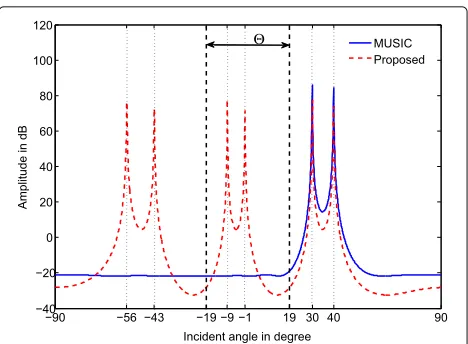
Figure 2 is conducted to show more clearly the imple-mentations of the new method. First, it is computed by (29) that
=−sin−1(1/3), sin−1(1/3)≈−19.47◦, 19.47◦. Next, two candidate angles θ11re = −9.6◦ and θ21re =
−1.4◦ are found by searchingP(θ )over only , and the
Fig. 2Direction finding by the proposed method, SNR=20 dB,
N=200,M1=M2=3. Two sources atθ1=30◦andθ2=40◦, half-wavelength ULA with nine sensors
Algorithm 1The proposed algorithm
Require: {x(t)}Nt=1:Nsnapshots of array output vector.
1: Use{x(t)}tN=1to getRby (4) and computeVnby (5) ; 2: Choose appropriate integersM1andM2according to
(8) and compute by (29);
3: foreachθ ∈ do
8: Calculate theM1Langles
9: Select theLDOAs among
10: return theLestimated source DOAs.
other four ones are computed by using (26) as follows
k=1, θ12re =sin−1sin(−9.6◦)+2/3≈29.99◦
k= −1, θ13re=sin−1sin(−9.6◦)−2/3≈ −56.45◦
k=1, θ22re =sin−1sin(−1.4◦)+2/3≈39.95◦
k= −1, θ23re=sin−1sin(−1.4◦)−2/3≈ −43.71◦. Finally, we calculate the numerical values of the cost function at all candidate angles in Table 1, from which we can conclude that the productaH(θ )Vn2get itsL = 2 minimum values at anglesθ12re =29.99◦andθ22re =39.95◦. Since the total number of signals L is supposed to be detected in advance, the above two angles are selected as the estimated DOAs, which match the true angles.
Remarks:
(1) Note that the eigenvectorγQθ
Table 1Numerical values of productaH(θ )Vn2at all candidate angles
Candidate angles −56.45◦ −43.71◦ −9.6◦ −1.4◦ 29.99° 39.95°
aH(θ )V
n2 8.7873 8.8731 8.8810 8.7873 2.89e-05 1.63e-05
True or virtual Virtual Virtual Virtual Virtual True True
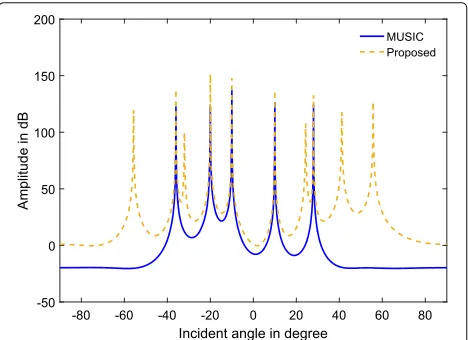
optimized solutioncoptmay not be in the form of a steering vector either. This means that we may have copt ∈ C1butcopt ∈/ C2. However, sinceQθ is com-puted by a given angleθusing (12), DOA information are contained is in bothQθandcopt. Therefore, signal DOA can be successfully estimated by (19). (2) The proposed method usesVnto construct its spec-trum, which is similar to MUSIC. Hence, the maxi-mum number of sources which can be identified by the new algorithm isL < M, which shows an out-standing advantage over the ADSANS-ML method [19]. An example is given in Fig. 3 to illustrate this
more clearly.
(3) It is the last step in Algorithm 1 that helps the proposed method to select the true angles from the computed candidate angles in various scenarios. An example for selecting true sources in the case where all the three true angles map to the same candidate angles is given in Fig. 4. Note that each of the three true angles has six candidate DOAs, which can be computed by using (26). Also note that the three true angles share the same ambiguous angles. To select the true angles, the values ofaH(θ )Vn2are com-puted in Table 2. Because the number of signalsL=3 is supposed to be detected in advance, the true angles
Fig. 3The maximum number of resolvable sources by the proposed method. SNR=30 dB,N=500,M1=2,M2=3. Five sources at
θ1= −36◦,θ2= −20◦,θ3= −10◦,θ4=10◦, andθ5=28◦, half-wavelength ULA with six sensors
Fig. 4Scenario in which some of the true sources map to the same candidate angles. SNR=10 dB,N=200,M1=6,M2=2. Three sources atθ1=5◦,θ2=24.87◦andθ3=48.92◦, half-wavelength ULA with 12 sensors
can be easily selected by selecting theL = 3 angels that minimizeaH(θ )Vn2. (4) The compressed spectral search by the proposed method is in fact resulted from the ambiguous DOAs, which is similar to the RV-MUSIC [8], C-MUSIC [10], and DSANA-ML [19] algorithms. Therefore, techniques suggested by C-MUSIC and DSANA-ML can be directly exploited for the proposed method to solve closely spaced candidate DOAs.
4 Complexity analysis
Using the fast subspace decomposition (FSD) technique [23], the complexity of MUSIC is given by [8, 10]
CMUSIC=M2(L+2)+J(M+1)(M−L)flops (30) whereJis the number of sample points in [−π/2,π/2].
For each point in , the new method has to compute three items includingQθ, the singular valued decompo-sition (SVD) ofQθ andP(θ ). Since there are at mostM2 non-zeros in each column ofb(θ )⊗IM1, the computation ofQθ requiresM2(M−L) (M1+M2)flops. AsQθ is of dimensionsM1×M1and we only need to findγ
Qθ min, the SVD ofQθ costsM12flops [24]. Note that the width of is 2 sin−1(1/M1)and for each point in and computing
P(θ )needsM21+M1flops.
On the other hand, each true source generate M1 ambiguous DOAs. Therefore, the total number of candi-date angles generated by the proposed method is M1L. For each candidate angle, we need to compute the prod-uct, which costs (M+1)(M−L) flops. Therefore, the complexity for solving the ambiguous DOAs is given by
Table 2Angle selecting for Fig. 4
Simulated angles θ1=5◦,θ2=24.87◦,θ3=48.92◦
Candidate angles −65.90◦ −35.42◦ −14.25◦ 5° 24.86° 48.92°
aH(θ )V
n2 11.9990 11.9990 11.9990 1.02e-04 1.15e-04 1.17e-04
True or virtual Virtual Virtual Virtual True True True
Based on the above analysis, the total complexity of the proposed method is given by
CProposed=M2(L+2)+
sin−1(1/M1) 90 J×
2M21+M1
+M2(M−L) (M1+M2)
+M1L(M+1)
×(M−L)flops. (31)
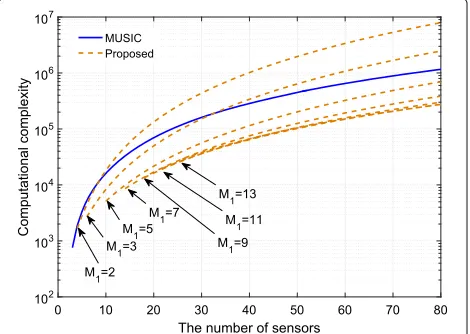
Figure 5 plots the complexity as functions of the num-ber of sensors. It is seen from the figure that the pro-posed method costs a heavier complexity as compared to MUSIC forM1 = 2, with which reaches its maxi-mum width. AsM1increases, gets smaller, and the new method costs significantly reduced complexities as com-pared to MUSIC. This implies that largerM1yields lower complexity. Since the number of ambiguous DOAs equals toM1, largerM1also leads to more ambiguities. Hence,
M1cannot be chosen too large in practice.
5 Performance study
Simulations with 500 independent Monte Carlo trials are conducted to assess the mean square error (MSE) perfor-mance of the proposed method, where the MSE is defined as
MSE 1 500
500
i=1
θi−θ2 (32)
withθ andθipresenting the true and the estimated DOA of the ith trial, respectively. Five algorithms including
Fig. 5Complexity versus the number of sensors,J=180,L=2
MUSIC [4], ESPRIT [5], C-MUSIC with β = 2 angu-lar sectors [10], U-MUSIC [25], RV-MUSIC [8], and the unconditional Cramér-Rao Lower Bound (CRLB) [26] are also applied for references.
To see clearly the performance of the proposed algo-rithm, Fig. 6 plots MSE against the SNR, in which a half-wavelength ULA with M = 12 sensors is used to locate L = 2 sources atθ1 = 30◦andθ2 = 40◦. Since the two parametersM1andM2for the proposed method satisfyM= M1·M2, different combinations for the two parameters are considered to provide further insights into the new method. In addition, the number of snapshots is fixed asN = 500 and the SNR varies from a wide range from SNR= −20 dB to SNR=20 dB in the simulation.
It is seen clearly from Fig. 6 that the proposed method shows a similar accuracy to the standard MUSIC and RV-MUSIC, which is much better than the ESPRIT and C-MUSIC techniques. It is also seen from the figure that the MSEs of the new method decrease slightly as M1 increases. However, the new method still performs closely to MUSIC withM1=4. SinceCMUSIC/CProposedM1=4 ≈ 23976/7699 ≈ 3.11 (J = 180), we can conclude that the proposed method trades off MSE by complexity effi-ciently.
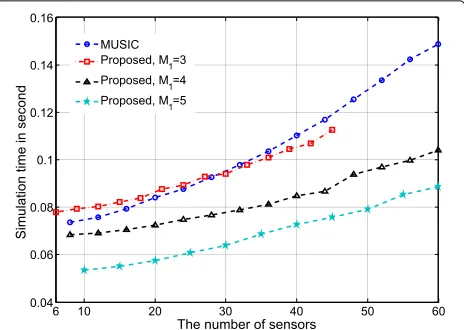
To verify the efficiency of the developed method and the computational complexity analysis in Section 4, we compare the simulation times costed by the stan-dard MUSIC and the proposed method with different choices for the parameterM1. In the simulation, we fix
Fig. 7Simulation time against the number of sensors, SNR=20 dB,
N=200, a fine search grid 0.11◦for MUSIC and the proposed method, two sources at 30◦and 40◦, half-wavelength ULA
SNR=20 dB,N = 200 and a fine search grid 0.11◦ is applied for spectral search in both MUSIC and the proposed method. The simulations presented here are performed by running the MATLAB codes in the same environment on a personal computer whose CPU config-urations and RAM are given by Intel(R) Core(TM) Duo T5870 2.0 GHz and 1 GB, respectively.
It is seen clearly from Fig. 7 that the proposed method costs a much smaller simulation time than the stan-dard MUSIC. It is also seen from the figure that as
M1 increases, the simulation time of the new method decreases dramatically, which matches the complexity comparison results of Fig. 5. It can be concluded from these observations that the proposed method shows an obvious computational efficiency advantage over the standard MUSIC.
6 Conclusions
We have proposed a new computationally efficient algo-rithm for DOA estimate. The key idea behind is to recon-struct the steering vector of a ULA as the Kronecker product of the two other steering vectors, leading to a limited spectral search with a significantly reduced com-plexity as compared to MUSIC. Simulations demonstrate that the new method has a very close MSE performance to MUSIC. Future research should be focused on extending the proposed method to arbitrary arrays.
Acknowledgements
The authors would like to thank the anonymous reviewers for their many insightful comments and suggestions, which helped improve the quality and readability of this paper.
This work is supported by National Natural Science Foundation of China (61501142), Shandong Provincial Natural Science Foundation (ZR2014FQ003), Special Foundation of China Postdoctoral Science (2016T90289), and China Postdoctoral Science Foundation (2015M571414).
Competing interests
The authors declare that they have no competing interests.
Received: 1 July 2016 Accepted: 1 November 2016
References
1. J Krim, M Viberg, Two decades of array signal processing research: the parametric approach. IEEE Signal Process. Mag.13(3), 67–94 (1996) 2. JC Chen, K Yao, RE Hudson, Source localization and beamforming. IEEE
Signal Process. Mag.19(2), 30–39 (2002)
3. I Ziskind, M Wax, Maximum likelihood localization of multiple sources by alternating projection. IEEE Trans. Acoust., Speech, Signal Process.36, 1553–1560 (1988)
4. RO Schmidt, Multiple emitter location and signal parameter estimation. IEEE Trans. Antennas Propag.34(3), 276–280 (1986)
5. A Paulraj, R Roy, T Kailath, A subspace rotation approach to signal parameter estimation. IEEE Trans. Signal Process.74, 1044–1046 (1986) 6. A Swindlehurst, M Viberg, Subspace fitting with diversely polarized
antenna arrays. IEEE Trans. Antennas Propag.41(12), 1687–1694 (1993) 7. Y Zhang, B Poh Ng, MUSIC-like DOA estimation without estimating the number of sources. IEEE Trans. Signal Process.58(3), 1668–1676 (2010) 8. FG Yan, M Jin, S Liu, XL Qiao, Real-valued MUSIC for efficient direction
estimation with arbitrary array geometries. IEEE Trans. Signal Process. 62(6), 1548–1560 (2014)
9. M Rbsamen, AB Gershman, Direction-of-arrival estimation for nonuniform sensor arrays: from manifold separation to Fourier domain MUSIC methods. IEEE Trans. Signal Process.57, 588–599 (2009) 10. FG Yan, M Jin, XL Qiao, Low-complexity DOA estimation based on
compressed MUSIC and its performance analysis. IEEE Trans. Signal Process.61(8), 1915–1930 (2013)
11. A Barabell, inAcoustic, Speech, and Signal Processing. Improving the resolution performance of eigenstructure-based direction-finding algorithms (IEEE International Conference on ICASSP ’83, Boston, 1983), pp. 336–339
12. CP Mathews, MD Zoltowski, Eigenstructure techniques for 2-D angle estimation with uniform circular arrays. IEEE Trans. Signal Process.42, 2395–2407 (1994)
13. J Ramos, CP Mathews, MD Zoltowski, FCA-ESPRIT: a closed-form 2-D angle estimation algorithm for filled circular arrays with arbitrary sampling lattices. IEEE Trans. Signal Process.47(1), 213–217 (1999) 14. M Pesavento, AB Gershman, KM Wong, Direction finding using partly
calibrated sensor arrays composed of multiple subarrays. IEEE Trans. Signal Process.50(9), 2103–2115 (2002)
15. S Abd Elkader, AB Gershman, KM Wong, Rank reduction direction-of-arrival estimators with improved robustness against subarray orientation errors. IEEE Trans. Signal Process.54(5), 1951–1955 (2006)
16. F Gao, AB Gershman, A generalized ESPRIT approach to direction-of-arrival estimation. IEEE Signal Process. Lett.12, 254–257 (2005)
17. F Belloni, A Richter, V Koivunen, DoA estimation via manifold separation for arbitrary array structures. IEEE Trans. Signal Process.55(10), 4800–4810 (2007)
18. BD Rao, KVS Hari, Performance analysis of root-MUSIC. IEEE Trans. Acoust., Speech, Signal Process.37(12), 1939–1949 (1989)
19. JW Shin, YJ Lee, HN Kim, Reduced-complexity maximum likelihood direction-of-arrival estimation based on spatial aliasing. IEEE Trans. Signal Process.62(24), 6568–6581 (2014)
20. MD Zoltowski, KT Wong, Member.Closed-form eigenstructure-based direction finding using arbitrary but identical subarrays on a sparse uniform cartesian array grid. IEEE Trans. Signal Process.48(8), 2205–2210 (2000)
21. J Li, P Stoica, MIMO radar with colocated antennas. IEEE Signal Process. Mag.24(5), 106–114 (2007)
22. P Pal, PP Vaidyanathan, Nested arrays: a novel approach to array processing with enhanced degrees of freedom. IEEE Trans. Signal Process. 58(8), 4167–4181 (2010)
23. G Xu, T Kailath, Fast subspace decomposition. IEEE Trans. Signal Process. 42(3), 539–551 (1994)
24. GH Golub, CH Van Loan,Matrix Computations. (Johns Hopkins Univ. Press, Baltimore, MD, USA, 1996)
25. KC Huarng, CC Yeh, A unitary transformation method for angle-of-arrival estimation. IEEE Trans. Signal Process.39, 975–977 (1991)