Reranking a wide-coverage
CCGparser
Dominick Ng and Matthew Honnibal and James R. Curran School of Information Technologies
University of Sydney NSW 2006, Australia
{dong7223,mhonn,james}@it.usyd.edu.au
Abstract
n-best parse reranking is an important technique for improving the accuracy of statistical parsers. Reranking is not con-strained by the dynamic programming re-quired for tractable parsing, so arbitrary features of each parse may be considered.
We adapt the reranking features and methodology used by Charniak and John-son (2005) for theC&CCombinatory Cat-egorial Grammar parser, and develop new features based on the richer formalism. The reranker achieves a labeled depen-dency F-score of 87.59%, which is a sig-nificant improvement over prior results.
1 Introduction
Accurate syntactic parsing has proven to be criti-cal for many tasks in natural language processing (NLP), including semantic role labeling (Gildea and Jurafsky, 2002), question answering (Echihabi and Marcu, 2003), and machine translation (De-Neefe and Knight, 2009). Improved parser accu-racy benefits many downstream tasks in the field.
One method of improving parsing accuracy is
reranking – the process of reordering the top n
analyses as determined by a base parser (Collins, 2000). The statistical models used in phrase-structure and dependency parsers rely on dynamic programming algorithms that restrict possible fea-tures to a local context. This is necessary for effi-cient decoding of the potential parse forest, ensur-ing tractability at the cost of excludensur-ing any non-local features from consideration. Reranking op-erates over complete trees that are the most prob-able derivations under the dynamic programming model, allowing arbitrary complex features of the parse to be incorporated without sacrificing effi-ciency. Poor local decisions made by parsers are easier to model and capture in the reranking phase.
Collins (2000) reports a 1.55% accuracy im-provement with reranking for the Collins parser, and Charniak and Johnson (2005) reports a 1.3% improvement for a reranked Charniak parser. An open question is how well reranking applies to parsers of different design to the Charniak and Collins parsers. An attempt to port the Char-niak and Johnson reranker for the Berkeley parser (Petrov et al., 2006) produced only minimal ac-curacy improvements (Johnson and Ural, 2010), suggesting that careful feature engineering is nec-essary for good performance.
In this paper we describe the implementation of a discriminative maximum entropy reranker for theC&Cparser (Clark and Curran, 2007), a state-of-the-art system based on Combinatory Catego-rial Grammar (CCG). We reimplement the features described in Charniak and Johnson (2005) to suit theCCGparser and replicate the Charniak reranker setup. Our experiments show that the PCFG -style features are less effective at reranking CCG
than Penn Treebank-style trees. We hypothesise that the binary-branching structure of CCG is the cause, as CCG trees are deeper and create differ-ent constitudiffer-ent structures compared to Penn Tree-bank trees. To address this, we develop a number of new features to take advantage of the more de-tailed formalism and the evaluation over recovered dependencies. We also experiment with regression and classification approaches, variations in feature pruning, and differing numbers of n-best parses for the reranker to consider.
2 Parser Reranking
Reranking has been successfully applied to de-pendency parsing (Sangati et al., 2009), machine translation (Shen et al., 2004), and natural lan-guage generation withCCG(White and Rajkumar, 2009). Collins (2000) describes reranking for the Collins (Model 2) parser (Collins, 1999). 36,000 sentences from Sections 02-21 of the Penn Tree-bank WSJ data are parsed with a modified ver-sion of the base parser, producing an average of 27 parses per sentence. Features are extracted from the parses to create reranker training data, including lexical heads and the distances between them, context-free rules in the tree,n-grams and their ancestors, and parent-grandparent relation-ships. Collins reports a finalPARSEVALF-score of 89.75% using a boosting-based reranker, a 1.55% improvement compared to the baseline parser.
The potential benefits from reranking are de-pendent on the quality of the candidate n-best parses. Huang and Chiang (2005) describe effi-cient and accurate algorithms for this task based on a directed hypergraph analysis framework (Klein and Manning, 2001). By improving the quality of the candidate parses, Huang and Chiang demonstrate how oracle reranking scores (using a perfect reranker that always choses the best parse from ann-best list) can be dramatically improved compared to the parses used in Collins (2000).
Charniak and Johnson (2005) describe discrimi-native reranking for the Charniak parser. A coarse-to-fine parsing approach allows high-quality n -best parses to be tractably computed while retain-ing dynamic programmretain-ing in the parser. When run in 50-best mode the Charniakn-best parser has an oracle F-score of 96.8% in the standard PARSE
-VALmetric – much higher than the 89.7% parser
baseline. The reranker produces a final F-score of 91.0% in 50-best mode. This is an improvement of 1.3% over the baseline model. Self-training over the reranked parses further improves performance to 92.1% F-score, which remains the state-of-the-art (McClosky et al., 2006). Self-training provides the additional benefit of improving the Charniak parser’s performance on out-of-domain data – a known weakness of supervised parsing.
More recently, the Charniak reranking system has been adapted for the Berkeley parser (Petrov et al., 2006). Unlike the Collins and Charniak parsers, which are broadly similar and heavily based on lexicalised models, the Berkeley parser
Jack baked a cake with raisins
N (S\NP)/NP NP/N N (NP\NP)/NP N
>
NP NP NP
>
NP\NP
<
NP
>
S\NP
<
[image:2.595.313.524.67.162.2]S
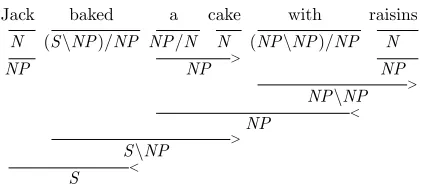
Figure 1: A simpleCCGderivation.
uses a split-merge technique to acquire a much smaller, unlexicalised grammar from its training data. Johnson and Ural (2010) report that rerank-ing leads to negligible performance improvements for the Berkeley parser, and acknowledge that the reranker’s feature set, adapted from Charniak and Johnson (2005), may be implicitly tailored to the Charniak parser over the Berkeley parser. In par-ticular, the feature pruning process for rerank-ing was conducted over output from the Charniak parser, which may have prevented useful features for the Berkeley parser from being chosen.
3 Combinatory Categorial Grammar
Combinatory Categorial Grammar (CCG, Steed-man (2000)) is a lexicalised grammar formalism based on combinatory logic. The grammar is di-rectly encoded in the lexicon in the form of cate-gories that govern the syntactic behaviour of each word. A small number of generic rules combine categories together to form a spanning analysis.
Categories may be atomic or complex. Atomic categories represent words and constituents that are syntactically complete, such as nouns (N),
noun phrases (NP), prepositional phrases (PP),
and sentences (S). Complex categories are binary
structures of the form X/Y orX\Y, and
repre-sent structures which combine with an argument of categoryY to produce a result of categoryX.
The forward and backward slashes indicate thatY
is expected to the right and left respectively. Complex categories can be thought of as func-tors that require particular arguments to produce a grammatical construction. Subcategorization information is encoded using nested categories. For example, transitive verbs have the category
(S\NP)/NP, which indicates that one objectNP
is expected to the right to form a verb phrase
S\NP, which in turn expects one subject NP to
In addition to forward and backward applica-tion, CCG has a number of other binary combi-nators based on function composition. There are also unary type-changing combinators that take a single category and transform it into another cat-egory. Figure 1 gives a simple CCG derivation, showing how categories are successively com-bined together to yield an analysis.
4 TheC&Cparser
TheC&Cparser (Clark and Curran, 2007) is a fast, highly accurate parser based on the CCG formal-ism. The parser is used in question answering sys-tems (Bos et al., 2007), computational semantics tools (Bos et al., 2004), and has been shown to per-form well in recovering unbounded dependencies (Rimell et al., 2009).
The parser divides the parsing process into two main phases: supertagging and parsing. First, the supertagger assigns a small set of initial cat-egories to each word in the sentence. Then, the parser attempts to find a spanning analysis using the proposed categories using the modified CKY
algorithm described in Steedman (2000). If the parser cannot find an analysis (i.e. there is no se-quence of combinators that can combine the pro-posed categories) the supertagger is run again at a higher ambiguity level, giving each word a larger set of possible categories, and the process is peated. The supertagging phase dramatically re-duces the number of derivations for the parser to consider, making the system highly efficient.
An n-best version of the C&C parser has re-cently been developed (Brennan, 2008), incorpo-rating the algorithms described in Huang and Chi-ang (2005). Then-best parser is almost as efficient as the baseline 1-best version, and we use it as the basis for all experiments presented in this paper.
CCGbank is the standard corpus for English parsing with CCG. It is a transformation of the Penn Treebank WSJ data into CCG derivations and dependencies (Hockenmaier and Steedman, 2007). Sections 02-21 are the standard training data for theC&C parser, with Section 00 used for development and Section 23 for evaluation. The supertagger requires part-of-speech information for each word as part of its feature set, so a POS
tagger is also included with theC&Cparser. Both the supertagger and thePOStagger are trained over tags extracted from Sections 02-21 of CCGbank.
5 Methodology
We frame the reranking task for CCG parsing as follows: given ann-best list of parses, ranked by the parser, choose the parse that is as close as possible to the gold standard. We use the stan-dardCCGlabeled dependency metric as described in Hockenmaier (2003) to define closeness to the gold standard, allowing us to explore both classi-fication and regression as frameworks for the task. In classification, the closest sentence(s) to the gold standard with respect to F-score are labeled as pos-itive, while all other sentences are labeled as neg-ative. If there are multiple parses with the highest F-score, they are all labeled as positive. In regres-sion, the F-score of each parse is used as the tar-get value. Both classification and regression ap-proaches were implemented usingMEGAM1.
n-best lists of parses were generated using the
n-best C&C parser using Algorithm 3 of Huang and Chiang (2005). We used the normal-form model for the C&C parser as described in Clark and Curran (2007) for all experiments in this pa-per. Reranker training data was created using n -best parses of each sentence in Sections 02-21 of CCGbank. As this is also the parser’s training data, care must be taken to avoid generating train-ing data where the parser’s confidence level is dif-ferent to that at run-time (caused by parsing the training data). We constructed ten folds of Sec-tions 02-21, training thePOS tagger, supertagger, and parser on nine of the folds and producing n -best parses over the remaining fold.
Features were generated over the n-best parses of the folded training data and the appropriate la-bel assigned based on the F-score. This data was used to train the reranker. Similarly, Section 24 of CCGbank was parsed using a model trained over Sections 02-21 for use as tuning data. At run-time, features were generated over then-best parses of the test data, and the most probable parse (clas-sification) or the parse with the highest predicted F-score (regression) was returned.
We experimented with values of 10 and 50 for
n to balance between the potential accuracy im-provement and the efficiency of the reranker. n
was kept constant between the training data and the final test data (i.e. a reranker trained on 50-best parses was then tested over 50-50-best parses).
Following Charniak and Johnson (2005) we im-plemented feature pruning for the reranker
train-1
ing data as follows. For each sentence, define a feature as beingpseudo-constantif it does not dif-fer in value over all the parses for that sentence. We keep all features that are non pseudo-constant in at leasttsentences in the training data. We ex-perimented with values of 0, 2, and 5 fortto in-vestigate the effect of feature pruning.
6 Reranking Features
The features described in this section are calcu-lated over CCG derivation trees produced by the
C&Cparser. We began by implementing the fea-tures described by Charniak and Johnson (2005), before developing features specifically for CCG
derivations. We also implemented the CCG pars-ing features described by Clark and Curran (2007), so that our reranking model would have access to the information used by the parser. These features include various combinations of word-category, word-POS,CCGrule, distance, and dependency
in-formation. Finally, the log score and rank assigned to each derivation by the parser were encoded as core features for the reranker.
CCGderivation trees have some important struc-tural differences from the trees that the Charniak and Johnson features were designed for. The most important difference is thatCCG trees are at most
binary branching2. As the longest non-terminal in the Penn Treebank has 51 children, features de-signed to generalise long production rules are use-ful in the Charniak and Johnson reranker but are less relevant toCCGtrees.
Another important difference is that CCG pro-duction rules are constrained by the combinatory rules, whereas Penn Treebank productions com-bine unrelated atomic symbols. For instance, a Penn Treebank production NP→NP PP would be translated intoCCGasNP→NP NP\NP. Much
of the information in the production is already present in the structure of theNP\NP category.
We speculate that this will make the features that capture the vertical context of a production rule less useful forCCG.
Finally, each ccg tree corresponds to exactly one dependency analysis, and this is produced as out-put by the C&C parser. This gives the reranker access to the full dependency analysis of each sentence, making the dependency-approximation
2
Steedman (2000) describes a ternary conjunction rule, but this is broken into two binary productions in CCGbank, using the marker[conj].
heuristics used by Charniak and Johnson (2005) unnecessary for our purposes.
The features adapted from Charniak and John-son (2005) are described in Sections 6.1 and 6.2 below. The novel CCG features we develop are described in Section 6.3. Most features were im-plemented as simple boolean indicator functions. Maximum entropy modelling exponentiates fea-ture values, so real-valued feafea-tures are more in-fluential than boolean features. We mitigated this effect by taking the log of real-valued features.
6.1 Tree Topology Features
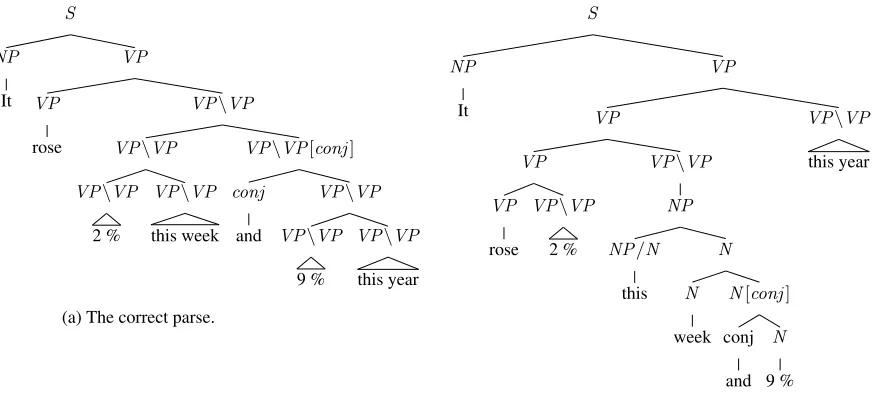
These features attempt to describe the overall shape of the parse tree, to capture the fact that English generally favours right-branching parse trees, with phonologically heavy constituents gen-erally occurring in sentence-final position. Tree topology can also be useful in capturing the bal-ance found in coordination attachment. These guidelines distinguish the correct parse tree in Fig-ure 2a from the incorrect parse tree in FigFig-ure 2b – the incorrect tree is more left-branching than the correct tree, with a shallower depth of balance in the coordination.
CoPar: records coordination parallelism at vari-ous depths. Indicates whether both sides of a co-ordination are identical in structure and category labels at depths of 1 to 4 from the coordinator.
CoLenPar: indicates the difference in size be-tween two halves of a conjunction (where size is the number of nodes in the yield) as well as whether the latter half is the final element.
Heavy: encodes the category and size of the sub-tree rooted at each terminal, whether the non-terminal is at the end of the sentence, and whether it is followed by punctuation. This crudely cap-tures the tendency for larger constituents to lie fur-ther to the right in a tree.
RightBranch: encodes the number of non-terminals on the longest path from the root of the tree to the right-most non-punctuation node in the tree, and the number of non-terminals in the tree that are not on this path.
SubjVerbAgr: captures the conjoinedPOStags of
the subject noun and verb in a sentence to distin-guish cases where the pluralisation does not agree. The subject is assumed to be the finalNP before
S
NP
It
VP
VP
rose
VP\VP
VP\VP
VP\VP
2 %
VP\VP
this week
VP\VP[conj]
conj
and
VP\VP
VP\VP
9 %
VP\VP
this year (a) The correct parse.
S
NP
It
VP
VP
VP
VP
rose
VP\VP
2 %
VP\VP
NP
NP/N
this
N
N
week
N[conj]
conj and
N
9 %
VP\VP
this year
[image:5.595.89.525.62.262.2](b) Parse featuring a conjunction error.
Figure 2: TwoCCGderivations for the sentence,It rose 2% this week and 9% this year.
6.2 Local Context Features
These features, adapted from Charniak and John-son (2005), attempt to represent various fragments of the tree as well as incorporate layers of vertical and horizontal context that are difficult to encode in the parser model.
Edge: captures the words and POStags immedi-ately preceding and following the subtree rooted at each non-terminal in the tree. This crudely cap-tures poor attachment decisions in local trees.
Heads: represents pairs of constituent heads as in-dicated by the parser at various levels in the tree. Heads are encoded as lexical items andPOStags.
HeadTree: records the entire tree fragment (in a bracketed string format) projected upwards from the head word of the sentence.
Neighbours: encodes the category of each non-terminal, its binned size, and the POStags of the
ℓ1 preceding words and the ℓ2 following words, whereℓ1 = 1or2andℓ2 = 1. Binned size is the number of words in the yield of the non-terminal, bucketed into 0, 1, 2, 4, or 5+.
NGramTree: records tree fragments rooted at the lowest common ancestor node ofℓ= 2or3 con-tiguous terminals in the tree. This represents the subtree encompassing each sequence of ℓ words in the sentence.
Rule: captures the equivalentCCGrule application represented at each non-terminal node; equivalent
to a context-free production rule.
SynSemHeads: yield pairs of semantic heads (e.g. the rightmost noun in a noun phrase) and func-tional heads (e.g. the determiner in a noun phrase) at each non-terminal in the tree. Heads are en-coded as lexical items andPOStags.
Word: yields each word in a sentence along with the categories ofℓ = 2 or3of its immediate an-cestor nodes in the tree.
WProj: for each terminal in the tree, encode the word combined with the category of its maximal projection parent, which is the first node found by climbing the tree until the child node is no longer the head of its parent.
6.3 CCGFeatures
We devised a number of new features for CCG
aimed at uncovering various combinator se-quences or combinations that may indicate an overly complicated or undesirable derivation. Ad-ditionally, these features attempt to encode more information about the dependencies licensed by the derivation as it is these dependencies which will be evaluated.
(Hock-enmaier and Steedman, 2007).
CoHeads: records the heads of both halves of a coordination as indicated by the parser, along with the depth at which the head is found. This attempts to encode the conjunction dependencies in the tree as incorrect conjunction dependencies propagate through to other dependencies in the tree. Heads are encoded as lexical items andPOStags.
LexDep: CCGdependencies can be partially cap-tured via the children of non-terminals in the tree. This feature is active for non-terminals with two children and encodes the heads of the children in terms of lexical items, POS tags, categories, and depth from the non-terminal. Dependencies in-volving punctuation are ignored as they are not as-sessed in the evaluation.
NumDeps: distinguishes between parses based on the log number of dependencies that they yield ig-noring punctuation. Dependencies are located us-ing the same heuristic as the LexDep feature.
TypeRaising: indicates the presence of unary type-raising in the tree. While type-raising is nec-essary to analyse some constructions inCCG, it has tightly restricted in the parser due to its power, and is expected to appear only rarely.
UnaryRule, BiUnaryRule: indicates the unary rules present in the tree and the bigram combina-tions of these rules. The unary rules do not include type-raising and are non-standard in CCG; they
were added by Hockenmaier and Steedman (2007) to CCGbank for constructions such as clausal ad-juncts, which are poorly handled by the formalism.
C&C Features: Finally, we also incorporate the dependency and normal-form features used by the C&C parser as described in Clark and Cur-ran (2007). These features encode various com-binations of word-category, word-POS, root-word,
CCGrule, distance, and dependency information.
7 Evaluation Measures
We follow the CCG dependency evaluation
methodology established by Hockenmaier (2003), using the EVALUATE scorer distributed with the
C&Cparser. It evaluates aCCGparse as a set of
la-beled dependencies consisting of the head, its lex-ical category, the child, and the argument slot that it fills. A dependency is considered correct only if all four elements match the gold standard.
LP LR LF AF
[image:6.595.314.518.63.122.2]Baseline 87.19 86.32 86.75 84.80 Oracle 10 91.98 90.89 91.43 89.47 Oracle 50 93.43 92.26 92.84 90.96
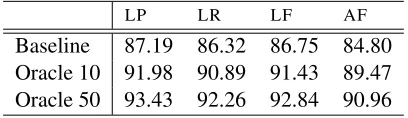
Table 1: Baseline and oraclen-best parser perfor-mance over Section 00 of CCGbank.
Statistical significance was calculated using the test described in Chinchor (1992), which measures the probability that the two sets of responses are drawn from the same distribution. A score below 0.05 is considered significant.
We report labeled precision (LP), labeled recall (LR), and labeled F-score (LF) results over gold standard POStags and labeled F-score over auto-matically assignedPOStags (AF).
8 Results
8.1 Oracle Performance
Reranking is dependent on high-quality parses from then-best parser. As seen in Table 1, the ora-cle labeled dependency F-score of then-bestC&C
parser is 92.48% given a perfect reranker over 50-best parses. This is a significant improvement over the baseline result of 86.75% and provides a solid basis for a reranker.
Our oracle score falls notably short of the 50-best oracle of 96.8% reported by Charniak and Johnson (2005), over a baseline of 89.7%. How-ever, these numbers refer to the PARSEVAL score for constituency parses, so they are not directly comparable to our dependency recovery metric.
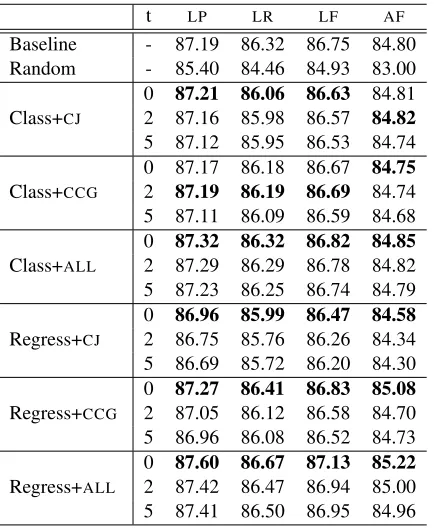
We present results in Tables 2 and 3 com-paring the 1-best C&C parser using the normal-form model (Clark and Curran, 2007), random-ized baselines (choosing a parse at random from the n-best list), and the reranking C&C parser in labeled dependency recovery over Section 00 of CCGbank. Our best result for 10-best rerank-ing is an F-score of 87.13% with gold POS tags and 85.22% with automatically assignedPOStags. This is achieved using the regression setup and all features without pruning. The best result for 50-best reranking is F-scores of 87.08% and 85.23% respectively, using the classification setup with all features and a pruning value of 2. These two results are both statistically significant improve-ments over the baseline parser.
t LP LR LF AF
Baseline - 87.19 86.32 86.75 84.80
Random - 85.40 84.46 84.93 83.00
Class+CJ
0 87.21 86.06 86.63 84.81
2 87.16 85.98 86.57 84.82
5 87.12 85.95 86.53 84.74
Class+CCG
0 87.17 86.18 86.67 84.75
2 87.19 86.19 86.69 84.74
5 87.11 86.09 86.59 84.68
Class+ALL
0 87.32 86.32 86.82 84.85
2 87.29 86.29 86.78 84.82
5 87.23 86.25 86.74 84.79
Regress+CJ
0 86.96 85.99 86.47 84.58
2 86.75 85.76 86.26 84.34
5 86.69 85.72 86.20 84.30
Regress+CCG
0 87.27 86.41 86.83 85.08
2 87.05 86.12 86.58 84.70
5 86.96 86.08 86.52 84.73
Regress+ALL
0 87.60 86.67 87.13 85.22
2 87.42 86.47 86.94 85.00
5 87.41 86.50 86.95 84.96
[image:7.595.312.518.62.361.2].
Table 2: 10-best reranking performance on Sec-tion 00 of CCGbank for various combinaSec-tions of features, pruning values t, and classification and regression experiments. Bolded scores are the highest for the feature set and approach.
t LP LR LF AF
Baseline - 87.19 86.32 86.75 84.80
Random - 83.90 82.58 83.24 81.50
Class+CJ
0 86.93 85.87 86.40 84.69
2 86.72 85.54 86.12 84.48
5 86.77 85.61 86.19 84.56
Class+CCG
0 87.17 86.10 86.63 84.62
2 87.14 86.07 86.60 84.66
5 87.29 86.17 86.72 84.66
Class+ALL
0 87.38 86.29 86.83 84.91
2 87.61 86.56 87.08 85.23
5 87.30 86.22 86.76 84.74
Regress+CJ
0 86.49 85.64 86.07 84.22
2 86.44 85.46 85.95 84.32
5 86.32 85.28 85.80 84.12
Regress+CCG
0 87.08 86.15 86.61 84.65
2 87.00 86.06 86.53 84.66
5 87.07 86.08 86.57 84.72
Regress+ALL
0 87.28 86.30 86.79 84.89
2 86.73 85.77 86.25 84.43
[image:7.595.75.293.66.331.2]5 87.04 86.06 86.55 84.66
Table 3: 50-best reranking performance on Sec-tion 00 of CCGbank for various combinaSec-tions of features, pruning values t, and classification and regression experiments.
LP LR LF AF
Best 87.60 86.67 87.13 85.22
-CoPar 87.47 86.57 87.02 85.11
-CoLenPar 87.53 86.59 87.06 85.17
-Heavy 87.44 86.55 86.99 85.09
-RightBranch 87.59 86.67 87.13 85.17
-SubjVerbAgr 87.26 86.26 86.76 84.88
-Edges 87.11 86.22 86.67 84.87
-Heads 87.55 86.65 87.10 85.26
-HeadTree 87.61 86.64 87.12 85.22
-Neighbours 87.50 86.59 87.05 85.16
-NGramTree 87.51 86.55 87.03 85.08
-Rule 87.54 86.58 87.05 85.14
-SynSemHeads 87.42 86.47 86.94 85.07
-Word 87.44 86.51 86.97 85.11
-WProj 87.44 86.55 86.99 85.09
-Balance 87.44 86.53 86.98 85.17
-CoHeads 87.38 86.47 86.93 84.90
-LexDep 87.52 86.58 87.04 85.15
-NumDeps 87.40 86.54 86.97 85.04
-TypeRaising 87.41 86.48 86.95 85.05
-UnaryRule 87.58 86.68 87.13 85.27
-BiUnaryRule 87.55 86.64 87.09 85.20
-C&C 87.44 86.48 86.96 84.97
Table 4: Subtractive analysis on the top perform-ing 10-best model on Section 00. Bold indicates a statistically significant change from the baseline.
results in much poorer performance than the 1-best baseline. All our experiments produced results that were significantly higher than the randomized result, indicating that our approaches were learn-ing useful features from the trainlearn-ing data. Even though the oracle scores increase withn(as shown in Table 1), the overall parse quality deteriorates.
Regression was generally more successful for 10-best reranking, while classification was better for 50-best reranking. However, there were very few cases where a statistically significant differ-ence in performance was observed between re-gression and classification approaches.
8.2 Features
[image:7.595.312.518.68.360.2]LP LR LF AF
[image:8.595.73.288.63.134.2]Baseline 87.19 86.32 86.75 84.80 SubjVerbAgr 86.76 85.87 86.31 84.33 Edges 86.29 85.45 85.87 83.95 Both 86.30 85.49 85.89 83.95
Table 5: 10-best isolation experiments for the SubjVerbAgr and Edges features on Section 00 us-ing regression and no prunus-ing.
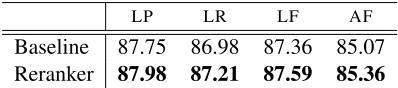
LP LR LF AF
Baseline 87.75 86.98 87.36 85.07 Reranker 87.98 87.21 87.59 85.36
Table 6: Baseline and final reranker performance over Section 23 of CCGbank with the normal-form model.
each set of features, the CCG-specific features were better than the Charniak and Johnson (2005) features by a statistically significant margin. This held in all experiments except one (10-best clas-sification), indicating that features tailored toCCG
trees and dependency evaluation were more dis-criminative between good and bad CCG parses.
This also implies that for reranking to improve the accuracy of a parser, the features must target that parser and the nature of its evaluation. Fea-tures producing state-of-the-art performance for the Charniak reranker had no positive impact on
CCGparsing in isolation.
We conducted subtractive feature analysis on our best performing model (10-best regression with all features and no pruning) to investigate the contribution of individual features. Features were individually removed and the reranker was retrained and retested on Section 00. The removal of the SubjVerbAgr and Edges features are statis-tically significant, while the removal of any other single feature results in a non-significant decrease in F-score. We then performed an isolation ex-periment, training and testing the reranker using just the SubjVerbAgr and Edge features with the log score and rank from the parser. Table 5 shows that these features do significantly worse than the baseline in isolation, indicating that it is the com-bination of features together which produces the improved performance.
8.3 Pruning
We found that increased feature pruning had a neg-ative impact on parsing accuracy. None of our ex-periments showed a significant improvement with higher pruning values, as opposed to Charniak and Johnson (2005) who found the count-based prun-ing to be useful. The best performprun-ing systems overall used pruning values of 0 or 2, implying that the pruning strategy is ineffective with respect to performance over such a varied set of features. One area where pruning does help is in the train-ing times for the reranker: some experiments are nearly twice as fast with a pruning valuet= 5 com-pared tot= 0. However, as this cost must only be paid once, the benefit of pruning with respect to actual parsing time is negligible.
[image:8.595.81.280.216.260.2]8.4 Final Results
Table 6 summarises the performance of our best reranker model against the baseline normal-form model on Section 23 of CCGbank. We achieve statistical significant improvement in F-score over the baseline. However, in real terms the change in F-score is small, indicating that reranking may not guarantee performance improvements even if it is carefully targeted to the parser.
9 Conclusion
We have implemented a maximum entropy reranker for the C&C CCG parser, building on the methodology and features of Charniak and John-son (2005) and extending the approach with new features. We have found that performance im-provements from reranking stem from targeting the reranker features at the parser and its evalua-tion: features tailored to CCGperform better than PCFG-style features in isolation. Our best system achieves an of 87.59%, which is a statistically sig-nificant improvement over the baseline parser.
The reranker scales with the efficiency of cal-culating features on parse trees. The features de-scribed in this paper require time linear in the number of nodes in the tree. However, the reranker is currently implemented as an external post-processing step. This leads to an order of magni-tude speed decrease; future work will include in-tegrating the reranker into the parser itself to miti-gate this speed impact.
improvements such as this one in parsing accuracy will benefit the variety of downstream applications that utilise parsing for practicalNLPtasks.
Acknowledgments
This work was supported by Australian Re-search Council Discovery grants DP0665973 and DP1097291, the Capital Markets CRC and a Uni-versity of Sydney Merit Scholarship.
References
Johan Bos, Stephen Clark, Mark Steedman, James R. Curran, and Julia Hockenmaier. 2004. Wide-Coverage Semantic Representations from a CCG Parser. InProceedings of the 20th International Conference on Computational Linguis-tics (COLING-04), pages 1240–1246, Geneva, Switzer-land, August.
Johan Bos, James R. Curran, and Edoardo Guzzetti. 2007. The Pronto QA system at TREC-2007: Harvesting Hy-ponyms, Using Nominalisation Patterns, and Comput-ing Answer Cardinality. InProceedings of the Sixteenth Text REtrieval Conference (TREC 2007), pages 726–732, Gaitersburg, Maryland, USA.
Forrest Brennan. 2008. k-best Parsing Algorithms for a Nat-ural Language Parser. Master’s thesis, University of Ox-ford.
Eugene Charniak and Mark Johnson. 2005. Coarse-to-Fine n-Best Parsing and MaxEnt Discriminative Reranking. In Proceedings of the 43rd Annual Meeting of the Associa-tion for ComputaAssocia-tional Linguistics (ACL-05), pages 173– 180, Ann Arbor, Michigan, USA, June.
Nancy Chinchor. 1992. The statistical significance of the MUC-4 results. InProceedings of the Fourth Mes-sage Understanding Conference (MUC-4), pages 30–50, McLean, Virginia, June.
Stephen Clark and James R. Curran. 2007. Wide-Coverage Efficient Statistical Parsing with CCG and Log-Linear Models.Computational Linguistics, 33(4):493–552. Michael Collins. 1999. Head-Driven Statistical Models for
Natural Language Parsing. Ph.D. thesis, University of Pennsylvania, Philadelphia, Pennsylvania, USA.
Michael Collins. 2000. Discriminative Reranking for Natu-ral Language Parsing. InProceedings of the 17th Interna-tional Conference on Machine Learning (ICML-00), pages 175–182, Palo Alto, California, USA, June.
Steve DeNeefe and Kevin Knight. 2009. Synchronous Tree Adjoining Machine Translation. In Proceedings of the 2009 Conference on Empirical Methods in Natural Lan-guage Processing (EMNLP-09), pages 727–736, Singa-pore, August.
Abdessamad Echihabi and Daniel Marcu. 2003. A Noisy-Channel Approach to Question Answering. In Proceed-ings of the 41st Annual Meeting of the Association for Computational Linguistics (ACL-03), pages 16–23, Sap-poro, Japan, July.
Daniel Gildea and Daniel Jurafsky. 2002. Automatic La-beling of Semantic Roles. Computational Linguistics, 28(3):245–288.
Julia Hockenmaier and Mark Steedman. 2007. CCGbank: A Corpus of CCG Derivations and Dependency Structures Extracted from the Penn Treebank. Computational Lin-guistics, 33(3):355–396.
Julia Hockenmaier. 2003. Parsing with Generative Mod-els of Predicate-Argument Structure. InProceedings of the 41st Annual Meeting of the Association for Compu-tational Linguistics (ACL-03), pages 359–366, Sapporo, Japan, July.
Liang Huang and David Chiang. 2005. Better k-best Pars-ing. InProceedings of the Ninth International Workshop on Parsing Technology (IWPT-05), pages 53–64, Vancou-ver, British Columbia, Canada, October.
Liang Huang. 2008. Forest Reranking: Discriminative Pars-ing with Non-Local Features. InProceedings of the Hu-man Language Technology Conference at the 45th Annual Meeting of the Association for Computational Linguistics (HLT/ACL-08), pages 586–594, Columbus, Ohio, June.
Mark Johnson and Ahmet Engin Ural. 2010. Reranking the Berkeley and Brown Parsers. InProceedings of Human Language Technologies: the 2010 Annual Conference of the North American Chapter of the Association for Com-putational Linguistics (HLT/NAACL-10), pages 665–668, Los Angeles, California, USA, June.
Dan Klein and Christopher D. Manning. 2001. Parsing and Hypergraphs. InProceedings of the 7th International Workshop on Parsing Technologies (IWPT-01), Beijing, China, October.
Mitchell P. Marcus, Beatrice Santorini, and Mary Ann Marcinkiewicz. 1993. Building a Large Annotated Cor-pus of English: The Penn Treebank. Computational Lin-guistics, 19(2):313–330.
David McClosky, Eugene Charniak, and Mark Johnson. 2006. Effective Self-Training for Parsing. InProceedings of the 2006 Human Language Technology Conference of the North American Chapter of the Association of Com-putational Linguistics (HLT/NAACL-06), pages 152–159, New York City, New York, USA, June.
Slav Petrov, Leon Barrett, Romain Thibaux, and Dan Klein. 2006. Learning Accurate, Compact, and Interpretable Tree Annotation. In Proceedings of the 21st Interna-tional Conference on ComputaInterna-tional Linguistics and 44th Annual Meeting of the Association for Computational Linguistics (COLING/ACL-06), pages 433–440, Sydney, Australia, July.
Laura Rimell, Stephen Clark, and Mark Steedman. 2009. Unbounded Dependency Recovery for Parser Evaluation. In Proceedings of the 2009 Conference on Empirical Methods in Natural Language Processing (EMNLP-09), pages 813–821, Singapore, August.
Federico Sangati, Willem Zuidema, and Rens Bod. 2009. A generative re-ranking model for dependency parsing. In Proceedings of the 11th International Conference on Parsing Technologies (IWPT-09), pages 238–241, Paris, France, October.
Libin Shen, Anoop Sarkar, and Franz Josef Och. 2004. Dis-criminative Reranking for Machine Translation. In Pro-ceedings of the 2004 Human Language Technology Con-ference of the North American Chapter of the Association for Computational Linguistics (HLT/NAACL-04), pages 177–184, Boston, Massachusetts, USA, May.
Mark Steedman. 2000. The Syntactic Process. MIT Press, Cambridge, Massachusetts, USA.