N
-ary Biographical Relation Extraction using Shortest Path Dependencies
Gitansh Khirbat Jianzhong Qi Rui Zhang
Department of Computing and Information Systems The University of Melbourne
Australia
[email protected] {jianzhong.qi, rui.zhang}@unimelb.edu.au
Abstract
Modern question answering and summa-rizing systems have motivated the need for complex n-ary relation extraction sys-tems where the number of related entities
(n) can be more than two. Shortest path dependency kernels have been proven to be effective in extracting binary relations. In this work, we propose a method that employs shortest path dependency based rules to extract complex n-ary relations without decomposing a sentence into con-stituent binary relations. With an aim of extracting biographical entities and re-lations from manually annotated datasets of Australian researchers and department seminar mails, we train an information ex-traction system which first extracts enti-ties using conditional random fields and then employs the shortest path dependency based rules along with semantic and syn-tactic features to extract n-ary affiliation relations using support vector machine. Cross validation of this method on the two datasets provides evidence that it outper-forms the state-of-the-artn-ary relation ex-traction system by a margin of 8% F-score.
1 Introduction
Information extraction (IE) is the process of ex-tracting factual information from unstructured and semi-structured data and storing it in a structured queryable format. Two important components of an IE system are entity extraction and relation ex-traction. These components are sequential and to-gether form the backbone of a classic IE system. Entity extraction systems have achieved a high ac-curacy in identifying certain entities such as men-tion of people, places and organizamen-tions (Finkel et
al., 2005). However, such named entity recogni-tion(NER) systems are domain-dependent and do not scale up well to generalize across all entities.
Relation extraction systems utilize the identi-fied entities to extract relations among them. Past two decades have witnessed a significant advance-ment in extracting binary domain-dependent re-lations (Kambhatla, 2004), (Zhao and Grishman, 2005) and (Bunescu and Mooney, 2005a). How-ever, modern question answering and summariz-ing systems have triggered an interest in captur-ing detailed information in a structured and se-mantically coherent fashion, thus motivating the need for complexn-ary relation extraction systems (where the number of entities,n ≥ 2). Some no-table n-ary relation extraction systems are (Donald et al., 2005) and (Li et al., 2015). Mc-Donald et al. (2005) factorized complexn-ary re-lation into binary rere-lations, representing them in a graph and tried to reconstruct the complex relation by making tuples from selected maximal cliques in the graph. While they obtained reasonable preci-sion and recall using a maximum entropy binary classifier on a corpus of 447 selected abstracts from MEDLINE, they have not explored the con-stituency and dependency parse features which have been proven to be efficient in relation extrac-tion. Li et al. (2015) make use of lexical semantics to train a model based on distant-supervision forn -ary relation extraction. However, the applicability of this method on other datasets is not clear.
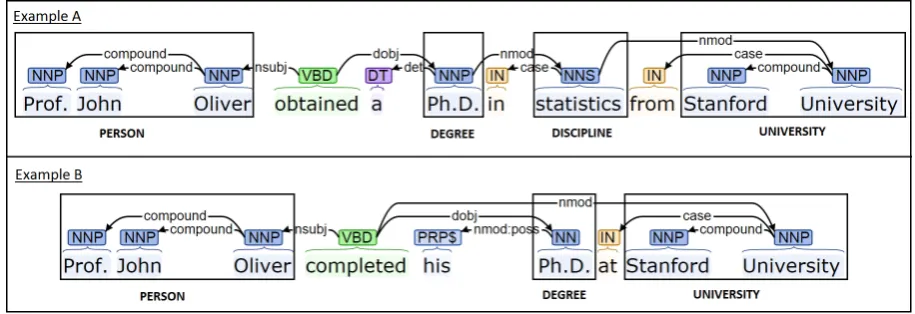
Figure 1: Example sentences with their dependency parses
dependency based rules to extract complex n-ary relations without decomposing the sentences into binary relations. These rules are based on the hy-pothesis which stipulates that the contribution of the sentence dependency graph to establish a rela-tionship is almost exclusively concentrated in the shortest path connecting all the entities such that there exists a single path connecting any two enti-ties at a given time. We present a thorough exper-imental evaluation and error analysis, making the following contributions:
• We propose a new approach to handle n -ary relation extraction using shortest path dependency-based rules.
• We conducted a thorough empirical error analysis of using CRF-based entity extractor coupled with SVM-based relation extractor.
• We present two manually annotated corpora containing biographical entities and relation annotations, which can be used for research or to augment existing knowledge bases.
The rest of the paper is organized as follows. Section 2 defines the problem. Section 3 reviews related studies. Section 4 discusses our method-ology. Section 5 introduces the corpora. Section 6 presents the experiments. Section 7 presents an error analysis and Section 8 concludes this paper.
2 Preliminaries
2.1 N-ary Relation Extraction
We study the problem of n-ary relation extrac-tion. A relation is defined in the form of a tuple t=< e1, e2, . . . , en>whereeiis an entity, which
can be mention of a person, place, organization, etc. The most studied relations are binary rela-tions, which involve two entities. If more than two entities exist in a relation, it becomes a complex relation which is called ann-ary relation. McDon-ald et al. (2005) define a complex relation as any n-ary relation amongnentities which follows the schema< t1, . . . , tn >whereti is an entity type.
An instance of this complex relation is given by a list of entities< e1, e2, . . . , en >such that either
type(ei) = ti, or ei = ⊥indicating that theith
el-ement of the tuple is missing. Here, type(ei) is a
function that returns the entity type of entityei.
For example, assume that the entity types are E={person (PER), degree (DEG), discipline (DISC), position (POS), university (UNI)} and we are interested to find a n-ary relation with schema<PER, DEG, DISC, UNI>that provides information of a person affiliated to auniversity, studying adegree in adiscipline. In example A shown in Figure 1, the expected extracted tuple is<Prof. John Oliver, Ph.D., statistics, Stanford University>. In example B, the expected extracted tuple is <Prof. John Oliver, Ph.D., ⊥, Stanford University>, since thedisciplineentity is not men-tioned. Thus, n-ary relation extraction systems aim to identify all instances of a complete and par-tially complete relations of interest.
2.2 Problem Definition
Given a set ofDdocuments containing biograph-ical data, we classify words in a documentdi ∈D
into entities< e1, e2, . . . , ej >andn-ary relations
given by dataset R, such thatrk ∈ R is a tuple
t=< e1, e2, . . . , en>wheren≥2. In particular,
3 Related Work
Information extraction is a sequential confluence of two processes - entity extraction and relation extraction. Entity extraction refers to the task of NER wherein the task is to correctly classify an entity (like person, location, organization, etc.) out of a given sentence in a textual document. Past two decades have seen a massive body of work which aimed to improvise the entity extraction systems (Bikel et al., 1997), (Cunningham et al., 2002) and (Alfonseca and Manandhar, 2002). It is a well-explored research area which has reached maturity (Finkel et al., 2005). Most NER systems are domain dependent and require training with a new annotated corpus for a new task.
Relation extraction refers to the task of find-ing relations among the entities which were ob-tained during entity extraction. A huge body of work addresses the task of extracting binary rela-tions wherein a relation exists between two enti-ties only. Feature-based supervised learning meth-ods like (Kambhatla, 2004) and (Zhao and Gr-ishman, 2005) leverage the syntactic and seman-tic features. Exploration of a large feature space in polynomial computational time motivated the development of kernel based methods like tree kernels (Zelenko et al., 2003) and (Culotta and Sorensen, 2004), subsequence kernels (Bunescu and Mooney, 2005b) and dependency tree kernel (Bunescu and Mooney, 2005a). Open IE system (Banko et al., 2007) gives a sound method to gen-eralize the relation extraction process, however the system does not give any insights to extract com-plexn-ary relations.
With advances in biomedical text mining and modern question answering systems, complex n -ary relation extraction is gaining attention wherein the task is to detect and extract relations existing between two or more entities in a given sentence. McDonald et al. (2005) attempt to solve this prob-lem by factorizing complex relations into binary relations which are represented as a graph. This graph is then used to reconstruct the complex re-lations by constructing tuples from selected max-imal cliques scored on the graph. Li et al. (2015) make use of lexical semantics to train a model based on distant-supervision forn-ary relation ex-traction. However, both these systems are compu-tationally expensive and do not scale up efficiently. Bunescu and Mooney (2005a) advocate the use of shortest path between the entities in a
de-pendency parse to compute the cartesian prod-uct of dependencies clubbed with respective POS tags. This method has been proven to be the best among all kernel methods to extract binary rela-tions. However, it is yet to be confirmed if it works for extracting complexn-ary relations.
4 Methodology
4.1 Shortest path dependency: binary to
n-aryrelations
We use dependency parsing (Manning et al., 2014) to help extractn-ary relations. Dependency parse provides information about word-word dependen-cies in the form of directed links. These depen-dencies capture the predicate-argument relations present in the sentence. The finite verb is taken to be the structural centre of the clause structure. All other syntactic units (words) are connected either directly (to the predicate) or indirectly (through a preposition or infinitive particle) to the verb us-ing directed links, which are called dependencies. Each dependency consists of a head from where the directed link originates and adependentwhere the link terminates. Dependencies can be clas-sified into two categories - local and non-local dependencies. Local dependencies refer to the dependencies which occur within a sentence and can be represented by predicate-argument struc-ture. Non-local dependencies refer to long-range dependencies involving two positions in a phrase structure whose correspondence can not be cap-tured by invoking predicate-argument structure.
Bunescu and Mooney (2005a) successfully demonstrated the use of shortest path dependen-cies between two entities to extractlocated (at) re-lation. We extend this hypothesis to form short-est path dependency based rules for n-ary re-lation extraction. If a sentence has n entities e1, e2, . . . , en such that there exists a relation r
among them, our hypothesis stipulates that depen-dency graph can be used to establish the relation-ship r(e1, e2, . . . , en) by leveraging the shortest
path connecting all the entities such that there ex-ists a single path connecting any two entities at a given time.
Entities are considered as one unit. In order to determine entity-level dependency of an entity ei, the compound dependencies are discarded and
the dependency between a word∈eiand the
sur-rounding word ∈/ ei is considered. For any two
• If there exists a direct dependency between the two words belonging to two entities e1 and e2, it is represented as (N ER(e1)– dependency name–N ER(e2)). This happens mostly in the case of local dependencies. In Example A, it can be illustrated by (Degree– nmod–Discipline).
• If there exists a common word connectinge1 ande2but not belonging to either, it is repre-sented by including this common word along with its dependencies for e1 and e2. This is usually the case of non-local dependen-cies. In Example A, it can be illustrated by (Person–nsubj–obtained–dobj–Degree).
4.2 Entity Extraction using CRF
The first stage of IE is entity extraction. An entity is defined as a token or a group of tokens which belong to some predefined categories depending on the task. Since our main goal is to extract af-filiation relations, we identify six relevant entity types namely Person, Degree, University, Disci-pline,OrganizationandPosition.
Person and Organization entities were classi-fied using Stanford’s NER software (Finkel et al., 2005) which makes use of a CRF classifier. For the remaining entities, we train a CRF-based clas-sifier similar to the Stanford’s NER, making using of features as described below.
1. Surface tokens (bag of words): For each word token w, all the words in a window size of five, with two words on either side ofware considered. Unigrams, bigrams and trigrams are taken into account.
In Example A, the surface token features spanning the first five words (“Prof.”, “John”, “Oliver”, “obtained” and “a”) are:
• Unigrams: Prof., John, Oliver, obtained,a
• Bigrams: (Prof., John),(John, Oliver), (Oliver, obtained), (obtained, a)
• Trigrams:
(Prof., John, Oliver), (John, Oliver, obtained), (Oliver, obtained, a)
2. Part of Speech (POS) Tags: The part of speech for a token like NNP (noun), PRP (pronoun) and IN (preposition) is a strong
syntactic feature. For each word token w, POS tags for all the tokens in a window size of five, with two words on either side ofw are considered. The POS tags for unigrams, bigrams and trigrams are also taken into ac-count. In Example A, the POS tag features spanning the first five words are:
• Unigrams: NNP,NNP,NNP,VBD,DT
• Bigrams: (NNP, NNP), (NNP, NNP),(NNP, VBD),(VBD, DT)
• Trigrams: (NNP, NNP, NNP), (NNP, NNP, VBD), (NNP, VBD, DT)
3. Presence in word list: We have created gazetteers of degrees, positions, disciplines and universities by crawling the web. Pres-ence of a wordw in the respective gazetteer indicating a potential entity mention is used as a feature.
For example: Lemmatized form of de-grees (PhD, BEng, BA, etc.), positions (Professor, Associate Professor, Assistant, etc.) and Universities with their abbrevia-tions (University of Melbourne, Unimelb, ANU, etc.)
We considered all the permutations of these fea-tures in an incremental fashion to train CRF mod-els using the scikit-learn toolkit (Pedregosa et al., 2011) as described in Section 6.
4.3 Complexn-ary Relation Extraction using SVM
The second stage of IE system is relation extrac-tion. A relation links two or more entities based on predefined rules to render meaningful informa-tion. In this work, we are interested in extracting n-ary affiliation relations(n≥2).
We classify each candidate entity pairs or a group of entities within a sentence into three af-filiation relation categories namelybinary (2-ary), ternary (3-ary) and quaternary (4-ary) as de-scribed in Section 5. We train a SVM with radial basis function (RBF) kernel to classify groups of entities within a sentence using these features:
2. Extracted entities: The entities extracted for each sentence from Stage 1 are strong indi-cators of presence of a relation. The six en-tity categories correspond to six different fea-tures while training a SVM. If either of the six entity categories is present in a candidate sentence, the corresponding feature is set to 1. Since our entity extraction system is not 100% accurate, there might be some entities in a few sentences which might not be identi-fied correctly. For such instances, we just use the entities which are identified correctly and leave the ones which are not.
For example: In example A, the entities iden-tified in stage 1 are: (e1, Prof. John Oliver), (e2, Ph.D.), (e3, statistics) and (e4, Stanford University). The entity features correspond-ing to Person, Degree, Discipline and Uni-versityare set to 1, while the features corre-sponding to other entity categories remain 0.
3. Part of Speech (POS) sequence: The part of speech sequence connecting the entity type acts as a pattern, the presence of which is used as a feature for the SVM classifier. This feature is important as it makes use of the syntactic structure coupled with the entity in-formation. We observe that many of the POS sequence patterns occur frequently for many documents in our dataset, which rules out the possibility of pattern sparsity.
In Example A, the POS sequence is ( Person-VBD-DT-Degree-IN-Discipline-DT-University).
In cases where an entity is not identified by our entity extractor, we consider the POS tag sequence of the missed entity in lieu of the actual entity type.
In Example B withDisciplinenot being iden-tified, the POS sequence is ( Person-VBD-DT-Degree-IN-NN-DT-University).
4. Shortest path dependency information:
The shortest path dependency based rules are essentially patterns, which act as features for the SVM. This feature is used as described in Section 4.1. The shortest path dependency based rules for each candidate group of en-tities identified in a given sentence are rep-resented as patterns across all the documents in the corpus. The dependency parse of each
candidate sentence is checked for the pres-ence of these patterns. If a pattern is present, the corresponding feature is set to 1.
For Example A, some of the patterns are: (Person–nsubj–obtained–dobj–Degree), (Person–nsubj–obtained–dobj–Degree– nmod–Discipline) and (Person–nsubj– obtained–dobj–Degree–nmod–Discipline– nmod–University).
For Example B, some of the patterns are: (Person–nsubj–completed–dobj–Degree), (Person–nsubj–completed–dobj–Degree– nmod–University)
We considered all the permutations of these fea-tures in an incremental fashion to train SVM mod-els using RBF kernel. The predicted tags are com-pared against the manually annotated gold relation data from AuRes and AuSem datasets described in Section 5. Depending on the number of identified entities (n) within a sentence and the association of thesenentities, the relation for a given sentence is categorized into binary, ternary or quaternary re-lation. We adopted a grid search on C andγ using 10-fold cross validation to prevent overfitting. The experiments are described in Section 6.
5 AuRes and AuSem Corpora
The standard datasets like ACE do not provide an-notations for complexn-ary relations where n >
2. The general affiliation relation category in ACE 2005 dataset contains annotations for only binary relations between entities likeOrganization andLocation, e.g.,<Microsoft, Redmond>. This makes it hard for complex n-ary relation extrac-tion where the number of related entities is more than two, which gave rise to the development of two new datasets1 with annotations for complex relations.
1. AuRes - A collection of 400 documents con-taining biographical information retrieved from the webpages of researchers and faculty of Australian universities, contains 4092 en-tities and 1152 relations.
2. AuSem - A collection of 300 seminar an-nouncement mails containing speaker’s biog-raphy from the department mailing list of the University of Melbourne, contains 2864 enti-ties and 983 relations.
1https://github.com/gittykhirbat/nary_
5.1 Label Description
Both AuRes and AuSem are manually annotated with entities and relations following the same an-notation guidelines as described below.
5.1.1 Entities
We have identified six different entities which de-scribe the biographical information of a person. We make use of Stanford NER system (Finkel et al., 2005) to classify entities likePersonand Orga-nizationas the classification accuracy is very high. For the remaining four entities, we annotate the documents using the following guidelines.
• Degree: Token having information related to a degree like B.Sc, PhD, masters or identi-fiers like undergrad, postrgad, doctoral.
• University: Token indicating name of a uni-versity or its abbreviation, like “Uniuni-versity of Melbourne”, “Unimelb”, “USyd”
• Discipline: Token containing information about a subject or discipline, e.g., Computer Science, Mathematics, Economics.
• Position: Token indicating the position of a person in the university of an organization, e.g., Software Engineer, Lecturer, Teacher.
5.1.2 Relations
The documents are annotated for affiliation tions spanning the six entities. The affiliation rela-tion types can be categorized into three classes:
1. Binary: When only two entities out of all the identified entities within a sentence are re-lated. For example, in the sentence “Prof. John Oliver did his Ph.D. under the super-vision of Prof. Henkel”, there are only two entities which satisfy the affiliation relation, <Prof. John Oliver, Ph.D.>.
2. Ternary: When three out of all the identified entities within a sentence are related. For ex-ample, in the sentence “Prof. John Oliver ob-tained his Ph.D. in statistics under the super-vision of Prof. Henkel”, only three entities satisfy the affiliation relation, <Prof. John Oliver, Ph.D., statistics>
3. Quaternary: When four out of all the iden-tified entities within a sentence are related. For example, in the sentence “Prof. John
Oliver obtained a Ph.D. in statistics from Stanford University under the supervision of Prof. Henkel”, four entities satisfy the affil-iation relation, <Prof. John Oliver, Ph.D., statistics, Stanford University>
5.2 Annotation
We used Brat annotation tool (Stenetorp et al., 2012) to annotate the document for entities and relations. The annotation task was carried out by two annotators with high proficiency in English. The gold standard was created by detecting an-notation overlaps by the two annotators. Legiti-mate disagreements were resolved by adding an extra attribute to the annotation guidelines which seeks the confidence of annotation on a categori-cal scategori-cale consisting of three values - high, medium and low. The inter-annotator agreement, as com-puted by Cohen’s Kappa measure (Cohen, 1960), was 0.86 for entity annotations and 0.81 for rela-tion annotarela-tions.
6 Experiments
6.1 Entity Extraction
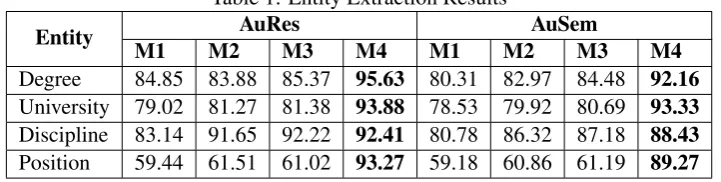
For both AuRes and AuSem datasets, we split the data into 70% training and 30% testing datasets. The training data is further split into 90% training and 10% development datasets. The features men-tioned in Section 4.2 are employed to train a CRF model using 10-fold cross validation. We train the model in an incremental fashion. Model M1 makes use of surface tokens which forms base-line for entity extraction. Model M2 adds POS tag information to M1. ModelM3adds word list presence feature to M1 and finally modelM4 com-bines all the features to train the CRF.
These models are used for predictions on the testing dataset, results (F-score in %) for which are shown in Table 1. The best result is obtained when surface tokens, POS tags and presence in word list features are used together. The F-scores for Per-son and Organization which are identified using Stanford’s NER system are 83.31% and 86.79% respectively.
6.2 N-ary Relation Extraction using SVM
Table 1: Entity Extraction Results
Entity AuRes AuSem
M1 M2 M3 M4 M1 M2 M3 M4
Degree 84.85 83.88 85.37 95.63 80.31 82.97 84.48 92.16 University 79.02 81.27 81.38 93.88 78.53 79.92 80.69 93.33 Discipline 83.14 91.65 92.22 92.41 80.78 86.32 87.18 88.43 Position 59.44 61.51 61.02 93.27 59.18 60.86 61.19 89.27
experiments, we split the data into 70% training and 30% testing datasets. The training dataset is further split into 90% training and 10% testing datasets. We adopted a grid search on C andγ us-ing 10-fold cross validation to prevent overfittus-ing. Pairs of (C, γ) were tried and the one with the best cross-validation accuracy was picked, which in our case turned to be(22,2−3.5).
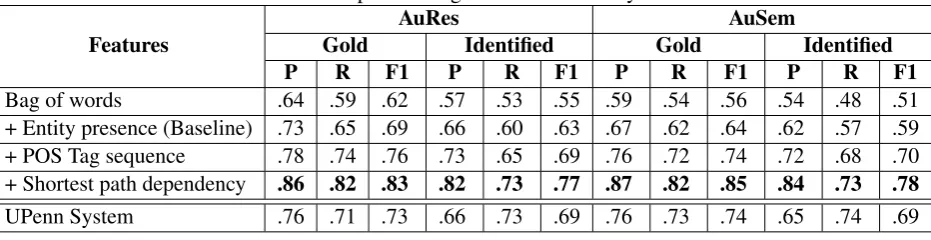
The features mentioned in Section 4.3 are em-ployed incrementally to train a SVM classifier with RBF kernel. The model using bag of words and entity presence features is our baseline system for this task. The SVM models are used for predic-tions on the testing dataset. Table 2 shows results for both sets of experiments for both the datasets. The columnsGoldandIdentifiedshow the results of performing relation extraction using gold stan-dard entity annotations and the system-identified entities respectively. Table 3 gives an account of the performance for extracting binary, ternary and quaternary relations.
7 Discussion
7.1 Error Analysis for Entity Extraction
An account of the entity-wise performance is pro-vided here:
1. Person: We used Stanford’s NER system for this entity. It was able to classify most of the English names correctly, did well on classifying some non-English names like “Katerina”, “Yassaf”, “Amit”. How-ever, it gave false positives like “Dahab”, “Vic” (which are location names); “Rio Tinto”, “Leightons” (which are Organiza-tion names); “Curtin” (which is a University name); “Dean” (which is a position name) and “Geojournal”, “J.J.Immunol.” (which are Journal names). These false positives ap-peared to be a result of the context in which they were being classified. It also resulted in some false negatives like “Cherryl”, “Long”,
“Wai-Kong”, which majorly happened be-cause of uncommon names.
2. Degree: We used our CRF model to clas-sify Degree entities, which performed well mainly due to an extensive gazetteer of most of the degrees which we used as a feature to train the CRF. It can classify degrees and their abbreviations like “Bachelor of Engi-neering”, “B.E.”, “BA (Hons.)”, “PhD”.
3. University: Our CRF model performs well in classifying University entities. This is because of a gazetteer of the university names which contains full names of the uni-versities as well as their abbreviations and aliases. e.g., “The University of Melbourne”, “Unimelb”, “Melbourne Uni”. Some of the false negatives arise in documents where the university name is not mentioned con-ventionally. e.g., “University of WA” (in-stead of “University of Western Australia” or “UWA”).
4. Organization: Stanford’s NER system is used for this entity. It did well in classifying most of the Organization entities. However, we witnessed some false negatives. It was not able to classify some not so well-known organizations (like “Action Supermarkets”, “Freja Hairstyling”, “Strategic Wines”) and new companies and startups (like “Tesla Mo-tors”, “SpaceX”).
5. Position: A gazetteer of academic positions like “Professor”, “Lecturer” was used to clas-sify such positions. However, more specific positions like “Bankwest Professor”, “Inau-gural Director” and “Founding member” got missed.
Table 2: Relation Extraction: Comparison of gold standard with system identified entities
Features
AuRes AuSem
Gold Identified Gold Identified
P R F1 P R F1 P R F1 P R F1
Bag of words .64 .59 .62 .57 .53 .55 .59 .54 .56 .54 .48 .51 + Entity presence (Baseline) .73 .65 .69 .66 .60 .63 .67 .62 .64 .62 .57 .59 + POS Tag sequence .78 .74 .76 .73 .65 .69 .76 .72 .74 .72 .68 .70 + Shortest path dependency .86 .82 .83 .82 .73 .77 .87 .82 .85 .84 .73 .78
[image:8.595.78.519.229.331.2]UPenn System .76 .71 .73 .66 .73 .69 .76 .73 .74 .65 .74 .69
Table 3: Relation Extraction: Performance acrossn-ary relations
Features 2-ary 3-ary 4-ary
P R F1 P R F1 P R F1
Bag of words 0.61 0.59 0.60 0.58 0.57 0.56 0.52 0.46 0.49 + Entity presence (Baseline) 0.68 0.64 0.66 0.67 0.61 0.64 0.61 0.55 0.58 + POS Tag sequence 0.75 0.73 0.74 0.71 0.69 0.70 0.65 0.63 0.64 + Shortest path dependency 0.83 0.79 0.81 0.81 0.75 0.78 0.76 0.70 0.73 State-of-the-art (UPenn System) 0.74 0.70 0.72 0.71 0.68 0.69 0.69 0.63 0.66
could not classify granular domains within major disciplines like “Equity and Tax”, “Shakespearean Literature”.
7.2 Error Analysis for Relation Extraction
An account of then-ary relation extraction system is provided here. Shortest path dependency-based rules prove to be the most effective feature for the trained SVM.
7.2.1 What Worked Well
• Simple relations: Sentences in which the en-tities are present in a non-complex way. For example, in the sentence “Corinne Fagueret has a Master of Environmental studies com-pleted at Macquarie University”, our system extracts<Person, Degree, University, Disci-pline> = <Corinne Fagueret, Master, Mac-quarie University, Environmental Studies>.
• Complex relations: Sentences in which the entities are present in a non-conventional way. For example, in the sentence “Af-ter getting the University of Sydney Sci-ence Achievement Prize in 2000 for get-ting the best weighted average mark for a BSc student, Peter graduated with first class honours and a medal in 2001”, our system can extract<Person, Degree, University>= <Peter, BSc, University of Sydney>.
• Multiple relations spanning multiple enti-ties: Our system can extract multiple re-lations from sentences. For example, in the sentence “Angeline is the President of the Lane Cove Bushland and Convener of the better Planning Network”, our system can extract <Person, Position, Organiza-tion> = <Angeline, President, Lane Cove Bushland> and <Person, Position, Orga-nization> = <Angeline, Convener, Better Planning Network>.
• Multiple relations spanning same entities: For example, in the sentence “Dr. John Oliver is an Assoc. Prof. and Head in the De-partment of Finance”, our system can ex-tract <Person, Position, Organization> = <John Oliver, Assoc. Prof., Department of Finance>and<Person, Position, Organiza-tion>=<John Oliver, Head, Department of Finance>.
7.2.2 What Did Not Work Well
by our entity extraction sub-system then our relation extraction sub-system makes use of the features to learn valid subset of relations occurring among then−xentities.
• Limitation of parser: Our system faces am-biguity in cases where an appositive depen-dency occurs between two entities. For ex-ample, in the sentence “Associate Professor Christoff Pforr (PhD) is Course Coordina-tor for Tourism and Hospitality and Group Leader of the Research Focus Area Sustain-able and Health Tourism with the School of Marketing, Curtin Business School”, School of Marketing and Curtin Business School are both classified as University entities with an appositive relation between the two because of the common word “School”. While ex-tracting relation, it is not clear which entity should be considered.
• Ambiguity in choosing correct entity: Sen-tences containing multiple entities with the same context cause an ambiguity. For exam-ple, in the sentence “Sarah is currently co-investigator with Professor Fiona Haslam for a study commissioned by Rio Tinto through the University of Adelaide”. In this sentence, there are two associations for Sarah - Rio Tinto and University of Adelaide. The sys-tem renders both, giving us a false positive <Sarah, co-investigator, Rio Tinto>.
• Unknown words from other language: For example, in the sentence “Marios holds a PhD in Political Science from Northern Ter-ritory University and a Staatsexamen in Ge-ography and Political Science as well as a Teaching Certificate from the University of T¨ubingen (Germany). Staatsexamen and T¨ubingen are not detected, thereby causing errors.
• Inference-based relations: Inference of rela-tion from previous sentences in the paragraph can not be done as our system lacks long dis-tance dependency information. For example, in the sentence “Ruhul words as a tutor for Biotechnology at RMIT University. He also worked in a similar position at the University of Melbourne.”, we are unable to infer what “similar position” mean. This would be ex-plored in the future.
7.3 Comparison with other state-of-the-art IE systems
A comparison with the UPenn system (McDon-ald et al., 2005) is provided in Table 2 and 3. We re-implement this system and train it on our training and development datasets using 10-fold cross validation. The learnt system is used to pre-dict the relations for testing dataset. At the time of this work, this system is the state-of-the-art in complexn-ary relation extraction, with an F1-score of 69.42% on a dataset of 447 abstracts se-lected from MEDLINE. On our datasets of AuRes and AuSem, their technique achieved F1-Score of 69.44% and 69.22% respectively as compared to 77.49% and 78.38% respectively using short-est path dependency based rules, which shows an improvement of 8% F1-score. Our technique ob-tained far less false positives and a comparable re-call.
8 Conclusions and Future Work
Through this paper, we show a new approach to n-ary relation extraction using shortest path de-pendency based rules which provides an improve-ment of 8% F1-score over the state-of-the-art. Two stage extraction procedure involving CRF-based entity extraction and SVM-based relation extrac-tion is proposed to extract affiliaextrac-tion relaextrac-tions. An empirical analysis is conducted over two manually annotated datasets to validate this method. The manually annotated datasets could be used for the advancement of natural language processing re-search in the future.
For future work, it would be interesting to inves-tigate the usage of shortest path parse tree for n -ary relation extraction since sentence parsing pro-vides a semantically rich information about a sen-tence. It would also be interesting to exploren-ary relation extraction spanning across multiple sen-tences. Finally, future use of the introduced cor-pora in research to augment existing knowledge bases could yield interesting insights.
Acknowledgments
References
Enrique Alfonseca and Suresh Manandhar. 2002. An unsupervised method for general named entity recognition and automated concept discovery. InIn: Proceedings of the 1 st International Conference on General WordNet.
Michele Banko, Michael J. Cafarella, Stephen Soder-land, Matt Broadhead, and Oren Etzioni. 2007. Open information extraction from the web. In Pro-ceedings of the 20th International Joint Conference on Artifical Intelligence, IJCAI’07, pages 2670– 2676, San Francisco, CA, USA. Morgan Kaufmann Publishers Inc.
Daniel M. Bikel, Scott Miller, Richard Schwartz, and Ralph Weischedel. 1997. Nymble: A high-performance learning name-finder. In Proceed-ings of the Fifth Conference on Applied Natural Language Processing, ANLC ’97, pages 194–201, Stroudsburg, PA, USA. Association for Computa-tional Linguistics.
Razvan C. Bunescu and Raymond J. Mooney. 2005a. A shortest path dependency kernel for relation ex-traction. InProceedings of the Conference on Hu-man Language Technology and Empirical Methods in Natural Language Processing, HLT ’05, pages 724–731, Stroudsburg, PA, USA. Association for Computational Linguistics.
Razvan C. Bunescu and Raymond J. Mooney. 2005b. Subsequence kernels for relation extraction. In Pro-ceedings of the 19th Conference on Neural Infor-mation Processing Systems (NIPS). Vancouver, BC, December.
J. Cohen. 1960. A Coefficient of Agreement for Nom-inal Scales. Educational and Psychological Mea-surement, 20(1):37.
Aron Culotta and Jeffrey Sorensen. 2004. Dependency tree kernels for relation extraction. In Proceed-ings of the 42Nd Annual Meeting on Association for Computational Linguistics, ACL ’04, Stroudsburg, PA, USA. Association for Computational Linguis-tics.
Hamish Cunningham, Diana Maynard, Kalina Bontcheva, and Valentin Tablan. 2002. A frame-work and graphical development environment for robust nlp tools and applications. In ACL, pages 168–175.
Jenny Rose Finkel, Trond Grenager, and Christopher Manning. 2005. Incorporating non-local informa-tion into informainforma-tion extracinforma-tion systems by gibbs sampling. InProceedings of the 43rd Annual Meet-ing on Association for Computational LMeet-inguistics, ACL ’05, pages 363–370, Stroudsburg, PA, USA. Association for Computational Linguistics.
Nanda Kambhatla. 2004. Combining lexical, syntac-tic, and semantic features with maximum entropy models for extracting relations. InProceedings of
the ACL 2004 on Interactive Poster and Demon-stration Sessions, ACLdemo ’04, Stroudsburg, PA, USA. Association for Computational Linguistics.
Hong Li, Sebastian Krause, Feiyu Xu, Andrea Moro, Hans Uszkoreit, and Roberto Navigli. 2015. Im-provement of n-ary relation extraction by adding lexical semantics to distant-supervision rule learn-ing. InICAART 2015 - Proceedings of the 7th Inter-national Conference on Agents and Artificial Intelli-gence. SciTePress.
Christopher D. Manning, Mihai Surdeanu, John Bauer, Jenny Finkel, Steven J. Bethard, and David Mc-Closky. 2014. The Stanford CoreNLP natural lan-guage processing toolkit. InAssociation for Compu-tational Linguistics (ACL) System Demonstrations, pages 55–60.
Ryan McDonald, Fernando Pereira, Seth Kulick, Scott Winters, Yang Jin, and Pete White. 2005. Simple al-gorithms for complex relation extraction with appli-cations to biomedical ie. InProceedings of the 43rd Annual Meeting on Association for Computational Linguistics, ACL ’05, pages 491–498, Stroudsburg, PA, USA. Association for Computational Linguis-tics.
F. Pedregosa, G. Varoquaux, A. Gramfort, V. Michel, B. Thirion, O. Grisel, M. Blondel, P. Pretten-hofer, R. Weiss, V. Dubourg, J. Vanderplas, A. Pas-sos, D. Cournapeau, M. Brucher, M. Perrot, and E. Duchesnay. 2011. Scikit-learn: Machine learn-ing in Python. Journal of Machine Learning Re-search, 12:2825–2830.
Pontus Stenetorp, Sampo Pyysalo, Goran Topi´c, Tomoko Ohta, Sophia Ananiadou, and Jun’ichi Tsu-jii. 2012. Brat: A web-based tool for nlp-assisted text annotation. InProceedings of the Demonstra-tions at the 13th Conference of the European Chap-ter of the Association for Computational Linguistics, EACL ’12, pages 102–107, Stroudsburg, PA, USA. Association for Computational Linguistics.
Dmitry Zelenko, Chinatsu Aone, and Anthony Richardella. 2003. Kernel methods for relation ex-traction. J. Mach. Learn. Res., 3:1083–1106, March.