Learning to Shift the Polarity of Words for Sentiment Classification
Daisuke Ikeda† Hiroya Takamura‡ Lev-Arie Ratinov†† Manabu Okumura‡ †Department of Computational Intelligence and Systems Science, Tokyo Institute of Technology
††Department of Computer Science, University of Illinois at Urbana-Champaign [email protected]
‡Precision and Intelligence Laboratory, Tokyo Institute of Technology {takamura,oku}@pi.titech.ac.jp
Abstract
We propose a machine learning based method of sentiment classification of sen-tences using word-level polarity. The polari-ties of words in a sentence are not always the same as that of the sentence, because there can be polarity-shifters such as negation ex-pressions. The proposed method models the polarity-shifters. Our model can be trained in two different ways: word-wise and sentence-wise learning. In sentence-wise learning, the model can be trained so that the prediction of sentence polarities should be accurate. The model can also be combined with features used in previous work such as bag-of-words and n-grams. We empiri-cally show that our method almost always improves the performance of sentiment clas-sification of sentences especially when we have only small amount of training data.
1 Introduction
Due to the recent popularity of the internet, individ-uals have been able to provide various information to the public easily and actively (e.g., by weblogs or online bulletin boards). The information often in-cludes opinions or sentiments on a variety of things such as new products. A huge amount of work has been devoted to analysis of the information, which is called sentiment analysis. The sentiment analysis has been done at different levels including words, sentences, and documents. Among them, we focus on the sentiment classification of sentences, the task
to classify sentences into “positive” or “negative”, because this task is fundamental and has a wide ap-plicability in sentiment analysis. For example, we can retrieve individuals’ opinions that are related to a product and can find whether they have the positive attitude to the product.
There has been much work on the identification of sentiment polarity of words. For instance, “beauti-ful” is positively oriented, while “dirty” is negatively oriented. We use the term sentiment words to refer to those words that are listed in a predefined polar-ity dictionary. Sentiment words are a basic resource for sentiment analysis and thus believed to have a great potential for applications. However, it is still an open problem how we can effectively use sen-timent words to improve performance of sensen-timent classification of sentences or documents.
The simplest way for that purpose would be the majority voting by the number of positive words and the number of negative words in the given sentence. However, the polarities of words in a sentence are not always the same as that of the sentence, be-cause there can be polarity-shifters such as nega-tion expressions. This inconsistency of word-level polarity and sentence-level polarity often causes er-rors in classification by the simple majority voting method. A manual list of polarity-shifters, which are the words that can shift the sentiment polarity of another word (e.g., negations), has been suggested. However, it has limitations due to the diversity of expressions.
and sentence-wise. While the word-wise learn-ing focuses on the prediction of polarity shifts, the sentence-wise learning focuses more on the predic-tion of sentence polarities. The model can also be combined with features used in previous work such as bag-of-words, n-grams and dependency trees. We empirically show that our method almost always im-proves the performance of sentiment classification of sentences especially when we have only small amount of training data.
The rest of the paper is organized as follows. In Section 2, we briefly present the related work. In Section 3, we discuss well-known methods that use word-level polarities and describe our motivation. In Section 4, we describe our proposed model, how to train the model, and how to classify sentences using the model. We present our experiments and results in Section 5. Finally in Section 6, we conclude our work and mention possible future work.
2 Related Work
Supervised machine learning methods including Support Vector Machines (SVM) are often used in sentiment analysis and shown to be very promising (Pang et al., 2002; Matsumoto et al., 2005; Kudo and Matsumoto, 2004; Mullen and Collier, 2004; Ga-mon, 2004). One of the advantages of these meth-ods is that a wide variety of features such as depen-dency trees and sequences of words can easily be in-corporated (Matsumoto et al., 2005; Kudo and Mat-sumoto, 2004; Pang et al., 2002). Our attempt in this paper is not to use the information included in those substructures of sentences, but to use the word-level polarities, which is a resource usually at hand. Thus our work is an instantiation of the idea to use a re-source on one linguistic layer (e.g., word level) to the analysis of another layer (sentence level).
There have been some pieces of work which fo-cus on multiple levels in text. Mao and Lebanon (2006) proposed a method that captures local senti-ment flow in docusenti-ments using isotonic conditional random fields. Pang and Lee (2004) proposed to eliminate objective sentences before the sentiment classification of documents. McDonald et al. (2007) proposed a model for classifying sentences and doc-uments simultaneously. They experimented with joint classification of subjectivity for sentence-level,
and sentiment for document-level, and reported that their model obtained higher accuracy than the stan-dard document classification model.
Although these pieces of work aim to predict not sentence-level but document-level sentiments, their concepts are similar to ours. However, all the above methods require annotated corpora for all levels, such as both subjectivity for sentences and senti-ments for docusenti-ments, which are fairly expensive to obtain. Although we also focus on two different lay-ers, our method does not require such expensive la-beled data. What we require is just sentence-level labeled training data and a polarity dictionary of sen-timent words.
3 Simple Voting by Sentiment Words One of the simplest ways to classify sentences us-ing word-level polarities would be a majority votus-ing, where the occurrences of positive words and those of negative words in the given sentence are counted and compared with each other. However, this major-ity voting method has several weaknesses. First, the majority voting cannot take into account at all the phenomenon that the word-level polarity is not al-ways the same as the polarity of the sentence. Con-sider the following example:
I have not had any distortion problems with this phone and am more pleased with this phone than any I’ve used before.
where negative words are underlined and positive words are double-underlined. The example sentence has the positive polarity, though it locally contains negative words. The majority voting would misclas-sify it because of the two negative words.
Another weakness of the majority voting is that it cannot be easily combined with existing methods that use the n-gram model or tree structures of the sentence as features. The method we propose here can easily be combined with existing methods and show better performance.
4 Word-Level Polarity-Shifting Model We assume that when the polarity of a word is dif-ferent from the polarity of the sentence, the polarity of the word is shifted by its context to adapt to the polarity of the sentence. Capturing such polarity-shifts will improve the classification performance of the majority voting classifier as well as of more so-phisticated classifiers.
In this paper, we propose a word polarity-shifting model to capture such phenomena. This model is a kind of binary classification model which deter-mines whether the polarity is shifted by its context. The model assigns a scoresshif t(x, S)to the
senti-ment wordxin the sentenceS. If the polarity ofx is shifted inS,sshif t(x, S)>0. If the polarity ofx
is not shifted inS,sshif t(x, S)≤0. Letwbe a
pa-rameter vector of the model andφbe a pre-defined feature function. Functionsshif tis defined as
sshif t(x, S) =w·φ(x, S). (1)
Since this model is a linear discriminative model, there are well-known algorithms to estimate the pa-rameters of the model.
Usually, such models are trained with each occur-rence of words as one instance (word-wise learning). However, we can train our model more effectively with each sentence being one instance (sentence-wise learning). In this section, we describe how to train our model in two different ways and how to apply the model to a sentence classification.
4.1 Word-wise Learning
In this learning method, we train the word-level polarity-shift model with each occurrence of sen-timent words being an instance. Training exam-ples are automatically extracted by finding sentiment words in labeled sentences. In the example of Sec-tion 3, for instance, both negative words (“distor-tion” or “problems”) and a positive word (“pleased”) appear in a positive sentence. We regard “distortion”
and “problems”, whose polarities are different from that of the sentence, as belonging to the polarity-shifted class. On the contrary, we regard “pleased”, whose polarity is the same as that of the sentence, as not belonging to polarity-shifted class.
We can use the majority voting by those (possi-bly polarity-shifted) sentiment words. Specifically, we first classify each sentiment word in the sentence according to whether the polarity is shifted or not. Then we use the majority voting to determine the polarity of the sentence. If the first classifier classi-fies a positive word into the “polarity-shifted” class, we treat the word as a negative one. We expect that the majority voting with polarity-shifting will out-perform the simple majority voting without polarity-shifting. We actually use the weighted majority vot-ing, where the polarity-shifting score for each senti-ment word is used as the weight of the vote by the word. We expect that the score works as a confi-dence measure.
We can formulate this method as follows. Here, N andP are respectively defined as the sets of neg-ative sentiment words and positive sentiment words. For instance,x∈Nmeans thatxis a negative word. We also writex ∈S to express that the wordx oc-curs inS.
First, let us define two scores, scorep(S) and
scoren(S), for the input sentenceS. Thescorep(S)
and thescoren(S) respectively represent the
num-ber of votes for S being positive and the number of votes for S being negative. If scorep(S) >
scoren(S), we regard the sentenceS as having the
positive polarity, otherwise negative. We suppose that the following relations hold for the scores:
scorep(S) = X
x∈P∩S
−sshif t(x, S) + X
x∈N∩S
sshif t(x, S), (2)
scoreX n(S) =
x∈P∩S
sshif t(x, S) + X
x∈N∩S
−sshif t(x, S). (3)
When either a polarity-unchanged positive word (sshif t(x, S) ≤ 0) or a polarity-shifted negative
word occurs in the sentenceS,scorep(S)increases.
We can easily obtain the following relation between two scores:
Since, according to this relation, scorep(S) >
scoren(S)is equivalent to scorep(S) > 0, we use
onlyscorep(S)for the rest of this paper.
4.2 Sentence-wise Learning
The equation (2) can be rewritten as
scorep(S) =
whereI(x)is the function defined as follows:
I(x) =
Thisscorep(S)can also be seen as a linear
discrimi-native model and the parameters of the model can be estimated directly (i.e., without carrying out word-wise learning). Each labeled sentence in a corpus can be used as a training instance for the model.
In this method, the model is learned so that the predictive ability for sentence classification is opti-mized, instead of the predictive ability for polarity-shifting. Therefore, this model can remain indeci-sive on the classification of word instances that have little contextual evidence about whether polarity-shifting occurs or not. The model can rely more heavily on word instances that have much evidence. In contrast, the word-wise learning trains the model with all the sentiment words appearing in a corpus. It is assumed here that all the sentiment words have relations with the sentence-level polar-ity, and that we can always find the evidence of the phenomena that the polarity of a word is different from that of a sentence. Obviously, this assump-tion is not always correct. As a result, the word-wise learning sometimes puts a large weight on a context word that is irrelevant to the polarity-shifting. This might degrade the performance of sentence classifi-cation as well as of polarity-shifting.
4.3 Hybrid Model
Both methods described in Sections 4.1 and 4.2 are to predict the sentence-level polarity only with
the word-level polarity. On the other hand, sev-eral methods that use another set of features, for ex-ample, bag-of-words, n-grams or dependency trees, were proposed for the sentence or document classi-fication tasks. We propose to combine our method with existing methods. We refer to it as hybrid model.
In recent work, discriminative models including SVM are often used with many different features. These methods are generally represented as
score0p(X) =w0·φ0(X), (7)
whereXindicates the target of classification, for ex-ample, a sentence or a document. Ifscore0p(X)>0, X is classified into the target class. φ0(X)is a fea-ture function. When the method uses the bag-of-words model,φ0 mapsXto a vector with each ele-ment corresponding to a word.
Here, we define new score functionscorecomb(S)
as a linear combination of scorep(S), the score
function of our sentence-wise learning, and score0p(S), the score function of an existing method. Using this, we can write the function as
scorecomb(S) =λscorep(S) + (1−λ)score0p(S)
Note thathiindicates the concatenation of two vec-tors,wcombis defined ashw, w0iandλis a
param-eter which controls the influence of the word-level polarity-shifting model. This model is also a dis-criminative model and we can estimate the param-eters with a variety of algorithms including SVMs. We can incorporate additional information like bag-of-words or dependency trees byφ0(S).
4.4 Discussions on the Proposed Model
Table 1: Statistics of the corpus customer movie # of Labeled Sentences 1,700 10,662 Available 1,436 9,492 # of Sentiment Words 3,276 26,493
Inconsistent Words 1,076 10,674
as “not great” or “not disappoint”. On the other hand, our polarity-shifter model learns that the word “not” causes polarity-shifts. Therefore, even if there was no “not disappoint” in training data, our model can determine that “not disappoint” has correlation with positive class, because the dictionary contains “disappoint” as a negative word. For this reason, the polarity-shifting model can be learned even with smaller training data.
What we can obtain from the proposed method is not only a set of polarity-shifters. We can also obtain the weight vectorw, which indicates the strength of each polarity-shifter and is learned so that the pre-dictive ability of sentence classification is optimized especially in the sentence-wise learning. It is impos-sible to manually determine such weights for numer-ous features.
It is also worth noting that all the models proposed in this paper can be represented as a kernel function. For example, the hybrid model can be seen as the following kernel:
Kcomb(S1, S2) =λ
X
xi∈S1 X
xj∈S2
K((xi, S1),(xj, S2))
+(1−λ)K0(S1, S2). (9)
Here, K means the kernel function between words and K0 means the kernel function be-tween sentences respectively. In addition,
P xi
P
xjK((xi, S1),(xj, S2)) can be seen as an instance of convolution kernels, which was proposed by Haussler (1999). Convolution kernels are a general class of kernel functions which are calculated on the basis of kernels between substruc-tures of inputs. Our proposed kernel treats sentences as input, and treats sentiment words as substructures of sentences. We can use high degree polynomial kernels as bothK which is a kernel between sub-structures, i.e. sentiment words, of sentences, and K0which is a kernel between sentences to make the
classifiers take into consideration the combination of features.
5 Evaluation 5.1 Datasets
We used two datasets, customer reviews 1 (Hu and Liu, 2004) and movie reviews 2 (Pang and Lee, 2005) to evaluate sentiment classification of sentences. Both of these two datasets are often used for evaluation in sentiment analysis researches. The number of examples and other statistics of the datasets are shown in Table 1.
Our method cannot be applied to sentences which contain no sentiment words. We therefore elimi-nated such sentences from the datasets. “Available” in Table 1 means the number of examples to which our method can be applied. “Sentiment Words” shows the number of sentiment words that are found in the given sentences. Please remember that senti-ment words are defined as those words that are listed in a predefined polarity dictionary in this paper. “In-consistent Words” shows the number of the words whose polarities conflicted with the polarity of the sentence.
We performed 5-fold cross-validation and used the classification accuracy as the evaluation mea-sure. We extracted sentiment words from General Inquirer (Stone et al., 1996) and constructed a polar-ity dictionary. After some preprocessing, the dictio-nary contains 2,084 positive words and 2,685 nega-tive words.
5.2 Experimental Settings
We employed the Max Margin Online Learning Algorithms for parameter estimation of the model (Crammer et al., 2006; McDonald et al., 2007). In preliminary experiments, this algorithm yielded equal or better results compared to SVMs. As the feature representation, φ(x, S), of polarity-shifting model, we used the local context of three words to the left and right of the target sentiment word. We used the polynomial kernel of degree 2 for polarity-shifting model and the linear kernel for
oth-1http://www.cs.uic.edu/˜liub/FBS/FBS.
html 2
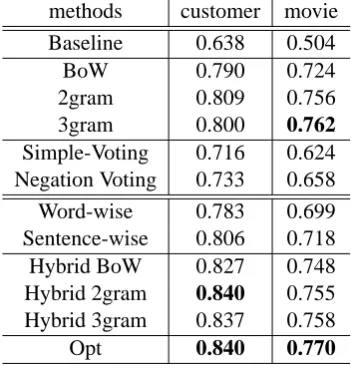
Table 2: Experimental results of the sentence classi-fication
methods customer movie Baseline 0.638 0.504
BoW 0.790 0.724
2gram 0.809 0.756 3gram 0.800 0.762 Simple-Voting 0.716 0.624 Negation Voting 0.733 0.658 Word-wise 0.783 0.699 Sentence-wise 0.806 0.718 Hybrid BoW 0.827 0.748 Hybrid 2gram 0.840 0.755 Hybrid 3gram 0.837 0.758 Opt 0.840 0.770
ers, and feature vectors are normalized to 1. In hy-brid models, the feature vectors,Px∈Sφ(x, S)I(x) andφ0(S)are normalized respectively.
5.3 Comparison of the Methods
We compared the following methods:
• Baseline classifies all sentences as positive.
• BoW uses unigram features. 2gram uses uni-grams and biuni-grams. 3gram uses uniuni-grams, bi-grams, and 3grams.
• Simple-Voting is the most simple majority vot-ing with word-level polarity (Section 3).
• Negation Voting proposed by Hu and Liu (2004) is the majority voting that takes negations into account. As negations, we employed not, no, yet, never, none, nobody, nowhere, nothing, and neither, which are taken from (Polanyi and Zaenen, 2004; Kennedy and Inkpen, 2006; Hu and Liu, 2004) (Section 3).
• Word-wise was described in Section 4.1.
• Sentence-wise was described in Section 4.2.
• Hybrid BoW, hybrid 2gram, hybrid 3gram are combinations of sentence-wise model and respectively BoW, 2gram and 3gram (Section 4.3). We setλ= 0.5.
Table 2 shows the results of these experiments. Hybrid 3gram, which corresponds to the proposed method, obtained the best accuracy on customer re-view dataset. However, on movie rere-view dataset, the proposed method did not outperform 3gram. In Section 5.4, we will discuss this result in details. Comparing word-wise to simple-voting, the accu-racy increased by about 7 points. This means that the shifting model can capture the polarity-shifts and it is an important factor for sentiment clas-sification. In addition, we can see the effectiveness of sentence-wise, by comparing it to word-wise in accuracy.
“Opt” in Table 2 shows the results of hybrid mod-els with optimalλand combination of models. The optimal results of hybrid models achieved the best accuracy on both datasets.
We show some dominating polarity-shifters ob-tained through learning. We obob-tained many nega-tions (e.g., no, not, n’t, never), modal verbs (e.g., might, would, may), prepositions (e.g., without, de-spite), comma with a conjunction (e.g., “, but” as in “the case is strong and stylish, but lacks a win-dow”), and idiomatic expressions (e.g., “hard resist” as in “it is hard to resist”, and “real snooze”).
5.4 Effect of Training Data Size
When we have a large amount of training data, the n-gram classifier can learn well whether each n-n-gram tends to appear in the positive class or the negative class. However, when we have only a small amount of training data, the n-gram classifier cannot capture such tendency. Therefore the external knowledge, such as word-level polarity, could be more valuable information for classification. Thus it is expected that the sentence-wise model and the hybrid model will outperform n-gram classifier which does not take word-level polarity into account, more largely with few training data.
To verify this conjecture, we conducted experi-ments by changing the number of the training ex-amples, i.e., the labeled sentences. We evaluated three models: sentence-wise, 3gram model and hy-brid 3gram on both customer review and movie re-view.
outper-Figure 1: Experimental results on customer review
Figure 2: Experimental results on movie review
forms 3gram on both datasets. We can also see that the advantage of sentence-wise becomes smaller as the amount of training data increases, and that the hybrid 3gram model almost always achieved the best accuracy among the three models. Similar behaviour was observed when we ran the same experiments with 2gram or BoW model. From these results, we can conclude that, as we expected above, the word-level polarity is especially effective when we have only a limited amount of training data, and that the hybrid model can combine two models effectively.
6 Conclusion
We proposed a model that captures the polarity-shifting of sentiment words in sentences. We also presented two different learning methods for the model and proposed an augmented hybrid classifier
that is based both on the model and on existing clas-sifiers. We evaluated our method and reported that the proposed method almost always improved the accuracy of sentence classification compared with other simpler methods. The improvement was more significant when we have only a limited amount of training data.
For future work, we plan to explore new feature sets appropriate for our model. The feature sets we used for evaluation in this paper are not necessar-ily optimal and we can expect a better performance by exploring appropriate features. For example, de-pendency relations between words or appearances of conjunctions will be useful. The position of a word in the given sentence is also an important factor in sentiment analysis (Taboada and Grieve, 2004). Fur-thermore, we should directly take into account the fact that some words do not affect the polarity of the sentence, though the proposed method tackled this problem indirectly. We cannot avoid this problem to use word-level polarity more effectively. Lastly, since we proposed a method for the sentence-level sentiment prediction, our next step is to extend the method to the document-level sentiment prediction.
Acknowledgement
This research was supported in part by Overseas Ad-vanced Educational Research Practice Support Pro-gram by Ministry of Education, Culture, Sports, Sci-ence and Technology.
References
Koby Crammer, Ofer Dekel, Joseph Keshet, Shai Shalev-Shwartz, and Yoram Singer. Online Passive-Aggressive Algorithms. In Journal of Machine
Learn-ing Research, Vol.7, Mar, pp.551–585, 2006.
Michael Gamon. Sentiment classification on customer feedback data: noisy data, large feature vectors, and the role of linguistic analysis. In Proceedings of the
20th International Conference on Computational Lin-guistics (COLING-2004) , pp.841–847, 2004.
David Haussler. Convolution Kernels on Discrete Struc-tures, Technical Report UCS-CRL-99-10, University of California in Santa Cruz, 1999.
Minqing Hu and Bing Liu. Mining Opinion Features in Customer Reviews. In Proceedings of Nineteeth
Alistair Kennedy and Diana Inkpen. Sentiment Classi-fication of Movie and Product Reviews Using Con-textual Valence Shifters. In Workshop on the Analysis
of Formal and Informal Information Exchange during Negotiations (FINEXIN-2005), 2005.
Taku Kudo and Yuji Matsumoto. A Boosting Algorithm for Classification of Semi-Structured Text. In
Proceed-ings of the Conference on Empirical Methods in Nat-ural Language Processing (EMNLP-2004), pp.301–
308, 2004.
Yu Mao and Guy Lebanon. Isotonic Conditional Ran-dom Fields and Local Sentiment Flow. In Proceedings
of the Newral Information Processing Systems (NIPS-2006), pp.961–968, 2006.
Shotaro Matsumoto, Hiroya Takamura, and Manabu Okumura. Sentiment Classification using Word Sub-Sequences and Dependency Sub-Trees. In
Proceed-ings of the 9th Pacific-Asia International Conference on Knowledge Discovery and Data Mining (PAKDD-2005), pp.301–310 , 2005.
Ryan McDonald, Kerry Hannan, Tyler Neylon, Mike Wells, and Jeff Reynar. Structured Models for Fine-to-Coarse Sentiment Analysis. In Proceedings of the 45th
Annual Meeting of the Association for Computational Linguistics (ACL-2007), pp.432–439, 2007.
Tony Mullen and Nigel Collier. Sentiment analysis us-ing support vector machines with diverse informa-tion sources. In Proceedings of the Conference on
Empirical Methods in Natural Language Processing (EMNLP-2004), pp.412–418, 2004.
Bo Pang, Lillian Lee, and Shivakumar Vaithyanathan. Thumbs up? Sentiment Classification using Machine Learning Techniques. In Proceedings of the
Confer-ence on Empirical Methods in Natural Language Pro-cessing (EMNLP-2002), pp.76–86, 2002.
Bo Pang and Lillian Lee. A Sentimental Education: Sentiment Analysis Using Subjectivity Summarization Based on Minimum Cuts. In Proceedings of the 42th
Annual Meeting of the Association for Computational Linguistics (ACL-2004), pp.271–278, 2004.
Bo Pang and Lillian Lee. Seeing stars: Exploiting class relationships for sentiment categorization with respect to rating scales. In Proceedings of the 43rd Annual
Meeting of the Association for Computational Linguis-tics (ACL-2005), pp.115–124, 2005.
Livia Polanyi and Annie Zaenen. Contextual Valence Shifters. In AAAI Spring Symposium on Exploring
At-titude and Affect in Text: Theories and Applications (AAAI-EAAT2004), 2004.
Philip J. Stone, Dexter C. Dunphy, Marshall S. Smith, and Daniel M. Ogilvie. The General Inquirer: A
Com-puter Approach to Content Analysis. The MIT Press,
1996.
Maite Taboada and Jack Grieve. Analyzing Appraisal Automatically. In AAAI Spring Symposium on