Attribute Relation Extraction from Template-inconsistent
Semi-structured Text by Leveraging Site-level Knowledge
Yang Liu, Fang Liu, Siwei Lai, Kang Liu, Guangyou Zhou, Jun Zhao National Laboratory of Pattern Recognition
Institute of Automation, Chinese Academy of Sciences
{yang.liu,fliu,swlai,kliu,gyzhou,jzhao}@nlpr.ia.ac.cn
Abstract
A variety of methods have been proposed for attribute-value extraction from semi-structured text with consistent templates (strict semi-text). However, when the tem-plates in semi-structured text are inconsis-tent (weak semi-text), these methods will work poorly. To overcome the template-inconsistent problem, in this paper, we proposed a novel method to leverage site-level knowledge for attribute-value extrac-tion. First, we use a graph-based random walk model to acquire site-level knowl-edge. Then we utilize such knowledge to identify weak semi-text in each page and extract attribute-value pairs. The experi-ments show that, comparing to the base-line method which does not utilize site-level knowledge, our method can improve the extraction performance significantly.
1 Introduction
Among types of relations, attributes (e.g. nation-ality, date of birth) have emerged as one of the most popular types (Alfonseca et al., 2010), as they capture properties of respective objects (or
instances) (e.g. Kobe Bryant). Generally, an
at-tribute relation consists of an object, an atat-tribute
and its associated value (e.g.Kobe Bryant - date of
birth - August 23, 1978, where “August 23, 1978”
is the value of “date of birth”). In this paper,
we call such a relation an object-attribute-value (OAV) tuple. Many methods have been proposed to extract attributes from semi-structured text (Ca-farella et al., 2008)(Venetis et al., 2011)(Crescenzi et al., 2001)(Arasu and Garcia-Molina, 2003) and unstructured text like webpages and Web search query logs (Reisinger and Pas¸ca, 2009)(Pas¸ca et al., 2010)(Pasca and Van Durme, 2007). Semi-structured text (strict semi-text) often has dis-tinctive HTML tags and consistent templates like
HTML tables (eg: Wikipedia infoboxes). How-ever, a lot of user-generated semi-structured text with weak structures exist, where their templates generating records are inconsistent and the HTML tags in these templates are less distinctive. In this paper, we focus on the issue of extracting attribute-value (AV) pairs from semi-structured text with in-consistent templates (weak semi-text).
In previous work, Yoshinaga and Torisawa (Yoshinaga and Torisawa, 2007) extracted AV pairs of given objects from semi-structured text. They induced templates via a set of attributes ob-tained beforehand and used the templates to ex-tract AV pairs. There are two constraints of their method. First, it heavily depends on the initial set of attributes. However, the quality and coverage of the initial set of attributes is hard to control. Sec-ond, they hold the assumption that attributes in the same block of semi-structured text are generated with the same template which weak semi-text does not satisfy. Their method mainly concentrated on extraction from semi-structured text with consis-tent templates (strict semi-text). When facing the weak semi-text with inconsistent templates, it will fail to obtain satisfactory results.
To resolve the problem of inconsistent tem-plates, we propose an unsupervised method by leveraging site-level knowledge to extract AV pairs from weak semi-text. We explore the intrin-sic structure connection among pages of the same website to address the problem. We make a two-stage effort: The first two-stage is to acquire knowl-edge that reveals the intrinsic similar structures among similar pages of the same site (site-level knowledge); the second stage is to leverage site-level knowledge to assist the AV pair extraction in weak semi-text.
In the paper, we present a novel approach that leverages site-level knowledge to extract in-stances’ attributes and their values from weak semi-text. To the best of our knowledge, little
Figure 1: System overview.
work has addressed the problems to extract AV pairs form weak semi-text. The experimental re-sults show that, when facing weak semi-text, our method outperforms the baseline method which does not leverage site-level knowledge.
2 System Description
The system consists of two part: the site-level extraction and the page-level extraction (Figure 1). Site-level extraction aims to obtain site-level knowledge from pages of a website. Page-level extraction leverages obtained site-level knowledge to help the AV pair extraction from each page.
2.1 Site-level Extraction
We describe details of the modules in site-level ex-traction (Figure 1).
2.1.1 Weak Semi-block Identification and Attribute Template Learner
We first segment a webpage into several blocks
based on the paragraph HTML tags. Then we
align the initial attributes to text of each block. The aligned attributes are used to induce templates to extract more attributes. A template is composed of a prefix and a separator. The separator is re-ferred to the character or word next to the matched attribute and the prefix means characters previous to it. We take the string which begins at the head of first html tag before the matched attribute and ends at the head of the matched attribute as the template’s prefix. For example a HTML fragment “,<div class=“spctrl”></div> 5O(Sex)µ
I(Male),”, in it, “5O(Sex)” is the attribute,
“</div> ” is the prefix and “µ” is the
separa-tor, the template is “</div>WCµ” where WC is
a placeholder for the attribute. And we set the pre-fix’s window size as 15. If no html tag has been found within the window, then the template of this attribute is abandoned. Finally, we obtain a collec-tion of templates of the weak semi-block.
We employ heuristic rules based on aligned at-tributes number and types and templates number
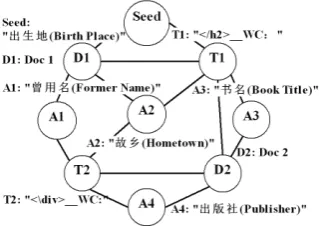
Figure 2: An example of our constructed graph.
to judge whether a block is a weak semi-block or not. Settings of two rules are discussed in the ex-periment at Section 5.4.1. They are: i) number of strings matched to initial attribute list is no smaller
thant1, and ii) sum of attributes’ probabilities
hav-ing been matched to strhav-ings in the text is larger
thant2. We represent them with a parameter
vec-torT = (t1, t2).
2.1.2 Attribute Extraction
The obtained templates are used to extract more
attributes in each block. Intuitively, more
fre-quent a template is found in a weak semi-block, more likely a string extracted by that template is an attribute. Based on this idea, templates with higher frequencies will have higher priority than those with the lower frequencies when extracting attributes. After we run through all the pages of the site, we get a collection of templates and at-tributes. Then we rank them to obtain site-level knowledge.
2.1.3 Ranker
To rank obtained templates and attributes to get site-level knowledge, we use the graph walk based technique (Wang and Cohen, 2007)(Wang and Co-hen, 2009).
We utilize random walk with restart (RWR) to provide relevance score between two nodes (Tong et al., 2006). After the computation, we rank the attributes and templates by their probabilities in the final state vector.
We further refine the obtained ranked attributes by filtering obvious errors and the low ranks (site-level attributes) and generalize the top ranked tem-plates by some rules (site-level temtem-plates). Site-level attributes and site-Site-level templates composed the site-level knowledge.
2.2 Page-level Extraction
This section describes modules in page-level ex-traction (Figure 1).
2.2.1 Weak Semi-block Identification and AV Pair Extraction
To identify weak semi-block, we take the advan-tage of site-level knowledge to make several em-pirical rules based on the alignment of site-level templates and text of each block. The strings ex-tracted by the templates are attribute candidates (AttCandi for short). We think only AttCandies
extracted by authentic templates are correct at-tributes. A template is regarded as authentic once anAttCandiextracted by it exists in the site-level attributes. In the extraction of attribute’s values, we follow the method in (Yoshinaga and Torisawa, 2007) with the hypothesis that an attribute imme-diately precedes its value, and another AV pair im-mediately follows those values.
2.2.2 Object Extraction
we need to obtainobjectsof AV pairs to form
at-tribute relations (OAV tuples) mentioned in
Sec-tion 1 (eg: Kobe Bryant - DateOfBirth - August
23, 1978). We inspect several sampled pages and find their shared unique HTML template of objects for AV pair in their own pages. And then use this shared template to extract objects in each pages.
3 EXPERIMENTS
3.1 Experiment Settings
We carry out the experiments on 3 million Baidu
Baike1 (Baike for short) pages. In them, 1/3 of
the pages (observed from our sampling) contain weak semi-text. For pre-processing, we remove infoboxes in each page which are strict semi-text.
1http://baike.baidu.com/
We evaluate on two aspects where site-level knowledge takes effect, they are: 1) weak semi-block identification in page-level extraction; 2) AV pair extraction in page-level extraction. We ran-domly sample 300 pages for manually labeling. 99 in them contain weak semi-blocks, and 1022 OAV tuples are labeled in the 99 pages. We use the manually labeled data as benchmark.
3.2 The Baseline
To demonstrate the effectiveness of incorporating the site-level knowledge, we implement a baseline system similar to Yoshinaga and Torisawa (Yoshi-naga and Torisawa, 2007), which does not utilize the site-level knowledge. For comparison with our method, unlike their work which obtains initial at-tributes via search engine by manually generated regular expressions (it is hard to repeat precisely), we use the same initial attributes (attributes in in-foboxes of Chinese Wikipedia) with our system as input.
3.3 Evaluation on Weak Semi-text
3.3.1 Evaluation on Weak Semi-block Identification (Ours vs. Baseline)
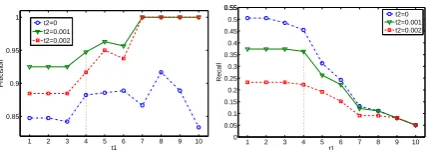
For weak semi-block Identification, we vary
pa-rameter vectorsT = (t1, t2)(Section 3.1) to show
the selection of parameters. We set t1 = {x :
1 ≤x ≤ 10},t2 = {0,0.001,0.002}. Details of
their effects to precision curves and recall curves are shown in Figure 3.
extrac-Table 1: Performances of weak semi-block location.
Output number Correct Precision Recall F-measure
Baseline Tβ 12 12 1.0 0.121 0.216
Baseline Tγ 59 50 0.847 0.505 0.633
Baseline Tα 38 36 0.947 0.364 0.526
SiteExt Tα 100 96 0.96 0.970 0.965
Table 2: Strict and loose precision (P), recall (R) and F-measure (F) comparison of OAV tuple acquisition.
P-strict R-strict F-strict P-loose R-loose F-loose
Baseline Tβ 0.822 0.159 0.266 0.888 0.171 0.287 Baseline Tγ 0.691 0.356 0.470 0.736 0.380 0.501 Baseline Tα 0.856 0.307 0.452 0.918 0.330 0.485 SiteExt Tα 0.844 0.770 0.805 0.887 0.810 0.847
tion. Therefore, we chooseT asTα = (4,0.001),
for our system (SiteExt), which gives a relatively
higher recall with a high precision (Figure 3).
We compared SiteExt Tα with T = Tα and
the baseline system which respectively uses Tα,
Tβ = (7,0.001)andTγ = (2,0). The weak
semi-block identification module of the baseline sys-tem is the same with the weak semi-block iden-tification module of SiteExt in site-level extrac-tion (Secextrac-tion 3.2). Therefore the results in these two modules are the same. From Figure 3, we
can see thatBaseline Tβbrings the highest recall
within the ones bringing highest precision, and
Baseline Tγ brings the highest precision within the ones bringing highest recall.
Table 1 shows that SiteExt Tα’s performance
has a dramatic improvement comparing to other baseline systems which do not leverage site-level knowledge. The reason is that site-level knowl-edge captures attributes and templates specific to
Baike. Meanwhile, weak semi-blocks in each
page of the same site also share these features. As a result, we can identify more weak semi-blocks and reduce the incorrect ones with the same initial attribute set.
3.3.2 Evaluation on Object-Attribute-Value (OAV) tuples (SiteExt vs. Baseline)
We then evaluate the results of OAV tuple extrac-tion. For different items in an OAV tuple, we select different similarity-computing methods. Because objects and attributes in an OAV tuple are always short phrases only with several words, we con-sider them as correct when their similarity meets a strict merit. On the other side, the value often con-tains descriptive contents which have more words. A small size of noises is acceptable. Therefore, besides the strict merit, we further select a loose
merit. The two merits are shown in (3) and (4).
Sloose= len(wd(Vbm
T
wd(Vext))
min(len(wd(Vbm), len(wd(Vext)))) (1)
Sstrict= len(wd(Vbm
T
wd(Vext))
max(len(wd(Vbm), len(wd(Vext)))) (2)
Where Vbm and Vext separately denote the
string of an attribute’s value in benchmark and in
our extraction results,wd(V)is a set of different
words inV, andlen(s)means sum of words in a
sets. In the experiment, we set the thresholds both
as 0.75. When all the similarity scores of three items (object, attribute, value) exceed the thresh-old, the extracted OAV tuple is regarded as correct. Table 2 shows the performance of different
sys-tems. Comparing to Baseline Tα, SiteExt Tα
has great improvements in recall and has a slightly
loss in precision. SiteExt Tα outperforms the
other two baseline systems in both precision and
recall. The experiment results prove that
site-level knowledge is quite essential and effective to promise a good performance when extracting OAV tuples from weak semi-text of the same website. The two systems use the same initial attribute set as input, our method can identify more weak semi-blocks and extract more OAV tuples. It also proves that our method is less sensitive to the initial at-tribute set.
4 Conclusion
Acknowledgments
This work was supported by the National Natu-ral Science Foundation of China (No. 61070106, No. 61272332 and No. 61202329), the National High Technology Development 863 Program of China (No. 2012AA011102), the National Basic Research Program of China (No. 2012CB316300) and the Opening Project of Beijing Key Labora-tory of Internet Culture and Digital Dissemination Research (ICDD201201).
References
E. Alfonseca, M. Pasca, and E. Robledo-Arnuncio. 2010. Acquisition of instance attributes via labeled and related instances. InProceedings of the 33rd in-ternational ACM SIGIR conference on Research and development in information retrieval, pages 58–65. ACM.
A. Arasu and H. Garcia-Molina. 2003. Extracting structured data from web pages. InProceedings of the 2003 ACM SIGMOD international conference on Management of data, pages 337–348. ACM.
M.J. Cafarella, A. Halevy, D.Z. Wang, E. Wu, and Y. Zhang. 2008. Webtables: exploring the power of tables on the web. Proceedings of the VLDB En-dowment, 1(1):538–549.
V. Crescenzi, G. Mecca, P. Merialdo, et al. 2001. Roadrunner: Towards automatic data extraction from large web sites. In Proceedings of the inter-national conference on very large data bases, pages 109–118.
M. Pasca and B. Van Durme. 2007. What you seek is what you get: Extraction of class attributes from query logs. InProceedings of the 20th International Joint Conference on Artificial Intelligence (IJCAI-07), pages 2832–2837.
M. Pas¸ca, E. Alfonseca, E. Robledo-Arnuncio, R. Martin-Brualla, and K. Hall. 2010. The role of query sessions in extracting instance attributes from web search queries. Advances in Information Re-trieval, pages 62–74.
J. Reisinger and M. Pas¸ca. 2009. Latent variable models of concept-attribute attachment. In Pro-ceedings of the Joint Conference of the 47th Annual Meeting of the ACL and the 4th International Joint Conference on Natural Language Processing of the AFNLP: Volume 2-Volume 2, pages 620–628. Asso-ciation for Computational Linguistics.
H. Tong, C. Faloutsos, and J.Y. Pan. 2006. Fast ran-dom walk with restart and its applications.
P. Venetis, A. Halevy, J. Madhavan, M. Pas¸ca, W. Shen, F. Wu, G. Miao, and C. Wu. 2011. Recovering se-mantics of tables on the web. Proceedings of the VLDB Endowment, 4(9):528–538.
R.C. Wang and W.W. Cohen. 2007. Language-independent set expansion of named entities using the web. InData Mining, 2007. ICDM 2007. Sev-enth IEEE International Conference on, pages 342– 350. IEEE.
R.C. Wang and W.W. Cohen. 2009. Character-level analysis of semi-structured documents for set expan-sion. InProceedings of the 2009 Conference on Em-pirical Methods in Natural Language Processing: Volume 3-Volume 3, pages 1503–1512. Association for Computational Linguistics.