TriS: A Statistical Sentence Simplifier
with Log-linear Models and Margin-based Discriminative Training
Nguyen Bach, Qin Gao, Stephan Vogel
and
Alex Waibel
Language Technologies Institute
Carnegie Mellon University
5000 Forbes Avenue, Pittsburgh PA, 15213
{
nbach, qing, stephan.vogel, ahw
}
@cs.cmu.edu
Abstract
We propose a statistical sentence simplifica-tion system with log-linear models. In contrast to state-of-the-art methods that drive sentence simplification process by hand-written linguis-tic rules, our method used a margin-based dis-criminative learning algorithm operates on a feature set. The feature set is defined on statis-tics of surface form as well as syntactic and de-pendency structures of the sentences. A stack decoding algorithm is used which allows us to efficiently generate and search simplification hypotheses. Experimental results show that the simplified text produced by the proposed system reduces 1.7 Flesch-Kincaid grade level when compared with the original text. We will show that a comparison of a state-of-the-art rule-based system (Heilman and Smith, 2010) to the proposed system demonstrates an improvement of 0.2, 0.6, and 4.5 points in ROUGE-2, ROUGE-4, andAveF10,
respec-tively.
1 Introduction
Complicated sentences impose difficulties on reading comprehension. For instance, a person in 5th grade can comprehend a comic book easily but will struggle to understand New York Times articles which require at least 12th grade average reading level (Flesch, 1981). Complicated sentences also challenge natural language processing applications including, but not limited to, text summarization, question answering, information extraction, and machine translation (Chandrasekar et al., 1996). An example of this is syntactic parsing in which long and complicated sentences will generate a large number of hypotheses and usually fail in disam-biguating the attachments. Therefore, it is desirable to pre-process complicated sentences and generate sim-pler counter parts. There are direct applications of sen-tence simplification. Dalemans et al. (2004) applied sentence simplification so that the automatically gen-erated closed caption can fit into limited display area. The Facilita system generates accessible content from Brazilian Portuguese web pages for low literacy readers using both summarization and simplification technolo-gies (Watanabe et al., 2009).
This paper tackles sentence-level factual simplifica-tion (SLFS). The objective of SLFS is twofold. First, SLFS will process the syntactically complicated sen-tences. Second, while preserving the content meaning, SLFS outputs a sequence of simple sentences. SLFS is an instance of the broader spectrum of text-to-text gen-eration problems, which includes summarization, sen-tence compression, paraphrasing, and sensen-tence fusion. Comparing to sentence compression, sentence simplifi-cation requires the conversion to be lossless in sense of semantics. It is also different from paraphrasing in that it generates multiple sentences instead of one sentence with different constructions.
There are certain specific characteristics that compli-cate a sentence, which include length, syntactic struc-ture, syntactic and lexical ambiguity, and an abundance of complex words. As suggested by its objective, sen-tence simplification outputs “simple sensen-tences”. Intu-itively, a simple sentence is easy to read and under-stand, and arguably easily processed by computers. A more fine-tuned definition on a simple sentence is sug-gested in Klebanov et al. (2004), and is termed Easy Access Sentences (EAS). EAS in English is defined as 1) EAS is a grammatical sentence; 2) EAS has one fi-nite verb; 3) EAS does not make any claims that were not present, explicitly or implicitly; 4) An EAS should contain as many named entities as possible.
While the last two requirements are difficult to quan-tify, the first two provide a practical guideline for tence simplification. In this paper, we treat the sen-tence simplification process as a process of statistical machine translation. Given the input of a syntactically complicated sentence, we translate it into a set of EAS that preserves as much information as possible from the original sentence. We develop the algorithm that can generate a set of EAS from the original sentence and a model to incorporate features that indicate the merit of the simplified candidates. The model is discrimina-tively trained on a data set of manually simplified sen-tences.
We briefly review related work in the area of text-to-text generation in Section 2. The proposed model for statistical sentence simplification is presented in Sec-tion 3. In SecSec-tion 4 we introduce the decoding algo-rithm. Section 5 and 6 describe the discriminative train-ing method we use and the feature functions.
ments and analysis are present in Section 7, followed by the conclusion in Section 8.
2 Related Work
Given the problematic nature of text-to-text generation that takes a sentence or a document as the input and op-timizes the output toward a certain objective, we briefly review state-of-art approaches of text-to-text genera-tion methods.
Early approaches in summarization focus on extrac-tion methods which try to isolate and then summarize the most significant sentences or paragraphs of the text. However, this has been found to be insufficient because it usually generates incoherent summaries. Barzilay and McKeown (2005) proposed sentence fusion for multi-document summarization, which produces a sen-tence that conveys common information of multiple sentences based upon dependency tree structures and lexical similarity.
Sentence compression generates a summary of a sin-gle sentence with minimal information loss, which can also be treated as sentence-level summarization. This approach applies word deletion, in which non informa-tive words will be removed from the original sentence. A variety of models were developed based on this per-spective, ranging from generative models (Knight and Marcu, 2002; Turner and Charniak, 2005) to discrim-inative models (McDonald, 2006) and Integer Linear Programming (Clarke, 2008). Another line of research treats sentence compression as machine translation, in which tree-based translation models have been devel-oped (Galley and McKeown, 2007; Cohn and Lapata, 2008; Zhu et al., 2010). Recently, Woodsend and La-pata (2011) proposed a framework to combine tree-based simplification with ILP.
In contrast to sentence compression, sentence sim-plification generates multiple sentences from one input sentence and tries to preserve the meaning of the orig-inal sentence. The major objective is to transform sen-tences in complicated structures to a set of easy-to-read sentences, which will be easier for human to compre-hend, and hopefully easier for computers to deal with.
Numerous attempts have been made to tackle the sentence simplification problem. One line of research has explored simplification with linguistic rules. Jon-nalagadda (2006) developed a rule-based system that take into account the discourse information. This method is applied on simplification of biomedical text (Jonnalagadda et al., 2009) and protein-protein infor-mation extraction (Jonnalagadda and Gonzalez, 2010). Chandrasekar and Srinivas (1997) automatically in-duced simplification rules based on dependency trees. Additionally, Klebanov et al. (2004) develop a set of rules that generate a set of EAS from syntactically com-plicated sentences. Heilman and Smith (2010) pro-posed an algorithm for extracting simplified declarative sentences from syntactically complex sentences.
The rule-based systems performs well on English.
However, in order to develop a more generic frame-work for other languages, a statistical frameframe-work is preferable. In this work, we follow this direction to treat the whole process as a statistical machine trans-lation task with an online large-margin learning frame-work. The method is generalizable to other languages given labeled data. To ensure the information is pre-served, we build a table of EAS for each object, and use stack decoding to search for the optimal combination of EAS. A feature vector is assigned to each combina-tion and we use an end-to-end discriminative training framework to tune the parameters given a set of train-ing data. Our method is different from Klebanov et al. (2004) in the way that we applied statistical model to rank the generated sentences. And the difference be-tween our method and Heilman and Smith (2010) is that we integrate linguistic rules into the decoding pro-cess as soft constraints in order to explore a much larger search space.
3 Statistical Sentence Simplification with
Log-linear Models
Assume that we are given an English sentencee, which is to be simplified into a setS of ksimple sentences
{s1, ..., si, ..., sk}. Among all possible simplified sets,
we will select the set with the highest probability ˆ
S(e) = arg max∀SP r(S|e). As the true probability
distribution of P r(S|e) is unknown, we have to ap-proximateP r(S|e)by developing a log-linear model
p(S|e). In contrast to noisy-channel models (Knight
and Marcu, 2002; Turner and Charniak, 2005) we di-rectly compute simplification probability by a condi-tional exponential model as follow:
p(S|e) = exp[
PM
m=1wmfm(S, e)]
P
S0exp[P
M
m=1wmfm(S0, e)]
(1)
wherefm(S, e), m= 1, ..., M are feature functions on
each sentence; there exists a model parameterwmare
feature weights to be learned.
In this framework, we need to solve decoding, learn-ing, and modeling problems. The decoding prob-lem, also known as the search problem, is denoted by thearg maxoperation which finds the optimalS that maximize model probabilities. Thelearning problem
amounts to obtaining suitable parameter values wM
1
subject to a loss function on training samples. Finally,
themodeling problemamounts to developing suitable
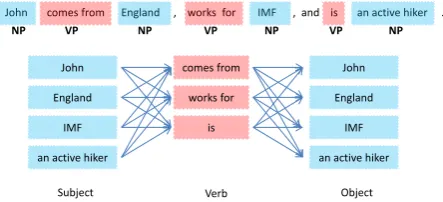
2 John comes from England , works for IMF , and is an active hiker .
NP VP NP VP NP VP NP
England John
IMF
an active hiker
Subject
England John
IMF
an active hiker
Object comes from
works for
is
Verb
Figure 1: Constructing simple sentences
4 Decoding
This section presents a solution to thedecoding prob-lem. The solution is based on a stack decoding algo-rithm that finds the bestS given an English sentence
e. Our decoding algorithm is inspired by the decoding algorithms in speech recognition and machine transla-tion (Jelinek, 1998; Koehn et al., 2007). For example, with a sentence e“John comes from England, works
for IMF, and is an active hiker”, the stack decoding
algorithm tries to find S, which is a set of three sen-tences: “John comes from England”, “John works for IMF” and “John is an active hiker”. Note thatS is a set ofksimple sentencesS = {s1, ..., si, ..., sk}. We
can assume the itemssi are drawn from a finite setS
of grammatical sentences that can be derived from e. Therefore, the first step is to construct the setS.
4.1 Constructing simple sentences
We define a simple English sentence as a sentence with SVO structure, which has one subject, one verb and one object. Our definition is similar to the definition of EAS, mentioned in section 1. However, we only focus on the SVO structure and other constraints are relaxed. We assume both subjects (S) and objects (O) are noun phrases (NP) in the parse tree. For a given English sentencee, we extract a listSN P of NPs and
a listSV of verbs. SN P has an additional empty NP
in order to handle intransitive verbs. A straightforward way to construct simple sentences is to enumerate all possible sentences based onSN P andSV. That results
in|SN P|2|SV|simple sentences.
Figure 1 illustrates the constructions for “John comes from England, works for IMF, and is an active
hiker”. The system extracts a noun phrase list SN P
{John, England, IMF, an active hiker}and a verb list
SV {comes from, works for, is}. Our model constructs
simple sentences such as “John comes from England” ,
“John comes from IMF” and “John comes from an
ac-tive hiker”. The total number of simple sentences,|S|,
is 48.
4.2 Decoding algorithm
Given a list of simple sentencesS, the decoder’s ob-jective is to construct and find the best simplification candidateS ⊂ S. We callS ahypothesisin the con-text of the decoder. The rationale behind our left-right
%&
!! "
#
$
John comes from England
IMF comes from England
an active hiker is England
John comes from IMF
John works for IMF
an active hiker is IMF
John comes from an active hiker
#
#
John is an active hiker
IMF is an active hiker
Figure 2: Left-right decoding by objects
stack decoding algorithm is to construct a hypothesis that covers all noun phrases and verb phrases of the original sentence.
The decoding task is to find the optimal solution over all possible combinations of simple sentences, given the feature values and learned feature weights. De-pending on the number of simple sentences per hypoth-esis, the search space grows exponentially. Since each simple sentence contains an object, we can group the candidate sentences by the object noun phrase. As a result, it is not necessary to evaluate all combinations; we can look at one object at a time from left to right. Figure 2 demonstrates the idea of decoding via objects. We have three objects “England”, “IMF” and “an
ac-tive hiker”. The algorithm first finds potential simple
sentences which have “England” as object. After fin-ishing “England”, the algorithm expands to “IMF” and
“an active hiker”. In this example the optimal path is
the path with bold arrows.
Algorithm 1: K-Best Stack Decoding
1: Initialize an empty hypothesis listHypList 2: InitializeHYPSis a stack of 1-simple-sentence
hy-potheses
3: fori= 0to|SV|do
4: Initialize stackexpandh
5: whileHYPSis not emptydo
6: pophfromHYPS
7: expandh←Expand-Hypothesis(h)
8: end while
9: expandh←Prune-Hypothesis(expandh,
stack-size)
10: HYPS←expandh
11: Store hypotheses ofexpanddintoHypList
12: end for
13: SortedHypList←Sort-Hypothesis(HypList)
14: Return K-best hypotheses inSortedHypList
Algorithm 1 is a version of stack decoding for sen-tence simplification. The decoding process advances by extending a state that is equivalent to a stack of hy-potheses. Line 1 and 2 initializeHYPSstack and
Hy-pList. AHYPSstack maintains a current search state,
size ofSV plus one. Lines 4-8 represent the hypothesis
expansion.
4
…
…
…
pop
Expand-Hypothesis
HYPS with 1 simple sentence
expandh
(a) Pop and Expand
5
HYPS with 1 simple sentence
expandh
…
…
…
Prune Hypothesis
HYPS with 2 simple sentences (b) Hypothesis pruning
Figure 3: A visualization for stack decoding
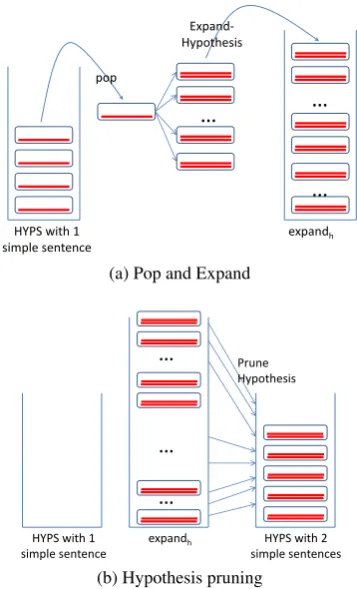
Figure 3a illustrates the pop-expand process of
HYPSstack with 1-simple-sentence hypotheses. The expansion in this situation expands to a 2-simple-sentence hypotheses-stack expandh. The size of
expandhwill exponentially increase according to the
size of SV andSN P. Therefore, we prefer to
main-tainexpandhwithin a limit number (stack-size) of
hy-potheses. Line 9 helps the decoder to control the size
of expandh by applying different pruning strategies:
word coverage, model score or both. Figure 3b illus-trates the pruning process onexpandhwith
2-simple-sentence hypotheses. Line 10 replaces the current state with a new state of the expanded hypotheses. Before moving to a new state,HypListis used to preserve po-tential hypotheses of the current state. Line 13 sorts hypotheses inHypListaccording to their model scores and a K-best list is returned in line 14.
5 Learning
Since defining a log-linear sentence simplification model and decoding algorithm has been completed, this section describes a discriminative learning algo-rithm for the learning problem. We learn optimized weight vectorwby using the Margin Infused Relaxed
Algorithm or MIRA (Crammer and Singer, 2003), which is an online learner closely related to both the support vector machine and perceptron learning frame-work. In general, weights are updated at each step time
iaccording to:
wi+1= arg minwi+1||wi+1−wi||
s.t. score(S, e)≥score(S0, e) +L(S,S0) (2)
whereL(S,S0) is a measure of the loss of using S0
instead of the simplification referenceS; score()is a cost function ofeandSand in this case is the decoder score.
Algorithm 2: MIRA training for Sentence Simplifier training setτ = {ft, et}Tt=1 has T original English
sentences with the feature vectorftofet.
εis the simplification reference set.
m-oracle setO={}. The current weight vectorwi.
1: i=0
2: forj= 1to Qdo
3: fort= 1to Tdo
4: H ←get K Best(St;wi)
5: O←get m Oracle(H;εt)
6: γ=
m
P
o=1
K
P
h=1
α(eo, eh;εt)(feo−feh)
7: wi+1=wi+γ
8: i=i+ 1
9: end for
10: end for
11: Return PQi=1∗Tw
i
Q∗T
Algorithm 2 is a version of MIRA for training the weights of our sentence simplification model. On each iteration, MIRA considers a single instance from the training set(St, et)and updates the weights so that the
score of the correct simplificationεtis greater than the
score of all other simplifications by a margin propor-tional to their loss. However, given a sentence there are an exponential amount of possible simplification can-didates. Therefore, the optimizer has to deal with an exponentially large number of constraints. To tackle this, we only considerK-best hypotheses and choose m-oracle hypotheses to support the weight update
de-cision. This idea is similar to the way MIRA has been used in dependency parsing and machine translation (McDonald et al., 2005; Liang et al., 2006; Watanabe et al., 2007).
updated conservatively.αis computed as follow: α= max(0, δ)
δ= min
(
C,L(eo,eh;εt)−[score(eo)−score(eh)]
||Seo−feh||22
)
(3) whereC is a positive constant used to cap the maxi-mum possible value ofα;score()is the decoder score; andL(eo, eh;εt)is the loss function.
L(eo, eh;εt)measures the difference between oracle
eoand hypothesisehaccording to the gold referenceεt.
Lis crucial to guide the optimizer to learn optimized
weights. We definedL(eo, eh;εt)as follow
L(eo, eh;εt) =AveFN(eo, εt)−AveFN(eh, εt)
(4) whereAveFN(eo, εt)andAveFN(eh, εt)is the
aver-age n-gram (n=[2:N]) cooccurrence F-score of(eo, εt)
and (eh, εt), respectively. In this case, we optimize
the weights directly against theAveFN metric over the
training data.AveFN can be substituted by other
eval-uation metrics such as the ROUGE family metric (Lin, 2004). Similar to the perceptron method, the actual weight vector during decoding is averaged across the number of iterations and training instances; and it is computed in line 11.
6 Modeling
We now turn to themodeling problem. Our fundamen-tal question is: given the model in Equation 1 with
M feature functions, what linguistic features can be
leveraged to capture semantic information of the orig-inal sentence? We address the question in this section by describing features that cover different levels of lin-guistic structures. Our model incorporates 177 features based on information from the original English sen-tencee which contains chunks, syntactic and depen-dency parse trees (Ramshaw and Marcus, 1995; Marn-effe et al., 2006).
6.1 Simple sentence level features
A simplification hypothesis s contains k simple sen-tences. Therefore, it is crucial that our model chooses reasonable simple sentences to form a hypothesis. For each simple sentencesiwe incorporated the following
feature functions:
Word Count These features count the number word in subject (S), verb (V) and object (O), also count-ing the number of proper nouns in S and the number of proper nouns in O.
Distance between NPs and Verbs These features focus on the number of NPs and VPs in between S, V and O. This feature group includes the number of NPs between S and V, the number of NPs between V and O, the number of VPs between S and V, the number of VPs between V and O.
Dependency Structures It is possible that the decoder constructs semantically incorrect simple sen-tences, in which S, V, and O do not have any semantic
connection. One way to possibly reduce this kind of mistake is analyze the dependency chain between S, V, and O on the original dependency tree ofe. Our
de-pendency structure features include the minimum and maximum distances of (S:O), (S:V), and (V:O).
Syntactic Structures Another source of informa-tion is the syntactic parse tree ofe, which can be used to
extract syntactic features. The sentence-like boundary feature considers the path from S to O along the syn-tactic parse tree to see whether it crosses the sentence-like boundary (e.g. relative clauses). For example in the original sentence “John comes from England and works for IMF which stands for International
Mone-tary Funds”, the simple sentence “IMF stands for
In-ternational Monetary Funds” has sentence-like
bound-ary feature is triggered since the path from “IMF” to
“International Monetary Funds” on the syntactic tree
of the original sentence contains an SBAR node. Another feature is the PP attachment feature. This checks if the O contains a prepositional phrase attach-ment or not. Moreover, the single pronoun feature will check if S and O are single pronoun or not. The last feature is VO common ancestor, which looks at the syn-tactic tree to see whether or not V and O share the same VP tag as a common ancestor.
6.2 Interactive simple sentence features
A collection of grammatically sound simplified sen-tences does not necessarily make a good hypothesis Dropping words, unnecessary repetition, or even wrong order can make the hypothesis unreadable. Therefore, our model needs to be equipped with features that are capable to measure the interactiveness across simple sentences and are also able to represents in the best
possible manner. We incorporated the following fea-tures into our model:
Sentence Count This group of features consider the number of sentences in the hypothesis. It consists of an integral feature of sentence countsci=|S|, and a group of binary featuresscbk = δ(|S|) = kwhere
k∈[1,6]is the number of sentence.
NP and Verb Coverage The decoder’s objective is to improve the chance of generating hypotheses that cover all NP and verbs of the original sentencee. These
features count the number of NPs and verbs that have been covered by the hypothesis, by the 1st and 2nd sim-ple sentences. Similarly, these features also count the number of missing NPs and verbs.
S and O cross sentences These features count how many times S of the 1st simple sentence is repeated as S of the 2nd simple sentence in a hypothesis. They also count the number of times O of the 1st sentence is the S of 2nd sentence.
1975). Also, we compute the edit-distance of hypothe-sis against the original sentence, and the average word per simple sentence.
Typed Dependency At simple sentence level we examine dependency chains of S, V and O, while at the hypothesis level we analyze the typed dependency between words. Our model has 46 typed dependencies which are represented by the 92 count features for the 1st and 2nd simple sentence.
7 Experiments and Analysis
7.1 Data
To enable the study of sentence simplification with our statistical models, we search for parallel corpora, in which the sources are original English sentences and the target is its simplification reference. For example, the source is “Lu is married to Lian Hsiang , who is also a vajra master , and is referred as Grand Madam Lu”. The simplification reference contains 3 simple sentences which are “Lu is married to Lian Hsiang”;
“Lian Hsiang is also a vajra master”; “Lu is referred
as Grand Madam Lu”. To the best of our knowledge,
there is no such publicly available corpora under these conditions1.
Our first attempt is to collect data automatically from original English and Simple English Wikipedia, based on the suggestions of Napoles and Dredze (2010). However, we found that the collected corpus is unsuit-able for our model. For example, consider the origi-nal sentence “Hawking was the Lucasian Professor of Mathematics at the University of Cambridge for thirty years, taking up the post in 1979 and retiring on 1
Oc-tober 2009”. The Simple Wikipedia reads “Hawking
was a professor of mathematics at the University of
Cambridge (a position that Isaac Newton once had)”
and “He retired on October 1st 2009”. The problems with this are that “(a position that Isaac Newton once had)” did not appear in the original text, and the pro-noun “He” requires our model to perform anaphora res-olution which is out of scope of this work.
We finally decided to collect a set of sentences for which we obtained one manual simplification per sentence. The corpus contains 854 sentences, among which 25% sentences are from the New York Times and 75% sentences are from Wikipedia. The average sentence length is 30.5 words. We reserved 100 sentences for the unseen test set and the rest is for the development set and training data. The annotators were given instructions that explained the task and defined sentence simplification with the aid of examples. They were encouraged not to introduce new words and try to simplify by restructuring the original sentence. They were asked to simplify while preserving all important information and ensuring the
1 We are aware of data sets from (Cohn and Lapata, 2008;
Zhu et al., 2010), however, they are more suitable in sentence compression task than in our task.
simplification sentences remained grammatically cor-rect2. Some examples from our corpus are given below:
Original: “His name literally means Peach Taro ; as Taro is a common Japanese boy ’s name , it is often
translated as Peach Boy .”
Simplification: “His name literally means Peach Taro”
; “Taro is a common Japanese boy ’s name” ; “Taro is
often translated as Peach Boy”
Original: “These rankings are likely to change thanks to one player , Nokia , which has seen its market share shrink in the United States .”
Simplification: “These rankings are likely to change thanks to one player , Nokia” ; “Nokia has seen its mar-ket share shrink in the United States”
7.2 Evaluation methods
Evaluating sentence simplification is a difficult prob-lem. One possible way to overcome this is to use readability tests. There have been readability tests such as Flesch, Gunning-Fog, SMOG, Flesch-Kincaid, etc. (Flesch, 1948; Gunning, 1968; McLaughlin, 1969; Kincaid et al., 1975). In this work, we will use Flesch-Kincaid grade level which can be interpret as the num-ber of years of education generally required to under-stand a text.
Furthermore, automatic evaluation of summaries has also been explored recently. The work of Lin (2004) on the ROUGE family metric is perhaps the best known study of automatic summarization evaluation. Other methods have been proposed such as Pyramid (Nenkova et al., 2007). Recently, Aluisio et al. (2010) proposed readability assessment for sentence simplifi-cation.
Our models are optimized towardAveF10, which is
the average F-score of n-gram concurrence between hypothesis and reference in whichn is from 2 to 10. Besides AveF10, we will report automatic evaluation
scores on the unseen test set in Flesch-Kincaid grade level, ROUGE-2 and ROUGE-4. When we evaluate on a test set, a score will be reported as the average score per sentence.
7.3 Model behaviors
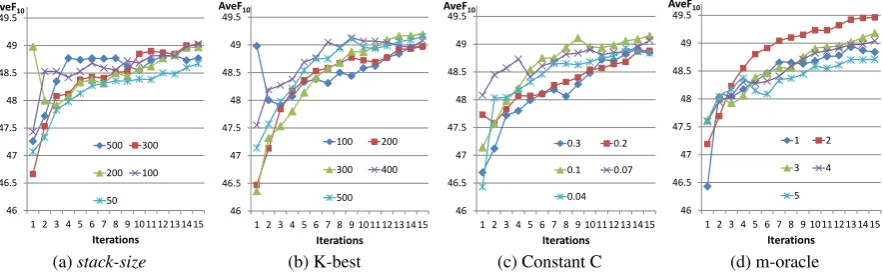
How well does our system learn from the labeled cor-pus? To answer this question we investigate the interac-tions of model and decoder hyper parameters over the training data. We performed controlled experiments on
stack-size, K-best, C, and m-oracle parameters. For
each parameter, all other model and decoder values are fixed, and the only change is with the parameter’s value of interest. Figure 4 illustrates these experiments with parameters over the training data during 15 MIRA training iterations with AveF10 metric. The weight
vectorwis initialized randomly.
2 Our corpus will be made publicly available for other
Stack size
Figure 4: Performance of the sentence simplifier on training data over 15 iterations when optimized towardAveF10
metric and under various conditions.
In Figure 4a, we experimented with 5 different val-ues from 100 to 500 hypotheses per stack. The ex-pected outcome is when we use a largerstack-sizethe decoder may has more chance to find better hypothe-ses. However, a largerstack-sizewill obviously cost more memory and run time is slower. Therefore, we want to find astack-sizethat compromises conditions. These experiments show that with astack-sizeof 200, our model performed reasonably well in comparison with 300 and 500. Astack-sizeof 100 is no better than 200, while astack-sizeof 50 is much worse than 200.
In Figure 4b, we experimented with 5 different val-ues of K-best list with K from 100 to 500. We ob-served a K-best list of 300 hypotheses seems to perform well compare to other values. In terms of stability, the curve of 300-best list appears less fluctuation than other curves over 15 iterations.
C is the hyper-parameter which is used in Equation 3 for weight updating in MIRA. Figure 4c shows experi-ments with different constant C. If C is a large number, it means our model prefers an aggressive weight up-dating scheme, otherwise, our model updates weights conservatively. When C is 0.3 or 0.2 the performance is worse than 0.1 or 0.07 and 0.04.
The last controlled experiments are shown in Fig-ure 4d, in which we test different values of m
rang-ing from 1 to 5. These experiments show that usrang-ing 2 oracle hypotheses consistently leads to better perfor-mances in comparison with other values.
7.4 Performance on the unseen test set
After exploring different model configurations we trained the final model with stack-size= 200; K-best = 300; C = 0.04; and m-oracle = 2. AveF10 score of
the final system on the training set is 50.69 which is about oneAveF10point better than any system in
Fig-ure 4. We use the final system to evaluate on the unseen test set. Also, we compare our system with the rule-based system (henceforth H&S) proposed by Heilman
and Smith (2010).3,4
Original Reference H&S Our system
9.6 8.2 8.3 7.9
Table 1: Flesch-Kincaid grade level of original, refer-ence, H&S, and our proposed simplification on the un-seen test set.
System AveF10 ROUGE-2 ROUGE-4
H&S 51.0 82.2 72.3 Our system 55.5 82.4 72.9
Table 2: Results on the unseen test set withAveF10,
ROUGE-2 and ROUGE-4 scores. Our system outper-forms the rule-based system proposed by Heilman and Smith (2010).
We first compare our system with H&S in the Flesch-Kincaid grade level, which indicates comprehension difficulty when reading an English text. The higher the number the more difficult the text. Table 1 shows the original text requires a reader of grade level 9 or 10. Both H&S and us provided simplification candidates, which are easier to read compared to the original text. Our model generated simpler hypotheses than the ref-erence, while H&S outputs were slightly more difficult to read than the reference.
Next, we compare our system with H&S in ngram-based metrics such asAveF10, ROUGE-2 and
ROUGE-4 as shown in Table 2. Our results are better than H&S by 0.2 and 0.6 point in ROUGE-2 and ROUGE-4, respectively. More interestingly, our system outperformed H&S by 4.5 points inAveF10,
3 We thank Michael Heilman for providing us his code.
4 We could not reach the authors of (Zhu et al., 2010) in
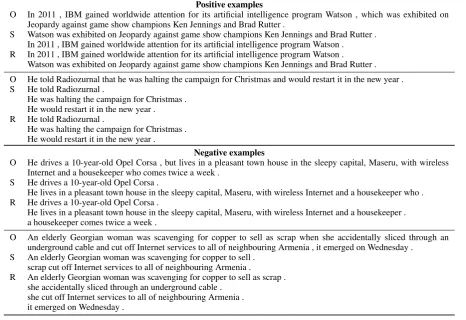
Positive examples
O In 2011 , IBM gained worldwide attention for its artificial intelligence program Watson , which was exhibited on Jeopardy against game show champions Ken Jennings and Brad Rutter .
S Watson was exhibited on Jeopardy against game show champions Ken Jennings and Brad Rutter .
In 2011 , IBM gained worldwide attention for its artificial intelligence program Watson . R In 2011 , IBM gained worldwide attention for its artificial intelligence program Watson .
Watson was exhibited on Jeopardy against game show champions Ken Jennings and Brad Rutter . O He told Radiozurnal that he was halting the campaign for Christmas and would restart it in the new year .
S He told Radiozurnal .
He was halting the campaign for Christmas . He would restart it in the new year .
R He told Radiozurnal .
He was halting the campaign for Christmas . He would restart it in the new year .
Negative examples
O He drives a 10-year-old Opel Corsa , but lives in a pleasant town house in the sleepy capital, Maseru, with wireless Internet and a housekeeper who comes twice a week .
S He drives a 10-year-old Opel Corsa .
He lives in a pleasant town house in the sleepy capital, Maseru, with wireless Internet and a housekeeper who . R He drives a 10-year-old Opel Corsa .
He lives in a pleasant town house in the sleepy capital, Maseru, with wireless Internet and a housekeeper . a housekeeper comes twice a week .
O An elderly Georgian woman was scavenging for copper to sell as scrap when she accidentally sliced through an
underground cable and cut off Internet services to all of neighbouring Armenia , it emerged on Wednesday . S An elderly Georgian woman was scavenging for copper to sell .
scrap cut off Internet services to all of neighbouring Armenia .
R An elderly Georgian woman was scavenging for copper to sell as scrap . she accidentally sliced through an underground cable .
she cut off Internet services to all of neighbouring Armenia . it emerged on Wednesday .
Table 3: We show the original sentence (O), our simplification (S), and simplification reference (R). Positive examples are cases when our simplifications closely match with the reference. Meanwhile, negative examples show cases when our model can not produce good simplifications.
which is a metric considering both precision and recall up to 10-gram. Over 100 sentences of the unseen test set, H&S outperforms us in 43 sentences, but is worse than our system in 51 sentences.
Table 3 shows examples of our system on the unseen test set. We present examples in cases where the pro-posed model works well and does not work well.
7.5 Discussions
This work shares the same line of research with (Kle-banov et al., 2004; Heilman and Smith, 2010) in which we all focus on sentence-level factual simplifi-cation. However, a major focus of our work is on log-linear models which offer a new perspective for sen-tence simplification on decoding, training, and model-ing problems. To contrast, consider rule-based systems (Klebanov et al., 2004; Daelemans et al., 2004; Sid-dharthan, 2006; Heilman and Smith, 2010), in which sentence simplification processes are driven by hand-written linguistic rules. The linguistic rules represent prior information about how each word and phrase can be restructured. In our model, each linguistic rule is en-coded as a feature function and we allow the model to learn the optimized feature weights based on the nature of training data.
A potential issue is the proposed model might be
sus-ceptible to the sparseness issue. We alleviated this is-sue by using structure level and count feature functions which are lexically independent.
There are some limitations in this work. First, the proposed model does not introduce new words which may lead to generate grammatically incorrect simple sentences. Second, we focus on structure simplification and not on lexical simplification. Finally, the proposed model does not deal with anaphora resolution, which means our model can generate repeatedly noun phrases repeatedly in multiple simple sentences.
8 Conclusions
In this paper we proposed a novel method for sen-tence simplification based on log-linear models. Our major contributions are the stack decoding algorithm, the discriminative training algorithm, and the 177 fea-ture functions within the model. We have presented insight the analyses of our model in controlled settings to show the impact of different model hyper parame-ters. We demonstrated that the proposed model outper-forms a state-of-the-art rule-based system on ROUGE-2, ROUGE-4, andAveF10by 0.2, 0.6, and 4.5 points,
respectively.
engi-neering, which can be applied in future work. To ad-dress the data sparsity issue, we plan to use crowd-sourcing such as Amazon Mechanical Turk to collect more training data. We plan to incorporate an n-gram LM to improve the grammaticality of hypotheses.
Acknowledgments
We would like to thank Colin Cherry for fruitful discus-sions and anonymous reviewers for helpful comments. We also thank Julianne Mentzer for proofreading the final version of the paper.
References
Sandra Aluisio, Lucia Specia, Caroline Gasperin, and Carolina Scarton. 2010. Readabil-ity assessment for text simplification. InProceedings of the NAACL HLT 2010 Fifth Workshop on Innovative Use of NLP for Building Educational Applications, pages 1–9. Association for Computational Linguistics.
Regina Barzilay and Kathleen R. McKeown. 2005. Sentence fusion for multidocument news summarization.Computational Linguistics, 31, September.
Raman Chandrasekar and Bangalore Srinivas. 1997. Automatic induction of rules for text simplification.Knowledge Based Systems, 10(3):183–190.
Raman Chandrasekar, Doran Christine, and Bangalore Srinivas. 1996. Motivations and methods for text simplification. InProceedings of 16th International Conference on Computational Linguistics, pages 1041–1044. Association for Computational Linguis-tics.
James Clarke. 2008.Global Inference for Sentence Compression: An Integer Linear Pro-gramming Approach. Ph.D. thesis, University of Edinburgh.
Trevor Cohn and Mirella Lapata. 2008. Sentence compression beyond word deletion. In Proceedings of the 22nd International Conference on Computational Linguistics (Col-ing 2008), pages 137–144, Manchester, UK, August. Coling 2008 Organizing Commit-tee.
Koby Crammer and Yoram Singer. 2003. Ultraconservative online algorithms for multiclass problems.Journal of Machine Learning Research, 3:951–991.
Walter Daelemans, Anja H¨othker, and Erik Tjong Kim Sang. 2004. Automatic sentence simplification for subtitling in Dutch and English. InProceedings of the 4th Interna-tional Conference on Language Resources and Evaluation (LREC-04), pages 1045– 1048.
Rudolf Flesch. 1948. A new readability yardstick.Journal of Applied Psychology, 32:221– 233.
Rudolf Flesch. 1981.How to write plain English. Barnes & Noble.
Michel Galley and Kathleen McKeown. 2007. Lexicalized Markov grammars for sentence compression. InProceedings of Human Language Technologies 2007: The Conference of the North American Chapter of the Association for Computational Linguistics, pages 180–187, Rochester, New York, April. Association for Computational Linguistics.
Robert Gunning. 1968.The technique of clear writing. McGraw-Hill New York, NY.
Michael Heilman and Noah Smith. 2010. Extracting simplified statements for factual ques-tion generaques-tion. InProceedings of the 3rd Workshop on Question Generation.
Frederick Jelinek. 1998.Statistical Methods for Speech Recognition. The MIT Press.
Siddhartha Jonnalagadda and Graciela Gonzalez. 2010. Sentence simplification aids protein-protein interaction extraction.CoRR.
Siddhartha Jonnalagadda, Luis Tari, J¨org Hakenberg, Chitta Baral, and Graciela Gonzalez. 2009. Towards effective sentence simplification for automatic processing of biomedical text. InProceedings of Human Language Technologies: The 2009 Annual Conference of the North American Chapter of the Association for Computational Linguistics, Com-panion Volume: Short Papers, pages 177–180, Boulder, Colorado, June. Association for Computational Linguistics.
Siddhartha Jonnalagadda. 2006. Syntactic simplication and text cohesion. Technical report, University of Cambridge.
Peter Kincaid, Robert Fishburne, Richard Rogers, and Brad Chissom. 1975. Derivation of new readability formulas (Automated Readability Index, Fog Count and Flesch Reading Ease Formula) for Navy enlisted personnel (Research Branch Report 8-75).Memphis, TN: Naval Air Station.
Beata Klebanov, Kevin Knight, and Daniel Marcu. 2004. Text simplification for infor-mation seeking applications. InOn the Move to Meaningful Internet Systems, Lec-ture Notes in Computer Science, volume 3290, pages 735–747, Morristown, NJ, USA. Springer-Verlag.
Kevin Knight and Daniel Marcu. 2002. Summarization beyond sentence extraction: A probabilistic approach to sentence compression.Artificial Intelligence, 139(1):91 – 107.
Philipp Koehn, Hieu Hoang, Alexandra Birch, Chris Callison-Burch, Marcello Federico, Nicola Bertoldi, Brooke Cowan, Wade Shen, Christine Moran, Richard Zens, Chris Dyer, Ondrej Bojar, Alexandra Constantin, and Evan Herbst. 2007. Moses: Open source toolkit for statistical machine translation. InProceedings of ACL’07, pages 177– 180, Prague, Czech Republic, June.
Percy Liang, Alexandre Bouchard-Cˆot´e, Dan Klein, and Ben Taskar. 2006. An end-to-end discriminative approach to machine translation. InProceedings of ACL’06, pages 761–768, Sydney, Australia. Association for Computational Linguistics.
Chin-Yew Lin. 2004. ROUGE: A package for automatic evaluation of summaries. In Stan Szpakowicz Marie-Francine Moens, editor,Text Summarization Branches Out: Proceedings of the ACL-04 Workshop, pages 74–81, Barcelona, Spain, July. Associa-tion for ComputaAssocia-tional Linguistics.
Marie-Catherine Marneffe, Bill MacCartney, and Christopher Manning. 2006. Generating typed dependency parses from phrase structure parses. InProceedings of LREC’06, Genoa, Italy.
Ryan McDonald, Koby Crammer, and Fernando Pereira. 2005. Online large-margin train-ing of dependency parsers. InProceedings of the 43rd Annual Meeting on Association for Computational Linguistics, ACL ’05, pages 91–98. Association for Computational Linguistics.
Ryan McDonald. 2006. Discriminative sentence compression with soft syntactic evidence. InProceedings 11th Conference of the European Chapter of the Association for Com-putational Linguistics, pages 297–304.
Hary McLaughlin. 1969. SMOG grading: A new readability formula.Journal of Reading, 12(8):639–646.
Courtney Napoles and Mark Dredze. 2010. Learning simple wikipedia: A cogitation in as-certaining abecedarian language. InProceedings of the NAACL HLT 2010 Workshop on Computational Linguistics and Writing: Writing Processes and Authoring Aids, pages 42–50, Los Angeles, CA, USA, June. Association for Computational Linguistics.
Ani Nenkova, Rebecca Passonneau, and Kathleen McKeown. 2007. The pyramid method: Incorporating human content selection variation in summarization evaluation. ACM Transactions on Speech and Language Processing, 4, May.
Lance Ramshaw and Mitchell Marcus. 1995. Text chunking using transformation-based learning. InProceedings of the Third ACL Workshop on Very Large Corpora, MIT, June.
Advaith Siddharthan. 2006. Syntactic simplification and text cohesion.Research on Lan-guage and Computation, 4(1):77–109, June.
Jenine Turner and Eugene Charniak. 2005. Supervised and unsupervised learning for sen-tence compression. InProceedings of the 43rd Annual Meeting on Association for Computational Linguistics, ACL ’05, pages 290–297. Association for Computational Linguistics.
Taro Watanabe, Jun Suzuki, Hajime Tsukada, and Hideki Isozaki. 2007. Online large-margin training for statistical machine translation. InProceedings of the EMNLP-CoNLL, pages 764–773, Prague, Czech Republic, June. Association for Computational Linguistics.
W.M. Watanabe, A.C. Junior, V.R. Uzˆeda, R.P.M. Fortes, T.A.S. Pardo, and S.M. Alu´ısio. 2009. Facilita: reading assistance for low-literacy readers. InProceedings of the 27th ACM International Conference on Design of communication, pages 29–36. ACM.
Kristian Woodsend and Mirella Lapata. 2011. Learning to simplify sentences with quasi-synchronous grammar and integer programming. InProceedings of the 2011 Confer-ence on Empirical Methods in Natural Language Processing, pages 409–420, Edin-burgh, Scotland, UK., July. Association for Computational Linguistics.