Synset Assignment for Bi-lingual Dictionary with Limited Resource
Virach Sornlertlamvanich
Thatsanee Charoenporn
Chumpol Mokarat
Thai Computational Linguistics Lab.
NICT Asia Research Center,
Thailand Science Park,
Pathumthani, Thailand
{virach,thatsanee,chumpol}@tcllab.org
Hitoshi Isahara
National Institute of Information
and Communications Technology
3-5 Hikaridai, Seika-cho, soraku-gaun,
Kyoto, Japan 619-0289
[email protected]
Hammam Riza
IPTEKNET, Agency for the
Assess-ment and Application of Technology,
Jakarta Pusat 10340, Indonesia
[email protected]
Purev Jaimai
Center for Research on Language
Processing, National University of
Mongolia, Ulaanbaatar, Mongolia
[email protected]
Abstract
This paper explores an automatic WordNet synset assignment to the bi-lingual diction-aries of languages having limited lexicon information. Generally, a term in a bi-lingual dictionary is provided with very limited information such as part-of-speech, a set of synonyms, and a set of English equivalents. This type of dictionary is comparatively reliable and can be found in an electronic form from various publishers. In this paper, we propose an algorithm for applying a set of criteria to assign a synset with an appropriate degree of confidence to the existing bi-lingual dictionary. We show the efficiency in nominating the synset candidate by using the most common lexi-cal information. The algorithm is evaluated against the implementation of Thai-English, Indonesian-Thai-English, and Mongo-lian-English bi-lingual dictionaries. The experiment also shows the effectiveness of using the same type of dictionary from dif-ferent sources.
1
Introduction
The Princeton WordNet (PWN) (Fellbaum, 1998) is one of the most semantically rich English lexical databases that are widely used as a lexical knowl-edge resource in many research and development topics. The database is divided by part of speech into noun, verb, adjective and adverb, organized in sets of synonyms, called synset, each of which represents “meaning” of the word entry.
This paper presents a new method particularly to facilitate the WordNet construction by using the existing resources having only English equivalents and the lexical synonyms. Our proposed criteria and algorithm for application are evaluated by im-plementing to Asian languages which occupy quite different language phenomena in terms of gram-mars and word unit.
To evaluate our criteria and algorithm, we use the PWN version 2.1 containing 207,010 senses classified into adjective, adverb, verb, and noun. The basic building block is a “synset” which is essentially a context-sensitive grouping of syno-nyms which are linked by various types of relation such as hyponym, hypernymy, meronymy, anto-nym, attributes, and modification. Our approach is conducted to assign a synset to a lexical entry by considering its English equivalent and lexical synonyms. The degree of reliability of the assign-ment is defined in terms of confidence score (CS) based on our assumption of the membership of the English equivalent in the synset. A dictionary from different source is also a reliable source to increase the accuracy of the assignment because it can ful-fill the thoroughness of the list of English equiva-lent and the lexical synonyms.
The rest of this paper is organized as follows: Section 2 describes our criteria for synset assign-ment. Section 3 provides the results of the experi-ments and error analysis on Thai, Indonesian, and Mongolian. Section 4 evaluates the accuracy of the assignment result, and the effectiveness of the complimentary use of a dictionary from different sources. Section 5 shows a collaborative interface for revising the result of synset assignment. And Section 6 concludes our work.
2
Synset Assignment
A set of synonyms determines the meaning of a concept. Under the situation of limited resources on a language, English equivalent word in a bi-lingual dictionary is a crucial key to find an appropriate synset for the entry word in question. The synset assignment criteria described in this Section relies on the information of English equivalent and synonym of a lexical entry, which is most commonly encoded in a bi-lingual dictionary.
Synset Assignment Criteria
Applying the nature of WordNet which introduces a set of synonyms to define the concept, we set up four criteria for assigning a synset to a lexical entry. The confidence score (CS) is introduced to annotate the likelihood of the assignment. The highest score, CS=4, is assigned to the synset that is evident to include more than one English equivalent of the lexical entry in question. On the contrary, the lowest score, CS=1, is assigned to any synset that occupies only one of the English equivalents of the lexical entry in question when multiple English equivalents exist.
The details of assignment criteria are elaborated as in the followings. Li denotes the lexical entry, Ej
denotes the English equivalent, Sk denotes the
syn-set, and ∈∈∈∈denotes the member of a set:
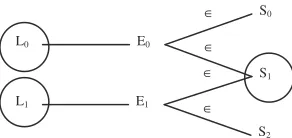
Case 1: Accept the synset that includes more than one English equivalent with confidence score of 4.
Figure 1 simulates that a lexical entry L0 has two
English equivalents of E0 and E1. Both E0 and E1
are included in a synset of S1. The criterion implies
that both E0 and E1 are the synset for L0 which can
be defined by a greater set of synonyms in S1.
Therefore the relatively high confidence score, CS=4, is assigned for this synset to the lexical en-try.
Figure 1. Synset assignment with SC=4 Example:
L0:
E0: aim E1: target
S0: purpose, intent, intention, aim, design
S1: aim, object, objective, target
S2: aim
In the above example, the synset, S1, is assigned
to the lexical entry, L0
, with CS=4.
Case 2: Accept the synset that includes more than one English equivalent of the synonym of the lexical entry in question with confidence score of 3.
In case that Case 1 fails in finding a synset that includes more than one English equivalent, the English equivalent of a synonym of the lexical en-try is picked up to investigate.
Figure 2. Synset assignment with SC=3 Figure 2 simulates that an English equivalent of a lexical entry L0 and its synonym L1 are included
in a synset S1. In this case the synset S1 is assigned
to both L0 and L1 with CS=3. The score in this case
is lower than the one assigned in Case 1 because the synonym of the English equivalent of the lexi-cal entry is indirectly implied from the English equivalent of the synonym of the lexical entry. The newly retrieved English equivalent may not be dis-torted.
Example:
L0: L1:
E0: stare E1: gaze
S0: gaze, stare S1: stare
In the above example, the synset, S0, is assigned
to the lexical entry, L0
, with CS=3.
Case 3: Accept the only synset that includes the only one English equivalent with confidence score of 2.
Figure 3. Synset assignment with SC=2 Figure 3 simulates the assignment of CS-2 when there is only one English equivalent and there is no synonym of the lexical entry. Though there is no any English equivalent to increase the reliability of the assignment, in the same time there is no synonym of the lexical entry to distort the relation. In this case, the only one English equivalent shows it uniqueness in the translation that can maintain a degree of the confidence.
Example:
L0:
E0: obstetrician
S0: obstetrician, accoucheur
In the above example, the synset, S0, is assigned
to the lexical entry, L0
, with CS=2.
Case 4: Accept more than one synset that in-cludes each of the English Equivalent with confi-dence score of 1.
Case 4 is the most relax rule to provide some re-lation information between the lexical entry and a synset. Figure 4 simulates the assignment of CS=1 to any relations that do not meet the previous
crite-ria but the synsets that include one of the English equivalent of the lexical entry.
Figure 4. Synset assignment with SC=1 Example:
is assigned to lexical entry L0
, with CS=1.
3
Experiment results
We applied the synset assignment criteria to a Thai-English dictionary (MMT dictionary) (CICC, 1995) with the synset from WordNet 2.1. To com-pare the ratio of assignment for Thai-English dic-tionary, we also investigate the synset assignment of Indonesian-English and Mongolian-English dic-tionaries.
WordNet (synset) T-E Dict (entry)
total assigned total assigned
Noun 145,103 18,353 (13%) 43,072 11,867 (28%)
Verb 24,884 1,333 (5%) 17,669 (13%)2,298
Adjective 31,302 (13%)4,034 18,448 (20%)3,722
Adverb 5,721 (13%)737 3,008 (51%)1,519
total 207,010 24,457 (12%) 82,197 19,406 (24%)
Table 1. Synset assignment to T-E dictionary In our experiment, there are only 24,457 synsets from 207,010 synsets, which is 12% of the total number of the synset that can be assigned to Thai lexical entries. Table 1 shows the successful rate in assigning synset to Thai-English dictionary. About 24 % of Thai lexical entries are found with the English equivalents that meet one of our criteria.
Going through the list of unmapped lexical en-try, we can classify the errors into three groups:-
1. Compound
The English equivalent is assigned in a
pound, especially in case that there is no an appropriate translation to represent exactly the same sense. For example,
L: E: retail shop
L: E: pull sharply
2. Phrase
Some particular words culturally used in one language may not be simply translated into one single word sense in English. In this case, we found it explained in a phrase. For example,
L:
E: small pavilion for monks to sit on to chant
L:
E: bouquet worn over the ear 3. Word form
Inflected forms i.e. plural, past participle, are used to express an appropriate sense of a lexical entry. This can be found in non-inflection languages such as Thai and most of Asian languages. For example,
L: E: grieved
The above English expressions cause an error in find an appropriate synset.
WordNet (synset) I-E Dict (entry)
total assigned total assigned
Noun 145,103 4,955 (3%) 20,839 (13%)2,710
Verb 24,884 (32%)7,841 15,214 (28%)4,243
Adjective 31,302 (12%)3,722 4,837 (51%)2,463
Adverb 5,721 (7%)381 414 (69%)285
total 207,010 16,899 (8%) 41,304 (24%)9,701
Table 2. Synset assignment to I-E dictionary We applied the same algorithm to Indonesia-English and Mongolian-Indonesia-English (Hangin, 1986) dictionaries to investigate how it works with other languages in terms of the selection of English equivalents. The difference in unit of concept is basically understood to effect the assignment of English equivalents in bi-lingual dictionaries. In Table 2, the size of Indonesian-English dictionary is about half of Thai-English dictionary. The suc-cess rates of assignment to the lexical entry are the same but the rate of synset assignment of Indone-sian-English dictionary is lower than one of
Thai-English dictionary. This is because the total num-ber of lexical entry is almost in the half size.
WordNet (synset) ME Dict (entry)
total assigned Total assigned
Noun 145,103 (0.18%)268 168 (74.40%)125
Verb 24,884 (0.96%)240 193 (72.02%)139
Adjective 31,302 (0.67%)211 232 (55.60%)129
Adverb 5,721 (0.61%)35 42 (40.48%)17
total 207,010 (0.36%)754 635 (64.57%)410
Table 3. Synset assignment to M-E dictionary A small set of Mongolian-English dictionary is also evaluated. Table 3 shows the result of synset assignment.
These experiments show the effectiveness of us-ing English equivalents and synonyms information from limited resources in assigning WordNet syn-sets.
4
Evaluations
In the evaluation of our approach for synset as-signment, we randomly selected 1,044 synsets from the result of synset assignment to Thai-English dictionary (MMT dictionary) for manually checking. The random set covers all types of part-of-speech and degrees of confidence score (CS) to confirm the approach in all possible situations. Ac-cording to the supposition of our algorithm that the set of English equivalents of a word entry and its synonyms are significant information to relate to a synset of WordNet, the result of accuracy will be correspondent to the degree of CS. The detail num-ber of synsets to be used in the evaluation is shown in Table 4.
CS=4 CS=3 CS=2 CS=1 total
Noun 7 479 64 272 822
Verb 44 75 29 148
Adjective 1 25 32 58
Adverb 7 4 4 1 16
total 15 552 143 334 1044
synset assignment and 43.2% in average for all part-of-speech.
CS=4 CS=3 CS=2 CS=1 total
Noun (71.4%) 5 (63.9%) 306 (53.1%) 34 (20.2%) 55 (48.7%) 400
Verb (52.3%) 23 (8.0%) 6 (13.8%) 4 (22.3%) 33
Adjective (8.0%) 2 (3.4%) 2
Adverb (100%) 7 (100%) 4 (100%) 4 (100%) 1 (100%) 16
total (80.0%) 12 (60.7%) 335 (30.8%) 44 (18%) 60 (43.2%) 451
Table 5. Accuracy of synset assignment With the better information of English equiva-lents marked with CS=4, the assignment accuracy is as high as 80.0% and decreases accordingly due to the CS value. This confirms that the accuracy of synset assignment strongly relies on the number of English equivalents in the synset. The indirect in-formation of English equivalents of the synonym of the word entry is also helpful. It yields 60.7% of accuracy in synset assignment for the group of CS=3. Others are quite low but the English equiva-lents are somehow useful to provide the candidates for expert revision.
CS=4 CS=3 CS=2 CS=1 total
Noun 2 22 29 53
Verb 2 6 4 12
Adjective Adverb
total 2 2 28 33 65
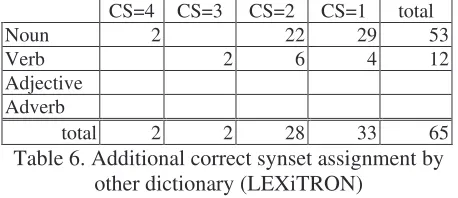
Table 6. Additional correct synset assignment by other dictionary (LEXiTRON)
To examine the effectiveness of English equiva-lent and synonym information from different source, we consulted another Thai-English diction-ary (LEXiTRON). Table 6 shows the improvement of the assignment by the increased number of cor-rect assignment in each type. We can corcor-rect more in noun and verb but not adjective. Verb and adjec-tive are ambiguously defined in Thai lexicon, and the number of the remained adjective is too few, therefore, the result should be improved uncon-cerned with the type.
CS=4 CS=3 CS=2 CS=1 total
total (93.3%) 14 (61.1%) 337 (50.3%) 72 (27.8%) 93 (49.4%) 516
Table 7. Improved correct synset assignment by additional bi-lingual dictionary (LEXiTRON) Table 7 shows the total improvement of the as-signment accuracy when we integrated English
equivalent and synonym information from differ-ent source. The accuracy for synsets marked with CS=4 is improved from 80.0% to 93.3% and the average accuracy is also significantly improved from 43.2% to 49.4%. All types of synset are sig-nificantly improved only if a bi-lingual dictionary from different sources is available.
5
Collaborative Work on Asian WordNet
There are some efforts in developing WordNets of some Asian languages, e.g. Chinese, Japanese, Ko-rean (Choi, 2003), (Choi et al., 2004), (Kaji et al., 2006), (KorLex, 2006), (Huang, 2007) and Hindi (Hindi Wordnet, 2007). The number of languages that have been successfully developed their Word-Nets is still limited to some active research in this area. However, the extensive development of WordNet in other languages is important, not only to help in implementing NLP applications in each language, but also in inter-linking WordNets of different languages to develop multi-lingual appli-cations to overcome the language barrier.We adopt the proposed criteria for automatic synset assignment for Asian languages which has limited language resources. Based on the result from the above synset assignment algorithm, we provide KUI (Knowledge Unifying Initiator) (Sornlertlamvanich, 2006), (Sornlertlamvanich et al., 2007) to establish an online collaborative work in refining the WorNets.
KUI is a community software which allows reg-istered members including language experts revise and vote for the synset assignment. The system manages the synset assignment according to the preferred score obtained from the revision process. As a result, the community WordNets will be ac-complished and exported into the original form of WordNet database. Via the synset ID assigned in the WordNet, the system can generate a cross lan-guage WordNet result. Through this effort, an ini-tial version of Asian WordNet can be fulfilled.
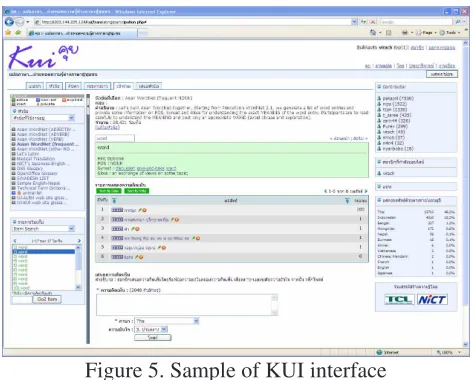
Figure 5 illustrates the translation page of KUI1.
In the working area, the login member can partici-pate in proposing a new translation or vote for the preferred translation to revise the synset assign-ment. Statistics of the progress as well as many useful functions such as item search, record jump, chat, list of online participants are also provided.
KUI is actively facilitating members in revising the Asian WordNet database.
Figure 5. Sample of KUI interface
6
Conclusion
Our synset assignment criteria were effectively applied to languages having only English equiva-lents and its lexical synonym. Confidence score was proved efficiently assigned to determine the degree of reliability of the assignment which later was a key value in the revision process. Languages in Asia are significantly different from the English language in terms of grammar and lexical word unit. The differences prevent us from finding the target synset by following just the English equiva-lent. Synonyms of the lexical entry and additional dictionary from different sources can be compli-mentarily used to improve the accuracy in the as-signment. Applying the same criteria to other Asian languages also yielded a satisfactory result. Following the same process that we had imple-mented to the Thai language, we are expecting an acceptable result from the Indonesian, Mongolian languages and so on. After the revision at KUI, the initial stage of Asian WordNet will be referable through the assigned synset ID.
References
Bernardo Magnini, Carlo Strapparava, Fabio Ciravegna
and Emanuele Pianta, 1994. A Project for the
Con-struction of an Italian Lexical Knowledge Base in the Framework of WordNet, IRST Technical Report # 9406-15.
Chu-Ren Huang, 2007. Chinese Wordnet, Academica
Sinica, Available at http://bow.sinica.edu.tw/wn/
CICC. 1995. Thai Basic Dictionary: Technical Report,
Japan.
Fellbaum, Christiane (ed.), 1998. WordNet: An
Elec-tronic Lexical Database. MIT Press, Cambridge, Mass.
Gabor Proszeky, Marton Mihaltz, 2002. Semi-Automatic
Development of the Hungarian WordNet, Proceed-ings of the LREC 2002, Spain
Gombojab Hangin with John R.Krueger and Paul D.Buell, William V.Rozycki, Robert G.Service,
1986. A modern Mongolian-English dictionary.
Indi-ana University, Research Institute for Inner Asian Studies.
Hindi Wordnet, 2007. Available at http://www.cfilt.iitb. ac.in/wordnet/webhwn/
Hiroyuki Kaji and Mariko Watanabe, 2006. Automatic
Construction of Japanese WordNet, Proceedings of LREC2006, Italy.
J. Atserias, S. Clement, X. Farreres, German Rigau, H.
Rodríguez, 1997. Combining Multiple Methods for
the Automatic Construction of Multilingual
Word-Nets, Proceedings of the International Conference on
Recent Advances in Natural Language, Bulgaria. K.S. Choi, H.S. Bae, W.Kang, J. Lee, E. Kim, H. Kim,
D. Kim, Y. Song1, and H. Shin, 2004.
Korean-Chinese-Japanese Multilingual Wordnet with Shared Semantic Hierarchy, Proceediongs of LREC 2004, Portugal.
Key-Sun Choi, 2003.CoreNet:
Chinese-Japanese-Korean wordnet with shared semantic hierarchy, Proceedings of Natural Language Processing and Knowledge Engineering, Beijing.
Korlex, 2006. Korean WordNet, Korean Language
Processing Lab, Pusan National University, 2007. Available at http://164.125.65.68/
NECTEC, 2006. LEXiTRON: Thai-English Dictionary,
Available at http://lexitron.nectec.or.th/
Spanish and Catalan WordNets, 2006. Available at http://www.lsi.upc.edu/~nlp/
Virach Sornlertlamvanich, 2006. KUI: The OSS-Styled
Knowledge Development System, Proceedings of The 7th AOSS Symposium, Malaysia.
Virach Sornlertlamvanich, Thatsanee Charoenporn,
Kergit Robkop, and Hitoshi Isahara. Collaborative