Towards Context-Based Subjectivity Analysis
Farah Benamara IRIT-CNRS
Toulouse [email protected]
Baptiste Chardon Synapse D´eveloppement
Toulouse baptiste.chardon
@synapse-fr.com
Yannick Mathieu LLF-CNRS
Paris yannick.mathieu@ linguist.jussieu.fr
Vladimir Popescu IRIT-CNRS
Toulouse [email protected]
Abstract
We propose a new subjectivity classi-fication at the segment level that is more appropriate for discourse-based sen-timent analysis. Our approach automati-cally distinguish between subjective non-evaluative and objective segments and be-tween implicit and explicit opinions, by using local and global context features.
1 Introduction
Subjectivity and polarity classification is one of the most studied research area in opinion analy-sis (Pang and Lee, 2004; Wiebe and Riloff, 2005; Wilson et al., 2009). The first task generally dis-tinguish between objective and subjective state-ments. Polarity classification is then performed in order to extract positive, negative and possi-bly neutral statements. These two tasks are co-dependent, since subjectivity analysis filters out statements that contain no opinion.
A common approach in these tasks is to rely on the prior polarity of words and expressions as encoded in external lexical resources. However, as (Polanyi and Zaenen, 2006) stated, identifying prior polarity alone may not suffice to improve sentiment analysis at a finer grain, we need both localandglobalcontext. Context providedlocally can help in two ways. First, it can be used in sub-jectivity word sense disambiguation (SWSD) in order to determine if a given word has a subjective or an objective sense (Akkaya et al., 2009). It can also be used to identify valence shifters (viz. nega-tions, modalities and intensifiers) that strengthen, weaken or reverse the prior polarity of a word or an expression (Kennedy and Inkpen, 2006; Wilson et al., 2009).Globalcontext on the other hand can be
used to identify implicit opinions and to improve the recognition of the overall stance.
Few research efforts have been undertaken on using discourse as features for sentence / clause-based opinion analysis. Among them, (Pang and Lee, 2004) assume that subjective and objec-tive sentences are more likely to appear together, (Asher et al., 2008) have developed an annota-tion schema for a fine-grained contextual opin-ion analysis using discourse relatopin-ions, (Taboada et al., 2008) have used a Rhetorical Structure Theory discourse parser in order to calculate se-mantic orientation by weighting the nuclei more heavily, and finally, (Somasundaran, 2010) has proposed a discourse-level treatment to improve sentence-based polarity classification and to rec-ognize the overall stance. More recently, (Zhou et al., 2011) proposed an unsupervised method to recognize RST-based discourse relations for elim-inating intra-sentence polarity ambiguities. How-ever, no work has investigated so far how dis-course structure can be used to enhance subjectiv-ity analysis (SA).
Using discourse for SA raises new issues: Is sentence/clause subjectivity-based analysis ap-propriate? Is binary subjective vs. objective clas-sification enough for capturing how opinions are expressed within discourse? and finally,how can rhetorical relations help to correctly identify sub-jective orientation at a finer-grained level?In this paper, we aim to answer these questions.
2 Context-Based SA: New Challenges 2.1 Segment-Based SA
The sentence level is not appropriate for context-based SA, since, in addition to objective clauses, a single sentence may contain several opinion
clauses that can be connected by rhetorical rela-tions. Moving to the clause level is also not ap-propriate, since several opinion expressions can be discursively related as in The movie is great but too long where we have a Contrast relation or as in Mr. Dupont, a rich business man, has been savagely killed where we have an Elabora-tionbecause the appositive gives further informa-tion about the eventuality introduced in the main clause. Therefore, we need to move to a finer-grained analysis, at the segment level. (Somasun-daran et al., 2007) have used a similar level to de-tect the presence of sentiment and arguing in dia-logues. However, segment annotations were pro-vided by their corpus, whereas in our case, seg-ments are defined according to the Segmented Dis-course Representation Theory (SDRT) (Asher and Lascarides, 2003) and are automatically detected.
2.2 Beyond Binary Classification
SA can not be simply reduced to binary subjec-tive vs. objecsubjec-tive classification. The following examples extracted from our corpus of French movie reviews illustrate this (they are translated in English and discourse segments are between []):
(1)[The movie is not bad,]a[although some persons left the auditorium]b
(2)[Laborious]a[and copy/paste of the first part.]b
(3)[This movie is poignant,]a[and the actors excellent.]b[It will remain in your DVD closet.]c
(4)[I suppose]a[that the government policy failed]b
Segments (1.a), (2.a), (3.a), (3.b) and (4.b) are explicit opinions. (1.b), (2.b) and (3.c) convey implicit opinions and (4.a) issubjective, but non-evaluative. (Wiebe et al., 2005) have already pro-posed an expression-level annotation scheme that distinguishes between explicit mentions of private states, speech events expressing private states, and expressive subjective elements. (Liu, 2010) has also observed that subjective sentences and opin-ionated sentences (which are objective or sub-jective sentences that express implicit positive or negative opinions) are not the same, even though opinionated sentences are often a subset of sub-jective sentences. We follow the same observa-tions and we propose a new subjectivity classifica-tion at the segment level that is more appropriate for discourse-based sentiment analysis. We auto-matically classify each segment into four classes, namelyS,OO,OandSN, as defined below.
Definition 1.S segmentsare segments that contain
explicitly lexicalizedsubjective and evaluative ex-pressions. Their polarity can be positive (as in (1.a)), negative (as in (2.a)) or neutral in the sense that their positivity/negativity depends on the con-text (as in (3.a)).
Definition 2.OO segmentsare positive or negative opinions implied in an objective segment. They do not contain any explicit subjective clues and are objective out of context1.
Definition 3. O segmentsdo not contain any lex-icalized subjective term, neither do an implied opinion.
Definition 4. SN segments are subjective, but non-evaluative segments that are used to introduce opinions. In general, these segments contain verbs that are used to report the speech and opinions of others. It is important to note that SN does not cover the cases of neutral opinion.
These classes have several advantages over standard binary classification. First, they allow us to distinguish between purely subjective expres-sions (S) and implicit subjective expresexpres-sions (OO). Secondly, our classes can be used to enhance po-larity classification, since they allow for the re-moval of the O and SN segments, which do not convey any positive, negative or neutral opinion. Finally, our classes can also be used to enhance the overall opinion strength assessment.SNsegments, especially in news articles, can play an important role since they convey the degree of veracity of the information and the degree of the commitment of the author and of the writer.
Recently, some efforts have been done on the automatic identification of implicit sentiments. For example, (Greene and Resnik, 2009) used lex-ical semantics and syntax. (Mus¸at and Tr˘aus¸an-Matu, 2010) investigated the influence of valence shifters on the identification of implicit sentiment in economic texts. However, to our knowledge, as yet no work proposed to automatically distin-guish between evaluative and non-evaluative seg-ments on the one hand, and between implicit and explicit opinions on the other hand, by using con-textual features.
2.3 Rhetorical relations and SA
Using SDRT as a formal framework, we have the following discourse relations: Contrast(a,b) in (1) marked by although, Continuation(a,b) in
1This definition does not take into account implicit
(2) marked byand, andAttribution(a,b) in (4).We observe in our corpus that segments related by a ContrastorContinuation relation often share the same subjective orientation (about 80 %). How-ever, discourse connectors are not the only indi-cator for deciding whether a segment is opinion-ated or not. Indeed, some connectors can intro-duce several discourse relations. In addition, re-lations are not always explicitly marked, as in (3) where the implicit opinion conveyed in segment cis linked to the subjective segments aandbby a Result relation. Another problem is how seg-ments are attached within the discourse structure. In (3), we haveContinuation(a,b) andResult([a,b], c) where [a,b] is a complex segment. Therefore, the subjectivity of segmentcdepends on [a,b].
Using discourse in opinion analysis is thus a complex task. As a preliminary step, we propose to study the influence of contextual features us-ing mostly lexically-marked discourse relations, and, crucially, without relying on any existing dis-course relation annotated corpora. We do not use complex segments and we assume that each seg-ment is only attached to the nearby segseg-ment on the left or on the right. In the next sections, we first present the data and our subjective lexicon. Sec-tions 5 and 6 detail respectively the segmentation algorithm and the classification strategies. Section 7 presents the experiments we carried out and dis-cusses the results.
3 Data and Annotations
Our corpus is composed of 136 French movie re-views extracted from the Allˆo Cin´e web site (115 are used for development (our gold) and 21 for test). Three judges performed a two step anno-tation: first segmentation and then segment clas-sification. Segmentation consists in finding el-ementary discourse units (EDUs). EDUs typi-cally correspond to verbal clauses, but also to other syntactic units describing eventualities, ad-juncts (like appositions or frame adverbials), non-restrictive relatives and appositions (for embedded EDUs). In case ofSEDUs, we observe that several opinion expressions (often conjoined NPs or APs clauses) can be related by discourse relations.We resegment such EDUs into separate clauses – for instance [the film is beautiful and powerful] is taken to express two segments: [the film is beau-tiful][and powerful]. For segment annotation, we rely on an already existing annotation guide
elabo-rated during the ANNODIS project (Afantenos et al., 2010) that shows that segmentation is a rela-tively easy task even for naives. In order to avoid errors in determining the basic units, segmentation relies on annotation consensus.
For segment classification, we elaborated a spe-cific annotation guide where we ask the judges to annotate each EDU intoS,OO,OandSN accord-ing to the definitions given in Section 2.2. First, the judges were trained to the task and discussed while annotating the same documents (10 reviews that were subsequently discarded from the gold). Then, they separately doubly-annotated each re-view. This yielded an average Cohens kappa of 0.7 forS, 0.72 forO, 0.61 forSNand 0.54 forOO. The latter two are moderate agreements and figure, we believe, an artifact of the length of the texts. Indeed, the longer a text is, the higher difficulty for human subjects is in detecting discourse con-text in longer con-texts. However, the study of this hy-pothesis falls out of the scope of this paper and is therefore left for future work. Nonetheless, these figures are well in the range of state-of-the-art re-search reports in distinguishing between explicit and implicit opinions (Toprak et al., 2010). For our experiments, the conflicting cases were resolved through discussion between annotators.
4 Subjective Lexicon
Our lexicon is composed of 270 verbs, 632 ad-jectives, 296 nouns, 594 adverbs, 51 interjec-tions, 178 opinion expressions, with 95 modali-ties among all these. Since there is no existing free subjective lexicon for French, we have man-ually built our own lexicon from the study of a wide variety of corpora.Following the opinion cat-egorization described in (Asher et al., 2008), each entry (except for adverbs) is associated to four high-level semantic categories (namelyreporting, judgement, sentimentand advice) and to 24 sub-categories. For adverbs, we use additional cat-egories: negation, affirmation, doubt, intensifier and manner. Only adverbs of manner express opinions, the other adverbs are used as valence shifters.
our lexicon is employed in an objective sense, we coupled our lexicon to an external French dic-tionary D that manually encodes the senses of more than 77 678 words and expressions depend-ing on syntactic configurations For example, the French adjective “noble” (noble) has three senses: (a) “noblesse” (pertaining to the aristocracy), (b) “pr´ecieux” (precious) and (c) “´elev´e” (lofty). For each entry EL in our lexicon, we manually look for its corresponding senses in D as follows: if EL ∈ Dthen ifSubjSenseEL ⊆SenseEL then add to our lexicon the set SubjSenseEL. Thus, fornoble we only retain (b) and (c) as subjective senses. This dictionary is used by the Cordial syn-tactic parser (Laurent et al., 2009) in order to per-form SWSD. If the identified sense found by the parser is encoded in our lexicon, then the word has a subjective sense; otherwise, it has an objective sense.
5 Automatic Discourse Segmentation
The segmentation is carried out using a set of lex-ical and syntactic features as described in (Afan-tenos et al., 2010). These features include the dis-tance from sentence boundaries, the dependency path, and the chunk start/end. Since we used a different syntactic parser, we modified certain features accordingly, and discarded others. We performed a two-level segmentation. First, we constructed a feature vector for each word token, which is classified into: R (Right) for words start-ing an EDU, L (Left) for tokens endstart-ing an EDU, N (Nothing) for words completely inside its EDUs, and B (Both) for tokens which constitute the only word of an EDU.
In the second step, the EDUs which contain at least one token that belongs to our subjective lexi-con were retained for a further segmentation. The latter is easier than the segmentation performed at the first level, because we do not encounter em-bedded segments. Thus, the second-level segmen-tation of EDUs comes down to searching for one or more “cut points” therein. Since the proportion of EDUs that need to be resegmented is relatively low (about 12 % in the gold standard), we carried out this step by using symbolic rules. These are mainly based on discourse markers.
We performed a supervised learning by using the MegaM software package2, based on the
Max-imum Entropy model (Berger et al., 1996) in order
2http://www.cs.utah.edu/~hal/megam/
to classify each segment into the R, L, Nothing or Both classes, as described above. We carried out a 10-fold cross-validation on our gold standard and an evaluation on the Test data. Table 1 shows first-level EDUs segmentation results for the Right, the Left and Nothing boundaries. For the symbolic segmentation, we evaluated our results (i) on the gold and (ii) on the Test data. The F-measures for boundary recognition are 97.88 % in (i) and 98.65 % in (ii); for the internal-boundaries, we have 84.17 % in (i) and 84.68 % in (ii). Finally, for the new EDU recognition we obtain 77.23 % in (i) and 76.31 % in (ii).
6 Classifiers
The classes, S, O, SN and OO are unbalanced in the development corpus. Besides, getting the OOsegments right is far from obvious, sometimes even for humans. This is why we have defined two orthogonal binary sets of classes:
(a) S NC vs. O NC where S NC = S ∪ SN and O NC =O∪OO which distinguish between subjective non-contextualsegments, which are in-trinsically subjective, irrespective of their context of occurrence and objective non-contextual seg-ments, which, in the absence of any context, are intrinsically objective.
(b) Eval Op vs. Non EvalOp where Eval Op = S∪OO and Non EvalOp =O∪SN which dis-tinguish betweenevaluativeandopinionated seg-ments, which, given the appropriate context, con-tain an explicit or an implicit opinion and non-evaluativeandnon-opinionated segments, which, irrespective to the context, are not evaluative.
On the gold standard, this grouping yields 919 S NC EDUs, 511 O NC EDUs and 1083 Eval Op EDUs, 347 Non EvalOp EDUs. Two binary clas-sifiers are constructed, one for each of the two bi-nary sets of classes, defined above: an “S” classi-fier for (a)and an “Op” classifier for (b). Given that the binary sets of classes represent two mu-tually independent re-partitionings of the segment space, the classifiers are independent of one an-other. Hence, they can be run in parallel. Then, their outputs are used, via a simple set of four rules, to yield the original four EDU classes. The rules are:
Precision Recall F-measure
R L Nothing R L Nothing R L Nothing
Gold 94.97 93.80 97.88 93.41 94.14 98.10 94.18 93.97 97.99 Test 92.61 93.47 94.05 81.79 78.69 98.15 86.86 85.45 96.06
Table 1: First-level EDU segmentation results (in percents)
operate on the same input text. Hence, to get the class of each EDU in the input text, it suffices to perform a fusion of the results of these classifiers, via the four rules shown above. Each classifier is based on SVMs (“Support Vector Machines”) (Burges, 1998). From each EDU a distinct feature vector is computed for each classifiers.
6.1 Feature Set
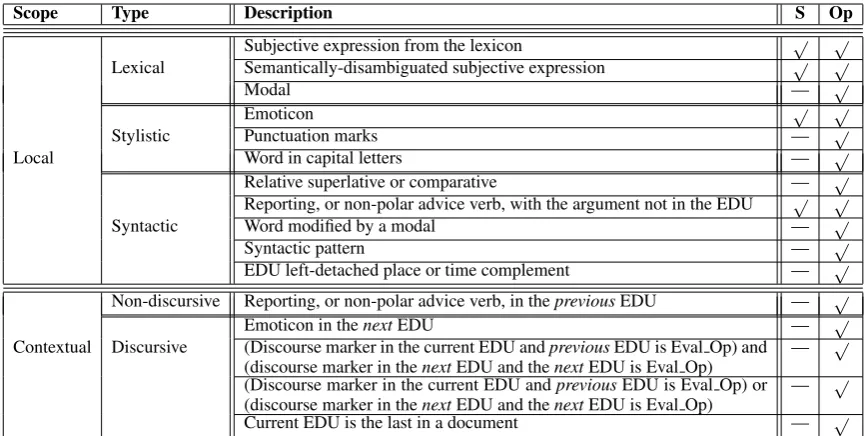
The features used are described in Table 2. They have been grouped in “Local” and “Contextual” features, according to whether they rely on adja-cent EDUs or not. All the features are binary.
Local Features. They have been grouped in “Lexical”, “Stylistic” and “Syntactic”, according to whether they rely on lexical information only, on stylistic or on syntactic information. We have three lexical features. The first one concerns the presence in an EDU of a noun, adjective, adverb of manner, verb, expression or interjection that be-longs to the lexicon, excluding entries expressing modalities and negations. The second feature re-fines the previous one by taking into account only those lexical entries that have subjective senses as described in section 4. The last lexical feature checks the presence of modals in the lexicon.
”Stylistic” features look for emoticons, words in capital letters and for specific punctuation marks. For emoticons, we rely on a dictionary of 79 emoticons. Capitalization is extracted by taking care to filter out certain standard acronyms, such as DVD. For punctuations, we look for sequences of punctuation marks, such as “??”, “!!”, “?!”, or “!?”.
We have five “syntactic” features. The first one looks for comparatives and relative superlatives using a set of manually-built French language-specific comparative and superlative patterns. The second one checks the presence of verbs in the “re-porting” category, or in the “advice” category that do not have prior polarity, and by seeing whether the arguments the verbs are in the EDUs or not. The next feature gets the scoping of the modals via a syntactic (dependence) analysis of the EDU. The fourth local syntactic feature is extracted by
us-ing a set of manually-built typical French syntac-tic patterns that bear a subjective meaning. These patterns also allow for some flexibility since other words might be intercalated. The last feature is also detected via a syntactic analysis of the text in order to check if an EDU is left-detached place or time (circumstantial) complement (CC) since these EDUs are mainly objective.
Contextual Features.These features have been grouped in two subtypes, “Non-discursive” and “Discursive”. Non-discursive features test the presence of a reporting or non-polar advice ver-band we test it on the EDU that occurs before (i.e., to the left of) the current EDU. The sec-ond group of contextual features refer to discourse constraints. The first one checks for theunmarked Commentary relation between the current EDU and the next one, when the latter contains an emoticon. If this happens, then that previous EDU is Eval Op. The next feature checks for the simul-taneous presence of two marked SDRT rhetorical relations, in the set{Continuation,Parallel,
Con-trast,Alternation}, one between the current EDU and the previous one, and the other between the current EDU and the next one, with the previous and the next EDUs being in the Eval Op class. In order to determine the presence of these rhetorical relations, we rely on a French lexicon of discourse connectors, developed with the SDRT rhetorical relations in mind (Roze et al., 2010). The feature that follows is a relaxation of the previous one, in that it applies when at least one marked rhetorical relation is found, between the previous EDU and the current one, or between the latter and the next one. The last feature is based on the empirically-motivated intuition that, in general, in reviews, the last EDU tends to be the second argument of a Re-sultrelation between (some EDUs in) the rest of the document and itself. As such, this last EDU tends to be in the Eval Op class.
6.2 Getting the Discursive Features
Scope Type Description S Op
Subjective expression from the lexicon √ √
Lexical Semantically-disambiguated subjective expression √ √
Modal — √
Emoticon √ √
Stylistic Punctuation marks — √
Local Word in capital letters — √
Relative superlative or comparative — √
Reporting, or non-polar advice verb, with the argument not in the EDU √ √
Syntactic Word modified by a modal — √
Syntactic pattern — √
EDU left-detached place or time complement — √ Non-discursive Reporting, or non-polar advice verb, in thepreviousEDU — √
Emoticon in thenextEDU — √
Contextual Discursive (Discourse marker in the current EDU andpreviousEDU is Eval Op) and (discourse marker in thenextEDU and thenextEDU is Eval Op) —
√ (Discourse marker in the current EDU andpreviousEDU is Eval Op) or
(discourse marker in thenextEDU and thenextEDU is Eval Op) — √
Current EDU is the last in a document — √
Table 2: Features for the two classifiers: S and Op
available Op classification of the previous and/or next EDUs. Of course, for a raw input text, such a classification is not available. Hence, we have de-vised an iterative procedure for the Op classifier, which first starts with an Op classification by us-ing all the features in Table 2, except forDF M. This provides a first Op classification of the input EDUs, which is used forbootstrappinga second iterative Op classification of the EDUs, this time by using all the features in Table 2.
In order to guarantee the convergence of the procedure, we rely on the idea that the goal of the Op classification is mainly to detectOOEDUs among intrinsicallyOEDUs. Thus, from the per-spective of the Op partitioning of the EDU space, the classification is supposed to start with all the input EDUs as Non EvalOp, and then to move the appropriate ones into the Eval Op class. This boils down to imposing a constraint on the second Op classification in the iterative procedure, namely, that it does not alter the class of the EDUs which had already been classified as Eval Op. The stop-ping criterion consists in the stabilization of the F-measure of the classifier with respect to the initial test data. The procedure assumes that both classi-fiers (the bootstrapping one and the iterative one) have been trained on the same data, except that the feature vectors are defined as appropriate for each classifier; the DF M features are determined, in the training phase, by relying on the gold annota-tion of the training EDUs.
The procedure goes as described below, where
bootstrp vs is the set of bootstrapping feature vectors, and curr vs(i) is the set of input
fea-ture vectors at iteration i. preds(i) are the
pre-dicted class labels of the respective SVM classi-fier, at iteration i; ← is the assignment operator; F score(A, B)is the F-measure between the class
labellings of a list of feature vectors, A, and a list of class labels,B, both lists having the same length. ⊕is an operator that takes the same types
of arguments as F score, A and B, and imple-ments the filter on the Eval Op EDUs ensuring the convergence of the iterative procedure (length(A)
is the number of elements in listA). It is defined as:
A⊕B::= forifrom0tolength(A):
ifclass(A[i]) =Non EvalOp:
class(A[i])←B[i]. We callϵthe “convergence factor”, a threshold of the F-measure variation from one iteration to an-other. M AX IT ERis the maximum number of iterations if convergence is not achieved before. The procedure is:
for an input test documenttest:
1. compute bootstrp vs, with all features except for DF M;
2. apply the bootstrapping classifier onbootstrp vs; obtain thuspreds(0)and
F score(0)←F score(bootstrp vs, preds(0)); 3. computeDF Mby usingpreds(0);
obtain thuscurr vs(0); 4. fornfrom1toM AX IT ER:
4.1 curr vs(n)←curr vs(n−1)⊕preds(n−1) 4.2 apply the iterative classifier oncurr vs(n);
obtain thuspreds(n)and
F score(curr vs(n), preds(n)); 4.3 if||F score(n)−F score(n−1)|| ≤ϵ:
STOP
5. computeF score(preds(n), test). 7 Experiments and Results
Several experiments were performed for testing the validity of our subjectivity classification ap-proach, and especially of the contextual features. Thus, first the two classifiers are assessed in a 10-fold cross-validation on the development corpus. Secondly, the two classifiers are evaluated on the 21-document test corpus, with the entire develop-ment corpus used for training. For both setups, we have used the SVM-light software package3.
Due to the fact that the feature vector spaces were found to be non-linearly-separable for both the S and Op classifiers, training was performed by us-ing polynomial kernels. The Op classifier is eval-uated in two manners when DF M features are used: first, the values of these features are drawn from the class annotation of the EDUs as given in the manually annotated corpus. Secondly, the iter-ative approach has been used, in order to test the approach in the real-life scenario when the con-textual features cannot be detected by relying on a prior annotation of the input data. In all situations, the four rules introduced in Section 6 are used on the results of the two classifiers for inferring the finer-grained class of each EDU.
7.1 Evaluation of the Classifiers
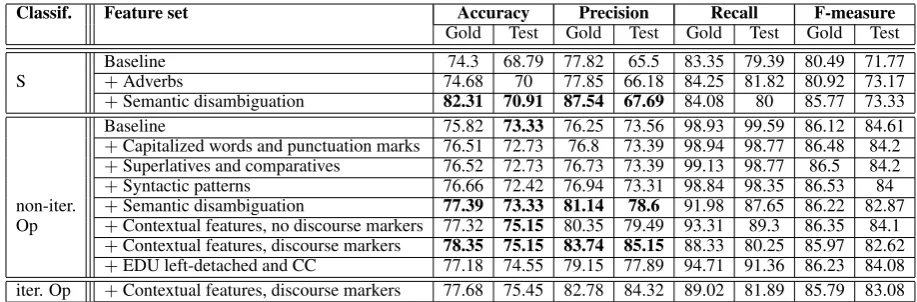
We first present, in Table 3 the results of both clas-sifiers, both in 10-fold cross-validation on the de-velopment corpus (“Gold”), and on the test data (“Test”). We first start with baseline feature sets, to which several features are progressively added; this is marked by the “+” sign. The best perfor-mances are marked in boldface. For the S classi-fier, our baseline considers only emoticons, all en-tries from the lexicon, except adverbs of manner or negation as well as modalities, along with the presence of a reporting verb with no argument. We observe that when adverbs of manner are added, all the performance figures improve, on both Gold and Test data (although a slight loss in precision is noticed on the new data). We also observe that adding SWSD yields the best performance figures for S.
For the Op classifier, our baseline uses local and syntactic features which rely on our lexicon: the
3http://svmlight.joachims.org/
presence of a subjective word or an emoticon or a modal or a word in the scope of a modal. Adding stylistic features provides a slight improvement of all the performance figures on the Gold but a slight degradation on the Test data. This might be due to a less regular way of using punctuation marks. The use of the feature referring to the presence of comparative and superlative patterns in the Gold slightly degrades precision, but provides the best recall of all the feature combinations for the Op classifier. On the Test data, no change in the mea-sures is recorded. When syntactic patterns are added the recall slightly degrades but the accuracy and precision improve, thus providing the best F-score of all the feature combinations on the Gold. However, on the Test data all performance figures slightly degrade. Adding SWSD degrades the re-call and, slightly, the F-measure but improves the accuracy and precision; this is true for the Gold and for the Test data. Adding contextual features that do not rely on a prior classification of the con-text slightly degrades accuracy and precision in the Gold, but provides a more significant improve-ment in the recall and yields a slightly higher F-score than without these features.
On the Test data, contextual features detect more subjective (explicit or implicit) EDUs than with-out them. Adding contextual features that rely on a prior classification of the EDUs, provides the best accuracy and precision of all our feature sets which shows their added value. The recall how-ever, worsens on both the Gold and on the Test data (and so does the F-measure), because of the sparseness of the discourse markers in our cor-pus. Indeed, these last contextual features rely on surface cues which mark only a slight proportion of the discourse relations considered (cf. Section 2.3). This shows that although discourse informa-tion seems to be useful in detecting (mostly im-plicit) subjective EDUs that cannot be detected by other surface means, providing a good coverage is a caveat that could be solved, we believe, through a deeper level of analysis (for example lexical se-mantic). Finally, adding syntactic information per-taining the EDU being a left-detached CC, and to the presence of a reporting or non-polar advice verb without argument, yields only an improve-ment of the recall and F-measure, but the accuracy and precision worsen.
af-Classif. Feature set Accuracy Precision Recall F-measure Gold Test Gold Test Gold Test Gold Test
Baseline 74.3 68.79 77.82 65.5 83.35 79.39 80.49 71.77
S +Adverbs 74.68 70 77.85 66.18 84.25 81.82 80.92 73.17
+Semantic disambiguation 82.31 70.91 87.54 67.69 84.08 80 85.77 73.33
Baseline 75.82 73.33 76.25 73.56 98.93 99.59 86.12 84.61
+Capitalized words and punctuation marks 76.51 72.73 76.8 73.39 98.94 98.77 86.48 84.2 +Superlatives and comparatives 76.52 72.73 76.73 73.39 99.13 98.77 86.5 84.2 +Syntactic patterns 76.66 72.42 76.94 73.31 98.84 98.35 86.53 84 non-iter. +Semantic disambiguation 77.39 73.33 81.14 78.6 91.98 87.65 86.22 82.87 Op +Contextual features, no discourse markers 77.32 75.15 80.35 79.49 93.31 89.3 86.35 84.1
+Contextual features, discourse markers 78.35 75.15 83.74 85.15 88.33 80.25 85.97 82.62 +EDU left-detached and CC 77.18 74.55 79.15 77.89 94.71 91.36 86.23 84.08 iter. Op +Contextual features, discourse markers 77.68 75.45 82.78 84.32 89.02 81.89 85.79 83.08
Table 3: Results (in percents) for the S and Op classifiers
Configuration S SN O OO
Gold Test Gold Test Gold Test Gold Test Best S / best non-iterative non-contextual Op 80.83 70.6 97.58 96.06 79.35 75.75 72.64 66.06
Best S / best non-iterative contextual Op 81.38 73.33 97.57 92.72 79.96 74.54 79.02 72.12 Best S / best iterative (contextual) Op 81.45 73.03 97.64 93.03 79.21 74.54 77.88 70.9
Table 4: Accuracies (in percents) for the four-class classification
ter at most 2 iterations on the Gold data, and at most 3 iterations on the Test data. As expected, the accuracies and precisions worsen slightly (by around 1 %) on the Test data, since the classes of the adjacent EDUs are not provided beforehand by the gold standard. However, on the Test data the accuracy (but not the precision) very slightly im-proves (by less than 0.5 %). The recall increases slightly as well on both data sets (by around 1 % as well), which means that the imperfections of the iteratively-obtained classification of the adja-cent EDUs somewhat compensates for the limits of these two features themselves.
7.2 Evaluation of the Four Classes
We now show the results of the classification of the EDUs in the four classes S, OO, SN andO, obtained by applying the four rules described in Section 6 on the outputs of the S and Op classi-fiers with the feature sets providing the best perfor-mance figures, according to the boldface results in Table 3. For the contextual Op configuration we analyze both the non-iterative (non-iter. Op) and iterative (iter. Op) performance effects on the four classes. The accuracies are synthesized in Table 4. We observe that adding contextual features im-proves the performance figures, except for theSN class, where they degrade by 0.01 % for the non-iterative contextual Op, and, only on the Test data, for the O class, where they degrade by 0.21 %. We especially notice the dramatic improvements,
on both the Gold and the Test data, for the OO class, of implicit subjective EDUs. We thus see that the contextual features provide an improve-ment of around 5–6 % for the accuracy. The im-provements are, as expected, less marked in iter. Op. However, the degradation is rather slight: less than 2 % for the OOclass and even less for the other classes. Nonetheless, even with the iter. Op, the performance figures remain higher than with the non-contextual Op classifier. Interestingly, in iter. Op, performance figures for the S (on the Gold only) andSNclasses slightly improve.
8 Conclusion and Further Work
In this paper, we have assessed a discourse-based approach to SA. We have proposed a method to distinguish between four types of discourse units, by using both local and global context features. In the future, we plan to annotate opinion docu-ments with SDRT-inspired relations, in order to learn them automatically from several cues other than discourse markers. We believe that the real strength of the discourse-based approach to opin-ion analysis appears when assessing the global po-larity of documents.
Acknowledgements
References
Stergos D. Afantenos, Pascal Denis, Philippe Muller, and Laurence Danlos. 2010. Learning recursive segments for discourse parsing. In Proceedings of the Language Resources and Evaluation Conference
(LREC), pages 3578–3584.
Cem Akkaya, Janyce Wiebe, and Rada Mihalcea. 2009. Subjectivity word sense disambiguation.
In Proceedings of Empirical Methods in Natural
Language Processing (EMNLP), pages 190–199,
Stroudsburg, PA, USA. Association for Computa-tional Linguistics.
Nicholas Asher and Alex Lascarides. 2003. Logics of
Conversation. Cambridge University Press.
Nicholas Asher, Farah Benamara, and Yvette Yannick Mathieu. 2008. Distilling opinion in discourse: A preliminary study. InProceedings of Computational
Linguistics (CoLing), pages 7–10, Manchester, UK.
Association for Computational Linguistics.
Adam L. Berger, Stephen A. Della Pietra, and Vin-cent J. Della Pietra. 1996. A maximum entropy approach to natural language processing. Compu-tational Linguistics, 22:39–71.
Christopher J. C. Burges. 1998. A tutorial on support vector machines for pattern recognition. Data min-ing and knowledge discovery, 2(2):121–167.
Stephan Greene and Philip Resnik. 2009. More than words: syntactic packaging and implicit sen-timent. In Proceedings of Human Language Tech-nologies: The Annual Conference of the North American Chapter of the Association for
Computa-tional Linguistics (HLT – NAACL), pages 503–511.
Alistair Kennedy and Diana Inkpen. 2006. Sentiment classification of movie and product reviews using contextual valence shifters. Computational Intelli-gence, 22(2):110–125.
Dominique Laurent, Sophie N`egre, and Patrick S´egu´ela. 2009. L’analyseur syntaxique Cordial dans Passage. In Proceedings of Traitement
Au-tomatique des Langues Naturelles (TALN), Senlis,
France.
Bing Liu. 2010. Sentiment analysis and subjectivity. In Nitin Indurkhya and Fred J. Damerau, editors,
Handbook of Natural Language Processing, Second Edition. CRC Press, Taylor and Francis Group, Boca Raton, FL.
Claudiu Mus¸at and S¸tefan Tr˘aus¸an-Matu. 2010. The impact of valence shifters on mining implicit eco-nomic opinions. Lecture Notes in Computer Sci-ence, 6304:131–140.
Bo Pang and Lillian Lee. 2004. A sentimental educa-tion: sentiment analysis using subjectivity summa-rization based on minimum cuts. InProceedings of
the 42nd Annual Meeting on Association for Com-putational Linguistics, pages 271–278, Stroudsburg, PA, USA. Association for Computational Linguis-tics.
Livia Polanyi and Annie Zaenen. 2006. Contextual va-lence shifters. InComputing Attitude and Affect in
Text: Theory and Applications, volume 20 of The
Information Retrieval Series, pages 1–10,
Berlin-Heidelberg. Springer-Verlag.
Charlotte Roze, Laurence Danlos, and Philippe Muller. 2010. LEXCONN: a french lexicon of discourse connectives. In Proceedings of Multidisciplinary
Approaches to Discourse (MAD), pages 114–125,
Moissac, France.
Swapna Somasundaran, Josef Ruppenhofer, and Janyce Wiebe. 2007. Detecting arguing and sentiment in meetings. InProceedings of the SIGdial Workshop
on Discourse and Dialogue, pages 26–34.
Associa-tion for ComputaAssocia-tional Linguistics.
Swapna Somasundaran. 2010. Discourse-level rela-tions for Opinion Analysis. PhD Thesis, University of Pittsburgh.
Maite Taboada, Kimberly Voll, and Julian Brooke. 2008. Extracting sentiment as a function of dis-course structure and topicality. In School of Com-puting Science Technical Report 2008-20.
Cigdem Toprak, Niklas Jakob, and Iryna Gurevych. 2010. Sentence and expression level annotation of opinions in user-generated discourse. In Proceed-ings of the 48th Annual Meeting of the Association for Computational Linguistics, ACL ’10, pages 575– 584, Stroudsburg, PA, USA. Association for Com-putational Linguistics.
Janyce Wiebe and Ellen Riloff. 2005. Creating sub-jective and obsub-jective sentence classifiers from unan-notated texts. In Proceedings of the International Conference on Intelligent Text Processing and
Com-putational Linguistics (CICLing), volume 3406 of
Lecture Notes in Computer Science, pages 486–497,
Berlin, Heidelberg. Springer-Verlag.
Janyce Wiebe, Theresa Wilson, and Claire Cardie. 2005. Annotating expressions of opinions and emo-tions in language. Language Resources and Evalu-ation, 39(2–3):165–210.
Theresa Wilson, Janyce Wiebe, and Paul Hoffmann. 2009. Recognizing contextual polarity: An explo-ration of features for phrase-level sentiment analy-sis.Computational Linguistics, 35(3):399–433. Lanjun Zhou, Binyang Li, Wei Gao, Zhongyu Wei,
and Kam-Fai Wong. 2011. Unsupervised discovery of discourse relations for eliminating intra-sentence polarity ambiguities. In Proceedings of the 2011 Conference on Empirical Methods in Natural
Lan-guage Processing, pages 162–171, Edinburgh,