Relevance Feedback using Latent Information
Jun Harashima
Graduate School of Informatics, Kyoto University,
Yoshida-honmachi, Sakyo-ku, Kyoto, 606-8501, Japan
Sadao Kurohashi
Graduate School of Informatics, Kyoto University,
Yoshida-honmachi, Sakyo-ku, Kyoto, 606-8501, Japan [email protected]
Abstract
We present a novel relevance feedback (RF) method that uses not only the sur-face information in texts, but also the la-tent information contained therein. In the proposed method, we infer the latent topic distribution in user feedback and in each document in the search results using latent Dirichlet allocation, and then we modify the search results so that documents with a similar topic distribution to that of the feedback are re-ranked higher. Evaluation results show that our method is effective for both explicit and pseudo RF, and that it has the advantage of performing well even when only a small amount of user feed-back is available.
1 Introduction
The main purpose of information retrieval (IR) is to provide the user with documents that are rele-vant to his/her information needs. However, it is difficult to achieve this by one-off retrieval, since user queries are typically short and often ambigu-ous (Jansen et al., 2000).
Relevance feedback (RF) is a technique to solve this problem. The basic procedure of RF is as fol-lows. First, a system obtains initial search results for a given query, and presents them to the user. The user then annotates some of the documents in the search results as being relevant or not, and the system modifies the search results using this feed-back.
There are a variety of RF methods that depend on different retrieval models. Rocchio’s algorithm (Rocchio, 1971) and the Ide dec-hi method (Ide, 1971) are well-known RF methods for the vector
space model (Salton et al., 1975). In the prob-abilistic model (Sp¨arck Jones et al., 2000), the weight of terms can be modified by feedback. For language modeling approaches (Ponte and Croft, 1998), Zhai and Lafferty (2001) proposed a fun-damental RF method.
As described above, many methods have been proposed for RF. However, most of the previous methods use only the surface information in texts. That is, they ignore the latent information in texts, which could assist in improving IR performance. For example, they do not and cannot use the infor-mation of words for RF that do not appear in user feedback even if these words are highly probable from the latent topics of the feedback.
In this paper, we explore a novel RF method for language modeling approaches. In the proposed method, we use not only the surface information in texts, but also the latent information contained therein. More specifically, we infer the latent topic distribution in user feedback and in each document in the search results using latent Dirichlet alloca-tion (LDA), and then we modify the search results so that documents with a similar topic distribution to that of the feedback are re-ranked higher. Evalu-ation results show that our method is effective for both explicit and pseudo RF, and that it has the advantage of performing well even when only a small amount of user feedback is available.
2 Language Modeling Approaches to IR In this section, we describe the language model-ing approaches to IR that form the basis of our method.
2.1 Overview
Language modeling approaches can be classi-fied into three types: the query likelihood model
(Ponte and Croft, 1998), the document likeli-hood model (Lavrenko and Croft, 2001), and the Kullback-Leibler (KL) divergence retrieval model (Lafferty and Zhai, 2001). In the query likelihood model, a document language model is constructed for each document in the collection. When a query is submitted by a user, the query likelihood is com-puted using the document model for each docu-ment. Then, the documents in the collection are ranked according to their likelihoods. In the docu-ment likelihood model, a query language model is constructed for a given query, and this is then used to compute the document likelihood for each doc-ument in the collection. The docdoc-uments are then ranked by their likelihoods. In the KL-divergence retrieval model, both a query model and a docu-ment model are constructed, and the docudocu-ments in the collection are ranked according to the KL-divergence between these models.
2.2 Language Model Construction
There are several ways of constructing a query model and a document model. One method is maximum likelihood estimation (MLE). The MLE of a wordwj with respect to a textt(e.g., query,
document) is computed as
PtM LE(wj) =
tf(wj,t)
|t| , (1)
wheretf(wj,t)represents the frequency ofwj in
t.
Dirichlet smoothed estimation (DIR) (Zhai and Lafferty, 2004) is also a well-known construction method. The DIR ofwj with respect totis
com-puted as follows.
PtDIR(wj) =
tf(wj,t) +µPDM LEall (wj)
|t|+µ (2)
where Dall represents a collection, and µ
repre-sents the smoothing parameter that controls the de-gree of confidence in the frequency inDall rather
than in the frequency int.
2.3 RF for Language Modeling Approaches
Zhai and Lafferty proposed a fundamental RF method for the language modeling approaches (Zhai and Lafferty, 2001). When user feedback is given, they construct a language model for the feedback. Then, a new query model is constructed by interpolating the feedback model with the orig-inal query model, which is used to obtain the ini-tial search results. Finally, they modify the search
results using the new query model. They show the effectiveness of their method through their exper-iments, and report that the performance is better than that of Rocchio’s algorithm.
3 LDA
In this section, we explain LDA, which is em-ployed in the proposed method.
3.1 Overview
LDA (Blei et al., 2003) is one of the most popular topic models, and is viewed as an Bayesian ex-tension of Probabilistic Latent Semantic Indexing (PLSI) (Hofmann, 1999). In PLSI, it is assumed that each document has a unique topic proportion θ = (θ1, . . . , θK). In contrast, LDA posits that
θ can take any values in the (K −1) simplex,
a topic proportion that means a point of the sim-plex is drawn from a Dirichlet distributionDir(α). Note that the parameterαis aK-vector with
com-ponents αk > 0. In LDA, the probability of a
documentdi in the training data is calculated as
follows.
P(di|α,β)
= Z
P(θ|α)
J
Y
j=1
„XK
k=1
P(wj|zk,β)P(zk|θ)
«tf(wj,di)! dθ
where zk(k = 1, . . . , K) represents a topic, and
β = (β1, . . . ,βK) represents the distributions
over words for each topiczk.
3.2 Parameter Estimation
In LDA, the expectation-maximization algorithm cannot be used to estimate the parameters, since the computation of the posterior distribution of la-tent variables is intractable. Thus, a wide vari-ety of techniques using the variational method and Gibbs sampling, have been proposed to estimate the parameters (Blei et al., 2003; Griffiths and Steyvers, 2004). Here, we explain the technique using the variational method, as this is employed in the proposed method.
First, variational parameters γi = (γi1, . . . , γiK) and φi = (φi1, . . . ,φiJ) are
introduced for each document di in the training
update equations:
φijk ∝ βkjexp (
Ψ(γk)−Ψ (∑K
k0=1
γk0
))
(3)
γik = αk+ J ∑
j=1
φijktf(wj,di) (4)
whereΨ is the first derivative of the logΓ func-tion.
Next,αandβare updated usingγi andφifor
eachdi. In the original paper, a Newton-Raphson
method was used to estimateα(Blei et al., 2003). However, estimation with the Newton-Raphson method has the disadvantages that it takes a long time and each estimatedαkcan be a negative value
under certain circumstances. It is known that the fixed-point iteration method (Minka, 2000) is a better estimation technique, and hence, we present the update equations based on this method. The update equations forαandβare given below.
βkj ∝ I ∑
i=1
φijktf(wj,di)
αk = ∑I
i=1{Ψ(αk+nik)−Ψ(αk)} ∑I
i=1{Ψ(α0+|di|)−Ψ(α0)}
αoldk
where nik = ∑Jj=1φijktf(wj,di), α0 =
∑K
k0=1αk0, andαoldk representsαkbefore the
up-date.
Finally, the updates ofγiandφifor eachdiand
those of α and β are iterated until convergence. Once all the parameters have been estimated, we can obtain the probability of a word wj given a
documentdias
PdLDAi (wj)' ∑K
k=1βkjγik ∑K
k=1γik
. (5)
3.3 Inference of Unseen Texts
One major advantage of LDA over PLSI is that it has a natural way of inferring the probabilities of unseen texts, which are not included in the training data. When we compute the probabilities of an unseen text t, the variational parameters γt and
φtare estimated using Eqs.(3) and (4). Then, for
example, the probabilities of words giventcan be obtained using Eq.(5).
3.4 LDA in IR
Certain works using LDA for IR are closely re-lated to our work. Wei and Croft (2006) incor-porate LDA into a query likelihood model, while
Zhou and Wade’s work can be viewed as a study that incorporates LDA into a KL-divergence re-trieval model (Zhou and Wade, 2009). Such works successfully utilize the latent information in texts through LDA, and report that the latent informa-tion is effective for ad-hoc retrieval. Although there are many differences between our work and those mentioned above, one of the biggest differ-ences is that whereas the other works explored the effectiveness of the latent information for ad-hoc retrieval, we explore it for RF beyond ad-hoc re-trieval.
4 Proposed Method
4.1 Overview
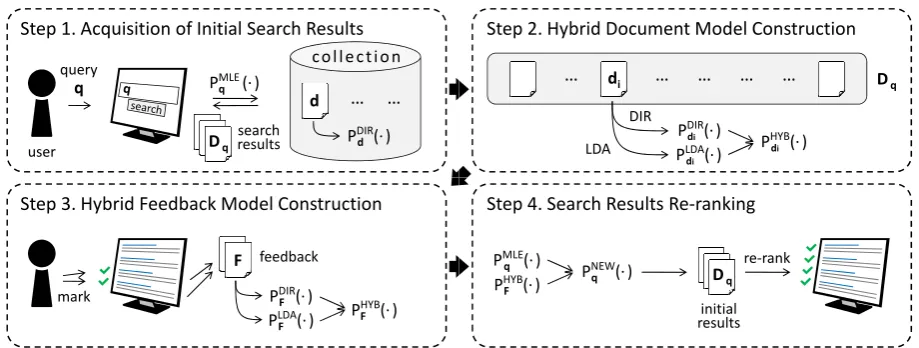
An overview of the proposed method is illustrated in Figure 1. First, when a query is submitted by a user, we obtain the initial search results (Step 1). Next, for each document in the search results, we construct a hybrid language model that contains not only the surface information, but also the la-tent information in the document (Step 2). Then, when user feedback is given, we also construct a hybrid language model for it (Step 3). Finally, we construct a new query model by interpolating the original query model with the feedback model. We also re-rank the initial search results using this new model so that documents with a similar topic dis-tribution to that of the user feedback are re-ranked higher (Step 4). In the following subsections, we describe each step in detail.
4.2 Acquisition of Initial Search Results
In the proposed method, we employ a KL-divergence retrieval model (Lafferty and Zhai, 2001) to obtain the initial search results for a given query. First, we construct the MLE-based query modelPM LE
q (·)for a queryqusing Eq.(1). Then,
for each document containingqin the collection, the KL-divergence between the DIR-based docu-ment model and the MLE-based query model is computed. That is, the score of a documentdfor a queryqis defined as follows.
initial score(d,q) =−KL(PqM LE(·)||PdDIR(·))
! " # $ % $# & $ '
" ()
* &
$# &
+ " # $ * $ '
" ()
, - & .
" ()
[image:4.595.69.529.59.233.2]/ 0 - &
Figure 1: Overview of the proposed method.
4.3 Hybrid Document Model Construction
For each document in the search results, we con-struct a hybrid language model, which we call the HYB-based language model. In this model, we take into account the latent information in docu-ments as well as the surface information.
First, an LDA-based document model that tains the latent information in the document is con-structed for each document. We perform LDA on Dq to infer the topic distribution in each
docu-ment di, and estimate the parameters α, β and
γi for eachdi as described in Section 3.2. Then,
the LDA-based document model is constructed by computing the probabilities of words givendi
us-ing Eq.(5). In this model, we can allocate high probability to words that are highly probable from the latent topic distribution of a document.
Next, for eachdi, we construct an HYB-based
document model PHY B
di (·) by interpolating the
DIR-based document model with the LDA-based document model as follows.
PdHY Bi (wj) = (1−a)PdDIRi (wj) +aP
LDA di (wj)
whereais a parameter that controls the reliability of the LDA-based document model.
This interpolation is motivated by significant improvements reported in (Wei and Croft, 2006). They also interpolate a DIR-based document model with an LDA-based document model, and perform LDA on the whole collection to construct the LDA-based document model. However, exe-cuting LDA throughout the whole collection re-quires high computational cost. In the proposed method, we can avoid this problem by performing LDA only on the set of search results, which is much smaller than the whole collection.
4.4 Hybrid Feedback Model Construction
When feedback is given, we also construct an HYB-based language model for it. First, we ob-tain feedbackF = (f1, . . . ,f|F|)that is relevant to the user’s information need. Note that, in this study, we are not concerned with whetherF is ex-plicit, imex-plicit, or pseudo feedback. Moreover, we have no preference of whether eachfi is a whole
document or part of a document (e.g., title, snip-pet).
Next, we perform LDA on F to infer the topic distribution in F, and construct the LDA-based feedback modelPLDA
F (·). To be more precise, we
generate a virtual relevant document f by com-bining eachfi, and infer the variational parameter
γfas described in Section 3.3. Then,PFLDA(·)is
constructed using Eq.(5).
Finally, we construct the HYB-based feedback model PHY B
F (·), which contains the surface and
latent information inF. PFHY B(·) is constructed
in the same manner asPdHY Bi (·). That is,
PFHY B(wj) = (1−a)PFDIR(wj) +aPFLDA(wj)
wherePFDIR(·)is constructed using Eq.(2).
4.5 Search Results Re-ranking
We construct a new query model, which is used to re-rank the initial search results. The new query model PqN EW(·) is constructed by interpolating
the original query modelPqM LE(·)with the hybrid
feedback modelPFHY B(·)as follows.
PqN EW(wj) = (1−b)PqM LE(wj) +bPFHY B(wj)
wherebis a parameter that controls the reliability
on Zhai and Lafferty’s linear combination method (see Section 2.3).
Then, for each document di in the search
re-sultsDq, we compute the KL-divergence between PdHY Bi (·)andPqN EW(·). That is, the score of
doc-umentdifor queryqand feedbackF is defined as re-ranking score(di,q,F)
=−KL(PqN EW(·)||PdHY Bi (·)).
Finally, we obtain the revised search results by re-ranking the documents inDqaccording to their
re-ranking scores. 5 Experiments
5.1 Overview
We conducted three experiments to evaluate the performance of our method. An overview of each experiment is given below.
Experiment 1. Effectiveness with Respect to Explicit and Pseudo RF
We examined how well our method performed in re-ranking the initial search results using explicit and pseudo feedback. In the experiment with ex-plicit RF, we obtained the top100documents with the highest initial scores as the initial search re-sults for a given query, and re-ranked them using our method with two relevant documents that were given explicitly. In our experiments, we employed the queries and the relevant documents provided by NTCIR (see Section 5.3). Then, we compared the results with the following three ()ranking re-sults.
INIT This is the ranking of the initial search re-sults obtained based on the KL-divergence retrieval model.
WORD This is the ranking of the search results obtained after simple RF, where we used only the surface information (i.e., words) in the feedback and the documents in the search re-sults. This ranking is equivalent to the rank-ing obtained usrank-ing our method witha= 0.
REPR This is the re-ranking result obtained us-ing Zhai and Lafferty’s RF method (Zhai and Lafferty, 2001). The process of the method is almost the same to that of WORD. The main difference is that it modifies the probabilities of words in feedback by a background word distribution (see their paper). We chose their method as it is a representative RF method for language modeling approaches.
Our method can also be applied to pseudo RF. Hence, we also explored the effectiveness of our method in this regard. With pseudo RF, the top
n documents in the initial search results are as-sumed to be relevant, and the search results are re-ranked based on this assumption. We imple-mented pseudo RF using our method for n = 10, and compared the results with the three
(re-)ranking results described above.
Experiment 2. Effect of the Amount of Feedback
It is important to know how well our method per-forms when only a small amount of feedback is obtained, because in practice users generally can-not be bothered to provide feedback, and thus sufficient feedback is rarely obtained. We inves-tigated how the amount of explicit feedback af-fected the performance of our method. To be more precise, we reduced the amount of available ex-plicit feedback little by little, and observed the change in precision at 10 top re-ranked documents (P@10). For this experiment, we used seven dif-ferent amounts of explicit feedback: 21, 20, 2−1,
2−2,2−3,2−4, and2−5relevant documents. Note
that, for example, 2−1 documents means that we used half a document’s worth of words in the rele-vant documents given as explicit feedback. In this case, half the words were sampled randomly from the feedback, and only these words were used for RF.
Experiment 3. Sensitivity to Parameters
It is also important to know how the reliability of the LDA-based document model and the HYB-based feedback model affect the performance of our method. Hence, we investigated how sensitive our method is to parametersaandb. We re-ranked
the initial search results using different values for these parameters ranging from0 to 1 in steps of 0.1, and measured how the performance of our
method changed according to these values.
5.2 Configuration of Our Method
The configuration of our method is given below. For the DIR estimation, we set the smoothing pa-rameter µ = 1,000. This setting was also
em-ployed in other works (Zhai and Lafferty, 2001; Wei and Croft, 2006). The number of topics K
for LDA was set to20, since with this setting we
rang-ing from10to100in steps of10. We set the ini-tial values ofαk(k = 1, . . . , K)to1, and the
ini-tial values ofP(wj|zk,β)to random values. The
number of iterations for the variational parame-ters and that for α and β were set to 10.
Addi-tionally, we limited the size of the vocabulary in LDA, designated asJ in Section 3, to1,000. We selected 1,000 words based on their importance
to the search results. Note that the importance of a word wj to the search resultsDq is defined
asdf(wj,Dq)∗log(|Dall|/df(wj,Dall)), where df(wj,D) represents the document frequency of wjin documentsD.
5.3 Data Set
In our experiments, we employed the test collec-tion used in the Web Retrieval Task in the Third NTCIR Workshop (Eguchi et al., 2002). The NT-CIR Workshops are a series of evaluation work-shops designed to enhance research in informa-tion access technologies. The test collecinforma-tion con-sists of11,038,720Japanese Web pages and 47
information needs. For each information need, about 2,000documents are rated as highly
rele-vant, fairly relerele-vant, partially relerele-vant, or irrele-vant. We used only40 information needs in our
experiments. The remaining7(with identification
numbers: 0011, 0018, 0032, 0040, 0044, 0047, and 0061) were not used, because we could not retrieve100documents for each (see Section 5.1).
Figure 2 gives an example of an information need for the Web Retrieval Task in the Third NT-CIR Workshop. The meaning of each element is given below.
hNUMi gives the identification number of the in-formation need.
hTITLEi provides up to three terms that are
sim-ilar to the actual query submitted to a real search engine.
hDESCi describes the user’s information need in a single sentence.
hRDOCi provides up to three identification
num-bers of examples of relevant documents for the information need.
We employed the terms in thehTITLEitag as the
query, and the documents in the hRDOCi tag as
explicit feedback. Note that since the numbers of terms and documents differed depending on the in-formation need, we employed the first two terms in
thehTITLEitag and the first two documents in the
hRDOCitag for each information need.
5.4 Evaluation Method
We used P@10, mean average precision (MAP), normalized discounted cumulative gain at 10 top (re-)ranked documents (NDCG@10), and NDCG@100 (J¨arvelin and Kek¨al¨ainen, 2002) in the evaluation. In the calculation of P@10 and MAP, documents that were rated as highly rele-vant, fairly relevant and partially relevant were re-garded as relevant, while documents rated as irrel-evant and unrated documents were regarded as ir-relevant. Note that MAP was calculated using all the (re-)ranked documents (i.e., 100documents).
In calculating NDCG, we assessed the relevance score of documents rated highly relevant, fairly relevant and partially relevant as 3, 2, and 1
re-spectively.
To evaluate the effectiveness of explicit RF, we decided in advance which documents would be used as explicit feedback as described in Section 5.3, and if these were included in the initial search results and the re-ranked results, we removed them from both sets of results. One common problem in the evaluation of the effectiveness of explicit RF is how to handle documents that users have marked as relevant (i.e., the input to RF methods) (Hull, 1993). If the initial search results and the re-ranked results are compared in a straightforward manner, the latter have an advantage. This is due to the fact that documents that are known to be rel-evant tend to be re-ranked higher. However, if we remove them from the re-ranked results, they have a disadvantage. This is especially true if there are few relevant documents. Therefore, we removed the documents used as explicit feedback from both the initial search results and the re-ranked results in the experiments with explicit RF.
In contrast, we did not apply extra care in Ex-periment 1 with pseudo RF, and measured the per-formance of each method using its raw (re-)ranked results.
5.5 Experimental Results
Experiment 1. Effectiveness with Respect to Explicit and Pseudo RF
hNUMi0008h/NUMi
hTITLEiSalsa, learn, methodsh/TITLEi
hDESCiI want to find out about methods for learning how to dance the salsah/DESCi hRDOCiNW011992774, NW011992731, NW011992734h/RDOCi
[image:7.595.313.521.155.208.2]Figure 2: Example of an information need for a Web Retrieval Task in the Third NTCIR Workshop.
Table 1: Effectiveness with respect to explicit RF.
P@10 MAP NDCG@10 NDCG@100
INIT 0.278 0.106 0.220 0.249
WORD 0.310 0.111 0.228 0.250
REPR 0.303 0.107 0.236 0.249
OURS 0.383 0.117 0.284 0.255
method witha = 0 andb = 0.7, while those for
OURS (our method) were obtained witha = 0.2
andb= 0.7.
Based on this table, we can confirm that our method is effective with respect to explicit RF. Our method significantly improved the initial search results across all metrics. Additionally, it outper-formed two other baseline RF methods, with the differences in all metrics being statistically signifi-cant (Wilcoxon signed-rank test,p <0.05). There
were no significant differences between the base-line methods, since they were similar in process to each other. These results suggest that the latent in-formation in the user feedback and each document in the search results is useful for explicit RF.
As a result of the investigation, we found that our method made good use of the words that did not appear in the feedback but were highly prob-able from the latent topic distribution of the feed-back. Consider the information need in Figure 2 as an example. The documents employed as user feedback did not contain the words “technique” or “level”, which are related to the information need. As such, the baseline methods could not use these words. In contrast, our method allocated a cer-tain degree of probability to these highly probable words using LDA, despite the words not appearing in the feedback, and hence raised the score of rel-evant documents in the search results containing these words.
Table 2 gives the results for pseudo RF. The val-ues of the parameters for WORD and OURS were determined as: a= 0, b = 0.7, anda= 0.1, b = 0.6, respectively. Note that the results of INIT in
[image:7.595.76.285.155.207.2]Table 2 differ from those in Table 1. This is be-cause although we removed the documents used as user feedback from the initial search results (and the re-ranked results) in the experiment with ex-plicit RF, we did not remove them from any of the results in this experiment.
Table 2: Effectiveness with respect to pseudo RF.
P@10 MAP NDCG@10 NDCG@100
INIT 0.298 0.112 0.243 0.268
WORD 0.303 0.111 0.258 0.274
REPR 0.300 0.112 0.250 0.270
OURS 0.330 0.112 0.283 0.278
From this table, we can see that our method sig-nificantly improved the initial search results. Ad-ditionally, our method outperformed the baseline methods. From these results, we can conclude that our method is also effective with respect to pseudo RF.
Experiment 2. Effect of the Amount of Feedback
Figure 3 shows the effect of the amount of ex-plicit feedback on the performance of our method. For comparison with baseline methods, we also present their results. The parameters for each method were identical to those used in Experiment 1 with explicit RF.
From this figure, we can see that our method achieved consistently high performance. For ex-ample, when20 relevant documents (i.e., one rel-evant document) were given as user feedback, our method improved the initial search results by about35%in P@10. Additionally, a notable fea-ture is that although the improvements in the base-line methods almost disappeared, our method per-formed well when only a small amount of feed-back was obtained. For example, improvement of about18%was achieved even with only2−5
doc-uments, which constituted an average of52words
in our experiment. The reason for this is, once again, that our method is able to use not only the surface words in the feedback, but also the highly probable words from its latent topic distribution.
!"#$# %& $' (% $ ) Figure 3: Effect of the amount of feedback.
Figure 4: Sensitivity to parametera.
Experiment 3. Sensitivity to Parameters
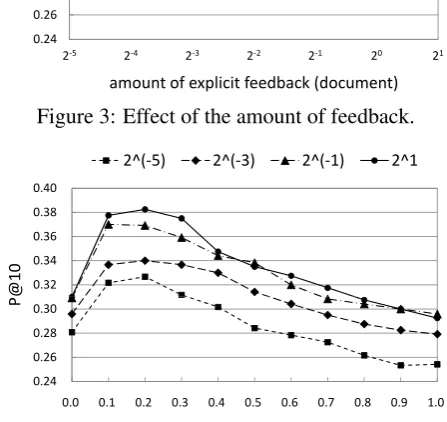
The sensitivity of the performance to a is
illus-trated in Figure 4. Each line in the figure rep-resents the results with different amounts of ex-plicit feedback: 2−5, 2−3, 2−1, and 21 relevant
documents. The value of the other parameter b
was fixed to 0.7. From this figure, we can see
that the performance of our method is sensitive to the value ofa, and that the optimal value is about 0.2. Despite the goal and setting being different
to ours, this optimal value is similar to that re-ported in (Wei and Croft, 2006), where the DIR-and LDA-based document models were interpo-lated as in our work.
The sensitivity tobis depicted in Figure 5. The
value ofawas fixed to0.2. According to this
fig-ure, we can see that the setting ofb also affected
the performance of our method. Additionally, this figure shows that if we set the value appropriately, the interpolated new query model is more effective than both the original query model on its own (i.e.,
b = 0.0) and the feedback model on its own (i.e., b = 1.0). These findings concur approximately
with the results presented in (Zhai and Lafferty, 2001).
Figure 5: Sensitivity to parameterb.
5.6 Discussion
Although our method achieved good performance in our experiments, we also encountered a prob-lem in that the method took a long time to execute. More specifically, our method required about one minute to estimate the parameters of LDA in Step 2. (On the other hand, the time required for Steps 1, 3, and 4 was only a few seconds.) Thus, we need to explore ways of reducing the time for parame-ter estimation so that our method can be used in real situations. One way of doing this is to choose a faster estimation technique. For example, col-lapsed variational methods may provide a viable solution (Teh et al., 2006; Asuncion et al., 2009). Another alternative is to decrease the size of the vocabulary, designated asJ in Section 3. For
ex-ample, we conducted an additional experiment, in which we setJ = 100, and confirmed that the time for parameter estimation fell to about 10 seconds without any significant change in performance.
6 Conclusion
[image:8.595.68.292.158.369.2]References
Arthur Asuncion, Max Welling, Padhraic Smyth, and Yee Whye Teh. 2009. On smoothing and inference for topic models. InProceedings of UAI 2009. David M. Blei, Andrew Y. Ng, and Michael I. Jordan.
2003. Latent dirichlet allocation. Jounal of Machine Learning Research, 3:993–1022.
Koji Eguchi, Keizo Oyama, Emi Ishida, Kazuko Kuriyama, and Noriko Kando. 2002. The web re-trieval task and its evaluation in the third ntcir work-shop. In Proceedings of SIGIR 2002, pages 375– 376.
Thomas L. Griffiths and Mark Steyvers. 2004. Finding scientific topics. InProceedings of NAS 2004, pages 5228–5235.
Thomas Hofmann. 1999. Probabilistic latent semantic indexing. InProceedings of SIGIR 1999, pages 50– 57.
David Hull. 1993. Using statistical testing in the eval-uation of retrieval experiments. InProceedings of SIGIR 1993, pages 329–338.
Eleanor Ide. 1971. New experiments in relevance feedback. In The SMART Retrieval System: Ex-periments in Automatic Document Processing, pages 337–354. Prentice-Hall Inc.
Bernard James Jansen, Amanda Spink, and Tefko Saracevic. 2000. Real life, real users, and real needs: a study and analysis of user queries on the web. Information Processing and Management, 36(2):207–227.
Kalervo J¨arvelin and Jaana Kek¨al¨ainen. 2002. Cumu-lated gain-based evaluation of ir techniques. ACM Transactions on Information Systems, 20(4):422– 446.
John Lafferty and Chengxiang Zhai. 2001. Document language models, query models, and risk minimiza-tion for informaminimiza-tion retrieval. InProceedings of SI-GIR 2001, pages 111–119.
Victor Lavrenko and W. Bruce Croft. 2001.
Relevance-based language models. InProceedings of SIGIR 2001, pages 120–127.
Thomas P. Minka. 2000. Estimating a dirichlet distri-bution. Technical report, Microsoft.
Jay M. Ponte and W. Bruce Croft. 1998. A language modeling approach to information retrieval. In Pro-ceedings of SIGIR 1998, pages 275–281.
Joseph John Rocchio. 1971. Relevance feedback in information retrieval. InThe SMART Retrieval Sys-tem: Experiments in Automatic Document Process-ing, pages 313–323. Prentice-Hall Inc.
Gerard Salton, Anita Wong, and Chung-Shu Yang. 1975. A vector space model for automatic indexing.
Communications of the ACM, 18(11):613–620.
Karen Sp¨arck Jones, S. Walker, and Stephen E. Robert-son. 2000. A probabilistic model of informa-tion retrieval: Development and comparative exper-iments. Information Processing and Management, 36(6):779–808,809–840.
Yee Whye Teh, David Newman, and Max Welling. 2006. A collapsed variational bayesian inference al-gorithm for latent dirichlet allocation. In Proceed-ings of NIPS 2006.
Xing Wei and W.Bruce Croft. 2006. Lda-based docu-ment models for ad-hoc retrieval. InProceedings of SIGIR 2006, pages 178–185.
Chengxiang Zhai and John Lafferty. 2001. Model-based feedback in the language modeling approach to information retrieval. In Proceedings of CIKM 2001, pages 403–410.
Chengxiang Zhai and John Lafferty. 2004. A study of smoothing methods for language models applied to information retrieval. ACM Transactions on Infor-mation Systems, 22(2):179–214.