Automatic Identification of Rhetorical Roles using Conditional
Random Fields for Legal Document Summarization
M. Saravanan
Department of CS & E
IIT Madras, Chennai-36
[email protected]
B. Ravindran
Department of CS & E
IIT Madras, Chennai-36
[email protected]
S. Raman
Department of CS & E
IIT Madras, Chennai-36
[email protected]
Abstract
In this paper, we propose a machine learning approach to rhetorical role identification from legal documents. In our approach, we annotate roles in sample documents with the help of legal experts and take them as training data. Conditional random field model has been trained with the data to perform rhetorical role identification with reinforcement of rich feature sets. The understanding of structure of a legal document and the application of mathematical model can brings out an effective summary in the final stage. Other important new findings in this work include that the training of a model for one sub-domain can be extended to another sub-domains with very limited augmenta-tion of feature sets. Moreover, we can significantly improve extraction-based summarization results by modifying the ranking of sentences with the importance of specific roles.
1
Introduction
With the availability of large number of colossal legal documents in electronic format, there is a rising need for effective information retrieval tools to assist in organizing, processing and retrieving this information and presenting them in a suitable user-friendly format. To that end, text summariza-tion is an important step for many of these larger information management goals. In recent years, much attention has been focused on the problem of understanding the structure and textual units in
this case, performing automatic segmentation of a document to understand the rhetorical roles turns out to be an important research issue. For instance, Farzindar (2004) proposed a text summarization method to manipulate factual and heuristic knowledge from legal documents. Hachey and Grover (2005) explored machine learning approach to rhetorical status classification by performing fact extraction and sentence extraction for automatic summarization of texts in the legal domain. They formalized the problem to extract most important units based on the identification of thematic structure of the document and determina-tion of argumentative roles of the textual units in the judgment. They mainly used linguistic features to identify the thematic structures.
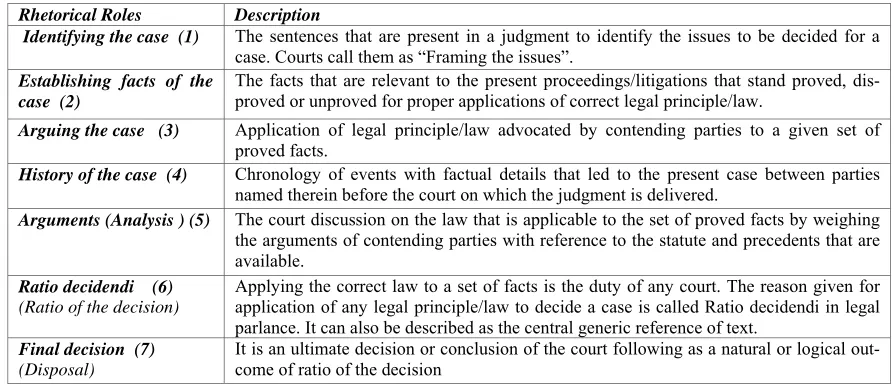
In this paper, we discuss methods for automatic identification of rhetorical roles in legal judgments based on rules and on machine learning techniques. Using manually annotated sample documents on three different legal sub-domains (rent control, income tax and sales tax), we train an undirected graphical model to segment the documents along different rhetorical structures. To represent the documents for this work, we mainly used features like cue words, state transition, named entity, position and other local and global features. The segmented texts with identified roles play a crucial part in re-ordering the ranking in the final extraction-based summary. The important sentences are extracted based on the term distribution model given in [Saravanan et al, 2006]. In order to develop a generic approach to perform segmentation, we use a fixed set of seven rhetorical categories based on Bhatia’s (1993) genre analysis shown in Table 1.
Rhetorical Roles Description
Identifying the case (1) The sentences that are present in a judgment to identify the issues to be decided for a case. Courts call them as “Framing the issues”.
Establishing facts of the case (2)
The facts that are relevant to the present proceedings/litigations that stand proved, dis-proved or undis-proved for proper applications of correct legal principle/law.
Arguing the case (3) Application of legal principle/law advocated by contending parties to a given set of
proved facts.
History of the case (4) Chronology of events with factual details that led to the present case between parties
named therein before the court on which the judgment is delivered.
Arguments (Analysis ) (5) The court discussion on the law that is applicable to the set of proved facts by weighing
the arguments of contending parties with reference to the statute and precedents that are available.
Ratio decidendi (6)
(Ratio of the decision)
Applying the correct law to a set of facts is the duty of any court. The reason given for application of any legal principle/law to decide a case is called Ratio decidendi in legal parlance. It can also be described as the central generic reference of text.
Final decision (7)
(Disposal)
It is an ultimate decision or conclusion of the court following as a natural or logical out-come of ratio of the decision
Table 1. The current working version of the rhetorical annotation scheme for legal judgments.
focus has been performing Natural Language processing tasks on newspaper and research paper domains. As a novel approach, we have tried and implemented the CRF model for role identification in legal domain. In this regard, we have first implemented rule based approach and extend this method with additional features and a probabilistic model. In another study, CRF is used as a tool to model the sequence labeling problem for summari-zation task (Shen at al., 2006). In our work, we are in the process of developing a fully automatic summarization system for a legal domain on the basis of Lafferty’s (2001) segmentation task and Teufel & Moen’s (2004) gold standard approaches. Legal judgments are different in characteristics compared with articles reporting scientific research papers and other simple domains related to the identification of basic structures of a document. To perform a summarization methodology and find out important portions of a legal document is a complex problem (Moens, 2004). Even the skilled lawyers are facing difficulty in identifying the main decision part of a law report. The genre structure identified for legal judgment in our work plays a crucial role in identifying the main decision part in the way of breaking the document in anaphoric chains. The sentence extraction task forms part of an automatic summarization system in the legal domain. The main focus of this paper is information extraction task based on the identified roles and methods of structuring summaries which has considered being a hot research topic
Most traditional rule learning algorithms are based on a divide-and-conquer strategy. SLIPPER [Cohen, 1999] is one of the standard rule learning algorithms used for information retrieval task. In SLIPPER, the ad hoc metrics used to guide the growing and pruning of rules are replaced with metrics based on the formal analysis of boosting algorithms. For each instance, we need to check each and every rule in the rule set for a given sentence. It takes more time for larger corpora (Yeh et al., 2005). Now we will discuss the importance of identifying rules in the data collection by various methods available for rule learning in the next section.
2
Text Segmentation Algorithms
We explain two approaches to text segmentation for identifying the rhetorical roles in legal judgments. The focus of the first approach is on a rule-based method with novel rule sets which we fine-tuned for legal domains. That is, we frame text segmentation as a rule learning problem. The proposed rule-based method can be enhanced with additional features and a probabilistic model. An undirected graphical model, Conditional Random Field (CRF) is used for this purpose. It shows significant improvement over the rule-based method. The explanation of these methods is given in the following sections.
compared to other rule learning algorithms even for a two-class problem. If we need to consider more than two classes and to avoid overfitting of ensemble of rules, one has to think of grouping the rules in a rule set and some chaining mechanism has to be followed. Another rule learning algorithm RuleFit (Friedman & Popescu, 2005) generates a small comprehensible rule set which is used in ensemble learning with larger margin. In this case, overfitting may happen, if the rule set gets too large and thus some form of control has to be maintained. Our main idea is to find a preferably small set of rules with high predictive accuracy and with marginal execution time.
We propose an alternative rule learning strategy that concentrates on classification of rules and chaining relation in each rhetorical role (Table 1) based on the human annotation schemes. A chain relation is a technique used to identify co- occurrences of roles in legal judgments. In our approach, rules are conjunctions of primitive conditions. As used by the boosting algorithms, a rule set R can be any hypothesis that partitions the set of instance X into particular role categorization; the set of instances which satisfy any one of seven different set of categorized roles. We start by generating rules that describe the original features found in the training set. Each rule outputs 1 if its condition is met, 0 if it is not met. Let us now define for a sample document X = (S1, S2,….,Sm) of size m, we assume that the set of rules R = {r
The CRF model-based retrieval system designed in this paper will depict the way a human can summa-rize a legal judgment by understanding the importance of roles and related contents. Conditional Random Fields is one of the recently emerging graphical models which have been used for text segmentation problems and proved to be one of the best available frame works compared to other existing models (Lafferty, 2001). A judgment can be regarded as a sequence of sentences that can be segmented along the seven rhetorical roles where each segments is relatively coherent in content. We use CRF as a tool to model the text segmentation problem. CRFs are undirected graphical models used to specify the conditional probabilities of possible label sequences given an observation sequence. More-over, the conditional probabilities of label sequences can depend on arbitrary, non independ-ent features of the observation sequence, since we are not forming the model to consider the distribution of those dependencies. In a special case in which the output nodes of the graphical model are linked by edges in a linear chain, CRFs make a first-order Markov independence assumption with binary feature functions, and thus can be understood as conditionally-trained finite state machines (FSMs) which are suitable for se-quence labeling. outline of our method is given below.
Procedure Test (X) If there exist a rule which satisfies then X(i,j) gets a value 1
Else
X(i,j) gets a value {1,0} based on chain relation S(k) = L (argmax Σ(X(i,j)))
j i
2.2 Conditional Random Fields and Features
1,C2,…..} defines a conditional probability for a label sequence l = l1,…..lw (e.g., Establishing
“points for consideration” belongs to s at position t in the sequence. Large positive values for Ck indicate a preference for such an event, while large negative values make the event unlikely and near zero for relatively uninformative features. These weights are set to maximize the conditional log likelihood of labeled sequence in a training set D = {( s
State Transition features - In CRFs, state
transitions are also represented as features (Peng & McCullam, 2006). The feature function f
t, lt) : t = 1,2,…w), written as:
LC (D) = ∑log PC(li | si) i
w m
= ∑ (∑∑ Ck fk (lt-1, lt. s, t) - log Zsi )...(2) i
t=1 k=1
The training state sequences are fully labeled and definite, the objective function is convex, and thus the model is guaranteed to find the optimal weight settings in terms of LC (D). The probable labeling sequence for an input si can be efficiently calculated by dynamic programming using modified Viterbi algorithm. These implementa-tions of CRFs are done using newly developed java classes which also use a quasi-Newton method called L-BFGS to find these feature weights efficiently. In addition to the following standard set of features, we also added other related features to reduce the complexity of legal domain.
Legal vocabulary features - One of the simplest
and most obvious set of features is decided using the basic vocabularies from a training data. The words that appear with capitalizations, affixes, and in abbreviated texts are considered as important features. Some of the phrases that include v. and
act/section are the salient features for arguing the case and arguments categories.
We have gathered a corpus of legal judgments up to the year 2006 which were downloaded from www.keralawyer.com specific to the sub-domains of rent control, income tax and sales tax. Using the manually annotated subset of the corpus (200 judgments) we have performed a number of preliminary experiments to determine which method would be appropriate for role identifica-tion. The annotated corpus is available from iil.cs.iitm.ernet.in/datasets. Even though, income tax and sales tax judgments are based on similar facts, the number of relevant legal sections / provisions are differ. The details and structure of judgments related to rent control domain are not the same compared to income tax and sales tax domains. Moreover, the roles like ratio decidendi and final decision occur many times spread over the full judgment in sales tax domain, which is comparatively different to other sub-domains. We have implemented both the approaches on rent control domain successfully. We found that the other sub-domains need specific add-on features which improve the result by an additional 20%. Based on this, we have introduced additional features and new set of rules for the income tax and sales tax related judgments. The modified rule set and additional features are smaller in number, but create a good impact on the rhetorical status
Indicator/cue phrases – The term ‘cue phrase’
indicates the key phrases frequently used which are the indicators of common rhetorical roles of the sentences (e.g. phrases such as “We agree with court”, “Question for consideration is”, etc.,). In this study, we encoded this information and generated automatically explicit linguistic features. Feature functions for the rules are set to 1 if they match words/phrases in the input sequence exactly.
Named entity recognition - This type of
recognition is not considered fully in summarizing scientific articles (Teufel & Moens, 2002). But in our work, we included few named entities like Supreme Court, Lower court etc., and generate binary-valued entity type features which take the value 0 or 1 indicating the presence or absence of a particular entity type in the sentences.
Local features and Layout features - One of the
main advantages of CRFs is that they easily afford the use of arbitrary features of the input. One can encode abbreviated features; layout features such as position of paragraph beginning, as well as the
sentences appearing with quotes, all in one framework.
k (lt-1, lt. s, t) in Eq. (1) is a general function over states and observations. Different state transition features can be defined to form different Markov-order structures. We define state transition features corresponding to appearance of years attached with Section and Act nos. related to the labels arguing the case and arguments.
Precision Recall F-measure Rhetorical Roles
Slipper Rule-based
CRF Slipper Rule-based
CRF Slipper Rule-based
CRF
Identifying the case 0.641 0.742 0.846 0.512 0.703 0.768 0.569 0.722 0.853
Establishing the facts of the case 0.562 0.737 0.824 0.456 0.664 0.786 0.503 0.699 0.824
Arguing the case 0.436 0.654 0.824 0.408 0.654 0.786 0.422 0.654 0.805
History of the case 0.841 0.768 0.838 0.594 0.716 0.793 0.696 0.741 0.815
Arguments 0.543 0.692 0.760 0.313 0.702 0.816 0.397 0.697 0.787
Ratio of decidendi 0.574 0.821 0.874 0.480 0.857 0.903 0.523 0.839 0.888
Rent Control Domain
Final Decision 0.700 0.896 0.986 0.594 0.927 0.961 0.643 0.911 0.973
Micro-Average of F-measure 0.536 0.752 0.849
Precision Recall F-measure Rhetorical Roles
Slipper Rule-based
CRF Slipper Rule-based
CRF Slipper Rule-based
CRF
Identifying the case 0.590 0.726 0.912 0.431 0.690 0.852 0.498 0.708 0.881 Establishing the facts of the case 0.597 0.711 0.864 0.512 0.659 0.813 0.551 0.684 0.838 Arguing the case 0.614 0.658 0.784 0.551 0.616 0.682 0.581 0.636 0.729 History of the case 0.437 0.729 0.812 0.418 0.724 0.762 0.427 0.726 0.786 Arguments 0.740 0.638 0.736 0.216 0.599 0.718 0.334 0.618 0.727 Ratio of decidendi 0.416 0.708 0.906 0.339 0.663 0.878 0.374 0.685 0.892 Income
Tax Domain
Final Decision 0.382 0.752 0.938 0.375 0.733 0.802 0.378 0.742 0.865 Micro-Average of F-measure 0.449 0.686 0.817
Precision Recall F-measure Rhetorical Roles
Slipper Rule-based
CRF Slipper Rule-based
CRF Slipper Rule-based
CRF
Identifying the case 0.539 0.675 0.842 0.398 0.610 0.782 0.458 0.641 0.811 Establishing the facts of the case 0.416 0.635 0.784 0.319 0.559 0.753 0.361 0.595 0.768 Arguing the case 0.476 0.718 0.821 0.343 0.636 0.747 0.399 0.675 0.782 History of the case 0.624 0.788 0.867 0.412 0.684 0.782 0.496 0.732 0.822 Arguments 0.500 0.638 0.736 0.438 0.614 0.692 0.467 0.626 0.713 Ratio of decidendi 0.456 0.646 0.792 0.318 0.553 0.828 0.375 0.596 0.810 Sales Tax
Domain
Final Decision 0.300 0.614 0.818 0.281 0.582 0.786 0.290 0.598 0.802 Micro-Average of F-measure 0.407 0.637 0.787
classification in the sales tax and income tax domains. It is common practice to consider human performances as an upper bound for most of the IR tasks, so in our evaluation, the performance of the system has been successfully tested by matching with human annotated documents.
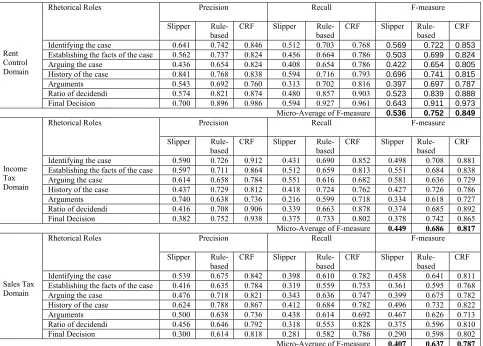
Kappa (Siegal & Castellan, 1988) is an evaluation measure used in our work to compare the inter-agreement between sentences extracted by two human annotators for role identification in legal judgments. The value (K=0.803) shows the good reliability of human annotated corpus. The results given in Table 2 show that CRF-based and rule-based methods perform well for each role categories compared to SLIPPER method. CRF-based method performs extremely well and paired t-test result indicates that it is significantly (p < .01) higher than the other two methods on rhetorical role identification for legal judgments belonging to rent control, income tax and sales tax
Figure 1 shows that the distribution of the seven categories is very much skewed, with 60% of all sentences being classified as history of the case. Basically it includes the remaining contents of the
Table 2. Precision, Recall and F-measure for seven rhetorical roles
sub-domains. In this experiment, we also made an effort to understand the annotation of relevance of seven rhetorical categories.
Figure 1. Distribution of rhetorical roles (10 entire
documents from rent control sub-domain)
1 1 2%%
2 9% 4%3
4 60% 5
19% 6 5%
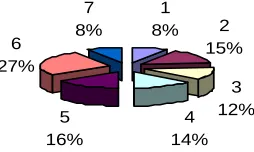
document other than the six categories. In this case, we have calculated the distribution among 10 judgments related to rent control documents. Figure 2 shows the rhetorical category distribution among the 10 different summaries from rent control domain. This shows that the resulting category distribution is far more evenly distributed than the one covering all sentences in Figure 1. Ratio of decidendi and final decision are the two most frequent categories in the sentences extracted from judgments. The label numbers men-tioned in the Figures denote the rhetorical roles which as defined in Table 1.
The automatic text summarization process starts with sending legal document to a preprocessing stage. In this preprocessing stage, the document is
to be divided into segments, sentences and tokens. We have introduced some new feature identifica-tion techniques to explore paragraph alignments. This process includes the understanding of abbreviated texts and section numbers and argu-ments which are very specific to the structure of legal documents. The other useful statistical natural language processing tools, such as filtering out stop list words, stemming etc., are carried out in the preprocessing stage. The resulting intelligible words are useful in the normalization of terms in the term distribution model (Saravanan et al., 2006). During the final stage, we have altered the ranks or removed some of the sentences from the final summary based on the structure discovered using CRF. The summarization module architecture is shown in Figure 3.
1
8% 2
15%
3 12% 4 14% 5
16% 6 27%
7 8%
Figure 2. Distribution of rhetorical roles (10
different summaries from rent control sub-domain)
The application of term distribution model brings out a good extract of sentences present in a legal document to generate a summary. The sentences with labels identified during CRF implementation can be used with the term distribution model to give more significance to some of the sentences with specific roles. Moreover, the structure details available in this stage are useful in improving the coherency and readability among the sentences present in the summary.
3
Legal Document Summarization
Extraction of sentences in the generation of a summary at different percentage levels of text is one of the widely used methods in document summarization (Radev et al., 2002). For the legal domain, generating a summary from the original judgment is a complex problem. Our approach to produce the summary is extraction-based method which identifies important elements present in a legal judgment. The identification of the document structure using CRF-model categorizes the key ideas from the details of a legal judgment. The genre structure has been applied to final summary to improve the readability and coherence. In order to evaluate the effectiveness of our summarizer, we have applied four different measures to look for a match on the model summary generated by humans (head notes) from the text of the original judgments.
Extrinsic and intrinsic are the two different evaluation strategies available for text summariza-tion (Sparck Jones & Gablier, 1996). Intrinsic measure shows the presence of source contents in the summary. F-measure and MAP are two standard intrinsic measures used for the evaluation of our system-generated summary. We have also used ROUGE evaluation approach (Lin, 2004) which is based on n-gram co-occurrences between
3.1 Applying term distribution model
Legal
Documents Segmented text with labels (CRF imple-mentation)
Pre-processing
Term distri-bution model
Summary with ratio & final decision
Figure 3. Architectural view of summarization
system.
In this paper, we have applied ROUGE-1 and ROUGE-2 which are simple n-gram measures. We compared our results with Microsoft, Mead Summarizer (Radev et al., 2003) and other two simple baselines: one which chooses 15% of words of the beginning of the judgment and second chooses last 10% of words of the judgment with human reference summaries. Both the baselines defined in this study are standard baselines for newspaper and research domains. The result shown in Table 3 highlights the better performances of our summarizer compared to other methods considered in this study. We can see that the results of MEAD and WORD summaries are not at the expected level, while our summarizer is best in terms of all four evaluation measures. Results are clearly indicated that our system performs significantly better than the other systems for legal judgments.
We would like to thank the legal fraternity for the assistance and guidance governs to us. Especially we express our sincere gratitude to the advocates Mr. S.B.C. Karunakaran and Mr. K.N. Somasunda-ram for their domain advice and continuous guidance in understanding the structure of legal document and for hand annotated legal judgments.
Table 3. MAP, F-measure and ROUGE scores.
4
Conclusion
This paper describes a novel method for generating a summary for legal judgments with the help of undirected graphical models. We observed that rhetorical role identification from legal documents is one of the primary tasks to understand the structure of the judgments. CRF model performs much better than rule based and other rule learning method in segmenting the text for legal domains. Our approach to summary extraction is based on the extended version of term weighting method. With the identified roles, the important sentences generated in the probabilistic model will be reordered or suppressed in the final summary. The evaluation results show that the summary generated by our summarizer is closer to the human generated head notes, compared to the other methods considered in this study. Hence the legal
community will get a better insight without reading a full judgment. Moreover, our system-generated summary is more useful for lawyers to prepare the case history related to presently appearing cases.
Dou Shen, Jian-Tao Sun, Hua Li, Qiang Yang, and Zheng Chen. 2007. Document Summarization using
Conditional Random Fields. International Joint
Conference on Artificial Intelligence, IJCAI 2007, Hyderabad, India, PP.2862-2867.
Acknowledgement
References
Atefeh Farzindar and Guy Lapalme. 2004. Legal text summarization by exploration of the thematic
structures and argumentative roles, In Text
sum-marization Branches out workshop held in conjunc-tion with ACL 2004, pages 27-34, Barcelona, Spain.
MAP F-
meas-ure
ROU GE-1
ROU GE-2
Baseline 1 0.370 0.426 0.522 0.286 Baseline 2 0.452 0.415 0.402 0.213 Microsoft
Word 0.294 0.309 0.347 0.201
Mead 0.518 0.494 0.491 0.263
Our system 0.646 0.654 0.685 0.418
Atefeh Farzindar and Guy Lapalme. 2004. Letsum, an
automatic legal text summarizing system, Legal
Knowledge and Information System, Jurix 2004: The Seventeenth Annual Conference, Amsterdam, IOS Press, PP.11-18.
Ben Hachey and Claire Grover. 2005. Sequence Model-ing for sentence classification in a legal
summariza-tion system, Proceedings of the 2005 ACM
sympo-sium on Applied Computing.
Bhatia, V.K., 1999. Analyzing Genre: Language Use in
Professional Settings, London, Longman.
Cohen,W., and Singer, Y. 1999. A simple, fast, and
effective rule learner, Proceedings of the Sixteenth
National Conference on Artificial Intelligence (AAAI-99), AAAI Press, pp.335-342.
Dragomir Radev, Eduard Hovy, Kathleen McKeown. 2002. Introduction to the special issue on
summari-zation, Computational Linguistics 28(4)4,
Associa-tion for Computing Machinery.
Friedmen, J.H., & and Popescu, B. E. 2005. Predictive
learning via rule ensembles (Technical Report),
Stanford University.
Fuchun Peng and Andrew McCullam, 2006. Accurate information extraction from research papers using
conditional random fields, Information Processing
Management, 42(4): 963-979.
John Lafferty, Andrew McCullam and Fernando Pereira, 2001. Conditional Random Fields: Probabil-istic models and for segmenting and labeling
sequence data, Proceedings of international
conference on Machine learning.
Karen Sparck Jones and Julia Galliers. 1996. Evaluating Natural Language Processing Systems: An Analysis
and Review. Natural Language Engineering,
4(2):175–190, Springer-Verlag.
Lin, Chin-Yew. 2004. ROUGE: a Package for
Automatic Evaluation of Summaries, Proceedings of
Workshop on Text Summarization, pp: 21--26, Bar-celona, Spain.
Marie-Francine Moens, 2004. An Evaluation Forum for
Legal Information Retrieval Systems? Proceedings
of the ICAIL-2003 Workshop on Evaluation of Legal Reasoning and Problem-Solving Systems (pp. 18-24). International Organization for Artificial In-telligence and Law.
Saravanan , M., Ravindran, B. and Raman, S. 2006. A Probabilistic Approach to Multi-document
summari-zation for generating a Tiled Sumamry, International
Journal of Computational Intelligence and Applica-tions, 6(2): 231-243, Imperial College Press.
Saravanan , M., Ravindran, B. and Raman, S. 2006. Improving legal document Summarization using
graphical models, Legal Knowledge and Information
System, JURIX 2006: The Nineteenth Annual Con-ference, Paris, IOS Press, PP.51-60.
Siegal, Sidney and N.John Jr. Castellan. 1988.
Non-parametric statistics for the behavioral sciences,
McGraw Hill, Berkeley, CA.
Simone Teufel and Marc Moens, 2002. Summarizing scientific articles – experiments with relevance and
rhetorical status, Association of Computational
Linguistics, 28(4): 409-445.
Yen-Yuan Yeh, Hao-Ren Ke, Wei-Pang Yang, and I-Heng Meng, 2005. Text summarization using a
trainable summarizer and latent semantic analysis,