A Correlational Encoder Decoder Architecture for Pivot Based Sequence
Generation
Amrita Saha
IBM Research India
Janarthanan Rajendran
I.I.T. Madras, India
Mitesh M. Khapra
I.I.T. Madras, India
Sarath Chandar
University of Montreal
Kyunghyun Cho
New York University
Abstract
Interlingua based Machine Translation (MT) aims to encode multiple languages into a common linguistic representation and then decode sentences in multiple target languages from this repre-sentation. In this work we explore this idea in the context of neural encoder decoder architectures, albeit on a smaller scale and without MT as the end goal. Specifically, we consider the case of three languages or modalitiesX,Z andY wherein we are interested in generating sequences in
Y starting from information available inX. However, there is no parallel training data available betweenX andY but, training data is available betweenX & Z andZ &Y (as is often the case in many real world applications).Z thus acts as a pivot/bridge. An obvious solution, which is perhaps less elegant but works very well in practice is to train a two stage model which first converts fromX toZ and then fromZ toY. Instead we explore an interlingua inspired solu-tion whichjointly learnsto do the following (i) encode X andZ to a common representation and (ii) decodeY from this common representation. We evaluate our model on two tasks: (i) bridge transliteration and (ii) bridge captioning. We report promising results in both these ap-plications and believe that this is a right step towards truly interlingua inspired encoder decoder architectures.
1 Introduction
Interlingua based MT (Nirenburg, 1994; Dorr et al., 2010) relies on the principle that every language in the world can be mapped to a common linguistic representation. Further, given this representation, it should be possible to decode a target sentence in any language. This implies that givennlanguages we just needndecoders andnencoders to translate between thesenC2 language pairs. Note that even
though we take inspiration from interlingua based MT, the focus of this work is not on MT. We believe that this idea is not just limited to translation but could be applicable to any kind of conversion involving multiple source and target languages and/or modalities (for example, transliteration, multilingual image captioning, multilingual image Question Answering,etc.). Even though this idea has had limited success, it is still fascinating and considered by many as the holy grail of multilingual multimodal processing.
It is interesting to consider the implications of this idea when viewed in the statistical context. For example, current state of the art statistical systems for MT (Koehn et al., 2003; Chiang, 2005; Luong et al., 2015b), transliteration (Finch et al., 2015; Shao et al., 2015; Nicolai et al., 2015), image captioning (Vinyals et al., 2015b; Xu et al., 2015),etc. require parallel data between the source and target views (where a view could be a language or some other modality like image). Thus, givennviews, we require
nC
2parallel datasets to build systems to convert from any source view to any target view. Obviously, this
does not scale well in practice because it is hard to find parallel data between allnC2 views. For
exam-ple, publicly available parallel datasets for transliteration (Zhang et al., 2012) cater to<20 languages. Similarly, publicly available image caption datasets are available only for English1and German2.
This work is licenced under a Creative Commons Attribution 4.0 International Licence. Licence details: http://creativecommons.org/licenses/by/4.0/
1http://mscoco.org/dataset/#download
2http://www.statmt.org/wmt16/multimodal-task.html
This problem of resource scarcity could be alleviated if we could learn only nstatistical encoders andnstatistical decoders wherein (i) the encoded representation is common across languages and (ii) the decoders can decode from this common representation (akin to interlingua based conversion). As a small step in this direction, we consider a scaled down version of this genericnC
2conversion problem.
Specifically, we consider the case where we have three viewsX,Z,Y but parallel data is available only betweenXZandZY (instead of all3C2parallel datasets). At test time, we are interested in generating
natural language sequences inY starting from information available inX. We refer to this as the bridge setup as the languageZhere can be considered to be a bridge/pivot betweenXandY.
An obvious solution to the above problem is to train a two-stage system which first converts fromX
toZ and then fromZ to Y. While this solution may work very well in practice (as our experiments indeed suggest) it is perhaps less elegant and becomes tedious as the number of views increases. For example, consider the case of converting fromXtoZ toRtoY. Instead, we suggest a neural network based model which simultaneously learns the following (i) a common representation forX andZ and (ii) decodingY from this common representation. In other words, instead of training two independent models using the datasets betweenXZ andZY, the model jointly learns from the two datasets. The resulting common representation learned for X andZ can be viewed as a vectorial analogue of the linguistic representation sought by interlingua based approaches. Of course, by no means do we suggest that this vectorial representation is a substitute for the rich linguistic representation but its easier to learn from parallel data (as opposed to a linguistic representation which requires hand crafted resources).
Note that our work should not be confused with the recent work of (Firat et al., 2016), (Zoph and Knight, 2016) and (Elliott et al., 2015). The last two works in fact require 3-way parallel data between
X,Z andY and learn to decode sequences inY given bothXandZ. For example, at test time, (Elliott et al., 2015) generate captions in German, given both (i) the image and (ii) its corresponding English caption. This is indeed very different from the problem addressed in this paper. Similarly, even though (Firat et al., 2016) learn a single encoder per language and a single decoder per language they do not learn shared representations for multiple languages (only the attention mechanism is shared). Further, in all their experiments they require parallel data between the two languages of interest. Specifically, they do not consider the case of generating sentences inY given a sentence in X when no parallel data is available betweenXandY.
We present an empirical comparison of jointly trained models which explicitly aim for shared en-coder representations with two-stage architectures. We consider two downstream applications (i) bridge transliteration and (ii) bridge caption generation. We use the standard NEWS 2012 dataset (Zhang et al., 2012) for transliteration. We consider transliteration between 12 languages pairs (XY) using English as the bridge (Z). Bridge caption generation is a new task introduced in this paper where the aim is to generate French captions for an image when no Image-French(XY) parallel data is available for training. Instead training data is available between Image-English (XZ) and English-French (ZY). In both these tasks we report promising results. In fact, in our multilingual transliteration experiments we are able to beat the strong two-stage baseline in many cases. These results show potential for further research in interlingua inspired neural network architectures. We do acknowledge that a successful interlingua based statistical solution requiring onlynencoders andndecoders is a much harder task whereas our work is only a small step in that direction.
2 Related Work
al., 2015a), speech recognition (Chorowski et al., 2015), image captioning (Xu et al., 2015) among other applications. All the above mentioned works focus only on the case when there is one source and one target. The source can be image, text, or speech signal but the target is always a text sequence.
Encoder decoder models in a multi-source, single target setting have been explored by (Elliott et al., 2015) and (Zoph and Knight, 2016). Specifically, Elliott et al. (2015) try to generate a German caption from an image and its corresponding English caption. Similarly, Zoph and Knight (2016) focus on the problem of generating English translations given the same sentence in both French and German. We would like to highlight that both these models require three-way parallel data while we are focusing on situations where such data is not available. Single source, multi-target and multi-source, single target settings have been considered in (Luong et al., 2015a). Recent work by Firat et al. (2016) explores multi-source to multi-target encoder decoder models in the context of MT. However, Firat et al. (2016) focus on multi-task learning with a shared attention mechanism and the goal is to improve the MT performance for a pair of languages for which parallel data is available. This is clearly different from the goal of this paper which is to design encoder decoder models for a pair of languages where no parallel data is available but data is available only between each of these languages and a bridge language.
Of course, in general the idea of pivot/bridge/interlingua based conversion is not new and has been used previously in several non-neural network settings. For example (Khapra et al., 2010) use a bridge language or pivot language to do machine transliteration. Similarly, (Wu and Wang, 2007; Zhu et al., 2014) do pivot based machine translation. Lastly, we would also like to mention the work in interlingua based Machine Translation (Nirenburg, 1994; Dorr et al., 2010) which is clearly the inspiration for this work even though the focus of this work is not on MT.
The main theme explored in this paper is to learn a common representation for two views with the end goal of generating a target sequence in a third view. The idea of learning common representations for multiple views has been explored well in the past (Klementiev et al., 2012; Chandar et al., 2014; Hermann and Blunsom, 2014; Chandar et al., 2016; Rajendran et al., 2015). For example, Andrew et al. (2013) propose Deep CCA for learning a common representation for two views. (Chandar et al., 2014; Chandar et al., 2016) propose correlational neural networks for common representation learning and Rajendran et al. (2015) propose bridge correlational networks for multilingual multimodal representation learning. From the point of view of representation learning, the work of Rajendran et al. (2015) is very similar to our work except that it focuses only on representation learning and does not consider the end goal of generating sequences in a target language.
3 Models
As mentioned earlier, one of the aims of this work is to compare a jointly trained model with a two stage model. We first briefly describe such a two stage encoder decoder architecture and then describe our model which is a correlation based jointly trained encoder decoder model.
3.1 A two stage encoder-decoder model
A two stage encoder-decoder is a straight-forward extension of sequence to sequence models (Cho et al., 2014; Sutskever et al., 2014) to the bridge setup. Given parallel data betweenXZ andZY, a two stage model will learn a generative model for each of the pairs independently. For the purpose of this work, the source can be an image or text but the target is always a natural language text. For encoding an image, we simply take its feature representation obtained from one of the fully connected layers of a convolutional neural network and pass it through a feed-forward layer. On the other hand, for encoding the source text sequence, we use a recurrent neural network. The decoder is always a recurrent neural network which generates the text sequence, one token at a time.
Let the two training sets be D1 = {xi, zi}Ni=11 andD2 = {zi, yi}Ni=12 where xi ∈ X, yi ∈ Y and
zi ∈ Z. Given D1, the first encoder learns to encode xi and decode the corresponding zi from this
encoded representation. The second encoder is trained independently of the first encoder and uses D2
to encode zi ∈ Z and decode the corresponding yi ∈ Y from this encoded representation. These
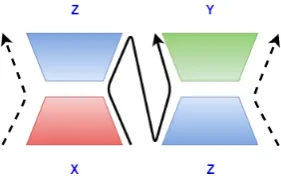
Figure 1: Two stage encoder-decoder model. Dashed lines denote how the model is used during train-ing time and solid line denotes the test time usage. We can see that two encoder-decoders are trained independently but used jointly during testing.
stages are run sequentially. In other words, given xj, we first encode it and decodezj from it using
the first encoder-decoder model. This decodedzj is then fed to the second encoder-decoder model to
generateyj. This sequential test process is indicated by solid arrows in Figure 1.
While this two stage encoder-decoder model is a trivial extension of a single encoder-decoder model, it serves as a very strong baseline as we will see later in the experiments section.
3.2 A correlation based joint encoder-decoder model
While the above model works well in practice, it becomes cumbersome when more views are involved (for example, when converting fromU toXtoY toZ). We desire a more elegant solution which could scale even when more views are involved (although for the purpose of this work, we restrict ourselves to 3 views only). To this end, we propose a joint model which uses the parallel dataD1(as defined above) to
learn one encoder each forXandZsuch that the representations ofxiandziare correlated. In addition
and simultaneously the model usesD2 and learns to decodeyj fromzj. Note that this joint training has
the advantage that the encoder forZbenefits from instances inD1andD2.
Having given an intuitive explanation of the model, we now formally define the objective functions used during training. GivenD1 ={xi, zi}Ni=11 , the model tries to maximize the correlation between the
encoded representations ofxiandzi defined as
Jcorr(θ) =−λcorr(s(hX(X)), s(hZ(Z))) (1)
wherehXis the representation computed by the encoder forXandhZis the representation computed
by the encoder forZ. As mentioned earlier, these encoders could be RNN encoders (in the case of text) and simple feedforward encoders (in the case of images).s()is a standardization function which adjusts the hidden representationshX andhY so that they have zero-mean and unit-variance. Further, λis a
scaling hyperparameter andcorris the correlation function defined as
N X
i=1
s(hX(xi))s(hZ(zi))T (2)
We would like to emphasize thats()ensures that the representations already have zero mean and unit variance and hence no separate standardization is required while computing the correlation. In addition to the above loss function, givenD2 ={zi, yi}Ni=12 , the model minimizes the cross entropy loss
Jce(θ) = N1 2
N2
X
k=1
P(yk|zk); P(yk|zk) = L Y
i=1
P(yki|yk<i, zk) (3)
whereLis the number of tokens inyk.
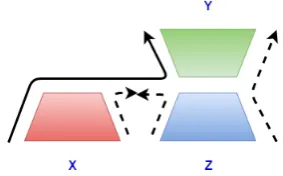
The dotted lines in Figure 2 show the joint training process where the model simultaneously learns to compute correlated representations forxiandziand decodeyifromzi. The testing process is shown by
the solid lines wherein the model computes a hidden representation forxi and then decodesyi from it
Figure 2: Correlated encoder-decoder model. Dashed lines denote how the model is used during training time and solid line denotes the test time usage. We can see that during training, both the encoders are trained to produce correlated representations and the decoder forY is trained based on encoderZ. During test time only encoder forXand decoder forY are used.
While training, we alternately pick mini-batches fromD1andD2and use the corresponding objective
function. Means and variances for the representations computed by the two encoders are updated at the end of every epoch based on the hidden representations of all instances in the training data. During the first epoch we assume the mean and variance to be 0 and 1. Note that λrescales the value of the correlation loss term so that it is in the same range as the value of the cross-entropy loss term.
4 Experiment 1: Bridge Transliteration
We consider the task of transliteration between two languagesXandY when no direct data is available between them but parallel data is available betweenX&Z andZ&Y. In the following subsections we describe the datasets used for our task, the hyperparameters considered for our experiments and results.
4.1 Datasets
We consider transliteration between 4 languages, viz., Hindi, Kannada, Tamil and Marathi resulting in 4C
2 = 12 language pairs. However, we do not use any direct parallel data between any of these
languages. Instead we use the standard datasets available between English and each of these languages which were released as part of the NEWS 2012 shared task (Zhang et al., 2012). Just to be explicit, for the task of transliterating from Hindi to Kannada, we constructD1 from the English-Hindi dataset and
D2from the English-Kannada dataset. The size of the training set (in words) for the four language pairs
English-Hindi, English-Kannada, English-Marathi and English-Tamil is 19918, 16556, 8500 and 16857 respectively and the validation and test set sizes (in words) are 500 and 1000 respectively. Fortunately, the English portion of the test set was common across all these four language pairs, thus allowing us to easily create test sets for all the 12 language pairs. For example, ifhi is the transliteration of the
English wordeiin the English-Hindi test set andkiis the transliteration of the same English wordei in
the English-Kannada test set then we add(hi, ki)as a transliteration pair in our Hindi-Kannada test set.
In this way, we created test sets containing 1000 words for all the 12 language pairs.
4.2 Hyperparameters
For the two stage encoder decoder model, we considered the following hyperparameters: embedding size∈ {1024, 2048}for characters, rnn hidden unit size∈ {1024, 2048}, initial learning rate∈ {0.01, 0.001}and batch size∈ {32, 64}. The numbers in bracket indicate the distinct values that we considered for each hyperparameter. Note that the embedding size and rnn size are always kept equal. All these parameters were tuned independently for the two stages using their respective validation sets. For the correlated encoder decoder model, in addition to the above hyperparameters we also hadλ∈[0.1, 1.0] as a hyperparameter. Here, we tuned the hyperparameters based on the performance on the validation set available betweenZY (since the correlated encoder decoder can also decodeyi ∈Y fromzi∈Z). Note
Two Stage PBSMT
PPPsrc PtgtP Hi Ka Ta Ma
Hi 36.3 33.2 33.6
Ka 41.3 32.1 26.2
Ta 30.5 25.8 19.2
Ma 46.9 33.7 30.9
Two Stage Encoder Decoder
PPPsrc tgtPP Hi Ka Ta Ma
Hi 42.1 43.4 34.8
Ka 46.2 42.9 30.7
Ta 37.5 34.8 23.8
Ma 45.8 34.9 31.7
Correlational Encoder Decoder
PPPsrc tgtPP Hi Ka Ta Ma
Hi 43.1 40.6 40.9
Ka 47.5 40.2 27.9
Ta 33.6 27.7 17.0
[image:6.595.71.530.70.130.2]Ma 59.0 37.1 34.5
Table 1: Transliteration Accuracy on the 12 language pairs involving (Hindi,Kannada,Tamil,Marathi) for the three comparative methods (Two Stage PBSMT, Two Stage Encoder Decoder and the proposed Correlational Encoder Decoder model. An underlined number in this table signifies that for that specific language pair the corresponding system is performing better than the Two Stage PBSMT model and the best performing system for any of the language-pairs is represented inboldfont
System En-Hi En-Ka En-Ta Accuracy (%) of Source-Target PairEn-Ma Hi-En Ka-En Ta-En Ma-En
PBSMT 51.7 45.3 50.0 30.2 51.1 47.9 41.4 35.0
Encoder-Decoder 61.6 53.7 57.7 38.0 57.3 54.5 46.2 31.1
Table 2: Transliteration accuracy of the PBSMT system and the Encoder-Decoder model on the 4 Indian languages (Hindi,Kannada,Tamil,Marathi) when transliterated from English and to English
4.3 Results
We compare our model with the following systems:
1. Two Stage PBSMT: Here, we train two PBSMT (Koehn et al., 2003) based transliteration systems usingD1andD2. This is an additional baseline to see how well an encoder decoder architecture compares
to a conventional PBSMT based system. We used Moses (Koehn et al., 2007) for building our PBSMT systems. The decoder parameters were tuned using the validation sets. Language model was trained on the target portion of the parallel corpus.
2. Two Stage Encoder Decoder: Here, we train two encoder decoder based transliteration systems using
D1andD2as described in Section 3.1.
Table 1 summarizes the accuracy (% of correct transliterations) of the three systems in the bridge setup. We observe that in 6 out of the 12 language pairs our correlated model does better than the 2 stage encoder decoder model. Further, it does better than the two-stage PBSMT baseline in 11 out of the 12 language pairs. This is very encouraging especially because such 2-stage approaches are considered to be very strong baselines for these tasks (Khapra et al., 2010). In general, the encoder decoder based approaches do better than PBSMT based systems. This is indeed the case even when we compare the performance of the PBSMT based system and the Encoder Decoder based system independently on the two stages (Table 2).
5 Experiment 2: Bridge Captioning
We now introduce the task of bridge caption generation. The purpose of introducing this task is two-fold. Firstly, we feel that it is important to put things in perspective and demonstrate that while interlingua inspired encoder decoder architectures are a step in the right direction, much more work is needed when dealing with different modalities in a bridge setup. Secondly, we think that this is an important task which has not received any attention in the past. We would like to formally define and report some initial baselines to motivate further research in this area. The formal task definition is as follows: Generate captions for images in languageL1(say, French) when no parallel data is available between images and
L1 but parallel data is available between Image-L2 (D1) and betweenL1-L2 (D2) whereL2is another
language (say, English). In the following subsection we describe the datasets used for this task, the hyperparameters considered for our experiments and the results.
5.1 Datasets
[image:6.595.77.520.220.256.2]Systems BLEU-4 BLEU-3 BLEU-2 BLEU-1 ROUGE-L CIDEr
Pseudo Im-Fr 15.5 24.2 37.4 56.5 38.3 41.2
Two Stage 16.6 25.7 39.0 58.3 39.5 49.1
[image:7.595.135.465.62.99.2]Correlational Encoder Decoder 12.6 19.3 31.1 50.5 34.3 29.8
Table 3: Image Captioning performance in generating French caption for a given image for the three methods: Pseudo Im-Fr, Two Stage and our Correlational Encoder Decoder based model.
2015). To create this data, they first merged the 80K images from the standard train split and 40K images from the standard valid split of MSCOCO data. They then randomly split the merged 120K images into train(118K), validation (1K) and test set (1K). They then collect French translations for all the 5 captions for each image in the test set using crowdsourcing. CrowdFlower (https://make.crowdflower. com) was used as the crowdsourcing platform and they solicited one French and one German translation for each of the 5000 captions using native speakers. Note that (Rajendran et al., 2015) report results for cross modal search and do not address the problem of crosslingual image captioning.
In our model, forD1 we use the same train(118K), validation (1K) and test sets (1K) as defined in
(Rajendran et al., 2015) and explained above. ChoosingD2 was a bit more tricky. Initially we
consid-ered the corpus released as part of WMT’12 (Callison-Burch et al., 2012) which contains roughly 44M English-French parallel sentences from various sources including News, parliamentary proceedings, etc. However, our initial small scale experiments showed that this does not work well because there is a clear mismatch between the vocabulary of this corpus and the vocabulary that we need for generating captions. Also the vocabulary is much larger (at least an order higher than what we need for image captioning) and it thus hampers training. Further, the average length and structure of these sentences is also very different from captions. Domain shift in MT is itself a challenging problem (not to mention the added complexity in a multimodal bridge setup). It was unrealistic to expect our model to work in the presence of these orthogonal complexities.
To isolate these issues and evaluate our model in a controlled environment, we needed a parallel corpus which had very similar characteristics to that observed in captions. Since we did not have such a corpus at our disposal we decided to follow (Rajendran et al., 2015) and use a pseudo parallel corpus between English-French. Specifically, we take the English captions from the MSCOCO data and translate them to French using the publicly available translation system provided by IBM (http://www.ibm.com/
smarterplanet/us/en/ibmwatson). Note that our model still does not see direct parallel data
between Image and French during training. We acknowledge that this is not the ideal thing to do but it is good enough to do a proof-of-concept evaluation of our model and understand its potential. We, of course, account for the liberty taken here by comparing with equally strong baselines as discussed later in the results section.
5.2 Hyperparameters
Our model has the following hyperparameters: embedding size, batch size, hidden representation size,
λ and learning rate. Based on experiments involving direct Image-to-English caption generation we observed that the following parameters work well : embedding size = 512, batch size = 80, rnn hidden unit size = 512, and learning rate = 4e-4 with Adam (Kingma and Ba, 2014) as the optimizer. We just retained these hyperparameters and did not tune them again for the bridge setup. We tuned the value ofλby evaluating the correlation loss on the Image-English validation set. Again, we do not use any Image-French data for tuning any hyperparameters.
5.3 Results
We now present the results of our experiments where we compare with the following strong baselines.
1. Two Stage: Here we use a Show & Tell model (Vinyals et al., 2015b) trained usingD1to generate an
English caption for the image. We then translate this caption into French using IBM’s translation system as described above.
MSCOCO
Images
Corr
elational
Encoder
Decoder Un homme est
surfer sur une vague dans l’oc´ean
Un skateur est en train de d´ecoller sur un skateboard
Une plaque avec un sandwich et un verre de bi`ere
Une girafe est debout dans la poussi`ere pr`es d’une arbores-cence
Un bus de trans-port en commun dans une rue de la ville
Un salon avec un canap´e , une table et un t´el´eviseur
Tw
o-Stage
Un homme cir-conscription une vague sur une planche de surf
Un homme cir-conscription un skateboard sur une rampe en bois
Une plaque de nourriture sur une table avec un verre de vin
Une girafe de-bout dans un champ avec des arbres en arri`ereplan
Un bus double sandwich au volant dune rue
Un salon avec un canap´e fauteuil et une t´el´evision
Pseudo
Im-Fr Un internaute
dans une combi-naison
isother-mique est
circonscription une vague
Un jeune garc¸on circonscription un skateboard dans un parc
Une plaque de nourriture sur une table en bois
Une girafe de-bout `a cˆot´e d’un autre girafe dans une zone
Un bus ville faire baisser une rue de la ville
[image:8.595.72.551.62.345.2]Un salon avec un canap´e , une ta-ble et un canap´e
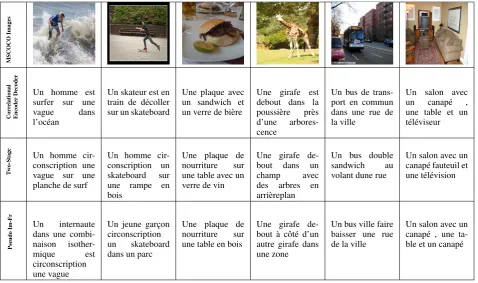
Table 4: Example captions generated by the three methods on a sample set of MSCOCO test images
the English captions into French (using IBM’s translation system).
We observe that our model is unable to beat the two strong baselines described above but still comes close to their performance. We believe this reinforces our belief in this line of research and hopefully more powerful models (perhaps attention based) could eventually surpass these two baselines.
As a qualitative evaluation of our model, Table 4 shows the captions generated by our model. It is exciting that even in a complex multimodal bridge setup the model is able to capture correlations between Images and English sentences and further decode relevant French captions from a given image.
The code and datasets used for Experiment 1 and 2 would be made available on request.
6 Conclusion
In this paper, we considered the problem of pivot based sequence generation. Specifically, we are inter-ested in generating sequences in a target language starting from information in a source view. However, no direct training data is available between the source and target views but data is available between each of these views and a pivot view. To this end, we take inspiration from interlingua based MT and pro-pose a neural network based model which explicitly maximizes the correlation between the source and pivot view and simultaneously learns to decode target sequences from this correlated representation. We evaluate our model on the task of bridge transliteration and show that it outperforms a strong two-stage baseline for many language pairs. Finally, we introduce a novel bridge caption generation task and report promising initial results. We hope this new task will fuel further research in this area.
References
Galen Andrew, Raman Arora, Jeff Bilmes, and Karen Livescu. 2013. Deep canonical correlation analysis.ICML. Dzmitry Bahdanau, Kyunghyun Cho, and Yoshua Bengio. 2014. Neural machine translation by jointly learning to
align and translate. InICLR 2015.
Chris Callison-Burch, Philipp Koehn, Christof Monz, Matt Post, Radu Soricut, and Lucia Specia. 2012. Findings of the 2012 workshop on statistical machine translation. InSeventh Workshop on Statistical Machine Transla-tion, WMT, pages 10–51, Montr´eal, Canada.
Sarath Chandar, Stanislas Lauly, Hugo Larochelle, Mitesh M Khapra, Balaraman Ravindran, Vikas Raykar, and Amrita Saha. 2014. An autoencoder approach to learning bilingual word representations. InProceedings of NIPS.
Sarath Chandar, Mitesh M. Khapra, Hugo Larochelle, and Balaraman Ravindran. 2016. Correlational neural networks. Neural Computation, 28(2):257 – 285.
David Chiang. 2005. A hierarchical phrase-based model for statistical machine translation. InACL 2005, 43rd Annual Meeting of the Association for Computational Linguistics, Proceedings of the Conference, 25-30 June 2005, University of Michigan, USA.
Kyunghyun Cho, Bart van Merrienboer, C¸aglar G¨ulc¸ehre, Dzmitry Bahdanau, Fethi Bougares, Holger Schwenk, and Yoshua Bengio. 2014. Learning phrase representations using RNN encoder-decoder for statistical machine translation. InProceedings of the 2014 Conference on Empirical Methods in Natural Language Processing, EMNLP 2014, October 25-29, 2014, Doha, Qatar, A meeting of SIGDAT, a Special Interest Group of the ACL, pages 1724–1734.
Jan Chorowski, Dzmitry Bahdanau, Dmitriy Serdyuk, Kyunghyun Cho, and Yoshua Bengio. 2015. Attention-based models for speech recognition. In Advances in Neural Information Processing Systems 28: Annual Conference on Neural Information Processing Systems 2015, December 7-12, 2015, Montreal, Quebec, Canada, pages 577–585.
Bonnie J. Dorr, Rebecca J. Passonneau, David Farwell, Rebecca Green, Nizar Habash, Stephen Helmreich, Ed-uard H. Hovy, Lori S. Levin, Keith J. Miller, Teruko Mitamura, Owen Rambow, and Advaith Siddharthan. 2010. Interlingual annotation of parallel text corpora: a new framework for annotation and evaluation. Natural Language Engineering, 16(3):197–243.
Desmond Elliott, Stella Frank, and Eva Hasler. 2015. Multi-language image description with neural sequence models. CoRR, abs/1510.04709.
Andrew Finch, Lemao Liu, Xiaolin Wang, and Eiichiro Sumita. 2015. Neural network transduction models in transliteration generation.Proceedings of NEWS 2015 The Fifth Named Entities Workshop, page 61.
Orhan Firat, Kyunghyun Cho, and Yoshua Bengio. 2016. Multi-way, multilingual neural machine translation with a shared attention mechanism. InNAACL HLT 2016, The 2016 Conference of the North American Chapter of the Association for Computational Linguistics: Human Language Technologies, San Diego California, USA, June 12-17, 2016, pages 866–875.
Karl Moritz Hermann and Phil Blunsom. 2014. Multilingual models for compositional distributed semantics. In
Proceedings of the 52nd Annual Meeting of the Association for Computational Linguistics, ACL 2014, June 22-27, 2014, Baltimore, MD, USA, Volume 1: Long Papers, pages 58–68.
Mitesh M. Khapra, A. Kumaran, and Pushpak Bhattacharyya. 2010. Everybody loves a rich cousin: An empirical study of transliteration through bridge languages. InHuman Language Technologies: Conference of the North American Chapter of the Association of Computational Linguistics, Proceedings, June 2-4, 2010, Los Angeles, California, USA, pages 420–428.
Diederik P. Kingma and Jimmy Ba. 2014. Adam: A method for stochastic optimization.CoRR, abs/1412.6980. Alexandre Klementiev, Ivan Titov, and Binod Bhattarai. 2012. Inducing Crosslingual Distributed Representations
of Words. InProceedings of the International Conference on Computational Linguistics (COLING).
Philipp Koehn, Franz Josef Och, and Daniel Marcu. 2003. Statistical phrase-based translation. InHLT-NAACL. Philipp Koehn, Hieu Hoang, Alexandra Birch, Chris Callison-Burch, Marcello Federico, Nicola Bertoldi, Brooke
Cowan, Wade Shen, Christine Moran, Richard Zens, Chris Dyer, Ondˇrej Bojar, Alexandra Constantin, and Evan Herbst. 2007. Moses: Open source toolkit for statistical machine translation. InProceedings of the 45th Annual Meeting of the ACL on Interactive Poster and Demonstration Sessions, ACL ’07, pages 177–180, Stroudsburg, PA, USA. Association for Computational Linguistics.
Minh-Thang Luong, Quoc V. Le, Ilya Sutskever, Oriol Vinyals, and Lukasz Kaiser. 2015a. Multi-task sequence to sequence learning. CoRR, abs/1511.06114.
Garrett Nicolai, Bradley Hauer, Mohammad Salameh, Adam St Arnaud, Ying Xu, Lei Yao, and Grzegorz Kondrak. 2015. Multiple system combination for transliteration. Proceedings of NEWS 2015 The Fifth Named Entities Workshop, page 72.
Sergei Nirenburg. 1994. Pangloss: A machine translation project. InHuman Language Technology, Proceedings of a Workshop held at Plainsboro, New Jerey, USA, March 8-11, 1994.
Janarthanan Rajendran, Mitesh M Khapra, Sarath Chandar, and Balaraman Ravindran. 2015. Bridge correlational neural networks for multilingual multimodal representation learning. arXiv preprint arXiv:1510.03519. Yan Shao, J¨org Tiedemann, and Joakim Nivre. 2015. Boosting english-chinese machine transliteration via high
quality alignment and multilingual resources. Proceedings of NEWS 2015 The Fifth Named Entities Workshop, page 56.
Ilya Sutskever, Oriol Vinyals, and Quoc V. Le. 2014. Sequence to sequence learning with neural networks. In
Advances in Neural Information Processing Systems 27: Annual Conference on Neural Information Processing Systems 2014, December 8-13 2014, Montreal, Quebec, Canada, pages 3104–3112.
Oriol Vinyals, Lukasz Kaiser, Terry Koo, Slav Petrov, Ilya Sutskever, and Geoffrey E. Hinton. 2015a. Grammar as a foreign language. InAdvances in Neural Information Processing Systems 28: Annual Conference on Neural Information Processing Systems 2015, December 7-12, 2015, Montreal, Quebec, Canada, pages 2773–2781. Oriol Vinyals, Alexander Toshev, Samy Bengio, and Dumitru Erhan. 2015b. Show and tell: A neural image
caption generator. InIEEE Conference on Computer Vision and Pattern Recognition, CVPR 2015, Boston, MA, USA, June 7-12, 2015, pages 3156–3164.
Hua Wu and Haifeng Wang. 2007. Pivot language approach for phrase-based statistical machine translation. In
ACL 2007, Proceedings of the 45th Annual Meeting of the Association for Computational Linguistics, June 23-30, 2007, Prague, Czech Republic.
Kelvin Xu, Jimmy Ba, Ryan Kiros, Kyunghyun Cho, Aaron C. Courville, Ruslan Salakhutdinov, Richard S. Zemel, and Yoshua Bengio. 2015. Show, attend and tell: Neural image caption generation with visual attention. In
Proceedings of the 32nd International Conference on Machine Learning, ICML 2015, Lille, France, 6-11 July 2015, pages 2048–2057.
Min Zhang, Haizhou Li, A. Kumaran, and Ming Liu. 2012. Report of NEWS 2012 machine transliteration shared task. In Proceedings of the 4th Named Entity Workshop, NEWS ’12, pages 10–20, Stroudsburg, PA, USA. Association for Computational Linguistics.
Xiaoning Zhu, Zhongjun He, Hua Wu, Conghui Zhu, Haifeng Wang, and Tiejun Zhao. 2014. Improving pivot-based statistical machine translation by pivoting the co-occurrence count of phrase pairs. InProceedings of the 2014 Conference on Empirical Methods in Natural Language Processing, EMNLP 2014, October 25-29, 2014, Doha, Qatar, A meeting of SIGDAT, a Special Interest Group of the ACL, pages 1665–1675.