An Integrated Representation of Linguistic and Social Functions of
Code-Switching
Silvana Hartmann, Monojit Choudhury, Kalika Bali
Microsoft Research Lab IndiaBangalore, India
[email protected],{monojitc,kalikab}@microsoft.com
Abstract
We present an integrated representation of code-switching (CS) functions, i.e., a representation that includes various CS phenomena (intra-/inter-sentential) and modalities (written/spoken), and aims to derive CS functions from local and global properties of the code-switched discourse. By applying it to several English/Hindi CS datasets, we show that our model contributes i) to the standardization and re-use of CS data collections by creating a resource footprint, and ii) to the study of CS functions by creating a systematic description and hierarchy of reported functions together with the (local and social) properties that may affect them. At the same time, the model provides a flexible framework to add emerging functions, supporting theoretical studies as well as the automatic detection of CS functions.
Keywords:Code-Switching, Multilingual, Bilingual, Pragmatics, Discourse
1.
Introduction
Code-Switching (CS), or alternating between two or more languages in a single conversation, is a marked feature of multilingual communities. Linguists have studied this phe-nomenon in great detail and recently, with the rise of so-cial media, the processing and generating of CS content has gained attention in the NLP community as well. The amount and type of code-switching depends on a number of structural, functional and social factors (Begum et al., 2016). Linguistic studies in the past have focused on two aspects that may be summarized as the ”how” and the ”why” of code-switching (Poplack, 2015). The ”how” aims to explain the grammatical principles that underlie code-switching per-formance; the ”why” aims to explain the function of code-switching in discourse, defining social, pragmatic, and dis-course functions of code-switching, for instanceaddressee specification,emphasis, ormarking quotations. These stud-ies are mostly based on limited recordings of conversations, concentrating on a small subset of functions, either linguis-tic, based on local properties of the discourse, or social and other global aspects. There are no large empirical studies on the interaction of linguistic and social aspects of CS func-tions. Further, there is no unified theory on the different CS functions and how they are expressed in discourse. Previ-ous theoretical work identifies lists of functions (see e.g., Abdul-Zahra (2010)), and recent work in NLP picks specific functions and aims to identify them in large collections of CS texts (Begum et al., 2016; Rudra et al., 2016). Thus, such studies use different levels of analysis, and often confuse observations (such as observing code-switchedreiteration ortranslation) with CS functions (reiterationis often used foremphasis), as in the following example from Begum et al. (2016) that uses the translation of an utterance for emphasis:
dimaag mein bhoosa bhara hai [gloss:up in their heads with fodder]. up in their heads with fodder.
The task ofdefininga comprehensive set of functions is very difficult, if not elusive. The same switching phenomenon, in our exampletranslation, is used for emphasis in some communities and for weakening request in others (Poplack,
1988). In such cases it is crucial to distinguish between sur-face form and (community-specific) function of a switching event. In this work, we present a new integrated framework for representing code-switching functions that builds the foundations for studying the functions of code-switching em-pirically at a large scale, particularly the interaction between the linguistic and social CS functions. Instead of defining a static set of functions, our framework provides the tools to define functions according to community-specific anal-yses. We define a flexible set of code-switching functions by first outlining a number of properties that characterize code-switched discourse, and then using these properties to characterize different switching phenomena and associate them to their functions. The proportion of properties and phenomena in a dataset can also be used to create a foot-print and compare different CS styles, for instance across language pairs or communities. We apply our framework to several English/Hindi code-switched datasets, i) creating footprints of CS corpora for comparison and standardiza-tion (adding a wider context to the statistics introduced by Guzm´an et al. (2017)) and ii) systematically describing and deriving CS functions for code-switched conversations.
2.
Related Work
from narrative to evaluative language) to conversation-level functions (marking an addressee in a conversation), or even higher-level social functions (showing an affilliation to a certain community). Gumperz (1982) lists six functions: quotation,addressee specification,interjection,reiteration, message qualification, and the semantic function of per-sonalization versus objectivization. Crystal (1987) reports the functionslack of competence,solidarity with a group, andcommunicating a certain attitude. Reyes (2004) lists functions such asreported speech,imitation quotation,turn accommodation,topic shift,situation switch(e.g., from aca-demic to non-acaaca-demic),insistence non-command(by re-iteration),emphasis on command,clarification/persuasion, person specification,question shift,discourse marker, and other. Abdul-Zahra (2010) addsquotationandaddressee qualificationto Crystal (1987)’s list.
Recently, large empirical studies have started to use Twitter as a data source to explore the functions of code-switching: Begum et al. (2016) analyze a set of English/Hindi Tweets and distinguish between several structural and pragmatic functions. Rudra et al. (2016) discover tendencies of bilin-gual speakers to express negative sentiment in (what is per-ceived as) their primary language. Rijhwani et al. (2017) is one of the first works to explicitly explore diverse CS com-munities on Twitter: they study different CS comcom-munities based on different language pairs and different localities. Due to the broadcasting nature of Twitter most of this work is focused on linguistic functions, ignoring functions that require global knowledge of the conversation setting.
Quantitative studies have proposed metrics on the distribu-tion of languages in CS corpora. Gamb¨ack and Das (2016) introduce the Code-Mixing Index, and Guzm´an et al. (2017) present a set of six metrics to quantify CS statistics, includ-ing the equality and burstiness of the language distribution, language entropy, and switching probability. These metrics consider the distribution of the different languages in the code-switched discourse. These metrics can thus, provide detailed statistics on the granularity of code-switching as a means to systematically study CS functions.
Mapping the above-mentioned function lists to a unified model is very difficult for several reasons: i) they cover social and local functions to different degrees, ii) small terminological differences are not clear (the terms reitera-tion,repetition, andtranslationare used for similar phenom-ena), and iii) they show varying degrees of granularity (e.g., whether or not to distinguish betweenquotation,imitation quotation, andreported speech). Thus, confusing properties of a CS utterance with its function: an observedtranslation can have the function ofemphasisorde-emphasisdepending on the community. In general, the relation between surface forms and potential functions available for a surface form is not well-defined. In addition, the lists are often incomplete and tailored to community-specific observations. A com-prehensive model should provide descriptive capabilities for representing conflicting functions across communities. We aim to create a framework that represents the properties of CS and uses them to define CS functions dynamically, in an attempt to resolve these problems.
3.
New Representation
In this section we introduce our new representation of CS functions that aims to fill the research gap discussed above. Our goal is to organize the functions observed in the litera-ture into a systematic hierarchy that considers the individual functions and the functional levels on which they apply. This new representation of code-switching functions lays the foundation for the study of the interaction between dif-ferent functional levels of code-switching in the future.
Requirements. Our representation should be a) the basis for analyzing the relationship between social and local CS functions, b) the means to distinguish surface properties of CS phenomena from their functions, c) the means to define functions based on their properties, and d) extensible by other functions and properties, for instance prosody and pauses in speech. We now define code-switching and the analysis dimensions used in our model.
Definition of code-switching. We define code-switching, short CS, as the use of at least two languages by the same speaker that is fluent in these languages within a single con-versation. We call the alternating sequences in the different languagesCS segments. As a prerequisite to defining code-switching functions, we define the unit of analysis for CS functions: aCS pairp(s1a, s2b)consists of twoCS
seg-ments s1 ands2 wheres1 is in languagela ands2is in
languagelb. Theswitch pointmarks the boundary between s1ands2. The segmentss1ands2can be of variable length
(number of tokens);s2extends to the next switch point or
the end of the utterance.
3.1.
Analysis Dimensions
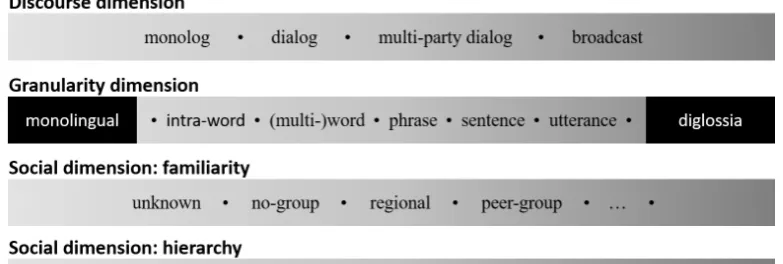
We define five analysis dimensions relevant to the identifica-tion of CS funcidentifica-tions, four global dimensions (Granularity, Modality, Discourse, and Social dimension), and theLocal dimension that considers properties of the specific CS pair. Granularityconsiders properties on the level of CS seg-ments. Its properties are represented by basic CS statistics and the metrics from Guzm´an et al. (2017) and Gamb¨ack and Das (2016).Modalitydefines different modes of record-ing CS language, such as written, spoken, multi-modal (in-cluding visual information). Discourserelates to the type of communication that is studied, e.g., monolog, dialog, multi-party dialog or broadcasting situations. Certain CS functions such as turn-taking have only been observed for dialogs. TheSocialdimension includes the social aspects of CS discussed earlier, representing information on the relationship and hierarchy between the conversation part-ners, including familiarity and politeness, but also whether the language community uses certain functions, e.g., repeti-tion for emphasis. In the following paragraphs we provide more detail on the properties we measure for each analysis dimension.
Figure 1: Global analysis dimensions for code-switched discourse.
expression, posture, gaze, gestures, etc. The modality of CS datasets depends on the recording medium. Previous work mostly uses speech recordings (and their transcripts), as well as written texts. It is thus focused on their inherent properties, such as emphasis and hesitations to structure utterances in spoken conversation, and punctuation to struc-ture them in written text. Socio-linguistic studies of CS however frequently refer to discourse-structuring functions of CS, and other ways to express the same functions, for in-stance gestures when addressing a speaker.1 We propose the
following categories for the modality dimension, of which at least written or audio are typically present:written, informal speech-like written, speech, andaudio-visual.
Discourse dimension The discourse dimension relates to the type of communication that is studied, e.g., whether we are studying at a monolog, dialog, multi-party-dialog or a broadcasting situation (which can be assumed for some Twitter messages), see the second line in Fig. 1. Certain functions that have been observed for CS contributions, such as turn-taking, are only applicable to dialog. The discourse dimension is closely related to the modality dimension: turn-taking is more important in immediate dialog, in particular in speech settings (be it present or via phone call), but may also occur in computer-mediated communication. We pro-pose the following categories for the discourse dimension: monolog, dialog, multi-party dialog, broadcast.
Granularity dimension The granularity dimension de-scribes the code-switched segments based on their size and syntactic type. It is illustrated in the third line of Fig. 1. The segment sizes can range from parts of words, single words and multi-word-expressions, via phrases and sentences to full utterances (up to sequences of sentences). One of the most frequently studied phenomena in CS research is intra-sentential switching, which maps to the segments up to the
1In how far emoticons and other frequent phenomena in written
computer-mediated communication, such as expressive lengthen-ing, emulate other modalities is an interesting research question in this context.
phrase level.
The granularity dimension helps to demarcate the boundaries of switching: we do not consider the use of loan-words by a predominantly monolingual speaker part of CS. The other end of the scale (as shown in Fig. 1) shows diglossia, where one speaker is capable of speaking two languages, but does not mix them in the same conversation, also outside of our definition of CS. Therefore, they are shown with a black background in Fig. 1.
Segments of different type will, of course, occur in the same conversation and in the language of the same speaker or community. The distribution over segment types, or dom-inant segment size can be used to characterize a specific CS dataset. Syntactic analysis, identifying sentences and phrases, might not be available for the studied language pair. In this case, the number of tokens in a segment can be used as a proxy for these categories. Previous work on CS in Twitter messages exploits quantitative statistics on segment size, studying CS with segment sizes of at least 3 words (Rudra et al., 2016). We propose the following list of categories for the granularity dimension:sub-word, single word, phrase, sentence, utterance.
Social dimension Code-switching speakers are known to modulate their use of switching to specific situations, de-pending on the participants involved. This information is captured in the social dimension. For a particular speaker, different social groups and situations may evoke different degrees of CS and affect their use of CS.
The social dimension includes aspects relevant to the meta-data associated with the conversation partner(s) or the ad-dressed audience, such as formality and politeness, famil-iarity, and the existence of certain group-internal (cultural) conventions of expressions. Details of the social dimension are typically recorded when gathering code-switched conver-sations, but they are mostly unknown when studying large Twitter datasets. As a consequence, most work on CS on Twitter did not consider the social dimension.
to further development: a) familiarity (unknown,no-group (no common group membership),regional(group defined by geographic properties),peer-group(various social factors, with further specification of sub-groups)) and b) hierarchy levels (unknown, no hierarchy difference, informal hierarchy difference, formal hierarchy difference).
3.2.
Local Dimension
Since they play a large role in our representation model, we introduce local properties in detail. We distinguish between simple atomic propertieson the CS segment level and com-pound propertiesthat build upon atomic properties. Both are relevant to identifying local CS functions. Relevant prop-erties include syntactic, semantic, and pragmatic propprop-erties of the CS segment:
Syntactic properties
• syntactic(si) =x∈ {sentence, clause, phrase, word, sub-word}
• quotation(si) = x ∈ {0,1}, x = 1 if si is highlighted by quotation marks2
• continuation(si) = x ∈ {0,1}, x = 1 if si starts a new sentence
• tag(si) = x ∈ {0,1}, x = 1ifsi is a tag (a fixed phrase used for greeting, etc.
• ne(si) =x∈ {0,1}, x= 1ifsiis a named-entity
Semantic properties
• topic(si) =xin a set of topics or in a distribution over topics
• content(si) =xwherexis a semantic representation ofsi(e.g., vector representation, logic form)
Sentiment properties
• sentiment(si) =x∈SENT ={-1,0,+1}, where -1 stands for negative, 0 for neutral, and +1 for positive sentiment, cf. Nakov et al. (2013).
Pragmatic properties
• speechact(si) = x ∈ SACS = {question, request, command,. . .}, cf. Searle (1969).
• dm(si) = x∈ {0,1}, wherex= 1ifsicontains a discourse marker, cf. Prasad et al. (2014).
Compound properties (on theCS pairlevel) Just likesi andsi+1are combined to build a CS pairp(si, si+1),
prop-erties ofsi andsi+1can be combined to build compound
properties. Some of the possible combinations are relevant with respect to the analysis of CS functions, for instance discovering the function of sentiment change.
In general, we create compound properties by a) pairing arbitrary properties ofsiandsi+1and b) by comparing the
property value ofsiandsi+1for the same property. For the
2In our introduction of local properties, we focus on their
iden-tification in written texts and speech transcripts. For the modalities
[image:4.595.305.542.69.177.2]audioandvisual, quotation marks can be replaced by gestures or prosodic markers of quotation.
Figure 2: Dependency between CS properties and functions.
sentimentproperty, a) leads to a sentiment-pair(si, si+1)
= hx, yi with 42 values for hx, yi, e.g., hx, yi
∈ SENT×SENT={h0,0i,h0,−1i,h0,+1i,. . .,h+1,+1i}. The latter, b) can be used to define topic change: topic-change(si, si+1) =x∈ {0,1}, x= 1iftopic(si)6= topic(si+1).
In the following, we define a number compound properties that are relevant for the definition of CS functions:
• topic-change(si, si+1) = x ∈ {0,1}, x = 1 if
topic(si)6=topic(si+1)
• translation(si, si+1) = x ∈ {0,1}, x = 1 if
content(si) =content(si+1)
• sentiment-pair(si, si+1) = hx, yiwith 42 values for
hx, yi ∈SENT×SENT
• speechact-pair(si, si+1) = hx, yiwith|SACT|2
val-ues for x, e.g.,hx, yi ∈SACT×SACT
• discourse-rel(si, si+1)= x ∈a set of discourse
rela-tions SREL that connectsiandsi+1
These properties can be used to describe a CS phenomenon independently of its function in discourse. We use these properties to define several common CS functions below.
3.3.
Deriving CS Functions from Properties
We use simple and compound properties of a CS pair to cre-ate operationalized definitions of common CS functions. We show three examples of common CS functions and property derivations here.Example 1: thenarrative-evaluativefunction that can be identified based on the discourse relation between the two CS segments and the sentiment involved, changing from neutral to positive or negative sentiment.
Example 2: negative reinforcement: if the sentiment-pair(si, si+1) consists of two sentiment expressionsha,bi
and b=−1, this indicates negative reinforcement. Example 3:marking quotation: if the second CS segment is highlighted by quotation marks (quotation(si+1)=1), this
indicates the use of CS to introduce a quotation or reported speech.
Example 4:the definition of Riloff et al. (2013) can be used to identifysarcasmin CS tweets as tweets with positive sen-timent in one segment and a negative situation (determined by topic) in the other CS segment.
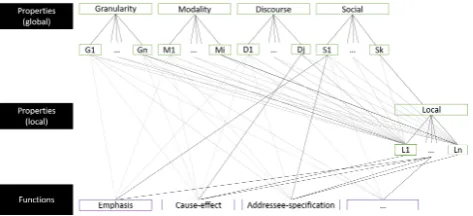
The integration of local and global propertiesin a joint representation of CS functions is a core motivation of this paper: besides local properties, CS functions are often also dependent on higher-level global properties (e.g., translation foremphasisis community-specific and depends on social contexts, social and discourse dimensions are relevant for ad-dressee specification). These dependencies are illustrated in an abstract fashion (i.e., without relating to specific proper-ties) in Fig. 2. The black lines mark observed dependencies between types of properties, grey lines show hypothetical dependencies that may exist between two property hierar-chies or between a property and a function. One goal of this work is to provide a representation framework for observed and expected dependencies for a given CS corpus.
Example 6:a CS function that incorporates local and global properties isaddressee qualification: to identify addressee qualification, we need some change in the switching behav-ior (e.g., monolingual to code switching), some deictic as-pect (e.g., a greeting tag or a gesture addressing the speaker) and information on the relation between the speaker and addressee, e.g., belonging to a peer group.
Example 7: an instance of the local functiontopic switch that occurs in a certain social setting, for instance a con-versation among colleagues in a professional setting, may be a marker of asituation switch. Thesituation switchcan only be identified if the social factors of the interaction are known.
Summary:this section shows several examples on how lo-cal properties indicate lolo-cal CS functions, and how lolo-cal and global properties, for instance social properties, can be jointly used to identify CS functions. The local and global properties provide necessary, but not sufficient information to identify CS functions. Still, they help to characterize CS phenomena and provide prerequisites for the large-scale corpus-based analysis of CS functions. Many local proper-ties can be determined using automatic methods and corpus meta-data capture the smaller set of global properties to a certain degree. We believe that a stronger formalization and standardization of corpus meta-data along the lines proposed in this work can support corpus-based analysis of the inter-action of local and global CS properties in the future. In the next sections, we show two applications of our integrated representation of CS functions.
4.
Application Scenario 1: Footprinting
Corpora
To demonstrate its use, we apply our model to several English/Hindi CS datasets. The first dataset D1 is based on speech transcripts of informal conversations, the other datasets M1 to M6 are based on dialogs from six Indian movies titledPink,Kapoor and Sons,Neerja,Talvar,Ek Main Aur Ek Tu, andD-day. These movies contain code-switched dialog in Hindi and English, whereby the ma-jority of the tokens was labeled as Hindi for all datasets. Transcripts of the movie dialogs are available for non-commercial purposes fromhttps://moifightclub. com/category/scripts. We performed automatic language labeling and annotated all datasets with the proper-ties introduced above, providing elaborate annotation guide-lines and an extensive training for our three annotators.
Au-tomatically created language tags were corrected as needed during the manual annotation of local properties. We plan to publish the annotations and datasets subject to permissions. We present two applications of our representation: footprint-ing CS discourse accordfootprint-ing to properties and functions in this section, and supporting automatic functions derivations in Section 5.
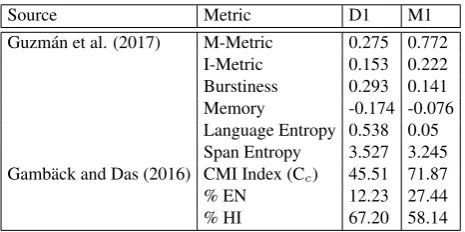
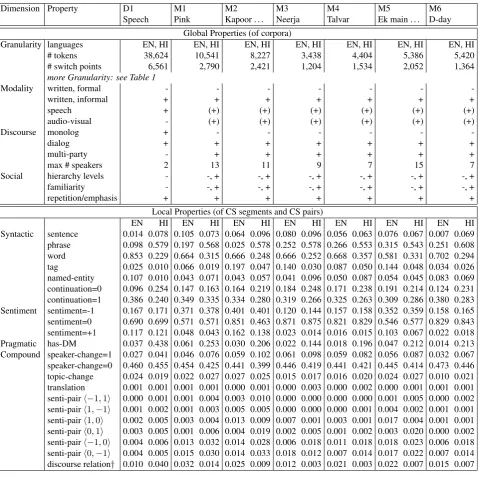
Footprinting CS discourse We can use the property val-ues defined above to createfootprints of a specific code-switched dataset. This is done by accumulating statistics for the different analysis dimensions as shown in Table 2. Fine-grained Granularity properties are provided by the CS metrics from Guzm´an et al. (2017) and Gamb¨ack and Das (2016). To save space, this is shown exemplary for the corpora D1 and M1 in Table 1. We refer to the original pub-lications for detailed explanations of the different metrics. Collecting the property values leads to a feature vector that can be compared across datasets to categorize and compare different manifestations of CS. Table 2 contrasts a subset of the global and local properties for D1 and M1 to M6. We were able to access D1 as speech transcript and speech recording, while the movie datasets are based on written transcript, but could in theory be accessed in their origi-nal audio-visual format. Conversations in D1 are generally based on two speakers, but also include a single monolog, while the movie datasets contain multi-party dialog with up to 13 speakers. There are no explicit hierarchy levels in D1, and the speakers do not know each other, while social prop-erties are varied in the movie dialogs. The local propprop-erties in the lower part of the table are split up by the language of the CS segments, for Compound properties, the language col-umn corresponds to the language of the second CS segment s2, contrasting the two switching directions. The
informa-tion in Table 2 goes beyond the detailed analysis of language distribution in Table 1, that shows similar Span Entropy, but different CMI, M-Metric, Burstiness, and Language Entropy for the two corpora D1 and M1. Relevant for studying CS functions is the more even distribution of languages in M1 (indicating more instances of switching and less borrowing) and its larger variety of social properties (e.g., speakers with different relationship and hierarchy levels). To contrast CS for different social aspects, statistics on interactions between specific pairs of speakers can be analyzed as sub-corpora of M1, as proposed in (Pratapa and Choudhury, 2017). The local properties also show a larger proportion of positive and negative sentiment, sentiment change, and discourse relations in M1 compared to D1, which indicates that it is a more promising source for studying CS functions related to these properties. One exception are Hindi discourse rela-tions that seem to be more prevalent in D1 compared to the movie datasets.
is Hindi. Tag-switching on the other hand is more prevalent for switches to English in all datasets, which supports the notion that Hindi is the main language in the movies. The use of English discourse relations at the beginning ofs2is
more prevalent in the movie datasets compared to the speech dataset D1.
We observe that many property combinations associated with CS functions are fairly rare in our datasets. An example is translation for emphasis. This function has been widely reported for English/Hindi code-switching, but there are only 13 instances even in the largest dataset D1. Finding evidence of CS functions in corpus data is difficult, which highlights the need for large corpus-based analyses.
Source Metric D1 M1
Guzm´an et al. (2017) M-Metric 0.275 0.772 I-Metric 0.153 0.222 Burstiness 0.293 0.141 Memory -0.174 -0.076 Language Entropy 0.538 0.05 Span Entropy 3.527 3.245 Gamb¨ack and Das (2016) CMI Index (Cc) 45.51 71.87
[image:6.595.54.287.234.350.2]% EN 12.23 27.44 % HI 67.20 58.14
Table 1: CS metrics for detailed Granularity properties.
5.
Application Scenario 2: Function
Derivation
For the second application, deriving functions from prop-erties, we focus on the movie dataset M1 that is based on the movie Pink, a court-room drama centering around a group of three girlfriends. One of the friends is accused of attempted murder, but claims she injured the victim, a young man, in self-defense. The interactions among the three friends and dialogs with the judge and attorney in the court room show different social settings, thus providing a good background for our analysis of the interaction of local and social functions of CS.
We first show examples for deriving local functions from properties, then discuss the interaction of local and global properties and their effects on deriving CS functions.
Deriving local functions from local properties The fol-lowing example from M1 shows thenegative reinforcement function:
[This is b***s**t]s1[Bakwaas hai poori ki poori]s2
-jhooth bol rahein hain yeh ladke aur aap bhi
Gloss: [This is nonsense]s1[This is all rubbish.]s2
-These boys are lying and so are you.
The English segments1and the Hindi segments2both have
negative sentiment (sentiment(s2)=sentiment(s1) = −1),
which together with the knowledge of a social property, i.e. the tendency of the English/Hindi-speaking community to use switching to emphasize negative emotions (Rudra et al., 2016) indicates the function ofnegative reinforcement. The same applies to the following example from M1:
[Aur Minal ko tumhari ek nahi dono aankhein phhodni chahiye thi]s1[and you think you can scare us.]s2
Gloss: [And Minal should have taken out not one but both your eyes ...]s1 [and you think you can scare
us.]s2
The following example from M1 shows the narrative-evaluativefunction:
[Chaar din ho gaye - kuchh hua nahin na ...]s1[So why
are we tense ?]s2
Gloss: [It’s been four days, nothing has happened ...]s1
[So why are we tense ?]s2
In this example, a neutral statement is followed by an eval-uation that shows negative sentiment. In the following ex-ample from M1, thenarrative-evaluativefunction appears in inverse order: the evaluatives1, thats shows negative
sentiment, is followed by the statements2.
[Look roz subah-subah tense hone se kya faayda !]s1
[We’ll go mad ...]s2
Gloss: [Look, what is the use of getting tense every day from the morning ...]s1[We’ll go mad ...]s2
The interaction of local and global properties The fol-lowing example fromKapoor and Sons(M2) shows a social function of CS, namely the assertion of Neetu Chachi’s iden-tity through the use of English. Neetu Chachi has come to visit from New York. The mother, who has a higher status in age and relationship, continues using Hindi, even though she does know English. Here the switch to English by Neetu Chachi (ins2ands4), who also knows Hindi perfectly well,
is used to denote her identity:
Neetu Chachi:[And look what I found in ...]s1
Mother:[Arre ... haan ...!Ye toh pata nahin kitni pu-rani hain. Yehtastekar.]s1
Gloss: [Oh yes! God knows how old this is! Taste this.]s1
Neetu Chachi:[It’s delicious!]s2[Timmy ko bolo na
mujhe kuch mutton recipes bheje]s3[Sharic just loves
this stuff!]s4
Gloss: [It’s delicious!]s2[Tell Timmy to send me some
mutton recipes ...]s3[Sharic just loves this stuff!]s4
Mother:[Haan usse bolti hoonemailkarne ke liye.]s5
Gloss: [Ok, I will tell her to email them to you.]s5
The examples shown in the previous paragraphs are based on informal conversation among friends and acquaintances. The following example from the moviePink(M1) shows an interaction in a formal court-room setting. In this ex-change, CS is aligned with situational changes based on social factors. The following statement is made by Deepak, the attorney defending Minal in the trial:
[Minal Honourable judge sahab aapko baithne ke liye keh rahein hain]s1[and please be quiet]s2
Dimension Property D1 M1 M2 M3 M4 M5 M6 Speech Pink Kapoor . . . Neerja Talvar Ek main . . . D-day
Global Properties (of corpora)
Granularity languages EN, HI EN, HI EN, HI EN, HI EN, HI EN, HI EN, HI # tokens 38,624 10,541 8,227 3,438 4,404 5,386 5,420 # switch points 6,561 2,790 2,421 1,204 1,534 2,052 1,364
more Granularity: see Table 1
Modality written, formal - - -
-written, informal + + + + + + +
speech + (+) (+) (+) (+) (+) (+)
audio-visual - (+) (+) (+) (+) (+) (+)
Discourse monolog + - - -
-dialog + + + + + + +
multi-party - + + + + + +
max # speakers 2 13 11 9 7 15 7
Social hierarchy levels - -, + -, + -, + -, + -, + -, +
familiarity - -, + -, + -, + -, + -, + -, +
repetition/emphasis + + + + + + +
Local Properties (of CS segments and CS pairs)
[image:7.595.58.538.66.544.2]EN HI EN HI EN HI EN HI EN HI EN HI EN HI Syntactic sentence 0.014 0.078 0.105 0.073 0.064 0.096 0.080 0.096 0.056 0.063 0.076 0.067 0.007 0.069 phrase 0.098 0.579 0.197 0.568 0.025 0.578 0.252 0.578 0.266 0.553 0.315 0.543 0.251 0.608 word 0.853 0.229 0.664 0.315 0.666 0.248 0.666 0.252 0.668 0.357 0.581 0.331 0.702 0.294 tag 0.025 0.010 0.066 0.019 0.197 0.047 0.140 0.030 0.087 0.050 0.144 0.048 0.034 0.026 named-entity 0.107 0.010 0.043 0.071 0.043 0.057 0.041 0.096 0.050 0.087 0.054 0.045 0.083 0.069 continuation=0 0.096 0.254 0.147 0.163 0.164 0.219 0.184 0.248 0.171 0.238 0.191 0.214 0.124 0.231 continuation=1 0.386 0.240 0.349 0.335 0.334 0.280 0.319 0.266 0.325 0.263 0.309 0.286 0.380 0.283 Sentiment sentiment=-1 0.167 0.171 0.371 0.378 0.401 0.401 0.120 0.144 0.157 0.158 0.352 0.359 0.158 0.165 sentiment=0 0.690 0.699 0.571 0.571 0.851 0.463 0.871 0.875 0.821 0.829 0.546 0.577 0.829 0.843 sentiment=+1 0.117 0.121 0.048 0.043 0.162 0.138 0.023 0.014 0.016 0.015 0.103 0.067 0.022 0.018 Pragmatic has-DM 0.037 0.438 0.061 0.253 0.030 0.206 0.022 0.144 0.018 0.196 0.047 0.212 0.014 0.213 Compound speaker-change=1 0.027 0.041 0.046 0.076 0.059 0.102 0.061 0.098 0.059 0.082 0.056 0.087 0.032 0.067 speaker-change=0 0.460 0.455 0.454 0.425 0.441 0.399 0.446 0.419 0.441 0.421 0.445 0.414 0.473 0.446 topic-change 0.024 0.019 0.022 0.027 0.027 0.025 0.015 0.017 0.016 0.020 0.024 0.027 0.010 0.021 translation 0.001 0.001 0.001 0.001 0.000 0.001 0.000 0.003 0.000 0.002 0.000 0.001 0.001 0.001 senti-pairh−1,1i 0.000 0.001 0.001 0.004 0.003 0.010 0.000 0.000 0.000 0.000 0.001 0.005 0.000 0.002 senti-pairh1,−1i 0.001 0.002 0.001 0.003 0.005 0.005 0.000 0.000 0.000 0.001 0.004 0.002 0.001 0.001 senti-pairh1,0i 0.002 0.005 0.003 0.004 0.013 0.009 0.007 0.001 0.003 0.001 0.017 0.004 0.001 0.001 senti-pairh0,1i 0.003 0.005 0.001 0.006 0.004 0.019 0.002 0.005 0.001 0.002 0.003 0.020 0.000 0.002 senti-pairh−1,0i 0.004 0.006 0.013 0.032 0.014 0.028 0.006 0.018 0.011 0.018 0.018 0.023 0.006 0.018 senti-pairh0,−1i 0.004 0.005 0.015 0.030 0.014 0.033 0.018 0.012 0.007 0.014 0.017 0.022 0.007 0.014 discourse relation† 0.010 0.040 0.032 0.014 0.025 0.009 0.012 0.003 0.021 0.003 0.022 0.007 0.015 0.007
Table 2: Footprinting CS corpora; DM = Discourse marker; + and - stand for boolean true and false;†marks property labels created automatically. Statistics in the lower half of the table are relative to the number of switch points in each dataset.
English is the marked language in the court-room setting, and switching to English emphasizes and reinforces the strength of the request. The emphasis is further enhanced by a local function, namely starting the English segment with discourse markerand. Deepak in his role as the attorney uses code-switching to English to emphasize the seriousness of his request, which is licensed by the hierarchy induced by the formal court-room setting. The characters Deepak and Minal are not familiar figures, and they are not separated by a hierarchy outside of the courtroom setting, so it would be rude for Deepak to switch to English to reinforce his request in this way in an informal setting.
A third interesting example of the interaction of social and global functions of code-switching occurs in the movie Neerja(M3). In this movie, a group of terrorists kidnaps a plane. They are opposed by a group of police officials. Depending on who has the upper hand in the negotiations,
each of the groups changes between formal, polite language (i.e. talking up when being lower in the hierarchy), or rude, impolite language (i.e. talking down when being higher in the hierarchy). One main characteristic of the impolite lan-guage is the stronger use of code-switching. These changes between up-talk and down-talk show an interaction between social hierarchy and use of code-switching in discourse.
6.
Conclusion
We present an integrated representation of code-switching functions to facilitate their systematic empirical study, par-ticularly the interaction between local and social aspects of the CS functions. The proposed representation is language-independent and can be extended by additional properties (for instance gestures for multi-modal corpora) and emerg-ing functions.
Comparative and systematic corpus-based study of CS is desired (Gullberg et al., 2009; Mysl´ın and Levy, 2015) and facilitated by an increasing number of available corpora (Diab et al., 2014; C¸ etinoˇglu, 2017; Rudra et al., 2016); With our framework we aim to contribute to the comparative corpus-based study of code-switching and to foster the dis-cussion of the interaction between local and social functions. Besides extending and improving the proposed representa-tion in our future work, we plan further applicarepresenta-tions of the framework to exemplify in which ways it can be used for CS research. Moreover, we will study the automatic deriva-tion of funcderiva-tions in more detail, with a particular focus on discourse relations.
Acknowledgments
This paper is built upon two annotation studies. We grate-fully acknowledge the support by Prof. Niloy Ganguly, Koustav Rudra, and Bidisha Samanta during the course of the two studies. Adithya Pratapa kindly provided the language tags and CMI metrics. Last, but not least, we acknowledge the contributions of our annotators Sanjana Arora, Shivangi Shukla, and Jyothsna Chakravarthy.
7.
Bibliographical References
Abdul-Zahra, S. (2010). Code-switching in language: An applied study. Journal Of College Of Education For Women, 21(1):283–296.
Auer, P. (2013). Code-switching in conversation: Language, interaction and identity. Routledge.
Begum, R., Bali, K., Choudhury, M., Rudra, K., and Gan-guly, N. (2016). Functions of Code-Switching in Tweets: An Annotation Framework and Some Initial Experiments. InProceedings of the Tenth International Conference on Language Resources and Evaluation (LREC 2016), pages 1644–1650, Portoroˇz, Slovenia.
C¸ etinoˇglu, ¨O. (2017). A code-switching corpus of turkish-german conversations. InProceedings of the 11th Linguis-tic Annotation Workshop, pages 34–40, Valencia, Spain. Crystal, D. (1987). The Cambridge Encyclopedia of
Lan-guage. Cambridge University Press, Cambridge, U.K. Diab, M., Hirschberg, J., Fung, P., and Solorio, T. (2014).
Proceedings of the First Workshop on Computational Ap-proaches to Code Switching. Doha, Qatar.
Gamb¨ack, B. and Das, A. (2016). Comparing the Level of Code-Switching in Corpora. InProceedings of the Tenth International Conference on Language Resources and Evaluation (LREC 2016), pages 1850–1855.
Gullberg, M., Indefrey, P., and Muysken, P., (2009). Re-search techniques for the study of code-switching, pages 21–39. Cambridge University Press, Cambridge.
Gumperz, J. (1982). Discourse Strategies. Cambridge Uni-versity Press, Cambridge.
Guzm´an, G., Ricard, J., Serigos, J., Bullock, B. E., and Toribio, A. J. (2017). Metrics for modeling code-switching across corpora. InProceedings of the Inter-speech 2017 Special Session on Code Switching, Stock-holm, Sweden.
Mysl´ın, M. and Levy, R. (2015). Code-switching and pre-dictability of meaning in discourse. Language, 91(4):871– 905.
Nakov, P., Rosenthal, S., Kozareva, Z., Stoyanov, V., Ritter, A., and Wilson, T. (2013). SemEval-2013 Task 2: Senti-ment Analysis in Twitter. InSecond Joint Conference on Lexical and Computational Semantics (*SEM), Volume 2: Proceedings of the Seventh International Workshop on Semantic Evaluation (SemEval 2013), pages 312–320, Atlanta, GA, USA.
Poplack, S. (1988). Contrasting patterns of code-switching in two communities. Codeswitching: Anthropological and sociolinguistic perspectives, 48:215–44.
Poplack, S. (2015). Code switching: Linguistic. In In-ternational Encyclopedia of the Social and Behavioral Sciences, 2nd edition, pages 918–925. Elsevier Ltd. Prasad, R., Webber, B., and Joshi, A. (2014). Reflections on
the Penn Discourse TreeBank, Comparable Corpora, and Complementary Annotation. Computational Linguistics, 40(4):921–950.
Pratapa, A. and Choudhury, M. (2017). Quantitative char-acterization of code switching patterns in complex multi-party conversations: A case study on hindi movie scripts. InProceedings of the 14th International Conference on Natural Language Processing (ICON-2017), pages 75–84, Kolkata, India, December. NLP Association of India. Reyes, I. (2004). Functions of code switching in school
chil-dren’s conversations.Bilingual Research Journal, 28:83– 96.
Rijhwani, S., Sequiera, R., Choudhury, M., Bali, K., and Maddila, C. S. (2017). An Exploratory Study of Struc-tural and Functional Aspects of English-Hindi Code Switching in Twitter. InProceedings of the 55th Annual Meeting of the Association for Computational Linguistics (Volume 1: Long Papers), pages 1971–1982, Vancouver, Canada.
Riloff, E., Qadir, A., Surve, P., De Silva, A., Gilbert, N., and Huang, R. (2013). Sarcasm as Contrast between a Pos-itive Sentiment and Negative Situation. InProceedings of the 2013 Conference on Empirical Methods in Natural Language Processing, pages 704–714, Seattle, WA, USA. Rudra, K., Rijhwani, S., Begum, R., Bali, K., Choudhury, M., and Ganguly, N. (2016). Understanding Language Preference for Expression of Opinion and Sentiment: What do Hindi-English Speakers do on Twitter? In Pro-ceedings of the 2016 Conference on Empirical Methods in Natural Language Processing, pages 1131–1141, Austin, TX, USA.