Semantic Relatedness of Wikipedia Concepts – Benchmark Data and a
Working Solution
Liat Ein Dor, Alon Halfon, Yoav Kantor, Ran Levy, Yosi Mass, Ruty Rinott, Eyal Shnarch,
Noam Slonim
IBM Haifa Reseacrh Lab
Haifa University, Mount Carmel, Haifa, HA 31905, Israel
{liate,alonhal,yoavka,ranl,yosimass,rutyr,eyals,noams}@il.ibm.com
Abstract
Wikipedia is a very popular source of encyclopedic knowledge which provides highly reliable articles in a variety of domains. This richness and popularity created a strong motivation among NLP researchers to develop relatedness measures between Wikipedia concepts. In this paper, we introduce WORD (Wikipedia Oriented Relatedness Dataset), a new type of concept relatedness dataset, composed of 19,276 pairs of Wikipedia concepts. This is the first human annotated dataset of Wikipedia concepts, whose purpose is twofold. On the one hand, it can serve as a benchmark for evaluating concept-relatedness methods. On the other hand, it can be used as supervised data for developing new models for concept relatedness prediction. Among the advantages of this dataset compared to its term-relatedness counterparts, are its built-in disambiguation solution, and its richness with meaningful multi-word terms. Based on this benchmark we develop a new tool, named WORT (Wikipedia Oriented Relatedness Tool), for measuring the level of relatedness between pairs of concepts. We show that the relatedness predictions of WORT outperform state of the art methods.
Keywords:Concept Relatedness, Relatedness function, Dataset
1.
Introduction
Wikipedia is the leading open encyclopedia with very good coverage on diverse topics. Many terms encountered in hu-man written texts are in fact Wikipedia concepts. As a re-sult, multiple NLP tasks, such as entity linking and docu-ment clustering, can benefit from quantitatively measuring the level of relatedness between such concepts. A variety of methods have been proposed for measuring relatedness be-tween Wikipedia concepts, e.g. (Witten and Milne, 2008; Strube and Ponzetto, 2006; Gabrilovich and Markovitch, 2007; Sherkat and Milios, 2017). Evaluating these meth-ods, and developing new ones naturally requires high qual-ity large benchmark data. Here, we introduce a new dataset, named WORD, composed of 19,276 Wikipedia concept pairs, manually annotated to determine their level of relat-edness.
We exploit these data to assess several types of state of the art semantic-relatedness tools, including word and document similarity functions (Mikolov et al., 2013; Gabrilovich and Markovitch, 2007), and link based meth-ods (Witten and Milne, 2008; Ceccarelli et al., 2013), for the task of concept relatedness. Moreover, we sug-gest several new utilities, that are explicitly designed for this task, such as PMI (Church and Hanks, 1990; Bulli-naria and Levy, 2007) measured between conceptsbased on their statistical co-occurrence in the entire Wikipedia corpus. We further exploit the data for supervised learn-ing of concept-relatedness function, and use our novel utili-ties along with known state-of-the-art semantic-relatedness methods as features in a Linear Regression (LR) model. The resultant concept-relatedness tool, termed henceforth WORT, clearly outperforms each individual feature.
Finally, to demonstrate the versatility of WORD, we sug-gest a mechanism for automatically generating a dis-ambiguated term-relatedness dataset from a Wikipedia
concept-relatedness dataset. This mechanism, which does not involve additional human annotation, yields a new term-relatedness dataset containing 37,309 pairs. This dataset, WORD, and the annotation guidelines are all avail-able in http://www.research.ibm.com/haifa/ dept/vst/debating_data.shtml.
2.
Related Work
Most existing semantic relatedness datasets are composed of pairs of words (e.g. (Finkelstein et al., 2002; Hill et al., 2014)). Nevertheless, dataets with other element types, such as multi-word terms (Levy et al., 2015b), knowledge base concepts (Ceccarelli et al., 2013) and documents (Lee and Welsh, 2005) are also available.
From all term-relatedness datasets, TR9856 (Levy et al., 2015b) is probably the most similar to the current work, mainly due to its large size, and its generation process. The major difference between the two is in the type of elements composing them, Wikipedia concepts vs. terms, and thus in the relatedness task underlying their scores. Although part of the terms in TR9856 can be linked to concepts, the con-cepts are not available in the data, and were not provided to the annotators.
concepts, instead of ranking pairs of concepts based on the aforementioned heuristics over Wikipedia.
3.
Benchmark Generation
The benchmark generation process is composed of several stages.
3.1.
Concept Pairs Selection
The objective of the Concept Pairs Selection stage is to cre-ate a balanced population of relcre-ated and unrelcre-ated concept pairs. Clearly, a set of randomly selected pairs is expected to contain a low fraction of related pairs. To overcome this we follow (Levy et al., 2015b) who suggested a sim-ilar procedure for n-grams, and hypothesize that concepts which are over represented within a given article, tend to be related to one another. Thus, we first apply the TagMe (Ferragina and Scaiella, 2010) wikification tool, to identify concepts mentioned in the article, and then use the Hyper-geometric (HG) test to create a Concept Lexicon (CL) per article, composed of all concepts with a HG p-value≤0.05 after Bonferroni correction.
We selected123Wikipedia articles covering various topics like ”affirmative action”, ”vegetarianism” and ”atheism”, and used the above mentioned procedure to generate123 CLs. From each CL we created160concept pairs by ran-domly selecting160concepts from the CL, and pairing40 of them with the article concept, and the rest120with an-other120concepts selected at random from the CL. For too small CLs, the maximal possible number of pairs was se-lected. In any case, we avoided selecting pairs of identical concepts.
3.2.
Annotation
The above process yielded a total of19,649concept pairs that were manually annotated via CrowdFlower, each by10 annotators. The annotators were presented with a pair of URIs of Wikipedia articles, and were asked to mark them as ”related”, if they believe there is an immediate associa-tive connection between them, and as ”unrelated” other-wise. The annotators were further instructed to consider antonyms as related.
3.3.
Post Processing
In order to increase the reliability of our dataset, we applied the following post processing procedure. We analyzed the inter-annotator agreement using Cohen’s kappa coefficient, and filtered out annotators whose average kappa with the other annotators was smaller than0.25. Annotators that did not have at least50common pairs with at least three other annotators were filtered out. The concept pairs that had less than 8 judgments after the annotators’ filtering process, were removed from the benchmark.
3.4.
Dataset Statistics
After filtering out some annotators we were left with247 distinct annotators with average pairwise Cohen’s kappa coefficient of0.57. Removing concept pairs that were left with<8annotations, we ended up with a total of19,276 annotated concept pairs covering10,871unique concepts. The relatedness score of each concept pair was computed
by averaging over the binary answers of the annotators, yielding a relatedness score in the range [0,1]. We refer to these data as WORD, standing for Wikipedia Oriented Relatedness Dataset.
WORD is enriched with related concepts, where more than 50%of the pairs have a positive score, and more than15% have a score > 0.5. WORD is also enriched with multi-word terms (MWTs). 66% of the concepts are MWTs, among which65%are bigrams. WORD is split into train-ing and test set, where2/3of the topic articles, are in the training set, and the rest are in the test set. The informa-tion provided in the data includes the concept URIs and titles; the title of the article from which they were selected; whether they belong to the train or test set; and their relat-edness annotation score.
3.5.
Advantages Compared to Existing Datasets
Most existing term-relatedness datsets suffer from several issues (Batchkarov et al., 2016; Chiu et al., 2016; Faruqui et al., 2016) for which WORD provides at least partial so-lutions. To the best of our knowledge, this is the largest dataset of its type, whose number of pairs is large enough to yield high quality learning and evaluation results. Un-like most existing datasets, it is split into a training and a test set, providing a well defined framework for devel-oping supervised relatedness methods, and for comparing between different relatedness functions. Furthermore, we use a cross validation setting, named LOTO, whose advan-tages are described in Section 4.. Moreover, as a concept-relatedness dataset, it is enriched with meaningful MWTs, unlike most standard term-relatedness datasets that include mostly unigrams, or noisy n-grams. Furthermore, the en-tities in WORD are disambiguated, since their meaning is provided by their Wikipedia article. As a result, the agree-ment within the annotators is rather high compared to the typical agreement in term-relatedness tasks. Finally, mod-els that learn from WORD can utilize the large amount of structure data and side information of Wikipedia for im-proving relatedness predictions.3.6.
Term Relatedness Dataset Generation
We suggest a method for automatically generating a term-relatedness dataset from Wikipedia concept term-relatedness dataset. Our method is based on redirects and commonness of Wikipedia links, which are used to find, for each concept, a disambiguated and reliable equivalence set of n-grams as-sociated with it. Then, given a concept pair{c1, c2}, these sets are used to create all possible n-gram pairs, and are assigned the score of{c1, c2}. This procedure is repeated for all the pairs in WORD, and results in a term-relatedness dataset of 37,309 pairs.4.
Wikipedia Oriented Relatedness Tool
(WORT)
Leave-One-Topic-Out (LOTO) cross validation setting on the training data, dividing the pairs into folds based on the article topic they originate from. This ensures that pairs in-cluded in the training set fold have little overlap with pairs associated with the left-out topic, hence avoiding a biased estimate of the model performance.
4.1.
Model Features
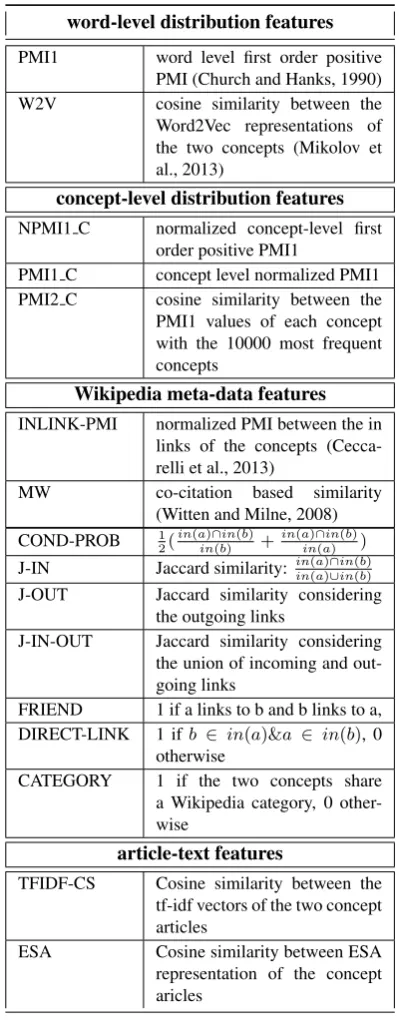
WORT has 16 features which we classify into four cate-gories, based on the type of information they rely on: word-level distribution, concept-level distribution, Wikipedia meta-data and article-text. The word-level distribution fea-tures treat a concept as the set of words composing its ar-ticle title. Specifically, the relatedness between concepts is computed as follows. Let r(x, y)be a word level re-latedness measure between words x and y. We define the word-to-concept relatedness between a word x and a con-cept B to bemaxir(x, yi), where{y1, .., yn}are the words of the article title of concept B. The relatedness between concept A and concept BCC(A, B)is the average word-to-concept relatedness between the words in A and the con-cept B. The concon-cept level relatedness between A and B is the average over the asymmetric functions CC(A, B) andCC(B, A). The word-level distribution features of the model are cosine similarity between Word2Vec(W2V) rep-resentation (Mikolov et al., 2013) and first order positive point mutual information (Church and Hanks, 1990), de-noted by PMI1. Notice that word-level second order posi-tive point mutual information (Bullinaria and Levy, 2007) was also computed, but was not included in the model since it did not contribute to its performance, probably due to its similarity to W2V (Levy et al., 2015a). The concept-level distribution features are novel relatedness methods, that adapt the word level measures to the level of concepts. These methods use concepts as basic units in the distribu-tion computadistribu-tions. For examples, all appearances of the terms ”U.S.”, ”U.S.A”, ”United States” etc. are treated as appearances of the concept ”United States”. This unifica-tion results in richer statistics about the associated terms. WORT includes the concept-level versions of PMI1, PMI2, and their normalized versions (Bouma, 2009), obtained based on applying TagMe (Ferragina and Scaiella, 2010) to the entire Wikipedia May 2017 dump. The Wikipedia meta-data features, rely on information such as the category and link structure. A thorough list of features from this group is provided in (Ceccarelli et al., 2013), most of which are in-cluded in WORT. Finally, WORT contains twoarticle-text features, ESA (Gabrilovich and Markovitch, 2007), and the cosine similarity between the tf-idf vectors of the two arti-cles (TFIDF-CS). Other features, such as the Jensen Shan-non divergence between the bag-of-words representation of two articles, were omitted from the final model due to their high computational time and their negligible contribution to the overall performance. The full list of the 16 WORT fea-tures and their description appears in Table 1. We usein(e) andout(e)to denote the number of incoming and outgoing links of concepte.
word-level distribution features
PMI1 word level first order positive PMI (Church and Hanks, 1990) W2V cosine similarity between the Word2Vec representations of the two concepts (Mikolov et al., 2013)
concept-level distribution features
NPMI1 C normalized concept-level first order positive PMI1
PMI1 C concept level normalized PMI1 PMI2 C cosine similarity between the PMI1 values of each concept with the 10000 most frequent concepts
Wikipedia meta-data features
INLINK-PMI normalized PMI between the in links of the concepts (Cecca-relli et al., 2013) the union of incoming and out-going links
FRIEND 1 if a links to b and b links to a, DIRECT-LINK 1 ifb ∈ in(a)&a ∈ in(b), 0
otherwise
CATEGORY 1 if the two concepts share a Wikipedia category, 0 other-wise
article-text features
TFIDF-CS Cosine similarity between the tf-idf vectors of the two concept articles
ESA Cosine similarity between ESA representation of the concept aricles
Table 1: Full list of WORT features
5.
Results
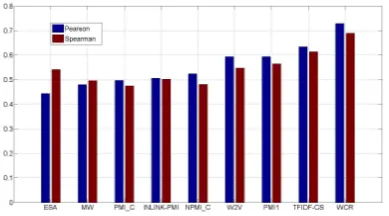
distri-butionfeatures, while INLINK-PMI, which computes the PMI between the incoming links of the two concepts (Cec-carelli et al., 2013), leads theWikipedia meta-datafeatures. To examine the statistical significance of the obtained fea-ture ranking, we used the MRDS method (Rastogi et al., 2015), which given a pair of features, computes the signif-icance of the difference between their prediction capabili-ties, based on the difference between their observed corre-lations, the correlation between them, and the size of the data. Applying this test to the pairs within the top ranked features, the advantage of PMI1 over W2V and INLINK-PMI over INLINK-PMI1 C was shown to be insignificant. The rela-tive ranking of the other feature pairs was statistically sig-nificant, with p-value< 0.05. We further applied MRDS to check the advantage of the highest ranked feature from each category, over the other members of its category. The advantage of PMI1 over W2V was already shown to be in-significant. However, the advantage in the three other fea-ture categories was significant, with p-value<0.05. Sorting the features by theirSpearmancorrelation results in a slightly different feature hierarchy. The three lead-ing features remain unchanged, but the concept-level fea-tures are replaced in the top list with link-structure feafea-tures. This result implies that the link based features are stronger in concept ranking then in prediction of relatedness level, where the opposite is true for theconcept-level distribution features.
WORT improvement of Spearman and Pearson correla-tion compared to the best feature (TFIDF-CS), is16%and 13%respectively. This improvement is significant for both Spearman and Pearson correlation with MRDS p-value<
10−308.
Figure 1: Pearson (blue) and Spearman (red) correlations of WORT (right most bars), and of the highest ranked WORT features according to Pearson correlation. The fea-ture names appear below the bars.
6.
Discussion and Future Work
We propose a novel type of semantic relatedness dataset, composed of pairs of Wikipedia concepts manually scored by human annotators. We display its usefulness for evalu-ating different families of relatedness functions, and study their relative performance. To demonstrate the versatil-ity of WORD, we introduce a mechanism for automati-cally converting it into an even larger disambiguated term-relatedness dataset. Furthermore, by using the documents of the concept articles, WORD can serve also as adocu-ment relatedness dataset which is dramatically larger than the existing dataset (Lee and Welsh, 2005). From the super-vised learning point of view, the performance of our new tool, WORT, which despite its simplicity, yields a relat-edness function that significantly improves state of the art methods, demonstrates the high synergistic potential that lies in the diversity of the participating features. More com-plex models can be learned for further improving the relat-edness function. For example, one can adopt the approach used by (Mueller and Thyagarajan, 2016) for metric learn-ing of sentences, and use Siamese networks for learnlearn-ing concept representations and a metric between them. Fi-nally, the concept pairs identified as related in WORD prob-ably manifest various types of relatedness, including topical relations, functional relations, and so forth. More work is needed to characterize these relations types and their rel-ative frequency in the data; different prediction methods could then be developed, specializing in predicting specific types of relations between concept pairs.
7.
Acknowledgements
The authors would like to thank Vered Shwartz for her con-tribution to the preliminary stages of this work.
8.
Bibliographical References
Batchkarov, M., Kober, T., Reffin, J., Weeds, J., and Weir, D. (2016). A critique of word similarity as a method for evaluating distributional semantic models. ACL 2016, page 7.
Bouma, G. (2009). Normalized (pointwise) mutual infor-mation in collocation extraction. InProceedings of the Biennial GSCL Conference, volume 156.
Bullinaria, J. A. and Levy, J. P. (2007). Extracting se-mantic representations from word co-occurrence statis-tics: A computational study.Behavior research methods, 39(3):510–526.
Ceccarelli, D., Lucchese, C., Orlando, S., Perego, R., and Trani, S. (2013). Learning relatedness measures for en-tity linking. In Proceedings of the 22nd ACM interna-tional conference on Information & Knowledge Manage-ment, pages 139–148. ACM.
Chiu, B., Korhonen, A., and Pyysalo, S. (2016). Intrinsic evaluation of word vectors fails to predict extrinsic per-formance. ACL 2016, page 1.
Church, K. W. and Hanks, P. (1990). Word association norms, mutual information, and lexicography. Compu-tational linguistics, 16(1):22–29.
Faruqui, M., Tsvetkov, Y., Rastogi, P., and Dyer, C. (2016). Problems with evaluation of word embeddings using word similarity tasks. arXiv preprint arXiv:1605.02276. Ferragina, P. and Scaiella, U. (2010). Tagme: on-the-fly annotation of short text fragments (by wikipedia enti-ties). InCIKM.
Finkelstein, L., Gabrilovich, E., Matias, Y., Rivlin, E., Solan, Z., Wolfman, G., and Ruppin, E. (2002). Placing search in context: The concept revisited. ACM Transac-tions on Information Systems, 20(1):116–131.
Hill, F., Reichart, R., and Korhonen, A. (2014). Simlex-999: Evaluating semantic models with (genuine) simi-larity estimation. arXiv preprint arXiv:1408.3456. Lee, M. D. and Welsh, M. (2005). An empirical evaluation
of models of text document similarity. InIn CogSci2005, pages 1254–1259. Erlbaum.
Levy, O., Goldberg, Y., and Dagan, I. (2015a). Improving distributional similarity with lessons learned from word embeddings. Transactions of the Association for Com-putational Linguistics, 3:211–225.
Levy, R., Ein-Dor, L., Hummel, S., Rinott, R., and Slonim, N. (2015b). Tr9856: A multi-word term relatedness benchmark. InProceedings of the 53rd Annual Meeting of the Association for Computational Linguistics and the 7th International Joint Conference on Natural Language Processing (Volume 2: Short Papers), pages 419–424, Beijing, China, July. Association for Computational Lin-guistics.
Mikolov, T., Chen, K., Corrado, G., and Dean, J. (2013). Efficient estimation of word representations in vector space.arXiv preprint arXiv:1301.3781.
Mueller, J. and Thyagarajan, A. (2016). Siamese recurrent architectures for learning sentence similarity. InAAAI, pages 2786–2792.
Rastogi, P., Van Durme, B., and Arora, R. (2015). Multi-view lsa: Representation learning via generalized cca. In HLT-NAACL, pages 556–566.
Sherkat, E. and Milios, E. (2017). Vector embedding of wikipedia concepts and entities. arXiv preprint arXiv:1702.03470.
Strube, M. and Ponzetto, S. P. (2006). Wikirelate! com-puting semantic relatedness using wikipedia. InAAAI, volume 6, pages 1419–1424.