A Parser for LTAG and Frame Semantics
David Arps, Simon Petitjean
Heinrich-Heine-Universit¨at D¨usseldorf[email protected], [email protected]
Abstract
Since the idea of combining Lexicalized Tree Adjoining Grammars (LTAG) and frame semantics was proposed (Kallmeyer and Osswald, 2013), a set of resources of this type has been created. These grammars are composed of pairs of elementary trees and frames, where syntactic and semantic arguments are linked using unification variables. This allows to build semantic representations when parsing, by composing the frames according to the combination of the elementary trees. However, the lack of a parser using such grammars makes it complicated to check whether these resources are correct implementations of the theory or not. The development of larger resources, that is to say large-coverage grammars, is also conditioned by the existence of such a parser. In this paper, we present our solution to this problem, namely an extension of the TuLiPA parser with frame semantics. We also present the frameworks used to build the resources used by the parser: the theoretical framework, composed of LTAG and frame semantics, and the software framework, XMG2.
Keywords:Parsing, Grammar, Syntax, Semantics, Tools, Systems, Applications.
1.
Introduction
The development of linguistic resources such as precision grammars and lexicons is a complex and time consuming task. Even though the challenges offered by these tasks often come from the size of the resources to develop, the difficulty can be increased by the lack of tools processing this type of data and allowing to test it. This is the case of grammars using both the formalism of Lexicalized Tree Adjoining Grammars and frames as semantic representa-tions. For example, the description of the syntax-semantics interface in (Zinova, 2017) uses a workaround (simulating the lexical insertion while creating the grammar, and not during parsing), as no parser for such a type of resource was available at the time. This paper introduces a parser which uses grammars of this type, based on an existing parser for LTAG: TuLiPA.
In Section 2., we provide a short explanation of the frame-work and show how it interacts with semantic parsing. In Section 3., we summarize the compact description of our resources in a metagrammar. In Section 4., we summarize the architecture of the TuLiPA parser that we are using. In Section 5., we introduce our new extension of TuLiPA to handle frame semantics, and give an example of use of this parser in Section 6..
2.
Semantic Parsing with LTAG
2.1.
Tree Adjoining Grammars
A Tree Adjoining Grammar consists of a set of elementary trees, from which larger trees are built using substitution and adjunction. Nodes in elementary trees have terminal or non-terminal labels. In a lexicalized TAG, every elementary tree has at least one terminal node. In a fully derived tree, all leaf nodes have terminal labels and all internal nodes have non-terminal labels. Elementary trees are either ini-tial trees or auxiliary trees. The latter have one leaf node marked as a foot node by an asterisk. The foot node and the root node of the auxiliary tree have the same label. All trees may have leaf nodes that are marked as substitution nodes by an arrow. A derivation starts with an initial tree. Two operations are used to combine trees during a deriva-tion. In substitution, the root node of an elementary tree
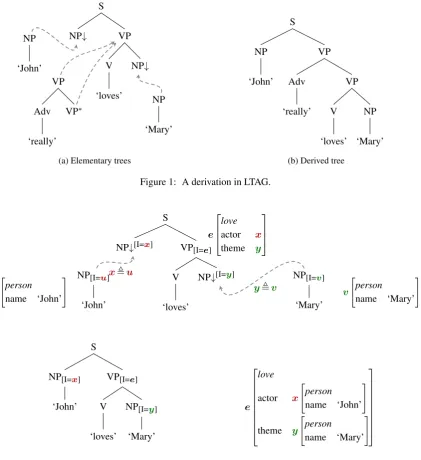
re-places a non-terminal leaf node of another tree, where both nodes have the same label. For adjunction, an auxiliary tree is adjoined to a target node in another tree. The root node of the auxiliary tree replaces the target node, and the part of the target tree below the target node is attached to the foot node in the auxiliary tree. An example is shown in Figure 1. In1a, the elementary trees for ‘John’ and ‘Mary’ are substi-tuted at the subject and object argument slots in the initial tree for ‘loves’. The adverbial modifier ‘really’ is adjoined at the VP node. The resulting derived tree is shown in 1b. Elementary trees represent the constructional meaning of their lexical items in that they have substitution nodes for all arguments of the anchor. Recursive phenomena like modification are modelled by adjunction, which leads to long-distance dependencies in derived trees that were local in one elementary tree (Joshi and Schabes, 1997). Thus, all elementary syntactic structures can carry semantic in-formation locally. Morphosyntactic inin-formation and links to the semantic representation are stored in feature struc-tures at the nodes of elementary trees (Vijay-Shanker and Joshi, 1988). The acceptance of a derivation is determined by unification of those feature structures.
2.2.
Frames and semantic parsing
In the syntax-semantics interface for LTAG proposed by (Kallmeyer and Osswald, 2013), semantic frames are repre-sented as base-labelled, typed feature structures. They can be understood as a straightforward representation of the se-mantic and conceptual knowledge about a situation, while having good computational properties as their composition relies on the unification of attribute-value structures. LTAG elementary trees are paired with frames by using unification variables, as shown in Figure 2.
NP
Figure 1: A derivation in LTAG.
NP[I=u]
Figure 2: An example of pairing of LTAG trees and frames and the result of their combination.
and ’Mary’ are both paired with frames of type person, where only the value of the attribute name differs, respec-tively labeled by the variablesuandv.
During parsing, as syntactic trees are combined (by adjunc-tion or substituadjunc-tion), the semantic representaadjunc-tions are also combined. The unification of variables in the feature struc-tures associated to the nodes triggers the unification of vari-ables in the frames. In our example, as the substitution of the subject NP takes place (combining the elementary trees of ’love’ and ’John’), the respective values associated to the attribute I in the feature structures are unified. This results in the unification of the variablesxandu, which makes the frame for John become the actor of the event ’love’. The same happens when the tree for ’Mary’ is substituted at the object NP node of the ’love’ tree: yandv unify to let the frame for ’Mary’ become the value of the theme attribute in the framee.
3.
XMG and XMG2
descrip-new compilers of the kind of XMG. It offers a collection of different languages and compilers (automatically gener-ated) dedicated to different description tasks. This set of description tools allows us to generate all the resources that we need in this paper using a single framework.
XMG comes with a system of dimensions which allows to separate the levels of linguistic description (here syntax and semantics, but also lexicon). Thehsynidimension allows to describe trees by using dominance and precedence con-straints between syntactic nodes, while thehframei dimen-sion allows the description of typed feature structures, as well as type hierarchies (Lichte and Petitjean, 2015). The hlemmaiand thehmorphidimensions can be used to gener-ate a lexicon. The architecture of the lexicon that we use for our parsing task will be described in the Section 6., together with examples of XMG2 code using the four previsously mentioned dimensions.
An XMG2 compiler takes as input a metagrammar, and produces the lexicon of all the structures described in it. In other words, it converts a compact representation of a re-source into the rere-source itself. In our case, every entry of the generated grammar is a pair of an unanchored tree and a typed feature structure. Grammars generated with XMG2 can naturally be used for tasks such as generation or pars-ing, provided that the adapted tool exists. The next section introduces TuLiPA, which is one of these tools.
4.
TuLiPA
Mildly context-sensitive grammar formalisms like TAG have been shown to capture complex natural language phe-nomena, such as cross-serial dependencies, while being parsable in polynomial time. TuLiPA (“T¨ubingen Lin-guistic Parsing Architecture” (Kallmeyer et al., 2008)) is a parser for several mildly context-sensitive formalisms, including LTAG. The LTAG grammars used by the origi-nal TuLiPA version can feature semantic information using predicate semantics as in the syntax-semantics interfaces of Gardent and Kallmeyer (2003) and Kallmeyer and Romero (2008).
The lexical information processed by TuLiPA is 2-layered. The morphological lexicon maps inflected tokens to their lemma, storing morphological information in a feature structure. The lemmas are stored with semantic informa-tion and the tree families to which the lemmas can be an-chored. Before parsing, trees are anchored, i.e. for every word of the input sentence, possible elementary trees are selected where the semantic information on the lemma of the word matches with the information on the anchor node of the tree.
Therefore, the grammar used by TuLiPA, similarly to the XTAG grammar (XTAG Research Group, 2001), is com-posed of three elements: a lexicon of unanchored elemen-tary trees (tree templates), a lexicon of lemmas and a lexi-con of fully inflected forms. This is another level of factor-ization (in addition to the metagrammatical one presented in Section 3.) which helps reducing the size of the resource. Currently, there are two parsing modes for parsing LTAG with semantic frames available in TuLiPA. As of (Kallmeyer et al., 2008), the input grammar is converted
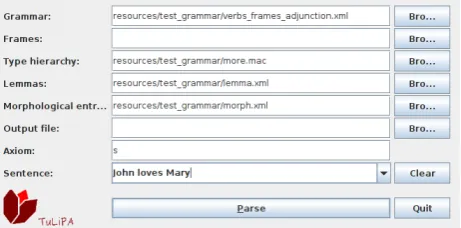
Figure 3: The user interface of TuLiPA
to a simple Range Concatenation Grammar (RCG, Boul-lier (1999)), which is used for parsing the input sentence, The TAG derivation structures are extracted from the RCG parsing results. Because this algorithm was designed to handle multi-component TAG (which is an extension of TAG), the conversion to RCG performed poorly on large-scale LTAG grammars. We included the implementation of a CYK parser by Thomas Schoenemann, based on the deduction rules given in (Kallmeyer, 2010). The parsing results, namely derivation trees, derived trees, derivation steps and possibly semantic representations, can be viewed in a graphical user interface or exported as XML files. In the next section, we will describe how we extended TuLiPA to be able to process LTAG grammars including frame semantics.
5.
A TuLiPA Extension for Frame Semantics
There are several motivations for the choice of TuLiPA as a starting point for our parser: with TuLiPA, we already have an open source LTAG parser, with graphical user interface, and multiplatform (as it is written in Java). As explained in the previous section, TuLiPA can already process semantic descriptions expressed as predicates.Our extension, released like TuLiPA as an executable jar1, accumulates typed feature structures instead of predicates during the parsing. The main changes are the following:
1. The grammars used are now composed of tree-frame pairs as presented in Section 2.. They are generated by XMG2, using thehsyniand thehframeidimensions.
2. A type hierarchy (also produced by XMG2) must also be given to the parser to process the unification of typed feature structures.
3. The lexicon of trees and frames can be given sepa-rately. If this option is chosen, the tree-frame pairs are built during parsing (according to information pro-vided by the lexicon).
Figure 3 shows the user interface of the parser where all the input data is given.
In the next section, we will go through all the steps which are necessary to create toy resources and recreate a parse example.
1https://github.com/spetitjean/
1 class commonnoun
Figure 4: XMG2 description for a proper noun elementary tree and its frame.
1 class commonnoun
Figure 5: XMG2 description for a proper noun elementary tree.
6.
Example of Parsing
To recreate the analysis of ’John eats pizza’ similar to the one given in Figure 2, we will first see how to create the inputs needed by TuLiPA. The source code is available online, see 1. All the input files (tree templates, frames, lemma lexicon and morphological lexicon) are XML files produced by XMG2. The use of a single framework is a new feature: While the grammar and the frames were al-ways produced by XMG, the morphological and lemma files used to be generated by a tool called lexConverter. The extensibility of XMG2 made it possible to create new compilers to generate these lexicons, using a consistent syntax and the same modular approach. In this work, we will use three different XMG2 compilers calledsynframe,
lexandmph, which are accessible by the same command (xmg compile).
6.1.
The grammar
The first resource to build is a LTAG grammar composed of at least 3 trees (transitive verb for ’eat’, proper noun for ’John’ and common noun for ’pizza’) paired with their cor-responding frames. These structures are described in the metagrammar and compiled using XMG2.
The XMG2 code describing a common noun tree and its frame can be as in Figure 4. Our architecture uses the no-tion of family, which are sets of trees which allow the same lexical anchors. In our example, the familycommonnounis composed of a unique tree, and the only lexical item com-patible with this family ispizza.
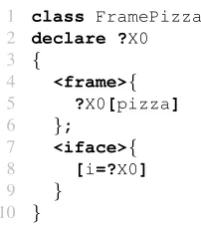
1 class FramePizza
Figure 6: XMG2 description for a single frame, to be paired with a syntactic tree during parsing.
On the first line,class commonnounmeans that we de-fine an XMG2 abstraction, which is in fact the tree-frame pair as it will be in the grammar. ?NP ?N ?X0 ?X1are unification variables used in the class. The tagssyn and frameseparate the syntactic and the semantic descriptions. In the syntactic one, two nodes (?NP and?N) are created with feature structures (?NP has category np, etc.). The node ?N is marked as an anchor node. Finally, the con-straint on line 7 means that XMG2 will only generate trees where the NP node has the N node as daughter.
On the semantic side, we create a typed feature structure of typepizza, labeled by the variable?X0. However, pairing the frame for a pizza with the TAG tree for a common noun is not a very natural solution. We will now split this en-try in two different lexicons: a purely syntactic lexicon of unanchored elementary trees and a purely semantic lexicon of frames. The syntactic treecommonnoun will be asso-ciated to the semantic frame pizzaonly when this token is read by the parser. The lemma lexicon will take care of this binding, as explained in the following subsection. This allows to associate different frames to one elementary tree, giving more flexibility.
In our case, we can split syntax and semantics as shown in Figures 5 and 6. The linking between the syntactic node and the semantic frame is this time done through the in-terface (iface). This dimension contains only a feature structure, which allows to share information between other dimensions. During parsing, when the elementary tree and the frame are paired, the two interfaces are unified, re-sulting in the unification of the two variables named?X1
(which were independent until now, as every structure has its own namespace). The two files (syntactic and semantic) are compiled using thesynframecompiler to produce the two lexicons.
6.2.
The lemmas
The second step is to create a lexicon of lemmas containing at least three entries (one transitive verb and two nouns). The entry for pizza is as shown in Figure 7.
2 {
3 <lemma> {
4 entry <- "pizza"; 5 sem <- FramePizza;
6 cat <- n;
7 fam <- commonnoun
8 }
9 }
Figure 7: XMG2 description for the lemma ’pizza’.
1 class MorphPizza
Figure 8: XMG2 description for the morphological entry for ’pizza’.
a new XMG2 file, which must be compiled with thelex
compiler.
6.3.
The inflected forms
Finally, we must write a lexicon of at least three inflected forms (’John’ for the lemma ’john’, etc.). The entry for ’pizza’ (one of the inflected forms of the previously defined lemma, along with ’pizzas’ for example) is shown in the code of Figure 8. This entry associates the inflected form ’pizza’ to the lemmapizza, with additional features, here only a syntactic category and a number. The XMG2 file containing this class amongst others can be compiled with themphcompiler to produce the lexicon of inflected forms.
6.4.
The type hierarchy
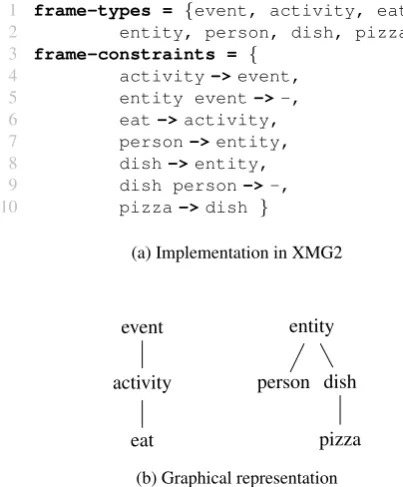
The implementation of the type hierarchy in Figure 9a fol-lows Lichte and Petitjean (2015). In the code, line 1 and 2 define the elementary types that are used in the hierarchy. From line 3 on, constraints are declared on these elemen-tary types. Constraints in the form of line 4 express type subsumption: every activity is also an event. Con-straints as in line 5 express that the unification of elemen-tary types fails: When a minimal model of the type hierar-chy is computed,entityandeventdo not have a com-mon subtype. An example is provided in the next section. It is also possible to express constraints on the attributes of frames with a certain type. For a more detailled description, see (Lichte and Petitjean, 2015). The graphical representa-tion in Figure 9b has to be read top-down, with the most general types on top.
6.5.
The parse result
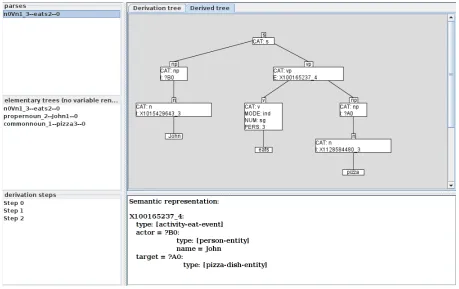
The result of the parse of the sentence ’John eats pizza’, as shown by the graphical interface of the parser, is given in Figure 10.
1 {
2 entity, person, dish, pizza}
3 frame-constraints = {
4 activity->event,
5 entity event->-,
6 eat->activity,
7 person->entity,
8 dish->entity,
9 dish person->-,
10 pizza->dish }
(a) Implementation in XMG2
event
Figure 9: The implementation and graphical representation of the type hierarchy used in ’John eats pizza’
On the left, we see the list of successful parses (only one), the set of elementary trees which were used to derive the selected parse, and the derivation steps. The derived tree is shown at the top right, with the semantic representation at the bottom.
The parse result is similar to the one which we gave in Fig-ure 2. The semantic representation consists of one frame: It has typeactivity-eat-eventand two attributes, the
actor andtarget of the verb. Their values are shared with the syntax: The actor is of type person-entity
and is unified with the interface feature in the
subject-np-node through the variable ?B0. The target is of type
pizza-dish-entity and corresponds to the object-np -node, unified by the variable ?A0. These unifications are triggered by substitution, and the insertion of ’john’ into the frame is triggered by lexical anchoring. Note that the typedish, which is not present in theeatframe nor in the
pizzaframe, is inferred from the type hierarchy (as every frame of typepizzamust also have typedish). The in-terface feature of the subject-n-node give an idea of this. Unification via adjunction works in the same way.
The types of the feature structures are here conjunctive types and get modified by the constraints expressed in the metagrammar. For instance, one constraint in our metagrammar specifies that all structures of typeperson
also have type entity, hence the conjunctive types [person-entity].
7.
Conclusion
Figure 10: Result of the parse of ’John eats pizza’
together or separately), one of lemmas and one of inflected forms. The composition of frames, implemented follow-ing Kallmeyer and Osswald (2013), happens as elementary trees are combined, triggered by the unification of linked variables. In Section 6., we showed how to create the dif-ferent resources to parse a simple example, and also that the analysis done by our tool for this example was the expected one. The availability of such a tool will make the use of the existing LTAG grammars including frame based semantics possible, and ease the creation of new ones.
As a next step, in order to improve parsing efficiency when using large grammar resources, we consider implementing grammar compression using subtree sharing and compres-sion of these subtrees into minimal Finite State Automata, as described in (Waszczuk et al., 2016)
We are also working on a parser for Role and Reference Grammar (RRG, Van Valin (2005)), following the formal-ization proposed in (Kallmeyer and Osswald, 2017). RRG is a grammar theory based on flat constituent structures and focusing on semantic and pragmatic aspects. We can of course imagine that grammars based on RRG and frame semantics will be created, with a framework similar to the one presented in this paper, and tested with our tool.
8.
Acknowledgements
The research presented here has been supported by the TreeGraSP Project funded by an ERC Consolidator Grant. We would like to thank three anonymous reviewers for their valuable comments on earlier drafts of this article.
9.
Bibliographical References
Boullier, P. (1999). On TAG and Multicomponent TAG Parsing. Research Report RR-3668, INRIA.
Crabb´e, B., Duchier, D., Gardent, C., Le Roux, J., and Par-mentier, Y. (2013). XMG : eXtensible MetaGrammar. Computational Linguistics, 39(3):1–66.
Gardent, C. and Kallmeyer, L. (2003). Semantic construc-tion in feature-based tree adjoining grammar. In 10th conference of the European Chapter of the Association for Computational Linguistics.
Joshi, A. K. and Schabes, Y. (1997). Tree-Adjoining Grammars. In G. Rozenberg et al., editors,Handbook of Formal Languages, volume 3, pages 69–124. Springer, Berlin, New York.
Kallmeyer, L. and Osswald, R. (2013). Syntax-driven se-mantic frame composition in lexicalized tree adjoining grammars. Journal of Language Modelling, 1(2):267– 330.
Kallmeyer, L. and Osswald, R. (2017). Combining predicate-argument structure and operator projection: Clause structure in role and reference grammar. In Pro-ceedings of the 13th International Workshop on Tree Ad-joining Grammars and Related Formalisms, pages 61– 70. Association for Computational Linguistics.
Kallmeyer, L. and Romero, M. (2008). Scope and Situa-tion Binding in LTAG using Semantic UnificaSitua-tion. Re-search on Language and Computation, 6(1):3–52. Kallmeyer, L., Lichte, T., Maier, W., Parmentier, Y.,
8, Manchester, England, August.
Kallmeyer, L. (2010). Parsing Beyond Context-Free Grammars. Springer Publishing Company, Incorpo-rated, 1st edition.
Lichte, T. and Petitjean, S. (2015). Implementing semantic frames as typed feature structures with XMG.Journal of Language Modelling, 3(1):185–228.
Petitjean, S., Duchier, D., and Parmentier, Y. (2016). XMG 2: Describing Description Languages. In Logi-cal Aspects of Computational Linguistics. Celebrating 20 Years of LACL (1996–2016) 9th International Confer-ence, LACL 2016, Nancy, France, December 5-7, 2016, Proceedings 9, pages 255–272. Springer Berlin Heidel-berg.
Van Valin, Jr., R. D. (2005). Exploring the Syntax-Semantics Interface. Cambridge University Press. Vijay-Shanker, K. and Joshi, A. K. (1988). Feature
struc-tures based tree adjoining grammars. InProceedings of the 12th Conference on Computational Linguistics - Vol-ume 2, COLING ’88, pages 714–719, Stroudsburg, PA, USA. Association for Computational Linguistics. Waszczuk, J., Savary, A., and Parmentier, Y. (2016).
En-hancing practical TAG parsing efficiency by capturing redundancy. In21st International Conference on Imple-mentation and Application of Automata (CIAA 2016), S´eoul, South Korea, July.
XTAG Research Group. (2001). A Lexicalized Tree Ad-joining Grammar for English. Technical Report IRCS-01-03, IRCS, University of Pennsylvania.