Design and Analysis of Deep Learning in
Neural Networks
G. Naga Sireesha
1,
V. Siva Parvathi
2,
Y. Surekha
3,
A.Vanamala Kumar
4M Tech Scholar Asst. Professor Asst. Professor Asst. Professor
Department of CSE 1,2,3,4, Prasad V Potluri Siddhartha Institute of Technology (PVPSIT) - A.P.India.
Email: [email protected] , [email protected]
[email protected] [email protected]
Abstract- Profound learning (DL) is a rising and wonderful point of view that licenses expansive scale
undertaking driven part grabbing from tremendous information. Regardless, normal DL is an absolutely deterministic model that reveals no information into information defenselessness decreases. In this paper, we have a tendency to show the considerations of fuzzy learning into deciliter to trounce the deficiencies of settled portrayal. The greater part of the planned fuzzy structure is an alternate leveled critical neural system that gets data from both fuzzy and neural delineations. By at that point, the information learnt from these two separate perspectives are joined everything considered framing the last information delineation to be assembled. The adequacy of the model is watched out for three handy errands of picture portrayal, high-rehash money related information want and mind MRI division that altogether cover bizarre state vulnerabilities in the grungy information. The fuzzy point of view wonderfully beats new non fuzzy and narrow learning methods on these errands.
Index Terms- Profound learning; neural delineations.
1. INTRODUCTION
1.1. Objective
A regular formative module of such application includes the accompanying viewpoint we expect to build up some of them.
To produce streamlined outcomes upgraded calculation in light of intriguing quality described by fast arrangement is executed.
• Understand how to assemble basic pattern models for order.
• Understand how to assemble neural systems for characterization.
• Understand how unique parameters for neural system calculations influence their yield. • Assess the precision of a few models utilizing cross-approval.
• Communicate the data caught in the neural system display.
In proposed framework, to conquer the deficiency of Fuzzy calculation, an enhanced Fused-Fuzzy calculation is proposed. Combined Fuzzy streamlined calculation in view of two-layer data increases and enhancement of the property estimation in light of user's intriguing quality When a trait is chosen from the neural system, the calculation ought not just consider the data pick up of chosen quality yet additionally its following
characteristics. This calculation can successfully abstain from favoring the quality with an extensive number of characteristic qualities. If there should be an occurrence of a substantial number of trait esteems, Fused-Fuzzy calculation in light of intriguing quality described by fast arrangement enhancement take the incentive between [0,1]. To produce the ideal expectation comes about, it is important to limit the sum and profundity of the neurons required to process through pre fuzzy channel.
The money related market not quite the same as a considerable measure of physical frameworks like we know the climate is that the monetary market is a kind of complex criticism component. What individuals anticipate that costs will be influences the costs they watch and afterward the costs they watch at that point influences how they will shape their assumptions regarding what the costs will be in the following time frame. The market is fundamentally an indeterminate brute or an unverifiable organization, it's an establishment where individuals exchange chance, swap hazard, and that is the reason it's there. Thus on the off chance that it were conceivable to anticipate it there would be no hazard.
2. BACKGROUND
Available online at www.ijrat.org
thru Markowitz [7] suggests a path x of advantage weights which total to 1 be picked to such a degree, to the point that immediate blends P[sub p] = x[sup c]P ordinary asset returns P (likely plenitude proceeds) which address the typical benefit for a collection, supported for a predefined level of "peril", V[sub p],. The successful backcountry is the arc of (P[sub p], V[sub p]) trailed by collections whose entry/danger transaction is perfect in this wisdom [9]. Relentless period, mean-distinction collection assurance has remained thought about a stochastic direct LQ perfect controller and in invert stochastic different conditions. The LQ issue lessened to clarifying a stochastic condition which is totally nonsingular BSDE with sporadic constants. It was confirmed that the compelling wild in the mean-standard deviation illustration remained a conventional line and in like manner danger free hypothesis is a specific believability despite when the credit cost is sporadic.
2.1 Fundamentals of Economic Risk:
As ahead of schedule as 1971, the estimate of hazard in collection choice replicas was perceived to hazardous meanwhile the genuine estimations of the factors of the dissemination profits are not recognized through assurance nevertheless rather should be assessed from together goal and particular data. A classical model created that careful the chief's absence of ideal data about the replica's constraints, however Bayesian techniques expected hazard estimation & typical direct relapse was utilized. Right around three decades later, a choice strategy was used to decide a benefit risk administration show for loss safety net providers in light of a stochastic, technique requiring situation accumulation and ex stake choice decides that take into consideration various situations. Once more, these discoveries recommend that the insurance agencies would lean toward precise portrayals of vulnerabilities are deficient in stochastic presentations. However, stochastic strategies seem common in writing to address vulnerability and equivocal data innate in collection administration doing with hazard and return. Vigorous streamlining the field that seeks to vulnerability in constraint estimation. Using hypothesis, a prototypical was recommended that measured the aggregate deviance of the acknowledged expected comes back from their ostensible appraisals to be not exactly or equivalent to some heartiness spending plan. The greatness of which originates from one's resilience for add up to estimation mistake, securing the financial specialist against developments in anticipated that profits up would the assigned measure of the first. A standard can be set to quantify separation of the deviance by either direct strategies or not. In any case, while
accentuation moderation of estimation and classic hazard in collection administration was developed the significance &measurable strategies turned out to be ordinary in the venture business, hearty portfolio advancement remains normally established in measurable estimation techniques. In the hearty portfolio streamlining issue, the traditional plans of VAR to be a great degree delicate to blunders in the malicious and covariance lattice the profits. Indeed, with consummate information of circulation, calculation for VAR sums is comparable unwieldy and effectively settled by statistical strategies. VaR is considered as most extreme misfortune on the collectionswere certainty stages are between 95% to 99% and time skyline in the vicinity of one and ten days. Again deficient information is dangerous since the genuine benefit and misfortune conveyance must be surmised not known with sureness. The supposition of an ordinary appropriation has been used every now and again yet is regularly truly off base. A restricted approach was planned by Luciano and Marena for its machine simplicity circumstances somewhere chance assessment must be performed rapidly. The lower bound is in this way deciphered as the more awful case situation at a certain level, just minor quantiles are recognized and vulnerability is clear. Hazard has every now and again been demonstrated by usefulness hypothesis. Usefulness ramifications Markowitz's hypothesis that speculator picks a collection exclusively on predictable esteem &variation, in this manner, I examined broadly. The ideal collection choice issue below Knightian vulnerability reflects the leader's collection comprising one unsafe and another hazard allowed resource. Anticipated that usefulness is utilized would determine limits on the no-exchange district for both idealistic and cynical chiefs bringing about a shut interim for the standard expected utility yet redundant shut for the Choquet expected utility. Along these lines, kinds of standard usefulness capacities tin affect the exchange region in-cooperation hazard and hazard allowed situations.
2.2 Fundamentals of Fuzzy Logic for Risk:
current work is Zebda's definition of fuzzy chance
where, if at time t the system is at state i and receiving input j, it goes to state k at time t+1 with fuzzy chance Qijk Eq. (2). Corresponding fuzzy
advantages area unit outlined by fuzzy sets Bijk
wherever
2.3 Fuzzy Managers
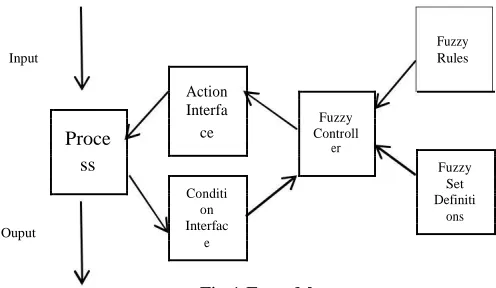
A fuzzy Managers system may be thought of as a variation of the everyday skilled system during which rules and on the market facts are wont to draw a conclusion. The diagram of general fuzzy Managers is shown below:
Fuzzy
Input Rules
Action
Interfa Fuzzy
ce
Proce Controll er
ss Fuzzy
Conditi Definiti Set
on ons
Interfac Ouput
[image:3.595.33.281.316.460.2]e
Fig 1.FuzzyManagers
As Fig 1 of Fuzzy Manager procedure module gets contribution to the type of a fresh fuzzy informational index. Additional info is as a fuzzy run or standards in light of fuzzy set hypothesis and important fuzzy usual descriptions that likewise go about as contribution to the fuzzy Manager. The State Border decides how much information fulfills "if" state of fuzzy defined run the show. At that point in light of the quality of every govern, the meaning of every fuzzy group in the standards, the Fuzzy Manager component fires every manage as indicated by its quality to give fuzzy yield. The ActLine defuzzifies fuzzy yield into game-plan. Consequence of the game-plan occupied gives contribution to the framework. Along these lines, the Fuzzy Controller show enables figuring out how to be accomplished as 1) the terminating quality of each run is estimated, 2) fuzzy yield enables standards to be refreshed, and 3) new activities are prescribed as the framework keeps on circling. This gives the Knowledge Base significant to any master framework.
3. MOTIVATION
It is increasingly necessary for explanations to be communicated effectively both to and from
autonomous systems. These explanations can offer insight into why an action has been chosen, or why a specified object has been given a specific classification label. The latter example can be realized by including rule-based fuzzy inference systems with expressive DL tools. The DL tools can learn to generate information dense feature labels which are then further interpreted by the fuzzy inference systems offering both a label and an explanation. Because the fuzzy inference systems depend on human defined structured rules, the system would be both easily to understand and easy to modify.
3.1 Fuzzy Inference
Fuzzy-inference systems, such as ANFIS [5] allow for complex non-linear problems to be approximated using if-then statements. These systems have a wide variety of applications and can encode both objective measurements and subjective information. Such systems have been used for a wide array of applications, including multimodal classification [2], medical imaging [4], and market prediction [2].
Structured rule based systems have the advantage of being able to be biased by subjective information. This provides an opportunity for an analyst to provide expert information to the system, improving classification results or changing the behavior of the system. This feedback bias can additionally be used to speed up learning for the autonomous systems while maintaining stability [1].
3.2 Deep Learning
Unlike the fuzzy-inference counterparts, deep learning methods including CNNs and Recurrent Neural Networks(RNNs) do not require hand crafted features. Instead, they rely on predefined structures and labeled data and are able tolearn features on their own. DL methods have been successful in complex sensor problems including fine grained imageclassification [8], speech recognition [3] and action recognition [1].
A remaining challenge for these DL methods involves extracting and interpreting the features that are learned by the networks. For many applications a classification label is not enough information; in these instances it is important to additionally be able to understand the high level features that have been generated by the networks. Preliminary work has shown that the networks do create, at some level, neurons which can be used to represent higher level abstractions including human and cat detectors, even when the networks are not trained to do so explicitly [9].
Available online at www.ijrat.org
an unsupervised system freeing the system from the burdens of having hand crafted labels. The problem of hand labeling data has often stalled development of DL systems as generating tens of thousands of training examples is tedious and difficult work. Second, having the ability to find specific neurons in a DL system which correspond to a specific requested feature allow
an analyst to hook into the network and pull out feature arrays. Instead of only having a class label for „car,‟ as is traditionally done in DL, it would be possible to find specific neurons for components of a car („windshield‟, „trunk‟, etc.). These features can be exploited directly by an analyst or fed into fuzzy-inference systems where they can automatically be grouped together to generate classification labels through rule based mechanisms.
3.4 Hybrid Learning Approaches
Having multiple machine learning algorithms be developed for a problem is by no means an original concept. Deeplearning has been coupled with many algorithms including random forest algorithms [10]. Here, high level features are generated through DL and fed into the random forest algorithm allowing information from multiple sensors to be mergedin a meaningful way. DL has also been expressed as hierarchical structures [6] which has extended classification problems to even finer grains of classification. DL has even been combined with fuzzy logic for multiple instance problems allowing hand crafted rules to be applied across an image [7].
4. TECHNICAL APPROACH
A hypothetical system (as seen in Fig 1) can be created using two components. The first is deep learning feature generation which can be used to create representative features from sensor data directly. The deep learning system would initially be trained on unlabeled data; desirable features would be extracted using methods similar to [9]. Once these features are extracted from the deep learning system, they will be integrated into fuzzy-inference systems.
These systems can incorporate both the features detected from the deep learning as well as subjective information from an analysts as a method of biasing the system. These two pieces together can be used for classification purposes. The final system would therefore be able to report both classification results and the specific features and rules that were activated for the system to arrive at its conclusion. Additionally, the final system could be further biased by an analyst asa form of feedback.
4.1 Deep learning feature generation
A deep learning architecture can be defined to handle raw data including either imagery or one dimensional signals,depending on the needs of an analyst. The weights can then iteratively be learned in an unsupervised manner without theneed for the data to be labeled. This process will generate high level features even without labeled data, as shown in [9].
Once these networks are trained, the activation of each neuron in the network can be tested for its responsiveness tolabeled stimuli, both positive and negative. A single input can have multiple labeled features present.
5.FUZZY PROFOUNDNEURAL NETWORK
5.1. Typical Configurations
The Fuzzy Profound Neural Network is appeared in Figure1, that is formed out of 4 learning components as shortened within the inscription of the Fig 2. Additional or less, the data (purple) take when 2 ways that to one by one build the fuzzy explanation portrayal (dark part) and also the NR (blue part). Thusly, the portrayals from these 2 views are joined along within the combination half (green part).
diverse layer images l . In each part, l is mediated as present talked about level. Part IFuzzy rationale portrayal (dark): Every hub ininfo level is associated various participation works allocate language specialist names to every information adaptable. The info adaptable is one measurement of information vector. fuzzy enrollment work figures tograde that information hub has a place with a specific fuzzy set.
5.2 FDNN Training
The preparation period of Fuzzy Profound Deep Neural Networks covers two noteworthy strides of bound instatement and calibrating. The introduction phases are basic in Deep Learning on the grounds that the entire learning framework isn't curved. Better instatement system may enable the neural system to focalize to a decent neighborhood least more effectively. In this paper, the introduction ought to be improved the situation both the fuzzy and neural parts.
6. OUTPUT SCREENS
6.1 Existing system:( for Apple DataSet)
Fig :6.1.1 screenshot for existing system
Fig:6.1.2 Graph plot for existing system
6.2 Proposed system:
Fig :6.2.1 screen shot for proposed system
Fig :6.2.2 Graph plot for proposed system
7. CONCLUSION
Here the paper presents a Fuzzy Profound Deep Neural Networks that progressively combines neural and the fuzzy rationale portrayals out and out for powerful information characterization. In this view, information equivocalness lessened by putting different fuzzy principles. What's more, the profound view diminishes the commotions information soft clean information portrayals to "see" with fuzzy rationale portrayal.
Available online at www.ijrat.org
mind tomography and high-recurrence financial info. The examinations with totally different non FDNNs uncover that Sunshine State is in point of fact a conceivable methodology to in addition upgrade the exhibitions of deciliter. Despite the actual fact that the concentrate of this paper is concerning info arrangement, the projected FDNN is adaptably related to different learning machines within the assignment driven layer, e.g., relapse, for additional broad component learning applications.
REFERENCES
[1] C.-T. Lin and C. S. G. Lee, “Neural-network-based fuzzy logic control anddecision system,” IEEE Trans. Comput., vol. 40, no. 12, pp. 1320–1336,Dec. 1991.
[2] J. J. Buckley and Y. Hayashi, “Fuzzy neural networks: A survey,” FuzzySets Syst., vol. 66, no. 1, pp. 1–13, 1994.
[3] H. K. Kwan and Y. Cai, “A fuzzy neural network and its application topattern
recognition,” IEEE Trans. Fuzzy Syst., vol. 2, no. 3, pp. 185–193,Aug. 1994.
[4] F. Wong, P. Wang, T. Goh, and B. Quek, “Fuzzy neural systems for stockselection,”
Financ.Anal.J., vol. 48, no. 1, pp. 47–52, 1992.
[5] M. Mehlawat and P. Gupta, “Fuzzy chance- constrained multiobjectiveportfolio selectionmodel,” IEEE Trans. Fuzzy Syst., vol. 22, no. 3, pp. 653–671, Jun. 2014.
[6] F.-J. Lin, C.-H.Lin, and P.-H. Shen, “Self-constructing fuzzy neural networkspeed controller for permanent-magnet synchronous motor drive,”IEEE Trans. Fuzzy Syst., vol. 9, no. 5, pp. 751–759, Oct. 2001.
[7] C.-F. Juang and C.-T. Lin, “An online self-constructing neural fuzzy inferencenetwork and its applications,” IEEE Trans. Fuzzy Syst., vol. 6, no. 1,pp. 12–32, Feb. 1998. [8]J. Ngiam, A. Khosla, M. Kim, J. Nam, H. Lee,
and A. Y. Ng, “Multimodaldeep learning,” in
Proc. 28th Int. Conf. Mach. Learn., 2011, pp. 689–696.
[9] Y. Bengio, “Learning deep architectures for AI,” Found. Trends Mach.Learn., vol. 2, no. 1, pp. 1–127, 2009.
[10]S. Zhou, Q. Chen, and X. Wang, “Fuzzy deep belief networks for semisupervisedsentiment classification,” Neurocomputing, vol. 131, pp. 312–322, 2014.