7
The Determinant of Fund Manager Performance of
School Operational Assistance (SOA) and Its Implication
toward the Financial Accountability
Irma Suryani1, Thatok Asmony2, M. Irwan3
Magister of Accounting Faculty of Economoics and Business Universitas Mataram, Indonesia
Abstract-The School Operational Assistance (SOA) program is the Indonesian government’s effort to implement the basic education without any cost. The allocation of SOA funds increased every year and this should be supported by the performance of its managers so that it will be able to increase the accountability. This research aimed to test the influence of human resource competence and organizational commitment toward the performance of SOA Fund managers and the implications toward financial accountability of SOA funds. This research was an explanatory research with using SmartPLS 3.0 analysis. The result of research showed that the competence of human resources has a positive effect toward SOA fund manager’s performance and organizational commitment influenced positively toward the SOA fund manager’s performance. This also influenced positively toward the financial accountability. The results of this research can be used as a reference for further research with using a wider sample and add more factors that can affect the performance of SOA fund managers and their implications for financial accountability.
Index Terms-financial accountability, performance, commitment, competence
1. INTRODUCTION
Law Number 20 Year 2003 about National Education System Article 11 stated that the Government and Regional Government must ensure the availability of funds for the implementation of education for every citizen aged 7-15 years. The logical consequence that appeared was the government must provide the basic education services for every citizen through the declaration of the 9-year Basic Education Compulsory and provide funding for the realization of the program through the School Operational Assistance (SOA) program.
The allocation of SOA year by year increased, this affected on the increasing SOA accountability report. The accountable Funds management of SOA was set in the SOA Technical direction (SOA) Year 2016 which referred toward the Regulation of the Minister of Education and Culture Number 16 year 2016. The State Administration Institution (2003) stated that the financial accountability was the responsibility about the financial integrity, disclosure and compliance with laws and regulations. This was suitable with the Instruction with the SOA, school as the SOA Fund Managers' must give the responsibility through the accountable financial report to the citizen as the success of SOA fund management.
Performance was determined by the competence of the person with the adequate provision of education, training and work experience (Sudarmanto 2014: 2). In addition, performance competencies were also influenced by the high commitment and strong performance that will lead the individuals in the achieving goals (Subagiyo, 2004).
8 The global phenomenon associated about SOA
funds has not realized the accountability in management of SOA funds, this was able to be seen with the discovery of various issues about the management of SOA Funds in a national scale that was at the reporting step, this was not only about the delay of reporting but also the presentation of reports including transparency and accountability report. This was a reflection of the still poor performance of School Fund Operational Fund (SOA) managers.
Based on the description of SOA funding issues and previous research studies, this test will test and provide the empirical evidence: (1) whether the competence and commitment influenced the performance of SOA fund managers, (2) whether the performance of managers influenced toward the financial accountability of SOA funds.
2. LITERATURE REVIEW AND HYPOTHESIS FORMULATION
a. Theoretical basis
The Accountability in management and SOA in this research can be explained from the perspective of Goal Setting Theory. This theory explained the relationship between defined goals and job performance through the goal-oriented targeting. When a person wanted to achieve his goal, this will use all of his efforts and use the relevant knowledge and skills (Locke and Latham, 2002). Accountability was the final goal that should be achieved. This can be realized with the maximum performance of the manager so that all the duties and responsibilities as a manager can be finished well.
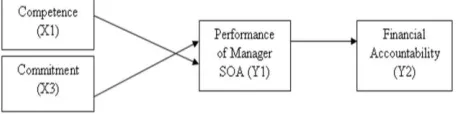
Achieving maximum performance will be realized if the individual has sufficient competence so that individuals can use the existing competence to achieve the goal of good performance. This was also suitable with the commitment of the organization that will support someone to work better and earnestly to achieve the maximum results. Based on the research of theory and previous research, the research model was built by the author, this can be seen at Figure 1.
[image:2.612.68.296.637.694.2]
Figure 1. Research Conceptual Framework
b. Hypothesis Formulation
Effect of human resource competence on performance
Competence was a characteristic of a person including knowledge, understanding, ability, values, attitudes and interests that enable to give a good or maximum performance in a particular job, role, task and responsibility. Research Grace (2014) done with a qualitative approach found that competence influenced the performance and can run effectively and efficiently. The results of these research were suitable with Ratnasari (2015) and Kasmini (2017) done with quantitative approach that showed that the competence influenced positively toward the performance.
The Goal Setting Theory stated that specific and difficult goals can be achieved with the internal beliefs about work-related skills (Bandura in Lunenberg, 2011). With the competence, a person was expected to complete the work well or professionally so that this pulled to get the good performance. Based on these arguments, the hypothesis that can be formulated was:
H1: Competence influenced positively toward the fund manager’s performance of School operational assistance.
The influence of Organizational Commitment toward performance
Robbins and Judge, Moorhead and Griffin (2013: 73) stated that organizational commitment reflected the identification and relation of an individual in the organization. A very commitment person may see himself as a true member of an organization by ignoring the source of small dissatisfaction; otherwise a less committed person was more likely to see himself as an outsider by expressing more dissatisfaction about many things.
9 positive relationship toward performance. someone
who has the high organizational commitment toward the organization tended to have the attitude of alignment, love and high obligation toward the organization therefore this motivated them to complete the work charged with more responsible and strive to achieve high performance as well. The higher a person's commitment was the more maximum performance was because someone was working earnestly in accordance with the commitment. Based on these arguments, the hypothesis that can be formulated was;
H2: Organizational Commitment influenced
positively toward the performance of School Operational Assistance (SOA)
The Influence of SOA Fund Managers
Performance toward SOA Financial
Accountability
Mangkunegara (2010) argued that the performance of employees was the work of quality and quantity achieved by an employee in performing their duties in accordance with the responsibilities given to him. The result of Tahar (2016) showed that the performance has a positive relation toward the financial accountability. The same research results were also shown by Kewo (2017) who stated that the performance has a positive effect toward accountability.
Viewed from Goal Setting Theory of Locke and Latham (2002) suggested that the initial goal setting theory was more related to the individual performance than the organizational performance, but the effect of goal setting has been proved to be applicable toward the individuals and organizational units and the entire organization (Verbeeten 2008). In this research, this can be seen that financial accountability in management and SOA was a goal to be achieved and can be realized with the good performance from manager.
Accountability can be achieved by a good performance of manager in carrying out its duties and responsibilities to realize the accountability. The better performance of managers was, the financial accountability of School Operational Assistance would be better also. Based on these arguments, the hypothesis that can be formulated was;
H3: The performance of fund managers of School Operational Assistance Fund influenced
positively toward the Financial
Accountability
3. RESEARCH METHODS
a. Population and Sample
The research was done in West Lombok District Government. The object of the research was the State Elementary School located in West Lombok regency which managed School Operational Assistance Fund (SOA). The method of selecting was purposive sampling that was the parties which was directly responsible toward the management of School Operational Assistance Fund (SOA) that was Treasurer and head master.
b. Method of Data Collection
The data was collected by a questionnaire survey based on the development of previous researches which closely related with variables in this test. The questionnaire was one set question which was arranged systematically so that the same question can be asked to each respondent.
Questionnaire was an effective data collection tool because it can be obtained from standard data that can be accountable for the purpose of comprehensive analysis about the characteristics of the population studied (Suprianto, 2000). In this research, questionnaire was submitted directly to the manager of SOA funds that have the low performance.
c. Data analysis method
10
4. RESULTS
a. Outer Model Test (Evaluation of Measurement
Model)
Evaluation of the measurement model or outer model was used to assess the validity and reliability of the construct. In Ghozali & Latan, this mentioned that validity testing including the validity of convergent and discriminant. The convergent validity was how far the positive correlation measurement with alternative steps from the same constructs to measure the convergence validity by looking at the Loading Factor for each constructor indicator. In Hair and friends (2013) stated that the value of the loading factor should be more than 0.5 because the minimal latent variable can explain the variance of each indicator by 50%. The amount of Loading Factor in this test was shown in Figure 2.
Based on the table above, it shows that the loading factor value of all indicators of each variable has a factor loading value upper than 0.5. This means that all indicators in each variable in this research have fulfilled the convergent validity.
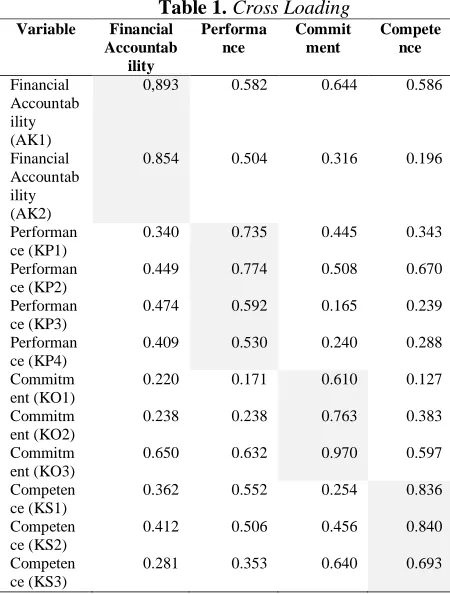
[image:4.612.74.528.100.279.2]Furthermore, the discriminant validity test can be seen on cross loading by comparing the correlation of the indicator construct with the correlation of other indicators. As shown in table 1 below:
Table 1.Cross Loading
Variable Financial Accountab
ility
Performa nce
Commit ment
Compete nce
Financial Accountab ility (AK1)
0,893 0.582 0.644 0.586
Financial Accountab ility (AK2)
0.854 0.504 0.316 0.196
Performan ce (KP1)
0.340 0.735 0.445 0.343
Performan ce (KP2)
0.449 0.774 0.508 0.670
Performan ce (KP3)
0.474 0.592 0.165 0.239
Performan ce (KP4)
0.409 0.530 0.240 0.288
Commitm ent (KO1)
0.220 0.171 0.610 0.127
Commitm ent (KO2)
0.238 0.238 0.763 0.383
Commitm ent (KO3)
0.650 0.632 0.970 0.597
Competen ce (KS1)
0.362 0.552 0.254 0.836
Competen ce (KS2)
0.412 0.506 0.456 0.840
Competen ce (KS3)
0.281 0.353 0.640 0.693
[image:4.612.319.544.315.612.2]From this table, it can be seen that the correlation of competency (KS) construct with its indicator has the higher value than correlation of competency indicator of apparatus with other constructs likewise with other constructs. This indicated that the reflexive indicators have fulfilled the discriminant validity.
11 Reliability testing aimed to prove the accuracy,
consistency and accuracy of the instrument in measuring the construct. To measure reliability can be done with Composite Reliability with value must be bigger than 0.7 for confirmatory research. Relative results can be seen at the table 2 below:
Table 2. Composite Reliability
Variable Composite Reliability
Financial Accountability (AK) 0.886
Performance (KP) 0.757
Commitment (KO) 0.833
Competence (KS) 0.805
Based on Table 2, it can be seen that the composite reliability values of all constructs were said well because it was upper than 0.70. Therefore all variables in this research have been reliable or fulfilled the composite reliability.
b. Evaluation of Structural Model or Inner
Model R Square Testing
Structural model testing with PLS was seen from the R-Square value for each endogenous latent variable as the predictive power from the structural model. R Square values were used to look at the ability of exogenous variables to explain endogen variables. R Square value gotten from the model in this research can be seen in Table 3 below:
Table 3. R Square Value
Variable R Square
Financial Accountability (AK) 0.368
Performance (KP) 0.409
Table 3 showed that the value of R² for the Performance construct of 0.447 or 45%r 39% was classified as the weak model. While the Financial Accountability construct got R2 value of of 0.389 or 39% was classified as the weak model effect (Ghozali & Latan: 81).
c. Hypothesis Testing
Hypothesis will be accepted if the value of t statistics> t table (1.68). Another way that can be used to find the hypothesis support was with looking at the significance of p-value compared with the error rate specified in this research for one-sided test with alpha 5% (0.05). If p values <0.05 mean the hypothesis is supported. The results of the estimate for path coefficients analysis (coefficient value of the path) are seen from Table 4.
Table 4. Path Coeficients
Variable Original
Sample
T Statistic P Value
Performance Financial Acountability
0.623 3.992 0.000
Commitment Performance
0.282 1.902 0.029
Competence Performance
0.472 3.456 0.000
The results of the first hypothesis testing shows that the competence of human resources positively affect the performance of SOA fund managers. This can be seen from table 4 where the value of T Statistic competence to performance is 3.456> 1.68 so it can be concluded that the hypothesis accepted. P values for the relation of competence of human resources with manager performance of 0.000 was smaller than alpha 0.05 (5%). This means that the relationship between human resource competence and significant manager performance.
The result of the second hypothesis test shows that organizational commitment has a positive effect on the performance of SOA fund managers. This can be seen from table 4 where the value of T Statistic commitmen to performance is 1.902> 1.68 so it can be concluded that the hypothesis accepted. P values for organizational commitment relationship with manager performance is 0.029 smaller than alpha 0.05 (5%). This means that the relationship between organizational commitment and organizational performance was significant.
The result of the third hypothesis test shows that the performance of SOA fund managers has a positive effect on the financial accountability. This can be seen from table 4 where the value of T Statistic performance to financial accountability is 3.992> 1.68 so it can be concluded that the hypothesis accepted. P values for manager performance with financial accountability is 0.000 smaller than alpha 0.05 (5%). This means that the relationship between performance dan financial accountability was significant.
5. DISCUSSION
The Influence of Human Resource Competency toward SOA Managers Performance
12 and experience. Hypothesis test results that have been
discussed previously showed the first hypothesis (H1) stated that Human Resource Competence (KS) influenced positively toward the performance of SOA (KP) managers proven and acceptable. The results of this research were suitable with Rahmat’s research (2014) done with a qualitative approach found that the competence influenced the performance so that management can run effectively and efficiently. The results were suitable with Ratnasari (2015) and Kasmini’s research (2017) done with quantitative approaches that showed the result that the competence influenced positively toward the performance.
The results of this research also gave the evidence that the competence of human resources manager of SOA in the elementary school in West Lombok Regency supported by educational background, knowledge, training, expertise and division of tasks will able to improve the performance of managers. Contribution of Goal Setting Theory was with the existence of good competence then SOA fund managers can complete their duties and responsibilities well in order to achieve maximum performance so that the organizational goals can be achieved.
The Influence of Organizational Commitment on SOA Managers Performance
Organizational commitment was the level at which a worker identified an organization, its goals and expectations to remain a member of the organization (Robbins and Judge, 2015: 47). Based on the results of hypothesis testing that has been done, the second hypothesis (H2) in this research was accepted, which stated the higher organization's commitment was the performance resulted. Seen from the Goal Setting Theory, with the existence of organizational commitment owned by managers of SOA funds in Elementary School in West Lombok Regency will be able to achieve its goal that was to improve the performance of managers in order to achieve the maximum results. The results of this research were consistent with the results of Nuraeni’s Research (2012) that showed that the organizational commitment influenced the performance. This research was in line with research done by Nurandini (2014) and Sapitri (2016) who found that organizational commitment has a positive relationship toward performance.
The Effect of SOA Managers' Performance on SOA Financial Accountability
Accountability was an obligation to give accountability and explain the performance and actions of a person/legal entity/head of an organization to a party who has the right or authority to hold accountable (LAN, 2004).
Based on the results of hypothesis testing done, the second hypothesis (H3) in this research was accepted, which stated that the higher performance of SOA fund managers was, the better also the financial accountability produced. Therefore the better performance was resulted by fund accountability managers of SOA funds in Elementary Schools in West Lombok District and this was able to increase the financial accountability of the SOA Fund. If the manager of the SOA funds can perform their duties and responsibilities properly, the accountability or accountability will increase. From the perspective of Goal Setting Theory with the existence of good performance so the purpose of the organization in this case accountability can be realized.
The results of this research were consistent with the results of research Kewo (2017) which stated that performance influenced positively toward the accountability. The higher performance will be accompanied by the increasing financial accountability.
6. CONCLUSION
Factors having a positive influence toward the performance of SOA managers were the competence of human resources and organizational commitment. To obtain the maximum performance so the manager must use what they have well and supported by strong organizational commitment from managers. Furthermore, the performance of SOA managers influenced positively toward the financial accountability of the SOA Fund.
13 increasing competence and organizational
commitment.
The results of this test was expected to be a reference for authors in other researches with the addition of larger variables and samples and higher levels of data analysis to get better results and can dig deeply other factors that influence the performance of SOA fund managers and its implications toward the financial accountability of SOA funds.
7. REFERENCES
Elwood, Sheila, 199. Parish Town and Councils : Financial Accountability And Management. Local Government Studies, 19 : 368-386. Fauzan, 2013. Pengaruh Good Governance Terhadap
Pengelolaan Dana Bantuan Operasional Sekolah. Tesis. Universitas Kanjuruhan, Malang.
Fitri, Afriliana (2014) Pengelolaan Dana BOS di SDN Mendiangin Kota Bukittinggi. Jurnal Administrasi Pendidikan vol 2/1 hal 33-831 Ghozali, Imam dan Latan, Hengky. 2015. Partial
Least Squares : Konsep, Teknik dan Aplikasi Menggunakan Pofram SmartPLS 3.0. Semarang : Badan Penerbit Universitas Diponegoro. Hidayat, Cynthia Novita. (2015). Pengaruh
Lingkungan Kerja dan Motivasi Kerja Terhadap Kinerja Karyawan Kantor PT. Keramik Diamond Industries. Jurnal AGORA. Vol. 3 No. 2, 2015. Universitas Kristen Petra Surabaya.
Kasmini, Ni Wayan Ayu. 2017. Pengaruh Pendidikan, Kompetensi, Kompensasi, Motivasi dan Komitmen Organisasi pada Kinerja Bendahara Sekolah Menengah di Kabupaten Gianyar. E-Jurnal Ekonomi dan Bsnis Universitas Udayana. Vol. 6, No. 1, Hal. 109-16.
Kewo, Leli. 2017. The Influence of Internal Control Implamentation and Managerial Performance on Financial AccountabilityLocal Government in Indonesia. International Journal of Economics and Financial Issue. Vol. 7 Issue 1, hal. 294-297.
Locke, Edwin A., Gary P. Latham. 2002. Building a Practically Usefull Theory Of Goal Setting and Task Motivation. American Pssychologist. Vol.57, No. 9, hal.705-717.
Locke, Edwin A., Gary P. Latham. 2006. New Direction in Goal Setting Theory . Association for Psychogy science, 15 (5):265-268.
Lunenberg, Fred C.2011. Goal Setting Theory of Motivation. International Journal of Management, Bussines and Administration, 15(1) : 1-5.
Luthans, Fred. 2002. Organizational Behaviour : An Evidence Based Approach. 12th Edition. New York : McGraw Hill.
Mahoney, TA., TH. Jerdee. and SJ. Carroll. 1963. Development of Managerial Performance: A Research Approach. Cincinnati OH: South-Western Publishing Company.
Moorhead, Gregory and Ricky W.Griffin. 2013. Organizational Behaviour : Managing People and Organizations. Edisi Terjemahan. Jakarta : Salemba Empat.
Mulyasa, 2014. Manajemen Berbasis Sekolah. Bandung : Remaja Kosda Karya.
Nabiha, AK Siti dan Basri, Hasan (2014). Accountability of Local Government : The Case of Aceh Province, Indonesia. Asia Pacifik Journal of Accounting and Finance. Vol 3/1 (1-14).
Nuraeni, Desi. 2013. Pengaruh Komitmen Organisasi Terhadap Kinerja Karyawan (Studi Pada PT. Atri Distribusindo Bandung). SMART-Study & Management Research Vol. X, No.3, hal. 55-67. Nurandini, Arina. 2014. Analisis Pengaruh
Komitmen Organisasi terhadap Kinerja Karyawan (Studi Pada Pegawai Perum Perumnas Jakarta). Jurnal Studi Manajemen & Organisasi . Jurnal 78-91.
Rahmad (2014) . Implementasi Kebijakan Penggunaan Dana Bnatuan Operasional Sekolah (BOS) dan Laporan Keuangan BOS. Jurnal Reformasi vol 4/1, 34-43.
Ratnasari, Sri Langgeng. 2016. Pengaruh Kompetensi dan Kompensasi Terhadap Kinerja Karyawan PT. PEB Batam. Prossiding Seminar Ekonomi dan Bisnis Call For Paper FEB UMSIDA, Hal. 424-44.
Resubun, Yanuarius. 2013. Factors Affecting Employee Performance in Regional Owned Interprises Papua Province Indonesia. Interdiciplinry Journal of Contemporary Research Businness. Vol. 5 No. 5, hal 755-767 Sadegi, Mohammad. 2013. Factor of Workplace That Affect Employes Performance A Case Study of Miyazu Malaysia. International Journal of Independent Research and Studies. Vol. 2 No.2 hal. 66-78.
14 Sudarmanto, 2014. Kinerja dan Pengembangan
Kompetensi SDM : Teori, Dimensi Pengukuran dan Implementasi dalam Organisasi. Yogyakarta : Pustaka Belajar.