Using a textual representational level component in the context of
discourse or dialogue generation
Franck Panaget*
Centre National d'Etudes des T@l@communications (CNET)
LAA/TSS/RCP
Route de Tr@gastel -- 22300 Lannion - France
email: [email protected] / tel: +33 96.05.28.52 / fax: +33 96.05.35.30
A b s t r a c t
A natural language generation system is typically con- stituted by two main components: a content planning component (e.g., text planner or dialogue act planner) and a linguistic realization component. But, this is not sufficient since, on the one hand, the message built by the content pldnning component is generally not adequately detailed in order to control the many possibilities for its expression and, on the other hand, the content planner cannot influence the way in which the message will be verbalized.
Generation systems require a third component, called the micro-planning (or sentence planning or phrasing) component, which acts as an intermediary between the pragmatico-semantic level and the purely syntactic level. The micro-planner is responsible for transforming the message into a textual structure. For this transformation to be achieved, grammatical and lexical resources must be selected.
1
I n t r o d u c t i o n
Traditionally, the architecture of a generation system is either pipelined (e.g., T E X T [McKeown 85]), interleaved (e.g., PAULINE [Hovy 90]) or integrate.d (e.g., KAMP [Appelt 85]). Whatever the approach, the system is di- vided into two main components: a message planning component and a linguistic realization component. The former is responsible for the selection and organization of the information to be conveyed; it builds a structure often called m e s s a g e . The latter involves the formula- tion of the message in grammatically correct sentences. In a context of discourse, the message planning compo- nent is a text planner and the message is a t e x t p l a n
*This work was realized at the lstituto per la Ricerca Scientifica e Tecnolo#ica ( I R S T ) in T r e n t o (Italy).
(e.g., see [Maier & Not 93]). In a context of dialogue, the message planner is a 'fictitious' component consisting of a dialogue act planner, which precedes the generation sys- tem, and a planner for surface linguistic acts, which is a component of the generation system. The dialogue act planner builds plans of dialogue acts. A plan of dialogue acts is a tree-like structure in which non-leaf nodes are. macro-acts (e.g., "disjunction" or "sequence" of dialogue acts) and leaf nodes are dialogue acts (see [Sadek 91]). A dialogue act conveys information about its type (e.g., "inform", "yn-question" or "confirm"), its propositional content (i.e., a semantico-conceptual representation of the information to be communicated), and the interlocutors. The surface linguistic act planner transforms a plan of dialogue acts into a p l a n o f s u r f a c e l i n g u i s t i c a c t s (i.e., the message). In particular, the dialogue act type is transformed into a surface linguistic act type such as "assertion", "answer" or "question", and the semantico- conceptual content into a semantic propositional content (cf. figure 1 and section 3).
One of the problems which appear in traditional gen- eration systems concerns the message itself: it is under- specified with respect to the language. On the one hand, the message planner cannot influence the way in which the message will be verbalized, and, on the other hand, the message is not detailed enough for the m a n y possibil- ities for its expression to be controlled. Figure 1 shows several messages (a text plan and three surface linguistic acts corresponding to the same dialogue act) and their different verbalizations.
Text plan: (rl / result
nucleus (el / shoot
agent john patient mary) satellite (e2 / ldll
agent john patient mary))
(Aa) John shot Mary. He killed her. (A2) M a r y was shot by John. He killed her. (A3) M a r y was shot by John. She was killed. (A4) John shot Mary killing her.
(As) John shot Mary who was killed.
Dialogue act: <S, Inform(U, ,x arrival-airport(x, ,y flight(y) ^ departure-time(y, 10:00)) = JFK)>
This dialogue act can be transformed into three distinct "assertions" or "answers".
• Content 1 = a destination-event whose theme is "the 10:00 flight" and destination is "3FK": (BA1) The lO:OO flight goes to JFK.
(BA2) It goes to J F K . .(BA3) To JFK.
• Content 2 -- an identity between "the arrival airport of the 10:00 flight" and "JFK": (Bin) The arrival airport of the 10:00 flight is JFK.
(BB2) The arrival airport is J F K . (BB3) JFK.
• Content 3 = a destination-event whose theme is "the hearer" and destination is "JFK": (Bca) You will arrive at JFK.
(Be2) A t JFh'.
Figure 1: Messages and their possible verbalizations
few restrictions on how to connect clauses. In particular, clauses can be connected with coordinate or subordinate conjunctions or can be simply realized as separate sen- tences. However, this kind of approach does not use the full expressive power of the language in which units may be much more tightly composed. Moreover, as argued in [Hovy 92], a two-component generation system is not satisfactory in producing 'good quality' texts since too m a n y phenomena are ignored or processed in a simplis- tic way, for example, a n a p h o r a planning, choice of lexical items, aggregation of clauses and noun phrases, selection of grammatical constructions (e.g., the choice of the verb voice), and segmentation into sentences (i.e., single sen- tence vs. separate sentences, hypotaxis vs. parataxis, and determination of clause order). T h e main difficulty in taking these phenomena into account is due to the fact that t h e y are
" s u p r a - g r a m m a t i c a l but not really related to con- tent selection and organization" [Hovy 92, p. 2]. In fact, Hovy argues that these phenomena should be treated after the message planning and before the lin- guistic realization.
!
7th International Generation Workshop * Kennebunkport, Maine * June 21-24, 1994
sem-cat
•
named-objectunique-object
--object
instance-of-a-kind
.
sample-of-a-kind
definite-set
r---result-object
r----object
- ~
l
process-object/ V s t a t e
event ~time-anchored-event --~process-event
/
P-'event-activ~'::
ansiti°n-even~
t---activity
--~process-activity
manner
_ ~ p r o p e r t y
__quality ~fra~e-adverbial
t---durative-adverbial
Figure 2: Partial hierarchy of semantic categories
ful to know that such linguistic phenomena exist in the target language without being able to realize them. For example, it is useful to know t h a t a present participial clause can verbalize the rhetorical relation "result", but it is not useful to know (in a first step) that a present participial clause is formed by adding "ing" at the end of the stem of a verb.
2
Micro-planning component
In order to solve the above mentioned problems, a compo- nent can be added between the message planner and the linguistic realizer (e.g., see [Levelt 89] or [Hovy 92]). The role of this third component, called the m i c r o - p l a n n e r in [Levelt 89], is to plan the best informational perspec- tive that can be given to the message. The component often uses an intermediate representation level. For ex- ample, in the system Epicure [Dale 88], a recoverable se- mantic structure, which specifies the underlying content of the utterance to be generated, and an abstract syntac- tic structure, which is much closer to the surface syntax of the linguistic form which will be produced, are used. Dale also shows how the two levels of representation play a role in the generation of elisions and one-anaphoric ex- pressions. However, the abstract syntactic level of most generation systems is often hazy and dependent on the syntactic formalism used by the linguistic realization com- ponent.
Our intermediate structure, which we call t e x t u a l 1 s t r u c t u r e , is expressed in terms of a b s t r a c t l i n g u i s - t i c r e s o u r c e s [Meteer 92] 2. These resources are abstrac- tions over concrete resources of language (e.g., syntactic structures, words, and grammatical features); they reflect linguistic constraints while abstracting away from syntac- tic details. They are useful for generation systems since
allowing a generation system to select the con- crete resources.., makes available many more degrees of freedom than the language actually permits [Meteer 92, p. 67].
Abstract linguistic resources become the terms in which the micro-planning component takes its decisions and that way they constrain the system to only do what is ex- pressible in the language since it is not allowed to choose them independently. We made some modifications on two kinds of abstract resources defined by Meteer: we improved her semantic categories by using perspectives from systemic functional linguistics (cf. section 2.1) and we extended the notion of resource trees (cf. section 2.2).
l"Textual" is used in the sense of the textual metafunc- tion in the systemic functional theory (see below). For pre- sentations of systemic functional linguistics, see [Halliday 85] or [Matthiessen & Bateman 91].
[image:3.612.58.567.81.332.2]Moreover, we explicitly defined lezical resources (cf. sec- tion 2.3).
2 . 1 S e m a n t i c h i e r a r c h i e s
Semantic categories (cf. figure 2) reflect pertinent combi- nations of linguistic features (e.g., syntactic features and lexical items). For example, the five sub-categories of o b j e c t s are specified from definiteness (i.e., definite or indefinite) and n u m b e r (i.e., singular or plural). These categories constrain the composition of the utterance by defining what kinds of constituents can be extended and how they can be composed. For example, an adjunct constituent of type m a n n e r can be added to an e v e n t
(e.g., Peter suddenly decided to go to the beach) whereas an adjunct of type p r o p e r t y cannot (e.g., *Peter impor- tantly decided to go to the beach4); a p r o c e s s - e v e n t can be composed with a d u r a t i v e - a d v e r b i a l (e.g., Karen watched T V for an hour) whereas a t r a n s i t i o n - e v e n t
m a y be composed of a f r a m e - a d v e r b i a l (e.g., Karen solved the problem in one hour).
On the one hand, we think that according to sys- temic linguistic theory s, the hierarchy of semantic cat- egories mikes ideational constraints and textual con- straints; b o t h are semantic, but semantic of rather dif- ferent kinds. Thus, while it is correct t h a t the categories e v e n t , manner, and p r o p e r t y are semantic (ideational) categories, taking an event perspective on something is a textual decision, e.g.,
"The ship sank."
is an ideational e v e n t , and it is textually presented within an EVENT-PERSPECTIVE.
"The sinking of the ship"
is still an ideational e v e n t , but it is now presented within an OBJECT-PERSPECTIVE. Even clearer are cases such as definite and indefinite noun phrases. Thus the dif- ferences between "a man" and "the man" can be char- acterized as follows. T h e y are both ideational of cate- gory PERSON. T h e noun phrase '% man" presents a dis- course entity of t h a t ideational semantic category which is textually UNIDENTIFIABLE. This is a category drawn f r o m textual semantics. Textual semantic classifications of discourse entities change as a text develops. T h e noun phrase "the man" is classified textually as IDENTIFI- ABLE. T h e former is realized grammatically (largely on
3The semantic categories are noted in typewriter text. 4FoUowing the general convention in linguistics, we use "*" to mark magrarrmaatical sentences.
sin this theory, language is organized functionally according to three metafunctions, concerned with the representation of experi- ence (ideational), symbolic interaction between interlocutors (in- terpersonal), and presentation of information as text in context (textual).
the basis of the textual semantic classification) as an in- definite noun phrase, the latter as a definite noun phrase. In this way, ideational semantics and textual semantics are complementary to each other and b o t h help constrain grammatical realization.
On the other hand, we think t h a t the textual p a r t of Meteer's hierarchy is too abstract to treat p h e n o m e n a that need syntactic information such as anaphora plan- ning and selection of grammatical constructions (see also the other examples of linguistic p h e n o m e n a given in sec- tion 1); in particular, syntactic information such as gen- der or verb voice is missing.
In order to solve these problems, we propose to re-- place the hierarchy with two constituent hierarchies: an ideational semantic hierarchy and a textual semantic hi- erarchy. T h e former is based on the Upper Model de- fined in [Bateman et al. 90]. T h e latter was developed by ourselves; we call it the hierarchy of textual semantic categories. These two hierarchies are not incompatible since
[a] language.., embodies a multiplicity of con- stituent hierarchies, coexisting in different parts of the system. They are not unrelated: on the contrary, lhey are all different facets of the same phenomenon. [...] At the same time, each of these hierarchies is independent of the others, and lhere are infinite possibilities of matching them up in a meaningful way [Halliday 85, p. 18].
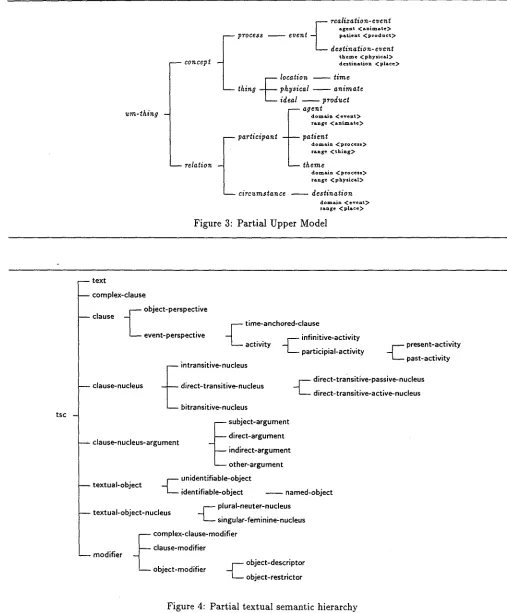
The U p p e r M o d e l provides a domain-independent, general and reusable conceptual organization which is used to classify the world knowledge when linguistic pro- cessing is to be performed. This general semantic taxon- omy can also be seen as an inheritance hierarchy t h a t organizes concepts according to how they can be ex- pressed (cf. figure 3). T h e Upper Model also'expresses (ideational) semantic restrictions on arguments required by entities it involves. For example, the realization-event 6
requires two participants: an agent t h a t must be an an- imate and a patient t h a t must be a product. T h e Upper Model also provides the type of qualities which m a y be ascribed to particular concepts. For example, the Up- per Model expresses t h a t the destination relation relates
a place object to an event.
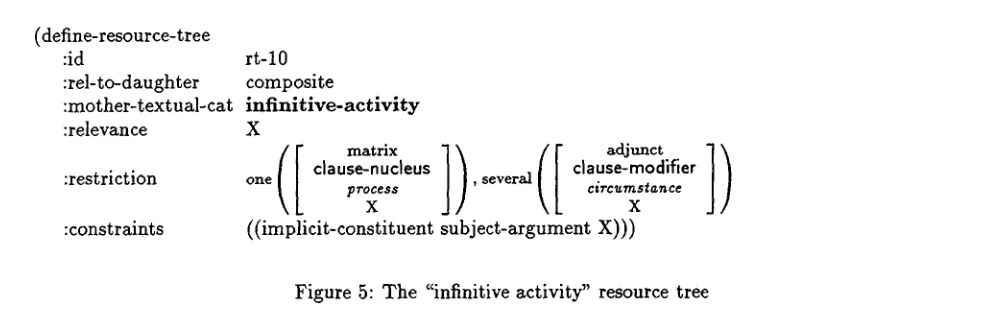
The h i e r a r c h y o f t e x t u a l s e m a n t i c c a t e g o r i e s is a property inheritance network t h a t represents tex- tual knowledge of the target language. Figure 4 shows a part of our hierarchy; the whole hierarchy contains about eighty categories. T h e definition of the t e x t u a l semantic categories is based on an analysis of French [Bescherelle 90] and of English [nalliday 85, Shinghal 92].
7th International Generation Workshop • Kennebunkport, Maine • June 21-24, 1994
urn-thing
V-- realization-event
[ ~ g e n t < ~ n i m ~ t e >
~ process ,,, e v e n t --1
patient <product>
t_.- destination-event
t h e m e < p h y a l ¢ ~ l >
- - C O n C e p t d e s t i n a t i o n < p l ~ c e >
[--..- location time thing ~ physical animate
L_. ideal product
•
agentd o m a i n < e v e n t > re, ride < ~ n i m ~ t e >
participant patient
d o m a i n < p r o c e s s >
r a n g e < t h i n g >
m relation theme
d o m a i n < p r o c e s s > r ~ n s e < p h y s i ¢ ~ l >
circumstance destination
d o m a i n < e v e n t > r s n s e < p l & c e >
Figure 3: Partial Upper Model
tsc - text
complex-clause
object-perspective
-- clause
~
event-perspective
clause-nucleus
- - time-anchored-clause
[ i--"- infinitive-activity activity
participial-activity intransitive-nucleus
~
irect-transitive-nucleus
bitransitive-nucleus
_•
subject-argumentdirect-argument
indlrect-argument other-argument clause-nucleus-argument
C present-activity past-activity
direct-transitive-passive-nucleus
C direct-transitive~active-nucleus
unidentifia ble-object f---
textual-object
-L._. identifiable-object named-object
plural-neuter-nucleus textual-object-nucleus
singular-feminine-nucleus complex-clause-modifier
h modifier ~ clause-modifier
L_
object-modifierC object-descriptor
object-restrictor
[image:5.612.57.564.81.694.2]We will explain the m e a n i n g of each textual category by describing the way in which they are realized f r o m a g r a m m a t i c a l viewpoint. Complex-clauses 7 are realized as sentences. T h e sub-hierarchy of clause represents dif- ferent linguistic forms of clause; in particular, the time- anchored-event is realized as a finite clause, the activity as a non finite clause and the object-perspective as clause nominalization. T h e clause-nucleus sub-hierarchy classi- fies different kinds of verbs (e.g., transitive and intransi- tive verbs) and verb voice. T h e other-argument is realized as verb a r g u m e n t t h a t has no specific g r a m m a t i c a l func- tion, whereas the three other clause-nucleus-arguments are realized as constituents whose g r a m m a t i c a l function is subject, direct object or indirect object. For e x a m - ple, the verb "to get to" requires two arguments: one subject-argument (realized as the subject) and one other- argument which represents the destination. T h e textual- object is realized as a noun phrase, and, in particular, the unidentifiable-object as an indefinite noun phrase and the identifiable-object as a definite one. T h e hierarchy of textual-object-nucleus corresponds to nouns; it represents various linguistic f o r m s of nouns with respect to their gen- der and number. T h e modifiers are realized as adjectives, adverbs, prepositional phrases, and s u b o r d i n a t e clauses.
2 . 2 R e s o u r c e t r e e s
Resource trees are primitive trees f r o m which textual structures are built. In particular, they indicate the way in which a constituent (i.e., a t e x t u a l structure node) can be expanded, t h a t is, w h a t are its sub--constituents, or ex- gended, t h a t is, w h a t kind of additional sub-constituents can be added. T h e y are defined f r o m e l e m e n t a r y trees. Meteer distinguished two basic forms of e l e m e n t a r y trees: the kernel tree and the composite tree. These two trees represent Halliday's distinction between the m u l t i v a r i a t e and the univariate structure, respectively [Halliday 85]. T h e kernel tree (i.e., the HEAD-ARGUMENT structure) is an a t o m i c structure, t h a t means, it cannot be modified in- dependently f r o m the whole structure. Essentially, it rep- resents a p r e d i c a t e / a r g u m e n t structure. T h e composite tree is an incremental structure, t h a t is, new child nodes can be added at a n y t i m e of the expansion of the m o t h e r node. Meteer distinguished the COMPOSITE-MATRIX- ADJUNCT structure, which corresponds to the hypotac- tic relation (i.e., the relation between dependent ele- m e n t s and their d o m i n a t i n g node), and the COMPOSITE- COORDINATE structure, which represents the p a r a t a c t i c relation (i.e., the relation between elements of equal sta- tus). Meteer defined resource trees as follows:
(define-composite-tree complex-event-tree ( m a t r i x &rest adjunct)
7The textual semantic categories are noted in sans serif text.
:constructor-function build-complex-event-tree :matrix-restrictions (state event)
:adjunct-restrictions ( m a n n e r location))
T h i s definition expresses t h a t the c o m p l e x - e v e n t re- source tree is a COMPOSITE tree whose MATRIX has to be of type s t a t e or e v e n t and ADJUNCTs of type raarmer or l o c a t i o n . It also specifies a constructor func- tion which builds the tree.
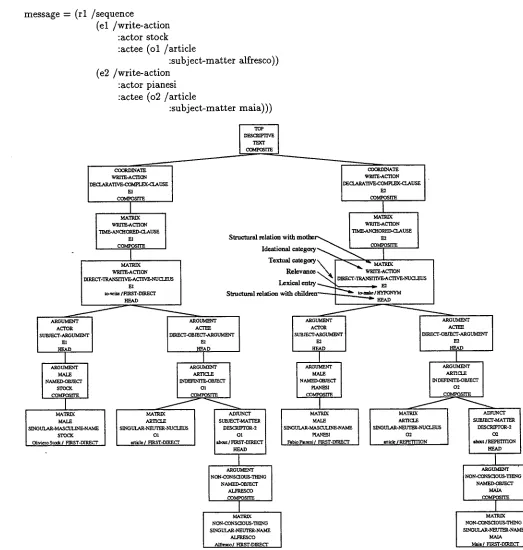
We think t h a t the language for defining resource trees is not powerful enough. For instance, it m u s t be explic- itly specified t h a t a c o m p o s i t e tree only has one m a t r i x node or t h a t an a c t i v ± ~ y does not have an explicit sub- ject. In order to solve this problem, a m o r e powerful lan- guage had to be defined. In particular, the restriction on daughter nodes is m o r e precise. In addition, we introduce the notions of relevance and constraints. Restrictions are expressed by using a specific language which expresses quantities (e.g., "one" or "several") and description of the daughter constituents. In particular, each daughter constituent is described by a structure, which we call a b - s t r a c t c o n s t i t u e n t , which specifies the ideational and t e x t u a l semantic categories of the constituent, its struc- tural relationship with the m o t h e r node, and its rele- vance. The r e l e v a n c e is the link between textual struc- ture nodes and parts of the message; it indicates the p a r t of the message verbalized by the m o t h e r node and its child nodes. C o n s t r a i n t s are conditions which m u s t be satis- fied by the textual structure. For example, constraints can express t h a t the subject-argument of an infinitive- activity will not explicitly a p p e a r in the final text. Figure 5 shows the definition of the "infinitive-activity" resource tree s, which is a composite tree whose m o t h e r node has the textual category infinitive-activity. T h e tree has one and only one m a t r i x node of the ideational category pro- cess and of the textual category clause-nucleus, and ad- ditional adjunct nodes of the ideational category circum- stance and of the textual category clause-modifier. It spec- ifies a constraint which states t h a t the subject-argument m u s t be implicit. It also indicates t h a t the m o t h e r node a n d its daughter nodes correspond to the s a m e p a r t of the message, t h a t is, they have the s a m e relevance (cf. the variable X in figure 5) 9.
2 . 3 L e x i c a l r e s o u r c e s
Lexical items, i.e., words, are lexical resources of the lan- guage. We represent their m e a n i n g by associating each of t h e m with entities of the Upper Model and of the tex-
8Meteer's resource trees axe expressed in terms of semantic cat- egories whereas our resource trees axe defined in terms of textual categories.
7th International Generation Workshop • Kennebunkport, Maine • June 21-24, 1994
(define-resource-tree
:id rt-10
:tel-to-daughter composite
:mother-textual-cat i n f i n i t i v e - a c t i v i t y
:relevance X
([=
clause-nucleus
:restriction o n e process
x :constraints
]) ([
several clause-modifier])
'
circumstance
X
((implicit-constituent subject-argument X)))Figure 5: The "infinitive activity" resource tree
tual semantic hierarchy. For example, the lexical resource which corresponds to the direct transitive verb "to write" is defined as follows:
[ " t o - w r i t e " ]
(direct-transltive-nucleus)
(write-action)
A lexical resource can be linked to more than one textual category; for example, the following resources
"article" ]
(slngular-neuter-nucleus plural-neuter-nucleus)
(a icle)
"quick" ]
(object-modifier clause-modifier)
(quick)
correspond to the nouns "article" and "articles" and to the adjective "quick" and the adverb "quickly", respec- tively. A lexical resource can also be associated with several ideational categories; for example, the following resource
[
(clause-modifier)]
(purpose enablemen~}
can be used to verbalize a rhetorical relation "purpose" or "enablement".
2 . 4 T e x t u a l s t r u c t u r e
The textual structure is a tree-like structure built from resource trees. It represents the constituency of the utterance (each node is a complete constituent of the utterance), the structural relations among constituents (head-argument, composite-matrix-adjunct, composite- coordinate), the ideational and textual categories, the rel- evance and the restriction of each node, and the lexemes.
In addition, a marker which describes the lexical cohe- sion of the text (see [Halliday & Hasan 76]) is associated to each lexeme. The textual structure provides linguistic information which is required for treating specific linguis- tic phenomena such as anaphora planning (see section 1). For example, in figure 6 (only the main information con- tained in each node is depicted), the textual structure indicates t h a t the domain instance "Stock" corresponds to a
male
and will be verbalized as a singular masculine proper name (named-object +singular-masculine-name).
Several textual structures can be built to verbalize one message. The structure which is selected is the one which has the higher cohesive score. This score is obtained by summing the scores of lexical cohesion of all lexical re- sources used in the textual structure. The score of each resource is obtained as follows:
• if the lexical resource appears in the local context (eft history of dialogue acts) then the lexical cohesion is scored 3;
• if the lexical resource appears in the active set of the history of linguistic resources then the score is 2;
• if the lexical resource appears in the open set of the history of linguistic resources then the score is 1;
* otherwise, the score is 0.
3
U t t e r a n c e generation in t h e
c o n t e x t of dialogue
[image:7.612.67.566.75.234.2]message = (rl /sequence
(el /write-action :actor stock :actee ( o l / a r t i c l e
:subject-matter alfresco)) ( e 2 / w r i t e - a c t i o n
:actor pianesi :actee ( o 2 / a r t i c l e
:subject-matter maia)))
I
wRn~-ACrK~NCO(RR.DINATE [
DEO..ARATIVE~LEX~.,AUSE
I COM~osrr~
I
WRn.~.ACrION 'r~A/~CH~D-CL~LSE! co~osrr~
[
WRII~-ACIII~I~ . ~ , ~ , ~ , ~ . ~
AI~UMI~t'r ACTOR $L, BL.~r-ARGUI~
El
I
I
S I N G U L A R - M . A ~ C U L I N E - N A M E S I N G U L A R - N E U T E R - N U C L E U S
s~o~
I
O lOlivi~ro $tod¢ ~ FIRST-DIRECT ankle / FIRST-DIRECT
COGRDI~IAT-. wRrrE-ACTION DE~.ARATIVE-C~EX-(X.AUSE
COMPOSrI~
I
I
WR.rfF.-ACTION~'~
[
TIME-ANC~ORED-O.AUSE Su'uctaralrelation with
moth,r-..._ [ m ]Ideational
c a t c g o ~ . ~ ~ COMPOSrm IARGUM~T ACTIVE
D I P . E C r . O B J E C T - A R G U M ~ T
El H E A D
t
INDENNnT~I~2T Ol ~Ml~rrE
...--- ----...
ADIUNCT $UBTECT~,'Ud~
DI~C~Jt'roR-2
Ol
IboQU FIRST-DIRECT
H - A D
ARGUMENT
N O N . ~ N S ~ O U S - T H I N G
~ ! ~ r r E
M A T R I X N O N - C O N S a O U S - ' r H ~ G 5 1 N G U L A R .NELrI'IER.NAME
A L F R E S C O Affr~co I FIRST-DIP.ECr
A R G U M ~ r r ACTOR SUB F~CT-ARGUM]~rr
E2 H E A D
I
I NAMED-CI~L.~2T
I
MA'I~.IX
I I
~'DI.IX
SINGULAR-MASCULINE-NAM... S I N G U L A R - N E U T E R - N U ( Z ~ J S
PI~ESI I 0 2
Pebio PiRncsi ( F'~.ST-D~R.ECT m't ick ~ I,uc,i'T~ rl i ~ O N
I
ARGU~'r
DIRECT-O GUM]~rr
I
I ARGU~TI N D i C i a . r E f i t COMi~ITE
ADJUNCT SUET-MATTER
DE~CPJFI'OR-2
O2
al~t IREPETITiON
I
ARGUMI~rrN O N-CCRNSCIOUS-'r ~-IING N A M E D . G ~ n E C T
COMPOSlrrE
I
NON-CONSCIOUS-THING $1NGULAR.N~.rrER.NAMEMAIA
Malu
/ FIRST-DIRECT"Oliviero Stock wrote an article about Alfresco. Fabio Pianesi made one about MAIA."
[image:8.612.56.579.93.643.2]7th International Generation Workshop • Kennebunkport, Maine ° June 21-24, 1994
answered yet. Each item of this list provides information on the dialogue act itself, the way in which conceptual entities t h a t appear in its propositional content were re- alized with respect to the lexical semantics and the list of linguistic resources used. This information constitutes a local c o n t e x t during the verbalization of the answer. The h i s t o r y o f c o n c e p t u a l e n t i t i e s contains informa- tion on the conceptual entities (e.g., "arrival-airport") al- ready verbalized in the dialogue and the way in which they were realized with respect to lexical semantics. This history is used for the verbalization of all surface linguis- tic acts, except for "answers" (the semantic realization of conceptual entities t h a t appear in an "answer" is con- strained by the local context retrieved from the history of dialogue acts). The h i s t o r y o f o b j e c t s involves in- formation on the instances of conceptual entities (e.g., " J F K " ) mentioned in the dialogue. It is used to retrieve objects t h a t are required from the lexical semantics point of view during the surface linguistic act planning (cf. the ideational semantic restrictions on arguments of entities of the Upper Model). It also provides information that is useful during anaphora planning, such as the information status (given or new) of objects. Finally, the h i s t o r y o f l i n g u i s t i c - r e s o u r c e s indicates which abstract linguistic resources have been used in the dialogue. It is divided into two sets: an active set and an open set. The a c t i v e set contains the linguistic resources used in the last sentence of the dialogue, and the o p e n s e t the resources used in the preceding sentences. In particular, this history is used to evaluate the cohesion of textual structures.
We will take an example to show how the generation system deals with these histories in order to verbalize a plan of dialogue acts. We will assume that the interlocu- tor (i.e., the user) uttered the following question during the dialogue:
The 10:00 flight goes to which airport?
The dialogue act planner builds a dialogue act of inform- ing that the airport is " J F K "1° (this act is shown in fig- ure 1). Since there is a request in the history of dia- logue acts t h a t corresponds to the dialogue act, the sur- face linguistic act planner decides to build an "answer" surface linguistic act. Then, it uses the local context pro- vided by this history in order to transform the semantico- conceptual content into a semantic content. In particular, it builds a propositional content expressing a destination- event whose theme is " t h e 10:00 flight" and whose desti- nation is " J F K " ~cf. content 1 in figure 1). Finally, the constructed linguistic act is passed to the micro-planning component. This component builds at least two textual structures representing the cases where the des~ination- even~ is verbalized by "to go" or "to arrive". Since "to go" 1°The way in which dialogue acts and plans of dialogue acts are built is explained in [Sadek 91].
appears in the local context, the selected textual struc- ture is the one corresponding to the following utterance:
The 10:00 .flight goes to JFK.
According to the content of the history of objects, the micro-planner can introduce anaphoric expressions. In that case, the built textual structure corresponds to:
It goes to JFK.
Finally, using the history of linguistic resources, the plan- ner can produce ellipsis, in which case, the textual struc- ture built corresponds to:
To JFK.
4
Concluding remarks
In this paper we described a component of a natural lan- guage generation, called the micro-planner, which is situ- ated between the message planner and the linguistic real- ization component. Its role is to bridge the gap between the two traditional components in order to avoid some of the problems which arise in two-component genera- tion systems. In order to achieve this, the micro-planner transforms the message built by the message planner into an intermediate structure, which we call textual struc- ture. This structure represents an abstract grammatical organization of the final text. In particular, it provides semantic and syntactic information, which is useful to handle linguistic phenomena such as anaphora planning. This new representational level is based on the notion of abstract linguistic resources [Meteer 92]. We made two main modifications. Firstly, Meteer's semantic category hierarchy was substituted by two distinct semantic hier- archies: an ideational semantic hierarchy (i.e., the Upper Model [Bateman et al. 90]) and a textual semantic hier- archy. Secondly, we increased the expressibility of the resource tree definition language. Moreover, we defined a simple mechanism to represent lexical resources of the language.
linguistic realization component only deals with syntactic details such as agreement and complete surface order and morphology.
Our micro-planning component is currently being in- tegrated in a text generation system developed at IRST (see [Maier & Not 93, Panaget 94]). A previous version ([Panaget 92]) was implemented in order to be integrated in a human-computer oral dialogue systefn developed at CNET [Sadek et al. 94]. For the former case, the linguis- tic realization component [Pianesi 91] is based on the gov- ernment and binding theory and a head-driven bottom- up generation algorithm. The component consists of an integrated system for editing, modifying and maintain- ing unification-based grammars. For the latter case, the linguistic realizer is based on Tree Adjoining Grammar [Joshi 87]. In particular, the textual structure is trans- formed into a derivation tree (i.e., a tree which specifies a derived tree through a bottom-up traversal), which is then 'executed' by the linguistic component in order to build a derived tree (i.e., a syntactic tree).
Acknowledgements
I am extremely grateful to John Bateman, Elisabeth Maier, Elena Not, David Sadek and Oliviero Stock for their helpful comments on early versions of this paper.
References
[Appelt 85] Appelt D.E., Planning english sentences;
Cambridge University Press, 1985.
[Bateman et al. 90] Bateman J.A., Kasper R.T., Moore J . D . & Whitney R.A., A general organization of ~he knowledge for natural language processing: the 1lehman
Upper Model, ISI research report, California, 1990. [Bescherelle 90] Bescherelle 3 - La grammaire pour tous,
Hatier, 1990.
[Dale 88] Dale R., Generating referring expressions in a domain of objects and processes, PhD, University of Edinburgh, 1988.
[Danlos 87] Danlos L., The linguistics basis of text gen- eration, Cambridge University Press, 1987.
[Halliday 85] Halliday M.A.K., Introduction to functional grammar, Edward Arnold, 1985.
[Halliday & Hasan 76] Halliday M.A.K. & Hasan R., Co- hesion in english, Longman inc., New York, 1976. [Hovy 90] Hovy E., Pragmatics and natural language
generation, Artificial Intelligence 43(2), pp 153-197, 1990.
[Hovy 92] Hovy E., Sentence planning requirements for automated explanation generation, DIAMOND Bericht n ° 23, 1992.
[Joshi 87] Joshi A.K., The relevance of Tree Adjoining Grammar to generation, In Kempen G. ed., Natu- ral language generation, Dordrecht, Martinus Nijhoff, 1987.
[Lever 89] Levelt W.J.M., Speaking - f r o m intention to articulation, The MIT Press, 1989.
[McKeown 85] Me Keown K.R., Discourse strategies for generating natural language text, A rtificial Intelligence
~7(i), pp 1-41, 1985.
[Maier & Not 93] Maier E. & Not E., Increasing cohesion in automatically generated natural language texts, In Torasso P. ed., Advances in A I - Third congress of the Italian Association for AI, Lectures notes in AI 728, Springer-Vexing, 1993.
[Matthiessen & Bateman 91] Matthiessen C. & Bateman J.A., Text generation and systemic-functional linguis- tics - Experiences from English and Japanese, Pinter Publishers, London, 1991.
[Meteer 92] Meteer M., Expressibility and the problem of efficient text planning, Pinter publishers, 1992.
[Panaget 92] Panaget F., De l'acte de dialogue au tan- gage natural : un ggndrateur d'dnoncds en con- texte de dialogue oral, CNET Technical Report NT/LAA/TSS/440, Lannion, France, 1992.
[Panaget 94] Panaget F., The micro-planning component of a generation system, IRST Technical Report 9402- 05, Trento, Italy, 1994.
[Pianesi 91] Pianesi F., Head driven bottom up genera- tion and government and binding: a unified perspec- tive, In proceedings of the 2 "a European Workshop on Natural Language Generation, Austria, 1991.
[Sadek 91] Sadek M.D., Dialogue acts are rational plans, In proceedings of the E S C A / E T R W workshop on "the structure of multimodal dialogue", Italy, September 16- 20, 1991.
[Sadek et al. 94] Sadek M.D., Ferrieux A & Cozannet A., Towards an artificial agent as the kernel of a spoken di- alogue system: a progress report, To appear in the pro- ceedings of the AAA1 workshop on integration of natu- ral language and speech processing, 1994.