Recognizing Referential Links:
An Information E x t r a c t i o n P e r s p e c t i v e
Megumi K a m e y a m a
Artificial Intelligence C e n t e r SRI I n t e r n a t i o n a l
333 R a v e n s w o o d Ave., Menlo P a r k , CA 94025, U.S.A.
megumi@ai, sri.
t o mAbstract
We present an efficient and robust reference reso- lution algorithm in an end-to-end state-of-the-art information extraction system, which must work with a considerably impoverished syntactic analy- sis of the input sentences. Considering this disad- vantage, the basic setup to
collect, filter,
thenorder
by salience
does remarkably well with third-person pronouns, but needs more semantic and discourse information to improve the treatments of other ex- pression types.Introduction
Anaphora resolution is a
component technology
of an overall discourse understanding system. This paper focuses on reference resolution in an infor- mation extraction system, which performs a par- tial and selective 'understanding' of unrestricted discourses.Reference Resolution in IE
An information extraction (IE) system automat- ically extracts certain predefined target informa- tion from real-world online texts or speech tran- scripts. The target information, typically of the form "who did what to whom where when," is ex- tracted from natural language sentences or format- ted tables, and fills parts of predefined template d a t a structures with slot values. Partially filled template d a t a objects about the same entities, en- tity relationships, and events are then merged to create a network of related data objects. These template d a t a objects depicting instances of the target information are the raw output of IE, ready for a wide range of applications such as database
46
updating and s u m m a r y generation. 1
In this IE context, reference resolution takes the form of
merging
partial d a t a objects about the same entities, entity relationships, and events de- scribed at different discourse positions. Merging in IE is very difficult, accounting for a significant portion of IE errors in the final output. This pa- per focuses on the referential relationships amongentities
rather than the more complex problem ofevent
merging.An IE system recognizes particular target infor- mation instances, ignoring anything deemed irrel- evant. Reference resolution within IE, however, cannot operate only on those parts that describe target information because anaphoric expressions within target linguistic patterns may have an- tecedents outside of the target, and those that oc- cur in an apparently irrelevant pattern may ac- tually resolve to target entities. For this reason, reference resolution in the IE system needs ac- cess to
all
of the text rather than some selective parts. Furthermore, it is reasonable to assume t h a t a largelydomain-independent
method of reference resolution can be developed, which need not be tailored anew each time a new target is defined.In this paper, I discuss one such entity refer- ence resolution algorithm for a general geo-political business domain developed for SRI's FASTUS T M system (Hobbs et al., 1996), one of the leading IE systems, which can also be seen as a representative of today's IE technology.
T h e I n p u t t o R e f e r e n c e R e s o l u t i o n
Multiple top-scoring sites working on IE have con- verged on the use of finite-state linguistic patterns applied in stages of smaller to larger units. This finite-state transduction approach to IE, first intro- duced in SRI's FASTUS, has proven effective for real-world texts because full parsing is far too am- biguous, slow, and brittle against real-world sen- tences. This means that we cannot assume correct and full syntactic structures in the input to ref- erence resolution in a typical IE system. The in- put is a set of (often overlapping or discontiguous) finite-state approximations of sentence parts. We must
approximate
fine-grained theoretical propos- als about referential dependencies, and adapt them to the context of sparse and incomplete syntactic input.T h e input to reference resolution in the the- oretical literature is assumed to be fully parsed sentences, often with syntactic attributes such as grammatical functions and thematic roles on the constituents (Webber, 1978; Sidner, 1979; Hobbs, 1978; Grosz, Joshi, and Weinstein, 1995). In im- plemented reference resolution systems, for pro- noun resolution in particular, there seems to be a trade-off between the completeness of syntac- tic input and the robustness with real-world sen- tences. In short, more robust and partial parsing gives us wider coverage, but less syntactic infor- mation also leads to less accuyate reference reso- lution. For instance, Lappin and Leass (1994) re- port an 86% accuracy for a resolution algorithm for third-person pronouns using fully parsed sen- tences as input. Kennedy and Boguraev (1996) then report a 75% accuracy for an algorithm that approximates Lappin and Leass's with more robust and coarse-grained syntactic input. After describ- ing the algorithm in the next section, I will briefly compare the present approach with these pronoun resolution approaches.
Algorithm
This algorithm was first implemented for the
MUC-6
FASTUS system (Appelt et al., 1995), and produced one of the top scores (a recall of 59% and precision of 72%) in the MUC-6 Coreference Task, which evaluated systems' ability to recog- 47nize coreference among noun phrases (Sundheim, 1995). Note that only
identity
of reference was evaluated there. 2The three main factors in this algorithm are (a) accessible text regions, (b) semantic consistency, and (c) dynamic syntactic preference. The algo- rithm is invoked for each sentence after the earlier finite-state transduction phases have determined the best sequence(s) of nominal and verbal expres- sions. Crucially, each nominal expression is associ- ated with a set of template data objects that record various linguistic and textual attributes of the re- ferring expressions contained in it. These data ob- jects are similar to
discourse referents
in discourse semantics (Karttunen, 1976; Kamp, 1981; Heim, 1982; Kamp and Reyle, 1993), in that anaphoric expressions such asshe
are also associated with corresponding anaphoric entities. A pleonasticit
has no associated entities. Quantificational nomi- nals such as
each company
are associated with en- tity objects because they are 'anaphoric' to group entities accessible in the context. In this setup, the effect of reference resolution ismerging
of multiple entity objects. Here is the algorithm.1. INPUT: Template entities with the following textual, syntactic, and semantic features:
(a) determiner type (e.g., DEF, INDEF, PRON) (b) grammatical or numerical number (e.g., SG,
PL, 3)
(c) head string (e.g.,
automaker)
(d) the head string sort in a sort hierarchy (e.g.,
aut omaker-+ company-+organizat ion)
(e) modifier strings (e.g.,
newly founded, with the
pilots)
(f) text span (the start and end byte positions) (g) sentence and paragraph positions 3
(h) text region type (e.g., HEADLINE, TEXT)
2Other referential relationships such as subset and part- whole did not reach sufficiently reliable i n t e r a n n o t a t o r agreements. Only identity of reference had a sufficiently high agreement rate (about 85%) between two h u m a n annotators.
2. F O R EACH potentially anaphoric entity object in the current sentence, in the left-to-right order, DO
(1) C O L L E C T antecedent entity objects from the accessible text region.
• For an entity in a HEADLINE text region, the entire T E X T is accessible because the headline summarizes the text.
• For an entity in a T E X T region, everything preceding its text span is accessible (except for the HEADLINE). Intrasentential cataphora is allowed only for first-person pronouns. • In addition, a locality assumption on
a n a p h o r a sets a (soft) window of search for each referring expression t y p e - - t h e entire preceding text for proper names, narrower for definite noun phrases, even narrower for pro- nouns, and only the current sentence for re- flexives. In the MUC-6 system, the window size was arbitrarily set to ten sentences for definites and three sentences for pronouns, ignoring paragraph boundariesl and no an- tecedents beyond the limit were considered. This clearly left ample room for refinement. 4 (2) F I L T E R with semantic consistency between the anaphoric entity E1 and the potential an- tecedent entity E2.
• Number Consistency: El's number must be consistent with E2's n u m b e r - - f o r example, twelve is consistent with PLURAL, but not with SINGULAR. As a special case, plural pronouns (they, we) can take singular organi- zation antecedents.
• Sort Consistency: E l ' s sort must ei- ther EQUAL or SUBSUME E2's sort. This reflects a monotonicity assumption on a n a p h o r a - - f o r example, since company sub- sumes a u t o m a k e r , the company can take a Chicago-based automaker as an antecedent, but it is too risky to allow the automaker to take a Chicago-based company as an antecedent. On the other hand, since 4For e x a m p l e , i n a m o r e r e c e n t F A S T U S s y s t e m , p a r a - g r a p h s are also c o n s i d e r e d in s e t t i n g t h e limit, a n d a t m o s t o n e c a n d i d a t e b e y o n d t h e l i m i t is p r o p o s e d w h e n n o c a n d i - d a t e s are f o u n d w i t h i n t h e limit.
48
a u t o m a k e r and a i r l i n e are neither the same sort nor in a s u b s u m p t i o n relation, an au- tomaker and the airline cannot corefer. (The system's sort hierarchy is still sparse and in- complete.)
• Modifier Consistency: E l ' s modifiers must be consistent with E2's modifiers--for ex- ample, French and British are inconsistent, but French and multinational are consistent. (The system d o e s n ' t have enough knowledge to do this well.)
(3) O R D E R by dynamic syntactic preference. The following ordering approximates the relative salience of entities. The basic underlying hypothesis is t h a t intrasentential candidates are more salient t h a n intersentential candi- dates as proposed, for example, in Hobbs (1978) and K a m e y a m a (in press), and t h a t fine-grained syntax-based salience fades with time. Since fine-grained syntax with gram- matical functions is unavailable, the syntactic prominence of subjects and left-dislocation is approximated by the left-right linear ordering. i. the preceding part of the same sentence in
the l e f t - r i g h t order
ii. the immediately preceding sentence in the l e f t - r i g h t order
iii. other preceding sentences within the 'limit' (see above) in the r i g h t - l e f t order
3. O U T P U T : After each anaphoric entity has found an ordered set of potential antecedent entities, there are destructive (indefeasible) and nonde- structive (defeasible) options.
(a) Destructive Option: M E R G E the anaphoric entity into the preferred antecedent entity . (b) Nondestructive Option: R E C O R D the an-
tecedent entity list in the anaphoric entity to allow reordering (i.e., preference revisions) by event merging or overall model selection. The MUC-6 system took the destructive op- tion. The nondestructive option has been im- plemented in a more recent system.
Leass's (1994) pronoun resolution algorithm, but each step in FASTUS relies on considerably poorer syntactic input. The present algorithm thus pro- vides an interesting case of what happens with extremely poor syntactic input, even poorer than in Kennedy and Boguraev's (1996) system. This comparison will be discussed later.
N a m e A l i a s R e c o g n i t i o n
In addition to the above general algorithm, a special-purpose alias recognition algorithm is in- voked for coreference resolution of proper names. 5 1. INPUT: The input English text is in mixed cases. An earlier transduction phase has rec- ognized unknown names as well as specific- type names for p e r s o n s , l o c a t i o n s , or o r g a n i z a t i o n s using name-internal pattern matching and known name lists.
2. FOR EACH new sentence, FOR EACH unknown
name, IF it is an alias or acronym of an- other name already recognized in the given text, MERGE the t w o - - a n alias is a selective sub- string of the full name (e.g., Colonial for Colo- nial Bee)~, and acronym is a selective sequence of initial characters in the full name (e.g., GM for General Motors).
O v e r a l l P e r f o r m a n c e
The MUC-6 FASTUS reference resolution algo- rithm handled only coreference (i.e., identity of ref- erence) of proper names, definites, and pronouns. These are the 'core' anaphoric expression types whose dependencies tend to be constrained by sur- face textual factors such as locality. The MUC-6 Coreference Task evaluation included coreference of bare nominals, possessed nominals, and indefi- nites as well, which the system did not handle be- cause we didn't have a reliable algorithm for these mostly 'accidental' coreferences that seemed to re- quire deeper inferences. Nevertheless, the system scored a recall of 59% and precision of 72% in the blind evaluation of thirty newspaper articles.
5 In addition, a specific-type name may be converted into another type in certain linguistic contexts. For instance, in a subsidiary of Mrs. Field, Mrs. Field is converted from a person name into a company name.
49
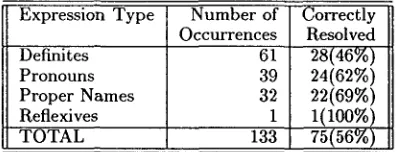
Expression Type Number of Occurrences
Definites ' 61
Pronouns 39
Proper Names 32
Reflexives 1
T O T A L 133
Correctly Resolved 28(46%) 24(62%) 22(69%) 1(100%) 75(56%) Table 1: Core Discourse Anaphors in Five Articles
Grammatical Person 3rd person 3rd person that
l s t / 2 n d person reflexive
I n t r a / I n t e r - S Antecedent intra-S inter-S inter-S inter-S intra-S
Number of Occurrences 27 6 1 5 1
Correctly Resolved
21(78%)
2(33%)
0(0%)
1(20%)
1(100%)
Table 2: Pronouns in Five Articles
Table 1 shows the system's performance in re- solving the core discourse anaphors in five ran- domely selected articles from the development set. Only five articles were examined here because the process was highly time-consuming. The perfor- mance for each expression type varies widely from article to article because of unexpected features of the articles. For instance, one of the five articles is a letter to the editor with a text structure drasti- cally different from news reports. On average, we see that the resolution accuracy (i.e., recall) was the highest for proper names (69%), followed by pronouns (62%) and definites (46%). There were not enough instances of reflexives to compare.
Table 2 shows the system's performance for pro- nouns broken down by two parameters, gram- matical person and inter- vs. intrasentential antecedent. The system did quite well (78%) with third-person pronouns with intrasentential antecedents, the largest class of such pronouns.
[image:4.596.324.524.148.224.2] [image:4.596.303.560.270.348.2]cles. This progressive decline in performance cor- responds to the progressive decline in the a m o u n t of syntactic information in the input to reference resolution. To summarize the latter decline, Lap-- pin and Leass (1994) had the following components in their algorithm.
1. INPUT: fully parsed sentences with grammati- cal roles and head-argument and head-adjunct relations
2. Intrasentential syntactic filter based on syntactic noncoreference
3. Morphological filter based on person, number, and gender features
4. Pleonastic pronoun recognition
5. Intrasentential binding for reflexives and recip- rocals
6. Salience c o m p u t a t i o n based on grammatical role, grammatical parallelism, frequency of men- tion, proximity, and sentence recency
7. Global salience c o m p u t a t i o n for noun phrases (NPs) in equivalence classes (with seven salience factors)
8. Decision procedure for choosing among equally preferred candidate antecedents
Kennedy and Boguraev (1996) approximated the above components with a poorer syntactic input, which is an o u t p u t of a part-of-speech tagger with grammatical function information, plus NPs recog- nized by finite-state patterns and NPs' adjunct and subordination contexts recognized by heuristics. With this input, grammatical functions and prece- dence relations were used to approximate 2 and 5. Finite-state patterns approximated 4. Three additional salience factors were used in 7, and a preference for intraclausal antecedents was added in 6; 3 and 8 were the same.
The present algorithm works with an even poorer syntactic input, as summarized here.
1. INPUT: a set of finite-state approximations of sentence parts, which can be overlapping or dis- contiguous, with no grammatical function, sub- ordination, or adjunct information.
.
3. 4.
.
50
No disjoint reference filter is used. Morphological filter is used.
Pleonastic pronouns are recognized with finite- state patterns.
Reflexives simply limit the search to the current sentence, with no a t t e m p t at recognizing coar- guments. No reciprocals are treated.
. Salience is approximated by c o m p u t a t i o n based on linear order and recency. No grammatical parallelism is recognized.
. Equivalence classes correspond to
merged entity
objects
whose 'current' positions are always the most recent mentions.8. Candidates are deterministically ordered, so no decision procedure is needed.
Given how
little
syntactic information is used in FASTUS reference resolution, the 71% accuracy in pronoun resolution is perhaps unexpectedly high. This perhaps shows t h a t linear ordering and re- cency are major indicators of salience, especially because grammatical functions correspond to con- stituent ordering in English. T h e lack of disjoint reference filter is not the most frequent source of errors, and a coarse-grained t r e a t m e n t of reflexives does not hurt very much, mainly because of the in- frequency of reflexives.A n E x a m p l e A n a l y s i s
In the IE context, the task of entity reference res- olution is to recognize referential links among par- tially described entities within and across docu- ments, which goes beyond third-person pronouns and identity of reference. The expression types to be handled include bare nominals, possessed nomi- nals, and indefinites, whose referential links tend to be more 'accidental' than textually signaled, and the referential links to be recognized include sub- set, membership, and part-whole.
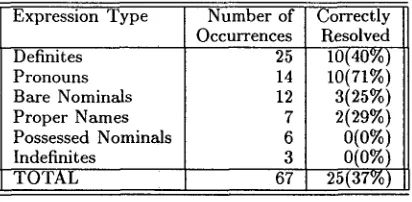
Expression Type Number of Occurrences Definites
Pronouns Bare Nominals Proper Names
Possessed Nominals Indefinites
TOTAL
25 14 12 7 6 3
Correctly Resolved 10(40%) 10(71%)
3(25%)
2(29%)
0(0%)
0(0%)
25(37%)
Table 3: Referential Links in the Example
to coreference, for which the code was prepared, the recall was only 51%.
Figure 1 shows this article a n n o t a t e d with ref- erential indices. T h e same index indicates corefer- ence. Index subscripts (such as 4a) indicate subset, part, or membership of a n o t h e r expression (e.g., indexed 4). T h e index number ordering, 1,...,N, has no significance. Each sentence in the T E X T region is n u m b e r e d with paragraph and sentence numbers, so, for instance, 2-1 is the first sentence in the second paragraph.
Note t h a t not all of these referential links need be recognized for each particular IE application. However, since reference resolution must consider all of the text for any particular application for t h e reason mentioned above, it is reasonable to assume t h a t an ideal domain-independent reference resolu- tion c o m p o n e n t should be able to recognize all of these. Is this a realistic goal, especially in an IE context? This question is left open for now. E r r o r
Analysis
Table 3 shows the s y s t e m ' s performance in recog- nizing the referential links in this article, grouped by referring expression types. These exclude t h e initial mention of each referential chain. Notable sources of errors and necessary extensions are sum- marized for each expression type here.
P r o n o u n s : Of the four pronoun resolution errors, one is due to a parse error (American in 7-1 was incorrectly parsed as a person entity, to which she in 8-1 was resolved), that in 6-2 is a discourse deixis (Webber, 1988), beyond the scope of t h e c u r r e n t approach, and two errors (it in 3-1 and its in 7-1) were due to the left-right ordering of intrasentential candidates. Recognition of par-
51
allelism among clause conjuncts and a stricter locality preference for possessive pronouns m a y help here.
D e f i n i t e s : Of the fifteen incorrect resolutions of definites, five have nonidentity referential rela- tionships, and hence were not handled. These nonidentity cases m u s t be handled to avoid er- roneous identity-only resolutions. Two errors were due to the failure to distinguish between generic and specific events. Token-referring def- inites (the union in 8-2 and the company in 9-1) were incorrectly resolved to recently mentioned types. T h r e e errors were due to the failure to recognize synonyms between, for example, call (3-2) vs. request (3-1) and campaign (9-1) vs. strategy (9-1). O t h e r error sources are a failure in recognizing an appositive p a t t e r n (9-1), the left-right ordering of the candidates in the pre- vious sentence (9-2), and three 'bugs'.
P r o p e r N a m e s : N a m e alias recognition was un- usually poor (2 out of 7) because American was parsed as a person-denoting noun. T h e lower- case print in Patt gibbs also m a d e it difficult to link it with Ms. Gibbs. Such parse errors and input anomalies hurt performance.
B a r e N o m i n a l s : Since bare nominaJs were not explicitly resolved, t h e only correct resolutions (3 out of 12) were due to recognition of ap- positive patterns. How can the o t h e r cases be treated? We need to u n d e r s t a n d the discourse semantics of bare nominMs b e t t e r before devel- oping an effective algorithm.
[image:6.596.54.260.147.248.2]HEADLINE: A m e r i c a n A i r l i n e s 1 Calls for M e d i a t i o n 1 5 In Its1 U n i o n 4 Talks2
D O C U M E N T DATE: 02/09/87
SOURCE: WALL S T R E E T J O U R N A L
1-1 A m r corp.'s A m e r i c a n A i r l i n e s 1 unit said it1 has called for f e d e r a l m e d i a t i o n 1 5 in i t s l c o n t r a c t t a l k s 2 with u n i o n s 4 representing its1 pilots10 and f l i g h t a t t e n d a n t s 1 7 .
2-1 A spokesman for t h e c o m p a n y l said A m e r i c a n l officials "felt t a l k s 2 had reached a point where m e d i a t i o n 1 5 would be helpful."
2-2 N e g o t i a t i o n s 2 a with t h e pilots16 have been going on for 11 months; talks2b with f l i g h t a t t e n d a n t s l v began six months ago.
3-1 T h e p r e s i d e n t 5 of t h e A s s o c i a t i o n o f P r o f e s s i o n a l F l i g h t A t t e n d a n t s 4 a , which represents A m e r i c a n l ' s m o r e t h a n 10,000 f l i g h t a t t e n d a n t s l ~ , called t h e r e q u e s t s for m e d i a t i o n l ~ "premature" and characterized its as a bargaining tactic t h a t could lead to a lockout.
3-2 P a t t g i b b s s , p r e s i d e n t s of t h e a s s o c i a t i o n 4 a , said talks2b with t h e c o m p a n y 1 seemed to be progressing well and t h e calls for m e d i a t i o n 1 5 came as a surprise.
4-1 The major outstanding issue in t h e n e g o t i a t i o n s 2 b with t h e f l i g h t a t t e n d a n t s 1 7 is a two-tier wage scale, in which recent employees' salaries increase on a different scale than the salaries of employees who have worked at a m e r i c a n 1 for a longer time.
4-2 T h e u n i o n 4 a wants to narrow the differences between the new scale and the old one.
5-1 T h e c o m p a n y 1 declined to comment on t h e n e g o t i a t l o n s 2 b or the outstanding issues.
5-2 Representatives for t h e 5 , 4 0 0 - m e m b e r A l l i e d P i l o t s A s s o c i a t i o n 4 b d i d n ' t return phone calls.
6-1 Under the Federal Railway Labor Act, [if t h e m e d i a t o r l s ~ fails to bring t h e t w o sides~ together and t h e t w o sidesT d o n ' t agree to binding arbitration, a 30-day cooling-off period follows]0.
6-2 After t h a t 6 , t h e unionTa can strike or t h e c o m p a n y T ~ can lock t h e u n l o n ~ a out.
7-1 M s . G i b b s 5 said t h a t in response to t h e c o m p a n y l ' s move, h e r s u n i o n 4 a will be "escalating" its4~ "corporate campaign" against A m e r i c a n 1 over the next couple of months.
7-2 In a c o r p o r a t e c a m p a i g n 1 0 , a u n i o n 9 tries to get a c o m p a n y s ' s financiers, investors, directors and other financial partners to pressure t h e c o m p a n y s to meet u n i o n 9 demands.
8--1 A c o r p o r a t e c a m p a i g n ~ 0 , she5 said, appeals to her5 m e m b e r s l ~ because "it10 is a nice, clean way to take a j o b action, and our4~ w o m e n 1 7 are hired to be nice."
8-2 t h e u n i o n 4 a has decided not to strike, she5 said.
9-1 T h e union4~ has hired a n u m b e r o f p r o f e s s i o n a l c o n s u l t a n t s 1 4 in its4~ b a t t l e 1 8 with t h e c o m p a n y 1 , including R a y Rogers14,~ of C o r p o r a t e Campaign Inc., t h e N e w Y o r k l a b o r c o n s u l t a n t 1 4 a who developed t h e s t r a t e g y 1 2 at G e o . A . H o r m e l ~ C o . l s ' s Austin, Minn., meatpacking plant last year.
9-2 T h a t c a m p a i g n 1 2 , which included a strike, faltered when t h e c o m p a n y 1 3 hired new workers and the International Meatpacking Union wrested control of the local union from R o g e r s 1 4 a ' supporters.
F i g u r e 1: E x a m p l e A r t i c l e A n n o t a t e d w i t h R e f e r e n t i a l L i n k s
is president of the association, and this 'associa- tion' is the Association of Professional Flight At- tendants. After it is understood as 'the members of the Association of Professional Flight Atten- dants,' the coreference with the flight attendants can be inferred. Similarly for our women in 8-1.
Indefinites: Some indefinites are 'coreferential' to generic types, for example, a corporate campaign (7-2, 8-1). Given the difficulty in distinguishing between generic and specific event descriptions, it is unclear whether it will ever be treated in a systematic way.
C o n c l u s i o n s
In an operational end-to-end discourse understand- ing system, a reference resolution component must work with input d a t a containing parse errors, lex- icon gaps, and mistakes made by earlier reference resolution. In a state-of-the-art IE system such as SRI's FASTUS, reference resolution must work with considerably impoverished syntactic analysis of the input sentences. The present reference res- olution approach within an IE system is robust and efficient, and performs pronoun resolution to an almost comparable level with a high-accuracy algorithm in the literature. Desirable extensions include nonidentity referential relationships, treat- ments of bare nominals, possessed nominals, and indefinites, type-token distinctions, and recogni- tion of synonyms. Another future direction is to turn this component into a corpus-based statisti- cal approach using the relevant factors identified in the rule-based approach. The need for a large tagged corpus may be difficult to satisfy, however.
A c k n o w l e d g m e n t
This work was in part supported by U.S. govern- ment c o n t r a c t s ~ _ - - - _" __:3
R e f e r e n c e s
Appelt, Douglas, Jerry Hobbs, John Bear, David Israel, Megumi Kameyama, Andy Kehler, David Martin, Karen Myers, and Mabry Tyson. 1995. SRI International FAS- TUS system: MUC-6 test results and analysis. In Pro- ceedings of the 6th Message Understanding Conference,
pages 237-248. DARPA.
53
Grosz, Barbara, Aravind Joshi, and Scott Weinstein. 1995. Centering: A framework for modelling the local coherence of discourse. Computational Linguistics, 21(2):203-226.
Heim, Irene. 1982. The Semantics off Definite and Indefinite
Noun Phrases. Ph.D. thesis, University of Massachusetts
at Amherst.
Hobbs, Jerry. 1978. Resolving pronoun references. Lin-
gua, 44:311-338. Also in B. Grosz, K. Sparck-Jones, and
B. Webber, eds., Readings in Natural Language Process-
ing, Morgan Kaufmann, Los Altos, CA, 1986, 339-352.
Hobbs, Jerry R., Douglas E. Appelt, John Bear, David Israel, Megumi Kameyama, Mark Stickel, and Mabry Tyson. 1996. FASTUS: A cascaded finite-state trans- ducer for extracting information from natural-language text. In E. Roche and Y. Schabes, editors, Finite State
Devices ]for Natural Language Processing. MIT Press,
Cambridge,Massachusetts.
Kameyama, Megumi. in press. Intrasentential centering: A case study. In Marilyn Walker, Aravind Joshi, and Ellen Prince, editors, Centering in Discourse. Oxford Univer- sity Press.
Kamp, Hans. 1981. A theory of truth and semantic repre- sentation. In J. Groenendijk, T. Janssen, and M. Stokhof, editors, Formal Methods in the Study of Language. Math- ematical Center, Amsterdam, pages 277-322.
Kamp, Hans and Uwe Reyle. 1993. From Discourse to
Logic. Kluwer, Dordrecht.
Karttunen, Lauri. 1976. Discourse referents. In James D. McCawley, editor, Syntax and Semantics: Notes ]from the
Linguistic Underground, volume 7. Academic Press, New
York, pages 363-386.
Kennedy, Christopher and Branimir Boguraev. 1996. Anaphora for everyone: Pronominal anaphora resolu- tion without a parser. In Proceedings off the 16th International Con]ference on Computational Linguistics
(COLING-'96}. Association for Computational Linguis-
tics.
Lappin, Shalom and Herbert Leass. 1994. An algorithm for pronominal anaphora resolution. Computational Linguis-
tics, 20(4):535-562.
Sidner, Candace. 1979. Towards a computational theory of definite anaphora comprehension in English discourse. Technical Report 537, MIT Artificial Intelligence Labo- ratory, Cambridge, MA, June.
Sundheim, Beth. 1995. Overview of results of the MUC- 6 evaluation. In Proceedings of the 6th Message Under-
standing Conference, pages 13-32. DARPA.
Webber, Bonnie. 1988. Discourse deixis: Reference to discourse segments. In Proceedings of the 26th Annual Meeting off the Association ]for Computational Linguis-
tics, pages 113-122. Association for Computational Lin-
guistics, June.
Webber, Bonnie Lynn. 1978. A Formal Approach to Dis-