U s i n g B i d i r e c t i o n a l S e m a n t i c R u l e s for G e n e r a t i o n
J i m B a r n e t t a n d I n d e r j e e t M a n i
M i c r o e l e c t r o n i c s a n d C o m p u t e r T e c h n o l o g y C o r p o r a t i o n ( M C C ) 3 5 0 0 W e s t B a l c o n e s C e n t e r D r i v e
A u s t i n , T e x a s 7 8 7 5 9 U . S . A .
A b s t r a c t
This p a p e r describes the use of a system of semantic rules to generate noun compounds, vague or polyse- mous words, and cases of m e t o n y m y . T h e rules are bi- directional and are used by the understanding system to interpret the s a m e constructions.
I n t r o d u c t i o n
In generation systems t h a t are paired with understand- ing systems, bidirectionality is desirable for reasons t h a t are b o t h theoretical (a single model of linguis- tic behaviour) and practical (shorter development time, greater consistency, etc.) 1. Recently, [Shieber et al. 89] and [Calder at al. 89] have presented generation algo- rithms t h a t share b o t h semantics and s y n t a x with the understanding system. This p a p e r presents an exten- sion of these algorithms to deal with p h e n o m e n a t h a t have often been l u m p e d together under ' p r a g m a t i c s ' , namely noun compounding, m e t o n y m y (the use of a word to refer to a related concept), and vague or poly- semous words like "have."
T h e difficulty with these constructions is t h a t they are productive, and cannot be handled easily by simply listing meanings in a lexicon. Taking noun compound- ing as an example, we have "corn oil" and "olive oil" referring to oil m a d e from corn or olives. We could add a lexical sense for "corn" m e a n i n g " m a d e from corn," but then we face an explosion in the size of the lexi- con, and an inability to understand or generate novel compounds: if we acquire "safflower" as the n a m e of a plant, we would like the s y s t e m to be able to handle "safflower oil" immediately, b u t this won't be possible if we need a separate lexical sense to handle compound- ing. T h e s y s t e m will be m o r e robust (and the lexicon more c o m p a c t ) if we can derive the desired sense of "safflower" from the basic noun sense when we need it. We have therefore developed a system of bidirectional semantic rules to handle these p h e n o m e n a at the ap- propriate level of generality.
IF or more detailed arguments along these lines, see [Appelt 87], [Shieber 88], [Jacobs 88a].
We have i m p l e m e n t e d these rules in C o m m o n Lisp as p a r t of the K B N L s y s t e m [Barnett et M. 90] at MCC, but nothing depends on the idiosyncracies of our for- malisms or i m p l e m e n t a t i o n , so the technique is com- patible with a wide variety of theories of the kinds of relations t h a t are likely to occur in these construc- tions, as in, e.g., [Finin 80] for noun compounds and [Nunberg 78] for oblique reference.
T h e F r a m e w o r k
T h e algorithms for recognition and generation use an agenda-based blackboard for communication and control [Cohen et al. 89]. Our s y n t a x component uses an extension of Categorial Unification G r a m m a r [Wittenburg 86] as the phrase-structure component of an LFG-style functional representation (f-struCture), and the semantic c o m p o n e n t m a p s from this represen- tation to sets of assertions in the interface language of the C Y C knowledge base [Lenat et al. 90].
Semantic rules m a p partial semantic interpretations onto other partial interpretations. T h e y consist of a left-hand side and a right-hand side, each consisting of one or more templates, plus a m e c h a n i s m for m a p p i n g an instantiation of either set of t e m p l a t e s onto an in- stantiation of the other set. The intuitive semantics of these rules is t h a t any interpretation t h a t matches the left-hand side licenses a second interpretation match- ing the right-hand side. For example, we can use the n a m e of an author to refer to his works ("I read Shake- speare"), and the corresponding semantic rule states t h a t the existence of an NP denoting an artist licences the use of the s a m e NP to refer to his works. T h e gen- eration system a p p l i e s the rules in a backward-chaining direction, while the understanding system runs t h e m forward. A later section contains a fuller discussion of the i m p l e m e n t a t i o n of the rules, while the next sections discuss their use at runtime.
G e n e r a t i o n
T h e generator is divided into strategic and tactical com- ponents. T h e former takes a f r a m e as input and cre- ates a description of it based on a set of discriminative
properties which are recorded in the KB and indicate which aspects of a frame are likely to be salient. If a comparison class is available, the resulting descrip- tion uniquely identifies the frame with respect to that class, otherwise it contains default 'interesting' proper- ties. Once it has generated this set of assertions, the strategic component calls the tactical component with a goal Semantics : Syntax, where Semantics consists of the assertions plus the distinguished variable that the utterance is 'about', and Syntax is an f-structure (which may specify no more than the category.)
Given this input, the tactical component uses a vari- ant of the semantic-head driven algorithms described by [Calder at al. 89] and [Shieber et al. 89] to generate a phrase whose syntax and semantics match the goal. Before examining this algorithm, we note that in cat- egorial grammars, most of the syntactic information is contained in the lexical definitions of words. For ex- ample, the lexical entry for a transitive verb like "read" specifies that it takes an object NP to its right and then a subject NP to its left. Any such constituent that takes at least one argument is called a funclor, while a con- stituent with no arguments is called atomic. Functors and their arguments are combined by a small number of binary rules, and there is also a set of unary rules, which can change the category of a constituent (forming passive verbs out of actives, for example.)
Next we define two relationships between con- stituents and goals: first, a constituent matches a goal if its semantics subsumes the goal's semantics and its syn- tactic category is the same as the goal's, with possible extra arguments. Thus the transitive verb "eat", with category S \ N P / N P , is a syntactic match for the goal category S because it will he an S once it gets its ar- guments. Second, a constituent satisfies a goal if it has identical semantics and its f-structure is a supergraph of the goal's f-structure.
Given this syntactic framework, the algorithm works by peeling off lexical functors and recursing on their ar- guments until it b o t t o m s out in an atomic constituent. Given a goal, the first step consists of lexical look-up to find an item that matches the goal. Once this item, called the semantic head, is found, the algorithm pro- ceeds both top-down and b o t t o m up. If the semantic head is a functor, it proceeds top-down trying to solve the sub-goal for its argument. Once this sub-goal is satisfied, the algorithm works b o t t o m - u p by applying unary grammar rules to to the argument constituent alone, or binary rules to combine it with the functor. When a complete constituent is found which satisfies the goal, we are done.
E x t e n s i o n : G o a l R e v i s i o n
T h e algorithm described above assumes a fixed set of choices in the lexicon. It can generate metonymic ex- pressions and noun compounds, but only at the cost of massive lexical ambiguity. We therefore extend it by
considering the possibility of goal revision as an alterna- tive to the lexical look-up step s. By running a semantic rule backward, we can map the current goal onto one or more new goals to which the algorithm recursively applies. Satisfying the new goals will generate an ex- pression with the desired meaning and thus indirectly satisfy the original goal.
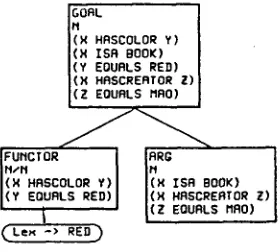
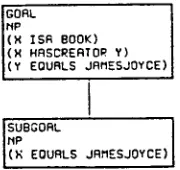
Revision using noun compounding rules leads to a binary decomposition of the original goal, as shown in Figure 2, while m e t o n y m y rules result in a unary de- composition, as shown in Figure 3. From this perspec- tive, we note that the lexical look-up of a functor can be viewed as a kind of guided binary decomposition (Figure 1), splitting the original goal into two sub-goals with the knowledge that one of them will be satisfied immediately.
[
:o.L
I
(X HRSCOLOR Y) [
(x Isg BOOK) I (Y EOURLS RED) | (X HRSCRER/OR Z) I (Z EOURLS MRO) ]
. t . I
(U HRSCOLOR V)l |(X ISR BOOK) | [(X HRSCRERTOR Z)[
l(V E%URLS
RED)][(Z EOURLS .BO) I
Figure 1: Lexical Lookup as Decomposition
Our extension to the algorithms of [Calder at al. 89] and [Shieber et al. 89] thus amounts to the decision to allow top-down decomposition to be guided by rules as well as lexical items. As we would expect, this is the mirror image of the situation during understanding, where semantic rules are used as an extension to the lexicon in the process of merging translations bottom- up. T h e extended algorithm is shown in the Appendix.
C o n t r o l l i n g R u l e A p p l i c a t i o n
The strategic component can control the choice among alternatives through its specification of the goal's syn- tax. For example, the strategic component can force the use of a compound by providing an appropriately detailed f-structure (i.e., one t h a t specifies the presence of a modifier of category N.) If it does so, no m a t t e r whether we are in best-first or all-paths mode, only the compounding alternative will succeed and satisfy the syntactic goal. On the other hand, if the syntactic goal is underspecified, the o u t p u t (in best-first mode) will
[image:2.596.352.492.242.368.2]depend on the tactical component's heuristic ordering. In this case, given the default ordering which prefers lexical look-up to noun compounding to metonymy, the tactical component will use a noun compound when lexical look-up fails (i.e., there is no corresponding ad- jective or preposition). Another result of this default ordering is t h a t m e t o n y m y will never fire in the ab- sence of a syntactic specification since there is always another way (unless the lexicon is incomplete) of say- ing the same thing using words that are in the lexicon. However, the literal alternative is usually more verbose than the m e t o n y m o u s expression, ,so the strategic com- ponent can force the use of m e t o n y m y by specifying a limit on the number of words the tactical component is allowed to use. Given a limit of 3 words, descriptive phrases like "a book by Joyce" will fail, and only the m e t o n y m o u s expression "Joyce" will succeed.
In best-first mode, substantial improvements in effi- ciency are possible by re-ordering the alternatives based on the syntactic properties of the goal. For example, it makes sense to try m e t o n y m y first if the desired length is significantly less than the number of assertions in the goal's semantics, since each lexical item normally covers only a few assertions.
G e n e r a t i n g N o u n C o m p o u n d s
Suppose we have a S o f t w a r e - M a c h i n e rule, stating that if "y" denotes any kind of
Software
and "x" a computer, "a y x" means aComputer
x t h a tCanRun-
Language
y. Now consider a goal with semantics(W
ISA Computer)(Z Equals Lisp)(W CanRunLanguage
Z),
distinguished variable W, and syntax NP. There is no lexical item covering all these assertions, or any lex- ical functor covering part of them (i.e., "Lisp" is not in the lexicon as an adjective.) Thus, even in best-first mode, we will end up applying the S o f t w a r e - M a c h i n e rule to this goal, resulting in the decomposition shown in Figure 2.GOAL rtP
(Q CRMRUMLPJIGURGE Z) (W ISR COMPUTER) (Z EOURLS LIGP)
I
(Z EOURLS LISP) I I(W I S R CO.PUIER) Iisfy the other. Combining the sub-goal solutions yields "Lisp machine" as a solution to the original goal.
Multiple compounds are handled by repeated invo- cations of the rules. Suppose we have a M e c h a n i s m - M a i n t e n a n c e rule, stating that if "x" denotes a
Ma-
chine
and "y" denotes any kind ofMaintenanceOpera-
lion,
"x y" denotes aMaintenanceOperation
y with yMaintains
x. Given input semantics(Y ISA Repair-
Operation)(Y Maintains X)(X ISA Computer)(X Can-
RunLanguage Z)(Z Equals Lisp),
with distinguished ref- erent Y, the maintenance rule will eventually fire, gen- erating patterns for a head(Y ISA RepairOperation)
and a modifier(X ISA Computer)(X CanRunLanguage
Z)(Z Equals Lisp).
T h e head's goal will be satisfied by the entry for "repair", but processing of the modifier will invoke the S o f t w a r e - M a c h i n e rule, just as in the example above. T h e o u t p u t will be "Lisp machine re- pair", with the left-branching structure [[Lisp machine] repair].For an example of a right-branching compound, sup- pose we have a P r o d u c t - M a n u f a c t u r e r rule stating that if "x" is the name of a
Product
and "y" is the name of aCompany,
then "a y x" is aProduct
x that isManuffacluredBy
company y. Given the input(X ISA
Computer)(X UanufacturedBy Y)(X CanRunianguage
Z)(Y Equals Symbolics)(Z Equals Lisp),
the product rule will fire, producing a modifier sub-goal for(Y
Equals Symbolics)
and a head sub-goal for(X ISA Com-
puter)(X CanRunLanguage Z)(Z Equals Lisp).
Thistime the S o f t w a r e - M a c h l n e rule will be invoked on the head sub-goal, while lexical item "Symbolics" will satisfy the modifier sub-goal, and the o u t p u t will be [Symbolics [Lisp machine]].
G e n e r a t i n g M e t o n y m i c R e f e r e n c e s
I
G O R L ~ ISR BOOK)(X HRSCRERTO~ ¥)
(Y EOURLS JRMESJOYCE)
I
Figure 3: Decomposition for Metonymy
Figure 2: Decomposition for a Noun C o m p o u n d
Recursing on the sub-goals, the lexical item "Lisp" will satisfy the left sub-goal, and "machine" will sat-
Suppose we have an A r t i s t rule licensing the use of an artist's name to refer to his works, and are try- ing to generate an NP with semantics
(X ISA Book)(X
HasCrealor JamesJoyce).
If we are in all-paths mode, or if the strategic component has requested a succinct [image:3.596.375.465.441.526.2] [image:3.596.79.225.470.586.2]rule, we need to c o m p u t e the inverse of the relation. 4 To do this we reverse the order of the s t a t e m e n t s and re- place each Bind s t a t e m e n t (which computes a relation between variable bindings) with its inverse. Here we rely on the fact t h a t the C Y C KB a u t o m a t i c a l l y main- tains inverses for all relations defined in it (for KBs without this feature, we would have to define inverses for all relations used in rules). If
CreatorOffis
the in- verse ofHasGreator,
then the inverse of(Bind Z (X
CreatorOf))
is simply(Bind X (Z HasCreator)).
A few m o r e details are necessary to complete the im- plementation. First, we define tlie relation
Instances,
which m a p s from classes to their elements, as the in- verse of
ISA.
Next we define a concatenation operator + on relations, so t h a t(Z (Instances + ttasGreator))
re- turns all the creators of instances of the class Z. 5 Next, we stipulate t h a t if the variable X is already bound,(Bind X (Z ttasCreator))
acts as a Filter, returning T iff X is a m o n g the values for(Z gasCreator.)
Finally, for reasons of efficiency, we cache separate p a t t e r n s for backward and forward application, instead of reversing the expressions at run time. T h e generation and under- standing p a t t e r n s for the A r t i s t rule are given below: Input P a t t e r n(W ISA Z)(new-var HasCreator X)
Bind
Y (Z Instances 4- HasCreator)
F i l t e r
(Y ISA Person)
O u t p u t P a t t e r a
(X Equals Y)
Input P a t t e r n
(X Equals Y)
Filter
(Y ISA Person)
B i n d
Z (Y CreatorOf + ISA)
Output
Pattern(W ISA Z)(new-var HasCreator Y)
Running the rule backward on
(Q ISA Book)(Q
HasCreator JamesJoyce),
initial unification binds Q toW, Z to
Book
and Y toJamesJoyce.
T h e Bind ex- pression serves as a filter in this case, checking t h a t Y is in fact theCrealorOfsome
instance of Z, the Filter expression checks t h a t Y is aPerson,
and the o u t p u t is(X Equals JamesJoyce),
which will m a t c h the lexi- cal semantics for "Joyce" p e r m i t t i n g us to use t h a t NP to refer to the book. Running the rule forward on(X
Equals JamesJoyce),
Yis bound toJamesJoyce,
the Fil- ter expression again checks t h a t Yis aPerson,
and the Bind expression binds Z to all the classes of objects Yis theCreatorOf(in
this case, the classBook).
T h e o u t p u t is an expression denoting anyBook
whichHasCreator
JamesJoyce,
thus letting us understand "Joyce" as re- ferring to aBook.
T h e rule f o r m a t is similar for noun compounds, ex- cept t h a t there are two input patterns (in the forward direction) and a single o u t p u t pattern. During under- standing, the two p a t t e r n s are unified with the inter-
4Mathematically, a relation is a set of ordered pairs, and its inverse is the set of inverted pairs. Any relation is there- fore guaranteed to have a unique inverse.
5The inverse of (rl + r2) is ((inverse r2) + (inverse rl)).
pretations of the head and modifier nouns, the Filters and Binds work as before, and the o u t p u t p a t t e r n is the interpretation of the compound. Backward application is as before, except t h a t the o u t p u t is a pair of instan- tiated patterns which the generation routine then uses as new goals.
R e l a t e d W o r k
A variety of s y s t e m s have used rules of the kind we are considering, either explicitly or implicitly, for use in
understanding
compounds, vague expres- sions, and m e t o n y m y , for example, [DaM et at. 87], [Hobbs et al. 88], [Grosz et at. 85], [Stallard 87], b u t no mention is m a d e of reversing these rules for gen- eration.A number of s y s t e m s generate compounds, b u t m o s t apparently do so using either phrasal lexi- cons (e.g., [Hovy 88], [Jacobs 88b], [Wilensky 88]), or multiple lexical senses (e.g., [Pustejovsky et at. 87], [Nirenburg et al. 88]), rather t h a n rules of the sort we propose. Other generation systems apparently con- struct noun c o m p o u n d s via specialized (uni-directional) strategies specified in the interface to the tactical com- ponent [McDonald et at. 88], or a combination of these techniques [McKeown 82]. We have been unable to find discussions of generation of m e t o n y m y , though at least some cases of it could obviously be handled via lexical ambiguity.
D i s c u s s i o n
T h e use of semantic rules seems to us to handle m o s t of the technical p r o b l e m s in providing an economical, bi- directional t r e a t m e n t of a variety of non-literal a n d / o r vague constructions. At the heart of any reversible sys- t e m is the notion of being able to run mappings for- wards or backwards, so that, for example, the under- standing and generation lexicons are inverses of each other. These rules are a natural extension of this mech- anism to more complex constructions. Furthermore, these rules can handle a wide variety of phenomena. In addition to the examples discussed above, we have used semantic rules for the lexical semantics of vague words like "have" and "of", which are like noun c o m p o u n d i n g and m e t o n y m y in t h a t the only alternative to massive lexical ambiguity is to c o m p u t e the nature of the rela- tion based on the interpretation of the arguments. This use of semantic rules for lexical semantics a m o u n t s to p e r m i t t i n g a lexical item to further decompose its sub- goal, instead of satisfying it i m m e d i a t e l y in the m a n - ner of Figure 1. Finally, these rules do not c o m m i t us to any particular analysis of the constructions in ques- tion (except insofar as they assume separate levels of syntactic and semantic representation.) To take noun compounding as an example, we can implement a wide variety of theories of the kinds of relations c o m p o u n d s express and of the hierarchies a m o n g them.
The main open issue is the development of strategies for the use of these expressions. The problem is most acute in the case of metonymy. At present, the strate- gic component can force the use of metonymous expres- sions by requiring brevity. However, use of m e t o n y m y is not just a m a t t e r of succinctness since it also tends to indicate informality and familiarity. In more ex- treme uses, it may have a poetic or humorous force. To use metonymy, compounds, or other vague expres- sions successfully, w e need a theory of how they effect the discourse, as well as a strategic component which is sophisticated enough to exploit the theory. As a first step in this direction, we are implementing a discourse module which will allow us to address some of these issues. For example, metonymous expressions are safer when used to refer to classes of objects that have al- ready been described than when used to introduce new ones. If "an Orris fishing rod" has already been men- tioned, then "an Orris" is likely to make sense, even to people who wouldn't have understood it the first time around. However, such individual heuristics will be of limited usefulness until they are integrated into a com- prehensive model of communication.
A c k n o w l e d g m e n t s
We are grateful to Elaine Rich for comments on an ear- lier draft of this paper.
A p p e n d i x : G e n e r a t i o n A l g o r i t h m The psuedocode for the generation algorithm is shown below, identifying the point of departure from the [Calder at al. 89] algorithm. The lexical lookup-step of line 1 is replaced with the more general top-down step of line la, by calling the new function ge,erafe-tp-dn. The rest of the (pseudo)code remains unchanged.
Here are the language constructs used in the pseu- docode. We denote local variable assignment as X := Y, with scope extending to the immediate containing construct. Destructuring by pattern matching is al- lowed, e.g. < X1 X2 X3 > : = Y simultaneously binds X1, X2 and X3 to the corresponding components in Y. AND and OR have exactly the behavior of Common Lisp AND and OR.
For the sake of conciseness,the function choose is used as a shorthand for control strategies: in all-paths mode, it finds all solutions; in best-first mode it imposes a heuristic ordering on the choices and finds a single so- lution, finding any subsequent solutions on backtrack- ing. The function choose-tp-dn-operatio, heuristically picks the best operation based on the goal. The func- tions match and satisfy are as defined earlier. The functions apply-unavy-bup-rule and apply-bi.avy-bup- rule constitute the rule application interface to gram- mar rules; similarly, the functions apply-uuary-tp-dn-
rule and apply-binary-tp-d.-rule constitute the rule ap- plication interface for the semantic rules.
FUNCTION generate(Goal);
1AND(;;OLD: Subgoal :ffi lex-decomp(Goal) ;; NEW:
la Subgoal := choose(generate-tp-dn(Goal))
; ; AS BEFORE:
2 choose(generate-bup(Subgoal, Goal))). FUNCTION generate-tp-dn(Goal);
operation :=
choose(choose-tp-dn-operation(Goal)) CASE operation
:lex
lex-decomp(Goal) :unary-decomp
; ; e.g. METONYMY RULES:
choose(apply-unary-tp-dn-rule(Goal)) :binary-decomp
; ; e.g. COMPOL~DING/VAGUEWORD RULES:
AND(<lef$-subgoal, right-subgoal> := choose(apply-binary-tp-dn-rule (Goal)),
choose(generate(left-subgoal)), choose(generate(right-subgoal)), choose(apply-binary-bup-rule (left-subgoal, right-subgoal))). FUNCTION generate-bup(Subgoal, Goal);
OR(satisfies(Subgoal, Goal), AND(Arg :=
choose(extract-arg(Subgoal)), Goall :=
choose(apply-binary-bup-rule (Subgoal, ARE)),
choose(generate(Arg)), choose(generate-bup (Goall, Goal))), AND(Goall :=
choose(apply-unary-bup-rule (Subgoal)),
choose(generate-bup
(Goall, Goal)))).
FUNCTION lex-decomp(Goal); AND(Subgoal :=
choose(lexical-lookup(Goal)), matches(Subgoal, Goal), Subgoal).
R e f e r e n c e s
[Appelt 83] D. E. Appelt, "Telegram: A Grammar For- malism For Language Planning", Proceedings of the ACt, M.I.T., 15-17 June, 1983.
[Appelt 87] D. E. Appelt, "Bidirectional Grammars and the Design of Natural Language Generation Systems", TINLAP-3 Posilion Papers, New Mex- ico State University, 7-9 January, 1987.
eessing', to appear in Communications of the ACM, August, 1990.
[Calder at al. 89] J. Calder, M. Reape, and H. Zeevat, "An Algorithm for Generation in Unification Cat- egorial Grammar", Proceedings of the 4th Confer- ence of the European Chapter of the ACL, pp. 233-- 240, Manchester, 10-12 April, 1989.
[Cohen et al. 89] R. M. Cohen, T. P. McCandless, and E. Rich, "A Problem Solving Approach to Human- Computer Interface Management", MCC Tech Report ACT-HI-g06-89, Fall 1989.
[Dahl et al. 87] D. Dahl, M. Palmer, and R. Passon- neau, "Nominalizations in Pundit", Proceedings of the ACL, Stanford, 6-9 July, 1987.
[Finin 80] T. Finin, "The Semantic Interpretation of Compound Nominals", University of Illinois,
Ph.D. Dissertation, 1980.
[Grosz et al. 85] B. Grosz, D. Appelt, P. Martin, and F. C. N. Pereira, "Team: An Experiment in the Design of Transportable Natural-Language Inter- faces", Artificial Intelligence.
[Hobbs et al. 88] J. K. Hobbs, M. Stickel, P. Martin, and D. Edwards, "Interpretation as Abduction",
Proceedings of the ACL, Buffalo, 7-10 June, 1988. [IIovy 88] E. H. Hovy, "Generating Language with a Phrasal Lexicon", in D. D. McDonald and L. Bole, eds., Natural Language Generation Systems,
Springer-Verlag, 1988.
[Jacobs 88a] P. S. Jacobs, "Achieving Bidirectional- ity", Proceedings of the lth International Confer-
ence on Computational Linguistics, Budapest, 22- 27 August, 1988, pp. 267-269.
[Jacobs 88b] P. S. Jacobs, "PHRED: A Generator for Natural Language Interfaces", in D. D. McDonald and L. Bole, eds., Natural Language Generation Systems, Springer-Verlag, 1988.
[Lenat et al. 90] D. Lenat and R. Guha, f'Building Large Knowledge Based Systems, Representations and Inference in the CYC Project", Addison Wes- ley, 1990.
[McDonald et al. 88] D. D. McDonald and M. W. Meteer, "From Water to Wine: Generating Natu- ral Language Text from Today's Application Pro- grams", Second Conference on Applied Natural Language Processing, Austin, 9-12 February, 1988. [McKeown 82] K. R. McKeown, "Generating Natural Language Text in Response to Questions About Database Structure", University of Pennsylvania,
Ph.D. Dissertation, 1982.
[Nirenburg et al. 88] S. Nirenburg, R. MeCardell, E. Nyberg, P. Werner, S. Huffman, E. Kenschaft and I. Nirenburg, "DIOGENES-88", CMU Tech Re- port CMU-CMT-88-107, June 1988.
[Nunberg 78] G. Nunberg, "The Pragmatics of Refer- ence", City College of New York, Ph.D. Disserta- tion, 1978.
[Pustejovsky et al. 87] J. Pustejovsky and S. Niren- burg, "Lexical Selection in the Process of Lan- guage Generation", Proceedings of the A CL, Stan- ford, 6-9 July, 1987.
[Shieber 88] S. M. Shieber, "A Uniform Architecture for Parsing and Generation", Proceedings of the 121h International Conference on Computational Linguistics, Budapest, 22-27 August, 1988, pp. 614-619.
[Shieber et al. 89] S. M. Shieber, G. van Noord, R. C. Moore, and F. C. N. Pereira, "A Semantic-fiend- Driven Generation Algorithm for Unification- Based Formalisms", Proceedings of the AGL, Van- couver, 26-29 June, 1989.
[Stallard 87] D. Stallard, "The Logical Analysis of Lex- teal Ambiguity", Proceedings of the ACL, Stan- ford, 6-9 July, 1987.
[Vaughan et al. 86] M. M. Vaughan and D. D. McDon- ald, "A Model of Revision in Natural Language Generation", Proceedings of the ACL, New York, 10-13 June, 1986.
[Wilensky 88] R. Wilensky, D. N. Chin, M. Luria, J. Martin, J. Mayfield, and D. Wu, "The Berkeley UNIX Consultant Project", Computational Lin- guistics, Vol. 14, No. 4, December 1988.
[Wittenburg 86] K. Wittenburg, "A Parser for Portable NL Interfaces Using Graph-Unification-Based Grammars", Proceedings of A A A I 86, 1986.