Combining Natural and Artificial Examples to Improve Implicit
Discourse Relation Identification
Chloé Braud
ALPAGE, Univ Paris Diderot & INRIA Paris-Rocquencourt
75013 Paris - France [email protected]
Pascal Denis
MAGNET, INRIA Lille Nord-Europe 59650 Villeneuve d’Ascq - France
Abstract
This paper presents the first experiments on identifying implicit discourse relations (i.e., relations lacking an overt discourse connective) in French. Given the little amount of annotated data for this task, our system resorts to additional data automatically labeled using unambiguous connec-tives, a method introduced by (Marcu and Echihabi, 2002). We first show that a system trained solely on these artificial data does not generalize well to natural implicit examples, thus echoing the conclusion made by (Sporleder and Lascarides, 2008) for English. We then explain these ini-tial results by analyzing the different types of distribution difference between natural and artificial implicit data. This finally leads us to propose a number of very simple methods, all inspired from work on domain adaptation, for combining the two types of data. Through various experiments on the FrenchANNODIScorpus, we show that our best system achieves an accuracy of41.7%, corresponding to a4.4%significant gain over a system solely trained on manually labeled data. 1 Introduction
An important bottleneck for automatic discourse understanding is the proper identification of implicit relations between discourse units. What makes these relations difficult is that they lack strong surface cues like a discourse marker. This point is illustrated in the French examples (1) and (2).1 In (1), the connective mais(but) triggers a relation of contrast, whereas in (2), there is no explicit connective to signal theexplanation relation, and the relation has to be inferred through other ways (in this case, a causal relation between having injured players and loosing).
(1) La hulotte est un rapace nocturne,maiselle peut vivre le jour.
The tawny owl is a nocturnal bird of prey,butit can live in the daytime.
(2) L’équipe a perdu lamentablement hier. Elle avait trop de blessés.
The team lost miserably yesterday. It had too many injured players.
Implicit relations are very widespread in naturally-occurring data. Thus, they make up between39.5% and 54% of the annotated examples in the Penn Discourse TreeBank (PDTB) (Prasad et al., 2008), depending on the relation types used.2 A quick look at other discourse corpora suggests that the problem is as pervasive (if not more) in other languages. The French ANNODIS corpus does not annotate the distinction between explicit and implicit relations, but a projection of a French connective lexicon on the data gives a proportion of47.4to71% of implicit relations, depending on the set of relations.3 For the German discourse corpus of (Gastel et al., 2011), (Versley, 2013) report65% of implicit relations.
In this paper, we tackle the problem of automatically identifying implicit discourse relations in French. To date, the large majority of studies on this task have focused on English, and to a lesser extent on German. Performance remain relatively low compared to explicit relations, due to the lack of strong This work is licenced under a Creative Commons Attribution 4.0 International License. Page numbers and proceedings footer are added by the organisers. License details:http://creativecommons.org/licenses/by/4.0/
1All our examples are taken from theANNODIScorpus:http://redac.univ-tlse2.fr/corpus/annodis/. 2The former count does not includeAltLex,EntRelandNoRelas implicit examples, whereas the latter does.
3The first count does not includeattribution,e-elaborationandframeexamples.
predictors. Because it relies on more complex, interacting factors, the identification of implicit relations requires a lot of data. But the available annotated for French is scarce: while the PDTB contains about 40,000examples, the FrenchANNODIS only has about 3,000examples. An additional challenge for building such a system for French compared to English is the lack of external lexical ressources (e.g., semantic verb classification, polarity database).
A natural approach to deal with the lack of annotated implicit data is to resort to additional data automatically obtained from explicit examples in which the connective is removed (Marcu and Echihabi, 2002). Provided that one could reliably identify discourse connectives, this approach makes it possible to create large amounts of additional implicit data from raw texts. Unfortunately, (Sporleder and Lascarides, 2008) show that a system trained on this type of artificially generated data does not generalize well, leading to important performance degradation compared to a system solely trained on natural data.
The central question we address in this paper is how to better leverage the large amount of automat-ically generated data. We first show that the bad generalization performance of the system trained on artificial data lies in important distribution differences between the two datasets. This analysis in turn leads us to investigate various simple schemes for combining natural and artificial data methods inspired from the field of domain adaptation. Our best combined system yields a significant improvement of4.4% over a system solely trained on the available manually annotated data.
The rest of this paper is organized as follows. Section 2 summarizes previous works on implicit relation identification. In section 3, we describe the problems introduced by the use of artificial data and the methods we develop to deal with them. In section 4, we give a description of the data used, and in section 5, we detail our feature set. Our experiments are then summarized in section 6.
2 Related Work
To date, there have been only a few attempts at building full document-based discourse parsers. On the RST-DT (Carlson et al., 2001), the best performing system is (Joty et al., 2013), who report an F1 score
of55.71 for labeled stuctures (with23relations). On the same corpus, (Sagae, 2009) and (Hernault et al., 2010) report F1scores of44.5and47.3, respectively. On the PDTB, the parser of Lin et al. (2010)
obtains an F1 score of33(16explicit relations,11implicit relations). On theANNODIScorpus, Muller
et al. (2012) reports F1scores of36.1(17relations) and46.8(4relations).
These still modest performance are due to wrong attachment decisions, as well as to errors in relation labeling. Most of these latter errors are mostly imputable to wrong classifications of implicit relations. Thus, the current best accuracy performance on explicit PDTB relations are94.15% on4relations (Pitler and Nenkova, 2009), and86.77% on16relations (Lin et al., 2010). By contrast, the best identification system for implicit PDTB relations obtains an accuracy of65.4% on4relations in (Pitler et al., 2009), and down to40.2% for11of the level2relations of PDTB (Lin et al., 2009). For German, Versley (2013)’s study on implicit relations reports42.5in F1for5relations and18.7for21relations. For French, Muller
et al. (2012) report an accuracy score of63.6% for their relation labeling system (over17relations), but they do not provide separate scores for explicit vs. implicit relations.
Another set of studies we directly build upon explore the idea that many connectives unambiguously trigger a unique relation, thus allowing to construct massive amount of (artificially) labelled implicit examples from raw data. Marcu and Echihabi (2002) were the first to use this method: they were mainly interested in showing that a removed connective could be recovered from its linguistic context. In turn, they only tested their approach on examples that were also generated automatically, and not on manually annotated implicit examples. In this setting, they report an accuracy of 49.7(6classes), significantly above luck. Reusing the same approach, Sporleder and Lascarides (2008) then showed that a system trained on a large amount of artificial examples (72000examples) performs much worse than the same system trained on a much smaller amount of natural examples (1,051examples) implicit examples, with accuracies of25.8and40.3, respectively.
Marcu and Echihabi’s (2002) original approach was based on the idea of finding pairs of semantically related words that together trigger a relation (such as “nocturne/jour” (“nocturnal/daytime”) in example 1 ofcontrast). Interestingly, Pitler et al. (2009) showed that word pairs extracted from artificial data are not helpful for implicit relation identification and, moreover, that the most informative word pairs are not semantically related. Blair-Goldensohn et al. (2007) showed that, forcauseandcontrastat least, results can be enhanced by improving the quality of the artificial data. Finally, Wang et al. (2012) propose a first approach that exploits both natural and artificial data. Specifically, they select the most informative training points among natural and artificial examples, both coming from the PDTB or the RST DT. They define deterministic rules for identifying so-called “typical” examples of a relation, the “seed” sets that are then expanded using a simple clustering algorithm. They report performance results well over those of (Pitler et al., 2009), but using a different evaluation protocole. 4 Also, their method is not easy to repoduce, especially for French, where we can not define the same deterministic rules as some of these depend on polarity information, for which we do not have external resources. Furthermore, their approach only extracts1to5% of the data as seed examples, which would represent too few examples on our corpus. Finally, we are interested in finer-grained relations, thus more difficult to discriminate using these kind of rules.
3 Proposed Approach
Our approach builds upon and extends the method of (Marcu and Echihabi, 2002) and (Sporleder and Lascarides, 2008) by investigating different strategies for combining natural and artificial examples of implicit discourse relations. These different combination schemes are inspired from domain adaptation and are motivated by the fact that artificial and natural examples follow different probability distributions.
3.1 Distribution Differences
Most machine learning algorithms are based on the assumption that data from training and test samples are independently and identically distributed (i.e., the i.i.d. sampling assumption). Yet, it seems that the use of artificial data clearly undermines this assumption. There is indeed no guarantee that our artificial examples should follow a distribution similar to that of the manual examples. This leads to the problem of learning from non-iid data, a problem that has attracted growing attention these last years in machine learning and NLP (Sogaard, 2013), (Hand, 2006).
In this particular context, we have two sets of data with the same output space (i.e., the discourse relations), and the same kind of inputs space (i.e., spans of text). But our data samples can differ in a number of ways. Following the terminology in (Moreno-Torres et al., 2012), we may encounter all the different kinds ofshiftthat can appear in a classification problem.
Prior Probability Shift This shift describes changes in the marginal distribution of theoutput(i.e., the relations). The artificial data do not have the same class distribution as the natural ones (see section 4). Neither do they have the same distribution as the natural explicit, because of the automatic extraction. This problem can be easily handled by resampling artificial data (see section 4).
Covariate Shift This shift describes changes in the marginal distribution of theinput(i.e., the pairs of spans of text). Artifical examples are originally explicit examples minus their connective, so it is rea-sonnable to think that these examples will have a different distribution from the natural implicit examples. Moreover, it is possible that, by removing the connective, we have made these examples semantically unfelicitous or even ungrammatical. Segmentation is another issue, since it is automatic and based on heuristics (see section 4). For example, artificial examples can not be multi-sentential whereas it can be the case for natural ones.
Concept Shift This shift describes changes in thejoint distribution of inputs and outputs. Consider for instance the occurrences of relations within inter- and intra-sentential contexts. The proportion of inter-sentential examples in natural and artificial datasets is the same forcontrast (57.1%), it is similar forresult(resp. 45.7% and39.8%), but very different forcontinuation(resp. 70% and96.5%) and for
explanation(resp. 21.4% and53.0%). Moreover, the extraction method is prone to errors, and it may be the case that we wrongly identify a word form as a discourse connective. Thus, we may produce examples annotated with a wrong relation or that do not involve any discourse relation at all. Finally, deleting a connective can make the discourse ackward or even incoherent (Asher and Lascarides, 2003). We can actually witness this with example (1). As shown by (Sporleder and Lascarides, 2008), deleting the connective can also change the inferred relation. They found examples ofexplanationin which an implicit relation becomes the only one inferable after removing the explicit marker.The deletion can also change the inferred relation (Sporleder and Lascarides, 2008). We found an even worse effect in our French corpus. In example (3), the connectivepuisqu(e)(because) triggers anexplanation, thus the events are ordered following the causal law. The cause, “migrer” (“migrate”), comes before the effect, “deviennent” (“becomes”). But when we delete the connective, the order of the events seems to be reversed. Keeping the first clause as the first argument, we then obtain aresultrelation in this sentence.
(3) Les Amorrites deviennent à la période suivante de sérieux adversaires des souverains d’Ur, puisqu’ils commencent alors à migrer en grand nombre vers la Mésopotamie.
In the next period, Amorrites become severe opponents of the sovereigns of Ur,becausethey then begin to migrate in large numbers to Mesopotamia.
3.2 Methods Inspired by Domain Adaptation
A way to deal with all the distribution differences observed is to reframe our problem within the frame-work of domain adaptation. Informally, the task of domain adaptation is to port some system from one domain, thesource, to another, thetarget. Informally, we have a distributionDsfor the source data and
a distributionDtfor the target data. The goal of the classifier is to build a good approximation ofDt. If
one uses data following the distributionDs in order to build this approximation, then the performance
will depend of the similarity betweenDsandDt. If these distributions are too dissimilar, the
approxi-mation will be bad and so will be the performance. It is the case in particular when the domains (e.g., text genres) are different. The goal of domain adaptation is precisely to deal with data from different distributions (Jiang, 2008), (Mansour et al., 2009). We are not exactly in the same setting, but we can regard the artificial data as thesource, and the natural data, on which we evaluate, as thetarget.
As a first step, we decided to investigate the simplest domain adaptation methods there is, such as those described in (Daumé III, 2007). These methods either combine directly the data or the models built on each set of data. Performance of all these systems will be compared to the base systems trained on only one set of data, in section 6.
Data combination The first possibility is to combine the data. The first model is trained on all natural
Model combination The second strategy consists in combining the models. A first set of methods involve adding new features. That is, we train a model on the artificial data, then run it on the natural examples. We use these predictions as new attributes for the natural model (ADDPRED). The parameter associated to the attribute therefore measures the importance to be given to the predictions made by the model trained on artificial data. We propose a variation of this method by adding the probabilities of each prediction as supplementary attributes (ADDPROB). The intuition is that even if the classifier is wrong, it could still be consistent in its errors. Yet another model combination consists in using the parameters of the artificial model as initial values for the manual model parameters (ARTINIT). This method allows to give an initial information to the natural model rather than a random intialization. Finally, we also build a model by linearly interpolating the two basic models (LININT).
In addition to these combination schemes, we also add a method to automatically select examples among the artificial set based on the confidence of the artificial model. Its aim is to filter out noisy examples, our hypothesis being that the more confident the model, the less noisy the example.
4 Data
In this work, we choose to focus on 4 relations, contrast, result, continuationand explanation, each of which can be either explicit or implicit. These are the same as the relations used in (Sporleder and Lascarides, 2008), allowing for easy comparison across languages, with the exception of the relation
summarywhich does not appear in theANNODIScorpus. Although it is difficult to map these relations onto the relation set of the PDTB, we can say that our relations are closer to level 2 and level 3 (i.e., fine-grained) PDTB relations than level 1 (i.e., coarse-grained) ones.
4.1 Manually Annotated Data:ANNODIS
Our natural implicit examples are taken from theANNODIScorpus, which is to date the only available French corpus annotated at the discourse level. Its annotations are based on the SDRT framework (Asher and Lascarides, 2003). It consists of86 newspaper and Wikipedia articles. 3,339examples have been annotated using 17 relations. In way of comparison, note that the PDTB has roughly12 times more annotated relations than ANNODIS. Documents are segmented in Elementary Discourse Units (EDUs) which can be clauses, prepositionnal phrases and some adverbials and parentheticals if the span of text describes an event. The relations link EDUs and complex segments, adjacent or not. The connectives are not annotated, which means that the examples of implicit relations had to be extracted automatically.
The corpus has been pre-processed using the MELt tagger (Denis and Sagot, 2009) for POS-tagging, lemmatization and morphological markings. Then, the documents have been parsed using the the MST-Parser (McDonald and Pereira, 2006) trained for French by (Candito et al., 2010). In order to identify implicit examples, we used the French lexicon of connectives (LexConn) developed by Roze et al. (2012). We simply matched all possible connective forms associated with the annotated relations (discardingà, which is too ambiguous). We did not add constraints on the connective position, as we wanted to be sure to exclude all explicit examples, this method led us to miss a few implicit examples. Out of1,108 examples annotated with one of the4relations considered,494were found to be implicit (see table 2).
4.2 Automatically Annotated Data
and Lascarides, 2008) only had50such connectives. We finally use122connectives, among which100 were seen in a correct configuration in the corpus. As a comparison,50 were used in (Sporleder and Lascarides, 2008).
Position Part-of-speech Patterns Examples
Inter-sentential All POS A1.C(,) A2. A1.Malheureusement(,) A2 A1.Surtout, A2.
Adv. A1. beg-A2(,)C(,) end-A2. A1. beg-A2,A1. beg-A2(,)de plusen outre, end-A2.(,) end-A2. A1. A2,C. A1. A2,remarque.
Intra-sentential All POS A1,C(,) A2. A1,de plus(,) A2. A1(,)donc(,) A2. SC and Prep. CA1, A2. Preuve queA1, A2.
PuisqueA1, A2.
Adv. A1, beg-A2(,)C(,) end-A2. A1, beg-A2,A1, beg-A2(,)de plusen outre, end-A2.(,) A2. A1, A2,C. A1, A2,réflexion faite.
Table 1: Defined patterns with some examples. “A1” stands for the first argument, “A2” for the second and “C” stands for the connective ; “beg” and “end” stand resp. for the beginning and the end of an argument ; “(x)” indicates that “x” is not necessary, depending on the connective form. Some patterns are only possible for some sets of connectives based on their part-of-speech (Subordinating Conjunction (SC), Preposition (Prep.), Averbials (Adv.)).
The heuristic used to extract the examples has two main steps. First, we search forms used in discourse readings using patterns (see table 1) that were manually defined for each connective based on its position, its part-of-speechand the punctuation around it. Second, we identify the connectives arguments using the same information. We make the same simplifying assumptions as in the previous studies: an argument covers at most one sentence, and we have at most2EDUs within a sentence. As additional constraint, we also require the presence of a verb in each relation argument. When two connectives occur in the same segment, it is possible that one modifies the other. In turn, a naive extraction could produce two examples with different relations but the same arguments. To avoid the creation of spurious examples, we extract two examples in these cases only if one is inter- and the other intra-sentential according to our extraction patterns.
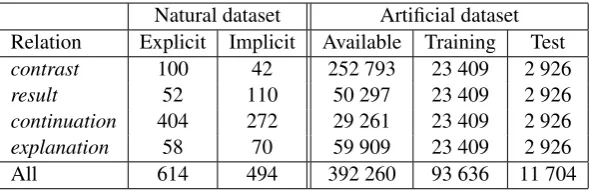
Natural dataset Artificial dataset Relation Explicit Implicit Available Training Test
contrast 100 42 252 793 23 409 2 926
result 52 110 50 297 23 409 2 926
continuation 404 272 29 261 23 409 2 926
explanation 58 70 59 909 23 409 2 926
[image:6.595.153.448.530.625.2]All 614 494 392 260 93 636 11 704
Table 2: Number of examples in our corpora, for the natural dataset, only the implicit examples are used.
18cases in which the connective form does not have a discourse reading.
5 Features
We adapted various features used in previous studies. The lack of ressources for French prevented us from using them all, especially the semantic ones. These features correspond to surface information and others more linguistic. As a comparison, (Marcu and Echihabi, 2002) only used pairs of words.
Sporleder and Lascarides (2008) used various linguistic features but no syntaxic ones. (Wang et al., 2012) used semantic, syntaxic and lexical information. We used lexico-syntaxic information. Finally, note that our goal is to evaluate the efficiency of data combinations. Thus we did not try to optimize this feature set, as it would have introduced another parameter in our model.
Indication of syntactic complexity: we compute the number of nominal, verbal, prepositional, adjec-tival and adverbial phrases.
Information concerning the heads of the arguments: we keep the lemma of negative element linked to the head, we also get some temporal/aspectual information (number of auxiliaries dependent of the head, tense, person, number of the auxiliaries), information about the heads dependents (if an object, a by-object or a modifier is present ; if a preposition dependent of the head, subject or object is present ; part-of-speech of the modifiers and prepositional dependents of the head, subject and object) and some morphological information (tense and person of the head if verbal, gender if non verbal, number of the head, precise part-of-speech, “VPP”, and simplified,“V”). We also add features pairing the tenses for verbal heads and the heads numbers.
Position: we add a feature indicating if the example is inter or intra-sentential.
Indication of thematic continuity: we compute general lemma overlap and lemma overlap for open class words.
6 Experiments
Our main objective is to assess whether one can use the artificial data to improve the performance of a system solely based on data manually annotated only available in small amount. We therefore test the methods described in section 3.
We experimented with a maximum entropy classifier from the MegaM5package, in multiclass clas-sification, with a maximum of100iterations. We did not try to optimize the regularization parameter which is then equal to1.
We rebalance the corpus of manually annotated data to a maximum of70examples per relation.6 We have too few annotated examples to be able to construct a separate test set sufficiently large to make statistical significance test. Thus, we decided to make a stratified nested cross-validation. It has been shown that this method provides an estimate of the error that is very close to that one could obtain on an independent evaluation set ((Varma and Simon, 2006), (Scheffer, 1999)), as it prevents us from optimizing our hyper-parameters and performing evaluation on the same data. Specifically, there are two cross-validation loops: the inner loop is used for tuning the hyper-parameters (as described in section 6.2) and the outer loop estimates the generalization error. The data are first split intoN folds. We take the foldk(with1 ≤ k ≤N) as the current evaluation set. TheN −1other folds are used as training data and split into M folds used for model fitting. The best model is then evaluated on the fold k. Finally, we report performance on theN folds. We used two5-fold cross-validation in order to select and evaluate the best models for the systems described in section 3.2. We have no guarantee to select the best models at each test step, but this procedure allows to evaluate the stability of the system with respect to the hyper-parameters (i.e. the chosen values should not be too scattered), the overfitting (i.e. inner and
5http://www.umiacs.umd.edu/~hal/megam/version0_3/
outer estimations should be close) and the stability of the models (i.e. variance in the predictive capacity, between the results on the outer folds).
As in the previous studies, we report performance using micro-averaged accuracy and F1 score per
relation. In order to evaluate the statistical significance of our results, we use the Student’s t-test (withp -value<0.05) which has been proved to work with very small sample (see (de Winter, 2013)) if the effect size (computed using the Cohen coefficient) and the correlation between the sample are large enough, while, as noted in (de Winter, 2013), the Wilcoxon signed rank test (that we initially tried) could lead to overestimatedp-value with such small sample. The results of the most relevant systems are presented in table 3.
Without selection With selection
NATONLY ARTONLY ADDPRED ARTINIT ADDPRED+SELEC NATW+selec
Accuracy 37.3 23.0 39.3 40.1 41.7∗ 41.3
contrast 15.0 23.2 16.0 16.9 20.8 19.2
result 47.6 15.7 50.6 45.9 51.0 48.3
continuation 28.1 32.1 31.9 34.0 31.2 32.4
explanation 47.9 22.4 46.7 52.2 53.9 53.4
Table 3: Most relevant systems, with or without selection of examples, overall accuracy and F1score per
relation,∗corresponds to a significant improvement over NATONLY.
6.1 Basic Models
In the first set of experiments, we trained two classifiers. The first one is trained on the natural implicit data (NATONLY,252examples), and the second one on the artificial implicit data (ARTONLY,93,636 examples). We test both models on natural implicit data.
The overall accuracy of the NATONLY model is 37.3 with F1 score ranging from 15.0for contrast
to 47.9 for explanation. The performance on contrast is fairly low, probably because this relation is the least frequent in our training set. Note that the overall accuracy obtained is quite close to the40.3 obtained for English by (Sporleder and Lascarides, 2008).
The overall accuracy of the ARTONLY model is47.8when evaluated on the same type of data, that is, artificial ones (11,704test examples), but only23.0when evaluated on natural data. This significant drop in performance has been observed in the previous studies on English. It can be attributed to the distribution differences described in section 3. We can observe that the use of the artificial data lowers the F1score forresultandexplanationwhile, forcontrast, F1score is raised by about10points.
6.2 Models with Combinations
In this section, we present the results for the systems using both natural and artificial data. We either directly combine the data or use the data to build separate models that are then combined. Some of these models use hyper-parameters. When weighting the natural examples, we test weights c ∈ [0.5,1,5] andc ∈ [10; 2000] with an increment of10until 100, of 50 until1000and of500until 2000. When adding random subsets of artificial data, we add each time k times the number of natural examples artificial examples withk ∈[0.1; 600]with an increment of0.1until1, of10until100and of50until 600. Finally, when taking a linear interpolation of the models, we build a new model by weighting the artificial model byα∈[0.1; 0.9]with increments of0.1.
revealing a high model stability. The other systems allow to evaluate the impact of the artificial data on the final results.
The only method leading to lower results is when training on the union of the data sets (UNION), the accuracy (22.6) is similar to ARTONLY. This was expected, as the natural data are about372times less numerous than the artificial ones, the new model is thus more influenced by the latter. Note that Wang et al. (2012) also experiment this setting but do not observe such a gap, maybe because their artificial data are based on manually annotated explicit examples, which are likely to be less noisy.
When directly combining the data, either by adding random subsets of the artificial data (ARTSUB, accuracy 34.5) or by weighting the natural examples (NATW, accuracy 38.9), we observe, on the in-ner folds, an inverse trend. As expected, the accuracy increases as the influence of the artificial data decreases, that is, decreasing the coefficients for ARTSUB and increasing the weights for NATW. Ob-serving the results in the inner folds reveals a same trend about the relative importance of the two kinds of data: natural data have to be around2.5 times more important than the artificial ones. We also ob-serve this effect with LININT, with the mean of the choosenα values equals to0.3. We also note that the variance for the values of the hyper-parameter for ARTSUB is pretty high, probably caused by the randomness of the subsamples selection. It is a bit lower for NATW and LININT showing that these methods are more robust. Nevertheless, the strategy does not give ana priorigood value for the hyper-parameter but restricts the space of values (1020plus or minus272for NATW and0.3plus or minus0.18 for LININT).
6.3 Models with Automatic Selection of Examples
Previous experiments showed that adding artificial data mostly improves the performance but still not significantly. We assume that a lot of the artificial data are noisy, which could hurt the systems. The method of selection of examples thus aims at eliminating potentially noisy examples. The artificial model is used on the training set, and we keep the examples that are predicted with a probability higher than a thresholds ∈ [0.3; 0.85]with an increment of0.1until0.5and of0.05until0.85. If the model is confident enough about its prediction, the example might not correspond to noise, that is, a word form that does not have a discourse readings and/or a segmentation error. We also check whether the connective is redundant. For each threshold, we rebalance the data based on the least represented relation (+SELECsystems).
The automatic selection of examples allows to improve previous results. The accuracy of the AR -TONLYmodel moves from23.0to25.0with selection, and the system UNIONmove from22.6to40.1 with selection.
The best results are obtained when we use artificial data to create new features but when we add only the relation predicted by the artificial model (ADDPRED+SELEC). With this system, we observe a clear tendency toward significance (accuracy41.7with a large effect size,0.756, and a high correlation,0.842). The F1scores for all classes are improved : 20.8forcontrast,51.0forresult,31.2forcontinuationand 53.9forexplanation. Two other systems get an accuracy over40: NATW+SELEC(accuracy41.3, with a trend toward significance8) and UNION+SELEC(no significantly higher than NATONLY). We note that ADDPREDcorresponds to the best baseline in (Daumé III and Marcu, 2006), which shows the relevance of dealing with the distributions differences in our data through domain adaptation methods.
The automatic selection step allows a more important weight on the informations provided by the artificial data. For LININT+SELEC, the best results are obtained with an almost equal influence of the two models. In the same way, the mean of the choosen values for the coefficient for NATW+SELEC is much lower, and it increases a lot for ARTSUB+SELEC allowing for larger subsamples. Even if the choosen values are widly scattered, these observations tend to prove that the selection improves the quality of our artificial corpus. Regarding the choosen values for the thresholds, the mean over all the systems is0.7, with a variable standard deviation but always greater than0.1. This deviation is pretty high, this hyper-parameter probably needs a better optimisation, by repeating the inner loop for example, but these experiments will allow to reduce the search space.
The automatic selection of examples leads to one system, namely ADDPRED+SELEC, significantly improving the accuracy of NATONLY. This shows that the artificial data, when rightly integrated, can thus be used to improve a system identifying implicit relations, especially if their influence is low, the model is driven towards the good distribution.
6.4 Effects on the Identification of the Relations
Looking at the F1score per relation, we observed that these systems have dissimilar behaviors. A larger
influence of the artificial model allows improvements forcontrast: the best result for this relation is ob-tained when only the artificial data are used for training (at best,28.8F1score with ARTONLY+SELEC).
The identification of the relationcontinuationseems to be also improved by the influence of the artificial data. We can observe it with the linear interpolation of the models: the mean of the F1 score increases
with the increasing of theαcoefficient for these relations. Forcontinuation, however, the best mean F1
is obtained withα = 0.8, this relation needs a certain degree of influence from the natural data. Some support for this proposition can be found in the fact that the best result for this relation is obtained with NATW (at best,44.7F1 score). For the other relations, a large weight on the artificial data clearly de-creases the F1score. However, the identification ofexplanationis improved when we add the predictions
of the artificial model (at best, ADDPRED+SELEC,53.9F1score). Improvement is fairly low forresult (at best,51.0with ADDPRED+SELEC).
The relation contrast might take advantage of less noisy artificial data as most of the examples are extracted using the connectivemais(but) always in discourse readings. Forexplanation, predictions of the artificial model could be quiet coherent as most of the artificial examples correspond to the pragmatic relationexplanation∗. Moreover, if we look at the feature distribution (850features overall), we observe
a gap of more than30% for2and5features forresultandexplanationthat is not observed forcontrast
andcontinuation, the relations that make the most of the artificial data.
7 Conclusion
We have presented the first system that identifies implicit discourse relations for French. This kind of relation is difficult to identify because of the lack of specific predictors. In the previous studies on English, the performance on this task are fairly low despite the use of complex features, probably because of a lack of manually annotated data. To deal with this issue, even more crucial for French, our system also resorts to additional data, automatically annotated using discourse connectives. These new data, however, do not generalize well to natural implicit data, because of distribution differences. We thus test methods inspired by domain adaptation in order to combine natural and artificial data. We add an automatic selection of examples among the artificial data to deal with noise generated by the method of automatic annotation. We manage to get significant improvement over a system solely trained using available data manually annotated by using automatic selection and the addition of features corresponding to the predictions of the artificial model.
In future work, we will explore more sophisticated methods to deal with data samples that follow different distributions. We will also explore ways to deal with imbalanced data and use our methods on all the relations annotated in our French corpus. Finally, we will test these methods on English corpora, in order to compare their efficiency with previous studies.
References
Stergos Afantenos, Nicholas Asher, Farah Benamara, Myriam Bras, Cécile Fabre, Lydia-Mai Ho-Dac, Anne Le Draoulec, Philippe Muller, Marie-Paule Péry-Woodley, Laurent Prévot, Josette Rebeyrolles, Ludovic Tanguy, Marianne Vergez-Couret, and Laure Vieu. 2012. An empirical resource for discovering cognitive principles of discourse organisation: the annodis corpus (regular paper). InProceedings of LREC.
Nicholas Asher and Alex Lascarides. 2003.Logics of Conversation. Cambridge University Press.
Marie Candito, Joakim Nivre, Pascal Denis, and Enrique Henestroza Anguiano. 2010. Benchmarking of statistical dependency parsers for french. InProceedings of ICCL (posters).
Lynn Carlson, Daniel Marcu, and Mary Ellen Okurowski. 2001. Building a discourse-tagged corpus in the framework of rhetorical structure theory. InProceedings of the Second SIGdial Workshop on Discourse and Dialogue.
Hal Daumé III and Daniel Marcu. 2006. Domain adaptation for statistical classifiers. Journal of Artificial Intelli-gence Research.
Hal Daumé III. 2007. Frustratingly easy domain adaptation. InProceedings of ACL.
Joost C.F. de Winter. 2013. Using the student’s t-test with extremely small sample sizes. Practical Assessment, Research & Evaluation.
Pascal Denis and Benoît Sagot. 2009. Coupling an annotated corpus and a morphosyntactic lexicon for state-of-the-art POS tagging with less human effort. InProceedings of PACLIC.
Anna Gastel, Sabrina Schulze, Yannick Versley, and Erhard Hinrichs. 2011. Annotation of implicit discourse relations in the tüba-d/z treebank. GSCL.
David J. Hand. 2006. Classifier technology and the illusion of progress.Statistical Science.
Hugo Hernault, Helmut Prendinger, David A. duVerle, and Mitsuru Ishizuka. 2010. Hilda: A discourse parser using support vector machine classification.Dialogue and Discourse.
Jing Jiang. 2008. A literature survey on domain adaptation of statistical classifiers. Available from: http://sifaka.cs.uiuc.edu/jiang4/domain_adaptation/survey/da_survey.html.
Shafiq R. Joty, Giuseppe Carenini, Raymond T. Ng, and Yashar Mehdad. 2013. Combining intra- and multi-sentential rhetorical parsing for document-level discourse analysis. InProceedings of ACL.
Ziheng Lin, Min-Yen Kan, and Hwee Tou Ng. 2009. Recognizing implicit discourse relations in the penn discourse treebank. InProceedings of EMNLP.
Ziheng Lin, Hwee Tou Ng, and Min-Yen Kan. 2010. A PDTB-styled end-to-end discourse parser. Technical report, National University of Singapore.
Yishay Mansour, Mehryar Mohri, and Afshin Rostamizadeh. 2009. Domain adaptation: Learning bounds and algorithms. InProceedings of COLT.
Daniel Marcu and Abdessamad Echihabi. 2002. An unsupervised approach to recognizing discourse relations. In Proceedings of ACL.
Ryan McDonald and Fernando Pereira. 2006. Online learning of approximate dependency parsing algorithms. In Proceedings of EACL.
Jose G. Moreno-Torres, Troy Raeder, Rocío Alaiz-Rodríguez, Nitesh V. Chawla, and Francisco Herrera. 2012. A unifying view on dataset shift in classification. Pattern Recognition.
Joonsuk Park and Claire Cardie. 2012. Improving implicit discourse relation recognition through feature set optimization. InProceedings of SIGDIAL.
Emily Pitler and Ani Nenkova. 2009. Using syntax to disambiguate explicit discourse connectives in text. In Proceedings of the ACL-IJCNLP (Short Papers).
Emily Pitler, Annie Louis, and Ani Nenkova. 2009. Automatic sense prediction for implicit discourse relations in text. InProceedings of ACL-IJCNLP.
Rashmi Prasad, Nikhil Dinesh, Alan Lee, Eleni Miltsakaki, Livio Robaldo, Aravind Joshi, and Bonnie Webber. 2008. The penn discourse treebank 2.0. InProceedings of LREC.
Charlotte Roze, Laurence Danlos, and Philippe Muller. 2012. Lexconn: A french lexicon of discourse connectives. Discours.
Tobias Scheffer. 1999. Error Estimation and Model Selection. Ph.D. thesis, Technischen Universitet Berlin, School of Computer Science.
Anders Sogaard. 2013. Semi-supervised learning and domain adaptation in natural language processing. Morgan & Claypool.
Caroline Sporleder and Alex Lascarides. 2008. Using automatically labelled examples to classify rhetorical relations, an assessment. Natural Language Engineering.
Caroline Sporleder. 2008. Lexical models to identify unmarked discourse relations: Does Wordnet help? Lexical-Semantic Resources in Automated Discourse Analysis.
Sudhir Varma and Richard Simon. 2006. Bias in error estimation when using cross-validation for model selection. BMC bioinformatics.
Yannick Versley. 2013. Subgraph-based classification of explicit and implicit discourse relations. InProceedings of IWCS.
WenTing Wang, Jian Su, and Chew Lim Tan. 2010. Kernel based discourse relation recognition with temporal ordering information. InProceedings of ACL.
Xun Wang, Sujian Li, Jiwei Li, and Wenjie Li. 2012. Implicit discourse relation recognition by selecting typical training examples. InProceedings of COLING (Technical Papers).