GENERATION OF NOUN COMPOUNDS IN HEBREW: CAN
SYNTACTIC KNOWLEDGE BE FULLY ENCAPSULATED?
Yael Dahan Netzer and Michael Elhadad
Ben Gurion University
• Department of Mathematics and Computer Science, Beer Sheva, 84105, Israel
( y a e l n [ elhadad) @cs. bgu. ac. i l
A b s t r a c t
Hebrew •includes a very productive noun-compounding construction called smixut. Because smixut is marked morphologically and is restricted by many syntactic constraints, it has been the focus of many descriptive studies in Hebrew grammar.
We present the treatment of smixut in HUGG, a FUF-based syntactic realization system capable of producing complex noun phrases in Hebrew. We contrast the treatment of smixut with noun-compounding in English and illustrate the potential for paraphrasing it introduces.
We Specifically address the issue of determining when a smixut construction can be gener- ated as opposed to other semantically equivalent constructs. We investigate several competing hypotheses - smixut is lexically, semantically and/or pragmatically determined. For each hy: pothesis, we explain why the decision to produce a smixut construction cannot be reduced t o a computation Over features produced by an outside module that Would not need to know about
the smixut phenomenon.
W e conclude that smixut provides yet another theoretical example where the interface that a syntactic realization component presents to the other components of a generation architecture cannot be made as isolated as we would hope. While the syntactic constraints on smixut are encapsulated within HUGG, the input Specification language to HUGG must contain a feature that specifies that smixut is requested if possible.
• However, because smixut accounts for close to half the cases of NP modifiers observed on a corpus of complex NPs, and it •appears to be the unmarked realization form for some frequent semantic relations, we empirically evaluate a default setting strategy for the feature u s e - s m i x u t based on a simple semantic Classification of the relations head-modifier in the NP. This study provides a Solid ground for the definition of a small set of predicates in the input specification language to HUGG, that has applications beyond the selection of smixut - - for the determination of the order of modifiers in the NP and the use of stacking vs. conjunction - - a n d for the definition of a bilingual input specification language.
1
I n t r o d u c t i o n
Over the p a s t three years,• we have s t a r t e d developing H U G G , a syntactic realization c o m p o n e n t for Hebrew. One of our o b j e c t i v e s is t o investigate constraints on t h e design of t h e i n p u t specification language to a s y n t a c t i c realization c o m p o n e n t t h r o u g h a contrastive analysis o f t h e r e q u i r e m e n t s of English and Hebrew. B y design, we are a t t e m p t i n g to keep the input to H U G G as similar as possible t o the one we defined in t h e S U R G E s y n t a c t i c realization for English [7]. A detailed
I
m
U
m
I
!
!
l
l
analysis of syntactic constructs specific to Hebrew becomes, therefore, critical to evaluate to which extent the input specification language can abstract away from knowledge of the syntax.
We investigate in this paper one such construct: the Hebrew noun-compounding form known as s r n i x u t . Because smixut is morphologically marked and remarkably productive in Hebrew, there exists a vast tradition of work in descriptive grammar of Hebrew providing functional analysis of the phenomenon [11] [10] [13]. This previous work has served as a fertile ground for our own generation-specific purposes.
T h e specific issue we discuss in this paper is: what information in the input specification to the syntactic realization component can license the selection of a smixut construct. The classical objectives of modularity and knowledge encapsulation indicate that this decision should be a private decision of the syntactic realization component. Because there are so many syntactic constraints on the use of smixut, the objective of encapsulation is made even more desirable.
After a thorough analysis of the different functions of the smixut construct and t h e constraints o v e r its use, our conclusion, however, is that this reductionist strategy fails: we cannot explain the selection of a smixut construct without considering simultaneously lexical, semantic and pragmatic factors.
Theoretically, in order to allow the syntactic realization component to select a smixut construct adequately, we are, therefore, left with two options: (1) either provide full, detailed access from the syntactic realization component to the complex semantic and pragmatic features that can impact on the decision; or else, (2) allow the other components to request the use of a smixut construct when they deem it adequate. In either case, modularity and encapsulation suffer. This analysis informs us in our design of a bilingual realization component: if a feature like u s e - s m i x u t is required in the input to the syntactic component, this level of abstraction cannot be appropriate as a bilingual construction. It also informs us in the general ongoing debate over the design of reusable syntactic components and their place in the architecture of generators.
From a more pragmatic perspective, however, we also provide a set of simple defaults for the generation of smixut based on a simple semantic classification of the relations head-modifier. We evaluate the validity of this classification by constructing input specifications for a corpus of more t h a n 800 comp!ex, noun phrases a n d regenerating from them. The validation process includes two aspects: (1) we test that human coders agree on the semantic relations they use to label complex NPs; a n d (2) we verify that the generator's decision to produce a smixut construction corresponds to that observed in the corpus. Preliminary results are provided in Section 4.3. They encourage us to view in the set of semantic relations we propose a useful basis for the design of an interlingual input specification language.
2 P r e v i O u s W o r k
2 . 1 N o u n c o m p o u n d s i n E n g l i s h
Noun compounds in English axe partly "frozen" lexical constructions (e.g., computer science) and
partly compositional constructions (e.g., computer equipment, farm equipment, city equipment...).
T h e problematic aspect of this construction is t h a t it seems to be very productive in English, but
yet severely constrained (e.g., * science equipment). Compound constructions are also regularly
ambiguous.
The various approaches developed to explain the construction of noun compounds and their interpretation can be classified in three groups: semantic, pragmatic, and statistical/lexical.
• Semantic theories explain the production of a noun compound N1 N2 as a derivation from a
semantic relation N1 R NP where t h e relation • R is elided. The theory of recoverably deletable
predicates (RDPs) Of [!2] proposes t h a t only a small set of relations (canse, have, make...) can participate in this process. Because these relations were too general and sometimes vague, and because one can observe many cases of compounds that do not correspond to any of the proposed RDPs, others have proposed to define more precise domain specific models to explain the deletion of certain relations.
Recognizing the importance of contextual factors, pragmatic theories predict the use of noun compounding when relations like naming or contrast play a role [6]. For example, when referring
to two persons wearing a jacket and a Coat respectively, one can use compounds like the jacket
man and the coat man even though, in neutral contexts, it would be difficult to interpret the same
compound (i.e., the wear relation is not deletable).
In [5], the explanation for compounding is provided in the form of lexical/syntactic knowledge. Generative devices inspired by [14] are found i n the lexicon. In addition, statistical knowledge predicts which derivations are the most likely.
From a generation perspective, the problem is less acute than for interpretation: we must decide whether to construct a compound as opposed to recover the missing relation between the head and the modifier. The problem has, therefore,• not received heavy attention for English generation. In the past, we used Levi's model in generation [8], but as part of the lexical chooser, and we did not include it within th e syntactic realization component.
In Hebrew, however, the smixut Construction is extremely productive (in our corpus, smixut modification accounts for 40% of all modifiers, more than any other type of syntactic modification • in NPs). We, therefore, had t o address the issue of when to generate smixut as a priority in the development of the NP grammar for HUGG.
2 . 2 N o u n c o m p o u n d s i n H e b r e w
The structure of noun compounds in Hebrew - smixut, is marked and, therefore, it has been the
focus of Hebrew language studies. T h e head (called nismax) is marked morphologically and it does
not carry a mark of definiteness even when it is semantically definite. [! 0] [2] provide detailed studies of t h e syntactic constraints on the use o f smixut. We provide an overview of the m a i n constraints in Section 3.
elided relation in a smixut. We build on these studies i n our implementation, b u t also investigate how a semantic account can be integrated w i t h p r a g m a t i c a n d lexical constraints,
3
N o u n C o m p o u n d s in H e b r e w : C o n s t r a i n t s
We briefly present in this section t h e basic syntactic constraints over t h e use of s m i x u t in Hebrew. T h e notion of "smixut" covers three m a i n constructions: [2] [10][p24]:
c o m p o u n d s e p a r a t e c o n s t r u c t d o u b l e - g e n i t i v e cadur ha-tinok ha-cadur Sel ha-tinok cadur-o Sel ha-tinok ball the-baby the ball of the baby ball-his of the-baby
Smixut is identified by two m a i n tests: first, when plural is used, only t h e head is m a r k e d morphologically w i t h a special inflection: yeled (child - singular) vs. yelad-im (children - plural non-smixut) vs. yald~ei (children - plural h e a d of smixut marking).
Second, w h e n definite is used, only the modifier is m a r k e d even t h o u g h the head is u n d e r s t o o d as definite: aron 'mitbax (cabinet kitchen) (a kitchen cabinet) vs. aron ha-mitbax (cabinet the-kitchen) (the kitchen cabinet).
Nominalizations are also built using a s m i x u t construction with a g e r u n d or a denominal as head:
Bo ha-role Bo 'o Sel ha-role The arrival of the doctor:
Arrive the-doctor Arrive=his of the-doctor
We categorize the constraints on the use of smixut in f o u r categories: syntactic, lexical, semantic and pragmatic.
3 . 1 S y n t a c t i c C o n s t r a i n t s
One of the m a i n constraints o n the use• of s m i x u t is t h a t a head can have only one n o u n modifier (called somex in Hebrew). W h e n several modifiers are a t t a c h e d to a head, t h i s constraint forces o t h e r relations to be realized in other syntactic constructions (post-modifier adjective, prepositional phrase or relative clause). For example, w h e n referring to a suit m a d e of leather, t h e default realization (unmarked) is the smixut beged wor (suit-leather). The alternative realization beged
me-wor (suit from-leather) with a qualifier P P is also possible, but less frequent. However, when referring to a bathing-suit i n leather 1 the default realization is beged-yam me-wor (suit-sea from- leather). Because the somex (noun modifier) position of t h e head beged is occupied by the yam (sea) modifier, the second modifier •(leather) is relegated to another (not nominal) position.
T h e head of a smixut must be a n o u n or a conjunction of nouns and it cannot be a c o m p o u n d itself. This means t h a t smixut only allows right branching 2. This is in contrast w i t h English, which allows right or left branching constructions: (computer communication) system vs. computer
(communication system).
P r o n o u n s a n d proper nouns cannot h e a d a smixut, a n d any p r o n o u n in t h e modifier position 'has the objective case and is agglutinated to t h e noun: ben-o son-him (his son).
T h e r e are several restrictions on the combination •of smixut with different d e t e r m i n e r types. Noun phrases in Hebrew are polydefinite - - t h a t is, definiteness is m a r k e d on several of the con- stituents in the phrase. A n y adjectival modifier is marked w i t h agglutinated definite markers, the same as the head noun. Quantifiers a n d d e t e r m i n e r s c a n be also marked. In smixut, only t h e
1Very frequent on Israeli beaches.
mod-n is marked a s definite. Therefore, compounded nouns are understood as having the same definiteness value. As a consequence, if definiteness of the head and modifier differs, smixut cannot be reed:
head-N + mod-N definite
( T h e son of t h e king)
ben ha-melex
s o n the-king
ben-o Sei ha-rnelex son-his of the-king
head-N + m o d - N indefinite ben me/ex ben Seg raelez (a son of a king) son king son of king
head-N indefinite, m o d - N definite benSeI ha-rnelez (a son of the king) s o n o f the king
head-N definite, m o d - N indefinite b e n - o Sel m e l e x ( T h e son of a king) son-his of king
3 . 2 L e x i c a l C o n s t r a i n t s
Not every noun can head a smixut construction: words which are lexical-compounds (cadur-sal -
ball-basket - basketball), words of foreign origin, cannot be in n i s m a z form (i. e. the special inflection of compound nouns), and therefore any modifiers must be realized in another syntactic construction. Several criteria exist to distinguish frozen f r o m p r o d u c t i v e smixut compounds: frozen com- pounds behave like regular smixut with-respect to plural marking (special morphology inflection). But depending on the level of cohesiveness of the frozen compound, definite marking may differ: beyt-sefer -house-book - (a school) may give ha-beyt-sefer (the school) instead of the predicted beyt ha-sefer for a productive smixut.
In addition, for frozen constructs, many additional constraints exist: the head cannot be mod-
ified (* beyt sefer kri'a - house book reading), cannot change its number (* beyt sfar-ym - h o u s e
books), cannot be taken apart ( * bayt Sel sefer - house of book) or be•conjoined to another somex
(noun modifier) (beyt sefer ve beyt Hol-im - house book and house patient-s - a school and hospital
but * beyt sefer ve-Hol-im - house book and patient-s). Detailed references f r o m linguistic and
sociolinguistic aspects are found in [4] a n d [3] respectively.
• 3.3 S e m a n t i c C o n s t r a i n t s
Smixut is often understood as a genitive type of construct, expressing dominantly a possessive relation between the head and the modifier. Very often, however, the relation expressed is not one of possession.
The semantic relation realized by the smixut has an influence on the possible paraphrases the smixut can receive [2]: some semantic relations (including possessive) can be realized in a double genitive construction while others can only be realized by a simple smixut. The semantic relation also determines which types of modifiers can be accepted in the smixut construction. In general, when a double genitive c o n s t r u c t i o n is not possible, then pronouns cannot appear as modifiers, even in a simple smixut.
In the case of gerunds, the only possible structures are compound and double-genitive while the separate construction is not possible.
Levi [11] claims that smixut realizes in Hebrew a number of universal semantic processes which exist i n o t h e r languages, thus extending her original analysis for English [12]. Her ':non predicative modifiers" theory claims t h a t Noun-noun compounding is produced by two •syntactic processes: nominalization or deletion of the predicate : which corresponds to the observed uses of smixut for possessive and gerund constructions.
Azar [2] classifies smixut into 15 semantic categories. This classification can be made parallel to Levi's RDPs. Glinert [10] also refers to such a classification in a similar manner.
,I
I
I
1
il
I
3 . 4 P r a g m a t i c C o n s t r a i n t s
T h e r e are cases, however, when s m i x u t can be constructed with no regard to the semantic set that was identified. Certain contexts license smixut constructions t h a t would not be obtained otherwise
- for example, contrast or n a m i n g [6].
In addition, smixut is associated with style and genre parameters. Seikevicz [16] analyzes transcripts of spoken Hebrew, a n d finds t h a t smixut is used when using a 'Sel' preposition is not possible.
Other pragmatic considerations for the use of smixut include the objective to generate a more compact text and to make of a c o m p o u n d an item available for further anaphorical reference.
Finally, decision to c o m p o u n d a head with a plural or singular modifier is related to the gener- icity of the description and to the habituality of the relation,.as is the case in English [15] (p. 916):
The table in the corner was laid f o r dinner The corner table The girl in the corner spoke to me ~ The corner girl
4
W h e n
C a n • S m i x u t
B e G e n e r a t e d ?
O u r main objective is to determine what features must be present in the input to the syntactic realization component to decide when to use a smixut construction.
We observe that the •production of smixut is semantically constrained, and that the semantic relation holding between head and modifiers determines which syntactic paraphrases are possible (among smixut, double-genitive a n d separate construct). A set of semantic predicates similar to Levi's R D P s seems to play a role in the decision. On the other hand, being a member of that set is not a sufficient nor necessary condition to generate a smixut.
I n the SURGE g r a m m a r for English, we did not address this decision, and assume that the i n p u t includes a predefined syntactic construction (classifier-head). For Hebrew, we must find an alternative approach b e c a u s e : (1) smixut is extremely frequent (40~0 of the noun modifiers in our corpus); (2) smixut is the default realization for many relations b u t it cannot be used in many syntactic contexts.
4 . 1 E x p l o i t i n g a S e m a n t i c C l a s s i f i c a t i o n
Our strategy is to provide in t h e input to HUGG a reliable default indicating that smixut should be used when possible, b u t making it possible to fall back on an alternative realization (separate or double genitive, or qualifier modification) when smixut is not possible.
For instance, lexical-compounds cannot be head a smixut, and, therefore, their modifier must be realized as a PP. T h e same semantic relation (e.g., material) will be realized in two different ways depending on the lexical property of t h e head:
coat leather head I lex "mewyl" ]
leather coat modifiers [ material [lax "wor" ] ]
If the same input is provided, but the property of the head n o u n is different, a different Con- struction will be generated:
bathing-suit •from-leather head lax "beged-yam"
• cat noun-compound
A similar m e c h a n i s m would d e t e r m i n e t h a t a smixut is not possible if t h e definiteness of the head a n d t h e modifier d o . n o t match, as discussed above in the a son o.f the king example.
T h e syntactic realizer also relies on t h e semantic classification of the relation head-modifier when several modifiers are attached to a single head. In this case, only a single modifier can be realized as a smixut. T h e others must be realized differently. In this case, the realizer must d e t e r m i n e which relation takes priority to become t h e smixut, a n d it must also provide a n appropriate paraphrase for t h e non-smixut modifier.
For example, t h e English N P leather house shoe will be generated in one of the following ways: 3
nawal bayit me-wor cat common
house shoe ~om-leather lex ~nawal"
shoe leather .for-the-house purpose lex "bayit" ]
Beyond smixut-related decisions, d e t e r m i n i n g a set of semantic relations is also useful to allow HUGG to d e t e r m i n e a p p r o p r i a t e defaults for prepositions in P P modifiers. For example, in the example above, HUGG can select the default preposition .for in shoe ]or the house because the relation of p u r p o s e is specified.
T h e same classification is also useful to determine the order a n d t h e syntactic s t r u c t u r e of a ' multi-modifier sequence in complex NPs.
In general, when several modifiers a t t a c h to a single head, a broken (conjuncted) sequence is created [9] (in contrast to English, where a stacking construction is generally used): .4 big white house vs. bayit gadol ve-lavan (house big and white).
However, when adjectives realize a semantic relation that could have b e e n reaiized by a smixut, they a p p e a r first i n the sequence of modifiers and they do not require a conjunction [1].
cat common
makdeHa HaSmalyt gadola lex "makdeHa"
In
a large electronic drill modifiers lex "HaSmaly"
size lex "gadol" ]
In this example, makdeHa HaSmalyt gadola is produced instead of * makdeha gadola ve- HaSmalyt because t h e electric modifier realizes the smixut-licensing relation of i n s t r u m e n t . This p h e n o m e n o n gives a further justification for t h e use of semantic relations in the input.
4 . 2 C l a s s i f i c a t i o n o f S e m a n t i c R e l a t i o n s
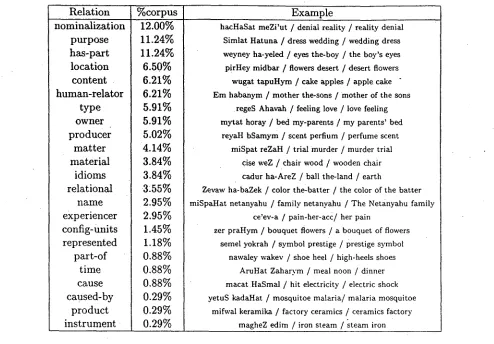
Since the syntactic realization c o m p o n e n t can make good use of a semantic classification in the input, we have designed t h e classification shown in Table 1, which synthesizes the lists provided by Levi, Glinert a n d Azar.
I n the table we present a basic list of relations with its occurrence percentage in our c o r p u s . It can be viewed t h a t some relations are m u c h more productive t h a n others - purpose, has-part. O u r classification is finer t h a n Levi's in distinguishing for example a m o n g different types of typical possessive relations (human-relator, has-part a n d ownership). This reflects slight differences in the default way of generation. Human-relator, for instance, is used as construct when t h e modifier is a pronoun, more often t h a n w i t h other ownership relations.
I
I
I
I
I
I
i
I
I
I
I
I
I
I
I -
Relation %corpus Example
nominalization purpose has-part location content . human-relator
12.00%
11.24%
11.24%
6.50%
6.21%
6.21%
hacHaSat meZi'ut / denial reality / reality denial Simlat Hatuna / dress wedding / wedding dress weyney ha-yeled / eyes the-boy / the boy's eyes PirHey midbar / flowers desert / desert flowers
wugat tapuHym / cake apples / apple cake " Em habanym / mother the-sons / mother of the sons
type owner producer
m a t t e r material idioms relational name
5.91%
5.91%
5.02%
4.14%
3.84%
3.84%
3:55% 2.95%regeS Ahavah / feeling love / love feeling mytat horay / bed my-parents / my parents' bed
reyaH bSamym / scent perfium / perfume scent miSpat reZaH / trial murder / murder trial
cise weZ / chair wood / wooden chair cadur ha-AreZ / ball the-land / earth
Zevaw ha-baZek / color the-batter / the color of the batter miSpaHat netanyahu / family netanyahu / The Netanyahu family
experiencer config-units represented part-of time cause caused-by
p r o d u c t instrument 2.95% 1.45% 1.18% 0.88% 0.88% O.88% 0.29% 0.29% 0.29%
ce'ev-a ] pain-her-acc/her pain
zer praHym / bouquet flowers ] a bouquet of flowers semel yokrah / symbol prestige / prestige symbol
nawaley waker / shoe heel / high-heels shoes AruHat Zaharym / meal noon / dinner macat HaSmal / hit electricity / electric shock yetuS kadaHat / mosquitoe malaria/malaria mosquitoe
mifwal keramika / factory ceramics / ceramics factory magheZ edim / iron steam / steam iron
Table 1: Semantic relations that can produce a smixut
4 . 3 V a l i d a t i o n o f t h e C l a s s i f i c a t i o n
To validate empirically the definition of our semantic classification, we g a t h e r e d a corpus of 853 complex NPs (NPs with more t h a n one modifier) from written Hebrew sources (newspaper and novels). For each NP, we labeled the relations head-modifier in terms of the relations listed in Table 1.
Our evaluation covers two aspects: we first verify t h a t h u m a n coders agree on t h e labeling; we t h e n verify that HUGG can generate from a labeled i n p u t a realization similar to that observed in the corpus.
Preliminary evaluation of the agreement among h u m a n judges shows agreement of about 90% between three judges (we are currently extending the number of judges). T h e percentage agreement includes a category "undecided" which covers about 5% of the cases. This corresponds to cases where judges found the relation ambiguous or unclear. Judges agreed on the labeling of unclear relations.
[image:8.612.56.550.75.419.2]139% I s m i x u t 131% ]Pp-qualifier I
34% describer 8% relative clause
W h e n regenerating from the labeled input we have determined, I-IUGG's decision to generate a smixut corresponded to that observed in the corpus on more than 95% of the cases.
5
L i m i t a t i o n s o f a S e m a n t i c A c c o u n t
While the semantic account described above provides good results, it cannot be the only mechanism licensing the production of smixut. We discuss in this section the type of interaction that must be allowed between discourse and pragmatic parameters and the syntactic realization component.
In [5], the interaction between lexical semantics and pragmatics is explored, and two axioms are proposed to interface between the defaults of the lexical semantic and the arbitrary knowledge of pragmatics: (1) defaults survive and (2) discourse wins. A statistical method is then added in Order to resolve possible interpretations. It isassumed, then, that the grammar/lexicon delimits the range of compounds and indicates conventional interpretations, but that some compounds may only be resolved by pragmatics and that non-conventional contextual interpretations are always available. To provide interpretations , a general schema is encoded in the lexicon leaving undecidable cases to be resolved by pragmatics. Probabilities of possible interpretations are taken from corpus frequencies. Accordingly, a new rule is added: (3) Prefer Frequent Senses, which can still be overridden by contextual factors.
From the generation perspective, the interaction between discourse licensed-relations and con- ventional readings must similarly be controlled by preference rules.
For example, when referring to a city destroyed by the Barbarian, discourse readings cannot
override the conventional reading i n
The Barbarian city:
discourse cannot force the reading of acity destroyed by the Barbarians.
This indicates that a non-monotonic form of reasoning, taking into account preference rules similar to that identified in [5] must be implemented at the pragmatic level. Clearly, this type of reasoning does not belong w i t h i n the syntactic realization component. Therefore, we conclude that the feature u s e - s m i x u t remains a necessary part of the input specification language to the syntactic realization component.
6
C o n c l u s i o n
We have presented in this paper basic data on the Hebrew smixut construction. Our strategy to implement smixut in the HUGG syntactic realization is to provide a simple semantic classification i n the input. We have demonstrated the many benefits this classification has within the realization process.
I
I
I
!
!
!
!
I
!
!
I
!
!
The same set of semantic relations is now being used in an extension to SURGE to allow similar paraphrasing decisions in English.
R e f e r e n c e s
[1] Talila Atias. The order of adjectives in Hebrew. Master's thesis, Tel Aviv University, Israel, 1981. (in Hebrew).
[2] M. Azar. Classification of hebrew compounds. In R. Nit, editor, Academic Teaching of Contem-
porary Hebrew. International Center for University Teaching of Jewish Civilization, Jerusalem, 1985. (in Hebrew).
[3] Ruth Berman and Dorit Ravid. On the lexical degree of the constructs in hebrew. Hebrew
Computational Linguistics, (24):5-22, 1986. (In Hebrew).
[4] Hagit Borer. On the morphological parallelism between compounds and constructs. Depart- ment of Cognitive Science, School of Social Sciences, University of California, Irvinne.
[5] Ann Copestake and Alex Lascarides. Integrating symbolic and statistical representation: The
lexicon pragmatics interface. In Proceedings of the 35th Annual Meeting of the Association for
Computational Linguistics, pages 136-143. ACL, 1997.
[6] P. Downinig. On the creation and use of english compound nouns. Language, 53(4)~810-842,
1977.
[7] Michael Elhadad. Using argumentation to control lexical choice: a unification-based imple-
mentation. PhD thesis, Computer Science Department, Columbia University, 1992.
[8] Michael Elhadad. Lexical choice for complex noun phrases: Structure, modifiers and deter-
miners. Machine Translation, 11:159-184, 1996.
David Gil. Stacked adjectives and conflgurationality. Linguistic Analysis, (12):141-158, 1983.
L. Glinert. The Grammar of Modern Hebrew. Cambridge University, 1989.
J.N. Levi. A semantic analysis of hebrew compound nominals. In Peter Cole, editor, Studies
in Modern Hebrew syntax and semantics. North-Holland, Amsterdam, 1976.
J.N. Levi. The Syntax and Semantics of Complex Nominals. Academic Press, New York, 1978.
Uzi Ornan. The Nominal Phrase in Modern Hebrew. PhD thesis, Hebrew University, Jerusalem,
1964: (in Hebrew).
James D. Pustejovsky. The generative lexicon. Computational Linguistics, 17(4):409-441,
December 1991.
R. Quirk, S. Greenbaum, G. Leech, and J. Svartvik. A comprehensive grammar of the English
language. Longman, 1985.
Channa Seikevicz. The Possessive Construction in Modern Hebrew: A Sociolinguistic Ap-
proach. PhD thesis, Georgetown University, Washington D.C., 1979.
[9]
[lO1
[111
[12]
[13]
[14]