Learning Transferable Representation for Bilingual Relation Extraction
via Convolutional Neural Networks
Bonan Min∗, Zhuolin Jiang∗ Raytheon BBN Technologies
10 Moulton St Cambridge, MA 02138
{bonan.min,zhuolin.jiang}@raytheon.com
Marjorie Freedman†, Ralph Weischedel† USC/Information Sciences Institute
4676 Admiralty Way Marina del Rey, CA 90292
{mrf,weisched}@isi.edu
Abstract
Typically, relation extraction models are trained to extract instances of a relation ontology using only training data from a single language. However, the concepts represented by the relation ontology (e.g. ResidesIn, EmployeeOf) are language in-dependent. The numbers of annotated ex-amples available for a given ontology vary between languages. For example, there are far fewer annotated examples in Spanish and Japanese than English and Chinese. Furthermore, using only language-specific training data results in the need to man-ually annotate equivalently large amounts of training for each new language a sys-tem encounters. We propose a deep neu-ral network to learn transferable, discrim-inative bilingual representation. Experi-ments on the ACE 2005 multilingual ing corpus demonstrate that the joint train-ing process results in significant improve-ment in relation classification performance over the monolingual counterparts. The learnt representation is discriminative and transferable between languages. When us-ing 10% (25K English words, or 30K Chi-nese characters) of the training data, our approach results in doubling F1 compared to a monolingual baseline. We achieve comparable performance to the monolin-gual system trained with 250K English words (or 300K Chinese characters) With 50% of training data.
∗indicates co-first authors. These two authors made equal
contribution.
†This work was done while the author was at Raytheon
BBN Technologies.
1 Introduction
Semantic relation extraction is critical to many applications including knowledge base popula-tion and quespopula-tion answering. The problem is well-studied when relation-specific annotations are available in a single target language. How-ever, the same relations can be represented us-ing a variety of languages. While the evidence of the relation in context is language specific (e.g. John spent several years living in Beijing vs约翰在北京生活了几年), the definition of re-lation itself is often language independent (e.g. ResidesIn) and the meaning should be preserved across languages.
We hypothesize that common, shared represen-tation can be learnt when annorepresen-tations are avail-able in multiple languages and propose a bilin-gual relation extraction algorithm for this purpose. Our basic building blocks are Convolutional Neu-ral Networks (CNN) with cross-lingual word em-beddings (Ammar et al., 2016). This allows the system to capture lexical similarities across lan-guages as well as phrase-level semantics. Build-ing on CNNs with cross-lBuild-ingual embeddBuild-ings, the algorithm is a joint training algorithm which trains a model from annotated datasets in a pair of lan-guages. We require that the annotated classes be consistent across languages, but do not require an-notations over parallel (or comparable) text. The base system combines two objectives: an objec-tive that predicts the correct relation labels in each dataset in one of the languages, and another ob-jective to separately learn a shared representation across languages as well as language-specific rep-resentations. To further force the learnt represen-tation to be discriminative among classes regard-less of language, a discriminative objective for learning the ideal representation (Section 3.3) is added onto the shared, bilingual representation.
The final combined algorithm essentially learns two types of useful representations: a language-independent relation-specific representation with the shared neurons, and a language-dependent relation-specific representation with the language-specific neurons.
Our contributions are the following:
• Developing a bilingual transfer learning algo-rithm for relation extraction that can use inde-pendent multilingual corpora annotated with the same set of relations. Analysis shows that the representation is discriminative.
• Demonstrating that jointly training from two languages outperforms its monolingual coun-terparts significantly.
• Showing that knowledge can be transferred from resource-rich language to resource-poor languages: On the ACE multilingual training corpus, we achieve comparable performance with 50% of the target-language training data using our approach and are able to double performance with only 10% (250K words) of target language data. This provides a very cost effective way to develop relation extrac-tors in new languages.
2 Related Work
Relation extraction is typically cast as a multi-class multi-classification problem in which a super-vised machine learning model is trained with la-beled datasets for classifying relations. Tradi-tional methods (Kambhatla, 2004; Zhou et al., 2005; Zhao and Grishman, 2005; Jiang and Zhai, 2007) either reply on a set of linguistic or seman-tic features, or use convolution tree kernels (Mos-chitti, 2006) with syntactic (Zhang et al., 2006), sub-sequence (Bunescu and Mooney, 2005b), or dependency trees (Bunescu and Mooney, 2005a) as means to represent input sentences. Recently, deep neural networks start to show promising re-sults in relation extraction. In particular, Convo-lutional Neural Networks (Zeng et al., 2014a; dos Santos et al., 2015; Nguyen and Grishman, 2015), Reccurrent/Recursive Neural Networks such as bidirectional LSTMs (Zhang et al., 2015), LSTM along shortest dependency paths (Xu et al., 2015), bidirectional tree-structured LSTM-RNNs (Miwa and Bansal, 2016) are shown to be effective. At-tention mechanism (Wang et al., 2016) is also ef-fective in further improving performance. Our baseline monolingual model is similar to (Nguyen and Grishman, 2015) and we does not require
parsing or composing multiple models.
There is very little work on multilingual relation extraction. (Qian et al., 2014) proposed an active learning approach for bilingual relation extraction with pseudo parallel corpora. (Kim et al., 2010) and (Kim et al., 2014) proposed cross-lingual an-notation projection approach for relation detection with parallel corpora. In contrast, our work don’t require parallel corpora nor Machine Translation. More recently, (Faruqui and Kumar, 2015) ap-plied cross-lingual projection for open-domain re-lation extraction in languages other than English. (Blessing and Sch¨utze, 2012) and Compositional Universal Schema (Verga et al., 2016) performs cross-lingual relation extraction with distant su-pervision (Mintz et al., 2009; Riedel et al., 2010; Surdeanu et al., 2012; Hoffmann et al., 2011; Rit-ter et al., 2013). These works are significantly dif-ferent from ours in that they either operates in the open-domain(Faruqui and Kumar, 2015) without a pre-defined relation schema, or in a distant su-pervision setting with a KB as source of supervi-sion. POLY (Nakashole et al., 2012) mines re-lational paraphrases from multilingual sentences which can be useful for relation extraction.
Besides relation extraction, (Huang et al., 2013) performs cross-language knowledge trans-fer with deep neural networks for speech recog-nition. (Guo et al., 2016) proposed a distributed representation-based framework for cross-lingual transfer learning for dependency parsers.
3 Bilingual Relation Extraction
Given a pair of monolingual corpora in two differ-ent languages and each corpus having been anno-tated with sentence-level relations1of pre-defined
types, the goal of bilingual relation extraction is to learndiscriminativerepresentations to identify the relation between a pair of mentions, regardless of which language the mention pair comes from (transferable across languages). We achieve the goal of learning discriminative representation by joint supervision of classification (softmax) loss and ideal representation loss. We achieve the ad-ditional cross-lingual transferring goal by learning shared representation across languages.
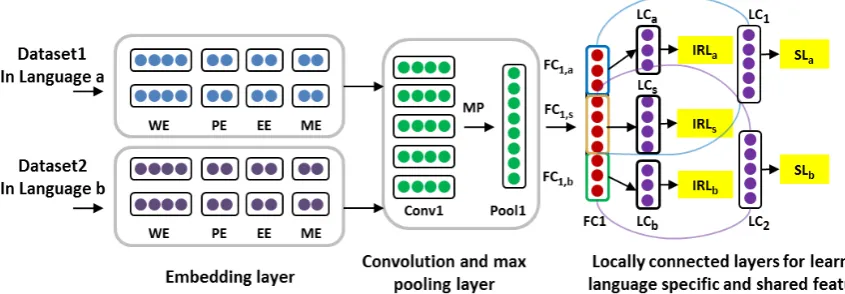
Figure 1: Bilingual relation extraction model trained with both softmax classification loss (SL) and ideal representation loss (IRL).IRLaandIRLbare language-specific ideal representation losses for language
aandbrespectively. IRLs is the shared representation loss across 2 languages. F C1,a andF C1,bare
2 sets of language-specific neurons for languageaandb, respectively. F C1,sis a set of shared neurons.
SLaandSLbare the softmax classification losses for languageaandbrespectively.
mention levels by real-valued vectors; (2) a convo-lution and max pooling layer to generate a fixed-size feature vector for an input sentence; (3) 3 lo-cally connected (LC) layers for learning language-specific and shared representations. These layers are learned to predict discriminative representa-tion using proposed ideal representarepresenta-tion loss (IRL) during training; (4) 2 LC layers for learning 2 re-lation classifiers with the softmax loss (SL). The 5 LC layers and the 5 prediction losses (3 IRLs and 2 SLs) are illustrated in Figure 1.
3.1 Embedding Layer
Word embeddings (WE) The inputs are sen-tences marked with pairs of mentions of interest. Given an input sentencex of length t, we firstly transform each word into a real-valued vector of dimension d1 by looking up a word embedding
matrixW1 ∈ Rd1×|V|, whereV is a fixed-sized
vocabulary. To project similar words in a pair of languages into close proximity, we use cross-lingual embedding trained with multiCCA (Am-mar et al., 2016) to initializeW1.W1will also be
finetuned during training.
MultiCCA only requires two monolingual cor-pora and a bilingual parallel dictionary. It first trains monolingual embeddings for each language independently from each monolingual corpus, capturing semantic similarity within each lan-guage. Then given the dictionary, it applies canon-ical correlation analysis (CCA) to estimate linear projections from the monolingual embeddings to bilingual embeddings. This makes translationally equivalent words in different languages to be em-bedded nearby each other.
Position embeddings (PE)The words close to the argument mentions are more informative to de-termine the relationship. Similar to (Santos et al., 2015), for each word, we map its relative distances to two argument mentions to two real-valued vec-tors of dimensiond2by a embedding matrixW2∈
Rd2×|D|, where Dis the set of relative distances
in a dataset. We obtain two vectors for each word with respect to the first and the second argument of the relation mention.
Entity type embeddings (EE) and mention level embeddings (ME)For each word, we map its entity type and mention level into real-valued vectors using embedding matrix W3 ∈ Rd3×|E|
andW4 ∈ Rd4×|M| respectively. E is the set of
entity types whileM is the set of mention levels. The final embedding dimension for each to-ken is n1 = (d1 + 2d2 +d3 +d4). This layer
will produce an embedding representationx(1) ∈
Rn1×twhen fed with an input sentencex(0) =x.
W1, W2, W3, W4 are parameters to be learnt via
the end-to-end model.
3.2 Convolution and Max Pooling Layer
Relations can be expressed by words or their com-binations. The model should utilize all local fea-tures extracted around each word in the sentence and predict the relation globally. Convolution operation is a natural approach to achieve this goal (Zeng et al., 2014b; Santos et al., 2015). Given a convolution filter i of window size k, the convolution operation on an input sentencex will produce a score vectorz= (z1, ..., z(t−k+1)),
wherezj =g1(wixj+bi).wi∈Rkn1 are the
j-th context window inx,biis a bias scalar andg1
is a non-linear function such as the rectified linear unit (ReLU). Then the max operation is applied to identify the most informativen-gram feature from this score vector:mi= max(z). We replicate this
process for a set of filters with different window sizes to capture importantn-gram features from an input sentence. The matrixW(2) = [w1, ...,wn
2],
wheren2 is the total number of filters, and vector
b(2) = [b
1, ..., bn2]are parameters to be learnt in
this convolution layer. Finally we obtain a fixed-sized feature vectorx(2) =m= [m1, ..., mn
2]∈ Rn2. The representationx(2) is generated by
tak-ing max pooltak-ing over entire sentence with filters of multiple window sizes. To prevent these neurons that generatemfrom co-adapting and force them to learn individual useful features, a dropout layer is added after the pooling layer for regularization. We added a fully connected layer to combine information captured by these filters: x(3) =
g2(W(3)x(2)+b(3))∈Rn3.W(3)andb(3)are
pa-rameters learnt in this layer, andg2 is a non-linear
function.
3.3 Learning Transferable, Discriminative Bilingual Representation
Given two sets of training examples Xa andXb
in two languages a and b, we aim at learning transferable, discriminative bilingual representa-tions. We achieve this by weight sharing at a high-level layer. We further improve the discriminative power of learnt representations using ideal repre-sentation loss. The bilingual reprerepre-sentation learn-ing model is shown in Figure 1.
Shared and Language-specific Neurons We aim at not only learning representation shared by both languages, but also learning representation specific to each language. We partition the neu-rons in theF C1layer into three disjoint sets: two language-specific sets (F C1,a and F C1,b) and a
shared bilingual setF C1,sto represent shared
fea-tures across languages. We expect thatF C1,a and
F C1,bcan model language-specific features, while
the common set F C1,s can model the share
fea-tures.
Discriminative Representation Learning As described in (Zeiler and Fergus, 2014; Krizhevsky et al., 2012), the neurons from high-level layers of a CNN tend to extract more abstract and class-specific features. If each neuron in a high-level layer of our CNN activates only when a specific relation is presented, this will lead to a
discrimi-native representation for relations. Such represen-tation, when learnt across language, would be ex-tremely useful for transferring useful information across languages for relation extraction.
To achieve this, we partition the neurons in each high-level layer into subsets, and encourage each subset to only represent sentences of one of the relation types. This results in an explicit corre-spondence between blocks of neurons and relation types. Specifically, we partition the neurons in each sub-layer (i.e.,LCa,LCb andLCs) into
dis-joint subsets and associate each subset with one specific relation label. For sentences of different relation types, we represent them using disjoint subsets of neurons. To do so, we integrate the ideal representation loss introduced in (Jiang et al., 2011) into our objective function during training. Let (xi;yi) denote training examplexi. The ideal
representation loss can be defined as:
Lr =kqi−cik (1)
where ci = W(ld)xi(ld−1) + b(ld) is the
pre-dicted representation for example xi from
lo-cally connected layer ld = {LCa, LCb, LCs}.
x(lid−1) is the representation of example xi from
F C1,a, F C1,b or F C1,s. W(ld) and b(ld) are
linear transform parameters and bias parameters learnt from these locally connected layers. We define qi as the ideal representation
correspond-ing to traincorrespond-ing sample xi from locally connect
layerld. The non-zero values of qi occur at the
indices where the training example xi and
neu-rons from layer ld shared the same relation
la-bel. For example, suppose we have six train-ing samples{x1, . . . ,x6}and their relation labels
y = [y1, . . . , y6] = [1,1,2,2,3,3]. Further
as-sume layer ld has six neurons {p1, . . . , p6} with
{p1, p2}associated with label 1,{p3, p4}label 2,
and {p6, p7} label 3. Then the ideal
representa-tions for these six samples are given by:
[q1, . . . ,q6] =
have similar representations while those from dif-ferent types have dissimilar representations.
Relation Classification We trained a pair of softmax classifiers for relation classification for languageaandb. The softmax classification loss
L∗
s,∗={a, b}can be defined as:
L∗s =−log(Peoyi
jeoj) (3)
where oj is thej-th element of the predicted
re-lation scoring vector from LC1 or LC2 layer in
Figure 1. Let ls denote these two locally
con-nected layers, i.e., ls = {LC1, LC2}. We have
o = W(ls)x(ls−1)
i +b(ls), whereW(ls) andb(ls)
are learnt parameters from layerls. x(lis−1) is the
representation of examplexiby concatenating the
activations fromF C1,a andF C1,s, or F C1,b and
F C1,s.
We combine the ideal representation loss and softmax classification loss to obtain the final loss function for a training sample (xi;yi):
ples in language aandb, respectively. They are computed via equation 3. The terms La
r, Lbr are
the ideal representation losses for languageaand
b respectively, while Ls
r is shared by both
lan-guages. The termL∗
r, ∗ = {a, b, s}can be
com-puted by equation 1. We minimized equation 4 using stochastic gradient descent.
4 Experiments
Parameter setting In the embedding layer, we used the pretrained 100-dimension bilingual word embeddings in (Ammar et al., 2016) to initialize
W1. We set the dimension of the other three
em-bedding matricesW2,W3andW4 to50and
ini-tialize them randomly. In the convolution layer, we set the filter widths to[2,3,4,5], and use150
filters per width. The number of neurons in the
F C1layer (F C1,a∪F C1,s∪F C1,b) is300. We
usetanhforg1, g2. All parameters are tuned with
the ACE development set (described in next sub-section). In bilingual experiments, we assigned56
neurons 2 for each of F C1,a andF C
1,b to learn
2We choose 56 to leave sufficient number of neurons for sharing across languages. We try 56, 63, 70 and no significant difference was observed.
language-specific features and the remaining neu-rons for language-shared features. λ is fixed to be 0.5. Training is done via stochastic gradient descent with Adam (Kingma and Ba, 2014) opti-mizer with a learning rate of 0.001.
Benchmarking baseline monolingual models
As we are not aware of prior work on bilingual re-lation extraction in similar settings, we first bench-mark our baseline monolingual model on two pop-ular monolingual datasets. We also use the ACE development dataset (described below) for tuning the parameters mentioned previously. The base-line monolingual model is similar to (Nguyen and Grishman, 2015) and only takes a English dataset as input. It is simplified from the model in Figure 1 by replacing theF CandLClayers with a fully-connected layer followed by a softmax loss. We evaluate it on two English datasets: the SemEval-2010 Task 8 dataset (Hendrickx et al., SemEval-2010) and the ACE 2005 dataset. The SemEval dataset con-tains 10,717 annotated examples (8,000 for train-ing and 2,717 for testtrain-ing). For ACE, to be com-parable to state-of-the-art Neural Network mod-els, we use the split in (Gormley et al., 2015; Nguyen and Grishman, 2015): find the ACE ar-ticles from news domains: broadcast conversa-tion (bc), broadcast news (bn), newswire (nw), and uses news (bn&nw) as the training set, half ofbc as the development set, the other half ofbcas the test set. Table 1 and Table 2 3show that the
per-formance of our monolingual baseline and various other systems. The monolingual model4achieves
higher performance than state-the-art CNN meth-ods with similar structure and no additional se-mantic features.
For the rest of the experiments, we focus on bilingual experiments. We evaluated our model on the ACE 2005 multilingual training corpus 5
which contains 596 English and 633 Chinese doc-uments6. The ACE corpus consist of articles from
weblogs, broadcast news, newsgroups, broadcast conversation, and is annotated exhaustively with 3The results reported in (Nguyen and Grishman, 2016) used a rich feature set (e.g., dependency parses). For fair comparison, we reported their results by running their code without those features.
4For fair comparison, we use the pre-trained word2vec word embeddings (Mikolov et al., 2013) with 300 dimensions for the monolingual experiments. For all other experiments, we use cross-lingual embeddings (Ammar et al., 2016).
5https://catalog.ldc.upenn.edu/LDC2006T06
Classifier F1 SVM (Rink and Harabagiu, 2010) 77.6 (82.2)
CNN (Zeng et al., 2014a) 78.9 (82.7) CNN (Nguyen and Grishman, 2015) 82.8
RNN (Socher et al., 2012) 74.8 (77.6) MVRNN (Socher et al., 2012) 79.1 (82.4) FCM (Yu et al., 2014) 80.6 (83.0)
Our English baseline 83.23
Table 1: Performance on SemEval-2010 Task 8 dataset (Hendrickx et al., 2010). The num-bers inside parentheses are the systems using fea-tures such as WordNet (all systems), dependency parses (Yu et al., 2014) and Google n-grams (Rink and Harabagiu, 2010). Our approach does not use these features but still achieves the best result.
Classifier P R F1
CNN (Nguyen and Grishman, 2016) 63.3 58.2 60.6 Our English baseline 62.1 60.1 61.1
Table 2: Performance on English ACE 2005 with the data split setting in (Gormley et al., 2015). relations. For documents in English or Chinese, we collected all annotated relation mentions, and generated relation mentions for the Other class by sampling pairs of entity mentions within a sentence but is not annotated as having a rela-tion. We refer to the resulted English dataset as ACE05.ENG, and refer to the Chinese ACE dataset asACE05.CHN in the rest of this section. We di-vided relation mentions into 5 folds, performed cross-validation and averaged the results. As is standard (e.g. (Grishman et al., 2005)), we use the mention boundaries and types provided by the an-notated data as input.
4.1 Comparing Bilingual Models to Alternative Approaches
To verify the effectiveness of our bilingual model, we compare four approaches:
• Baseline: We train two monolingual mod-els onACE05.ENGandACE05.CHN respec-tively. These two models used bilingual word embedding and only used the softmax classi-fication loss during training.
• Bilingual-FT: To see if having access to ad-ditional training data from another language helps, we pre-train each monolingual model with the other language(source)’s training dataset and then finetune it using the target language’s training dataset7
7For example, we pre-train the Chinese model with ACE05.ENG, fine-tune with ACE05.CHN, then test with Chinese.
• Bilingual-Joint We train a bilingual model on the Chinese and English datasets jointly with the softmax loss. The model is similar to the bilingual model in Figure 1, but without the ideal representation losses8.
• Bilingual-Joint-IRL We train the bilingual model on ACE05.ENG and ACE05.CHN jointly using the softmax and ideal represen-tation loss (the complete model in Figure 1). The results are summarized in Table 3. The training approach (bilingual-FT), which pre-trains a model on the additional language’s dataset and then finetune on the target language dataset, achieves better results than training the monolin-gual baseline. The bilinmonolin-gual-Joint approach can simultaneously learn language-specific and shared bilingual representations, therefore it is able to generalize across languages while still making use of language-specific information. Its performance exceeds that of baseline and bilingual-FT. The bilingual-Joint-IRL method achieves the best re-sult: it encourages the learnt representation to be discriminative among relation types. In particular, the learnt cross-lingual representation is encour-aged to differentiate relation types regardless of language. It captures both language-specific and cross-lingual relation semantics, and thus has the best of both worlds.
4.2 Transfer representations to lower-resource languages
For just a handful of languages, (e.g. English, Chinese) corpora of relation annotation are read-ily available. However, for most languages few (if any) such resources exist. We show that our approach yields large gains in F1 when a small amount of targettraining is combined with large amounts of existingsourceannotation.
Approach Precision RecallACE05.ENG F1 Precision RecallACE05.CHN F1
baseline 72.5 68.3 70.4 75.6 75 75.3
bilingual-FT 70.8 72.1 71.4 78.4 75.6 77.0 bilingual-Joint 72.6 73.3 72.9 77.7 76.4 77.1 bilingual-Joint-IRL 74.3 75.6 74.9 80.9 77.1 78.9
Table 3: Performances of the bilingual models on the ACE 2005 multilingual training corpus.
Figure 2: Performance of Chinese and English re-lation extraction by varying the size of in-domain training data. For the model with access to another language (source), we use the full dataset from the source but only a fraction of in-domain data in thetargetlanguage. We sample each dataset from 10% to 50% with 10% as the incremental step size. x-axis is the percentage of training data intargetis used, and y-axis shows F1 scores.
10% training data is available, and gains 30% to 66% relative improvement in F1 with 20% train-ing data. The biltrain-ingual extractor trained with only 50% of the target training data achieves perfor-mance nearing (<5%difference) that of the base-line approach using all of the target resources. This results provides a new and cost-effective way to perform relation extraction when resources are limited for a new language.
4.3 Analysis on learnt representation
Learning discriminative representationsWe use
LCa and LCs to represent a sentence from
lan-guagea, and useLCb andLCsto represent a
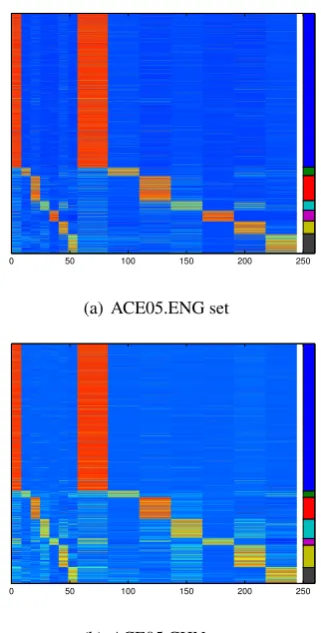
sen-tence from languageb. We visualize the predicted representations for testing examples in both En-glish and Chinese in Figure 3. X-axis shows the
244 neurons9 from locally connect layers LCa
-LCs, and LCb-LCs. Y-axis shows all testing
ex-amples (each row represents an example). Each
9The number of neurons in layersLCaandLCbare both 56, while layerLCscontains188neurons.
0 50 100 150 200 250
(a) ACE05.ENG set
0 50 100 150 200 250
(b) ACE05.CHN set
Figure 3: Visualization of predicted presentation for test examples in both languages. X-axis indi-cates the 244 neurons from layers LCa-LCs (or
LCb-LCs). Y-axis corresponds to the indices of
test examples. The color shows strength of pair-wise association between examples and neurons (the brighter the color, the stronger association). Each color in the color bar located at the right most of each subfigure represents one relation type for a subset of testing examples.
Relation English Chinese
ORG-AFF ... while japanese officials ... ...应新加坡总理吴作栋的邀请...
PHYS ...which is ... outside the center of baghdad... ...前日在广州被公安 寻回... PART-WHOLE ...this is that city hall in orlando... ...亚齐省首府班达亚齐
PER-SOC ...you go to your grandma ’s house 该名家长起初以为孩子撒谎... GEN-AFF joseph britt of kennesaw , ga , recently... 日本历史上有过女天皇 ART i ’ve decided i ’ll take the train home later 我们的军舰在厂里...
Table 4: Examples of relation mentions that are found to be similar to its cross-lingual counterparts using our model. The two examples in each row is similar to each other.
predicting relation types.
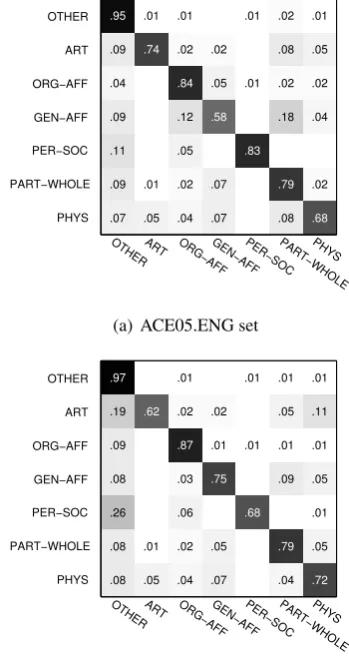
Confusion matrix on bilingual relation ex-traction To further understand the discrimina-tive power of the bilingual model with regard to predicting relation types, we plot the confu-sion matrix using the bilingual model over all examples in the ACE datasets. Figure 4 shows that our model performs well on differentiating the classes. It also shows that our algorithm performs slightly worse in differentiating PHYS, PART-WHOLE and GEN-AFF relations, in both English and Chinese. This is caused by the trump-ing rules in ACE relation definition. ACE anno-tation guideline defines a relation Org-Location-Origin (a subtype ofGEN-AFF) for locations of ORG’s, and defines another relation Geographi-cal(a subtype ofPART-WHOLE) for locations of facilities/locations/GPEs, and further defines a re-lation Located (as a subtype of PHY) to capture the physical location of a person. These relations share the same high-level semantics but are de-fined as different ACE types.
Examples of similar relation instances across languagesWe took the last-layer activations as a “relation embeddings” representation for each re-lation instance. To see how well the cross-lingual representation learning did, we calculated pair-wise similarities10 between all relation instances
in Chinese and English. Table 4 shows examples in which each pair of instances in the same row in the two languages are very similar11to each other.
The model learns lexical similarity such as japanese officials and 新加坡 总理 (Singapore prime minister). It also knowscity hall in orlando is similar to 亚齐省首府班达亚齐 (Aceh capital of Banda Aceh). It further learns complicated cor-respondence such as you go to your grandma ’s house and 该名家长 起初以为孩子 撒谎(The 10We use cosine distance as the similarity metric. The smaller cosine distance is, the more similar the pair.
11Here we definevery similaras ranked within top-50 most similar instances in the entire dataset, with regard to the query instance from the other language.
.95 .01 .01 .01 .02 .01
.09 .74 .02 .02 .08 .05
.04 .84 .05 .01 .02 .02
.09 .12 .58 .18 .04
.11 .05 .83
.09 .01 .02 .07 .79 .02
.07 .05 .04 .07 .08 .68 OTHER
ART
ORG−AFF
GEN−AFF
PER−SOC
PART−WHOLE
PHYS
OTHERART ORG−AFFGEN−AFFPER−SOCPART−WHOLEPHYS
(a) ACE05.ENG set
.97 .01 .01 .01 .01
.19 .62 .02 .02 .05 .11
.09 .87 .01 .01 .01 .01
.08 .03 .75 .09 .05
.26 .06 .68 .01
.08 .01 .02 .05 .79 .05
.08 .05 .04 .07 .04 .72 OTHER
ART
ORG−AFF
GEN−AFF
PER−SOC
PART−WHOLE
PHYS
OTHERART ORG−AFFGEN−AFFPER−SOCPART−WHOLEPHYS
(b) ACE05.CHN set
Figure 4: Confusion matrices of bilingual-Joint-IRLon the ACE datasets.
parent previously thought the child was lying) The diverse range of examples in Table 4 shows that the model not only captures lexical similarity, but also syntactic and long-range semantic similarities across the pair of languages.
5 Conclusion
of data are available in both languages and when only limited training data is available in the target language.
Acknowledgments
This work was supported by DARPA/I2O Contract No. FA8750-13-C-0008 under the DEFT pro-gram. The views, opinions, and/or findings con-tained in this article are those of the author and should not be interpreted as representing the offi-cial views or policies, either expressed or implied, of the Department of Defense or the U.S. Govern-ment. This document does not contain technology or technical data controlled under either the U.S. International Traffic in Arms Regulations or the U.S. Export Administration Regulations.
References
Waleed Ammar, George Mulcaire, Yulia Tsvetkov, Guillaume Lample, Chris Dyer, and Noah A. Smith. 2016. Massively multilingual word embeddings.
CoRR, abs/1602.01925.
Andre Blessing and Hinrich Sch¨utze. 2012. Crosslin-gual distant supervision for extracting relations of different complexity. In Proceedings of the 21st ACM International Conference on Information and Knowledge Management, CIKM ’12, pages 1123– 1132, New York, NY, USA. ACM.
Razvan Bunescu and Raymond Mooney. 2005a. A Shortest Path Dependency Kernel for Relation Ex-traction. InProceedings of Human Language Tech-nology Conference and Conference on Empirical Methods in Natural Language Processing, pages 724–731, Vancouver, British Columbia, Canada. Association for Computational Linguistics.
Razvan Bunescu and Raymond J Mooney. 2005b. Sub-sequence kernels for relation extraction. In NIPS, pages 171–178.
Manaal Faruqui and Shankar Kumar. 2015. Multilin-gual Open Relation Extraction Using Cross-linMultilin-gual Projection. InProceedings of the 2015 Conference of the North American Chapter of the Association for Computational Linguistics: Human Language Technologies, pages 1351–1356, Denver, Colorado. Association for Computational Linguistics.
Matthew R. Gormley, Mo Yu, and Mark Dredze. 2015. Improved relation extraction with feature-rich com-positional embedding models. In Proceedings of the 2015 Conference on Empirical Methods in Nat-ural Language Processing, pages 1774–1784, Lis-bon, Portugal. Association for Computational Lin-guistics.
Ralph Grishman, David Westbrook, and Adam Meyers. 2005. Nyus english ace 2005 system description. In
ACE 2005 Evaluation Workshop.
Jiang Guo, Wanxiang Che, David Yarowsky, Haifeng Wang, and Ting Liu. 2016. A Distributed Representation-based Framework for Cross-lingual Transfer Parsing. J. Artif. Int. Res., 55(1):995–1023. Iris Hendrickx, Su Nam Kim, Zornitsa Kozareva, Preslav Nakov, Diarmuid O Seaghdha, Sebastian Pado, Marco Pennacchiotti, Lorenza Romano, and Stan Szpakowicz. 2010. Semeval-2010 task 8: Multi-way classification of semantic relations be-tween pairs of nominals. InProceedings of the 5th International Workshop on Semantic Evaluation. Raphael Hoffmann, Congle Zhang, Xiao Ling, Luke
Zettlemoyer, and Daniel S Weld. 2011. Knowledge-Based Weak Supervision for Information Extraction of Overlapping Relations. In Proceedings of the 49th Annual Meeting of the Association for Com-putational Linguistics: Human Language Technolo-gies, pages 541–550, Portland, Oregon, USA. Asso-ciation for Computational Linguistics.
Jui-Ting Huang, Jinyu Li, Dong Yu, Li Deng, and Yi-fan Gong. 2013. Cross-language Knowledge Trans-fer using Multilingual Deep Neural Network with Shared Hidden Layers. InIEEE International Con-ference on Acoustics, Speech, and Signal Processing (ICASSP).
Jing Jiang and ChengXiang Zhai. 2007. A systematic exploration of the feature space for relation extrac-tion. InProceedings of NAACL HLT 2007. Associa-tion for ComputaAssocia-tional Linguistics.
Zhuolin Jiang, Zhe Lin, and Larry Davis. 2011. Learn-ing a discriminative dictionary for sparse codLearn-ing via label consistent k-svd. InProceedings of CVPR. Nanda Kambhatla. 2004. Combining Lexical,
Syntac-tic, and Semantic Features with Maximum Entropy Models for Information Extraction. InThe Compan-ion Volume to the Proceedings of 42st Annual Meet-ing of the Association for Computational LMeet-inguis- Linguis-tics, pages 178–181, Barcelona, Spain. Association for Computational Linguistics.
Seokhwan Kim, Minwoo Jeong, Jonghoon Lee, and Gary Geunbae Lee. 2010. A Cross-lingual Anno-tation Projection Approach for Relation Detection. InProceedings of the 23rd International Conference on Computational Linguistics (Coling 2010), pages 564–571, Beijing, China. Coling 2010 Organizing Committee.
Seokhwan Kim, Minwoo Jeong, Jonghoon Lee, and Gary Geunbae Lee. 2014. Cross-lingual annotation projection for weakly-supervised relation extraction.
ACM Transactions on Asian Language Information Processing (TALIP), 13(1):3.
Alex Krizhevsky, Ilya Sutskever, and Geoffrey Hinton. 2012. Imagenet classification with deep convolu-tional neural networks. InProceedings of NIPS. Tomas Mikolov, Kai Chen, Greg Corrado, and Jeffrey
Dean. 2013. Efficient estimation of word represen-tations in vector space.CoRR, abs/1301.3781. Mike Mintz, Steven Bills, Rion Snow, and Daniel
Ju-rafsky. 2009. Distant supervision for relation ex-traction without labeled data. In Proceedings of the Joint Conference of the 47th Annual Meeting of the ACL and the 4th International Joint Conference on Natural Language Processing of the AFNLP, pages 1003–1011, Suntec, Singapore. Association for Computational Linguistics.
Makoto Miwa and Mohit Bansal. 2016. End-to-End Relation Extraction using LSTMs on Sequences and Tree Structures. In Proceedings of the 54th An-nual Meeting of the Association for Computational Linguistics (Volume 1: Long Papers), pages 1105– 1116, Berlin, Germany. Association for Computa-tional Linguistics.
Alessandro Moschitti. 2006. Efficient convolution ker-nels for dependency and constituent syntactic trees. InECML, volume 4212, pages 318–329. Springer. Ndapandula Nakashole, Gerhard Weikum, and Fabian
Suchanek. 2012. Patty: A taxonomy of relational patterns with semantic types. In Proceedings of the 2012 Joint Conference on Empirical Methods in Natural Language Processing and Computational Natural Language Learning, pages 1135–1145, Jeju Island, Korea. Association for Computational Lin-guistics.
Thien Huu Nguyen and Ralph Grishman. 2015. Re-lation Extraction: Perspective from Convolutional Neural Networks. InProceedings of the 1st Work-shop on Vector Space Modeling for Natural Lan-guage Processing, pages 39–48, Denver, Colorado. Association for Computational Linguistics.
Thien Huu Nguyen and Ralph Grishman. 2016. Com-bining Neural Networks and Log-linear Models to Improve Relation Extraction. InProceedings of IJ-CAI Workshop on Deep Learning for Artificial Intel-ligence, New York, USA.
Longhua Qian, Haotian Hui, Ya’nan Hu, Guodong Zhou, and Qiaoming Zhu. 2014. Bilingual Ac-tive Learning for Relation Classification via Pseudo Parallel Corpora. In Proceedings of the 52nd An-nual Meeting of the Association for Computational Linguistics (Volume 1: Long Papers), pages 582– 592, Baltimore, Maryland. Association for Compu-tational Linguistics.
Sebastian Riedel, Limin Yao, and Andrew McCal-lum. 2010. Modeling Relations and Their Mentions without Labeled Text. In Joint European Confer-ence on Machine Learning and Knowledge Discov-ery in Databases, pages 148–163, Barcelona, Spain. Springer, Berlin, Heidelberg.
Bryan Rink and Sanda Harabagiu. 2010. Classifying semantic relations by combining lexical and seman-tic resources. In Proceedings of the 5th Interna-tional Workshop on Semantic Evaluation.
Alan Ritter, Luke Zettlemoyer, Mausam, and Oren Et-zioni. 2013. Modeling missing data in distant super-vision. Transactions of the Association for Compu-tational Linguistics.
Cicero dos Santos, Bing Xiang, and Bowen Zhou. 2015. Classifying Relations by Ranking with Con-volutional Neural Networks. InProceedings of the 53rd Annual Meeting of the Association for Compu-tational Linguistics and the 7th International Joint Conference on Natural Language Processing (Vol-ume 1: Long Papers), pages 626–634, Beijing, China. Association for Computational Linguistics. Cicero Nogueira Santos, Bing Xiang, and Bowen
Zhou. 2015. Classifying relations by ranking with convolutional neural network. In Proceedings of ACL.
Richard Socher, Brody Huval, Christopher D. Man-ning, and Andrew Y. Ng. 2012. Semantic compo-sitionality through recursive matrix-vector spaces. In Proceedings of the 2012 Joint Conference on Empirical Methods in Natural Language Process-ing and Computational Natural Language LearnProcess-ing, EMNLP-CoNLL ’12, pages 1201–1211, Strouds-burg, PA, USA. Association for Computational Lin-guistics.
Mihai Surdeanu, Julie Tibshirani, Ramesh Nallapati, and Christopher D Manning. 2012. Multi-instance Multi-label Learning for Relation Extraction. In
Proceedings of the 2012 Joint Conference on Empir-ical Methods in Natural Language Processing and Computational Natural Language Learning, pages 455–465, Jeju Island, Korea. Association for Com-putational Linguistics.
Patrick Verga, David Belanger, Emma Strubell, Ben-jamin Roth, and Andrew McCallum. 2016. Multi-lingual relation extraction using compositional uni-versal schema. In Proceedings of the 2016 Con-ference of the North American Chapter of the As-sociation for Computational Linguistics: Human Language Technologies, pages 886–896, San Diego, California. Association for Computational Linguis-tics.
Linlin Wang, Zhu Cao, Gerard de Melo, and Zhiyuan Liu. 2016. Relation Classification via Multi-Level Attention CNNs. In Proceedings of the 54th An-nual Meeting of the Association for Computational Linguistics (Volume 1: Long Papers), pages 1298– 1307, Berlin, Germany. Association for Computa-tional Linguistics.
Processing, pages 1785–1794, Lisbon, Portugal. As-sociation for Computational Linguistics.
Mo Yu, Matthew R. Gormley, and Mark Dredze. 2014. Factor-based compositional embedding models. In
Proceedings of the NIPS Learning Semantics Work-shop.
Matthew Zeiler and Rob Fergus. 2014. Visualizing and understanding convolutional networks. In Proceed-ings of ECCV.
Daojian Zeng, Kang Liu, Siwei Lai, Guangyou Zhou, and Jun Zhao. 2014a. Relation Classification via Convolutional Deep Neural Network. In Proceed-ings of COLING 2014, the 25th International Con-ference on Computational Linguistics: Technical Papers, pages 2335–2344, Dublin, Ireland. Dublin City University and Association for Computational Linguistics.
Daojian Zeng, Kang Liu, Siwei Lai, Guangyou Zhou, and Jun Zhao. 2014b. Relation classification via convolutional deep neural network. InProceedings of COLING.
Min Zhang, Jie Zhang, and Jian Su. 2006. Explor-ing Syntactic Features for Relation Extraction us-ing a Convolution Tree Kernel. In Proceedings of the Human Language Technology Conference of the NAACL, Main Conference, pages 288–295, New York City, USA. Association for Computational Lin-guistics.
Shu Zhang, Dequan Zheng, Xinchen Hu, and Ming Yang. 2015. Bidirectional Long Short-Term Mem-ory Networks for Relation Classification. In The 29th Pacific Asia Conference on Language, Informa-tion and ComputaInforma-tion, pages 73–78.
Shubin Zhao and Ralph Grishman. 2005. Extracting relations with integrated information using kernel methods. InProceedings of the 43rd Annual Meet-ing on Association for Computational LMeet-inguistics, ACL ’05, pages 419–426, Stroudsburg, PA, USA. Association for Computational Linguistics.