Topical Key Concept Extraction from Folksonomy
Han Xue
1,2, Bing Qin
1*, Ting Liu
1, Chao Xiang
1 1Research Center for Social Computing and Information Retrieval
Harbin Institute of Technology, Harbin, China
{hxue,bqin,tliu}@ir.hit.edu.cn, [email protected]
2Harbin Engineering University, Harbin, China
Abstract
Concept extraction is a primary subtask of on-tology construction. It is difficult to extract new concepts from traditional text corpus. Moreover, building a single ontology for mul-tiple-topic corpus may lead to misconception. To deal with these problems, this paper pro-poses a novel framework to extract topical key concepts from folksonomy. Folksonomy is a valuable data source due to real-time update and rich user-generated contents. We first identify topics from folksonomy using topic models. Next the tags are ranked according to their importance for a certain topic by apply-ing topic-specific random walk methods. The top-ranking tags are extracted as topical key concepts. Especially, a novel link weight func-tion which combines the local structure infor-mation and global semantic similarity is pro-posed in importance score propagation. From the perspectives of qualitative and quantitative investigation, our method is feasible and effec-tive.
1
Introduction
Ontology can be seen as an organized structure of concepts according to their relations (Cui et al., 2009). Therefore, concept extraction is an im-portant subtask of ontology construction. Exist-ing works mainly focus on extractExist-ing concepts from text corpus (Buitelaar et al., 2005). Howev-er, it is difficult to find text corpus that accurate-ly characterize a highaccurate-ly focused, even fast-changing topic (Liu et al., 2012) of the domain. For instance, it is easier to find text corpus for a common topic of movie such as “comedy”, but it
*Correspondence author
is much more difficult to find one for a specific topic such as “cult”. Since “cult” movies often do not follow traditional standards of mainstream movies. Moreover, it is not easy for them to find a formal definition and description in text corpus. However, we can more easily find some tags (ar-bitrary words assigned by people to the resources of interest) to describe this kind of movie, such as cult, non-mainstream, small budgets and so on. Motivated by the fact that social tags give us flexibility and ease to describe a topic, we try to use folksonomy (Trant, 2009) as a new data source. The word ‘folksonomy’ is a blend of the words ‘folk’ and ‘taxonomy’. It is the achieve-ment of collective wisdom derived from the practice of collaboratively creating tags to anno-tate and categorize web resource.
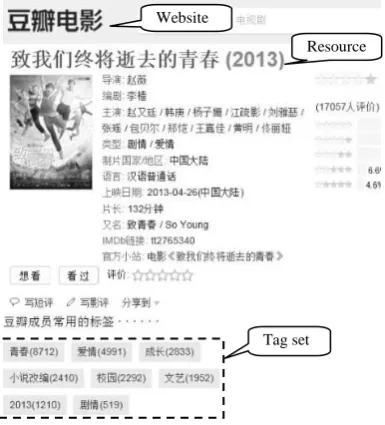
Figure 1. A folksonomy example
Take Douban.com for example, which is a Chinese SNS website allowing registered users to record information and create tags related to
Website
Resource
Tag set
their interested resources, such as film, books, music and recent activities. As shown in Fig. 1, in the folksonomy-driven web site 豆瓣电影网 站‘Douban.com Movie1’, the resource 致我们终
将逝去的青春‘So Young’ is annotated with a set of tags including 青春‘youth’, 爱情‘romance’, and 成长‘growth’ ordered by the frequency of use which update automatically.
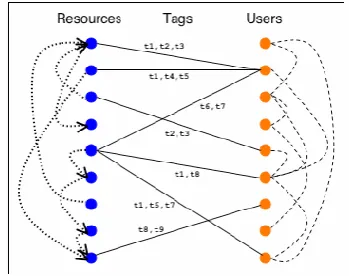
Compared with traditional text corpus, folk-sonomy can overcome the knowledge acquisition bottleneck. It is superior to text corpus in three aspects. (1) tag is more free and easier to charac-terize a highly focused, even fast-changing topic; (2) tag as a candidate concept has been extracted by collective wisdom, which avoids a series of natural language processing tasks applied to text corpus such as word segmentation, part of speech tagging, and syntactic parsing and so on; (3) the associated relationships among resources, tags and users through tagging provide a large amount of potentially valuable semantic infor-mation for mining. However, folksonomy also has two disadvantages, such as ambiguity and lack of hierarchy. To avoid misconception, we think of building multiple topic-specific ontolo-gies instead of a single one.
In this paper, we propose to automatically ex-tract topical key concepts from folksonomy. The topical key concept should be abstract, repre-sentative of the corresponding topic. It should contain common features that can be inherited by other non-core relevant concepts under the same topic. For example, the topical key concepts in the field of movie may be comedy, biography and action and so on. To extract the topical key concepts, we learn the topic distribution of the tags by applying LDA (Latent Dirichlet Alloca-tion) (Blei et al., 2003) at first. After that, the tags are ranked on the basis of the importance scores for a certain topic by a variant of topic-specific PageRank (Page et al., 1999). Specially, the novel contribution of the variant is a new link weight function in importance propagation, which combines the local similarity (defined as co-occurrence of tags in a same resource as-signed to the given topic) with the global similar-ity (defined as cosine similarsimilar-ity of two tags over all the topic dimensions in the whole collection considered). Then, the top-ranking tags that best represent the corresponding topic are extracted as topical key concepts.
1
http://movie.douban.com
In view of limited Chinese corpus and com-plex Chinese syntax for ontology construction, we tried on Chinese folksonomy data. Experi-ments on movie data from Douban.com show that new link weight function can largely help boost the performance. To the best of our knowledge, our work is the first to study how to extract topical key concepts from folksonomy in the field of Chinese ontology construction. We perform a thorough analysis of the proposed method, which can be useful for future work in this direction.
Although our goal is to build Chinese ontolo-gy based on the topical key concepts from this work, our method can be widely used in many other tasks such as information navigation and recommendation system. Furthermore, our meth-od is unsupervised and language independent, which is applicable in the web era with enormous information.
The rest of the paper is organized as follows. Section 2 reviews some related works; Section 3 describes our proposed method; Section 4 pre-sents our experiments and resultant analysis; and Section 5 draws the conclusions and directions for the future work.
2
Related Work
Many efforts have been made to extract the key concepts for ontology construction. These meth-ods can be divided into two categories according to topic-sensitive or not.
Topic-free Some key concepts of famous on-tologies are usually defined by linguists or do-main experts. The suggested upper merged on-tology (SUMO) is such a kind of ontologies. The expert-based methods are accurate and standard. However, to tackle the time-consuming and labo-rious problems, efforts are also made to use semi-automatic and automatic methods.
Among semi-automatic methods, rule-based methods are known for high accuracy if the pat-terns are carefully chosen according to morpho-logical structure or special format of corpus (Na-kayama et al., 2008), either manually or via au-tomatic bootstrapping (Hearst, 1992). However, the methods suffer from sparse coverage of pat-terns in a given corpus.
such as TF-IDF weighting (Hulth, 2003) are not feasible for folksonomy since short text snippets only. Graph-based ranking methods are the state of the art. They are superior to the statistic-based methods because of considering structure infor-mation between words. Mihalcea and Tara (2004) propose to use TextRank, a modified PageRank algorithm to extract key concepts from text. But TextRank only maintain a single importance score for each word. Hotho et al. (2006) propose a graph-based ranking algorithm for folksonomy, named FolkRank. They convert triadic hyper-graph in folksonomy into an undirected tripartite graph. But we consider that the tripartite graph may include much noise for key concept extrac-tion.
As a word usually spans multiple topics, the importance of the word with respect to different topics would be different. It seems that the pre-vious works mentioned above may lead to mis-conception by mixing different topics together.
Topic-sensitive In order to overcome miscon-ceptions, the topic models and other clustering models such as DA (Deterministic annealing) (Zhou et al., 2007) are used to derive topical key concepts from corpus based on word occurrence information. These clustering models usually regard corpus as a bag of words. They can find the topic or the leading word in each cluster, but cannot distinguish concrete entity well.
It is intuitive to consider topic information in graph-based ranking methods for topical key concept extraction.
Haveliwala (2002) proposes topic-sensitive PageRank (TSPR) to get a set of PageRank vec-tors biased a set of representative topics and gen-erate more accurate rankings than a single Pag-eRank vector. Nie et al. (2006) propose a topical link analysis model (TLA) to affect the im-portance propagation. However, the topics in TSPR and TLA are both from ODP (Open Direc-tory Project)2 extracted manually. Based on their
works, Jin et al. (2011) implement a topic-sensitive tag ranking (TSTR) approach in folk-sonomy automatically through LDA. TSTR per-forms better than TSPR and TLA because topics extracted by LDA are more conformed to the actual situation than the topics of ODP. They pay more attention to the effect of the transfer action probability on the importance score of tags which benefit us to know the propagation pro-cess. It seems that mixing together the random
2
http://www.dmoz.org/
walks of all the topics in one graph may cause noise compared to independent topic graphs.
Liu et al. (2010) decompose a traditional ran-dom walk into multiple ranran-dom walks specific to various topics, named Topical PageRank (TPR). The novel contribution is the study on topic-specific preference value setting. And then, Zhao et al. (2011) argue that context-free propagation may cause the importance scores to be off-topic. They model the score propagation with topic context when setting the link weights and then denote this context-sensitive topical PageRank as cTPR. Enlightened by TPR and cTPR, we further propose a new link weight function to express the semantic similarity between two tags of folk-sonomy. The novel link weight function com-bines the local similarity (defined as co-occurrence of tags in a same resource assigned to the given topic) with the global similarity (de-fined as cosine similarity of two tags over all the topic dimensions in the whole collection consid-ered).
3
Method
In this section, we will introduce our method. We firstly give some definitions and then overview our method, and finally introduce topic identifi-cation and tag ranking in detail.
a set of topics Z over the resource collection S. Hence, we extract topics from S.
The basic idea of our method is to incorporate topic distribution into importance score propaga-tion of tags when setting the link weight as well as the preference value. Especially, the link weight function considers both the local and global similarity with respect to different topics.
First of all, we identify topics from folksono-my resource collection S using topic models (Section 3.1). Next for each topic, we build the tag graph and use the random walk techniques to measure the tag importance. Based on the im-portance scores, we extract the top-ranking tags as the topical key concepts (Section 3.2).
3.1 Topic Identification
Latent Dirichlet Allocation (LDA) is a typical representative of topic models. In LDA, each word w in a document d is regarded to be gener-ated by first sampling a topic z from d’s topic distribution θ, and then sampling a word from the distribution over words Ф that characterizes topic z. θ and Ф are drawn from conjugate Dirichlet priors α and β, separately.
We use resource set S represented by a set of tag as our input file to run LDA. After the pa-rameters converge by Gibbs sampling, we main-ly use two of these output files in this paper. One is model-final.phi, which is a |Z|*|V| matrix about Ф, whose element is the probability of tag
i
w conditional on topic zji.e. P w z( i| j).The other is model-final.tassign, which is a |S|*|V| matrix, where each row of data stands for a resource s followed by a set of elements, and each element consists of a tag and a topic which the tag most likely to be assigned to.
Through LDA, we can obtain the topic
distri-
is calculated as the number of times all the topics appear in the model-final.tassign. Then, we can calculate the local and global similarity between two tags using Eq. 3 and Eq. 4. semantic similarity between tagwiandwj. In Eq. 3, , ,j i S w w z
C counts the number of co-occurrences of tagwiandwjin a same resource of S assigned to S. We can get them from statistical calculation of the model-final.tassign. Global w ws( j, i) stands for the global semantic similarity between tagwiandwj. From the whole resource collection S, we can get the cosine similarity between tag wiandwjover all the topic dimensions by plugging Eq. 1 into Eq. 4.
3.2 Tag Ranking
After topic identification, we perform topical key concept extraction followed by two steps, name-ly, tag graph construction and tag ranking.
Above all, some formal notations are given.
where damping factor ranges from 0 to 1, and V is the number of vertices. The damping factor indicates that each vertex has a probability of (1)to perform a random jump to another ver-tex within this graph while has a probability of
to follow the out-degree link. The PageRank importance scores are obtained by running Eq. 5 iteratively until convergence. The second term in Eq. 5 can be regarded as a smoothing factor to make the graph fulfill the property of being ape-riodic and irreducible, so as to guarantee that PageRank converges to a unique stationary dis-tribution.
In fact, the second term of PageRank in Eq. 5 can be set to be non-uniformed. The idea of Top-ical PageRank (TPR) is to run Biased PageRank for each topic separately. Formally, in the Pag-eRank of a specific topic z, they assign a topic-specific preference value Pr ( )z w to each word w as its random jump probability with
w V Pr ( )z w 1. For topic z, the topic-specific PageRank importance scores are defined as follows, dow size. Zhao et al. (2011) propose to use a top-ical context-sensitive PageRank method (cTPR). Formally, they havewhere they calculate the propagation from wj to i
w in the context of the topic z, namely, the link weight e w wz( j, i)from wj to wiis parameterized by z. In Eq.7, the link weight between two words is calculated as the number of co-occurrences of the two words in tweets assigned to the topic z.
However, we believe that the link weight only contains the co-occurrence information is not enough. On the basis of cTPR, we further pro-pose a new link weight function (Eq.8).
( , ) ( , )((1 ) ( , ) )
z j i s j i s j i
e w w Local w w Global w w (8)
The weight factor controls the proportion of the local structure information (Eq.3) and global semantic similarity (Eq.4) in Eq.8. Through the new link weight, the propagation of our method not only reflects the specific local co-occurrence information of two tags in a single resource, but also reflects the non-specific global semantic similarity of two tags in the whole resource set. In our tag ranking method, we obtain the im-portance scores for each tag in different topics by Eq.7. In which, e w wz( j, i)is calculated by Eq.8, calculated as Eq.1, which is the best one among the three choices discussed by Liu et al. (2010).
4
Experiments
4.1 Dataset
Our evaluation dataset is crawled from Dou-ban.com Movie, which is a popular Chinese So-cial Networking Service (SNS) website allowing registered users to create content related to mov-ies. The dataset contains top 250 movies with 1760 tags assigned by users up to June 2012. After removing stop words and noises, we pre-pare 1737 tags corresponding to 249 movies for LDA. Empirically, we set the number of topics to 40 and ran LDA with 1000 iterations of Gibbs sampling.
We further select two baseline methods that most similar to ours, i.e., TPR and cTPR. All of them are iterative algorithms. We terminate the algorithms when the number of iterations reaches 100 or the difference of importance scores about each vertex between two neighbor iterations is less than 0.000001.
baseline and our method based on permutation and combination of the three parameters are pre-sented.
4.2 Gold Standard Annotation
We construct the evaluation standard by pooling (Voorhees et al., 2005) method. The reason lies in two aspects. One is that there is no existing gold standard for topical key concept extraction from folksonomy, and the other is that it is im-possible to determine all the topics and key con-cepts manually. We randomly mix 729 results from TPR, cTPR and our method, and then ask two judges to score as 1(relevant, abstract and representative) or 0 (irrelevant or too specific). Only if the two judges score 1 for the same tag, the tag will be determined as correct topical key concept. Otherwise, the tag will be determined as wrong.
4.3 Evaluation Metrics
The traditional evaluation metrics represented as follows,
whereCcorrectdenotes the number of correct topi-cal key concepts extracted by a method,
extract
C denotes the number of automatically ex-tracted topical key concepts by a method, andCstandarddenotes the total number of topical key concepts referenced by gold standard. Three of them are averaged on all the topics.
In addition to the traditional metrics preci-sion/recall/F-measure, we use another two met-rics to take the order into account.
One metric is mean average precision (MAP). MAP is desirable to measure the overall perfor-mance of topical key concept ranking,
| | number of correct key concepts of topic z refer-enced by the gold standard.
The other metric is mean reciprocal rank (MRR) (Voorhees, 1999)which is used to evalu-ate how the first correct topical key concept for ban.com Movie, we realize the baseline methods, i.e., TPR and cTPR. The TPR calculates the co-occurrence number of two tags in a same re-source as the link weight, namely ( , ) i, j
S
j i w w
e w w C .
In cTPR, the link weight is calculated as the co-occurrence number of two tags in a same
re-The grid-search algorithm is applied to obtain the optimal parameter combination from 729 candidates. Through an exhaustive combination of three parameters, we obtain the best value of every evaluation indicator in three methods.
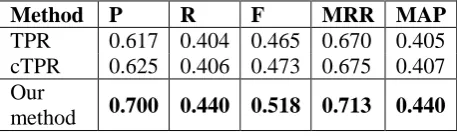
Method P R F MRR MAP
TPR 0.617 0.404 0.465 0.670 0.405 cTPR 0.625 0.406 0.473 0.675 0.407 Our
method 0.700 0.440 0.518 0.713 0.440 Table 1. Comparisons of our method and the
baselines (t-test, p-value<0.0001)
the curve diagram describes the fluctuation of the methods. Although our method is influenced by parameter, ours is superior to the baselines in all parameter values.
Figure 3. Comparison of the methods on MRR while varying (t-test, p-value<0.0001)
Similarly, we can see clearly from Fig.4 that significant promotion of our method compared to the baselines through introducing. In addition, our method keeps stable with the variations of .
Figure 4. Comparison of the methods on MRR while varying (t-test, p-value<0.0001)
The statistics in Fig.5 illustrate that our meth-od remains stable when Q is from 0.1 to 0.7, and the curve improves significantly by increasing Q until Q reaches 0.9. While the other two methods change greatly as Q varies. Especially, the base-line methods become rather poor when Q is equal to 0.9. We infer that the baseline methods may lose many links in the tag graph when faced with a high threshold Q, because the link be-tween two tags which the global semantic simi-larity lower than Q will be removed. Neverthe-less, our method can deal with this problem very
well. These experimental results demonstrate the robustness of our method.
Figure 5. Comparison of the methods on MRR while varying Q (t-test, p-value<0.0001)
4.5 Qualitative Evaluation
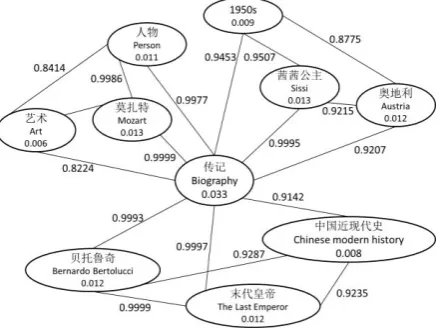
In this subsection, some qualitative evaluations are provided on the basis of the resultant graphs with respect to different topics generated by our method.
Figure 6. An example of topical graphs generated by our method
To our surprise, it seems that some apparently unrelated tags are closely connected in our re-sultant graph. The interesting findings help us to further detect the fact that usually obtained through common sense or reasoning. For exam-ple, 末代皇帝‘The Last Emperor’ and 贝纳尔 多·贝托鲁奇‘Bernardo Bertolucci’, which can be used to infer the fact that ‘The Last Emperor’ is a biographical film directed by ‘Bernardo Ber-tolucci’. Likewise, we observe that the dense connections among 茜 茜 公 主‘Sissi’, 奥 地 利 ‘Austria’ and “1950s” can help us to infer the fact that ‘Sissi’ is a “1950s” film in ‘Austria’. All of them are connected to ‘Biography’, which means ‘The Last Emperor’ and ‘Sissi’ all belong to ‘Biography’. These insights further prove that our method can well connect the most related tags together with respect to the topic through the novel link weight model.
In addition, a few unusual genres of movie emerge in our works which enrich the traditional movie categories. For example, 公路‘road mov-ie’, 默片‘silent movie’, 黑色电影‘film noir’, and 神片 shen-pian and so on. The sensibility for upcoming concepts indicates that our method is a necessary complement for traditional concept extraction.
4.6 Error Analysis
We perform error analysis after experiments. A typical error is 姜文 ‘Jiang Wen’, a famous mov-ie actor in China which is wrongly recognized as a topical key concept. The vertices that closely related to 姜文 ‘Jiang Wen’ in the graph are 宁 静‘Jing Ning’, 夏雨‘Yu Xia’ and 阳光灿烂的日 子‘In the Heat of the Sun’. We believe that the best topical key concept about this topic is 文艺 ‘literature’. However, ‘literature’ cannot be cre-ated if it never appears in the tags of Dou-ban.com. This error is due to randomness of folksonomy tagging itself. We consider integrat-ing other relative folksonomy data sources such as Baidu video3 to overcome this defect in the future work.
5
Conclusion
In this paper we study the novel problem of topi-cal key concept extraction from folksonomy. A new link weight function is proposed to improve graph-based ranking method for topical key con-cept extraction. Quantitative and qualitative
3
http://video.baidu.com
evaluations indicate the robustness and effec-tiveness of our method. In the future, we will make full use of the topical key concepts and relevant entities, and also the relationships by-product for Chinese ontology construction. Ex-periments on the folksonomy data from Dou-ban.com Movie show that our method is feasible. We will further explore our method in other do-mains such as music and more large-scale data with the help of other folksonomy-based systems. Acknowledgments
This work was supported by National Natural Science Foundation of China (NSFC) via grant 61273321, 61133012 and the National 863 Lead-ing Technology Research Project via grant 2012AA011102. Finally, we would like to thank the anonymous reviewers for their insightful comments.
References
Angeletou S, Sabou M, Motta E. 2008. Semantically
Enriching Folksonomies with FLOR. In the 1st
In-ternational Workshop on Collective Semantics:
Collective Intelligence & the Semantic Web,
Tenerife,Spain,pages 1-16.
Blei D M, Ng A Y, Jordan M I. 2003. Latent dirichlet
allocation. Journal of Machine Learning
Re-search, volume 3, pages 993-1022.
Buitelaar P, Cimiano P, Magnini B. 2005. Ontology Learning from Text: Methods, Applications
and Evaluation, volume 123, pages 3-12.
Cui G, Lu Q, Li W, et al. 2009. Automatic acquisition of attributes for ontology construction.In
Comput-er Processing of Oriental Languages.
Lan-guage Technology for the Knowledge-based
Economy, Springer Berlin Heidelberg, pages
248-259.
Haveliwala T H. Topic-sensitive pagerank. 2002. In
Proceedings of the 11th Association for Com-puting Machinery international conference on
World Wide Web(ACM), pages 517-526.
Hearst M A. 1992. Automatic acquisition of hypo-nyms from large text corpora. In Proceedings of the 14th Association for Computational Lin-guistics conference on Computational
linguis-tics-Volume 2(ACL), pages 539-545.
rank-ing.The Semantic Web: Research and
Applica-tions, Springer Berlin Heidelberg, pages 411-426.
Hulth A. 2003. Improved automatic keyword
extrac-tion given more linguistic knowledge. In
Proceed-ings of the 2003 Association for Computation-al Linguistics conference on EmpiricComputation-al
meth-ods in natural language processing (ACL),
pages 216-223.
Jin Y, Li R, Wen K, et al. 2011. Topic-based ranking
in Folksonomy via probabilistic model. Journal of
Artificial Intelligence Review, 36(2), pages
139-151.
Liu X, Song Y, Liu S, et al. 2012. Automatic taxono-my construction from keywords. In Proceedings of the 18th Association for Computing
Ma-chinery international conference on
Knowledge discovery and data mining (ACM SIGKDD), pages 1433-1441.
Liu Z, Huang W, Zheng Y, et al. 2010. Automatic keyphrase extraction via topic decomposition. In
Proceedings of the Association for Computa-tional Linguistics Conference on Empirical Methods in Natural Language Processing
(ACL), pages 366-376.
Marlow C, Naaman M, Boyd D, et al. 2006. HT06, tagging paper, taxonomy, Flickr, academic article,
to read. In Proceedings of the 17th Association
for Computing Machinery conference on
Hy-pertext and hypermedia (ACM), pages31-40.
Mihalcea R, Tarau P. 2004. TextRank: Bringing order into texts. In Proceedings of Association for Computational Linguistics Conference on Em-pirical Methods in Natural Language
Pro-cessing, 4(4), pages 404-411.
Nakayama K, Pei M, Erdmann M, et al. 2008. Wik-ipedia Mining-WikWik-ipedia as a Corpus for
Knowledge Extraction. In Proceedings of Annual
Wikipedia Conference, pages 1-15.
Nie L, Davison B D, Qi X. 2006. Topical link analy-sis for web search. In Proceedings of the 29th annual international Association for Compu-ting Machinery conference on Research and development in information retrieval (ACM
SIGIR),pages 91-98.
Page L, Brin S, Motwani R, Winograd T. 1999. The pagerank citation ranking: Bringing order to the
web. Technical report, Stanford Digital
Li-brary Technologies Project, pages 1-17.
Trant J. 2009. Studying Social Tagging and Folkson-omy: A Review and Framework. Journal of
Digi-tal Information, 10(1), pages 1-42.
Voorhees E M. The TREC-8 question answering track
report. 1999. In Proceedings of TREC, pages
77-82.
Voorhees E, Harman D, Standards N I, et al. 2005. TREC: Experiment and evaluation in information
retrieval . Cambridge: MIT press Boston, pages
1-567.
Zhao X, Jiang J, He J, et al. 2011. Topical keyphrase extraction from Twitter. In Proceedings of the
49th Annual Meeting of the Association for
Computational Linguistics: Human Language
Technologies (ACL), pages 1-10.
Zhou M, Bao S, Wu X, et al. 2007. An unsupervised model for exploring hierarchical semantics from
social annotations. Journal of the Semantic Web,