Learning Kernels over Strings using Gaussian Processes
Daniel Beck∗ Trevor Cohn Computing and Information Systems
University of Melbourne, Australia
{d.beck, t.cohn}@unimelb.edu.au
Abstract
Non-contiguous word sequences are widely known to be important in mod-elling natural language. However they are not explicitly encoded in common text representations. In this work we propose a model for text processing using string kernels, capable of flexibly representing non-contiguous sequences. Specifically, we derive a vectorised version of the string kernel algorithm and their gradi-ents, allowing efficient hyperparameter optimisation as part of a Gaussian Process framework. Experiments on synthetic data and text regression for emotion analysis show the promise of this technique.
1 Introduction
Text representations are a key component in any Natural Language Processing (NLP) task. A com-mon approach for this is to average word vectors over a piece of text. For instance, a bag-of-words (BOW) model uses one-hot encoding as vectors and it is still a strong baseline for many tasks. More recently, approaches based on dense word representations (Turian et al., 2010; Mikolov et al., 2013) also showed to perform well.
However, averaging vectors discards any word order information from the original text, which can be fundamental for more involved NLP prob-lems. Convolutional and recurrent neural net-works (CNNs/RNNs) can keep word order but still treat a text fragment as a contiguoussequence of words, encoding a bias towards short- over long-distance relations between words. Some RNN models like the celebrated LSTMs (Hochreiter
∗This work was partially done while the first author was
at The University of Sheffield, United Kingdom.
and Schmidhuber, 1997) perform better in cap-turing these phenomena but still have limitations. Recent work (Tai et al., 2015; Eriguchi et al., 2016) showed evidence that LSTM-based mod-els can be enhanced by adding syntactic infor-mation, which can encode relations between non-contiguous words. This line of work requires the employment of accurate syntactic parsers, restrict-ing their applicability to specific languages and/or text domains.
In this work we propose to revisit an approach which goes beyond contiguous word representa-tions: string kernels (SKs). Their main power comes from the ability to represent arbitrary non-contiguous word sequences through dynamic pro-gramming algorithms. Our main contribution is a model that combines SKs with Gaussian Processes (GPs) (Rasmussen and Williams, 2006), allowing us to leverage efficient gradient-based methods to learn kernel hyperparameters. The reasoning be-hind our approach is that by optimising hyperpa-rameters in a fine-grained way we can guide the kernel to learn better task-specific text representa-tions automatically.
To enable the learning procedure we redefine the SK algorithm in a vectorised form and derive its gradients. We perform experiments using syn-thetic data, giving evidence that the model can capture non-trivial representations. Finally, we also show how the approach fares in a real dataset and explain how the learned hyperparameters can be interpreted as text representations.
2 String Kernels
Here we give a brief intuition1 on string kernels,
based on the formulation proposed by Cancedda
1We give a thorough explanation of the original SK
equa-tions in the Supplementary Material, as well as a detailed derivation of our vectorised version with its hyperparameter gradients.
et al. (2003). Let|s|be the length of a string s,
sj the j−th symbol insands:−1 the prefix con-taining the full stringsexcept for the last symbol. Definesim(a, b)as a similarity measure between individual symbols aandb. Given two strings s
andtand a maximum n-gram lengthn, the string kernelk(s, t)can be obtained using the recursion
k00(s, t) = 1,for alls, t,
where λg andλm are decay hyperparameters for
symbol gaps and matches, respectively, andµi is
the weight for the kernel of n-gram orderi. The decay hyperparameters smooth the kernel values when sequences are very similar to each other while the n-gram weights help to tune the signal coming from different subsequence lengths.
Our goal is optimise the kernel hyperparame-ters in a fine-grained way using gradient-based methods. For this, we first redefine the kernel in a vectorised form. This not only eases gradient derivations but also allow our implementation to capitalise on recent advances in parallel process-ing and linear algebra libraries for better perfor-mance.2 Given two stringssandt, the equations
for our vectorised version are defined as
S=EsETt,
whereEs andEt are matrices of symbol
embed-dings for each string,is the Hadamard product
2Our open-source implementation is based on TensorFlow
(Abadi et al., 2015).
andD` ∈R`×R`is the matrix the recursion from the original kernel equations. For the matricesE, we focus on dense word em-beddings but they could also be one-hot vectors, simulating hard matching between symbols.
Given this formulation, the hyperparameter gra-dients can be easily derived. From the vectorised definition, we can see that gradients with respect to µare simply k, the intermediate n-gram spe-cific kernel values. Forλg and λm the gradients simply follow the kernel equations in an analo-gous manner. Note that the gradient calculations do not affect the time or space complexity of the main kernel, and in practice they can be obtained together using a single algorithm since they share many common terms.
Finally, we incorporate the kernel into a Gaus-sian Process regression model (henceforth, GP-SK). We assume the label y for an input strings
is sampled from a functionf(s)∼ GP(0, k(s, t)), withtiterating over all other strings in a dataset. With this, we can define the marginal likelihood as
logp(y|s,θ) = log
where G is the Gram matrix with respect to the training sets andθ is the set of kernel hyperpa-rameters. By taking its derivative and plugging in the kernel gradients, we can optimise its hyperpa-rameters using gradient-based methods.3
2.1 Complexity and Runtime Analysis
The original string kernel algorithm has complex-ity O(n|s||s0|), i.e., quadratic in the size of the
largest string. Our vectorised version is cubic,
O(n`3), where`= max(|s|,|s0|), due to two
ma-trix multiplications in the equations for K0 i.
An-other way of reaching this result is to realise that
3We refer the reader to Rasmussen and Williams (2006,
K00
i is actually not needed anymore: all
calcula-tions can be made by updating K0
i only. In fact,
Lodhi et al. (2002) introduced the term k00 as a
way to reduce the complexity fromO(n|s||s0|2)to
O(n|s||s0|). The complexity for the gradient
cal-culations is alsoO(n`3).
However, even though our vectorised version has higher complexity, in practice we see large gains in runtime. We assess this empirically running the following experiment with synthetic strings:
• We employ characters as symbols with a one-hot encoding as the embedding, using all En-glish ASCII letters, including uppercase (52 symbols in total);
• The maximum subsequence length is set to 5; • 100 instances are generated randomly by uni-formly sampling a character until reaching the desired string length.
We test our kernels with lengths ranging from 10 to 100.
Figure 1 shows wall-clock time measurements as the string lengths increase.4 It is clear that the
vectorised version is vastly faster than the original one, with up to two orders of magnitude. Com-paring the CPU and GPU vectorised implemen-tations, we see that we can reap benefits using a GPU when dealing with long sentences. GPU processing can be further enhanced by allowing portions of the Gram matrix to be calculated in batches instead of one instance at a time.
These results are intriguing because we do not expect a quadratic complexity algorithm to be out-performed by a cubic one. It is important to note that while we made efforts to optimise the code, there is no guarantee that either of our implemen-tations is making the most of the underlying hard-ware. We plan to investigate these matters in more detail in the future.
3 Experiments
We assess our approach empirically with two sets of experiments using natural language sentences as inputs in a regression setting.5 The first one
4Experiments were done in a machine with an Intel Xeon
E5-2687W 3.10GHz as CPU and a GTX TITAN X as GPU.
5Code to replicate the experiments in this section
is available at https://github.com/beckdaniel/ ijcnlp17_sk. This also include the performance exper-iments in Section 2.1.
Figure 1: Wall-clock time measurements for the SK versions using different string lengths. Time is measured in seconds and correspond to the calcu-lation of a 100×100 Gram matrix with random strings of a specific length.
uses synthetically generated response variables, providing a controlled environment to check the modelling capacities of our method. The second set uses labels from an emotion analysis dataset and serve as a proof of concept for our approach.
3.1 Synthetic Labels
Consider an ideal scenario where the data is dis-tributed according to a GP-SK. Here we aim at an-swering two questions: 1) whether we can retrieve the original distribution through optimisation and 2) whether a simpler model can capture the same distribution. The first gives us evidence on how feasible is to learn such a model while the second justify the choice of a SK compared to simpler al-ternatives.
To answer these questions we employ the fol-lowing protocol. First we define a GP-SK with the following hyperparameter values:
λg = 0.5 λm= 0.2 σ2= 0.1 µ1= 1.0 µ2 = 0.5 µ3 = 0.25 whereσ2is the label GP noise. This choice of hy-perparameter values is arbitrary: our goal is sim-ply to check if we can retrieve these values through optimisation. The same procedure could be ap-plied for different values.
After defining the GP-SK model we calculate the its corresponding Gram matrix using a set of sentences and their respective word embeddings. This matrix contains the covariances of a multi-variate Gaussian distribution with mean vector 0
et al., 1993) and represent each word as a 100d GloVe embedding (Pennington et al., 2014).6
The data sampled from the procedure above is used to train another GP-SK with randomly initialised hyperparameters, which are then opti-mised. We run this procedure 20 times, using the same inputs but sampling new labels every time.
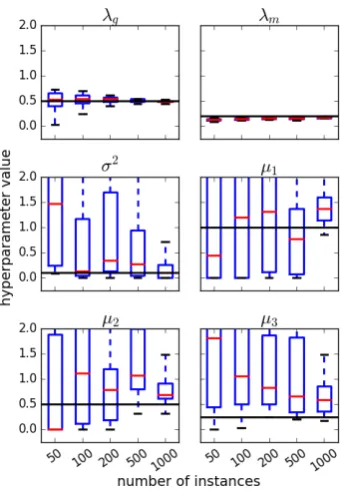
Hyperparameter stability Figure 2 shows the hyperparameter values retrieved after optimisa-tion, for increasing training set sizes. The decay hyperparameters are the most stable ones, being retrieved with high confidence independent of the dataset size. The original noise value is also ob-tained but it needs more instances (1000) for that. The n-gram coefficients are less stable com-pared to the other hyperparameters, although the uncertainty seems to diminish with larger datasets. A possible explanation is the presence of some level of overspecification, meaning that very different coefficient values may reach similar marginal likelihoods, which in turn corresponds to multiple plausible explanations of the data. Solu-tions for this include imposing bounds to the coef-ficients or fixing them, while freely optimising the more stable hyperparameters.
Predictive performance To evaluate if the GP-SK models can be subsumed by simpler ones, we assess the predictive performance on a disjoint test set containing 200 sentences. Test labels were sampled from the same GP-SK distribution used to generate the training labels, simulating a setting where all the data follows the same distribution.
Figure 3 shows results across different training set sizes, in Pearson’sr correlation. We compare with GP baselines trained on averaged embed-dings, using either a linear or a Squared Exponen-tial (SE)7 kernel. The SK model outperforms the
baselines, showing that even a non-linear model can not capture the GP-SK distribution.
To investigate the influence of hyperparameter optimisation, we also show results in Figure 3 for a SK model with randomly initialised hyperparame-ter values. Clearly, optimisation helps to improve the model, even in the low data scenarios.
3.2 Emotion Analysis
As a first step towards working with real world data, we employ the proposed approach in an
emo-6nlp.stanford.edu/projects/glove. We use
the version trained on Wikipedia and Gigaword.
7Also known as RBF kernel.
Figure 2: String kernel hyperparameter optimisa-tion results. Original hyperparameter values are shown as black lines while each box corresponds to a specific dataset size. Red lines show the me-dian values, while box limits correspond to the
[0.25,0.75]quantiles.
Figure 3: Prediction results, averaged over 20 runs. “SK (rdm)” corresponds to string kernel with random hyperparameter values and “SK (opt)”, with optimised hyperparameters.
NLPD↓ MAE↓ r↑
SK 4.06 10.53 0.586
Linear 4.09 11.03 0.539
SE 4.03 10.09 0.611
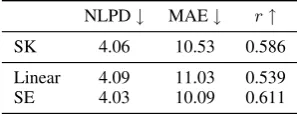
Table 1: Emotion analysis results, averaged over all emotions and cross-validation folds.
λg 7.36×10⁻⁷ λm 0.0918
µ1 12.37 µ2 33.73 µ3 154.51
µ4 2.58 µ5 8.54
Table 2: SK hyperparameter values for a single model predicting the emotionsurprise.
cross validation and average the results.
Table 1 compares the performance of GP-SK with the baselines trained on averaged embed-dings. Besides Pearson’s r correlation, we also compare the models in terms of Mean Absolute Error (MAE) and Negative Log Predictive Density (NLPD), a metric that takes into account the full predictive distribution into account (Qui˜nonero-Candela et al., 2006). The main figure is that GP-SK outperforms the linear baseline but lags behind the SE one. This shows that non-linearities present in the data can not be captured by the GP-SK model. Since the string kernel is essentially a dot product over exponentially-sized vectors, it is not surprising that it is unable to capture non-linear behaviour. This gives us evidence that developing non-linear extensions of string kernels could be a promising avenue for future work.
Inspecting hyperparameters Probing the hy-perparameters can give us insights about what kind of representation the kernel is learning. On Table 2 we show the values for one of the models that predict the emotionsurprise. We can see that
λghas a very low value, while theµvalues show
a preference for subsequences up to 3 words. This lets us conclude that the kernel learned a text rep-resentation close tocontiguous trigrams.
4 Related Work
String kernels were originally proposed for text classification (Lodhi et al., 2002; Cancedda et al., 2003) while recent work apply them for native lan-guage identification (Ionescu et al., 2014) and sen-timent analysis (Gim´enez-P´erez et al., 2017), with promising results. Hyperparameter optimisation in these works is done via grid search and could
potentially benefit from our proposed approach. Gaussian Processes have been recently em-ployed in a number of NLP tasks such as emo-tion analysis (Beck et al., 2014), detecemo-tion of tem-poral patterns in microblogs (Preoiuc-Pietro and Cohn, 2013), rumour propagation in social media (Lukasik et al., 2015) and translation quality esti-mation (Cohn and Specia, 2013; Shah et al., 2013; Beck et al., 2016). These previous works encode text inputs as fixed-size vectors instead of working directly on the text inputs.
Among other recent work that aim at learning general structured kernels, the most similar to ours is Beck et al. (2015), who use GPs to learn tree kernels. Lei et al. (2017) unroll string kernel com-putations and derive equivalent neural network ar-chitectures. In contrast, our work put the learning procedure inside a GP model, inheriting the ad-vantages of Bayesian model selection procedures. Nevertheless, many of their kernel ideas could be applied to a GP setting, which we leave for future work.
5 Conclusion
In this paper we provided the first steps in combin-ing strcombin-ing kernels and Gaussian Processes for NLP tasks, allowing us to learn the text representations used by the kernels by optimising its hyperparam-eters in a fine-grained way. Experiments showed promising results in capturing text patterns that are not modelled by simpler baselines.
For future work, we plan to extend the model to account for non-linear representations, using approaches such as Arc-cosine kernels (Cho and Saul, 2009) and also applying the ideas from Lei et al. (2017). Another important avenue to pursue is to scale the model to larger datasets using recent advances in Sparse GPs (Titsias, 2009; Hensman et al., 2013). These in turn can enable richer ker-nel parameterisations not only for strings but other structures as well.
Acknowledgements
References
Mart´ın Abadi, Ashish Agarwal, Paul Barham, Eugene Brevdo, Zhifeng Chen, Craig Citro, Greg S. Cor-rado, Andy Davis, Jeffrey Dean, Matthieu Devin, Sanjay Ghemawat, Ian Goodfellow, Andrew Harp, Geoffrey Irving, Michael Isard, Yangqing Jia, Rafael Josefowicz, Lukasz Kaiser, Manjunath Kudlur, Josh Levenberg, Dan Man´e, Rajat Monga, Sherry Moore, Derek Murray, Chris Olah, Mike Schuster, Jonathon Shlens, Benoit Steiner, Ilya Sutskever, Kunal Tal-war, Paul Tucker, Vincent Vanhoucke, Vijay Vasude-van, Fernanda Vi´egas, Oriol Vinyals, Pete Warden, Martin Wattenberg, Martin Wicke, Yuan Yu, and Xiaoqiang Zheng. 2015. TensorFlow: Large-Scale Machine Learning on Heterogeneous Distributed Systems.
Daniel Beck, Trevor Cohn, Christian Hardmeier, and Lucia Specia. 2015. Learning Structural Kernels for Natural Language Processing. Transactions of the Association for Computational Linguistics, 3:461– 473.
Daniel Beck, Trevor Cohn, and Lucia Specia. 2014. Joint Emotion Analysis via Multi-task Gaussian Pro-cesses. In Proceedings of EMNLP, pages 1798– 1803.
Daniel Beck, Lucia Specia, and Trevor Cohn. 2016. Exploring Prediction Uncertainty in Machine Trans-lation Quality Estimation. In Proceedings of CoNLL.
Nicola Cancedda, Eric Gaussier, Cyril Goutte, and Jean-Michel Renders. 2003. Word-Sequence Ker-nels. The Journal of Machine Learning Research, 3:1059–1082.
Youngmin Cho and Lawrence K Saul. 2009. Ker-nel Methods for Deep Learning. InProceedings of NIPS, pages 1–9.
Trevor Cohn and Lucia Specia. 2013. Modelling An-notator Bias with Multi-task Gaussian Processes: An Application to Machine Translation Quality Es-timation. InProceedings of ACL, pages 32–42.
Akiko Eriguchi, Kazuma Hashimoto, and Yoshimasa Tsuruoka. 2016. Tree-to-Sequence Attentional Neu-ral Machine Translation. InProceedings of ACL.
Rosa M. Gim´enez-P´erez, Marc Franco-Salvador, and Paolo Rosso. 2017. Single and Cross-domain Polar-ity Classification using String Kernels. In Proceed-ings of EACL, pages 558–563.
James Hensman, Nicol`o Fusi, and Neil D. Lawrence. 2013. Gaussian Processes for Big Data. In Pro-ceedings of UAI, pages 282–290.
Sepp Hochreiter and J¨urgen Schmidhuber. 1997. Long Short-term Memory. Neural Computation, 9(8):1735–80.
Radu Tudor Ionescu, Marius Popescu, and Aoife Cahill. 2014. Can characters reveal your native lan-guage? A language-independent approach to native language identification. InProceedings of EMNLP, pages 1363–1373.
Tao Lei, Wengong Jin, Regina Barzilay, and Tommi Jaakkola. 2017. Deriving Neural Architectures from Sequence and Graph Kernels. In Proceedings of ICML.
Huma Lodhi, Craig Saunders, John Shawe-Taylor, Nello Cristianini, and Chris Watkins. 2002. Text Classification using String Kernels. The Journal of Machine Learning Research, 2:419–444.
Michal Lukasik, Trevor Cohn, and Kalina Bontcheva. 2015. Point Process Modelling of Rumour Dynam-ics in Social Media. InProceedings of ACL, pages 518–523.
Mitchell P. Marcus, Beatrice Santorini, and Mary Ann Marcinkiewicz. 1993. Building a large annotated corpus of English: The Penn Treebank. Computa-tional Linguistics, 19(2):313–330.
Tomas Mikolov, Ilya Sutskever, Kai Chen, Greg Cor-rado, and Jeffrey Dean. 2013. Distributed Repre-sentations of Words and Phrases and their Composi-tionality. InProceedings of NIPS, pages 1–9. Jeffrey Pennington, Richard Socher, and
Christo-pher D. Manning. 2014. GloVe: Global Vectors for Word Representation. In Proceedings of EMNLP, pages 1532–1543.
Daniel Preoiuc-Pietro and Trevor Cohn. 2013. A tem-poral model of text periodicities using Gaussian Pro-cesses. InProceedings of EMNLP, pages 977–988. Joaquin Qui˜nonero-Candela, Carl Edward Rasmussen,
Fabian Sinz, Olivier Bousquet, and Bernhard Sch¨olkopf. 2006. Evaluating Predictive Uncertainty Challenge. MLCW 2005, Lecture Notes in Com-puter Science, 3944:1–27.
Carl Edward Rasmussen and Christopher K. I. Williams. 2006. Gaussian processes for machine learning, volume 1. MIT Press Cambridge.
Kashif Shah, Trevor Cohn, and Lucia Specia. 2013. An Investigation on the Effectiveness of Features for Translation Quality Estimation. InProceedings of MT Summit XIV.
Carlo Strapparava and Rada Mihalcea. 2007. SemEval-2007 Task 14 : Affective Text. In Proceedings of SemEval, pages 70–74.
Kai Sheng Tai, Richard Socher, and Christopher D. Manning. 2015. Improved semantic representations from tree-structured long short-term memory net-works. InProceedings of ACL.