118
AN EFFICIENT AND ELASTIC APPROACH FOR
PARTIAL SHAPE MATCHING USING DTW
Mr. Akash G. Mohod
1,Prof. Dinesh S. Datar
21 Department of Computer Science and Engineering, G.H.R.C.E.M., Amravati.
2Asst. Prof. Department of Information Technology, G.H.R.C.E.M., Amravati
ABSTRACT
Scale invariant and deformation tolerant partial shape matching is a novel approach to the problem of establishing the best match between an open contour and a part of a closed contour. Shape descriptors are computed along open or closed contours in a spatially non-uniform manner. The resulting ordered collections of shape descriptors constitute the global shape representation. A variant of an existing Dynamic Time Warping (DTW) matching technique is use to handle the matching of shape representations. The problem of matching closed-to-closed contours is naturally treated as a special case. In this method is general and can be built on top of any existing shape matching algorithms. The transform shapes into sequences and utilize an algorithm that determines a subsequence of a target sequence that best matches a query. Extensive experiments on benchmark datasets but also in the context of specific applications, demonstrate that the scheme outperforms existing methods for the problem of partial shape matching and performs comparably to methods for full shape matching.
Keywords:- Shape analysis, Dynamic programming, matching, shape descriptor, Dynamic Time Warping.
1.
INTRODUCTIONShape matching is a fundamental problem in computer vision and pattern recognition. Scale invariance is a feature of objects or laws that do not change if scales of length, energy, or other variables, are multiplied by a common factor. Deformation tolerance means tolerating a change in the volume or shape of object. The main idea is to develop a computationally inexpensive and transformation invariant measure of a shape boundary that can be used in shape recognition. Shape matching deals with transforming a shape, and measuring the resemblance with another one, using some similarity measure. So, shape similarity measures are an essential ingredient in shape matching. Shapes are represented as binary images depicting foreground objects over their background and developing a shape descriptor for a sampled boundary point of any shape [6] [10]. This project discusses the Partial shape matching for scale invariant and deformation tolerant images. The matching method is for coding the boundary of two dimensional shapes. I propose the method that operates on 2D images. Shapes are represented as binary images depicting foreground objects over their background. I assume that the shapes have already been extracted from images and are represented by their bounding contours. My primary contribution to this work is to measure the similarity between shapes. A key characteristic of this work is the estimation of shape similarity and correspondences based on shape descriptor. Here, outline of the object is extracted and pre-processed to smoothen some of the noise [1].
The proposed distance is applied to shape classification and shape retrieval. Recently, computer vision has extensively studied object recognition and known significant progress, but current techniques do not provide entirely significant solutions [13, 12]. mentioned algorithm which can be used for partial shape matching in brief.
•Wedge wave feature extraction algorithm:
and detecting correspondences of convexities between two shapes. This method is also based on model of human visual information processing, in which shape matching consists of four phases:
1) Image input, 2) Shape description, 3) Feature extraction, and 4) Correspondence detection.
Input image is black and white image and the shape is described as a set of discrete points.
Feature extraction is not just a process to extract features but also a process to classify feature. The best feature for shape matching is convexity, classification of a convexity as a feature consists of four factors.
• Location on the contour
• Direction facing contour
• Scale of convexity
• Class of convexity (sharp or dull)
Fig1 : Convexity classification
Above figure shows what these classifications actually indicate concerning the contour. Wedge wave that consists of two line segments is a unit wave to express convexity, the size of basic wedge wave is calculated from the size of shape so that size independent classification can be performed. To utilize convexity as feature, this method is used [10].
•Genetic algorithm:
The genetic algorithm (GA) is such a search and optimization method, which has developed to stimulate the mechanism of natural evolution and is powerful in finding the global or near global optimal solution of optimization problems. The genetic algorithm has found kinds of applications successfully and has shown to be of great promising. The genetic algorithm is adopted to get higher speed, better quality, and stronger self-adaptive ability [10].
•Dynamic Time Warping:
Dynamic time warping (DTW) is an algorithm for measuring similarity between two sequences which may vary in time or speed. For instance, similarities in walking patterns would be detected, even if in one video the person was walking slowly and if in another he or she were walking more quickly, or even if there were accelerations and decelerations during the course of one observation. DTW has been applied to video, audio, and graphics — indeed, any data which can be turned into a linear representation can be analyzed with DTW.
A feature of DTW that is useful for the field of handwriting recognition is it being able to handle curves of unequal length i.e., curves that consist of a different number of points. This allows comparison without re-sampling. Because re-sampling usually deletes information or adds \false" information, it is better not to use it [1][11].
2.1 Pattern Recognition:
techniques find applications in many areas: machine learning, statistics, mathematics, computer science, biology, etc.
Pattern recognition is the scientific discipline whose goal is the classification of objects into a number of categories or classes. Depending on the application, these objects can be images or signal waveforms or any type of measurements that need to be classified.
2.2 Partial Shape Matching:
Shape matching is an important ingredient in shape retrieval, recognition and classification, alignment and registration, and approximation and simplification. Partial shape matching is an essential process for image retrieval and computer vision. Its basic requirements are location-free, size-free, orientation-free, and noise-tolerance. I often treat image as shape. For example, image retrieval is a process searching similar shape from large amount of image data. Many shape matching methods have been proposed, but most of them can recognize only whole shape’s similarity. For smarter search in image retrieval and recognizing occluded shape, partial similarity is quite important [10]
Shape matching is of central importance in a number of computer vision problems such as shape classification, retrieval, recognition, and simplification. Shape matching also deals with transforming a shape, and measuring the resemblance with another one. The quality of the shape matching process depends on whether its final outcome agrees with human judgment [1].
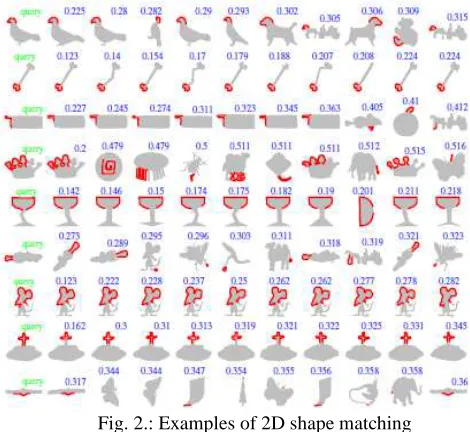
[image:3.595.188.423.373.589.2]The Fig 2 shows some of the example of 2D shape matching and the process of shape matching is shown as Fig. 3.
Fig. 2.: Examples of 2D shape matching
The primary problem with matching is lack of knowledge on how to deal with geometric distortion i.e. noise. Almost all forms of shape representation are sensitive to geometrical distortions.
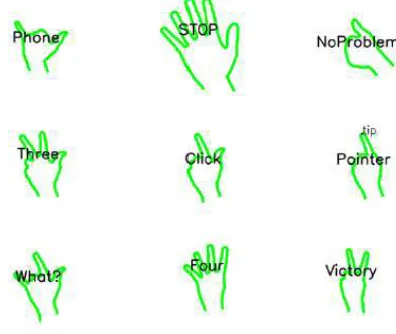
Fig. 3 .: Prototypes used for hand posture recognition.
2.
ANALYSIS OF PROBLEM.When the first partial shape matching concept was proposed, it attracted the attention of increasing numbers of researchers and many successful applications are now available.
Shapes to be matched are typically the result of some kind of segmentation process which, being imperfect, may introduce a considerable amount of noise that needs to be tolerated. In most of the cases, arbitrary differences in scale and orientation should not affect the matching process. Due to viewpoint dependencies and shape articulations and deformations, different 2D image projections of the shape of the same 3D object may differ considerably. Further complications are caused by occlusions which force shape matching to be based on partial evidence. In this particular case, the best matching of an open contour with part of a closed contour needs to be established. From the computational point of view, the main obstacle to matching or recognizing shapes is deformation. Since the possible deformations grows exponentially in the size of the shape, matching shapes globally by searching for the correct deformation is intractable in practice. The problem is further complicated by occlusion and missed edge detections All of the above complicating factors do not appear in isolation, but contribute collectively to increasing the complexity of the matching problem. Shape matching also deals with transforming a shape, and measuring the resemblance with another one.
In the context of this work, my proposed system that will be trying to address the 2D shape matching problem by simultaneously considering all the above complicating factors. My aim is to perform the fast shape matching so that it should finish matching in less time. Aiming at the insufficiencies of previous partial shape matching techniques, I will try to propose some improvement strategies [10] [1] [7].
3.
PROPOSED WORKThe proposed system will be implemented to provide a solution to the problem of partial shape matching. The method that operates on 2D images. Shapes are represented as binary images depicting foreground objects over their background. I assume that the shapes have already been extracted from images and are represented by their bounding contours. My primary contribution to this work is to measure the similarity between shapes. The outline of the object will be extracted and pre-processed to smoothen some of the noise.
view. A matching approach should be invariant under scaling and translation and robust under small geometric distortion, occlusion and outliers. The proposed system will be simple and easy to use.
4.
CONCLUSIONIn this paper, we proposed using work presented a solution to the problem of partial shape matching. The key idea and main contributions of this work lie in the proposed shape descriptor, the scale dependent sampling, and the cost assignment for descriptor matching. The shape descriptor is robust under significant deformations due to articulation, efficient to compute and captures sufficient information to enable high performance. The problem of matching closed-to-closed contours is naturally treated as a special case. This work will prove to be most efficient for the problem of establishing the best match between an open contour and a part of a closed contour. As compared with other similar matching methods, this model can be used for image recognition and matching in practice.
We have future plans as follows for more sophisticated shape matching:
1. Applying other matching technique
2. Utilizing scale space (for roughly matching) 3. Developing other applications
4. Shape with multiple contour
REFERENCES
[1] Damien Michel, Iasonas Oikonomidis, Antonis Argyros, “Scale invariant and deformation tolerant partial shape matching”, Image and Vision Computing 459–469,29Jan2011.
[2]Gang Xu, Wenxian Yang, “Fast Shape Matching Using a Hybrid Model”, 2009 International Conference on Computer Engineering and Technology.
[3]R. da S. Torres, A.X. Falcão, “Contour salience descriptors for effective image retrieval and analysis”, Image and Vision Computing Journal 3–13,25 Jan 2007.
[4]L. Gorelick, M. Galun, E. Sharon, R. Basri, A. Brandt, “Shape representation and classification using the poisson equation”, IEEE Transactions on Pattern Analysis and Machine Intelligence 1991–2005. 28 Dec 2006.
[5]R. da S. Torres, A.X. Falcão, L. da Fa Costa, “A graph-based approach for multiscale shape analysis”, Pattern Recognition 37 issue 1163–1174, 2004.
[6]S.Belongie, J.Malik and J. Puzicha. “Shape and object recognition using shape contexts”, IEEE Trans. Pattern Analysis and Machine Intell. _ 24 (4): 509-522, April 2002.
[7]Euripides G.M. Petrakis, Aristeidis Diplaros, and Evangelos Milios, “Matching and Retrieval of Distorted and Occluded Shapes Using Dynamic Programming”, IEEE Transactions On Pattern Analysis And Machine Intelligence, Vol. 24, No. 11, November 2002.
[8]T.B. Sebastian, P.N. Klein, B.B. Kimia, “Recognition of shapes by editing shock graphs”, IEEE International Conference on Computer Vision, 755–762, 2001.
[9]S. Loncaric, “A survey of shape analysis techniques”,Pattern Recognition 983–1001, 31 March1998.
[10]Koichi Mori, Masakazu Ohira, Motoko Obata, Koichi Wada, Kazuo Toraichi, “A Partial Shape Matching Using Wedge Wave Feature Extraction”, Institute of Information Sciences and Electronics, University of Tsukuba Tsukuba, Ibaraki, Japan 305.
[11]Ralph Niels, “Dynamic Time Warping”, “http://dtw.noviomagum.com.”
[12]Daliri, M.R., Torre, V., 2008. Robust symbolic representation for shape recognition and retrieval. Pattern Recognit. 41 (5), 1799–1815.