e
e
e
O
e
O
O
e
O
O
O
O
O
O
O
O
0
O
e
O
O
O
O
O
O
O
O
O
O
O
e
O
O
O
e
O
O
O
O
Anaphora Resolution using an Extended Centering Algorithm
in a Multi-modal Dialogue System
Harksoo IGm, Jeong-Mi Cho, Jungyun SCO Department of Computer Science, Sogang University
Seoul, 121-742, Korea
[email protected], [email protected], [email protected]:kr
Abstract
Anaphora in multi-modal dialogues have different aspects compared to the anaphora in language-only dialogues. They often refer to the items signified by a gesture or by visual means. In this paper, we define two kinds of anaphora: screen anaphora and referring anaphora, and propose two general methods to resolve these anaphora. One is a simple mapping algorithm that can find items refetxed with/without pointing gestures on a screen. The other is the centering algorithm with a dual cache model, which Walker's centering algorithm is extended to for a multi-modal dialogue system. The extended algorithm is appropriate to resolve various anaphora in a multi-modal dialogue .because it keeps utterances, visual information and screen switching- ,.tim.e. In the experiments, the system.
Correctly resolved 384 anaphora out of 402 anaphom in 40 dialogues (0..54 anaphom per utterance) showing 95.5% correctness.
Introduction
Human face<o-face communication is an ideal model for humm-computa- interface. One of the major features of face-to-face communication is its multiplicity of communication channels that acts on multiple modalities. By providing a number of channels through which information may pass between a user and a computer, a multi-modal dialogue system gives the user a
• more convenient and natural interface than a
language-only dialogue system. In the system, a
user often uses a variety of anaphodc expressions like this, the red item, it, etc. User's
intention is passed to the system through multiple channels, e.g., the auditory channel (carrying speech) and the visual channel (c~nrying gestures and/or facial expressions). For
example, a user can say utterance (4) in Figure ! ! while touching an item on the screen. The user may also say utterance (8) without touching the screen when there is only one red item displayed on the screen. Moreover, the user can use anaphoric expression to refer to an entity in previous utterances as in utterance (10).
(1) S: May I help you7
(2) U: I want to see some desks.
(3) S: (displaying mode/200 and mode/250)
W e have these modeb.
(4) U: (pointing to the model200)
How much is thLv? (5) S: It is 150,000 Won.
(6) U: I'd like to see some chairs, too. (7) S: (displaying model 100 and model 150)
We have t/w~re medeb.
(8) U: How much is the red item?
(9) S: It is 80,000 Won.
(10) U: (pointing to the model 100)
l'd like to buy thb and tke prev/ous se/ect/on.
Figure 1: Motivational example I
Previous rescaw, h on a multi-modal dialogue system was focused on finding the relationship
between a pointing gesture and a deictic
expression (Bolt (1980), Neal et al. (1988), Salisbury et al. (1990.), Shimazu et al. (1994), Shimazu and Takmhima ( 1 9 9 6 ) ) a n d on mapping a predefined symbol to a simple
t S means a multi-modal dialogue system and U
command (Johnston et al. (1997)). None of them, however, suggest methods of resolving deictic expressions with which pointing gestures are omitted: e.g.. the red item in utterance (8). These approaches do not consider resolving an anaphoric expression that refers an object mentioned in previous utterances or displayed on previous screens. It, however, is important also for a multi-modal dialogue system to resolve all of these anaphora so that the system should correctly catch his/her intention. In this paper, we propose general methods to resolve a variety of anaphoric expressions that are found in a multi-modal dialogue. We classify anaphora into two types: deictic expression with/without a pointing gesture and referring expression, and propose methods to resolve them.
To resolve deictic expression like this in utterance (4) which c ~ r s with a pointing gesture and the red item in utterance (8) which is uttered with n o pointing gestures, the system counts the "number of pointing gestures and the number of anaphoric noun phrases included in a user's utterance, and compares them. Then, the system maps the noun phrases to pointed items.
To resolve referring expression, one of the w e l l known methods is centering theory
developed by Grosz, Jo~hi, and Weinstein (Grosz et al. (1983)). The centering algorithm was further developed by Brennan, Friedman and Pollard for pronoun resolution (Brennan et al. (1987)) and was improved by Walker (Walker (1998)). However,' those centering algorithms are not applicable to resolve anaphora in a multi-medal dialogue because the algurithm excludes the gestures and facial • expression of a dialogue partner, which are important clues to mgierstand his/her uttexances. And. the algorithm cannot resolve complex
anaphora like the previous selection
in(10)beeanse it does not keep the time When the
previous screen is switched to the current screen. To resolve inch anaphom, we extend Walker's centedng algorithm to the one with a dual cache model, which keeps the information displayed on a ~ With screen switching-time.
The rest of this paper begins with describing our approach in section !. After showing two methods to resolve anaphora in a rrmlti-modal dialogue system in section 2, we report
experimental results on these methods in section 3. Finally. we draw some conclusions.
22
1 O u r a p p r o a c h
In this paper, we define two types of anaphora: screen anaphora and referring anaphora. Screen anaphora is an anaphoric noun phrase that refers to an entity on the present screen by a pointing gesture or through a visual channel. For example, th/s in uuerance (4) in Figure ! is the screen anaphora referred by a pointing gesture, and the red item in utterance (8) is the one referred through a visual channel. Referring anaphora is an anaphoric noun phrase that refers to an entity in previous utterances or on pre~,ions screens,
For example, we call it in utterance (9) referring anaphora because the referred entity is the red item in the previous utterance (8). We also call
the previous selection in utterance (10) referring anaphora because the refe~nt is the model 200 shown on the previous screen.
The screen anaphora resolution algorithm counts the number of pointing gestures and the number of anaphoric noun phrases included in the user's utterance and compares them. If the numbers are equal, the system maps the gestures to the phrases. Otherwise. the system uses some heuristics to map the gestures according to the priority of the phrases.
The referring anaphora resolution algorithm is based on the Walker's centering algorithm with a cache model. Centering is formulated as a theory that relates focus of attention, choice of referring expressions and perceived coherence of utterances; within a discourse segment. The centering algorithm (Ccnsz et al. (1983), Brennan et al. (1987), Walker et aL (1990)) consists of three main structures. Forward- looking Centers are entities which form a set of entities associated with each. utterance.
Forward-looking Centers are ranked according
to their relative salience. The highest ranged entity is called the Preferred Center. Backward- looking Center is a special member of this set. It is the highest ranked member of Forward- looking Centers of the previous utterance, which is also realized in the current utterance. T h e algorithm defines a set of constraints, rules, and transition states between a pair of utterances by the use of these structures. It incorlgntes these rules and the other linguistic constraints to resolve anaphoric expressions. In the past, it was integrated with a stack model because most researchers believed that the centers should exist within a discourse segment (Grosz and Sidner
(9} NtS 8 0 . 0 0 0 WOn. -
{ 8 } HOw m u c h nt ff~' * ~ steoO
(~') We have s.,~se m o O e l $
c i t e r * , t t m
feuee¢ ..>
S ' w f f c h i t ~ l - f i m e
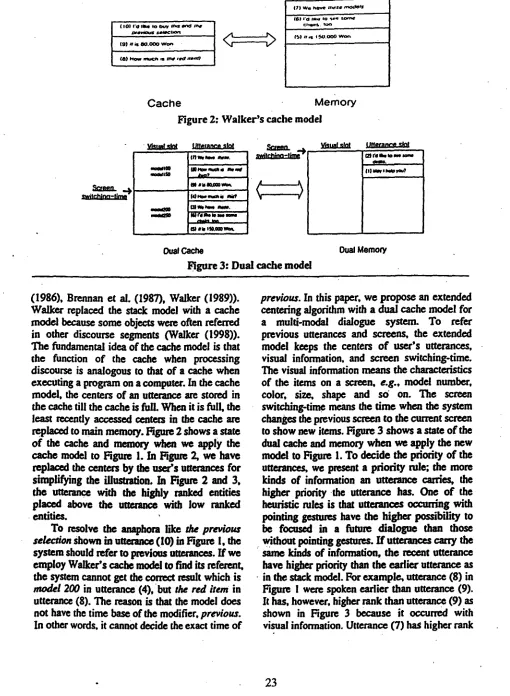
[image:3.612.41.551.50.746.2]Cache Memory
Figure 2: Walker's cache model
• ~ m ~ r a ~ s k ~ ~maml s l o l
lwmbll~
m ~
m ~ t r , e ~
m m ~ J G ~ m ~ Id~ ~a~ ~ i w um~q
W m b t ~ . ~
~ . / l e h l n o - l i m ~
Iffo.fg f t ~ ~k~| {2} ~111, e so me ~ m l
O) M w e m , ~ u ?
Dual Cache
Figure 3: Dual cache model
Oual Memory
(1986), Brennan et al. (1987), Walker (1989)). Walker replaced the stack model with a cache model because some objects were often referred in other discourse segments (Walker (1998)). The fundamental idea of the cache model is that the function of the cache when processing discourse is analogous to that of a cache when executing a program on a computer. In the cache model, the centers of an utterance are stored in the cache fill the cache is full. When it is full, the least ~ e n t l y accessed centet~ in the cache are replaced to main memory. Figure 2 shows a state of the cache and memory when we apply the cache model to Figure 1. In Figure 2, we have replaced the centers by the user's utterances for simpfifying the illustration, In Figme 2 and 3, the utterance with the highly ranked entities placed above the utterance with low ranked entities.
To resolve the amphora h'ke the previous selection Shown in utterance
(I0) in Figure I, the
system should refer to previous utterances. If we employ Walker's cache model to find its referent, the system cannot get the correct result which is model 200 in utterance (4),but the red item in utterance (8). The reason is that the model does not have the time base of the modifier, previous.In other words, it cannot decide the exact time of
than utterance (8) because it occurred With gesture information such as the user's pointing gesture or the system's blinking gesture for the highlighted items as well as visual information. Now, if the dual cache model is applied to the system to find the referred entity of the previous selection shown in utterance (10) in Figure l. the system can get the correct referent, model 200 in utterance (4), because the model recognizes the time base of previous and searches centers in the utterance slot associated with the previous visual slot which includes model 200 and model 250 as
shown in Figure 3.
2 A n a p h o r a resolution a l g o r i t h m s
2.1 The screen anaphora resolution algorithm The screen anaphora resolution algorithm replaces screen anaphora in an utterance with the items referred with/without pointing gestures. For example, if a user says "I'd like to buy this and the red cha/r." when pointingto an item on
the screen, this in the utterance means the item that he/she points to and the red chair means the
chair on the screen that is red. According to the number of anaphora and the number of gestures co-occun-ed with an utterance, we divide the algorithm into three cases.
Case 1: The number of gestures and the number of anaphora are equal.
Case 1 occurs most frequently in a multi-modal dialogue. In this case, the algorithm replaces the • anaphora with the pointed items according.to the order of occunence. For example; "th/s in the utterance (4) in Figure I can bz resolved by this
simple mapping.
Case 2: The number of gestures is less than
the number of anaphora.
Case 2. occurs when a user omits a pointing gesture because heJshe can uniquely select an item on the screen with the anaphoric expression or when the~ are referring anaphom as well as screen amphora as in utterance (I0) in Figure I. In the former case, the algorithm can easily resolve the anaphora because it can uniquely decide the referred entity on the screen by visual information of the item. However, the algorithm cam~ot resolve the referring anaphora in this step because it needs to look at the previous utterances. The algorithm passes them to the referring anaphor a resolution algorithm. We will
show the referring anaphora resolution algorithm
in section 3.2. .
Case 3: The number o f gestures is greater than the number of anaphora.
Case 3 occurs when a user omits all or part of the utterance. The omission consists of t w o types: partial omission and total omission. To process the former, the algorithm first checks for missing essential cases in the case-frame. I f the algorithm finds the omitted one, it fills the omitted one up and generates the supplemented
result of the semantic analysis. For example, i f a
user says "How much.'?" when he/she pointsto
model i00 on the screen, the algorithm assumes
that he/she omitted the theme it and generates
the new semantic result like "How much is it?". Then, it processes the result according to the same method as Case 1. In the latter case, the algorithm assumes that the user uttered either • 'o l ~ o l ~ . f f h i s , please.)" or
"ol~-~ol~.
(These, please.)" because he/she just pointed to an item/ite.ms without an utterance. After restoring the omitted utteranc.e, it can easily resolve the anaphora as Case 1.2.2 The referring anaphora r e s o l u t i o n algorithm
The referring anaphora resolution algorithm finds referents by using previous utterances and visual information. In utterance (10) in Figure I, the user says, " I'd like to buy this and the
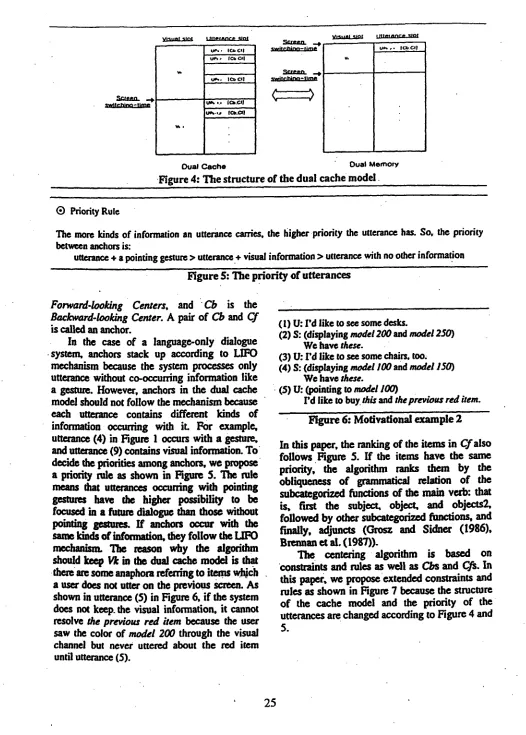
previous selection." while he/she points to model 100. The system can resolve th/s using the screen armphora resolution algorithm. However, the system cannot find the referred entity of the previous selection. The referring anaphora resolution algorithm resolves these kinds of anaphom. The algorithm is based on an extended centering algorithm with the dual cache model. The dual cache model consists o f two slots and time points: visual slot, utterance slot, and screen switching-times as shown in Figure 4. The visual slot contains the. visual infommtion, Le.., items displayed on a screen. The utterance slot contains the centers of the user's ul~.amtces. The screen switching-time, which is illustrated by an arrow, keeps the time when the previous screen is switched to the current screen. In Figure 4, Vt is the kth visual slot, which includes visual information of the kth screen././eta means the utterance that has the jth priority at the kth visual slot. Cf is a list of
V i ~ t J A ! q l l O l l | l l { e , q l J } t ' f • .t11~1
t ~ * • I C b Gel U f ' * * | C b C t l W*
t i n , , . , | C l t . G g |
t , ' ~ . . ,~, I C b . C l l
" 4 * ,
O u a l C a c h e
T, c m ~ n - 4 ' e w i t r ' . h i t , ~ n - f l r m ~
~ i t t ' ~ h l t ' t t q - | | t ~
u*'. ,. IC~C,!
O u a l M e m o r y
-Figure 4: The structure of the dual cache model.
(~) Priority Rule
The more kinds of information an utterance carries, the higher priority the utterance has. So,. the priority between anchors is:
[image:5.612.44.570.32.767.2]utterance + a pointing gesture > utterance + visual information > utterance with no other information
Figure 5: The priority of utterances
Fmward-lookin 8 Centers, and C b is the
Backward.looking Center. A pair of Cb and Cf
is called an anchor.
In the case of a language-only dialogue • system, anchors stack up according to LIFO mechanism because the system processes only utterance without co-occurring information like a gesture. However, anchors in the dual cache model should not follow the mechanism because each utterance contains different kinds of information occurring with it. For example, utterance (4) in Figure 1 occurs with a gesture. and utterance (9) contains visual information. T o decide the priorities among anchors, we propose a priority rule as shown in Figure 5. The rule means that utterances eccmring with pointing gestures have the higher possibility to be focused in a future dialogue than those without pointing gestures. If anchors occur with the same kinds of informadon, they follow the mechanism. The reason why the algorithm should keep Vk in the dual cache model is that there are some anaphora referring to items which a user does not utter on the previous screen. As shown in utterance (5) in Figure 6, if the system does not keep. the visual information, it cannot resolve the previous red item because the user
saw the color of model 200 through the visual channel but never uttered about the red item until utterance (5).
(1) U: I'd like to see some desks.
(2) $: (displaying model 200 and model 250)
We have these.
(3) U: I'd like to see some chairs, too. (4) S: (displaying mode/100 and model 150)
We have these.
• (5) u: (poindng to model/00)
I'd like to buy this and the pr~ioas red item.
Figure 6: Motivational example 2
In this paper, the ranking of the items in Cf also follows Figure 5. If the items have the same priority, the algorithm ranks them by the obliqueness of grammatical relation of the subcategorized functions of the main verb: that is, first the subject, object, and objects2, followed by other subcategorized fen~ons, and finally, adjuncts (Grosz and Sidner (1986), Brennan et ul. (1987)).
• -.. •
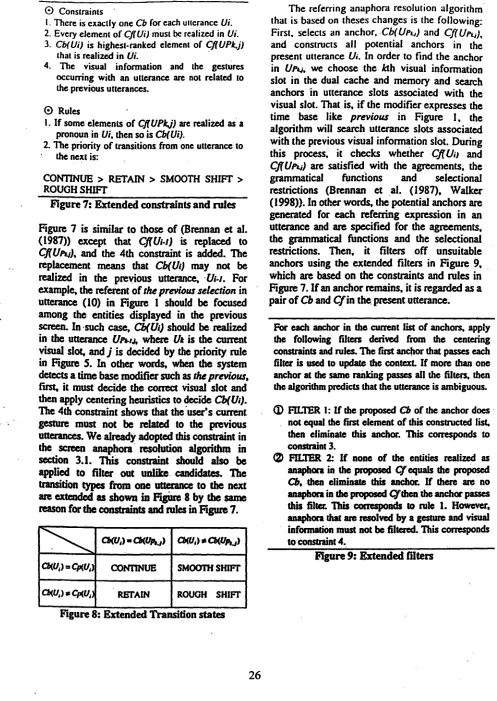
(~) Constraints
I. There is exactly one Cb for each uttcrance Ui.
2. Every element of CflUi) must bc realized in UL
3. Cb(Ui) is highest-ranked element of Cj~UPk.j)
that is realized in UL
4. The visual information and the gestures occurring with an utterance arc not related to the previous utterances.
(~) Rules
!. If some elements of C.KUPkj) are realized as a pronoun in Ui, then so is tb(Ui).
2. The priority of transitions from one utterance to the next is:
COITI'INUE > RETAIN > SMOOTH SHIFT > ROUGH SHIFT
Figure 7: E x t e n d e d constraints a n d rules
Figure 7 is similar to those of (Brennan et al. (1987)) except that C.KUz-z) is replaced to ¢~Ue~), and the 4th constraint is added. The replacement means that tb(UO may not be realized in the previous utterance., .Ui-z. For example, the referent of the previous selection in utterance (I0) in Figure I should be focused among the entities displayed in the previous screen. In.such case. Cb(UO should be realized in the utterance Ue~j, where Ut is the current visual slot, and j is decided by the priority rule in Figure 5. In other words, when the system detects a time base modifier such as the previous, first, it must decide the correct visual slot and then apply centering heuristics to decide Cb(UO. The 4th constraint shows that the user's current gesture must n o t be related to the previous utterances. We already adopted this constraint in the screen anaphora resolution algoritlun in section 3.1. This constraint should also be applied to filter out unlike candidates. The transition types from one utterance to the next axe extended as shown in Pig~rc 8 by the same reason for the constraints and rules in Figure 7.
C~u,) = C~U,)i
ct~u,), cr~u,~ Rm'^n¢
Figure 8: Extended Transition states C/,(U,)- Ct<O~.j) ¢::~U,),* Ct<Up~)
CONTINUE SMOOTH SHIFT
ROUGH SHIFT
26
T h e referring anaphom resolution a l g o r i t h m that is based on theses changes is the f o l l o w i n g :
First, selects an anchor, Cb(UPL,) and Cf(Ue~), and constructs all potential anchors in the present utterance Ui. In order to find the anchor in UPs, we choose the kth visual information slot in the dual cache and memory and search anchors in utterance slots associated with the visual slot. That is, if the modifier expresses the time base like previous in Figure l, the algorithm will search utterance slots associated with the previous visual information slot. During this process, it chocks whether Cj~Uij and CJ~UP~) are satisfied with the agreements, the grammatical functions and selectionaI restrictions (Brennan et al. (1987), Walker (1998)). In other words, the potential anchors are generated for each referring expression in an utterance and are specified for the agreements, the grammatical functions and the seloctional restrictions. Then, it filters off unsuitable anchors using the extended filters in Figure 9, which are based on the constraints and rules in Figure 7. If an anchor remains, it is regarded as a pair of Cb and Cfin the present utterance.
For each anchor in the current list of anchors, apply the following filters derived from the centering constraints and rules. The first anchor that passes each filter is used to update the contcxL If more than one anchor at the same ranking passes all the fiitc~ then the algorithm predicts that the utterance is ambiguous.
(D FILTER h If the proposed Cb of the anchor does not equal the first element of this constructed list. then eliminate this anchor. This corresponds to constraint 3.
~) FILTER 2: If none of the entities realized as anaphota in the proposed Cf equals the proposed Cb. then eliminate this anchor. If there are no anaphora in the proposed qthcn+the anchor passes this filter. This conmpoads to rule 1. Howcvor. anaphora that are resolved by a gesture and visual
information must not be filtered. This corresponds to constraint 4.
Figure 9: Extended Idlers
[image:6.612.53.305.52.624.2] [image:6.612.55.552.60.761.2]Tabl e 1: The component ratio of the experimental data and the experimental result
Screen Anapbora Referring Anaphora Total
Frequency 328 74 402
(the component ratio) (8 ! .6%) (I 8.4%) (100%)
# of detected anaphora 317 71 388
(recall) (96.6%) (95.9%) (96.5%)
# of resolved anaphora 316 68 384
(precision) (99.7%) (94.4%) (98.7%)
(# of resolved anaphora / 96.3% 91.9% 95.5%
Frequency)* 100
3 Evaluation a n d analysis of the experiments
3.1 The experimental d a t a
In order to experiment the proposed alg0rithms, we collected multi-modal dialogues which were simulated by 10 graduate students. They consist of 40 dialogues with 754 utterances (18.85 utterances per dialogue). The subject of the dialogue is furniture home shopping using a touch screen monitor. The data contains the user's utterances, pointing gestures and various visual information. In the data, we found 402 anaphoric noun phrases (10.5 anaphora per dialogue, and 0.54 anaphora per utterance). It means that anaphora resolution is very important for the multi-modal dialogue system. The screen anaphora appeared 4 times (81.6%) as much as the referring anaphora as shown in Table I. It shows that a user usually points to the item when he/she wants to select an item on the screen.
3.2 The analysis of experimental result
The two proposed aigndthlm detected 388
anaphora correctly from 402 amphora and detected i mmphora incorrectly. The recall rate is %..5% as shown in Table !. The algorithms resolved 384 mmphora from the detected anaphora (389 anaphora), and the p t ~ s i o n is 98.7% as shown in Table !. Most of the failures were caused by preprocessing modules in our multi-modal dialogue system that generate an input for proposed anaphora resolution algorithms. T h e failure patterns are the following.
• The system failed to detect the anaphora modified by a subordinate clause like " o t . ~
buy the red chair that I selected before.)"
because we restricted anaphora as noun phrases modified by noun or adjective. • The screen anaphora resolution algorithm
failed to know whether -~ g:'~(two mode/s) in " - ~ .E W~ ;'I'll ~]'o17~ ]~o] o~q..8.? (What is the price difference of two
models?)"
was anaphori¢ noun phrase because a user did not explicitly use a definite article,the,
in Korean. In English,we can easily know that -~ .H~'(two
mode/s) is a anaphoric noun phrase because a user normally uses the. In Korean, however, it is difficult to find this kind of anaphora because the use of a definite article is a weak grammar role.
• .The referring armphora resolution algorithm failed to resolve the anaphora i i k e O ~
o
q]~ ~all of the previous chair) because
the anaphom is expressed as a singular expression in Korean. Usually Koreans are not strict in number agreement. If the preprocessing modules can recognize the singular exp/ession as the plural ~pression by looking at the meaning of Cl~all), the
algoritlnn can resolve these kinds of failure
pauems.
A~ we can see in the=~ failure cases, most failures are due to some special characteristics of Korean dialogues. We believe the proposed algorithms work much better in English multi- modal dialogues.
Conclusion
variety o f anaphora because the system has various input channels, We proposed general algorithms to resolve such various anaphora in the multi-modal dialogue system, We defined two kinds of multi-modal anaphora, screen anaphora and referring anaphora. To resolve the screen anaphora, we proposed simple mapping algorithm. We proposed an extended centering algorithm integrated with the dual cache model to resolve referring anaphora. In the experiments, among 402 anaphora in 40 dialogues (0.54 anaphora per utterance), 384 anaphora were resolved. The result reflects the fact that the proposed algorithms work fairly well in resolving a variety of anaphora in multi-modal dialogues.
In a furore work, we will test the system by using the Cf ranking method (Walker et at. (1990), Walker et at. (1994)) that Walker uses for Japanese. Since Korean is similar in structure to Japanese (i.e. it is a free word order, head- final language, with morphemic marking for grammatical function and topic), it would be interesting to see if the Cf ranking method can enhance our system's performance in multi- modal dialogue environment.
Acknowledgements
Authors arc grateful to the anonymous reviewers for their, valuable comments on this paper. This work was supported in pa~ by the Ministry of Information and Communication Under the title of "A Research on Multimodal Dialogue Interlace".
References
Bolt It. 0980) Put-That-Them: Voice and gesture at
the graphics interface. Compnter Graplu'cs,
14(3)'.262-270.
Brennan $.. Friedman M. end Pollant C (1987) A
• Ccn~iaS Approach to PronouL In Proceedin&s of
25~ AC/., pp. 155-162.
Gfo~ B. J., Jofhi A. ~ and Weinstein S. (1983)
Providing a unified account of definite noun phrases in discourse. In Proceedings of the 21st Anmml Meetlng of the ACL, pp. 44-50.
Grosz B. J. and Sidncr C. L. (1986) Attentions, intentions, and the structure of discourse.
Computational Linguistics, i 2(3): 175-204.
Johnston M., Cohen P., McGee D., Oviatt S., Pittman J. and Smith 1. (1997) Unification-based
Mullimodal Integration. In Proreedi.g.~ . f 81h EACL. pp. 281-28X.
Kim H. and Sco J. (1997) A Mulli-Modal User inlcrface System in Home Shopping Domain. (in Korean) In '97 Spring Proceedings of Conference on Korea Cognitive SCience Society. pp. 74-80. Neal J., Dobes Z., Bcttinger K. and Byoun J. (1988)
Multi-Modal References in Human-Computer Dialogue. In Proceedings of AAAI-88, pp. 819-823. Salisbury M. W., Hendrickson J. H. and Lammers T. L., Fu C. and Moody S. A. (1990) Talk and draw: bundling speech and graphics. IEEE Computer,
23(8)'.59-65.
Shimazu H., Arita S. and Takashima Y. (1994) Multi-Modal Definite Clause Grammar. In
Proceedings of COUNG'94, pp. 832-836.
Shimazu H. and Takashima Y. (1996) Multi-Modal- Method: A Design Method for Building Multi- Modal Systems. In Proceedings OfCOUNG'96, pp. 925-930.
Walker M. (1989) Evaluating discourse processing algorithms. In Proceedings of the 27th Annual Meeting of the ACL, pp. 251-26 i. :':~
Walker M., lida M. and Cote S. (1990) Centering in Japanese discourse. In Proceedings of the 13th International Conference on Computational Linguistics. pp. 1.7.
Walker M., lida M. and Cote S. (1994) Japanese discourse and the process of centering.
Computational Linguistics, 20(2): 193-233.
Walker M. (1998) Centering Anaphora Resolution, and Discourse Structure. In: M. A. Walker, A. If.. Joshi & E F. Prince(Eds.), Centering Theory in Discour=e. Oxford/UK: Oxford U.P., pp. 401-435.
@
0
0
O
0
0
O
O
O
0
O
0
0
@
0
O
O
0
O
0
0
O
0
0
0
@
@
0
@
0
O