Improving POS Tagging of German Learner Language in a Reading
Comprehension Scenario
Lena Keiper, Andrea Horbach, Stefan Thater
Saarland UniversityDepartment of Computational Linguistics Saarbr¨ucken, Germany
{lkeiper, andrea, stth}@coli.uni-saarland.de
Abstract
We present a novel method to automatically improve the accurrcy of part-of-speech taggers on learner language. The key idea underlying our approach is to exploit the structure of a typical language learner task and automatically induce POS information for out-of-vocabulary (OOV) words. To evaluate the effectiveness of our approach, we add manual POS and normalization information to an existing language learner corpus. Our evaluation shows an increase in accuracy from 72.4% to 81.5% on OOV words.
Keywords:Part-of-Speech Tagging, Learner Language, Corpus Annotation
1.
Introduction
With the increasing availability of computer-assisted lan-guage learning (CALL) applications, there comes a growing need to develop and improve NLP tools that are able to process learner language automatically in order to give meaningful feedback to language learners. For most tasks involving free-text input by the learner (unlike for instance simple multiple choice questions or gap-filling tasks), appli-cations need to deal with unrestricted learner language input using NLP techniques.
In this paper, we consider the preprocessing step of part-of-speech (POS) tagging of learner language. POS tagging is a fundamental part of most NLP tool chains and provides necessary input for higher-level processing steps such as algorithms for scoring the contents of learner answers. The challenge is that out-of-the-box POS tagging models are usually trained on standard language like newspaper arti-cles, and consequently also perform best on newspaper text. Learner language, however, typically differs substantially from the newspaper data, so that out-of-the-box-models are not directly applicable in a CALL setting. The standard model of the tagger considered in this paper, for instance, achieves an accuracy of over 97% when applied to newspa-per text, but only 93% when applied to learner language. One important reason for this performance drop is that learner language contains many out-of-vocabulary (OOV) tokens, i.e. tokens that the tagger has not seen during train-ing. They are frequent in learner language for two reasons: One is that the domain of the learner language input differs from typical newswire texts. We call these OOV words lex-ical gaps. The second and more important reason is that learner language contains a lot of noise such as typos and other spelling errors, as well as grammar problems. They lead to nonexistent word forms which we callmisspellings. Since learner language also tends to differ on the syntactic level, the tagger often cannot exploit contextual information to guess the correct POS tag for OOV as effectively as in the case of standard language.
Examples (1) and (2) illustrate these phenomena: The first example shows two typical types of misspelling errors at the lexical level: The noun “Erflog” (correct form: Erfolg, Eng.: success) is a spelling error with a letter swap; “geld” (correct
form: Geld, Eng.: money) is written in lowercase although in German all nouns are capitalized. Due to these errors a standard tagger tags the two nouns as a verb in the former and an adjective in the latter case. In the second example, the noun “Dusche” (Eng.: shower) is correctly spelled, but it is alexical gap, because the word does not occur in the training data. The tagger chooses erroneously to tag the word as an adjective instead of a noun.
(1) Learner: Viel Erflog und geld haben
Normalized:Viel Erfolg und Geld haben
Tagger: ADVVVFINKONADJAVAINF
Gold: ADVNN KONNN VAINF
(2) Learner: Der Herd und die Dusche Normalized:Der Herd und die Dusche Tagger: ART NN KON ARTADJA Gold: ART NN KON ARTNN
This paper makes two contributions. First, we describe a method to improve the POS tagging performance on learner language by automatically inducing POS information for OOV tokens. Second, we provide POS and normalization annotation on top of the CREG corpus (Meurers et al., 2011). We use the annotation to evaluate our method, but it is also a potentially useful resource in its own right.
occurs in the reference. If that is the case, we assume that the learner really meant this word: We are therefore able to normalize misspellings to words occurring in the refer-ence. We add lexical gaps that occur in the reference to the the tagger lexicon together with the POS tag that has been assigned to them by the tagger in the reference. As the refer-ence texts are standard language and therefore tagged with a high degree of accuracy, we trust their POS annotation and propagate the POS label of OOV words in the reference back to the corresponding token in the learner answer. Consider the following example of a learner answer that con-tains the OOV wordverlossen. In the reference, the word as is does not occur; therefore we assume it to be a misspelling and not a lexical gap. While standard spell checkers would correct the word as either a form ofverlassenor one of ver-lieren (verloren)we find the correct variant by comparing the word to all words occurring in the reference that contains
verloren, but no instance ofverlassen.
(3) Learner:Apfelwein ist einer traditionalle Wein f¨ur ein hundert Jahre. Eine Konsequenz ist Kultur ver-lossen. (. . . )
Text:(. . . ) W¨urde dieser Begriff verboten, h¨atte das Land Hessen eines seiner bedeutendsten Identifika-tionssymboleverloren(. . . )
To evaluate the effectiveness of our approach, we manually annotate the learner answers within CREG, the Corpus of Reading Comprehension Exercises for German (Meurers et al., 2011) with POS tags and normalization information, i.e., correct word forms of incorrect learner words. The added value of our annotations compared to previous annotation efforts such as the FALKO corpus (Reznicek et al., 2012) is that we provide both manual POS tags and normalization information. It is also grounded in the structure of the CREG corpus, whose reference texts allow both a context-aware manual and automatic normalization. Our automatic tagging approach gives us an improvement of 10% on OOV words. The remainder of this paper is organized as follows: We provide more background and an overview of related work in Section 2. We describe our corpus annotations in Section 3, and the design of our POS-tagging architecture in Section 4. We present an evaluation of the POS-tagging in Section 5, and conclude with Section 6.
2.
Background and Related Work
Learner language can differ quite substantially from standard language. Deviations from the standard can occur on all levels, including, but not limited to spelling, lexicon, syntax and morphology. They are not universal for all learners, but depend on factors such as native language, current level in the foreign language and learning strategies. Selinker (1972) coined the terminterlanguagefor these language variants of individual learners.Those differences from standard language affect automatic POS tagging most notably on the areas of spelling variance, punctuation, morphology and word order. However, indi-vidual differences make it hard to build one POS tagger model for all learners. Instead of building a single tagger model, we therefore make use of what we know about the context of the learning task and exploit information from
the reference material to make assumptions on the target hypothesis. In doing so, we adopt a common way of coping with learner language in NLP applications: the integration of a normalization (spelling error correction) step into a lin-guistic pipeline that tries to bring the input closer to standard language.
The task of (manual as well as automatic) normalization of learner language has been addressed in several works, for German data most notably in the FALKO corpus (Reznicek et al., 2012). This corpus consists of summaries and essays written by language learners and native speakers. Similar to our annotations, the FALKO corpus provides (manual) normalization information on several linguistic levels. Their
minimal target hypothesishas the aim of transforming the text into a parsable structure to enable automatic processing, while theextended target hypothesisalso remedies errors on semantic, lexical, pragmatical and stylistic levels. The cor-pus also comes with POS information, but unlike us they do not provide a manual POS annotation, but use automatically assigned POS tags on the minimal target hypothesis. Reznicek and Zinsmeister (2013) provide a study about automatic POS tagging performance for learner texts from a subcorpus of FALKO. However, they evaluate only those tokens where an ensemble of taggers disagree and manually annotate only a very small data sample of learner essays. POS annotation of learner language with a completely differ-ent goal has been approached by D´ıaz-Negrillo et al. (2010), who annotated NOCE, an English learner corpus by Spanish learners. Their approach differs from ours in that they are not normalizing learner language into standard language, but explicitly deal with properties of learner language by anno-tating separately the three individual sources of evidence for a POS tag: lexicon, morphology and distribution. This ap-proach allows them to identify sources of errors and to query the corpus searching for particular learner language phenom-ena and, is thus a valuable resource for both researchers and teachers in the study of learner language. With our different goal of improving POS tagging to enable automatic linguis-tic processing, we are instead trying to fit learner language into the framework of a standard tagset in order to enable higher NLP processing steps.
A different way to look at POS tagging of learner language is to see it as a problem of domain adaptation. Recent work on domain adaptation has focused on Computer-Mediated Communication (CMC) data. For instance, Gadde et al. (2011) leverage word clusters based on surface similarity to link OOV words from an SMS corpus to known words and, similar to us, they also use language models to find the most plausible normalized sentence variant as a preprocessing step for tagging. Han et al. (2012) create a normalization dictionary for OOV words from English Twitter data based on distributional similarity and rank them based on string similarity.
frequency that allows relation to known words to be learned from unannotated data. Such approaches do not work in our case because of the small size of our corpus and the fact that individual learner errors are not phenomena that occur with the same frequency as deviations in CMC data. We overcome this problem by instead leveraging information from the reading material that narrows down the pool of potential replacement candidates.
3.
Corpus and Annotations
This section introduces one of the key contributions of our paper: the annotation project that adds both part-of-speech and normalization information to the learner answers in the CREG corpus.
We organize the annotation into two subsequent steps. In a first step, we normalize the input, i.e., we replace incorrect words in the learner answers by the words that the learner presumably wanted to use (thetarget hypothesis). In a sec-ond step, we then label the words in the learner answer with POS information based on the target hypothesis. The normalization step is a necessary prerequisite to POS an-notation since the POS anan-notation should reflect what the learner intended to express (on the lexical level). We thus decided to make the target hypothesis explicit as a separate annotation layer in order to make the POS annotations as transparent as possible and also to provide a gold standard for automatic normalization approaches.
3.1.
Data
We use CREG, the Corpus of Reading Comprehension Exer-cises (Meurers et al., 2011), as the basis of our annotations. It is the main German corpus for the task of short-answer scoring (Ziai et al., 2012; Koleva et al., 2014) and consists of 1032 learner answers (LAs) given to 177 questions about a total of 32 reading text, as well as teacher-specified target answers. The data had been collected in German language courses at two universities in the United States, all learners were American native speakers. For our annotations, we fo-cus on the learner language material, i.e. the learner answers. We use only those answers given primarily in German. An-swers had been transcribed twice in the corpus; we always use the first transcript and tokenized it using the Stanford CoreNLP tokenizer (Manning et al., 2014). The tokens we thereby get for our annotation study sum up to a total of 12175. In our approach to automatically improve POS tag-ging on learner answers, we also make use of the additional material, which consists of standard language data that is lexically related to the learner language data.
3.2.
Normalization
In cases where a learner answer deviates from standard lan-guage we asked our annotators to form a target hypothesis, i.e., to formulate what the language learner presumably in-tended to say. We distinguish two normalization levels: on the first level (N1), we normalize misspellings; on the second level (N2), we additionally normalize grammatical errors such as incorrect case assignments or missing articles or prepositions. Our system, described in the next section, uses information from level N1 only; level N2 is used only
in the evaluation to estimate an upper bound of tagger per-formance.
Consider Example 4, where the learner used “das”, which is the definite article in standard German, but most likely wanted to use the subordinate conjunction “dass” (that). This mistake was potentially due to the phonological simi-larity of the two words. While a word with the surface form
dasin German can only be tagged as an article, relative or demonstrative pronoun, only the formdasscan occur as a conjunction and was presumably intended in this sentence. Therefore, the annotator first normalizeddastodassbefore tagging the word as subordinate conjunction KOUS. Addi-tionally, we see in this example a normalization where the learner uses an untypical spelling for the German umlaut in “f¨ur” and mixed up accusative with dative for the personal
pronouns.
(4) LA: Sie dachtedas es war nichtfuer ihr. N1: Sie dachtedasses war nichtf ¨ur ihr. N2: Sie dachtedasses war nichtf ¨ur sie .
POS: PPER VVFIN KOUS PPER VAFIN PTKNEG APPR PPER $. She thought that it was not for her.
Our perspective on normalization as a prerequisite for POS annotation motivates our main annotation guideline: When-ever possible we only normalize on token level, i.e., we do not insert or delete words and especially do not change word order, apart from the following three exceptions:
• separate one (accidentally fused) word into two indi-vidual words (“einsman” becomes to “eins man”)
• combining two words into one word, mostly for Ger-man compound nouns which have to be written as one token, but are often split by the English native learners (“Polizei Gewalt” becomes to “Polizeigewalt”)
• adding and deleting articles and prepositions
Unlike Reznicek et al. (2012) we do not concern ourselves with lexical or pragmatic aspects in the normalization.
3.2.1. Annotation Process
Annotations were carried out by two trained computational linguistics students (native speakers of German). For each learner answer they had access to the reference material, so that they could form their target hypothesis based on the context of an answer. Cases of disagreement were checked by a third annotator, one of the authors, who adjudicated instances that were clearly annotation errors. As L¨udeling (2008) pointed out, it is often difficult, if not impossible, to find exactly one target hypothesis. Therefore, if two different target hypothesis were both plausible they were both kept as alternatives, to maintain the diversity of potential linguistic interpretations of an answer.
3.2.2. Analysis
IV OOV
N1 or N2 9% (1023) 35% (452)
N1 3% (369) 32% (414)
N2 6% (691) 6% (83)
Table 1: Number of all IV and OOV that were normalized on N1 and N2 by at least one annotator
to Landis and Koch (1977). For those tokens where the an-notators agreed to normalize them, they produced the same annotation in 86.2% of all normalizations in level N1, and 89.2% of all normalizations in level N2.
In the adjudication step, 47% of all disagreements were resolved into only one correct form, while for the remaining 53% both normalizations were kept as plausible.
After adjudication, 12.1% of all tokens (1475) had been normalized by at least one annotator and 10.0% (1220) by both. To test the influence of normalization on automatic POS tagging, we tagged both the normalized and the original version of the data with a standard tagger. 27.3% of all normalized tokens changed their POS tag between these two runs.
When dividing tokens into those that are in the lexicon of a standard tagger and those that are not, we see that 35% of all OOV tokens were normalized by at least one annotator (32% on N1 and 6% on N2), and only 9% of the in-vocabulary (IV) tokens. 82 tokens were normalized on both levels. The semantic correctness of an answer, however, has no influence on the number of normalizations; correct learner answers contain on average as many normalizations as incor-rect answers. This is a plausible result, given that teachers are instructed to ignore spelling errors when scoring short-answer questions.
39% of all orthographic normalizations (N1) concerned capi-talization issues and 11% German umlaut spelling. Although we allowed some operations beyond token level, they occur rarely in our annotations: Only in 7.3% of all normalizations in N1 did a token have to be split or two tokens were merged, and on level N2 only 14 tokens (1.8%) were deleted and 52 (6.7%) inserted.
3.3.
Part-of-Speech Annotation
In the second annotation step, learner answers were anno-tated with POS tags using the Stuttgart-T¨ubingen tagset (Schiller et al., 1999). We extended the standard tagset with one extra tag,LL, for learner language that annotators could always use when they felt that the language used was so corrupt that no other tag would fit the token.
3.3.1. Annotation Process
All material were annotated by the same two student anno-tators with access to the reference material. As described in the normalization section, we tried to stay as close as possible to the surface form of each token and correct what we assumed to be spelling mistakes. POS tags were then selected in such a way that they fit this normalized version (step 1) of a token.
Newspaper LA References
NN 22% 22% 16%
ART 11% 10% 8%
APPR 9% 5% 6%
ADJA 6% 3% 3%
NE 6% 4% 3%
ADV 4% 2% 5%
VVFIN 4% 4% 7%
KON 3% 3% 2%
VAFIN 3% 4% 2%
PPER 2% 3% 6%
REST 30% 40% 42%
Table 2: The most frequent POS tags
3.3.2. Analysis
The two annotators reached an almost perfect agreement of κ= 0.95, even if they found different normalizations. All disagreements (577) were reannotated by a third annotator. A majority vote between these three annotators was used to determine the final POS tag. 17 remaining cases of disagree-ment were adjudicated by the authors. After adjudication 58 tokens with two possible normalizations had two different POS tags.
The tag LL was used in 38 cases. The following table shows some of the occurrences.
(5) a) Es ist etwas die besserpktewohnenen.
b) Machensind 66,1 Prozent Frauen.
c) Die Salzburger lassen etwas der Brunnen im Winterfrhnzu werden.
d) Man muss deutscher Staatsbrger seinzueine GmbH gegrndet werden.
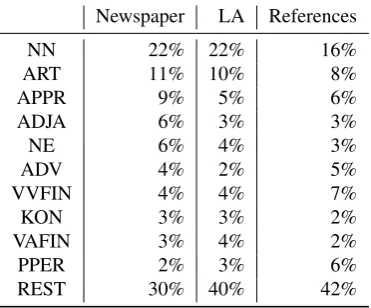
Table 2 compares the frequency of the 10 most frequent POS tags in newspaper texts, our annotated learner data and the reference texts. We can see that learner data and reference texts have a similar distribution of POS tags that differs from that of newspaper texts.
4.
System Description
This section describes the architecture of our automatic tag-ging system. The general aim is to minimize the number of words that are OOV to the tagger, as tagging accuracy for these words is generally much lower than for IV words. We leverage two methods to achieve this goal: One is to correct
misspelled wordsbefore tagging into their most likely cor-rect form, while the second is to extend the tagger lexicon with OOV words that occur in the reference material of a learner tex; we call themlexical gaps. We first describe the decision process, for which method will be applied, and then discuss both variants of dealing with OOV words in more detail.
LA
OOV IV
Lexical gap: Lexical extension Misspelling:
generate normalization candidates
ranking replace
re-run tagger
in Ref not in Ref V/A/N +
not in Ref
Figure 1: System overview with the handling of misspellings (upper branch) and lexical gaps (lower branch)
4.1.
Decision Between Lexical Gaps and
Misspellings
The lexicon of a POS tagger depends on the training corpus, i.e. all words not seen during training are OOV. Words can be OOV for two different reasons: First, it is possible that a perfectly correct word is a lexical gap and just does not occur in the training data. Second, words that are misspelled are also OOV to a tagger that has been trained on standard newspaper text.
The references for a learner answer are one major resource for deciding whether a word belongs to the first or second of these categories. In our corpus, 84% of all tokens in the normalized learner answers also occur in their references. This supports the claim that learners lift material from the reference into their answers. Therefore we apply the follow-ing rule: If a word that is OOV to the tagger occurs (in some inflectional form) in the reference it is likely that the learner intended to use this word (instead of misspelling a different word). We will therefore treat such a word as a lexical gap, and words that do not occur in the related material will be treated as potential misspellings.
In the corpus, about 59% of all OOV words indeed occur in the references and are treated as lexical gaps; the others are treated as potential spelling errors.
4.2.
Lexicon Extension for Lexical Gaps
We determine the lexical gaps by the rule described above. Next, we determine the POS tag(s) with which words are added to the tagger lexicon. We exploit the fact that the references are mostly well-formed texts and that TnT is able to guess the correct POS tag for OOV words using suffix and context information. A sample annotation of 1000 tokens of references showed a tagging accuracy of 90% for OOV words from the references.
Inspecting tagging results on the learner answers, we find that the accuracy on words that are lexical gaps is much lower (81%). Our strategy therefore is to retrieve the tags that have been assigned to lexical gaps in the references and include them in the lexicon. If a word occurs multiple times in the the text with different POS tags, we save all of them, i.e. the word is treated as ambiguous.
4.3.
Automatic Normalization of Misspellings
After adding lexical gaps to the lexicon, we treat the remain-ing OOV words as potential misspellremain-ings.
4.3.1. Candidate Generation
We exploit the fact that most tokens in the LA stem from the reference: We compare each remaining OOV word with
all words from its reference and collect all words with a Damerau-Levenshtein distance below some threshold as nor-malization candidates. We use a slightly modified version of the distance measure that assigns lower penalties to frequent learner issues such as capitalization and problems with Ger-man umlauts. Moreover, we compare not only to the specific word form that occurs in the reference, but extract all word forms for each lemma that is known in the TIGER corpus and compare to all of them. That means if we encounter the OOV formverlossenand have the verb infinitive ver-lierenin the reference, we compareverlossenalso to other inflectional forms ofverlierenthat occur in TIGER, such as
verloren.
This method only deals with OOV words, but about 25% of orthographic corrections in our manual normalizations concern tokens whose surface form is known in the training data, for example the correction from “das” to “dass”. There-fore it is desirable to correct such misspellings that result in an IV word as well. As it might, however, introduce noise to treat every word as potentially misspelled, we restrict ourselves to IV words which do not occur in the reference and normalize them against the TIGER lexicon. We only normalize words that have been tagged as content words, because function words are often very short and similar on the surface level, so that they result in a large number of orthographic neighbors.
We determine the thresholds for normalization with the reference and with TIGER individually via 10-fold cross-validation on the complete dataset.
4.3.2. Candidate Ranking
We use language models to choose between the different normalizations option for a token, including the original form of the token: We combinatorically enumerate all possi-ble normalized versions of a sentence and run them though a language model built with the SRILM toolkit (Stolcke, 2002) in order to retrieve normalizations that fit the sentence context. The language model has been trained using the Mannheimer Corpus1and the German part of the Wikipedia Corpus (Margaretha and L¨ungen, 2014) as well as all the reading texts from the references. We keep those normal-izations that constitute the variant of the sentence with the lowest perplexity.
Consider the following example sentence where two words have been automatically normalized, one with only one alternative and one with two, here listed in parentheses.
(6) Eine europ¨aische Studie da¨uber (dr¨uber,dar ¨uber) , worauf sie nicht vorzichten (verzichten) k¨onnten
1
Number of Tokens Accuracy
Original LA 12175 92.8%
IV 10902 95.2%
OOV 1273 72.4%
Normalized LA 12196 (- 12) 95.5% (+ 2.7)
IV 11174 (+ 270) 96.6% (+ 1.4)
OOV 989 (- 282) 82.4% (+ 10.0)
Table 3: Accuracies for an out-of-the box tagging model on the original and the normalized data on OOV and in-vocabulary (IV) tokens.
We feed all six combinatorical variants of the sentence into the language model and find the words in bold print as the ones with the highest probability and, choose them as the normalization.
5.
Experiments
5.1.
Experiment 1: Baselines and Upper Bounds
To establish a baseline, we evaluate the out-of-the-box model trained on the TIGER corpus on our annotated gold standard. As an upper bound for the normalization component, we also run the model on the normalization gold-standard version of the data. Results are reported in Table 3.
Compared to tagging accuracy on standard texts of 96 to 97%, the tagger performs significantly worse on our data set. Unsurprisingly, the performance is much better for the normalized LA, the accuracy gain from 92.8% to 95.5% bringing us back into the region of tagger performance on standard text.
The accuracy on OOV tokens increases by 10% to 82%, both because more precise contextual information leads to better tagging results and because normalization leads to a better performance of suffix heuristics used for OOV words. Also for IV tokens, we can observe an accuracy gain. One reason is that normalization from one IV token to another increases accuracy: E.g. the conjunctiondassmisspelled as
dasis always mistagged as an article or pronoun, whereas the normalized version can be correctly tagged.
The difference in the total number of tokens between the two evaluations is due to some normalizations that split, merge or insert tokens. The number of OOV tokens is obviously reduced because many normalizations of misspellings result in IV words. Among the remaining 989 OOV tokens, 1.1% were tokens in which the learner language was so corrupt that the annotators were not able to find a normalization. We also evaluated for comparison the performance on the original partitioning of tokens into OOV and IV under the out-of-the-box model and see very similar results.
5.2.
Experiment 2: Evaluating our Tagging
Approach
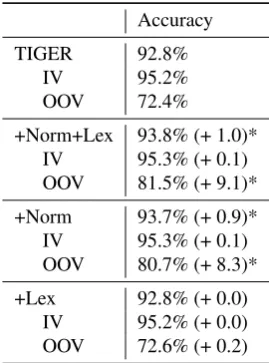
Table 4 shows the performance of our full system (+Norm+Lex) compared to the TIGER baseline. We reach an accuracy improvement of 1% for all and 9.1% for OOV tokens. The improvement is statistically significant accord-ing to a McNemar test (p<0.001)
Accuracy
TIGER 92.8%
IV 95.2%
OOV 72.4%
+Norm+Lex 93.8% (+ 1.0)*
IV 95.3% (+ 0.1)
OOV 81.5% (+ 9.1)*
+Norm 93.7% (+ 0.9)*
IV 95.3% (+ 0.1)
OOV 80.7% (+ 8.3)*
+Lex 92.8% (+ 0.0)
IV 95.2% (+ 0.0)
OOV 72.6% (+ 0.2)
Table 4: Accuracy of our system (+Norm+Lex), compared to the TIGER baseline, and to variants that use just one component. * denotes improvement compared to TIGER that is significant according to a McNemar test (p<0.001)
Accuracy
TIGER 92.8%
IV 95.2%
OOV 72.4%
+Gold 93.2% (+ 0.4)*
IV 95.4% (+ 0.2) *
OOV 74.3% (+ 2.1) *
+Norm+Lex 93.8% (+ 1.0) **
IV 95.3% (+ 0.1)
OOV 81.5% (+ 9.1)**
Table 5: Accuracy of a straightforward retraining approach compared to our system. * denotes improvement compared to TIGER that is significant according to a McNemar test (p<0.001); ** denotes improvements compared to TIGER and +Gold that are significant according to a McNemar test (p<0.001)
5.3.
Experiment 3: Retraining the Tagger
One obvious alternative approach for adapting a tagger to a new domain is to train it on in-domain training data. Fol-lowing Horbach et al. (2014), we add two-thirds of our annotated data to the TIGER corpus (+Gold), retrain the tagger models and evaluate on the remaining 4000 tokens. Table 5, however, shows that this approach performs signifi-cantly worse than our system.
5.4.
Evaluation of Individual System
Components
D-L-Distanz+Ref Aspell
Precision 0.85 0.51
Recall 0.57 0.44
F-Score 0.69 0.47
Correct Token 0.86 0.54
Correct Lemma 0.89 0.62
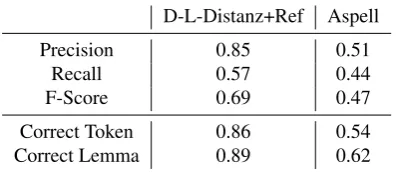
Table 6: Aspell vs. Damerau-Levenshtein Distance; upper half: number of normalizations on the right tokens; bottom half: number of all tokens with the right normalization
Performance of Lexicon Extension Additionally, we evaluate the automatic generated lexicon extensions: Two human annotators determine the POS tags of the added words as a gold standard for our automatically retrieved tags. We found that about 90% of all words are correctly tagged. Frequently, errors are confusions between normal nouns and named entities.
Performance of Normalization We compare our normal-ization method against our gold-standard normalnormal-izations and compare the results to a baseline produced by running the spell checker GNU Aspell2and taking the first proposed nor-malization. In Table 6 the results are summarized: First we evaluate the binary decision on whether a token should be normalized in terms of precision, recall and F-score. Next, if a token is normalized both in the gold standard and by our normalizer or Aspell respectively, we compare how often the correct normalization is found. In both aspects our system produces better results than a state-of-the-art spell checker. The F-score increases by 20%. If a normalization is in the right place, in 86% of all cases it is exactly the same as in the manual annotation for our system.
Evaluation of Language Models The normalization al-ternatives were ranked by a language model. The language model distinguishes between an average of 2.2 alternatives. In 86% of all cases one of them is the correct one, and in 69% the language model ranks the correct one highest.
5.5.
Analysis
Table 7 shows precision, recall and F-score for the out-of-the-box model and the improvements by our approach. For the sake of simplicity, we merged similar tags, e.g. all verb tags, into a coarser-grained label. We can make two observations: First, the performance of the TIGER model on learner data is in general reduced; there are no prominent outliers, apart from quite infrequent classes. Second, the improvement we get from our approach manifests across all POS tags.
6.
Conclusions
In this paper, we addressed the task of POS tagging for learner language. We presented both normalization and POS annotation for the CREG corpus, providing a gold standard as an evaluation basis for further POS tagging and normalization approaches.
2aspell.net
TIGER +Norm+Lex
POS Precision Recall F-Score Precision Recall F-Score
Adjective 93.7 84.5 88.8 +01.0 + 07.5 +04.5 Adverb 93.4 84.0 88.4 +01.0 +00.7 +00.9 Preposition 96.4 97.4 96.9 +02.3 -00.7 +00.8 Determiner 98.9 97.9 98.4 +00.0 -00.1 -00.1 Cardinal 92.2 93.3 92.7 +02.8 -00.9 +01.0 FM 76.8 65.5 70.7 +00.0 +03.6 +02.0 Conjunction 95.0 96.6 95.8 +00.6 -00.2 +00.2 Noun 96.3 97.8 97.0 +01.5 + 00.2 +00.9 Pronoun 92.5 96.5 94.4 +01.0 -00.6 +00.3 Particle 96.9 95.1 96.0 +00.4 +00.4 +00.4 TRUNC 75.0 100.0 85.7 +00.0 +00.0 +00.0 Verb 97.6 96.6 97.1 -00.6 +01.5 +00.4 XY 99.8 99.8 99.8 -00.2 +00.1 +00.0
Table 7: Precision, recall, and F-score percentage values for the out-of-the-box TIGER model and changes in perfor-mance for our approach
The structure of the corpus, i.e. the fact that every piece of learner language is an answer to a specific question about a text, allows us to make educated guesses if a token is OOV a standard tagger, both through lexical extension and normalization. In doing so, we get a significant improvement in tagging performance from 92.8 to 93.8% . On OOV words alone, we improve from 72.4 to 81.5%.
7.
Acknowledgements
We thank the three anonymous reviewers for their helpful comments. We also thank our annotators Sophie Henning and Maximilian Wolf for their help with this study. This work was funded by the Cluster of Excellence “Mul-timodal Computing and Interaction” of the German Excel-lence Initiative.
8.
Bibliographical References
Brants, S., Dipper, S., Eisenberg, P., Hansen, S., K¨onig, E., Lezius, W., Rohrer, C., Smith, G., and Uszkoreit, H. (2004). Tiger: linguistic interpretation of a german cor-pus. Research on Language and Computation, 2(4):597– 620.
Brants, T. (2000). Tnt – a statistical part-of-speech tag-ger. InProceedings of the Sixth Conference on Applied Natural Language Processing, pages 224–231, Seattle, Washington, USA, April. Association for Computational Linguistics.
D´ıaz-Negrillo, A., Meurers, D., Valera, S., and Wunsch, H. (2010). Towards interlanguage pos annotation for effective learner corpora in sla and flt. Language Forum, 36(1–2):139–154. Special Issue on Corpus Linguistics for Teaching and Learning. In Honour of John Sinclair. Gadde, P., Subramaniam, L. V., and Faruquie, T. A. (2011).
Workshop on Multilingual OCR and Analytics for Noisy Unstructured Text Data, page 5. ACM.
Han, B., Cook, P., and Baldwin, T. (2012). Automatically constructing a normalisation dictionary for microblogs. InProceedings of the 2012 joint conference on empirical methods in natural language processing and computa-tional natural language learning, pages 421–432. Associ-ation for ComputAssoci-ational Linguistics.
Horbach, A., Steffen, D., Thater, S., and Manfred, P. (2014). Improving the performance of standard part-of-speech taggers for computer-mediated communication. In Pro-ceedings of the 12th edition of the KONVENS conference Vol. 1. - Hildesheim.
Koleva, N., Horbach, A., Palmer, A., Ostermann, S., and Pinkal, M. (2014). Paraphrase detection for short answer scoring. InProceedings of the third workshop on NLP for computer-assisted language learning at SLTC 2014, Uppsala, Sweden.
Landis, J. R. and Koch, G. G. (1977). The measurement of observer agreement for categorical data. Biometrics, 33(1):pp. 159–174.
L¨udeling, A. (2008). Mehrdeutigkeiten und kategorisierung: Probleme bei der annotation von lernerkorpora. Fort-geschrittene Lernervariet¨aten, pages 119–140.
Manning, C. D., Surdeanu, M., Bauer, J., Finkel, J., Bethard, S. J., and McClosky, D. (2014). The Stanford CoreNLP natural language processing toolkit. InAssociation for Computational Linguistics (ACL) System Demonstrations, pages 55–60.
Margaretha, E. and L¨ungen, H. (2014). Building linguistic corpora from wikipedia articles and discussions. JLCL, 29(2):59–82.
Meurers, D., Ziai, R., Ott, N., and Kopp, J. (2011). Eval-uating answers to reading comprehension questions in context: Results for german and the role of information structure. InProceedings of the TextInfer 2011 Workshop on Textual Entailment, pages 1–9, Edinburgh, Scottland, UK. Association for Computational Linguistics.
Prange, J., Thater, S., and Horbach, A. (2015). Unsuper-vised induction of part-of-speech information for oov words in german internet forum posts. Inproceedings of NLP4CMC workshop.
Rehbein, I. (2013). Fine-grained pos tagging of german tweets. InLanguage Processing and Knowledge in the Web, pages 162–175. Springer.
Reznicek, M. and Zinsmeister, H. (2013). Stts-konfusionsklassen beim tagging von fremdsprachlerner-texten. JLCL, 28(1):63–83.
Reznicek, M., Ldeling, A., Krummes, C., Schwantuschke, F., Walter, M., Schmidt, K., Hirschmann, H., and An-dreas, T. (2012). Das falko-handbuch korpusaufbau und annotationen version 2.01.
Schiller, A., Teufel, S., Stckert, C., and Thielen, C. (1999). Guidelines fr das tagging deutscher textcorpora mit stts. Technical report, Universitt Stuttgart, Universitt Tubin-gen.
Selinker, L. (1972). Interlanguage.International Review of Applied Linguistics in Language Teaching, 10(1–4):209– 232.
Stolcke, A. (2002). Srilm - an extensible language model-ing toolkit. InProceedings International Conference on Spoken Language Processing.
Ziai, R., Ott, N., and Meurers, D. (2012). Short Answer As-sessment: Establishing Links Between Research Strands. InProceedings of the 7th Workshop on Innovative Use of NLP for Building Educational Applications (BEA7), pages 190–200, Montreal, Canada. Association for Com-putational Linguistics.