Semi-Automatic Construction of Korean-Chinese Verb Patterns
Based on Translation Equivalency
Munpyo Hong
Dept. of
Speech/Language
Technology
Research,
ETRI
Korea
[email protected]
Young-Kil Kim
Dept. of
Speech/Language
Technology
Research,
ETRI
Korea
[email protected]
Sang-Kyu Park
Dept. of
Speech/Language
Technology
Research,
ETRI
Korea
[email protected]
Young-Jik Lee
Dept. of
Speech/Language
Technology
Research,
ETRI
Korea
[email protected]
Abstract
This paper addresses a new method of constructing Korean-Chinese verb patterns from existing patterns. A verb pattern is a subcategorization frame of a predicate extended by translation information. Korean-Chinese verb patterns are invaluable linguistic resources that only used for Korean-Chinese transfer but also for Korean parsing. Usually a verb pattern has been either hand-coded by expert lexicographers or extracted auto-matically from bilingual corpus. In the first case, the dependence on the linguistic intuition of lexicographers may lead to the incompleteness and the inconsistency of a dictionary. In the second case, extracted patterns can be domain-dependent. In this paper, we present a method to construct Korean-Chinese verb patterns semi-automatically from existing Korean-Chinese verb patterns that are manually written by lexicographers.
1
Introduction
PBMT (Pattern-based Machine Translation) approach has been adopted by many MT researchers, mainly due to the portability,
customizability and the scalability of the approach. cf. Hong et al. (2003a), Takeda (1996), Watanabe & Takeda (1998). However, major drawback of the approach is that it is often very costly and time-consuming to construct a large amount of data enough to assure the performance of the PBMT system. From this reason many studies from PBMT research circles have been focused on the data acquisition issue. Most of the data acquisition studies were about automatic acquisition of lexical resources from bilingual corpus.
resources to extract verb patterns. However, as for language pairs like Korean-Chinese for which there are not so much bilingual corpus available in electronic form, the approach does not seem to be suitable. Another serious problem with the bilingual corpus-based approach is that the patterns extracted from the corpus can be domain-dependent.
The verb pattern generation based on translation equivalency is another good alternative to data acquisition from bilingual corpus. The idea was originally introduced by Fujita & Bond (2002) for Japanese to English MT.
In this paper, we present a method to construct Korean-Chinese verb patterns from existing Korean-Chinese verb patterns that are manually written by lexicographers. The clue for the semi-automatic generation is provided by the idea that verbs of similar meanings often share the argument structure as already shown in Levin (1993). The synonymy among Korean verbs can be indirectly inferred from the fact that they have the same Chinese translation.
We have already applied the approach to TELLUS K-C and increased the number of verb patterns from about 110,000 to 350,000. Though 350,000 patterns still contain many erroneous patterns, the evaluations in section 5 will show that the accuracy of the semi-automatically generated patterns is noteworthy and the pattern matching ratio improves significantly with 350,000 pattern DB.
2
Related Works
When constructing verb pattern dictionary, too much dependence on the linguistic intuition of lexicographers can lead to the inconsistency and the incompleteness of the pattern dictionary. Similar problems are encountered when working with a paper dictionary due to the insufficient examples. Hong et al (2002) introduced the concept of causative/passive linking to Korean word dictionary. The active form ‘mekta (to eat)’ is linked to its causative/passive forms ‘mekita (to let eat)’, and ‘mekhita (to be eaten)’, respectively. The linking information of this sort helps lexicographers not to forget to construct verb patterns for causative/passive verbs when they write a verb pattern for active verbs. The semi-automatic generation of verb patterns using
translation equivalency was tried in Hong et al (2002). However, as only the voice information was used as a filter, the over-generation problem is serious.
Fujita & Bond (2002) and Bond & Fujita (2003) introduced the new method of constructing a new valency entry from existing entries for Japanese-English MT. Their method creates valency patterns for words in the word dictionary whose English translations can be found in the valency dictionary. The created valency patterns are paraphrased using monolingual corpus. The human translators check the grammaticality of the paraphrases.
Yang et al. (2002) used passive/causative alternation relation for semi-automatic verb pattern generation. Similar works have been done for Japanese by Baldwin & Tanaka (2000) and Baldwin & Bond (2002) .
3
Verb Pattern in TELLUS K-C
The term ‘verb pattern’ is understood as a kind of subcategorization frame of a predicate. However, a verb pattern in our approach is slightly different from a subcategorization frame in the traditional linguistics. The main difference between the verb pattern and the subcategoriza-tion frame is that a verb pattern is always linked to the target language word (the predicate of the target language). Therefore, a verb pattern is employed not only in the analysis but also in the transfer phase so that the accurate analysis can directly lead to the natural and correct genera-tion. In the theoretical linguistics, a subcatego-rization frame always contains arguments of a predicate. An adjunct of a predicate or a modifier of an argument is usually not included in it. However, in some cases, these words must be taken into account for the proper translation. In translations adjuncts of a verb or modifiers of an argument can seriously affect the selection of target words. (1) exemplifies verb patterns of “cata (to sleep)”:
(1)
cata1 : A=WEATHER!ka ca!ta1 > A :v [param(A)ka cata: The wind has died down]
cata2 : A=HUMAN!ka ca!ta > A :v [ai(A)ka cata: A baby is sleeping] cata 3 : A=WATCH! ka ca!ta > A :v [sikye(A)ka cata: A watch has run down] cata 4 : A=PHENOMENA!ka ca!ta > A :v [phokpwungwu(A)ka cata: The storm has abated]
On the left hand of “>” Korean subcate-gorization frame is represented. The argument position is filled with a variable (A, B, or C) equated with a semantic feature (WEATHER, HUMAN, WATCH, PHENOMENA). Currently we employ about 410 semantic features for nominal semantic classifications. The Korean parts of verb patterns are employed for syntactic parsing.
On the right hand of “>” Chinese translation is given with a marker “:v”. To every pattern is attached an example sentence for better comprehensibility of the pattern. This part serves for the transfer and the generation of Chinese sentence.
4
Pattern Construction based on
Chinese Translation
In this chapter, we elaborate on the method of semi-automatic construction of Korean-Chinese verb patterns. Our method is similar to that of Fujita & Bond (2002) and inspired by it as well, i.e. it makes most use of the existing resources.
The existing resources are in this case verb patterns that have already been built manually. As every Korean verb pattern is provided with the corresponding Chinese translation, Korean verb patterns can be re-sorted to Chinese translations. The basic assumption of this approach is that the verbs with similar meanings tend to have similar case frames, as is pointed out in Levin (1993). As an indication to the similarity of meaning among Korean verbs, Chinese translation can be employed. If two verbs share Chinese translation, they are likely to have similar meanings. The patterns that have translation equivalents are seed patterns for automatic pattern generation.
Our semi-automatic verb pattern generation method consists of the following four steps:
Step1: Re-sort the existing Korean-Chinese verb patterns according to Chinese verbs
Example:
Chinese Verb 1: (to give)
tulita A=HUMAN!ka B=CAR!lul tuli!ta cwuta A=HUMAN!ka
B=HUMAN!eykey
C=VEGETABLE!lul cwu!ta swuyehata A=HUMAN!ka B=MONEY!lul
swuyeha!ta
Chinese Verb 2: (to stop)
kumantwuta A=HUMAN!ka
B=CONSTRUCTION!lul kumantwu!ta
kwantwuta A=ORGANIZATION!ka B=VIOLATION!lul kumantwu!ta
When the re-sorting is done, we have sets of synonymous Korean verbs which share Chinese translations, such as {tulita, cwuta, swuyehata} and {kumantwuta, kwantwuta }.
Step2: Pair verbs with the same Chinese translation
Example:
Chinese Verb 1: (to give)
Pair1:
tulita A=HUMAN!ka B=CAR!lul tuli!ta cwuta A=HUMAN!ka
B=HUMAN!eykey
C=VEGETABLE!lul cwu!ta
Pair2:
tulita A=HUMAN!ka B=CAR!lul tuli!ta swuyehata A=HUMAN!ka B=MONEY!lul
swuyeha!ta
Pair3:
cwuta A=HUMAN!ka B=HUMAN!eykey
swuyeha!ta
Step3: Exchange the verbs, if the following three conditions are met:
- The two Korean verbs of the pair have the same voice information
- Neither of the two verbs is idiomatic expressions
- The Chinese translation is not
Example:
tulita A=HUMAN!ka B=HUMAN!eykey C=VEGETABLE!lul tuli!ta
tulita A=HUMAN!ka B=MONEY!lul tuli!ta
cwuta A=HUMAN!ka B=CAR!lul cwu!ta cwuta A=HUMAN!ka B=MONEY!lul
cwu!ta
swuyehata A=HUMAN!ka B=CAR!lul swuyeha!ta
swuyehata A=HUMAN!ka B=HUMAN!eykey C=VEGETABLE!lul swuyeha!ta
Step4: If the newly-generated pattern already exists in the verb pattern dictionary, it is discarded.
The three conditions to be met in the third step are the filters to prevent the over-generation of patterns. The following examples shows why the first condition, i.e., “the voice of the verbs in question must agree”, must be met.
ttuta : A=PLANT!ka B=PLACE!ey ttu!ta "!$#&% '( )
namwutip(A)i mwulwi(B)ey ttuta: A leaf is floating on the water*
ttiwuta : A=HUMAN!ka B=PLACE!ey C=PLANT!lul ttiwu!ta > A + C :v
%
B ( [ai(A)ka mwulwi(B)ey namwutip(C)ul ttiwuta: A baby floated a leaf on the water]
, .-/0
sayongtoyta : A=HUMAN!eyuyhay B=MEDICINE!ka sayongtoy!ta 1
'2
!$#
[hankwuksalamtul(A)eyuyhay yak(B)i hambwulo sayongtoyta: The drug is misused by Koreans]
sayonghata : A=HUMAN!ka B=MEDICINE!lul sayongha!ta 1
!3#4'
[hankwuksalamtul (A)un yak(B)ul hambwulo sayonghanta: Koreans are misusing the drug]
As we re-sort the existing patterns according to the Chinese verbs which are marked with “:v”, the verbs of different voice may be gathered together. However, as the above examples show, the voice (active vs. causative in (2), passive vs. active in (3)) affects the argument structure of verbs. We conclude that generating patterns without considering the voice information can lead to the over-generation of patterns. The voice information of verbs can be obtained from the linking information between the verb pattern dictionary and the word dictionary. We will not look into the details of the linking relation between the verb pattern dictionary and the word dictionary of TELLUS K-C system in this paper. cf. Hong et al. (2002)
The second condition relates to the lexical patterns of Korean. Lexical patterns are used for collocational expressions. As the nature of collocation implies, a predicate that shows a strict co-occurrence relation with a certain nominal argument cannot be arbitrarily com-bined with any other nouns.
The third condition deals with the support verb construction of Chinese. The four verbs,
belong to the major verbs in Chinese that form support verb construction with predicative nouns. In support verb construction, the argument structure of the sentence is not determined by a verb but by a predicative noun. Because of this, the same Chinese translation cannot be the indication of similar meaning of Korean verbs, as followed:
5 .670
ttallangkelita (to ring): A=BELL!ka ttallangkeli!ta 1
!$#
ssawuta1 (to fight) : A=HUMAN!ka B=PROPERTY!wa ssawu!ta 1&
' !8# [kunye(A)ka mwulka(B)wa ssawunta: She is struggling with high price]
wuntonghata (to exercise) : A=HUMAN!ka B=PLACE!eyse wuntongha!ta 1
% '
9
!$#
[ku(A)ka chewyukkwan(B)eyse wuntonghanta: He is exercising in the gymnasium]
Although the Korean verbs “ttallangkelita (to ring)”, “ssawuta (to fight)”, “wuntonghata (to exercise)” share the Chinese verb “: ”, the argument structure of each Chinese translation is determined by the predicative nouns that are syntactically objects of the verbs.
5
Evaluation
The 114,581 verb patterns we have constructed for 3 years were used as seed patterns for semi automatic generation of patterns. After the steps 1 and 2 of the generation process were finished, the sets of possible synonymous verbs were constructed. To filter out the wrong synonym sets, the whole sets were examined by two lexicographers. It took a week for two lexicographers to complete this process. The wrong synonym sets were produced mainly due to the homonymy of Chinese verbs.
From the original 114,581 patterns, we generated 235,975 patterns. We performed two evaluations with the generated patterns. In the first evaluation, we were interested in finding out how many correct patterns were generated. The second evaluation dealt with the improve-ment of the pattern matching ratio due to the increased number of patterns.
Evaluation 1
In the first evaluation we randomly selected 3,086 patterns that were generated from 30 Chinese verbs. The expert Korean-Chinese lexicographers examined the generated patterns. Among the 3,086 patterns, 2,180 were correct. The accuracy of the semi-automatic generation was 70.65%. Although the evaluation set was relatively small in size, the accuracy rate seemed to be quite promising, considering there still
remain other filtering factors that can be taken into account additionally.
Chinese Verbs 30
Unique generated patterns 3,086
Correct patterns 2,180
Erroneous patterns 906
[image:5.595.319.516.104.193.2]Accuracy 70.65%
Table 1: Accuracy Evaluation
The majority of the erroneous patterns can be classified into the following two error types:
The verbs share similar meanings and selectional restrictions on the arguments. However, they differ in selecting the case markers for argument positions (the most prominent error).
Ex) ~eykey masseta/ ~wa taykyelhata (to face somebody)
The verbs share similar meanings, but the selectional restrictions are different.
Ex) PAPER!lul kyopwuhata (to deliver) / MONEY!lul nappwuhata (to pay)
Evaluation 2
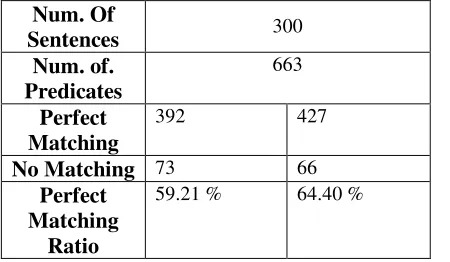
In the second evaluation, our interest was to find out how much improvement of pattern matching ratio can be achieved with the increased number of patterns in comparison to the original pattern DB. For the evaluation, 300 sentences were randomly extracted from various Korean newspapers. The test sentences were about politics, economics, science and sports. In the 300 sentences there were 663 predicates.
With the original verb pattern DB, i.e. with 114,581 patterns, the perfect pattern matching ratio was 59.21%, whereas the perfect matching ratio rose to 64.40% with the generated pattern DB.
114,581 Verb patterns
Num. Of
Sentences 300
Num. of. Predicates
663
Perfect Matching
392 427
No Matching 73 66
Perfect Matching
Ratio
[image:6.595.79.304.68.199.2]59.21 % 64.40 %
Table 2: Pattern Matching Ratio Evaluation
6
Conclusion
Korean-Chinese verb patterns are invaluable linguistic resources that cannot only be used for Korean-Chinese transfer but also for Korean analysis. In the set-up stage of the development, a paper dictionary can be used for exhaustive listing of entry words and the basic usages of the words. However, as the verb patterns made from the examples of a dictionary are often in-sufficient, a PBMT system suffers from the coverage problem of the verb pattern dictionary. Considering there are not so many Korean-Chinese bilingual corpus available in electronic form till now, we believe the translation-based approach, i.e. Chinese-based pattern generation approach provides us with a good alternative.
The focus of our future research will be given on the pre-filtering options to prevent over-generation more effectively. Another issue will be about post-filtering technique using monolingual corpus with minimized human intervention.
References
T. Baldwin and F. Bond. 2002. Alternation-based Lexicon Reconstruction, TMI 2002
T. Baldwin and H. Tanaka. 2000. Verb Alternations and Japanese – How, What and Where?
PACLIC2000
F. Bond and S. Fujita. 2003. Evaluation of a Method of Creating New Valency Entries, MT-Summit 2002
S. Fujita and F. Bond. 2002. A Method of Adding New Entries to a Valency Dictionary by Exploiting Existing Lexical Resources, TMI2002
M. Hong, Y. Kim, C. Ryu, S. Choi and S. Park. 2002. Extension and Management of Verb Phrase Patterns based on Lexicon Reconstruction and Target Word Information, The 14th Hangul and Korean Language Processing (in Korean)
M. Hong, K. Lee, Y. Roh, S. Choi and S. Park. 2003. Sentence-Pattern based MT revisited, ICCPOL 2003
B. Levin. 1993. English verb classes and alternation , The University of Chicago Press
K. Takeda. 1996. Pattern-based Machine Translation,
COLING 1996
H. Watanabe and K. Takeda. 1998. A Pattern-based Machine Translation System Extended by Example-based Processing, ACL 1998