The information-processing difficulty of incremental parsing
John Hale
Department of Linguistics and Languages Michigan State University
East Lansing, MI 48824-1027 [email protected]
Abstract
When an incremental parser gets the next word, its expectations about upcoming grammatical struc-tures can change. When a word greatly constrains these grammatical expectations, uncertainty is re-duced. This elimination of possibilities constitutes information processing work. Formalizing this no-tion of informano-tion processing work yields a com-plexity metric that predicts human repetition ac-curacy scores across a systematic class of linguis-tic phenomena, the Accessibility Hierarchy of rela-tivizable grammatical relations.
1 Introduction
An attractive hypothesis in psycholinguistics, dat-ing back at least to the 1950s, has been that the degree of predictability of words in sentences is somehow related to understandability (Taylor, 1953), production difficulty (Goldman-Eisler, 1958) or, more recently, eye-movements (McDonald and Shillcock, 2003). However, since the 1950s, inte-grating this hypothesis with realistic models of lin-guistic structure has remained a challenge.
Lounsbury (1954) appreciated the formal char-acter of the problem. He defined a finite, artificial language, endowed with a rudimentary phonology, morphology and syntax, and showed that a word’s informational contribution could be formally de-fined as the entropy reduction brought about by its addition to the end of a sentence fragment. He qual-ified the significance of his achievement, saying
An entropy reduction analysis presupposes that the number of possible messages is finite, and that the probabilities of each of the mes-sages is known....Thus it appears that the en-tropy reduction analysis could be applied only to limited classes of natural language mes-sages since the number of mesmes-sages in nearly all languages is indefinitely large
(Lounsbury, 1954, 108)
A fuller presentation of this work can be found in Hale (forthcoming).
The present paper extends Lounsbury’s original idea to infinite languages, by applying two classi-cal ideas in (probabilistic) formal language theory: Grenander’s (1967) closed-form solution for the en-tropy of a nonterminal in a probabilistic context-free phrase structure grammar, and Lang’s (1974; 1988) insight that an intermediate parser state is itself a specification of a grammar.
This extension permits the psycholinguistic hy-pothesis ERH to be examined.
Entropy Reduction Hypothesis (ERH) a
per-son’s processing difficulty at a word in a sentence is directly related to the number of bits signaled to the person by that word with respect to a probabilistic grammar the person knows.
In section 2 a method for calculating the entropy reduction of a word in a sentence generated by a probabilistic grammar is presented. Section 3 de-scribes the empirical domain of interest, the Acces-sibility Hierarchy (Keenan and Comrie, 1977). Sec-tion 4 goes on to describe two probabilistic gram-mars in the class of mildly context-sensitive Min-imalist Grammars (Stabler, 1997). One expresses the “promotion analysis” (Kayne, 1994) of relative clauses while the other expresses the more standard “adjunction analysis” (Chomsky, 1977). The pre-dictions of these grammars through the lens of the ERH are considered in sections 5 through 7, where it is shown that predictions derived from the pro-motion analysis match human repetition accuracy scores better than predictions derived from the ad-junction analysis. Section 8 concludes.
2 Entropy Reduction
in probabilistic grammars as random variables. For instance, in the rules given below,
0.87 NP→the boy
0.13 NP→the tall boy
the nonterminal NP can be viewed as a random variable that has two alternative outcomes. Indeed, nonterminals generally in probabilistic context-free phrase structure grammars (PCFGs) can be viewed this way. Since their outcomes are discrete, their entropyHis easily calculated
H(X) = −X
x∈X
p(x) log2p(x) (1)
H(NP) = −[(0.87×log20.87) +(0.13×log20.13)] ≈ 0.56bits
There is just over half a bit of uncertainty about how NP is going to rewrite, because the outcome is so heavily weighted towards the first alternative. In this simple example there is no recursion, so the generated language is finite. To obtain the uncer-tainty about infinite PCFG languages, a recursive relation due to Grenander (1967) can be used to cal-culate the entropy of the start symbolSwhich be-gins all derivations.
2.1 Entropy of nonterminals in a PCFG
Grenander’s theorem is a recurrence relation that gives the entropy of each nonterminal in a PCFGG
as the sum of two terms. Let the set of production rules inGbeΠand the subset rewriting nontermi-nalξbeΠ(ξ). Denote byprthe probability of a rule
rhaving daughtersξj1, ξj2, . . .. Then
h(ξi) = −
X
r∈Π(ξi)
prlog2pr
H(ξi) = h(ξi) +
X
r∈Π(ξi)
pr[H(ξj1)
+H(ξj2) +· · ·]
(Grenander, 1967, 19)
the first term, lowercaseh, is simply the definition of entropy for a discrete random variable. The sec-ond term, uppercase H, is the recurrence. It ex-presses the intuition that derivational uncertainty is propagated from children to parents.
For PCFGs that define a probability distribution, the solution to this recurrence can be written as a matrix equation where I is the identity matrix, ~h
the vector of the h(ξi) and A is a matrix whose
(i, j)th component gives the expected number of nonterminals of typejresulting from nonterminals of typei.
H = (I −A)−1~h (2)
2.2 Incomplete sentences
Grenander’s theorem supplies the entropy for any PCFG nonterminal in one step by inverting a ma-trix. To determine the contribution of a particu-lar word, one would like to be able to look at the change in uncertainty about compatible derivations as a given prefix string is lengthened. When this set, the set of derivations generating a given stringw= w0w1. . . wn as a left prefix, is finite, it can be
ex-pressed as a list. In the case of a recursive grammar this set is not finite and some other representation is necessary.
Lang and Billot observe (1974; 1988; 1989) that the incremental state of a parser can be described by another, related grammar. They view parsing as the intersection of a grammar with a regular lan-guage, of which ordinary strings are but the simplest examples. This perspective readily accommodates incomplete sentences as regular languages whose members all have the same initialnwords but con-tinue with all possible words of the terminal vocabu-lary, for all possible lengths. IfL(G)is the language of the grammarG, parsing an initial substringwis the intersection depicted in 3 where the period de-notes any terminal symbol ofGand the Kleene star indicates any number of repetitions.
w(.)∗∩L(G) (3)
The result of this intersection is a new context-free grammar describing just the derivations whose yield begins with the stringw. By generalizing the input from a single string to a regular set of strings, the grammatical continuations can be captured in the new, output grammar. These grammars are eas-ily read off of chart parsers’ internal data structures by attaching position indices to nonterminal names, thus distinguishing recognized constituents in dif-ferent positions.
The uncertainty associated with the the start sym-bol of this new, resultant grammar is the conditional entropy H(S|w1, w2,· · ·wn). The entropy
SUBJECT⊃DIR. OBJECT⊃INDIR. OBJECT⊃OBLIQUE⊃GENITIVE⊃OCOMP
Figure 1: The Accessibility Hierarchy of relativizable grammatical relations
3 The Accessibility Hierarchy
This paper examines the processing predictions of the ERH on a systematic class of relative clause types, the Accessibility Hierarchy (AH) shown in figure 1. The AH is an implicational markedness hierarchy of grammatical relations discovered by Keenan and Comrie in (1977). The implication is that if a language has a relative-clause formation rule applicable to grammatical relations at some point x on the AH, then it can also form relative clauses on grammatical relations listed at all points beforex.
This hierarchy shows up in a variety of mod-ern syntactic theories that have been influenced by Relational Grammar (Perlmutter and Postal, 1974). In Head-driven Phrase Structure Grammar (Pollard and Sag, 1994) the hierarchy corresponds to the order of elements on the SUBCAT list, and inter-acts with other principles in explanations of bind-ing facts. The hierarchy also figures in Lexical-Functional Grammar (Bresnan, 1982) where it is known as Syntactic Rank.
Keenan and Comrie speculated that their typo-logical generalization might have a basis in per-formance factors. This idea was examined in a repetition-accuracy experiment carried out in 1974 but not published until 1987. Subjects in this study repeated back stimulus sentences after a delay while under the additional memory load of a digit-memory task. Stimuli were subject-modifying rel-ative clauses embedded in one of four carrier sen-tence frames, exemplified in figure 2.
subject extracted they had forgotten that the boy who
told the story was so young
direct object extracted the fact that the cat which
David showed to the man likes eggs is strange
indirect object extracted I know that the man who
Stephen explained the accident to is kind
oblique extracted he remembered that the food which
Chris paid the bill for was cheap
genitive subject extracted they had forgotten that the
girl whose friend bought the cake was waiting
genitive object extracted the fact that the sailor whose
ship Jim took had one leg is important
Figure 2: Relative clauses in each of four carrier sentence types
The results of the human study, given in figure 3,
SU DO IO OBL GenS GenO
repetition
accuracy 406 364 342 279 167 171
Figure 3: results from Keenan & Hawkins (1987)
show that repetition accuracy1 declines across the AH. Keenan and Hawkins (1987) note however that “It remains unexplained just why RCs should be more difficult to comprehend-produce as they are formed on positions lower on the AH.”
The ERH, if correct, would offer just such an ex-planation. If a person’s difficulty on each word of a sentence is related to derivational information sig-naled by that word, then the total difficulty reading a sentence ought to be the sum of the difficulty on each word2.
4 Minimalist Grammars
If correct, the ERH would explain the increasing difficulty across the AH in terms of greater or lesser uncertainty about intermediate parser states. To cal-culate these predictions, some assumption must be made about what those structures are.
4.1 Two analyses of relativization
Toward this end, two grammars covering the Keenan and Hawkins stimuli were written in the Minimalist Grammars (Stabler, 1997) formalism. These grammars were exactly the same except for their treatment of relative clauses.
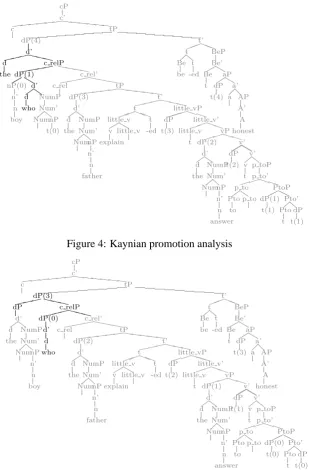
One grammar expresses the usual analysis of rel-ative clauses as right-adjoined modifiers (Chomsky, 1977). The other expresses the promotion analysis of relative clause. The analysis, which dates back to the 1960s, is revived in Kayne (1994). For reasons having to do with Kayne’s general theory of phrase structure, he proposes that, in a sentence like 1, the underlying form of the subject is akin to 2.
1
Each response was coded for accuracy on a 0-2 scale where 2 means perfect repetition and 1 suggests minor, grammatical errors. A score of 0 was assigned when the response did not include a relative clause of the indicated grammatical function. Cf.Keenan and Hawkins (1987)
2
(1) the boy who the father explained the answer to was honest
(2) [IP the father explained the answer to
[DP[+wh]who boy[+f]] ]
According to Kayne, at an early stage (2) of syn-tactic derivation, the determiner phrase (DP) “who boy” occupies what will eventually be the gap posi-tion. This DP moves to a specifier position of the en-closing, empty-headed (C0) complementizer phrase (CP), thereby checking a feature+wh as indicated in 3.
(3) [CP [DPwho boy[+f]]iC0[IPthe father ex-plained the answer to ti] ]
In a second movement, “boy” evacuates from DP, moving to another specifier (perhaps that of the silent agreement morpheme, Agr) as in 4 – checking a different feature,+f.
(4) [AgrPboyjAgr[CP [DPwho tj]iC0[IPthe father explained the answer to ti] ] ]
The entire structure becomes a complement of a de-terminer to yield a larger DP in 5.
(5) [DPthe[AgrPboyjAgr[CP [DPwho tj]iC0
[IP the father explained the answer to ti] ] ]
]
No adjunction is used in this derivation, and, un-conventionally, the leftmost “the” and “boy” do not share an exclusive common constituent. Nor is the wh-word “who” co-indexed with anything. Struc-tural descriptions involving both the Kaynian anal-ysis and the more standard adjunction analanal-ysis are shown in figures 4 and 5 respectively3. The other linguistic assumptions suggested by these diagrams are discussed in chapter 4 of Hale (2003).
4.2 Formal grammars of relativization
The Minimalist Grammars (MG) formalism (cf. Stabler and Keenan (2003) for a systematic pre-sentation) facilitates the relatively transparent im-plementation of ideas like movement and fea-ture checking that figure prominently in the two analyses of relativization discussed in the previ-ous subsection. MGs define a set of sentences by closing the structure-building functions merge and move on a finite set of lexical entries; how-ever, this does not mean that parsing must happen bottom-up. A fundamental result, obtained inde-pendently by Harkema (2001) and Michaelis (2001)
3The X-bar structures depicted in figures 4 and 5 are drawn using tools developed by Edward Stabler and colleagues.
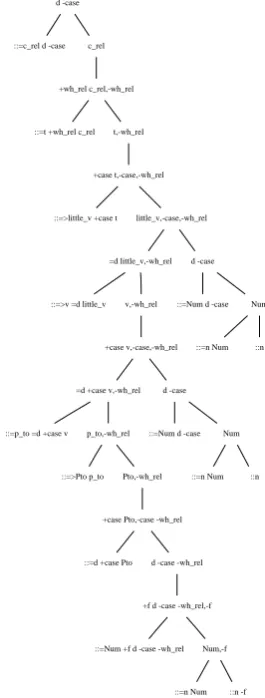
is that MGs are equivalent to Multiple free grammars (Seki et al., 1991). Multiple context-free grammars generalize standard context-context-free grammars by allowing the string yields of daugh-ter categories to be manipulated by a function other than simple concatenation. As in Tree Adjoin-ing Grammar (Joshi et al., 1975) a record of these manipulations is kept at each node of an MG deriva-tion tree, while a picture of the result is manifested in derived trees such as the ones in figures 4 and 5. The derivation tree on the promotion grammar is shown4 in figure 6 for the substring “the boy who the father explained the answer to.”
d -case
::=c_rel d -case c_rel
+wh_rel c_rel,-wh_rel
::=t +wh_rel c_rel t,-wh_rel
+case t,-case,-wh_rel
::=>little_v +case t little_v,-case,-wh_rel
=d little_v,-wh_rel d -case
::=>v =d little_v v,-wh_rel
+case v,-case,-wh_rel
=d +case v,-wh_rel d -case
::=p_to =d +case v p_to,-wh_rel
::=>Pto p_to Pto,-wh_rel
+case Pto,-case -wh_rel
::=d +case Pto d -case -wh_rel
+f d -case -wh_rel,-f
::=Num +f d -case -wh_rel Num,-f
::=n Num ::n -f ::=Num d -case Num
::=n Num ::n ::=Num d -case Num
::=n Num ::n
Figure 6: Derivation tree on promotion grammar.
The derivation trees encode everything there is to know about MG derivations, and can be parsed in a variety of orders. Most importantly, if equipped with weights on their branches, they can be gener-ated by probabilistic context-free grammars.
cP
c hhhhhhtP
dP(4)
PPlittle v’
Figure 4: Kaynian promotion analysis
cP
c hhhhhhtP
dP(3)
XXXlittle vP
Figure 5: more standard adjunction analysis
5 Procedure
Derivation trees on both grammars were obtained5 for each of Keenan and Hawkins’ (1987) twenty-four stimulus sentences6. Branches of these deriva-tion trees were viewed as PCFG rules with probabil-ities set according to the usual relative-frequency es-timation technique (Chi, 1999). However, because the stimuli were intentionally constructed to have
5
Derivations were obtained using a parser described in Ap-pendix A of Hale (2003)
6
To eliminate number agreement as a source of derivational uncertainty, the results were calculated using a modified stim-ulus set in which four noun phrases were changed from plural to singular.
exactly four examples of each structure, these sen-tences were weighted in accordance with a corpus study (Keenan, 1975) to make their relative frequen-cies more realistic.
6 Results
The summed entropy reductions exhibit a signifi-cant correlation with the repetition accuracy scores collected by Keenan and Hawkins (1987).
250 300 350 400 450 500error score 30
35 40 45 50 55 total bits reduced
Accessibility Hierarchy promotion grammar r2
=0.45, p<0.001
250 300 350 400 450 500error score 50
55 60 65 70 75 total bits reduced
Accessibility Hierarchy adjunction grammar r2
=0.02, n.s.
Figure 7: Predictions of two probabilistic Minimalist Grammars through the lens of the ERH
exhibit a significant correlation with repetition ac-curacy scores.
7 Discussion
From the perspective of the ERH, the difference be-tween the promotion and adjunction grammars re-sides in the uncertainty of particular states an incre-mental parser would pass through on the way to a complete analysis.
On the Keenan and Hawkins’ (1987) stimuli, these grammars specify incremental parser states that support explanations for some of the observed repetition accuracy asymmetries, abbreviated<. SU<IO subject extracted relatives are easier than
indirect object extracted relatives, because a left-to-right incremental parser evades, in just subject extracted relatives, the uncertainty as-sociated with questions like
• which internal argument is the gap?
• did dative shift happen?
These questions are defined by alterna-tive derivation-subtrees associated with the verb phrase. For the DO stimuli that use poten-tially ditransitive embedded verbs the same ex-planation is available, however only two out of four items in the Keenan and Hawkins (1987) set qualify.
IO<OBL there is only one type of extraction
from indirect object, whereas on these gram-mars, the head of the oblique phrase (“for” “with” “on” or “in”) signals which of four cat-egorically separate kinds of extraction has oc-curred. These alternatives correspond to four different derivation-nonterminals.
OBL<GEN both grammars analyze “whose” as
taking a common noun argument, for example
“whose ship.” But in just the promotion gram-mar, “whose” is further analyzed as the ordi-nary “who” morpheme plus a complex pos-sessive phrase headed by “-s” (McDaniel et al., 1998). Because of the recursive charac-ter of this possessor category, the structure of “whose’s” common noun argument introduces additional uncertainty not present in the indi-rect object extracted relatives.
Strikingly, the two grammars disagree on six out-liers in figure 7(b) where just the adjunction gram-mar predicts very great difficulty in conjunction with the ERH. These outlier predictions are made on just the sentences that use the nominal carrier frame beginning with “the fact that...” Because the adjunc-tion grammar analyzes relative clauses with an MG rule analogous to the phrase structure rule (4),
DP → DP CPrel. (4)
all DPs are available for modification by any num-ber of stacked relative clauses. The nominal frame introduces an additional DP, not present in the other stimuli, that can be modified in this way.
By contrast, the promotion grammar does not in-clude a +f promotion feature on any lexical en-try for “fact,” precluding the possibility of such modification. Moreover, even with such a feature, the promotion grammar assigns different categories to the outermost versus successive relative clause modifiers. Because only one relative clause is ever stacked in the Keenan and Hawkins (1987) stimulus set, the relevant recursion is not attested, yielding a category of caseless subject DP that is more certain than it is in the adjunction grammar.
of 2ndand subsequent stacked relative clause modi-fiers is closer to0(its value on the trained promotion grammar) than to0.31(its value on the trained ad-junction grammar). Beyond these particular stimuli, this modeling motivates a general question about the scale of structural expectations in human sen-tence processing. Does disconfirmation of a more complicated structural alternative (such as stacked relative clauses) induce greater processing difficulty than disconfirmation of a simpler one? Such em-pirical issues go beyond the scope of this paper but suggest particular kinds of future work.
8 Conclusion
By extending Lounsbury’s (1954) entropy reduction idea to infinite languages, it has become possible to relate predictability and processing difficulty in a way that takes into account linguistic structures de-fined by one kind of mildly context-sensitive gram-mar formalism. This relation is the linking hypoth-esis ERH.
On this linking hypothesis, a grammar express-ing the promotion analysis of relative clauses yields whole-sentence predictions more closely approxi-mating human repetition accuracy results than does a grammar expressing the standard adjunction anal-ysis.
If the ERH is true, this result suggests that one grammar carries a kind of greater psychological va-lidity than the other. On the other hand, to the extent that the promotion grammar correctly char-acterizes human linguistic competence, this con-firms the ERH as a linking hypothesis. In any case, the information-processing difficulty of incremental parsing can now be given a more specific definition.
Acknowledgments
The author wishes to thank Paul Smolensky, Ed Sta-bler and Ted Gibson.
References
Sylvie Billot and Bernard Lang. 1989. The struc-ture of shared forests in ambiguous parsing. In
Proceedings of the 1989 Meeting of the Associa-tion for ComputaAssocia-tional Linguistics.
Joan Bresnan, editor. 1982. The Mental
Repre-sentation of Grammatical Relations. MIT Press,
Cambridge, MA.
Zhiyi Chi. 1999. Statistical properties of prob-abilistic context-free grammars. Computa-tional Linguistics, 25(1):131–160.
Noam Chomsky. 1977. On Wh-Movement. In Pe-ter Culicover, Thomas Wasow, and Adrian
Ak-majian, editors, Formal Syntax, pages 71–132. Academic Press, New York.
Frieda Goldman-Eisler. 1958. Speech produc-tion and the predictability of words in context.
Quarterly Journal of Experimental Psychology,
10:96–106.
Ulf Grenander. 1967. Syntax-controlled probabili-ties. Technical report, Brown University Division of Applied Mathematics, Providence, RI.
John Hale. 2003. Grammar, uncertainty and
sen-tence processing. Ph.D. thesis, Johns Hopkins
University, Baltimore, Maryland.
Henk Harkema. 2001. Parsing Minimalist
Gram-mars. Ph.D. thesis, UCLA.
Aravind K. Joshi, Leon S. Levy, and Masako Taka-hashi. 1975. Tree adjunct grammars. Journal of
Computer and System Sciences, 10:136–163.
Richard S. Kayne. 1994. The Antisymmetry of
Syn-tax. MIT Press.
Edward L. Keenan and Bernard Comrie. 1977. Noun phrase accessibility and universal grammar.
Linguistic Inquiry, 8(1):63–99.
Edward L. Keenan and Sarah Hawkins. 1987. The psychological validity of the Accessibility Hi-erarchy. In Edward L. Keenan, editor,
Univer-sal Grammar: 15 Essays, pages 60–85, London.
Croom Helm.
Edward L. Keenan. 1975. Variation in universal grammar. In R.W. Shuy and R.W. Fasold, edi-tors, Analyzing Variation in Language. George-town University Press.
Bernard Lang. 1974. Deterministic techniques for efficient non-deterministic parsers. In J. Loeckx, editor, Proceedings of the 2nd Colloquium on
Automata, Languages and Programming,
num-ber 14 in Springer Lecture Notes in Computer Science, pages 255–269, Saarbru¨ucken.
Bernard Lang. 1988. Parsing incomplete sentences. In Proceedings of the 12th International
Confer-ence on Computational Linguistics, pages 365–
371.
Floyd G. Lounsbury. 1954. Transitional proba-bility, linguistic structure and systems of habit-family hierarchies. In C. E. Osgood and T. A. Sebeok, editors, Psycholinguistics: a survey of
theory and research. Indiana University Press.
Dana McDaniel, Cecile McKee, and Judy B. Bern-stein. 1998. How children’s relatives solve a problem for minimalism. Language, pages 308– 334.
lexical probabilities during reading.
Psychologi-cal Science, 14:648–652.
Jens Michaelis. 2001. On Formal Properties of
Minimalist Grammars. Ph.D. thesis, Potsdam
University.
David Perlmutter and Paul Postal. 1974. Lectures
on Relational Grammar. LSA Linguistic
Insti-tute, UMass Amherst.
Carl Pollard and Ivan A. Sag. 1994. Head-driven Phrase Structure Grammar. University of
Chicago Press.
Hiroyuki Seki, Takashi Matsumura, Mamoru Fujii, and Tadao Kasami. 1991. On multiple context-free grammars. Theoretical Computer Science, 88:191–229.
Edward Stabler and Edward Keenan. 2003. Struc-tural similarity. Theoretical Computer Science, 293:345–363.
Edward P. Stabler. 1997. Derivational minimal-ism. In Christian Retor´e, editor, Logical
As-pects of Computational Linguistics, pages 68–95.
Springer.