A Power Mean Based Algorithm for Combining Multiple
Alignment Tables
Sameer Maskey, Steven J. Rennie, Bowen Zhou IBM T.J. Watson Research Center
{smaskey, sjrennie, zhou}@us.ibm.com
Abstract
Most existing techniques for combining multiple alignment tables can combine only two alignment tables at a time, and are based on heuristics (Och and Ney, 2003), (Koehn et al., 2003). In this pa-per, we propose a novel mathematical for-mulation for combining an arbitrary num-ber of alignment tables using their power mean. The method frames the combi-nation task as an optimization problem, and finds the optimal alignment lying be-tween the intersection and union of multi-ple alignment tables by optimizing the pa-rameterp: the affinely extended real num-ber defining the order of the power mean function. The combination approach pro-duces better alignment tables in terms of both F-measure and BLEU scores.
1 Introduction
Machine Translation (MT) systems are trained on bi-text parallel corpora. One of the first steps involved in training a MT system is obtaining alignments between words of source and target languages. This is typically done using some form of Expectation Maximization (EM) algo-rithm (Brown et al., 1993), (Och and Ney, 2003), (Vogel et al., 1996). These unsupervised algo-rithms provide alignment links between english wordseiand the foreign wordsfjfor a givene−f
sentence pair. The alignment pairs are then used to extract phrases tables (Koehn et al., 2003), hi-erarchical rules (Chiang, 2005), or tree-to-string mappings (Yamada and Knight, 2001). Thus, the
accuracy of these alignment links has a significant impact in overall MT accuracy.
One of the commonly used techniques to im-prove the alignment accuracy is combining align-ment tables obtained for source to target (e2f) and target to source (f2e) directions (Och and Ney,
2003). This combining technique involves obtain-ing two sets of alignment tablesA1andA2for the
same sentence pair e−f, and producing a new set based on union A∪ = A1 ∪A2 or
intersec-tionA∩ =A1∩A2or some optimal combination
Ao such that it is subset ofA1 ∪A2 but a
super-set ofA1 ∩A2. How to find this optimalAo is a
key question. A∪ has high precision but low re-call producing fewer alignments andA∩ has high recall but low precision.
2 Related Work
Most existing methods for alignment combina-tion (symmetrizacombina-tion) rely on heuristics to iden-tify reliable links (Och and Ney, 2003), (Koehn et al., 2003). The method proposed in (Och and Ney, 2003), for example, interpolates the intersec-tion and union of two asymmetric alignment ta-bles by adding links that are adjacent to intersec-tion links, and connect at least one previously un-aligned word. Another example is the method in (Koehn et al., 2003), which adds links to the inter-section of two alignment tables that are the diago-nal neighbors of existing links, optiodiago-nally requir-ing that any added links connect two previously unaligned words.
opti-mizing an EM-like objective function based on agreement heuristics. In (Ayan et al., 2004), the authors present a technique for combining align-ments based on various linguistic resources such as parts of speech, dependency parses, or bilingual dictionaries, and use machine learning techniques to do alignment combination. One of the main dis-advantages of (Ayan et al., 2004)’s method, how-ever, is that the algorithm is a supervised learning method, and so requires human-annotated data. Recently, (Xiang et al., 2010) proposed a method that can handle multiple alignments with soft links which are defined by confidence scores of align-ment links. (Matusov et al., 2004) on the other hand, frame symmetrization as finding a set with minimal cost using use a graph based algorithm where costs are associated with local alignment probabilities.
In summary, most existing alignment combina-tion methods try to find an optimal alignment set Ao that lies betweenA∩ andA∪ using heuristics. The main problems with methods based on heuris-tics are:
1. they may not generalize well across language pairs
2. they typically do not have any parameters to optimize
3. most methods can combine only 2 align-ments at a time
4. most approaches are ad-hoc and are not mathematically well defined
In this paper we address these issues by propos-ing a novel mathematical formulation for com-bining an arbitrary number of alignment tables. The method frames the combination task as an op-timization problem, and finds the optimal align-ment lying between the intersection and union of multiple alignment tables by optimizing the pa-rameterpof the power mean function.
3 Alignment combination using the power mean
Given an english-foreign sentence pair (eI1, f1J)
the alignment problem is to determine the pres-ence of abspres-ence of alignment links aij between
the wordsei andfj, wherei ≤ I andj ≤ J. In
this paper we will use the convention that when aij = 1, words ei and fj are linked, otherwise
aij = 0. Let us define the alignment tables we
ob-tain for two translation directions as A1 andA2,
respectively. The union of these two alignment tablesA∪ contain all of the links inA1 andA2,
and the intersectionA∩ contain only the common links. Definitions 1 and 2 below define A∪ and A∩ more formally. Our goal is to find an align-ment set Ao such that |A∩| ≤ |Ao| ≤ |A∪|that maximizes some objective function. We now de-scribe the power mean (PM) and show how the PM can represent both the union and intersection of alignment tables using the same formula.
The power mean:
The power mean is defined by equation 1 below, wherepis a real number in(−∞,∞)andanis a
The power mean, also known as the generalized mean, has several interesting properties that are relevant to our alignment combination problem. In particular, the power mean is equivalent to the geometric meanGwhenp→0as shown in equa-tion 2 below:
The power mean, furthermore, is equivalent to the maximum functionM whenp→ ∞:
Importantly, the PM Sp is a non-decreasing
function of p. This means that Sp is lower
bounded byGand upper-bounded byM forp ∈
[0,∞]:
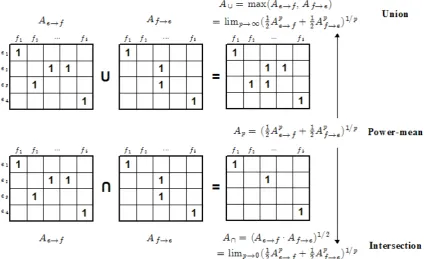
Figure 1: The power-mean is a principled way to interpolate between the extremes of union and inter-section when combining multiple alignment tables.
They key insight underpinning our mathematical formulation of the alignment combination prob-lem is that the geometric mean of multiple align-ment tables is equivalent to their intersection, while the maximum of multiple alignment tables is equivalent to their union.
LetAqbe an alignment with elementsaqij such
that aqij = 1 if words ei and fj are linked, and
aqij = 0otherwise. The union and intersection of
a set of nalignment tables can then be formally defined as follows:
Definition 1: The union of alignments A1, A2, ..., Anis a setA∪ witha∪ij = 1ifa
q ij = 1
foranyq∈ {1,2, ..., n}.
Definition 2: The intersection of alignments A1, A2, ..., Anis a setA∩ witha∩ij = 1ifa
q ij = 1
forallq∈ {1,2, ..., n}.
Figure 1 depicts a simple example of the align-ment combination problem for the common case of alignment symmetrization. Two alignments ta-bles,Ae→f andAf→e (one-to-many alignments),
need to be combined. The result of taking the union A∪ and intersection A∩ of the
ta-bles is shown. A∪ can be computed by taking the element-wise maximum ofAe→f andAf→e,
which in turn is equal to the power meanAp of
the elements of these tables in the limit asp→ ∞. The intersection of the two tables,A∩, can simi-larly be computed by taking the geometric mean of the elements of Ae→f and Af→e, which is
equal to the power mean Ap of the elements of
these tables in the limit asp→0. Forp∈(0,∞),
equation 4 implies thatAp has elements with
val-ues betweenA∩andA∪. We now provide formal proofs for these results when combining an arbi-trary number of alignment tables.
3.1 The intersection of alignment tables A1..Anis equivalent to their
element-wise geometric mean G(A1, A2, ..., An), as defined in (2).
P roof : Let A∩ be the intersection of all Aq
whereq ∈ {1,2, .., n}. As per our definition of intersection∩between alignment tables,A∩ con-tains links whereaqij = 1∀q.
of G(A1, A2, ..., An). Then agij is the
geo-metric mean of the elements aqij where q ∈
{1,2, .., n}, as defined in equation 2, that is,agij = (Qnq=1agij)n1. This product is equal to 1 iffaq
ij =
1∀q and zero otherwise, sinceaqij ∈ {0,1} ∀q. HenceAg =A∩. Q.E.D.
3.2 The union of alignment tablesA1..Anis
equivalent to their element-wise
maximumM(A1, A2, ..., An), as defined
in (3).
P roof :LetA∪ be the union of all Aq for q ∈
{1,2, .., n}. As per our definition of the union be-tween alignmentsA∪has links whereaqij = 1for someq.
LetAmbe the set that contain the elements of
M(A1, A2, ..., An). Let amij be the maximum of
the elementsaqijwhereq ∈ {1,2, .., n}, as defined in equation (3). The max function is equal to 1 iffaqij = 1for someq and zero otherwise, since aqij ∈ {0,1} ∀q. HenceAm =A∪. Q.E.D. 3.3 The element-wise power mean
Sp(A1, A2, ..., An)of alignment tables
A1..Anhas entries that are
lower-bounded by the intersection of these tables, and upper-bounded by their union forp∈[0,∞].
P roof :We have already shown that the union and intersection of a set of alignment tables are equivalent to the maximum and geometric mean of these tables, respectively. Therefore given that the result in equation 4 is true (we will not prove it here), the relation holds. In this sense, the power mean can be used to interpolate between the in-tersection and union of multiple alignment tables. Q.E.D.
4 Data
We evaluate the proposed method using an English-Pashto translation task, as defined by the DARPA TransTac program. The training data for this task consists of slightly more than 100K par-allel sentences. The Transtac task was designed to evaluate speech-to-speech translation systems, so all training sentences are conversational in nature. The sentence length of these utterances varies greatly, ranging from a single word to more than
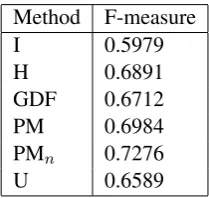
Method F-measure
I 0.5979
H 0.6891
GDF 0.6712 PM 0.6984 PMn 0.7276
U 0.6589
Table 1: F-measure Based on Various Alignment Combination Methods
50 words. 2026 sentences were randomly sampled from this training data to prepare held out devel-opment set. The held out Transtac test set consists of 1019 parallel sentences.
5 Experiments and Discussion
We have shown in the previous sections that union and intersection of alignments can be mathemat-ically formulated using the power mean. Since both combination operations can be represented with the same mathematical expression, we can search the combination space “between” the in-tersection and union of alignment tables by op-timizing p w.r.t. any chosen objective function. In these experiments, we define the optimal align-ment as the one that maximizes the objective func-tion f({aijt},{ˆaijt}, p), where f is standard
F-measure,{ˆaijt} is the set of all estimated
align-ment entries on some dataset,{aijt}is the set of
all corresponding human-annotated alignment en-tries, andpis the order of the power mean func-tion. Instead of attempting to optimize the F-measure using heuristics, we can now optimize it by finding the appropriate power orderpusing any suitable numerical optimization algorithm. In our experiments we used the general simplex algo-rithm of amoeba search (Nelder and Mead, 1965), which attempts to find the optimal set of parame-ters by evolving a simplex of evaluated points in the direction that the F-measure is increasing.
In order to test our alignment combination for-mulation empirically we performed experiments on English-Pashto language with data described in Section 4. We first trained two sets of alignments, the e2f and f2e directions, based on GIZA++
intersec-tion (I) and union (U). We obtained F-measure of 0.5979 for intersection (I), 0.6589 for union (U). For intersection the F-measure is lower presum-ably because many alignments are not shared by the input alignment tables so the number of links is under-estimated. We then also re-produced the two commonly used combination heuristic meth-ods that are based on growing the alignment di-agonally (GDF) (Koehn et al., 2003), and adding links based on refined heuristics (H) (Och and Ney, 2003), respectively. We obtained F-measure of 0.6891 for H, and 0.6712 for GDF as shown in Table 1.
We then used our power mean formulation for combination to maximize the F-measure function with the aforementioned simplex algorithm for tuning the power parameter p, where F-measure is computed with respect to the hand aligned de-velopment data, which contains 150 sentences. This hand aligned development set is different than the development set for training MT models. While doing so we also optimized table weights Wq ∈(0,1),PqWq = 1, which were applied to
the alignment tables before combining them using the PM. TheWqallow the algorithm to weight the
two directions differently. We found that the F-measure function had many local minima so the simplex algorithm was initialized at several val-ues of p and {Wq} to find the globally optimal
F-measure.
After obtaining power mean outputs for the alignment entries, they need to be converted into binary valued alignment links, that is, Sp(a1ij, a2ij, ...anij)needs to be converted into a
bi-nary table. There are many ways to do this con-version such as simple thresholding or keeping best N% of the links. In our experiments we used the following simple selection method, which ap-pears to perform better than thresholding. First we sorted links by PM value and then added the links from the top of the sorted list such thatei andfj
are linked ifei−1andei+1are connected tofj, or
fj−1andfj+1is linked toei, or botheiandfjare
not connected. After tuning power mean parame-ter and the alignment weights the best parameparame-ter gave an F-measure of 0.6984 which is higher than commonly used GDF by 2.272% and H by 0.93% absolute respectively. We observe in Figure 2 that
even though PM has higher F-measure compared with GDF it has significantly fewer number of alignment links suggesting that PM has improved precision on the finding the alignment links. The presented PM based alignment combination can be tuned to optimize any chosen objective, so it is not surprising that we can improve upon previous results based on heuristics.
One of the main advantages of the combining alignment tables using the PM is that our state-ments are valid for any number of input tables, whereas most heuristic approaches can only pro-cess two alignment tables at a time. The presented power mean algorithm, in contrast, can be used to combine any number of alignments in a sin-gle step, which, importantly, makes it possible to jointly optimize all of the parameters of the com-bination process.
In the second set of experiments the PM ap-proach, which we call PMn, is applied
simultane-ously to more than two alignments. We obtained four more sets of alignments from the Berke-ley aligner (BA) (Liang et al., 2006), the HMM aligner (HA) (Vogel et al., 1996), the alignment based on partial words (PA), and alignment based on dependency based reordering (DA) (Xu et al., 2009). Alignment I was obtained by using Berke-ley aligner as an off-the-shelf alignment tool. We built the HMM aligner based on (Vogel et al., 1996) and use the HMM aligner for producing Alignment II. Producing different sets of align-ments using different algorithms could be useful because some alignments that are pruned by one algorithm may be kept by another giving us a big-ger pool of possible links to chose from.
We produced Alignment III based on partial words. Pashto is morphologically rich language with many prefixes and suffixes. In lack of a mor-phological segmenter it has been suggested that keeping only first ‘n’ characters of a word can ef-fectively reduce the vocabulary size and may pro-duce better alignments. (Chiang et al., 2009) used partial words for alignment training in English and Urdu. We trained such alignments using using GIZA++ on parallel data with partial words for
Pashto sentences.
Figure 2: Number of Alignments Links for Dif-ferent Combination Types
2009). (Xu et al., 2009) showed that transla-tion between subject-verb-object (English) and subject-object-verb (Pashto) languages can be im-proved by reordering the source side of the par-allel data. They obtained dependency tree of the source side and used high level human gener-ated rules to reorder source side using precedence-based movement of dependency subtrees. The rules were particularly useful in reordering of verbs that moved to the end of the sentence. Mak-ing the orderMak-ing of source and target side more similar may produce better alignments for lan-guage pairs which differ in verb ordering, as many alignment algorithms penalize or fail to consider alignments that link words that differ greatly in sentence position. A Pashto language expert was hired to produce similar precedence-based rules for the English-Pashto language pair. Using the rules and algorithm described in (Xu et al., 2009) we reordered all of the source side and used GIZA++to align the sentences.
The four additional alignment sets just de-scribed, including our baseline alignment, Align-ment V, were combined using the presented PMn
combination algorithm, where n signifies the number of tables being combined. As seen on Table 1, we obtained an F-measure of 0.7276 which is 12.97% absolute better than intersection and 6.87% better than union. Furthermore PMn,
which in these experiments utilizes 5 alignments, is better than PM by 2.92% absolute. This is an encouraging result because this not only shows that we are finding better alignments than
inter-section and union, but also that combining more than two alignments is useful. We note that PMn
performed 3.85% absolute better than H (Och and Ney, 2003), and 5.64% better than GDF heuris-tics.
In the above experiments the parameters of the power mean combination method were tuned on development data to optimize alignment F-measure, and the performance of several align-ment combination techniques were compared in terms of F-measure. However, it is not clear how correlated alignment F-measures are with BLEU scores, as explained in (Fraser and Marcu, 2007).
While there is no mathematical problem with optimizing the parameters of the presented PM-based combination algorithm w.r.t. BLEU scores, computationally it is not practical to do so because each iteration would require a complete training phase. To further evaluate the quality of the align-ments methods being compared in this paper, we built several MT models based on them and com-pared the resulting BLEU scores.
E2F Dev Test I 0.1064 0.0941 H 0.1028 0.0894 GDF 0.1256 0.1091 PM 0.1214 0.1094 PMn 0.1378 0.1209
U 0.1062 0.0897
Table 2: E2F BLEU: PM Alignment Combination Based MT Model Comparision
English and Pashto, but for English we had signif-icantly more monolingual sentences (1.4 million in total) compared to slightly more than 100K sen-tences for Pashto. We tuned our MT model using minimum error rate (Och, 2003) training.
F2E Dev Test I 0.1145 0.1101 H 0.1262 0.1193 GDF 0.1115 0.1204 PM 0.1201 0.1155 PMn 0.1198 0.1196
U 0.1111 0.1155
Table 3: F2E BLEU : PM Alignment Combina-tion Based MT Model Comparision
We built five different MT models based on Intersection (I), Union (U), (Koehn et al., 2003) Grow Diagonal Final (GDF), (Och and Ney, 2003) H refined heuristics and Power Mean (PMn)
align-ment sets wheren = 5. We obtained BLEU
(Pa-pineni et al., 2002) scores for E2F direction as shown in Table 2. As expected MT model based on I alignment has the low BLEU score of 0.1064 on the dev set and 0.0941 on the test set on E2F direction. Intersection, though, has higher preci-sion, but throws away many alignments, so the overall number of alignments is too small to pro-duce a good phrase translation table. Similarly the U alignment also has low scores (0.1062 and 0.0897) on the dev and test sets, respectively. The best scores for E2F direction for both dev and test set is obtained using the model based on PMn
al-gorithm. We obtained BLEU scores of 0.1378 on the dev set and 0.1209 on the test set which is bet-ter than all heuristic based methods. It is betbet-ter by 1.22 absolute BLEU score on the dev set and 1.18 on a test compared to commonly used GDF (Koehn et al., 2003) heuristics. The above BLEU scores were all computed based on 1 reference. Note that for the e2f direction PM, which com-bines only 2 alignments, is not worse than any of the heuristic based methods. Also note that the difference in the BLEU score of PM and PMnis
quite large, which indicates that combining more than two alignments using the power mean leads to substantial gains in performance.
Although we saw significant gains on E2F
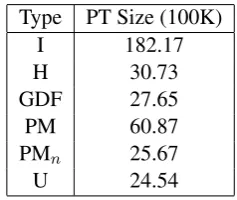
di-Type PT Size (100K)
I 182.17
H 30.73
GDF 27.65
PM 60.87
PMn 25.67
U 24.54
Table 4: E2F Phrase Table Size
rection we did not see similar gains on F2E di-rection unfortunately. Matching our expectation Intersection (I) produced the worse results with BLEU scores of 0.1145 and 0.1101 on the dev and test set respectively, as shown in Table 3. Our PMn algorithm obtained BLEU score of 0.1198
on the dev set and 0.1196 on test set which is better by 0.83 absolute in dev set over GDF. On the test set though performance between PMnand
GDF is only slightly different with 0.1196 for PMnand 0.1204 for GDF. The standard deviation
on test set BLEU scores for F2E direction is only 0.0042 which is one third of the standard devia-tion in E2F direcdevia-tion at 0.013 signifying that the alignment seems to make less difference in F2E direction for our models. One possible explana-tion for such results is that the Pashto LM for the E2F direction is trained on a small set of sen-tences available from training corpus while En-glish LM for F2E direction was trained on 1.4 mil-lion sentences. Therefore the English LM, which is trained on significantly more data, is probably more robust to translation model errors.
Type PT Size (100K)
I 139.98
H 56.76
GDF 22.96
PM 47.50
PMn 21.24
U 20.33
Table 5: F2E Phrase Table Size
phrases to be extracted. The Union (U) method, on the other hand, tends to produce the least num-ber of phrases, because the phrase extraction al-gorithm has more constraints to satisfy. We ob-serve that PT produced by intersection is signifi-cantly larger than others as seen in Tables 4 and 5. The PT size produced by PMn as shown in
Table 4 is between I and U and is significantly smaller than the other heuristic based methods. It is 7.1% smaller than GDF heuristic based phrase table. Similarly in F2E direction as well (Table 5) we see the similar trend where PMn PT size
is smaller than GDF by 4.2%. The decrease in phrase table size and increase in BLEU scores for most of the dev and test sets show that our PM based combined alignments are helping to pro-duce better MT models.
6 Conclusion and Future Work
We have presented a mathematical formulation for combining alignment tables based on their power mean. The presented framework allows us to find the optimal alignment between intersection and union by finding the best power mean parameter between 0 and∞, which correspond to intersec-tion and union operaintersec-tions, respectively. We eval-uated the proposed method empirically by com-puting BLEU scores in English-Pashto transla-tion task and also by computing an F-measure with respect to human alignments. We showed that the approach is more effective than intersec-tion, union, the heuristics of (Och and Ney, 2003), and the grow diagonal final (GDF) algorithm of (Koehn et al., 2003). We also showed that our al-gorithm is not limited to two tables, which makes it possible to jointly optimize the combination of multiple alignment tables to further increase per-formance.
In future work we would like to address two particular issues. First, in this work we converted power mean outputs to binary alignment links by simple selection process. We are currently investi-gating ways to integrate the binary constraint into the PM-based optimization algorithm. Second, we do not have to limit ourselves to alignments ta-bles that are binary. PM based algorithm can com-bine alignments that are not binary, which makes it easier to integrate other sources of information
such as posterior probability of word translation into the alignment combination framework. 7 Acknowledgment
This work is partially supported by the DARPA TRANSTAC program under the contract number of NBCH2030007. Any opinions, findings, and conclusions or recommendations expressed in this material are those of the authors and do not nec-essarily reflect the views of DARPA.
References
Al-Onaizan, Yaser and Kishore Papineni. 2006. Dis-tortion models for statistical machine translation. In
Proceedings of ACL.
Ayan, Necip, Bonnie J. Dorr, , and Nizar Habash. 2004. Multi-align: Combining linguistic and statis-tical techniques to improve alignments for adaptable mt. InProceedings of the 6th Conference of the As-sociation for Machine Translation in the Americas. Brown, P., V. Della Pietra, S. Della Pietra, and R.
Mer-cer. 1993. The mathematics of statistical machine translation: parameter estimation. Computational Linguistics, 19(2):263–311.
Chiang, David, Kevin Knight, and Samad Echihabi. 2009. InPresentation at NIST MT 2009 Workshop, August.
Chiang, David. 2005. A hierarchical phrase-based model for statistical machine translation. In Pro-ceedings of ACL.
Fraser, Alexander and Daniel Marcu. 2007. Measur-ing word alignment quality for statistical machine translation.Comput. Linguist., 33(3):293–303. Koehn, Philipp, Franz Josef Och, and Daniel Marcu.
2003. Statistical phrase-based translation. In Pro-ceedings of HLT/NAACL.
Liang, Percy, Ben Taskar, and Dan Klein. 2006. Alignment by agreement. InProceedings of ACL. Matusov, Evgeny, Richard Zens, and Hermann Ney.
2004. Symmetric word alignments for statistical machine translation. In Proceedings of COLING, page 219, Morristown, NJ, USA.
Nelder, JA and R Mead. 1965. A simplex method for function minimization. The Computer Journal 7: 308-313.
Och, Franz J. 2003. Minimum error rate training in statistical machine. InProceedings of ACL.
Papineni, Kishore, Salim Roukos, Todd Ward, and Wei jing Zhu. 2002. Bleu: A method for automatic eval-uation of machine translation. InIn Proceedings of ACL, pages 311–318.
Vogel, Stephan, Hermann Ney, and Christoph Till-mann. 1996. Hmm-based word alignment in statis-tical translation. InCOLING 96: The 16th Int. Conf. on Computational Linguistics, pages 836–841.
Xiang, Bing, Yonggang Deng, and Bowen Zhou. 2010. Diversify and combine: Improving word alignment for machine translation on low-resource languages. InProceedings of ACL.
Xu, Peng, Jaeho Kang, Michael Ringgaard, and Franz Och. 2009. Using a dependency parser to improve smt for subject-object-verb languages. InNAACL, pages 245–253, Morristown, NJ, USA.